JDCS Vol. 18, No. 8, pp. 1577-1584, Dec. 2017
우리나라 도시재생 계획체계에 대한 연구 : 도시재생전략계획을 대상으로
조병호1*ᆞ류태창2ᆞ김현3
1
목원대학교 도시환경화학공학과
2
우송대학교 교양학과
3
소상공인시장진흥공단 유통혁신실
A Study on South Korean Urban Regeneration Plan System : for strategic urban regeneration plans
Cho Byeong-Ho
1*ㆍRyu Tae-Chang2ㆍKim Hyun31
Department of Urban Environment and Chemical Engineering, Mokwon University
2
Department of Liberal Arts, Woosong University
3
Office of Distribution Innovation, Small Enterprise Market Promotion Corporation
[요 약]
최근 전국적으로 많은 지자체들이 ‘도시재생특별법’ 개정과 ‘도시재생 선도지역’, ‘도시재생 뉴딜정책’의 추진으로 도시재생 사업을 추진하고 있지만, 공모사업 중심의 도시재생사업은 ‘도시재생특별법’에 의한 도시재생 계획체계에 맞게 추진하기에는 한 계가 있다. 이처럼 공모사업 중심의 획일적인 계획과 비 계획체계에 의한 도시재생사업 추진되고 있어 많은 전략계획과 활성화계 획 등 계획수립 소요시간 증가와 이에 따른 사회적 비용증가 등 많은 문제점을 야기하였다. 이에 본 연구에서는 도시재생 계획체 계 정립 및 유연화 등의 방법론을 모색하고자 함을 목적으로 도시재생 계획체계의 운영 실태를 분석하여 문제점을 분석하고 개선 방안을 제시하여 우리나라의 도시재생 계획체계 재정립 등의 방안을 연구하고자 한다.
[Abstract]
Publicly funded project centered urban regeneration projects have limitations in the implementation to fit the urban regeneration plan system under the ‘Special Act on Promotion of and Support for Urban Regeneration.’ Since urban regeneration projects have been promoted with publicly funded project centered uniform plans and non-planned systems as such, many problems have arisen such as increases in the time to establish plans such as many strategic plans and activation plans and resultant increases in social costs.
Therefore, in this study, with a view to finding methodologies for the establishment and flexibilization of urban regeneration plan systems, the actual state of operation of the urban regeneration plan system was analyzed to find problems and present improvement plans for reestablishment of the South Korean urban regeneration plan system.
색인어 :
도시재생 뉴딜정책, 전략계획, 활성화계획, 쇠퇴진단, 활성화지역
Key word : Urban Planning, Urban Regeneration, Total Information System, Decline Diagnosis, Multiple decline index, etc
http://dx.doi.org/10.9728/dcs.2017.18.8.1577
This is an Open Access article distributed under the terms of the Creative Commons Attribution Non-CommercialLicense(http://creativecommons .org/licenses/by-nc/3.0/) which permits unrestricted non-commercial use, distribution, and reproduction in any medium, provided the original work is properly cited.
Received 10 December 2017; Revised 20 December 2017 Accepted 25 December 2017
*Corresponding Author; Byung-ho Cho Tel: +82-042-829-7663
E-mail: [email protected]
Ⅰ. Introduction
South Korean cities are in the process of changing their paradigms from development oriented cities in the past to management oriented cities. To respond to changes in social and economic conditions such as the deterioration of cities, changes in industrial structures, and population decreases, South Korean cities had to get out of past methods such as the improvement of settlement conditions through the improvement of physical environments and had to implement integrated and gradual urban regeneration projects in the form of governance participated by diverse entities[1].
The government enacted the 「Special Act on Promotion of and Support for Urban Regeneration」(hereinafter, Special Act for Urban Regeneration) in 2013 and newly established the Special Committee on Urban Regeneration chaired by the prime minister to prepare various support measures such as constituting dedicated organizations and support organizations thereby starting a new urban regeneration project to support urban regeneration policies in earnest. Through the foregoing, urban regeneration projects were diffused to the whole country through leading regions and general regions and most local governments are now implementing urban regeneration projects as key projects[2][3][4].
As such, with the revision of the ‘Special Act on Promotion of and Support for Urban Regeneration’ and the promotion of the
‘urban regeneration leading regions’ and the ‘urban regeneration new deal policy’, many local governments throughout the country have been promoting urban regeneration projects recently[5][6].
However, publicly funded project centered urban regeneration projects have limitations in the implementation to fit the urban regeneration plan system under the ‘Special Act on Promotion of and Support for Urban Regeneration.’ Since urban regeneration projects have been promoted with publicly funded project centered uniform plans and non-planned systems as such, many problems have arisen such as increases in the time to establish plans such as many strategic urban regeneration plans (hereinafter, strategic plans) and urban regeneration activation plans(hereinafter, activation plans) and resultant increases in social costs. In addition, since the plan system to select regions to be activated through the establishment of strategic plans and establish activation plans for the selected regions has limitations, the establishment of strategic plans should not be considered as an essential element any longer and should be considered as an optional element. Therefore, with a view to finding methodologies for the establishment and flexibilization of the urban regeneration plan system, this study will analyze the actual
state of operation of urban regeneration plan systems to find problems and present improvement plans in order to derive implications for reestablishment of the South Korean urban regeneration plan system[7][8][9].
Therefore, for this study, first, the urban regeneration plan system was theoretically reviewed. Thereafter, strategic plans were generally reviewed and the actual state of strategic plans already established was analyzed. Finally, strategic plans of two local governments were compared and analyzed to present a direction of the establishment of strategic plans.
Ⅱ. Urban regeneration plan system
The urban regeneration plan system consists of the basic policy for national urban regeneration at the national level, strategic plans at the level of cities, and activation plans at the level of regions for the country, cities, and regions, respectively and forms a system of plans raging from upper plans to sub plans. Among them, the basic policy for national urban regeneration is the top plan implemented for the entire country pursuant to the Special Act for Urban Regeneration and plays the role of presenting basic guidelines and plan goals for strategic plans and activation plans, which are sub plans.
The basic policy for national urban regeneration is a national urban regeneration strategy established for integrated, planned, and efficient implementation of urban regeneration for 10 years to come (2014~2023) and is a national level basic urban regeneration plan that presents the goals, key policies, and directions of support for urban regeneration.
The strategic plans should be established to conform to the basic policy for national urban regeneration and city/gun master plans. These strategic plans establish local governments' strategies to implement urban regeneration such as determining concrete methods for achievement of goals in linkage with the visions and goals of cities presented in the relevant city/gun master plans and selecting regions to be activated into which the capability should be intensively input. They are official plans established every 10 years pursuant to article as of the Special Act for Urban Regeneration and should present urban regeneration implementation strategies such as investigating and discovering various plans, projects, programs, and tangible/intangible regional assets related to urban regeneration and designating regions for activation of urban regeneration.
The activation plans are sub plans of strategic plans, have the
nature of concrete implementation strategies for achievement of
the goals of the regions to be activated designated in strategic
plans, and should be established to conform to the basic policy for national urban regeneration and strategic plans. That is, activation plans are implementation plans of efficient execution and promotion of urban regeneration projects in regions to be activated. When activation plans have been established, urban regeneration projects are implemented in the regions to be activated pursuant to the activation plans.
III. Analysis of strategic urban regeneration plans
3.1 Present situation of establishment of strategic plans
As of May, 2017, 19 local governments established strategic plans to select 213 regions to be activated. Since many local governments are still establishing strategic plans, it can be regarded that most local governments are establishing strategic plans. However, since most local governments established strategic plans while they were implementing publicly funded projects for leading regions and general regions rather than establishing strategic plans for urban regeneration based on the urban regeneration plan system or implement urban regeneration based on non-urban regeneration plan systems established by them, publicly funded projects cannot be smoothly implemented.
In the case of leading regions, regeneration could not be properly implemented because periods of time exceeding one year were spent to establish activation plans after the designation of leading regions and in the case of general regions, regeneration could not be properly implemented because the process for activation plans to be examined and approved through a gateway review should be undergone. In other words, since the strategic plans and activation
plans of those local governments that were selected as leading regions were approved in 2015 or 2016, numerous obstacles to the implementation of regeneration projects could not but occur.
Although regions selected as leading regions and general regions are allowed to flexibly establish strategic plans or activation plans, in fact, most regions established activation plans before implementing regeneration projects.
3.2 Selection of regions to be activated
The guidelines indicate that declining regions should be selected before selecting regions to be activated. The declining regions should be selected utilizing some of the 36 indicators used in the integrated urban regeneration information system and the local governments that establish strategies should select and utilize the indicators.
The decline indicators used to select regions to be activated were analyzed through the ‘strategic urban regeneration plans’ of Seoul and six major metropolitan cities. Based on the results of analysis, the Seoul government divided declining regions into a city economy based type and a neighborhood regeneration type and was using 15 differentiated decline indicators for each type.
In addition to the 36 decline indicators, the Seoul government was utilizing population & society(the number of cultural facilities and the number of social welfare facilities per 1,000 population) and physical environments(the rate of parking lots secured, the ratio of the area of station influence areas, the number of building permits, the number of bus stops, and the ratio of the area of city parks) as additional indicators.
The Busan government used three indicators; the rate of population growth, the rate of increases in the number of businesses, and the ratio of deteriorated houses, which are used to select declining regions. The Daegu government used a total of 18 indicators comprising 14 out of the 36 decline diagnosis indicators and four additional indicators for physical environments(the ratio of too small lots) and industry &
economy(the rates of increase or decrease in the number of persons engaged in the food and lodging industries, the number of persons engaged in knowledge-based business, and the number of persons engaged in the cultural consumption industry). The Incheon government used 9 out of the 36 decline diagnosis indicators and one additional indicator for population and society(the ratio of single-person households). The Gwangju government used 10 out of the 36 decline diagnosis indicators and the Daejon government used 10 out of the 36 decline diagnosis indicators. Finally, the Ulsan government used 27 out of the 36 decline diagnosis indicators. As such, the indicators used to select declining regions are selected to show both aspects of diversity Fig. 1. Urban regeneration plan system (Source:
Integrated Urban Regeneration Information System)
and uniformity in the uniform range.
Based on the results of analysis, among the decline diagnosis indicators, four indicators; the rate of increase/decrease in manufacturing businesses, the number of persons engaged in wholesale/retail business, residential areas, and the diffusion ratio of houses were not used and seven indicators; the number of child heads of household, old age-dependency ratio, the numbers of persons engaged in major industries by industry, fiscal self-reliance ratios, fluctuation rates of land prices (residential, commercial), and the ratio of vacant houses were used once. In general, indicators that are constructed in si/gun/gu units can be regarded to be unsuitable for judgment of declines in community units and the choice of indicators to be used should vary with the types of regions to be activated. For instance, the ratio of industry & economy indicators should be increased for economy-based type regions and central downtown type regions and the ratio of physical environment indicators should be increased for village vitalizing type and housing support type regions.
Ⅳ. Analysis of indicators for selection of regions to be activated
The regions to be activated are selected by first selecting declining regions and thereafter giving priorities to the declining regions for activation using indicators with weights given through expert questionnaire surveys. Therefore, the processes to select regions to be activated of two local governments with different ranks and population scales were analyzed. Region A is a metropolitan city with a population exceeding 1.5 million and region B is a complex city comprising both urban and rural areas with a population smaller than 30,000.
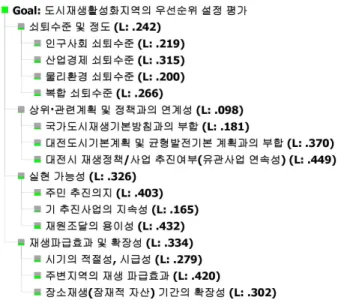
The indicators are largely divided into four higher level indicators and 13 lower level indicators. The upper level indicators were divided into the level and degree of declines, linkage with upper level/related plans and policies, feasibility, and the ripple effects and expandability of regeneration and each upper level indicator has 3~4 lower level indicators.
4.1 Analytic hierarchy process(AHP) for selection of regions to be activated of region A
The priorities of indicators set for selection of regions to be activated for urban regeneration were calculated and according to the result, the priority of the ripple effects and expandability of regeneration was shown to be the highest with a value of 0.334 followed by feasibility with a value of 0.326, the level and degree of declines with a value of 0.242, and linkage with upper level/related plans and policies with a value of 0.098. The inconsistency index, which is the reliability of importance (priority), was 0.02 indicating that the reliability was high.
The results of calculation of importance (priorities) of elements by sector are as follows. In the case of the level and degree of declines, the importance of the level of declines in industries/economy was shown to be the highest at 0.315 followed by the level of composite declines at 0.266, the level of population and society declines at 0.216, and the level of physical environment declines at 0.200. The inconsistency index was 0.00504 indicating that the reliability was high.
In the case of the linkage with upper level/related plans and policies, the importance of whether A city implemented regeneration policies/projects (continuity of related projects) was the highest at 0.449 followed by conformity with A city's master city plan and master plan for balanced development at 0.370 and conformity with the basic policy for national urban regeneration at 0.181. The inconsistency index was 0.00009 indicating that the reliability was high.
In the case of feasibility, the importance of the easiness of financing was the highest at 0.432 followed by the will of residents to implement at 0.403 and the continuity of projects
Fig. 3. Analytic hierarchy process tree view
Fig. 2. AHP hierarchical structure
already implemented at 0.165. The inconsistency index was 0.00056 indicating that the reliability was high.
Finally, in the case of the ripple effects and expandability of regeneration, the importance of the ripple effects on surrounding regions was the highest at 0.420 followed by the expandability based on place regeneration(potential asset) at 0.302 and the appropriacy/urgency of time at 0.279. The inconsistency index was 0.01 indicating that the reliability was high.
4.2 Analytic hierarchy process(AHP) for selection of regions to be activated of region B
According to the results of analysis of the importance of four upper level sectors, the importance of feasibility was shown to be the highest at 0.494 followed by the ripple effects and expandability of regeneration at 0.267, the level and degree of declines at 0.155, and linkage with upper level/related plans and policies at 0.084. As shown in the importance of upper level indicators, it can be seen that establishing feasible strategic plans is an important part at the beginning of urban regeneration.
According to the results of analysis of the importance of lower level indicators under feasibility, the importance of the easiness of financing was shown to be the highest at 0.459 followed by the will of residents to implement at 0.352 and the continuity of projects already implemented at 0.189. The inconsistency index was 0.00. The high priority of the easiness of financing in the establishment of strategic urban regeneration plans shown in the analysis is considered as indicating that the easiness of financing acts as an important factor of the feasibility of urban regeneration projects. In addition, the fact that residents' will to implement was shown to be important for projects is considered attributable to the fact that unlike rebuilding/redevelopment projects, urban
regeneration projects are implemented with cooperation/collaboration with regional residents and thus the directions are determined by residents' will to participate.
According to the results of analysis of the importance of lower level indicators under the ripple effects and expandability of regeneration, the importance of the ripple effects on surrounding regions was the highest at 0.454 followed by the appropriacy/urgency of time at 0.292 and the expandability based on place regeneration(potential asset) at 0.254. The inconsistency index was 0.01. Given that the ripple effects on surrounding regions were shown to be an important factor, if regeneration projects are implemented only in a region, the continuity may disappear and if the effects of urban regeneration gradually spread to surrounding regions, the effects of urban regeneration will increase. The appropriacy/urgency of time and the expandability based on place regeneration(potential asset) were shown to be similar in terms of importance.
According to the results of analysis of the importance of lower level indicators under the level and degree of declines, the importance of the level of declines in industries/economy was shown to be the highest at 0.315 followed by the level of composite declines at 0.259, the level of population and society declines at 0.255, and the level of physical environment declines at 0.171. The inconsistency index was 0.03. A results of analysis that among the levels of declines, the level of declines in industries/economy is a primary factor for urban declines can be derived. The declines in industries/economy lead to economic depression in the city and population outflows resulting in the decline of the city. When establishing a strategic urban regeneration plan, an urban economy based urban regeneration plan should be established. The levels of importance of the level of composite declines and the level of population and society declines are similar and the level of importance of the level of physical environment declines is shown to be lower.
According to the results of analysis of the importance of lower level indicators under the linkage with upper level/related plans and policies, the importance of whether region B implemented regeneration policies/projects (continuity of related projects) was the highest at 0.563 followed by conformity with B city's master city plan and master plan for balanced development at 0.288 and conformity with the basic policy for national urban regeneration at 0.149. The inconsistency index was 0.06. The high importance of whether B city implemented regeneration policies/projects (continuity of related projects) shown in the analysis is considered as indicating that the establishment of urban regeneration strategic plans that have continuity with regeneration policies or projects already implemented acts as an important factor. Conformity with B city's master city plan and master plan for balanced development Fig. 4. Results of analysis of the importance of upper
level indicators
is the second most important factor and this is considered as indicating that urban regeneration strategic plans should be established in linkage with the city's master city plan and master plan for balanced development to pursue the development into a balanced city. The reason why the importance of conformity with the basic policy for national urban regeneration was shown to be low is considered to be the fact that the basic policy for national urban regeneration presented the direction of urban regeneration in the entire country of South Korea and has limitations in the application to B city. Therefore, following the integrated directivity while establishing strategic urban regeneration plan that fit B city is considered important.
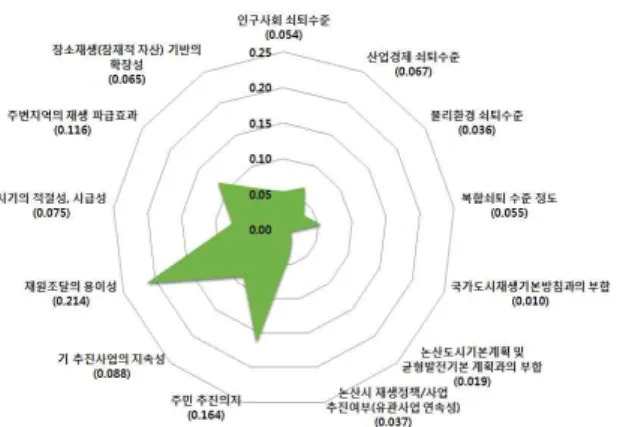
In the results of expert questionnaire surveys on the priorities for selection of regions to be activated in region B, the integrated inconsistency index was shown to be 0.03 indicating that the respondents' evaluation of importance was consistent. In the results of analysis of the importance of all lower level factors, the importance of easiness of financing(0.214) was shown to be the highest followed by that of residents' will to implement(0.164) and ripple effects of regeneration on surrounding regions indicating that financing should be implemented first for urban regeneration projects as presented above. In addition, the results of analysis are considered as indicating and along with residents' will to implement, ripple effects also act as an important for regeneration projects.
4.3 Colligation and implications
In the results of analysis, the weights of feasibility and ripple effects and expandability of regeneration were shown ton be high in both A and B. However, the weight of ripple effects and expandability of regeneration was shown to be higher in the case of A and the weight of feasibility was higher in the case of B.
This is because A is a large city where the diffusion and spread of
urban regeneration are required first while in the case of B, whether projects have been implemented cannot but be regarded to be the most important considering the budget and scale of the local government. It could be seen that the two local governments had different perspectives in selection of regions to be activated because of the scales and conditions of the two local governments. When the lower level indicators were seen, it could be seen clearly what are regarded important.
Ⅴ. Conclusion
With a view to finding methodologies for the establishment and flexibilization of urban regeneration plan systems, this study was conducted to analyze the actual state of operation of the urban regeneration plan system to find problems and present improvement plans for reestablishment of the South Korean urban regeneration plan system.
The actual state of the flexible urban regeneration plan system for urban regeneration space systems was analyzed and based on the results, it could be seen that; ① despite that the main purpose of establishment of strategic urban regeneration plans is selecting regions to be activated, most local governments were establishing activation plans earlier than or simultaneously with strategic plans in order to support publicly funded projects, ② those local governments that had established urban regeneration strategic plans had problems in setting indicators for selection of regions for activation; despite that regions to be activated should be selected reflecting the characteristics of local governments, different local governments were using similar indicators(priorities and weights of indicators), and finally ③ the current direction of implementation of urban regeneration projects was restricting residents' participation by policy. Since urban regeneration projects are being implemented based on the characteristics of publicly funded projects rather than the status and purpose of strategic plans as such, the South Korean urban regeneration space systems should be analyzed focusing on the establishment of plan systems that will enable the implementation of integrated and sustainable projects by effectively linking urban regeneration projects centering on places by excluding local governments that have not established any strategic plan from the selection of publicly funded projects and securing flexibility 'excluding publicly funded projects.
Fig. 5. Results of analysis of importance levels by factor
Acknowledgement
This research was supported by a grant(14AUDP-B077117-03) fromUrban Architecture Research Project Program funded by Ministry of Land, Infrastructure and Transport of Korean government.
References