Knowledge Based New POI Recommendation Method in LBS Using Geo-Ontology and Multi-Criteria Decision Analysis
1)
Joo, Yong Jin*
要 旨
위치 기반 서비스는 사용자 중심의 위치를 기반으로 한 정보 서비스이며 유비쿼터스 시대에 있어서 핵심적인 엔진 으로서 논의되어져오고 있다. 본 연구의 목적은 다중 의사 결정 기법을 통해 이동 단말 사용자의 위치 정보와 공 간적 선호도를 반영한 새로운 온톨로지 추론 시스템을 개발하는 것이다. 이를 위해 POI 검색을 위한 온톨로지 기 반의 LBS 추론시스템을 개발하고 사용자의 상황인식정보와 개인적 특성 및 공간선호도에 따른 온톨로지로 구축을 하여 그 구현 결과를 보였다. 또한 사용자의 의사결정시 결정기준요소에 가중치 부여를 위한 Cost Value Ontology 를 구축하여, 다 기준 의사추론을 통해 사용자에게 적절한 추천 결과가 도출되는 위치 기반 서비스 방법을 제안하 였다.
핵심용어 : 모바일 웹 서비스, 위치기반서비스, 온톨로지, 경로 안내 시스템, 다기준의사결정
Abstract
LBS services is a user-centric location based information service, where its importance has been discussed as an essential engine in an Ubiquitous Age. We aimed to develop an ontology reasoning system that enables users to derive recommended results suitable through selection standard reasoning according to various users' preferences. In order to achieve this goal, we designed the Geo-ontology system which enabled the construction of personal characteristics of users, knowledge on personal preference and knowledge on spatial and geographical preference.
We also integrated a function of reasoning relevant information through the construction of Cost Value ontology using multi-criteria decision making by giving weight according to users' preference.
Keywords : Mobile Web Service, LBS(Locational Based Services), Ontology, Route Guidance System, Multi-criteria decision making
1. Introduction
Context awareness refers to the recognition of in- dividual’s location, time, weather, schedule and per- sonal preference. Current location based serv- ices(LBS) provides information and services simply with users’ context based on the users’ current loca- tion including map, weather, and traffic situation (Spiekermann, S., 2004; Tilson, D,2004). Semantic technology was recently adapted in the LBS area while trying to get out of providing merely simple information. Semantic technology is an intellectual technology which understands the meaning in the system by giving meanings to the information (YoungHoon Yu,, 2009). In order to apply semantic
technology, we need the formation of systematic mechanism for knowledge interface and the concept of the ontology. Using ontology, it is possible to support the decision making through the communication be- tween users and system, and provide intelligent and flexible services which recommend the most suitable services to the users(U. Visser, 2002; Abolghasem, 2007).
Recent researches provide users with the in- formation through the inference of single criteria us- ing information of users and preference. This has a limit which can not reflect the users’decision making with various criteria. In order to overcome the limit, we architected ontology according to location, basic information, preference and spatial preference by in- terpreting and context awareness of users. After ar-
2011년 1월 25일 접수, 2011년 2월 22일 채택
* Research Professor, member, Integrated Urban Research Center, Institute of Urban Sciences, University of Seoul([email protected])
연구논문
chitecting the cost value ontology to give weight on the factors of the decision making criteria, we sug- gest the service measures based on location can pro- vide the users with the recommended suitable result through multi-criteria decision inference.
In this research, we designed ontology according to location, basic information, preference and spatial preference by interpreting and context awareness of users. After architecting the cost value ontology to give weights on the elements of the decision making criteria, we architect a GIS inference system which shows the suitable recommended results for the users’ current location and context through multi-cri- teria decision inference. Therefore, we aimed to de- velop a knowledge base POI recommendation LBS that can support user participation as collective intelligence.
To make this goal come true, we firstly analyzed the previous context aware – location based systems, and investigate the possibility of unification with the geographic data system after studying previous re- searches which are based on the theories related to ontology. Next, in order to architect ontology, we de- fined using the Ontology Web Language (OWL) which is the standard of the World Wide Web Consortium (W3C). Then, since the experimental GIS inference system has spatial question functions, we architected the ontology for users’ context awareness, individual characteristics, spatial preference and the search results come from the corresponding spatial questions. And then, we architected the cost value ontology which is to consider the weight of the fac- tors for various decision making criteria as well. And last but not least, we applied the LBS inference sys- tem which is embodied in the area for the experiment. After analyzing actual inferenced result, we tried to seek the practical application possibility in LBS inference system through using ontology.
2. Considerations in Applying Semantic LBS
2.1 Related Works
Costa-Requena, Haitao, and Espigares (2002) pro- posed a novel mechanism to create a common LBS
universally understood by different terminals or systems. The LBS protocol works in wired and wire- less IP networks for providing LBS and reuses exist- ing network elements and protocols. Kim et al.
(2005) focused on how LBS applications obtain in- tegrated, dynamic, and sensitive content on different domains. They applied Semantic Web technologies to resolve these issues and designed an architecture to combine Semantic Web technologies with LBS and implemented a prototype to describe the Semantic LBS. Tilson, Lyytinen, and Baxter(2004) presented a framework to help design and assess the potential of LBS and identify a viable strategy for service positioning. Individual service concepts are passed through two stage filters to simplify later analysis.
These filters incorporate our growing knowledge of social and behavioral characteristics of location-aware services along with technical and commercial considerations. They also proposed a scenario analy- sis and other techniques for mitigating risks in deci- sion making under the uncertainty that surrounds these services. McDiarmid and Irvine(2004) presented a protocol that allows users to anonymously receive location-based information, within certain restrictions.
The protocol can be used to guarantee user anonym- ity for user-pulled location-based services with a handset-based location measurement system. Alexander (2005) presented several novel realizations of adap- tive GI services for mobile applications by using dy- namic personalization as well as context factors.
2.2 Context Awareness for LBS
For the most part, LBS have provided information
on the database. the database is designed through the
reference of various information and search patterns
according to the users and location information. After
inputting the information suitable for the criteria, the
information match to the condition is provided
through query. In the case of database based on
search method, there could be difficulties when
searching complex questions related to users’ func-
tion of saving information contexts due to the data-
bases' particular function of saving information ac-
cording to the forecasted criteria. In order to provide
more intelligent LBS, studies of context aware LBS
which provide LBS matches for the users’ demand and considers user’s situations, were recently introduced. After architecting ontology with consid- eration for users’ location information, schedule, in- formation of service, service operating hours and costs, these researches provide users with suitable services through inference of information matching the meaning. However, these researches did not con- sider users’ preference and spatial preference, and cannot support analytic decision making according to the importance of various factors for decision making.
3. Design of Context awareness based Ontology in LBS System
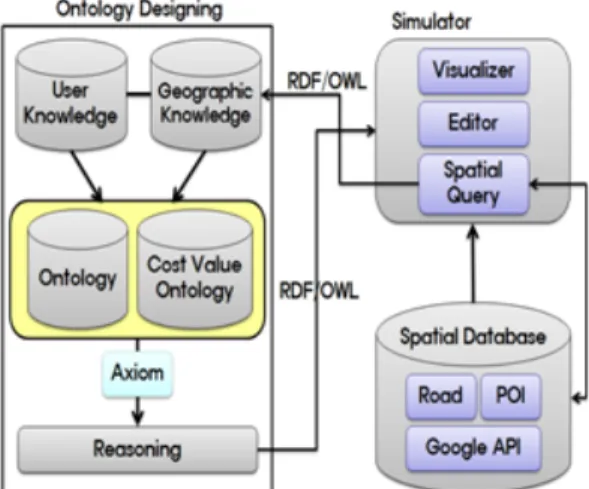
3.1 System Architecture in Sematic LBS The architecture of the total system which was sug- gested in this research is comprised of tree different parts : ontology design, user interface and space database. Figure 1 shows the detailed system architecture.
When modeling the real world according to a spe- cific subject, ontology does not only clearly define the concepts which resulted after the agreement from relevant individuals and groups, but also to a logical group of terms which are expressed as a formation that computers can understand and process (World Wide Web Consortium, 2004). Ontology defines the terms that are used in the domain and their relations
Figure 1. The Detailed Architecture of Ontology Inference System
and needed to share the knowledge information and the common semantic understanding of its architecture. It is also used for efficient reusing of domain knowledge. The characteristics of ontology are the plentiful expressions of relations and causal relationship, connection and expansion of the real in- formation and the concept system, expansion of knowledge, providing reuse, mutual application and connecting different information and knowledge base which is possible for logical inference. For ontology language, there are RDF (Resource Description Framework) and OWL (Web Ontology Language).
RDF is a standard language for technology exchanges of meta-data which was presented by W3C. For mu- tual application among various meta-data, RDF pro- vides common rules about semantics, architecture and syntax.
3.2 Ontology Structure for Personalized Information
In this research, ontology is composed of class, re- lations, instances, axioms and cost value ontology.
Class is a concept of the domain or tasks, which are usually organized in taxonomies. Class in this re- search is composed of user profile and spatial data.
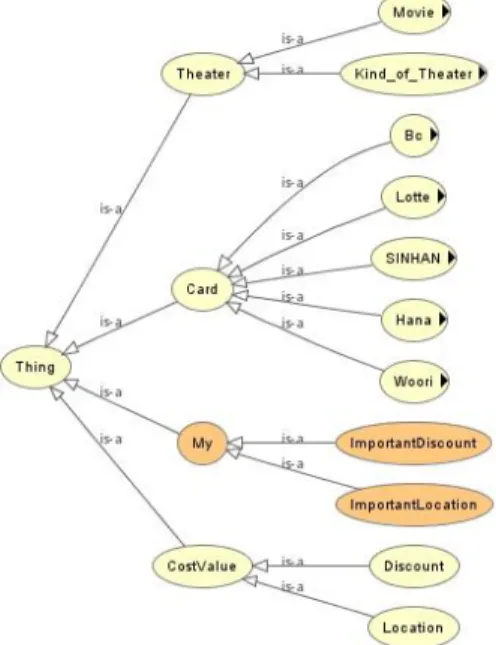
Relations are a type of interaction between concepts of the domain. Instances are used to represent specif- ic elements of class. Axioms are model sentences that are always true. This research uses a semantic technique and applies for context-aware. Through the users’ profile, space, constraint design, cost value on- tology, instance and axiom, the final ontology like below was designed. Figure 2 shows ontology where is constructed in the last.
3.2.1 User Profile
In order to use users’ context awareness, users’ ba- sic information is inputted in the system users use. In the user profile ontology, information about users’
age, gender, possessing card, location, preference and preferred location is architected.
3.2.2 Spatial Preference
It is a part about important spatial preference
among users’ context awareness. That is, spatial pref-
Figure 2. Design of Ontology Structure erence is able to determine travel mode choice
(walking, bike, and public transportation). In accord- ance with selected travel mode, range of radius search in order to choose final destination POI can be changed into walking coverage (400-500m), bike coverage (2-3km), public transportation coverage (10km). Therefore, in case users set up walking as a travel mode, they can use the services from corre- sponding POI when the walking approach distance is within 400-500 m and the walking hours is within maximum 6 minutes, users get the spatial database they want within the maximum 500m.
3.2.3 Relation
In context awareness, time is the most important variable for users’ context interpretation and an im- portant attribute for the users’ selection and the system. It is because providing the most suitable schedule for users is the subject should be preferen- tially considered when choosing the operating hours of service location or movies from theater. For example, the user’s flexible hours is from 13 to 17 o’clock. In case of movie 1, the starting time of the movie does not match user’s flexible time. In case of movie 3, it is not recommended to the user because the finish- ing time of the movie does not match user’s flexible time. However, in case of movie 2, the movie starts and finishes in the range of user’s flexible time. For
Figure 3. Time Table
this reason, movie 2 is recommended to the users un- der the condition of time constraint.
3.2.4 Cost Value Ontology and Axiom based on AHP
In order to give weight on the selection criteria when deciding POI and service, cost value ontology was architected. In this study, distance rate and dis- count rate were presented as selection criteria for POI and service. In order to calculate weight, AHP method was used. Discount rate and distance rate were se- lected as criteria factor of selection. We decided the semantic scale and figure, and then organized them in a matrix according to the decision criteria.
Through the pair wise comparison between the cri-
teria factor of selection and POI, we compare accord-
ing to the number of cases of every criteria factor of
<Class IRI="#My"/>
<ObjectIntersectionOf>
<ObjectSomeValuesFrom>
<ObjectProperty IRI="#hasActor"/>
<Class IRI="#DongWonKang"/>
</ObjectSomeValuesFrom>
<ObjectSomeValuesFrom>
<ObjectProperty IRI="#hasGenre"/>
<Class IRI="#Action"/>
</ObjectSomeValuesFrom>
<DataSomeValuesFrom>
<DataProperty IRI="#hasDiscountVal"/>
<DatatypeRestriction>
<Datatype abbreviatedIRI="xsd:integer"/>
<FacetRestriction facet="&xsd;maxInclusive">
<Literal datatypeIRI="&xsd;integer">7</Literal>
</FacetRestriction>
</DatatypeRestriction>
</DataSomeValuesFrom>
<DataSomeValuesFrom>
<DataProperty IRI="#hasLocationLen"/>
<DatatypeRestriction>
<Datatype abbreviatedIRI="xsd:integer"/>
<FacetRestriction facet="&xsd;maxInclusive">
<Literal datatypeIRI="&xsd;integer">3</Literal>
</FacetRestriction>
</DatatypeRestriction>
</DataSomeValuesFrom>
<DataSomeValuesFrom>
omit </EquivalentClasses>
Figure 5. Owl/Xml Rendering Figure 4. OWL-VIZ Model
selection and POI. Through the sum total of weight selection criteria about for POI, the maximum price is used for decision making, and this maximum price is applied to ontology. As shown in figure 4, Using AHP method, we can give the different service result depending on user preference in terms of location of POI and kind of Card.
As knowledge which is expressed strictly, axiom is
something we have to accept without any proof if it
is right. In logic, public interest has an essential
meaning to show the knowledge which is the premise
of inference. When constructing ontology, axiom
strictly expresses the definition of vocabulary and
concept. Axiom also has a function of inference
about the questions of ontology ability which is de-
scribed using vocabulary and concept that are con-
tained in ontology. As shown in formula, axiom sug-
gests the most appropriate theater and movie by com-
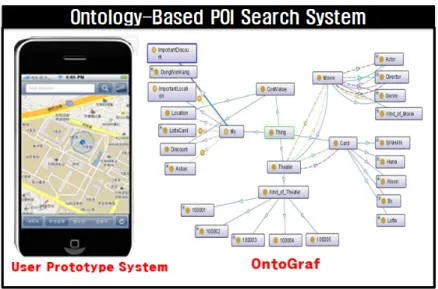
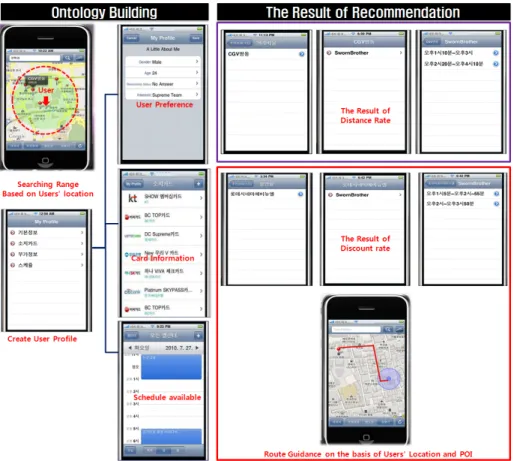
Figure 6. User Interface of Implemented Prototype System and designed OntoGraf paring user's preference, schedule and movie time
among nearby movie theater through giving weights to decision criteria factors which user consider more importantly. In other words, axiom indicates that user has LotteCard as a discount card and favorite movie genre is an action-film. In addition, favorite actor is DongWon Kand and time that user can see a movie on schedule is from 13~17. Lastly, current user re- gards discount rate highly than distance rate, which were defined by AHP.
≡
∃
∩
∩
∩
∩
∩
≧ ≦ ∩