
Journal of Internet Computing and Services(JICS) 2015. Feb.: 16(1): 29-37 29
악보인식 전처리를 위한 강건한 오선 두께와 간격 추정 방법
☆
A Robust Staff Line Height and Staff Line Space Estimation for the Preprocessing of Music Score Recognition
나 인 섭
1*김 수 형
1*뀌
1In-Seop Na Soo-Hyung Kim Trung Quy Nquyen
요 약
이 논문에서는 모바일 기기상에서 카메라기반 악보인식을 위한 오선 두께와 오선 간격을 추정하는 전처리 기술을 제안한다
.
캡쳐된 영상은 조명이나
,
흐려짐,
저해상도 등의 많은 왜곡으로 인해 인식에 어려움이 있다.
특히 복잡한 배경을 가지고 있는 악보 영상인식의 경우 더욱 그렇다
.
악보 기호 인식에서 오선 두께와 오선 간격은 인식에 큰 영향을 끼친다.
이들 정보는 이진화에도 사용되는데
,
복잡한 배경을 가지고 있는 경우 일반적인 이진 영상은 오선 두께와 간격을 추정하는데 만족스럽지 못하다.
따라서 우리는 에지영상에서 런
-
길이 엔코딩 기술을 이용해 오선 두께와 간격 추정하는 강건한 알고리즘을 제안한다.
제안된 방법은2
단계로 구성되어있다
.
첫 번째 단계는 소벨 연산자에 의해 영역별로 에지 영상을 기반으로 오선 두께와 간격을 추정한다.
각 에지 영상의 열은 런-
길이 엔코딩 알고리즘에 의해 기술된다
.
두 번째 단계는 안정한 경로 알고리즘을 이용한 오선 검출과 오선 위치를 추적하는 적응적LTH
알고리즘을 이용한 오선 제거이다.
실험결과 복잡한 영상의 경우에도 강건함과 높은 인식률을 보였다.
☞ 주제어
:
악보인식,
오선 두께,
오선 간격,
런 길이,
모바일ABSTRACT
In this paper, we propose a robust pre-processing module for camera-based Optical Music Score Recognition (OMR) on mobile device. The captured images likely suffer for recognition from many distortions such as illumination, blur, low resolution, etc. Especially, the complex background music sheets recognition are difficult. Through any symbol recognition system, the staff line height and staff line space are used many times and have a big impact on recognition module. A robust and accurate staff line height and staff line space are essential. Some staff line height and staff line space are proposed for binary image. But in case of complex background music sheet image, the binarization results from common binarization algorithm are not satisfactory. It can cause incorrect staff line height and staff line space estimation. We propose a robust staff line height and staff line space estimation by using run-length encoding technique on edge image. Proposed method is composed of two steps, first step, we conducted the staff line height and staff line space estimation based on edge image using by Sobel operator on image blocks. Each column of edge image is encoded by run-length encoding algorithm Second step, we detect the staff line using by Stable Path algorithm and removal the staff line using by adaptive Line Track Height algorithm which is to track the staff lines positions. The result has shown that robust and accurate estimation is possible even in complex background cases.
☞
keyword : Music Score Recognition, Staff Line Height, Staff Line Space, Run Length, Mobile
1. Introduction
1School of Electronics and Computer Engineering, Chonnam National. Univ. Gwangju, 500-757, Korea.
* Corresponding author ([email protected])
[Received 14 October 2014, Reviewed 27 October 2014, Accepted 1 November 2014]
☆ “This work was supported by SAMSUNG ELECTRONICS CO., LTD.”and Basic Science Research Program through the NRF funded by the MEST(2014-014400)
☆ A preliminary version of this paper was presented at APIC-IST 2014 and was selected as an outstanding paper.
In our life, music appears in everywhere, every culture.
Preserving and developing this heritage is always the important thing for every country. Many old music sheets are got a lot distortion and deformation from year to year. Digitization has been commonly used as a possible tool for preservation because of its convenient for storage and management. In order to transform from paper-based music manuscript documents into a digitized format which is readable by computer, we use OMR(Optical Music Score Recognition) system. Other applications of OMR are entertainment and learning which are big business sectors. The main tasks of an OMR system are
ISSN 2287-1136 (Online)http://www.jksii.or.kr
recognition, representation and storage of music scores in a machine readable format. OMR has been received much focus for decades. Many systems have been proposed and archived significant progress recently. However, the results still need more improvement. The typical framework of an ORM system includes steps: binarization; staff-line detection and removal;
segmentation and text removal; symbol recognition;
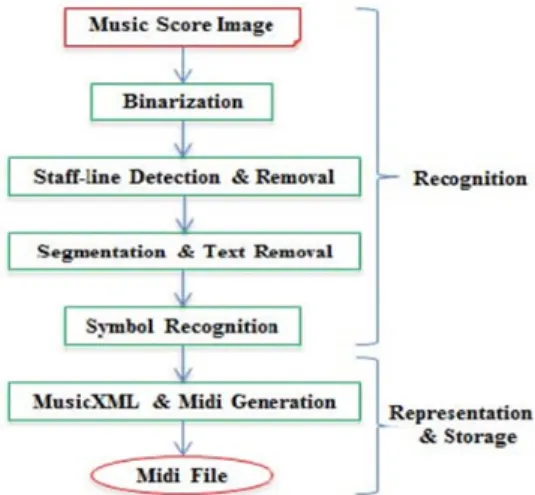
MusicXML and Midi generation (See Fig. 1). Through any symbol recognition system, the staff line height and staff line space are used many times and have a big impact on recognition module. The robust and accurate staff line height and staff line space are essential. The focus of this paper is the staff line height and staff line space estimation on the complex background music sheets.
Figure 1. Typical framework of OMR system
2. RELATED WORKS
In the presence of a binary image most OMR algorithms rely on an estimation of the staff line thickness and the distance that separates two consecutive staff lines (see Figure 2). The work suggested by Cardoso and Rebelo [1], which encouraged the work proposed in [2], presents a more robust estimation of the sum of staff line height and staff space height by finding the most common sum of two consecutive vertical runs (either black run followed by white run or the reverse) (See figure 3). However, the complex background images are not considered.
Figure 2. Staff space height and staff line height
Figure 3. Illustration of the estimation of the reference value staff line height and staff space height using a single column. From Pinto et al. [8]
Many staff line detection and removal method have been proposed [3-8]. And staff line detection is usually considered as the first step of staff line removal. The result from staff line detection guides the staff line removal. The simplest approach of staff line detection is using horizontal projection, and then finding local maxima [6]. These local maxima represent staff line positions. This approach requires straight and horizontal staff line which is not common in music sheet image. Music sheet image usually suffer degradation such as curve or skew therefore horizontal projection approach does not work efficiently in real cases.
Other methods are proposed to overcome degradation such as using Hough Transform to detect staff lines [9], Line Adjacency Graph (LAG) [10-12]; line tracing [13-15].
Fujinaga et al in [6] use many different techniques such as run-length coding, connected-component analysis and projection for finding staff lines. In [4, 8], authors proposed a graph based algorithm to detect staff line which give an excellent result. Once all staff lines are detected, staff line removal is executed to completely remove staff line pixels.
In [16], Dalitz et al did a comparative study of staff line
removal algorithms, and they divided staff line removal
approaches into four main categories: Line Tracking [5, 17,
18], Vector Field [19], Run length [6, 14], Skeletonization [13] (See Table 1).
Table 1. Staff line removal algorithms [16]
Algorithm Reference Category
Line Track Height [5] Line Tracking
Fujinaga [6] Run Length
Skeleton [13] Skeletonization
Roach/Tatem [14] Vector Field Line Track Chord [18] Line Tracking
Carter [20] Run Length
In [20], Carter and Bacon used LAG to segment the image sheet to parts. Each part is either part of staff line or not. Neighbor segments are merged by using some vertical and horizontal criterions. The final results do not contain the symbols and can be removed directly. Line Track Height algorithm [5] is one of the simplest staff line removal algorithms but very powerful. LTH algorithm requires a robust and reliable staff line detection algorithm. Detected staff line pixels are tracked and removed if its vertical run length is larger than specified threshold value. From experiment, the threshold value is set globally as 2 ∗ staff line height. Choosing threshold value is very important. If the threshold value is too large, we might even remove some symbol pixels. Otherwise, if the threshold value is too small, there are many remaining noise pixels.
3. PROPOSED METHODS
3.1 Staff Line Height and Staff Line Space Estimation Based On Edge Image The well-known run-length encoding (RLE), which is a very simple form of data compression in which runs of data are represented as a single data value and count, is often used to determine these reference values . In a binary image, used here as input for the recognition process, there are only two values: one and zero. In such a case, the RLC is even more compact, because only the lengths of the runs are needed. For example, the sequence {1 1 0 1 1 1 0 0 1 1 1 1 0 0 1 1 1 1 0 1 1 1 1 1 0 0 1 1 1 1 1 1} can be coded
as 2, 1, 3, 2, 4, 2, 4, 1, 5, 2, 6, assuming that 1 starts a sequence (if a sequence starts with a 0, the length of zero would be used).
First, edge image is extracted from captured image by applying Sobel operator on image blocks [21]. In music sheet image, staff lines and music symbol have a lot of edge property. In other hand, the background content tends to have much less edge property. Therefore, the extracted edge image preserve very well staff lines and symbols content while remove almost background content (See figure 4a, 4b).
Each column of edge image is encoded by run-length encoding algorithm (See figure 5, 6). We find the most common sum of four consecutive vertical runs. This summation value represents the sum of staff line height and staff line space. Afterward, to compute the staff line height and staff line space, we find the most common four run which the sum of runs equals above computed value. Staff line height is the maximum value of four runs. And staff line space is the second largest value of four runs (See equation (1) and (2)).
Staffspace_height = max({a, b, c, d}) (1)
Staffline_height
= max({a, b, c, d}-{Staffspace_height})+2 (2)
(a)
(b)
Figure 4. (a) Captured image, (b) Extracted edge image by using Sobel operator on blocks
Figure 5. Each column of edge image is encoded by RLE algorithm
Figure 6. Illustration of the estimation of the reference value staff line height and staff line space
in edge image
3.2 Staff Line Detection and Removal
3.2.1 Staff line detection using stable path In [4], Cardoso et al. proposed a new and robust staff
line detection algorithm based on graph theory where staff lines are the solution of a global optimization problem. They consider image as a graph with pixels as nodes and arcs connecting neighboring pixels. The weight of each arc is a function of pixel values. The objective of design weight function is to assign low weight for interest (black) pixels and high weight for others (white) pixels (See equation (3)).
The staff lines detection results are connected paths between the two margins of the image. The authors introduced a new term (stable path) which is the shortest path between two regions (left margin and right margin of the music sheet image). Finding all staff lines in music score image problem becomes a mathematic problem which is finding all stable paths in a graph. We also need to execute some post- processing steps in order to removing false detected staff lines. First, we will eliminate all found staff lines which have the percentage of number black pixels is less than a threshold (in our experimental, we choose threshold is 0.7).
Next, we execute uncrossing staff line. Although true staff lines never intersect each other, but we might get some crossing staff lines in results of stable path algorithm.
Finally, Smoothing and trimming staff lines are applied.
Before meeting the real staff line, a path travels through a sequence of white pixels. Likewise, after the end of the staff line, the path goes through a sequence of white pixels until it meets the right margin of the image. In Fig. 7, we show one example of input and output of the stable path algorithm.
f(p,q)={ c1 if p or q are black pixels
c2 otherwise } (3)
With c2> c1, in experiment we use c1=2, c2=6
Figure 7. (a) Input image; (b) result of stable path algorithm
3.2.2 Adaptive Line Track Height Algorithm Our proposed method is based on the LineTrack Height (LTH) algorithm which is introduced by Randiramahefa et al in [5]. The goal LTH is to track the staff lines positions obtained by a detection algorithm and remove vertical run sequences of black pixels that have a value lower than a specified threshold, which was experimentally set at 2 ∗ staff line height. The ideas of this algorithm come from the remark which is the vertical run of black pixel in the symbol usually significant longer than the vertical run of the black pixel in staff line. The staff line height value is computed globally from music sheet image. However, LTH does not remove staff line completely in case of staff height variation (Fig. 8.b).
In our proposed method, there are two main iterations. In the first iteration, we track following every detected staff line pixels of each staff line, then compute the vertical run of black detected staff line pixel. If the vertical run length value is less than a local threshold which is computed adaptively based on staff line height value of current staff line. In our experiment, we choose local threshold is 2 ∗ local staff line height. Local staff line height of one staff line is the mode values of all vertical run lengths value of detected staff line pixels. However, because of degradation, there are still many noise staff line after the first removal iteration (Fig. 8.b).
In the second iteration, we do tracking one more time to completely remove the remaining staff line pixels by connected component analysis along the staff line pixels. If number of pixels of the connected component is less than the threshold (staffline_height2), this connected component is removed. The second iteration can remove well staff line pixel noises from first iteration (see Fig. 8.c). Fig. 9 show the efficient removal of our method compare to LTH method in case of staff line height values are varied within one music sheet image. The LTH cannot remove the thick staff lines, but our method does.
(a)
(b)
(c)
Figure 8. (a) input image; (b) removal result after first iteration; (c) removal result after second
iteration.
(a)
(b)
(c)
Figure 9. Staff line removal results: (a) original music score image with staff line heights are varied.
(b) Result of LTH algorithm. (c) Result of proposed method.
4. EXPERIMENTAL RESULTS
4.1 Evaluation of Pre-processing
To evaluate our pre-processing method, we compare
recognition accuracy on three systems. The first system is
SharpEye, there is no pre-processing step is applied. The
SharpEye’s built-in binarization module is used for binarization.
For another two system, we use two pre-processing algorithm.
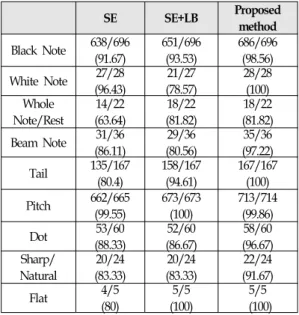
The first algorithm is adaptive thresholding. The second algorithm is our proposed algorithm. The output of pre-processing method is the input of SharpEye. The evaluation is done on four images which background is presented. The experimental results show that our proposed method gives the best accuracy on constructed dataset (See table 2).
Table 2. Pre-processing evaluation
SE SE+LB Proposed
method
Black Note 638/696(91.67)
651/696 (93.53)
686/696 (98.56) White Note 27/28
(96.43)
21/27 (78.57)
28/28 (100) Whole
Note/Rest
14/22 (63.64)
18/22 (81.82)
18/22 (81.82) Beam Note 31/36
(86.11)
29/36 (80.56)
35/36 (97.22) Tail 135/167
(80.4)
158/167 (94.61)
167/167 (100) Pitch 662/665
(99.55)
673/673 (100)
713/714 (99.86)
Dot 53/60
(88.33)
52/60 (86.67)
58/60 (96.67) Sharp/
Natural
20/24 (83.33)
20/24 (83.33)
22/24 (91.67)
Flat 4/5
(80)
5/5 (100)
5/5 (100) SE: SharpEye without pre-processing,
SE+LB: SharpEye with adaptive thresholding binarization
4.2 Evaluation of Staff Line Removal The evaluation metric is based on pixel based metric. The staff removal is considered as two-class classification problem at pixel level. To evaluate algorithms we compute precision, recall, F-measure f and error rate E.R by equations (4) (5) (6) and (7) respectively.
With # mean “number of” and sp mean “staff pixels”. In other words, we can explain above terms as followings:
− #correctclassified sp is number of true positive classification.
− #misclassified non sp is number of false positive classification.
− #missclassified sp is number of false negative classification.
− #all sp+#all non sp is number pixels in the image.
We evaluate the proposed method on ICDAR 2011 dataset for music score removal competition [22]. This dataset consists of 1000 ideal handwritten music sheet images and these ideal images are distorted by 12 deformation models. Each deformation model generates 1000 images. They are divided into 6000 training images and 6000 testing images. We run experiment with the testing image set. However, our staff line detection (stable path) algorithm rejects all thick and interrupted staff line images.
It is not because of our proposed method but because the detection step. Therefore, number of images are used for evaluation is 5000 testing images. We compare our methd with other algorithms: Carter [23], Fujinaga [6] and the combination between stable path (for detection) and LTH (for removal) [4]. Because Fujinaga’s method executes the de-skewing step, the shape of output of curvature and rotated images is changed compare to original image.
Therefore we cannot compare the output and ground truth image to evaluate the removal performance in these images.
We ignore these images in performance measure result for Fujinaga’s method. The evaluation results are shown in table 3 and table 4.
Table 3. Evaluation comparison between algorithms
Algorithm Precision Recall F
Stable Path + LTH[4]
99.12
94.24 96.62Fujinaga [6] 91.57 94.21 92.87
Carter [23] 98.90 87.43 92.81
Our method 98.39
96.42 97.40
Table 4. Error rate of algorithms for distorted models
[4] [6] [23] Our
Ideal
1.68
4.69 2.83 1.78Curvature 9.61 n.a 3.26
2.56
Kanungo 4.08 6.39 15.65
3.28
Rotation 6.01 n.a
4.02
6.07Staff line
thickness v1 2.65
2.56
2.93 2.60 Staff linethickness v2 2.84
2.24
3.69 2.71 Staff liney-variation v1 4.88 6.70 6.39 3.00 Staff line
y-variation v2 2.69 8.90 5.05 2.64 Typeset
emulation
1.65
23.29 6.19 1.69White speckles
2.49
7.82 16.34 2.54 Average E.R 3.86 7.82 9.572.89
5. CONCLUSIONS
In this paper, we proposed a robust staff line height and staff line space estimation even in case of background is presented. Our proposed algorithm is able to remove background in the captured music sheet image very well.
Removing background from input image helps to improve the accuracy of SharpEye recognition module on our experiment. The staff line removal is introduced to reduce the staff line removal error. The experimental result shows that our staff line removal algorithm archives the state-of-the-art result. For our proposed recognition system, we compare with other commercial applications, we archive the competitive accuracy but processing time is very fast even executing on mobile device environment.
References
[1] Cardoso JS, Rebelo,”A Robust staffline thickness and distance estimation in binary and gray-level music scores”, Proceedings of The twentieth international conference on pattern recognition, pp. 1856–1859,2010.
http://dx.doi.org/10.1109/icpr.2010.458
[2] Pinto T, Rebelo A, Giraldi G, Cardoso JS ,”Music score binarization based on domain knowledge”, Pattern recognition and image analysis. Lecture notes in computer science, 6669. Springer, Heidelberg, pp. 700–
708, 2011.
http://dx.doi.org/10.1007/978-3-642-21257-4_87 [3] Otsu, N.”A threshold selection method from gray-level
histograms”, IEEE Transactions on Systems, Man and Cybernetics 9(1) , pp. 62–66, 1979.
http://dx.doi.org/10.1109/tsmc.1979.4310076 [4] J. dos Santos Cardoso, A. Capela, A. Rebelo, C. Guedes,
and J. P. da Costa , “Staff detection with stable paths”, IEEE Transactions on PAMI, 31, pp. 1134–1139, 2009.
http://dx.doi.org/10.1109/tpami.2009.34
[5] Randriamahefa, R., Cocquerez, J. P., Fluhr, C., Ppin, F., and Philipp, S,”Printed music recognition”, Proceedings of the 2nd International Conference on Document Analysis and Recognition (ICDAR’93), pp. 898–901, 1993.
http://dx.doi.org/10.1109/icdar.1993.395592 [6] Fujinaga I,”Staff detection and removal”, George S (ed)
Visual perception of music notation: on-line and off-line recognition. Idea Group Inc., Hershey, pp 1–39, 2004.
http://dx.doi.org/10.4018/978-1-59140-298-5.ch001 [7] Soo-Hyung Kim, Hwa-Jeong Son, Sung-Ryul Oh,
Chil-Woo Lee, and Il-Seok Oh, "Staff-Line Detection and Removal Algorithm for a Camera-based Recognition of Music Score Images", Proc. 2nd Korea-Japan Joint Workshop on Pattern Recognition, pp. 131-138, 2007.
[8] A. Rebelo, A. Capela, J.F.P. da Costa, C. Guedes, E.
Carrapatoso, and J.S. Cardoso, “A Shortest Path Approach for Staff Line Detection”, Proc. Third Int’l Conf. Automated Production of Cross Media Content for Multichannel Distribution, pp. 79-85, 2007.
http://dx.doi.org/10.1109/axmedis.2007.2
[9] Miyao H, Nakano Y. ,”Note symbol extraction for printed piano scores using neural networks”, IEICE Trans Inform Syst E79-D, pp.548–554, 1996.
[10] Bainbridge, D.,”An extensible optical music recognition system”, Nineteenth Australasian Computer Science Conference, pp. 308–317, 1997.
[11] Bellini P, Bruno I and Nesi P. ,”Optical music recognition: architecture and algorithms”, Interactive multimedia music technologies. IGI Global, Hershey, pp 80–110, 2008.
http://dx.doi.org/10.4018/978-1-59904-150-6.ch005 [12] Rossant F and Bloch I ,”Robust and adaptive OMR system including fuzzy modeling, fusion of musical rules, and possible error detection”, EURASIP J Appl Signal Process (1),2007.
http://dx.doi.org/10.1155/2007/81541
[13] Prerau D. ,”Computer pattern recognition of standard engraved music notation”, 1970. “A critical survey of music image analysis”, Blostein D, Baird H (eds) Structured document image analysis. Springer, Heidelberg, pp. 405–434,1992.
http://dx.doi.org/10.1007/978-3-642-77281-8_19 [14] Roach JW and Tatem JE,”Using domain knowledge in
low level visual processing to interpret handwritten music: an experiment”, 1988. “A critical survey of music image analysis”, In: Blostein D, Baird H (eds) Structured document image analysis. Springer, Heidelberg, pp 405–
434, 1992.
http://dx.doi.org/10.1016/0031-3203(88)90069-6 [15] Tardón LJ, Sammartino S, Barbancho I, Gómez V, Oliver
A.,”Optical music recognition for scores written in white mensural notation”, EURASIP J Image Video Process.
2009.
http://dx.doi.org/10.1155/2009/843401
[16] C. Dalitz, M. Droettboom, B. Czerwinski, and I. Fujigana,
“A Comparative Study of Staff Removal Algorithms”, IEEE Trans. Pattern Analysis and Machine Intelligence,30(5), pp. 753-766,2008.
http://dx.doi.org/10.1109/tpami.2007.70749 [17] P. Martin, C. Bellissant., “Low-Level Analysis of Music
Drawing Images”, First International Conference on Document Analysis and Recognition,France, pp. 417-425, 1991.
[18] D. Bainbridge, T.C. Bell.,”Dealing with superimposed Objects in Optical Music Recognition”, Proceedings of the 6th International Conference on Image Processing and its Applications. pp. 756-760, 1997.
http://dx.doi.org/10.1049/cp:19970997
[19] Tardón LJ, Sammartino S, Barbancho I, Gómez V, Oliver A.,”Optical music recognition for scores written in white mensural notation”, EURASIP J Image Video Process, 2009.
http://dx.doi.org/10.1155/2009/843401
[20] N.P. Carter, R.A. Bacon. “Automatic Recognition of Printed Music”, Structured Document Image Analysis, Springer, pp. 454-65, 1992.
http://dx.doi.org/10.1109/icpr.1996.547279 [21] Pietikainen, Matti, and Oleg Okun. "Edge-based method
for text detection from complex document images", Document Analysis and Recognition, 2001. Proceedings.
Sixth International Conference on. IEEE, 2001.
http://dx.doi.org/10.1109/icdar.2001.953800 [22] A. Fornes, A. Dutta, A. Gordo, and J. Llados, “The
ICDAR 2011 music scores competition: Staff removal and writer identification”, ICDAR, pp. 1511–1515, 2011.
http://dx.doi.org/10.1109/icdar.2011.300
[23] Carter NP, (1992) “Automatic recognition of printed music in the context of electronic publishing”, “A critical survey of music image analysis”, In: Blostein D, Baird H (eds) Structured document image analysis. Springer, Heidelberg, pp. 405–434, 1989.
http://dx.doi.org/10.1007/978-3-642-77281-8_19
[24] http://en.wikipedia.org/wiki/MusicXML.
◐ 저 자 소 개 ◑
나 인 섭 (In Seop Na)
He received his B.S., M.S. and Ph.D. degree in Computer Science from Chonnam National University, Korea in 1997, 1999 and 2008, respectively. Since 2012, His research interests are image processing, pattern recognition, character recognition and digital library.
김 수 형 (Soo Hyung Kim)
He received his B.S. degree in Computer Engineering from Seoul National University in 1986, and his M.S.
and Ph.D degrees in Computer Science from Korea Advanced Institute of Science and Technology in 1988 and 1993, respectively. From 1990 to 1996, he was a senior member of research staff in Multimedia Research Center of Samsung Electronics Co., Korea. Since 1997, he has been a professor in the Department of Computer Science, Chonnam National University, Korea. His research interests are pattern recognition, document image processing, medical image processing, and ubiquitous computing.
뀌 (Trung Quy Nguyen)
He received his M.E. degree in Electronics & Computer Engineering at Chonnam National University, Korea in 2014 and in his B.S. degree in Faculty of Mathematics and Computer Science from University of Science, Vietnam National University - Ho Chi Minh City in 2008. From 2008 to 2012, he was a software engineer at eSilicon Vietnam. His research interests are pattern recognition, machine learning and web technologies.
![Table 1. Staff line removal algorithms [16]](https://thumb-ap.123doks.com/thumbv2/123dokinfo/4718486.509050/3.808.79.380.217.361/table-staff-line-removal-algorithms.webp)

![Table 4. Error rate of algorithms for distorted models [4] [6] [23] Our Ideal 1.68 4.69 2.83 1.78 Curvature 9.61 n.a 3.26 2.56 Kanungo 4.08 6.39 15.65 3.28 Rotation 6.01 n.a 4.02 6.07 Staff line thickness v1 2.65 2.56 2.93 2.60](https://thumb-ap.123doks.com/thumbv2/123dokinfo/4718486.509050/7.808.80.381.159.616/table-error-algorithms-distorted-curvature-kanungo-rotation-thickness.webp)