Tracking and Face Recognition of Multiple People Based on GMM, LKT and PCA
Won Oh Lee
†, Young Ho Park
††, Eui Chul Lee
†††, HeeKyung Lee
††††, Kang Ryoung Park
†††††ABSTRACT
In intelligent surveillance systems, it is required to robustly track multiple people. Most of the previous studies adopted a Gaussian mixture model (GMM) for discriminating the object from the background.
However, it has a weakness that its performance is affected by illumination variations and shadow regions can be merged with the object. And when two foreground objects overlap, the GMM method cannot correctly discriminate the occluded regions. To overcome these problems, we propose a new method of tracking and identifying multiple people. The proposed research is novel in the following three ways compared to previous research: First, the illuminative variations and shadow regions are reduced by an illumination normalization based on the median and inverse filtering of the L*a*b* image. Second, the multiple occluded and overlapped people are tracked by combining the GMM in the still image and the Lucas-Kanade-Tomasi (LKT) method in successive images. Third, with the proposed human track- ing and the existing face detection & recognition methods, the tracked multiple people are successfully identified. The experimental results show that the proposed method could track and recognize multiple people with accuracy.
Key words: Intelligent surveillance system, tracking multiple people, GMM, LKT, face recognition
※ Corresponding Author : Kang Ryoung Park, Address:
(100-715) Division of Electronics and Electrical Engin- eering, Dongguk University, Pil-dong 3-ga, Jung-gu, Seoul, Republic of Korea, TEL : +82-10-3111-7022, FAX
: +82-2-2277- 8735, E-mail : [email protected] Receipt date : Sep. 23, 2011, Revision date : Dec. 25, 2011 Approval date : Jan. 27, 2012
†††††
Division of Electronics and Electrical Engineering, Dongguk University, Seoul, Republic of Korea (E-mail: [email protected])
†††††
Division of Electronics and Electrical Engineering, Dongguk University, Seoul, Republic of Korea (E-mail: [email protected])
†††††
Department of Computer Science, Sangmyung University, Seoul, Republic of Korea
(E-mail: [email protected])
†††††
Broadcasting and Telecommunications Convergence Research Laboratory, Electronics and Telecommu- nications Research Institute (ETRI), Daejeon, Republic of Korea
(E-mail: [email protected])
†††††
Division of Electronics and Electrical Engineering, Dongguk University, Seoul, Republic of Korea
※ This work was supported by the R&D program of KCC. (09912-03002, Development of Interactive View Control Technologies for IPTV).
1. INTRODUCTION
With the widespread use of closed circuit TV (CCTV) cameras, intelligent surveillance systems have become a hot research topic in the computer vision field [1,2]. These systems have various ap- plications, such as access monitoring in a specific area, crowd congestion analysis, detection of ab- normal behaviors [3], traffic monitoring, human identification at a distance, etc [1].
Previous researches are divided into two cate-
gories: the hardware-based and the software-
based methods. The multimodal sensor-based
system is an example of the hardware based
method. It detects and identifies the objects of in-
terest by using pyroelectricity infrared (PIR) sen-
sors, audio sensors, or Doppler sensors [4-6]. Most
of the software-based methods adopt the use of
digital image processing and computer vision
[1,7-31], which have the advantages of using
cheaper camera systems and the obtaining of more detailed information of the object than the hardware-based ones. The software-based meth- ods start with motion detection. Motion detection usually involves environment modeling and motion segmentation [1]. For environment modeling, many algorithms have been introduced, including the temporal average of an image sequence [22,23], adaptive Gaussian estimation [24], and parameter estimation based on the pixel processes [25,26].
Motion segmentation includes background sub- traction [9,27,32], temporal difference [28], optical flow [29-31] and Gaussian mixture modeling (GMM) [14-17,22]. With the recent technological development of intelligent surveillance systems, it is required to track multiple persons robustly, tak- ing into account the changes in illumination and background. However, most of previous studies into environment modeling and motion segmenta- tion use the information from a still image or that found in successive images. The motion segmen- tation based on GMM, which has been used in most cases, has a weakness in that its performance is affected by illumination variations and in that the shadow regions can be merged with the object [14-17,22]. In order to solve these problems, many methods using color, texture, and reflectance esti- mations have been proposed [18,19]. However, these methods are too slow to be used in a re- al-time surveillance environment. In addition, when two foreground objects overlap, the GMM method cannot discriminate the occluded regions [33].
In previous researches, SVM-based combining method based on Retinex filtering and histogram stretching [34], and fuzzy-based Retinex filtering [35] have been introduced, which are designed for face recognition instead of real-time surveillance system.
In order to overcome these problems, we propose a new method of tracking and identifying multiple people. The proposed research is novel in the fol- lowing three ways compared to previous research:
First, the illuminative variations and shadow re- gions are reduced by an illumination normalization based on the median and inverse filtering of the L*a*b* image. Second, the multiple occluded and overlapped people are tracked by combining the GMM in the still image and the Lucas-Kanade- Tomasi (LKT) method in successive images.
Third, with the proposed human tracking and the existing face detection & recognition methods, the tracked multiple people are successfully identified.
Although many face recognition systems have been studied [36-41], there are few researches into the adoption of face recognition technology in a surveillance environment [20,21]. However, these few studies performed face detection and recog- nition using simple backgrounds or an indoor environment. Alternatively, the proposed method can track multiple people with face information, in indoor and outdoor environments having a complex background. The rest of this paper is organized as follows: The proposed method is explained in Section 2. Experimental results and conclusions are shown in Section 3 and 4, respectively.
2. The Proposed Method
2.1 The overview of the proposed method
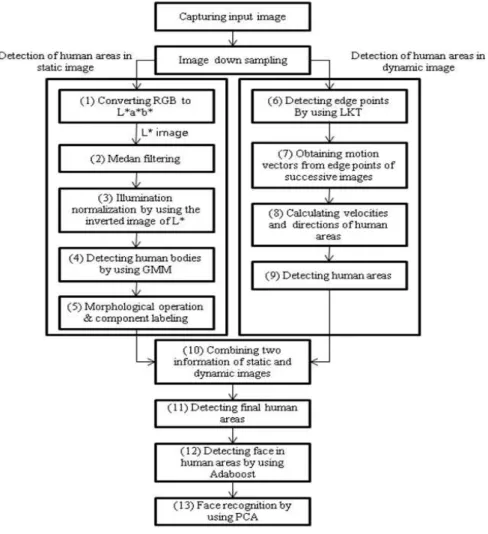
Fig. 1 shows an overview of the proposed
method. First, a RGB color image is captured and
transformed into a L*a*b* color image in order to
extract the lightness component (L) for the reduc-
tion of the illumination variation of the captured
image, as shown in step (1) of Fig. 1. The L image
is blurred by the median filter, as shown in step
(2) of Fig. 1 and the inversion of the L image is
used for the illumination normalization, as shown
in step (3) of Fig. 1. The illumination variation is
reduced by adding the original captured image to
the inverted one. The regions of interest (ROIs) of
the human objects are extracted using the GMM
method in the gray image, as shown in step (4)
of Fig. 1. A more accurate human area is deter-
Fig. 1 A flow chart of the proposed method.
mined through the morphological operation and the component labeling, as shown in step (5) of Fig. 1.
The edge points of the object are found by using the LKT method, as shown in step (6) of Fig. 1.
Through analyzing the correspondences between the edge points in the current and the previous frames by the LKT method, the multiple motion vectors can be calculated, as shown in steps (7) and (8) of Fig. 1. The human area is determined based on the motion vectors, as shown in step (9) of Fig. 1. Then, the information of motion vectors is combined with the detected human region by the GMM, as shown in step (10) of Fig. 1. From that, the genuine human areas are continuously ex- tracted, as shown in step (11) of Fig. 1, even if
multiple objects are overlapped. After that, the face area is detected by using the Adaboost face de- tector in the predetermined search region in the human area, as shown in step (12) of Fig. 1.
The detected face area is then normalized into a 32×32 pixel image. Finally, as shown in step (13) of Fig. 1, the extracted face is matched with the previously enrolled face template by using the PCA based face recognition method.
2.2 The foreground segmentation based on the GMM in the gray image
In order to discriminate the moving foreground
objects from the image, the background needs to
be determined. The GMM is a very popular method
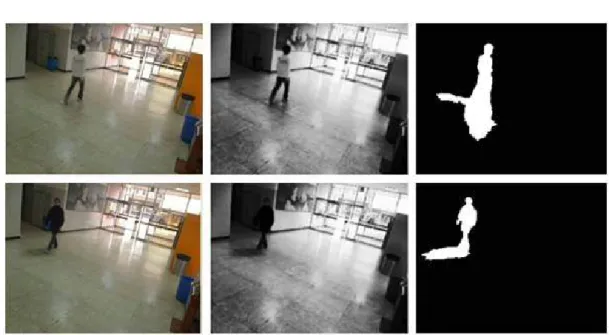
Fig. 2. The detection of the human area by the GMM. Left figures: the original image. Middle figures:
the gray image. Right figures: the human area detected by using the GMM.
used to segment the objects through the modeling background robust to a little amount of local change [32]. Assuming that the distributions of the pixel values define the corresponding probability density functions (PDF), the background and the foreground can be adaptively determined through the updating of the PDF and checking whether the input pixel value is included in the PDF of the background. This is when the Gaussian probability model is usually used to define the PDF. The Gaussian probability model is suitable to represent that the data is assembled to the center of the average. Although the Gaussian probability model is widely used, it is restricted to making a uni-mo- dal distribution [42]. That is to say, the normal Gaussian model can represent only simple and slight changes of the pixel values. Therefore, we need a probability density function that is able to represent a more general form. This is the Gaussian mixture model and it is the sum of the plural num- ber of the Gaussian probability model, and can be presented as the following equation [32,33]:
(1)
where
(2) And
(3) where α is the learning rate. M
k,tis assigned as 1 for the model to be detected and 0 for that not to be detected. And μ is the mean, Σ
k,tis the var- iance which is defined as . Here, is unit matrix. After the Gaussians are ordered by the value of ω/α, the first B distributions are chosen as the background model.
(4)
where T is the minimum portion of the background model.
To increase the processing speed of the GMM,
a 24-bit RGB color image, as shown in the left ones
of Fig. 2, is converted to an 8-bit gray image, as
shown in the middle ones of Fig. 2. Then, as shown
in the right ones of Fig. 2, the human area is lo-
calized using the GMM.
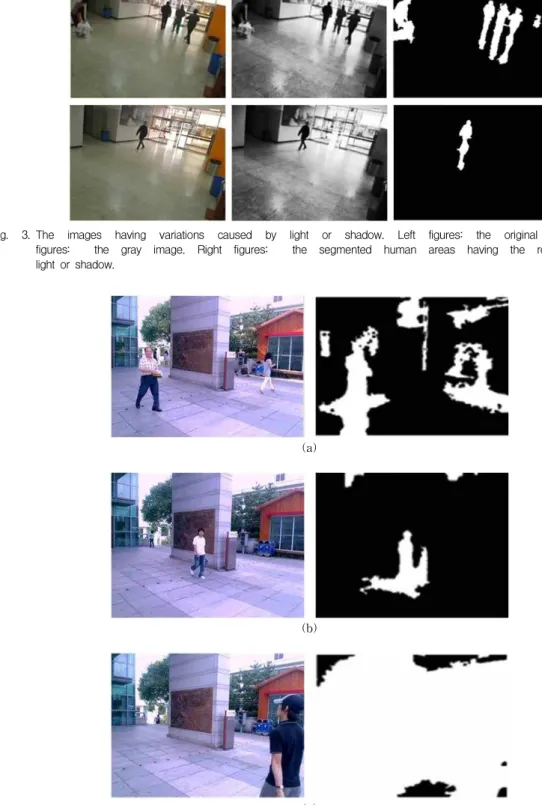
The GMM based method has a problem in that it is sensitive to illuminative variations, as shown in the right figures of Fig. 3. To overcome this problem, we reduce the influence of the lightness by normalizing the illuminative component of the image before determining the human area.
2.3 The illumination normalization method
In general, the images captured by camera have the variation of environmental light or shadow as shown in Fig. 3.
Since there is no significant visual difference between areas (having the variation of light or shadow) and those without it in successive images, the correct foreground region is difficult to be dis- criminated only by the GMM. If the shadows or the light reflective areas are connected to a human area, the size of detected human area becomes big- ger than the correct human area. If the shadows or light reflective areas are separate from the hu- man area, there can be a problem that the separate areas are falsely recognized as being other human ones. Fig. 4 shows the examples that are influenced by light reflection or shadow areas.
In face recognition, illumination normalization methods based on Retinex filtering have been in- troduced, but they are too slow to be used in a re- al-time surveillance environment, since it uses time consuming Gaussian convolutions and loga- rithmic operations using the whole image [35]. So, a fast algorithm for solving this problem is pro- posed as follows:
After the RGB image is converted to the L*a*b*
image, an illuminative component image is ac- quired by applying the 5×5 pixel median filter to the L image, as shown in Fig. 5 (b). The L image includes all the factors of illumination variation, and the gray component of objects and background.
Through median filtering, the illumination varia- tion can be approximated excluding the gray com- ponent of objects and background as shown in Fig.
5 (b).
The inverted image is obtained from this, as shown in Fig. 5 (c). The influence of the illumina- tive variation is suppressed by summing the in- verted image and the original L image, as shown in Fig. 5 (d). For example, the dark shadow on left bottom side of Fig. 5 (a) is reduced in Fig. 5 (d).
In addition, the dark corridor (the left of a person) of Fig. 5 (a) becomes brighter in Fig. 5 (d). And the lighting of all parts of Fig. 5 (d) becomes more uniform than that of Fig. 5 (a).
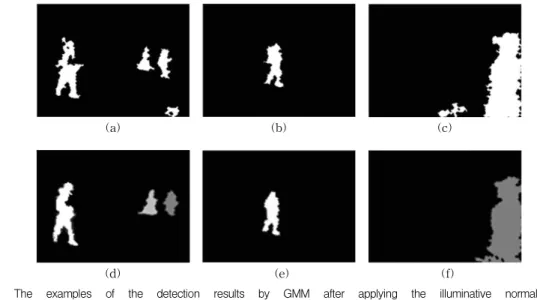
The processing time of proposed illumination normalization is 8.6ms in the input image of 320×240 pixels on average, while Retinex algorithm [35,43] takes 96ms in the image of same size. The total processing time is 90.6 ms (11 frames/sec) in a desktop computer, having an Intel® core 2™ Duo CPU 2.4GHz with 3GB RAM. Fig. 6 shows the re- sults of the GMM based foreground extraction af- ter applying the proposed illuminative normalization.
In previous research [44], the shadow of the foreground area can be removed on the basis that the color information of the shadow is similar to that of background in the detected foreground box, but the gray level of the shadow is different from that of background in the detected foreground box.
However, in our experiments, the parts of fore- ground area (especially, a user wearing white clothes) were also incorrectly removed as the shadow by this method, but through the proposed illumination normalization, the shadows of fore- ground are removed while the most of foreground area are maintained.
Along with the detected foreground regions
found by the illumination normalization and the
GMM, additional post-processing methods, such
as morphological operations and component labe-
ling, are performed. In morphological operation,
erosion and dilation are performed, through which
some holes or concave regions can be filled and
the uneven boundaries of foreground can be
smooth. Through component labeling, the noise
region whose size is small and isolated can be
Fig. 3. The images having variations caused by light or shadow. Left figures: the original image. Middle figures: the gray image. Right figures: the segmented human areas having the reflection of the light or shadow.
(a)
(b)
(c)
Fig. 4. Examples of images that include illuminative variation (left) and the resultant images using GMM
(right). (a) the case of noise that is generated by illuminative variation. (b) the case including
shadow. (c) the case including an abrupt change of illumination.
(a) (b)
(c) (d)
Fig. 5. An example of illumination modeling. (a) the original image (b) The illuminative component acquired by median filtering (c) The inverted image of (b) (d) result image combining (a) and (c).
(a) (b) (c)
(d) (e) (f)
Fig. 6. The examples of the detection results by GMM after applying the illuminative normalization. (a) the result with Fig. 4 (a) (left one). (b) the result with Fig. 4 (b) (left one). (c) the result with Fig.
4 (c) (left one). In addition, the examples of the detection results obtained by further post-processing.
(d) the result with Fig. 6 (a). (e) the result with Fig. 6 (b). (f) the result with Fig. 6 (c).
removed. Using these methods a more accurate foreground area can be obtained, as shown in Fig. 6.
2.4 Solving the occlusion problem by combin- ing the GMM and the LKT
However, when multiple foreground objects are tracked, occlusion or overlap problems can happen.
In the case of exclusively using the GMM method,
the occlusion problem causes the detection of im-
poster foreground objects. In addition, if the
Fig. 7. The detected motion vectors by the LKT (points: the detected corner points by the LKT, arrows : the motion vectors calcu- lated from the moved corner points in the successive images, box : the final box of human area).
tracked multiple objects are overlapped, the GMM can extract only one merged area. To overcome these problems, our new method of combining the GMM in the still image and the Lucas-Kanade- Tomasi (LKT) method in the successive images is proposed as follows. The LKT method calculates motion vectors, which are created based on the shifted corner points found in the successive im- ages [45,46].
The LKT method tracks feature points by cal- culating the correlations among them on the basis of the mean square error (MSE) [46,47]. This algo- rithm is represented by the following equation [11]:
) ( ) ( )
( x I x d n x
J = - + (5)
where I( ) is the brightness in the current frame, x is the location of the pixel, d is the displacement vector, n( ) is the noise, and J( ) is the brightness of the next frame. As shown in Eq. (6), feature tracking is carried out in the direction that mini- mizes the MSE of the feature window W [48].
))
2( ) (
å
Î( - -
=
jWI x
jd J x
je (6)
where ε is the MSE. The brightness function needs to be approximated using the Taylor series ex- pansion [46]. By repeating this procedure, the opti- mal displacement vector d is found.
Consequently, the feature points in the detected eye regions are extracted by using the Shi and Tomasi detection algorithm [49], and then, these feature points are tracked by the LKT method [48].
The detected motion vectors obtained by the LKT are shown by the arrows in Fig. 7.
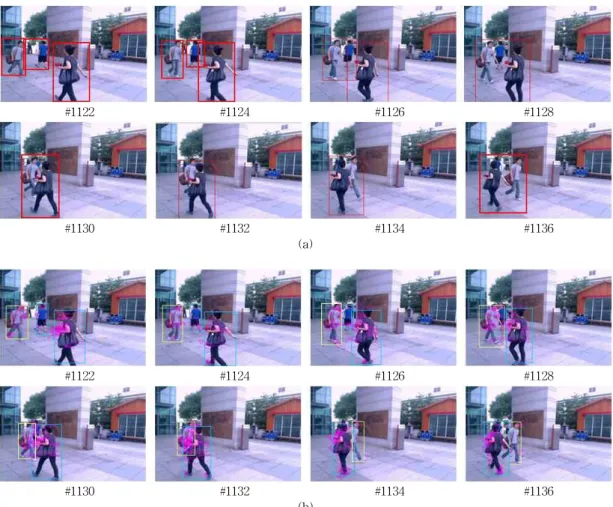
The final human area is detected in order to combine the human areas based on the GMM and the LKT. In detail, inside the box region including the detected area of GMM, the motion vectors (the arrows of Fig. 7) are located by the LKT. Based on the outmost starting and ending points of the motion vectors, one box (the box of Fig. 7) is de- fined as the final human area. By using these schemes, the occlusion problem can be solved be- tween the moving objects, as shown in Fig. 8. In Fig. 8, the numbers (#1122~#1136) below each fig- ure represent the frame number.
Fig. 9 shows the detection results of Fig. 3 by using proposed methods.
2.5 The face detection using the Adaboost algorithm and face recognition based on the PCA
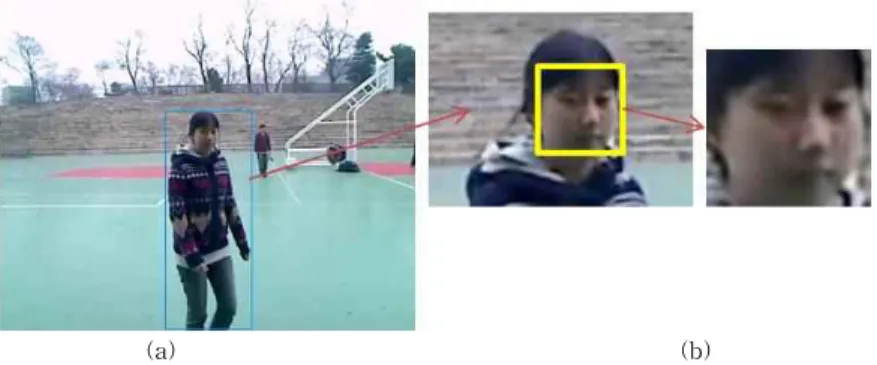
Our research uses the adaptive boosting (Ada- boost) algorithm for detecting the face region [50, 51]. Through the training of the Adaboost algo- rithm, a highly accurate simple classifier is posi- tioned in front of the hierarchical structures, which reduces false detections. Fig. 10 shows an example of the detection of the face region by using the Adaboost face detector inside of the detected hu- man area.
Only when the width of the box detected by the
GMM and the LKT is greater than the predeter-
mined threshold is the face detection performed. In
the case that it is less than the threshold, even if
the face region is detected successfully, the face
recognition frequently fails due to the shortage of
pixel information in the facial region. The optimal
threshold was empirically determined to be 50 pix-
els in order to have accurate face recognition.
#1122 #1124 #1126 #1128
#1130 #1132 #1134 #1136
(a)
#1122 #1124 #1126 #1128
#1130 #1132 #1134 #1136
(b)
Fig. 8. Examples of tracking multiple and overlapped objects (a) by using GMM and (b) by combining GMM and LKT.
(a) (b)
Fig. 9. The detection results of Fig. 3 by using proposed methods. (a) the case of Fig. 3 (a). (b) the case of Fig. 3 (b).
In order to reduce false face detection errors and the processing time, the face region is detected only in the predetermined area located inside the fore- ground region. The rough positions of the eyes and
lips are detected by using binarization and compo-
nent labeling in the predetermined area inside the
detected face region. Based on them, a more accu-
rate face region is defined and then is normalized
(a) (b)
Fig. 10. An example of detecting face region by using Adaboost face detector inside of the detected human area. (a) Detected human area. (b) and (c) show the detected face region.
Fig. 11. The examples of the eigen-faces.
to 32×32 pixels for face recognition.
In this research, face recognition is performed based on the principal component analysis (PCA) method. The PCA is a statistical method which can reduce the dimensions of the original feature space, thereby an optimal feature space can be obtained [52,53]. The PCA method, being the most popular method in face recognition, is used in order to get a low dimensional component which includes the principal component from a face image. In previous research, the comparisons of PCA-based computer face recognition and human face recognition ac- cording to facial components were also performed [54]. The obtained vectors that represent the low dimensional space are called eigen-faces, which are obtained from the training images. In general, the PCA makes eigen-vectors by using covariance matrix C
T i M
i
i
m )( m )
M (
C = å - -
=
x x
1
1 (7)
where x
iis one dimensional vector of ith face
image (p×q pixels size), and m is the average vec- tor of face images of training data. By calculating covariance matrix C, basis vector U is determined by choosing k vectors whose magnitude of ei- gen-value is larger. From that, the eigen-vector w is determined by projecting face image (x) to basis vector U.
) m
T