Fragrance Chemicals in the Essential Oil of Mentha arvensis Reduce Levels of Mental Stress
Haeme Cho
1, Kandhasamy Sowndhararajan
1, Ji-Wook Jung
2, Jin-Woo Jhoo
3and Songmun Kim
1*
1
Department of Biological Environment, Kangwon National University, Chuncheon 200-701, Korea
2
Department of Herbal Medicinal Pharmacology, Daegu Haany University, Kyungsan 712-715, Korea
3
Department of Animal Products and Food Science, Kangwon National University, Chuncheon 200-701, Korea
Received May 29, 2013 /Revised July 18, 2013 /Accepted July 25, 2013The aim of this work was to determine the chemical composition of essential oil from aerial partsof Mentha arvensis L. f. piperascens (MAO) and to evaluate the effect of its fragrant chemicals on electro- encephalographic (EEG) activity of human brain. The MAO was obtained by supercritical CO
2extraction. The maximum yield was 2.38% at conditions of 70ºC and 200 bar. There were 32 volatile chemicals with 6 alcohols (67.11%), 13 hydrocarbons (17.05%), 9 esters (11.50%), 2 ketones (7.16%), 1 oxide (2.77%), and 1 aldehyde (0.56%). The major components were (Z,Z,Z)-9,12,15-octadecatrien-1-ol (50.06%), 2-hydroxy-4-methoxyacetophenone (7.50%), and 3,4-dihydro-8-hydroxy-3-methyl-1H-2-ben- zopyran-1-one (6.60%). Results of the EEG study showed that inhalation of MAO significantly changed the EEG power spectrum values of relative gamma, relative fast alpha, and spectral edge frequency 90%. During the inhalation of MAO, the value of relative fast alpha was significantly increased (p<0.05). On the other hand, the values of gamma and the spectral edge frequency 90% were sig- nificantly decreased (p<0.05). The present study suggests that fragrant chemicals of essential oil of M.
arvensis reduce the level of mental stress and that they could be used in the treatment of psychophy- siological disorders.
Key words : Electroencephalogram, Mentha arvensis, essential oil, fragrance, supercritical extraction
*Corresponding author
*Tel:+82-33-250-6447, Fax:+82-33-241-6440
*E-mail : [email protected]
This is an Open-Access article distributed under the terms of the Creative Commons Attribution Non-Commercial License (http://creativecommons.org/licenses/by-nc/3.0) which permits unrestricted non-commercial use, distribution, and reproduction in any medium, provided the original work is properly cited.
Journal of Life Science 2013 Vol. 23. No. 7. 933~940 DOI : http://dx.doi.org/10.5352/JLS.2013.23.7.933
Introduction
The genus Mentha (Lamiaceae syn. Labiatae) comprises approximately 30 species and members of this genus are characterized by their volatile oils which are of great eco- nomic importance, being used by the flavor, fragrance and pharmaceutical industries [7, 21]. Mentha arvensis L. f. piper- ascens Malinvaud ex Holmes is commonly cultivated in trop- ical and sub-tropical climates. The plant is aromatic, stimu- lant and carminative, and it has been used as antispasmodic, anti-mycotic and anti-peptic ulcer agents [13, 23]. It contains several aromatic and bioactive compounds such as men- thone, menthofuran, sesquiterpenes, flavonoids, triterpenes, carotenoids, tannins and minerals [16]. It has unique im-
portance among the species because of its high content of (1R,2S,5R)-2-isopropyl-5-methylcyclohexanol (menthol). Due to physiological cooling effects of menthol, the plant has been used as fragrance component in soaps, detergents, cos- metics, confectionary and toothpastes [1, 22].
The pharmaceutical properties of aromatic plants are
commonly attributed to its essential oils. Essential oils are
complex, multi-component systems mainly composed of ter-
penes [8]. They are one of the important sources for the treat-
ments of various psychophysiological disorders such as de-
pression, anxiety and cognitive disorders [18]. The physio-
logical and psychological effects of fragrances could be eval-
uated by electroencephalographic (EEG) study. Taking into
account the popular uses and biological activities of M. ar-
vensis, it is surprising that no psychophysiological study has
been performed concerning the effect of its essential oil on
EEG activity of human brain. Therefore, the present inves-
tigation was undertaken to determine the chemical composi-
tion of essential oil from aerial parts of M. arvensis using
GC/MS analysis and to evaluate the effect of its inhalation
on EEG activity of human brain.
Materials and Methods Plant material
Aerial parts of Mentha arvensis L. f. piperascens were pur- chased from BN Herb Inc., Pyeongchang, South Korea. A voucher specimen was deposited in the Herbarium of Kangwon National University under the number KWNU 85135. The plant material was dried at room temperature, ground to a powder using a blender and stored at -20
oC prior to use.
Supercritical CO
2extraction (SFE)
The SFE of essential oil from aerial parts of M. arvensis (MAO) was performed on an ISA-SCCO-S-050-500 SFE de- vice (ILSHIN Autoclave Co. Ltd., Daejeon, Korea). Carbon dioxide (99.5%, w/w pure) was delivered from a standard cylinder and compressed to an extraction pressure by an air-driven liquid pump. For each condition, about 120 g of milled M. arvensis aerial parts were loaded into a stainless steel extraction vessel. During the extraction process, the ex- traction pressure, extraction temperature and CO
2fl ow rate were controlled by adjusting the regulating valves. To opti- mize the SFE conditions for MAO, the extraction was con- ducted at different pressures (200, 300 and 400 bar) and tem- peratures (40, 50, 60 and 70
oC). The CO
2fl ow rate was main- tained at 30 ml/min. After one hour of extraction time, the extraction vessel was depressurized and the oil was collected from the separation vessel. The amount of extracted oil was determined gravimetrically after collection, and the ex- traction yield was expressed as percent of the dry weight of aerial parts of M. arvensis.
Gas chromatography/mass spectrometry (GC/MS) analysis
GC/MS analysis of MAO was performed using a Varians CP3800/Varians 1200L gas chromatography/mass spec- trometer, equipped with a Varians VF-5MS poly- dimethylsiloxane capillary column (30 m × 0.25 mm, film thickness 0.25 μm). The oven temperature was initially at 50
oC (held for 5 min) and then increased to 250
oC at 5
oC/min. The injector temperature was maintained at 250
oC.
The ion source temperature was 280
oC and electron energy was 70 eV. The analyzer was scanned over the range of m/z 50 to 500. Helium gas was used as a carrier gas at a constant fl ow rate of 1 ml/min. The components of MAO were identi fi ed on the basis of comparison of their retention times and mass spectra with publish data and computer matching with
Wiley 275 and National Institute of Standards and Technology (NIST, 3.0) spectral libraries.
Effect of inhalation of MAO on EEG activity Subjects
Twenty right-handed healthy volunteers (10 men and 10 women) aged 20-30 years participated in this study. None of the subjects had olfactory diseases, smoked or abused drugs. All subjects gave their informed consent before participation.
EEG recordings
EEGs were recorded using QEEG-8 system (LXE3208, LAXTHA Inc., Daejeon, Korea) from 8 grounding electrodes placed on the scalp at left prefrontal (Fp1), right prefrontal (Fp2), left frontal (F3), right frontal (F4), left temporal (T3), right temporal (T4), left parietal (P3) and right parietal (P4) according to the International 10-20 System. All electrodes were referenced to the ipsilateral earlobe electrode.
Fragrance Administration
MAO was used as the fragrance stimulus. The stimulus was presented to the subjects in a randomized sequence.
EEG measurement sites maintain a constant temperature (23°C) and humidity (50%) to 32.5 m
2size of the laboratory.
The subjects were instructed to sit quietly, close their eyes and to breathe normally during the measurement. The fragrance stimulus was dipped in a filter paper (1 cm
2) then placed about 3 cm in front of the subject's nose. EEG was recorded before and during the fragrance exposure for 30 seconds.
Data Analysis
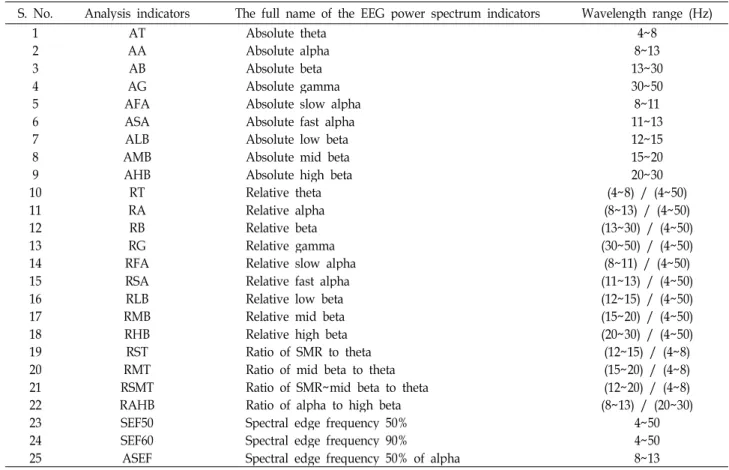
The mean power values [microvolt (μV)] were calculated for 25 EEG analysis indicators (Table 1). The t-mapping of EEG waves of brain was constructed by using Telescan soft- ware package (LXSMD61, LAXTHA Inc., Daejeon, Korea).
The SPSS statistical package 18 (SPSS, Inc., Chicago, IL, USA) was used for data analysis on EEG activity before and dur- ing the exposure of MAO by a paired t-test based on the EEG power spectrum values.
Results Yield of essential oil
SFE of the essential oil from aerial parts of M. arvensis
was carried out under different conditions of temperature
(40, 50, 60 and 70
oC) and pressure (200, 300 and 400 bar),
Table 1. EEG indicators used in the analysis
S. No. Analysis indicators The full name of the EEG power spectrum indicators Wavelength range (Hz)
1 AT Absolute theta 4~8
2 AA Absolute alpha 8~13
3 AB Absolute beta 13~30
4 AG Absolute gamma 30~50
5 AFA Absolute slow alpha 8~11
6 ASA Absolute fast alpha 11~13
7 ALB Absolute low beta 12~15
8 AMB Absolute mid beta 15~20
9 AHB Absolute high beta 20~30
10 RT Relative theta (4~8) / (4~50)
11 RA Relative alpha (8~13) / (4~50)
12 RB Relative beta (13~30) / (4~50)
13 RG Relative gamma (30~50) / (4~50)
14 RFA Relative slow alpha (8~11) / (4~50)
15 RSA Relative fast alpha (11~13) / (4~50)
16 RLB Relative low beta (12~15) / (4~50)
17 RMB Relative mid beta (15~20) / (4~50)
18 RHB Relative high beta (20~30) / (4~50)
19 RST Ratio of SMR to theta (12~15) / (4~8)
20 RMT Ratio of mid beta to theta (15~20) / (4~8)
21 RSMT Ratio of SMR~mid beta to theta (12~20) / (4~8)
22 RAHB Ratio of alpha to high beta (8~13) / (20~30)
23 SEF50 Spectral edge frequency 50% 4~50
24 SEF60 Spectral edge frequency 90% 4~50
25 ASEF Spectral edge frequency 50% of alpha 8~13
in order to evaluate their influence on the yield of the essen- tial oil (Fig. 1). The influence of four different temperatures on the essential oil isolated from M. arvensis aerial parts was studied using a constant pressure of 400 bar. The results in- dicated that the significant increase of essential oil yield with increase of temperature from 40
oC (0.28%) to 50
oC (1.33%) and the yield was nearly same when increase the temper- ature from 50
oC (1.33%) to 60
oC (1.35%). However, the yield was increased with further increment of temperature from 60
oC (1.35%) to 70
oC (1.64%) at 400 bar pressure. The influ- ence of pressure was studied using a constant temperature at 70
oC based on the higher yield. The yield was increased while decreasing the pressure from 400 to 200 bar (1.63%
to 2.38%). The optimized extraction conditions for the yield of essential are temperature at 70
oC and pressure at 200 bar.
Chemical composition of the essential oil
The identified compounds of the MAO were listed in Table 2 according to their area percentage. Results showed that among 32 components identified, (Z,Z,Z)-9,12,15-octa- decatrien-1-ol (50.06%) was found to be major compound in the essential oil of aerial parts of M. arvensis. In addition,
Fig. 1. Yields of essential oil from aerial parts of
M. arvensis
at different supercritical CO2 extraction conditions.Aerial parts of
M. arvensis
from five different lots were pooled together and used for SFE.2-hydroxy-4-methoxyacetophenone (7.50%), 3,4-dihydro-8-
hydroxy-3-methyl-1H-2-benzopyran-1-one (6.60%), β-selinene
(5.55%), (Z)6,(Z)9-pentadecadien-1-ol (3.32%), caryophyllene
oxide (2.77%), α-selinene (2.76%) and phenylethyl alcohol
(1.88%) were found to be considerable levels in the essential
oil of M. arvensis aerial parts in the present study.
Table 2. Essential oil composition of aerial parts of
M. arvensis
No. Retentiontime (min) Compound name Area
(%) Component CAS number Formula M.W 1 40.237 (Z,Z,Z)-9,12,15-Octadecatrien-1-ol 50.06 Alcohol 506-44-5 C18H32O 264.45 2 33.738 2-Hydroxy-4-methoxyacetophenone 7.50 Ether 552-41-0 C9H10O3 166.17 3 36.940 3,4-dihydro-8-hydroxy-3-methyl-1H-2-benzopyran-1-one 6.60 Ketone 17397-85-2 C10H10O3 178.18
4 35.151 β-Selinene 5.55 Hydrocarbon 17066-67-0 C15H24 204.35
5 40.106 (Z)6,(Z)9-Pentadecadien-1-ol 3.32 Alcohol 77899-11-7 C15H28O 224.38
6 38.008 Caryophyllene oxide 2.77 Oxide 1139-30-6 C15H24O 220.35
7 35.376 α-Selinene 2.76 Hydrocarbon 473-13-2 C15H24 204.35
8 21.667 Phenylethyl Alcohol 1.88 Alcohol 60-12-08 C8H10O 122.16
9 31.920 β-Elemene 1.59 Hydrocarbon 515-13-9 C15H24 204.35
10 34.851 α-Curcumene 1.58 Hydrocarbon 644-30-4 C15H22 202.34
11 49.784 Mercaptoacetic acid, bis(trimethylsilyl) 1.57 Ester 6398-62-5 C8H20O2SSi2236.48
12 38.335 Nonadecane 1.41 Hydrocarbon 629-92-5 C19H40 268.52
13 39.561 Methyl 7,10,13,16,19-docosapentaenoate 1.28 Ester None C23H38O2 344.53
14 39.951 5,8,11-Heptadecatrien-1-ol 1.27 Alcohol 22117-09-5 C17H30O 250.42
15 31.367 3-Hydroxy-2,4,4-trimethylpentyl-ester-2-methyl-propanoic acid 1.08 Ester 74367-34-3 C12H24O3 216.32 16 34.907 2,6,10-Trimethyltetradecane 1.06 Hydrocarbon 14905-56-7 C17H36 240.47
17 31.450 Copaene 1.03 Hydrocarbon 3856-25-5 C15H24 204.35
18 32.929 Caryophyllene 0.87 Hydrocarbon 87-44-5 C15H24 204.35
19 30.539 Propanoic acid, 2-methyl-, 2,2-dimethyl- 0.70 Ester 74367-33-2 C12H24O3 216.32
20 31.030 γ-Nonalactone 0.70 Ketone 104-61-0 C9H16O2 156.22
21 37.724 Methyl stearidonate 0.70 Ester None C18H28O2 276.41
22 43.814 Heneicosane 0.61 Hydrocarbon 629-94-7 C21H44 296.57
23 33.012 α-Ionone 0.56 Aldehyde 127-41-3 C13H20O 192.30
24 33.310 α-Bergamotene 0.52 Hydrocarbon 17699-05-7 C15H24 204.35
25 32.200 Pentadecane 0.51 Hydrocarbon 629-62-9 C15H32 212.41
26 36.310 Heptadecane, 2,6,10,15-tetramethyl- 0.46 Hydrocarbon 54833-48-6 C21H44 296.57 27 39.004 Phenol,2,6-bis(1,1-dimethylethyl)-4-(1-methylpropyl)- 0.40 Alcohol 17540-75-9 C18H30O 262.43
28 47.009 Methyl heptacosanoate 0.36 Ester 55682-91-2 C28H56O2 424.74
29 48.648 Ethyl palmitate 0.36 Ester 628-97-7 C18H36O2 284.48
30 50.907 Propanedioic acid, bis[2-(trimethylsilyl)ethyl] ester 0.35 Ester 90744-45-9 C13H28O4Si2 304.53
31 35.673 β-Bisabolene 0.35 Hydrocarbon 495-61-4 C15H24 204.35
32 52.453 Rhodopin 0.24 Alcohol 105-92-0 C40H58O 554.89
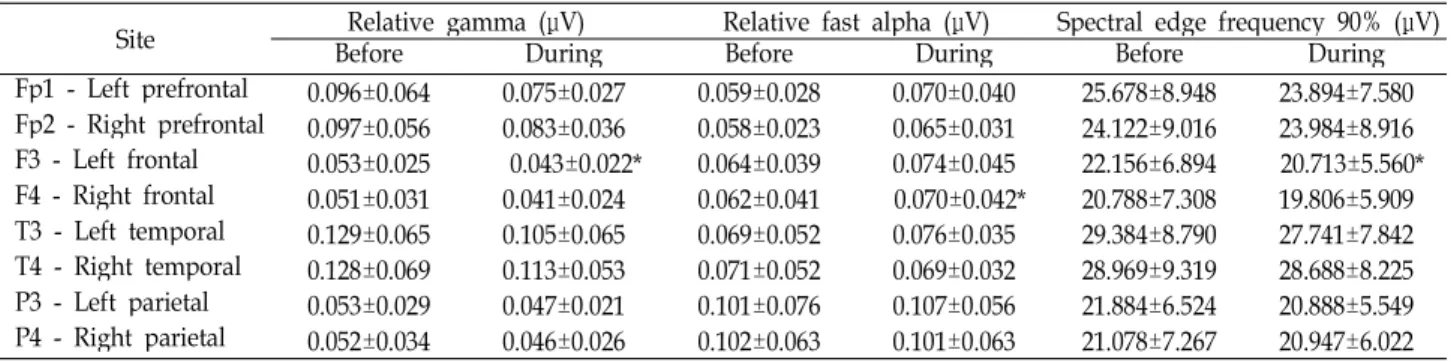
Table 3. Changes of EEG power spectrum values before and during the inhalation of essential oil of
M. arvensis
Site Relative gamma (μV) Relative fast alpha (μV) Spectral edge frequency 90% (μV)
Before During Before During Before During
Fp1 - Left prefrontal 0.096±0.064 0.075±0.027 0.059±0.028 0.070±0.040 25.678±8.948 23.894±7.580 Fp2 - Right prefrontal 0.097±0.056 0.083±0.036 0.058±0.023 0.065±0.031 24.122±9.016 23.984±8.916 F3 - Left frontal 0.053±0.025 0.043±0.022* 0.064±0.039 0.074±0.045 22.156±6.894 20.713±5.560*
F4 - Right frontal 0.051±0.031 0.041±0.024 0.062±0.041 0.070±0.042* 20.788±7.308 19.806±5.909 T3 - Left temporal 0.129±0.065 0.105±0.065 0.069±0.052 0.076±0.035 29.384±8.790 27.741±7.842 T4 - Right temporal 0.128±0.069 0.113±0.053 0.071±0.052 0.069±0.032 28.969±9.319 28.688±8.225 P3 - Left parietal 0.053±0.029 0.047±0.021 0.101±0.076 0.107±0.056 21.884±6.524 20.888±5.549 P4 - Right parietal 0.052±0.034 0.046±0.026 0.102±0.063 0.101±0.063 21.078±7.267 20.947±6.022 Values are mean±standard deviation.
*Significant differences (
p
<0.05) during the fragrant inhalation.EEG activity
The changes of EEG power spectrum values of brain due to the inhalation of MAO are presented in Table 3. Among
the values of 25 indices analyzed, significant changes were
observed in the values of relative gamma, relative fast alpha
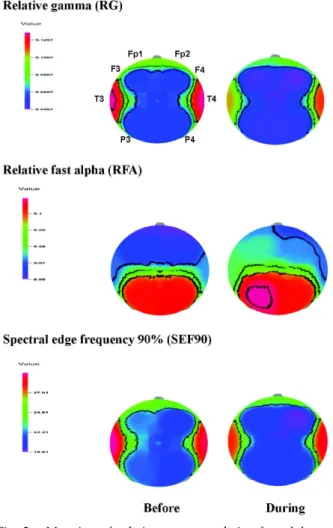
and spectral edge frequency 90%. The t-mapping of brain
Fig. 2. t-Mapping of relative gamma, relative fast alpha and spectral edge frequency 90% brain waves before and during the inhalation of essential oil of
M. arvensis.
Fp1, left prefrontal; Fp2, right prefrontal; F3, left frontal; F4, right frontal; T3, left temporal; T4, right temporal; P3, left parietal; P4, right parietal.expressed the changes of these EEG waves before and dur- ing the exposure of MAO (Fig. 2). After the inhalation of MAO, the EEG power spectrum values were changed sig- nificantly with increase of fast alpha and decrease of relative gamma and spectral edge frequency 90% waves. These changes were observed maximum in the frontal and tempo- ral regions. The relative gamma values highly decreased in the left (Fp1) and right prefrontal (Fp2) regions from 0.096 to 0.075 μV and from 0.097 to 0.083 μV, respectively. In the left (T3) and right temporal (T4) regions also decreased from 0.129 to 0.105 μV and from 0.128 to 0.113 μV, respectively.
Whereas, the values of fast alpha waves significantly in- creased (p<0.05) in the right frontal region from 0.062 to 0.070 μV.
Discussion
Aromatic plants are commonly used in the traditional sys- tem of medicine. Essential oils extracted from them are wide- ly used for the treatments of various diseases, such as cancer, cardiovascular diseases, atherosclerosis, thrombosis, bacte- rial and viral infections [8]. Generally, essential oils are ex- tracted by conventional methods such as hydro-distillation, steam distillation and solvent extraction. However, the limi- tations of these techniques are thermal degradation, partial hydrolysis, incomplete extraction, solvent residues and post-extraction process [5]. Therefore, supercritical fluid ex- traction (SFE) of active compounds from plant material is an alternative technique and has certain advantages over steam-distillation and solvent extraction. SFE can be per- formed at lower temperatures, thereby preserving the origi- nal extract composition and properties [17]. Carbon dioxide is the most desirable solvent for supercritical fluid extraction for the extractions of fragrances and other active compounds. In addition, it is an inert, non-flammable, non-toxic, inexpensive, odorless and generally accepted a harmless ingredient in pharmaceuticals, cosmetics and food [4, 17, 26]. Hence, SFE was performed for the extraction of essential oil from aerial parts of M. arvensis. In the present study, results of SFE revealed that extraction temperature and pressure were the dominant factors to affect the yield of essential oil isolated from M. arvensis. Thus, the best con- ditions obtained for the extraction of MAO were temper- ature at 70
oC and pressure at 200 bar. Similarly, Khajeh et al. [11] studied the effects of pressure and temperature on the SFE of Ferula assa-foetida oil. The results showed that the extraction yield was higher under a pressure of 300 bar and temperature 35
oC. Baysal and Starmens [3] studied that SFE of caraway seed and their results showed that the parame- ters of pressure and temperature were played major roles on the extraction yield. They suggested that at moderate temperature (31.1
oC) and pressure (73.8 bar), the extraction yield was considerably higher. Since the parameters of tem- perature and pressure potentially affect the extraction yield, the optimization of the experimental conditions represents a crucial step in the development of a SFE method.
In the present study, the major compound (Z,Z,Z)-
9,12,15-octadecatrien-1-ol has been previously identified in
Camellia taliensis. Among 28 aroma components from the
volatile oils of Camellia taliensis, (Z,Z,Z)-9,12,15-octadecatri-
en-1-ol present up to 1.2% in tender leaves and 11.2% in
older leaves [28]. Verma et al. [27] reported that the essential oil of M. arvensis mainly composed of menthol, menthone, isomenthone, menthyl acetate, limonene and neomenthol.
Further, stated that the essential oil content and terpenoids composition of M. arvensis were found to vary with respect to crop age. The chemical composition of plant essential oils may vary according to species, part of the plant, season of harvesting and geographical origin [10, 24]. In addition, the extraction methods can also influence the type and amount of molecules extracted [2, 14].
In EEG study, inhalation of MAO provided significant changes on EEG power spectrum values of relative gamma, relative fast alpha and spectral edge frequency 90%. Iijima et al. [9] reported that the fast alpha activity increased sig- nificantly during agarwood incense exposure compared to that during rose oil exposure. Similarly, the present study reveals that the increase of fast alpha waves during the in- halation MAO when compared to before inhalation.
Sayowan et al. [19] demonstrated that the inhalation of lav- ender oil increased the theta and alpha power spectrum val- ues in all the regions. Further, the author suggested that the increase of alpha wave activity is highly correlated to the relaxation effect of brain. Previously, several studies have stated that alpha activity was increased significantly due to the inhalation of fragrances and provided relaxing effect on brain activity [6, 9, 19]. The results of present study showed that the increase of fast alpha waves enhanced the attention and relaxation effects of brain functions. The alpha activity (8-13 Hz) is one of the fundamental electrophysiological events of the human electroencephalogram (EEG). Klimesch (12) described that the EEG oscillations in the alpha wave is positively related to cognitive performance and brain maturity. Further, the author stated that alpha frequency shows large inter-individual differences which are related to age and memory performances. Motomura et al. [15] sug- gested that the exposure of lavender oil increased the level of theta 1 waves and decreased the level of beta waves.
These changes could be attributed to reducing stress state associated with relaxation. The present investigation re- vealed that the decrease of relative gamma waves reduced the mental tension, anxiety and excited states of human brain.
In addition, the decrease of SEF90 values during the in- halation of MAO is attributed to the reduction of excessive anxiety, tension, anxiousness, or emotional states. The spec- tral edge frequency is calculated from the power in fre-
quency ranges. The area under the curve of the power spec- trum is calculated first. Following the frequency is derived that separates 90% of the area from 10% of the area is called as SEF90. The spectral edge frequency may increase during light anaesthesia and then decrease at deeper levels [25].
Schwender et al. [20] stated that the SEF90 is reduced with increasing the concentration of anaesthetics. Furthermore, it has been suggested that SEF may be used to measure depth of anaesthesia and indicate arousal during emergence from general anaesthesia.
Overall results in the study show that the higher yield of essential oil was obtained through SFE at 70
oC and 200 bar pressure. The GC/MS analysis of essential oil indicated that the separation of 32 components. Further, the present investigation indicates that the brain wave activities in re- lated to mood and stress states were affected by the exposure of M. arvensis essential oil. This study provides evidence that M. arvensis essential oil as a potential source of aromatic compounds with great potential on the treatment of psycho- physiological disorders.
References
1. Alvi, M. N., Ahmad, S. and Rehman, K. 2001. Preparation of menthol crystals from Mint (
Mentha arvensis
).Int J Agric Biol
3, 527-528.2. Bakkali, F., Averbeck, S., Averbeck, D. and Idaomar, M. 2008.
Biological effects of essential oils – a review.
Food Chem Toxicol
46, 446-475.3. Baysal, T. and Starmens, D. A. J. 1999 Supercritical carbon dioxide extraction of carvone and limonene from caraway seed.
J Supercrit Fluid
14, 225-234.4. Cao, X., Tian, Y., Zhang, T. and Ito, Y. 2000. Supercritical fluid extraction of catechins from
Cratoxylum prunifolium
Dyer and subsequent purification by high-speed coun- ter-current chromatography. J Chromatogr A
898, 75-81.5. Danh, L. T., Triet, N. D. A., Hana, L. T. N., Zhaoa, J., Mammucaria, R. and Fostera, N. 2012. Antioxidant activity, yield and chemical composition of lavender essential oil ex- tracted by supercritical CO2.
J Supercrit Fluid
70, 27-34.6. Diego, M. A., Jones, N. A., Field, T., Hernandez- Reif, M., Schanberg, S., Kuhn, C., McAdam, V., Galamaga, R. and Galamaga, M. 1998. Aromatherapy positively affects mood, EEG patterns of alertness and math computations.
Int J Neurosci
96, 217-224.7. Dorman, H. J. D., Kosar, M., Kahlos, K., Holm, Y. and Hiltunen, R. 2003. Antioxidant properties and Composition of aqueous extracts from
Mentha
species, hybrids, varieties, and cultivars.J Agric Food Chem
51, 4563-4569.8. Edris, A. E. 2007. Pharmaceutical and therapeutic potentials of essential oils and their individual volatile constituents:
a review.
Phytother Res
21, 308-323.9. Iijima, M., Osawa, M., Nishitani, N. and Iwata, M. 2009.
Effects of incense on brain function: evaluation using elec- troencephalograms and event related potentials.
Neuropsychobiology
59, 80-86.10. Jordan, M. J., Martinez, R. M., Goodner, K. L., Baldwin, E.
A. and Sotomayor, J. A. 2006. Seasonal variation of
Thymus hyemalis
Lange and SpanishThymus vulgaris
L. essential oils composition.Ind Crop Prod
24, 253-263.11. Khajeh, M., Yamini, Y., Bahramifar, N., Sefidkon, F. and Pirmoradei, M. R. 2005. Comparison of essential oils com- positions of
Ferula assa-foetida
obtained by supercritical car- bon dioxide extraction and hydrodistillation methods.Food Chem
91, 639-644.12. Klimesch, W. 1999. EEG alpha and theta oscillations reflect cognitive and memory performance: a review and analysis.
Brain Res Rev
29, 169-195.13. Kowati, R., Satish, B. P., Harsha, R., Dinesha, R. and Hareesh, A. R. 2010.
In vitro
antioxidant activity of leaves ofMentha arvensis
Linn.J Pharm Res
3, 1951-1954.14. Mejri, J., Abderrabba, M. and Mejri, M. 2010. Chemical com- position of the essential oil of
Ruta chalepensis L: influence of drying, hydro-distillation duration and plant parts. Ind Crop Prod
32, 671-673.15. Motomura, N., Sakuri, A. and Yoysuya, Y. 2001. Reduction of mental stress with lavender odorant.
Percept Mot Skills
93, 713-718.16. Patil, K. and Mall, A. 2012. Hepatoprotective activity of
Mentha arvensis
Linn. leaves against CCL4 induced liver damage in rats.Asian Pac J Trop Dis
2, S223-S226.17. Reverchon, E. 1997. Supercritical fluid extraction and fractio- nation of essential oils and related products
. J Supercrit Fluid
12, 37-41.18. Rombola, L., Corasaniti, M. T., Rotiroti, D., Tassorelli, C., Sakurada, S., Bagetta, G. and Morrone, L. A. 2009. Effects of systemic administration of the essential oil of bergamot (BEO) on gross behaviour and EEG power spectra recorded from the rat hippocampus and cerebral cortex.
Funct Neurol
24, 107-112.19. Sayowan, W., Siripornpanich, V., Piriyapunyaporn, T., Hongratanaworakit, T., Kotchabhakdi, N. and Ruangrungsi,
N. 2012. The effects of lavender oil inhalation on emotional states, autonomic nervous system, and brain electrical activity.
J Med Assoc Thai
95, 598-606.20. Schwender, D., Daunderer, M., Mulzer, S., Klasing, S., Finsterer, U. and Peter, K. 1996. Specral edge frequency of the electroencephalogram to monitor “depth” of anaesthesia with isoflurane and propofol.
Brit J Anaesth
77, 179-184.21. Shaiq Ali, M., Saleem, M., Ahmad, W., Parvez, M. and Yamdagni, R. 2002. A chlorinated monoterpene ketone, acy- lated β-sitosterol glycosides and a flavanone glycoside from
Mentha longifolia
(Lamiaceae).Phytochemistry
59, 889-895.22. Sinha, R. and Chattopadhyay, S. 2011. Changes in the leaf proteome profile of
Mentha arvensis
in response toAlternaria alternata
infection.J Proteomics
74, 327-336.23. Sokovic, M. D., Vukojevic, J., Marin, P. D., Berkik, D. D., Vajs, V. and Griensven, L. J. L. D. 2009. Chemical composi- tion of essential oils of
Thymus
andMentha
species and their antifungal activities.Molecules
14, 238-249.24. Teixeira, B., Marques, A., Ramos, C., Neng, N. R., Nogueira, J. M. F., Saraiva, J. A. and Nunes, M. L. 2013. Chemical composition and antibacterial and antioxidant properties of commercial essential oils.
Ind Crop Prod
43, 587-595.25. Tonner, P. H. and Bein. B. 2006. Classic electroencephalo- graphic parameters: Median frequency, spectral edge fre- quency etc.
Best Pract Res Clin Anaesthesiol
20, 147-159.26. Varona, S., Martin, A., Cocero, M. J. and Gamse, T. 2008.
Supercritical carbon dioxide fractionation of Lavandin es- sential oil. Experiments and modeling.
J Supercrit Fluid
45, 181-188.27. Verma, R. S., Rahman, L., Verma, R. K., Chauhan, A., Yadav, A. K. and Singh, A. 2010. Essential oil composition of menthol mint (
Mentha arvensis)
and peppermint (Mentha piperita
) cultivars at different stages of plant growth from Kumaon region of Western Himalaya.Open Acc J Med Arom Plants
1, 13-18.28. Zhu, L. F., Dong, H. Z., Yang, S. X., Zhu, H. T., Xu, M., Zeng, S. F., Yang, C. R. and Zhang, Y. J. 2012. Chemical compositions and antioxidant activity of essential oil from green tea produced from