Identification of the Polymorphisms in IFITM2 and IFITM5 Genes and their Association with Ulcerative Colitis
Hun-Soo Kim
1, Ji-Su Mo
1, Khondoker Jahengir Alam
1, Won-Cheol Park
2, Keun Young Kim
2and Soo-Cheon Chae
1*
1Department of Pathology, School of Medicine, Wonkwang University, Iksan, Chonbuk 570-749, Korea
2Department of Surgery, School of Medicine, Wonkwang University, Iksan, Chonbuk 570-749, Korea Received November 12, 2014 /Revised January 7, 2015 /Accepted January 13, 2015
Interferon inducible transmembrane protein (IFITM) family genes have been implicated in various cel- lular processes such as the homotypic cell adhesion functions of IFNs and cellular anti-proliferative activities. The present study aimed to investigate whether the polymorphisms of the IFITM2 and IFITM5 genes are associated with susceptibility to UC. We identified a total of thirteen polymorphisms (eleven SNPs and two variations) in the IFITM2 gene and twelve polymorphisms (eleven SNPs and one variation) in the IFITM5 gene, by the direct sequencing method. Genotype analysis in the IFITM2 and IFITM5 SNPs was performed by polymerase chain reaction-restriction fragment length poly- morphism (PCR-RFLP) and Taq-Man probe analysis, and the haplotype frequencies of IFITM2 and IFITM5 SNPs for multiple loci were estimated using the expectation maximization (EM) algorithm.
The genotype and allele frequencies of IFITM2 SNPs, as well as IFITM5 SNPs, in UC patients were not significantly different from those of the healthy controls. We also analyzed the combined frequen- cies of rs77537847 of IFITM1, rs909097 of IFITM2, and rs56069858 of IFITM5 in the UC patients and the healthy controls. Although the distribution of the major combined genotype frequency did not dif- fer significantly between the healthy controls and the UC patients, the GGT combined frequency in the healthy controls was significantly different from that in the UC patients (P=0.002). This result sug- gests that the combined genotype of the IFITMs polymorphisms may be associated with a suscepti- bility to UC and could be a useful genetic marker for UC.
Key words : IBD, IFITM2 (Interferon inducible transmembrane protein 2), IFITM5, UC, polymorphism
*Corresponding author
*Tel : +82-63-8506793, Fax : +82-63-8522110
*E-mail : [email protected]
This is an Open-Access article distributed under the terms of the Creative Commons Attribution Non-Commercial License (http://creativecommons.org/licenses/by-nc/3.0) which permits unrestricted non-commercial use, distribution, and reproduction in any medium, provided the original work is properly cited.
Journal of Life Science 2015 Vol. 25. No. 1. 84~92 DOI : http://dx.doi.org/10.5352/JLS.2015.25.1.84
Introduction
Inflammatory bowel disease (IBD) is a chronic disease that is frequently encountered in the gastrointestinal tract and it can profoundly affect the quality of life. Ulcerative colitis (UC) and crohn’s disease (CD) in humans are the two major forms of IBD [10]. IBDs are complex and multifactorial in- volving genetic, environmental and microbial factors [1, 13, 1]. Cytokine production in lamina propria CD4
+T lympho- cytes differs between CD and UC. Whereas CD is associated with increased production of T helper 1 cell (Th1) type cyto- kines, such as interferon-gamma (IFN-γ) and tumor necrosis factor alpha (TNF-α), UC is associated with T cells that pro-
duce large amounts of the Th2 type cytokine IL-5, however, IFN-γ production is not affected [17, 21, 22].
The human IFITM genes are located on chromosome 11p15.5, and composed of five genes: IFITM1, IFITM2, IFITM3, IFITM5 [15] and IFITM10, which is newly identified as a member of IFITM family [2]. Expression levels of IFITM genes have been found to be up-regulated in gastric cancer cells and colorectal tumors [4, 29]. The IFITM family potently inhibits human immunodeficiency virus type 1 (HIV-1) [23], SARS coronavirus [16], West Nile virus and dengue virus infections [12]. IFITM1 was initially cloned from a human lymphoid cell cDNA library [15], and is located on chromo- some 11p15.5 [24]. IFITM2 (also known as 1-8D) is associated with both cell cycle arrest and subsequent p53-independent apoptosis [14]. IFITM5 (also known as OI5, BRIL and DSPA1) is highly expressed in osteoblasts and thought to have a function in bone formation and osteoblast maturation [7]. Actually, the IFITM5 gene has been found to be mutated in patients with osteogenesis imperfecta (OI) type V [11, 26].
Some of the OI patients have been identified with the hetero-
zygous mutation in the 5′-UTR of IFITM5. This mutation
creates the addition of five new amino acids to the N-termi- nus of the protein by frame alternative start-codon.
We have previously identified single nucleotide poly- morphisms (SNPs) and multiple variation regions in the IFITM1 and IFITM3 gene, and have suggested that IFITM1 and IFITM3 polymorphisms are associated with a suscepti- bility to UC [20, 25]. However, other IFITM family including the IFITM2 and IFITM5 genes in the epipathogenesis of UC has not been elucidated. In an attempt to understand the genetic influences of IFITM2 and IFITM5 on UC, we have identified possible variation sites and SNPs through the two exons of IFITM2 and IFITM5 and their boundary intron se- quences, including the ~2.2 kb promoter regions. Genotype and allele frequencies of IFITM2 and IFITM5 polymorphisms were analyzed on genomic DNAs isolated from UC patients and healthy controls in order to determine whether or not these IFITM2 and IFITM5 SNPs are associated with suscepti- bility to UC. Furthermore, we investigated haplotype fre- quencies constructed by these SNPs in both groups.
Materials and Methods Patients and DNA Samples
The DNA samples used in this study were provided by the Biobank of Wonkwang University Hospital, a member of the National Biobank of Korea, which is supported by the Ministry of Health and Welfare. On the basis of approval and informed consent from the institutional review board (WKUH-1157), we obtained the genomic DNAs from 126 UC patients (70 males and 56 females) and 532 healthy controls (334 males and 198 females). Mean ages of IBD patients and controls were 41.3 years and 40.9 years, respectively.
Genomic DNA was extracted from peripheral blood leuko- cytes by using a standard phenol-chloroform method or by using a Genomic DNA Extraction kit (iNtRON Biotechnol- ogy, Korea) according to the manufacturer's directions. IBD patients were recruited from the outpatient clinic at Wonkwang University Hospital. Patients were classified into the IBD group according to clinical features, endoscopic findings, and histopathologic examinations. Healthy controls were recruited from the general population, and had re- ceived comprehensive medical testing at the Wonkwang University Hospital. All subjects in this study were Korean.
Polymerase chain reaction (PCR) and sequence analysis
The entire coding regions of the IFITM2 and IFITM5 gene,
including the ~2.2 kb promoter regions, were partially am- plified by PCR using the two primer pairs (Table 1). PCR reactions were prepared by previously described procedures [27]. Amplification was carried out in a GeneAmp PCR sys- tem 9700 thermocycler (PE Applied Biosystem, USA) at 95
oC for 5 min in order to pre-denature the template DNA, fol- lowed by 30 cycles of denaturation at 98
oC for 10 s, anneal- ing at 68
oC for 30 s and extension at 72
oC for 2.0 or 2.5 min.
The final extension was completed at 72
oC for 7 min. PCR products purified by use of a PCR purification kit (Millipore, USA) were used template DNA for sequencing analysis.
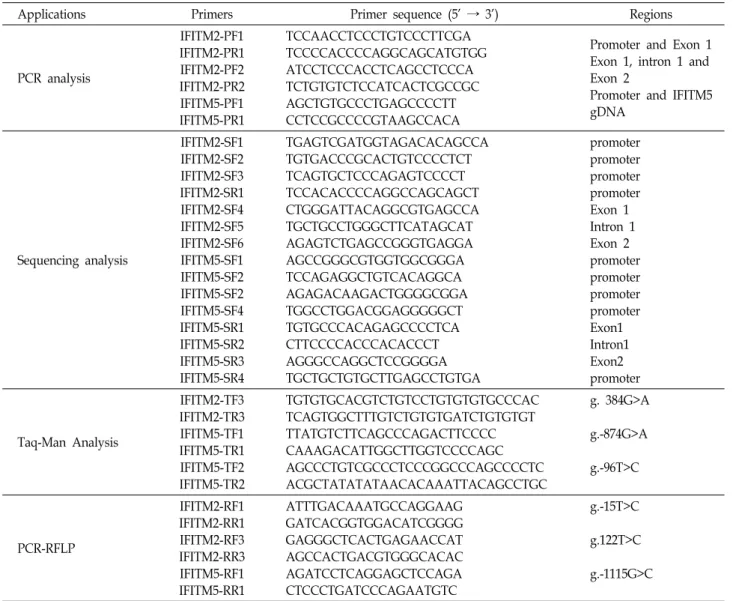
Purified PCR products were sequenced using the ABI Prism BigDye Terminator cycle sequencing system (PE Applied Biosystems, USA) on the ABI 3100 automatic sequencer (PE Applied Biosystem). Both sense and antisense strands of PCR products were directly sequenced using the same pri- mers used for the PCR amplification, and seven primers were additionally used to sequence the promoter and intron 1 region (Table 1). SNPs and variation sites of the IFITM2 and IFITM5 gene were detected by direct sequence analysis.
The reference sequence for the IFITM2 and IFITM5 gene was based on the sequence of human chromosome 11, clone RP13-317D12 and RP11-326C3, respectively.
Genotype analysis by Taq-Man probe
The assay reagents for g.384G>A (rs909097) in the IFITM2, and for g.-874G>A (rs7111803) and g.-96T>C (rs56069858) in the IFITM5 gene was designed by Applied Biosystems (Applied Biosystems, USA). The reagents consisted of a 40X mix of un-labeled PCR primer and TaqMan MGB probes were labeled with the FAM dye and the other with the fluo- rescent VIC dye [5]. The reaction in 10 μl was optimized to work with 0.125 μl 40x reagents, 5 μl 2x TaqMan Genotyping Master mix (Applied Biosystems, USA), and 2 μl (50 ng) of genomic DNA. The PCR conditions were as follows: one cycle at 95
oC for 15 min; 40 cycles at 95
oC for 15 s and 60
oC for 45 s. The PCR was performed in the ABI plus (Applied Biosystems, USA). The samples were read and analyzed using the software ABI plus (Applied Biosystems, USA).
Polymerase chain reaction-restriction fragment length polymorphism (PCR-RFLP) analysis
IFITM2 containing g.-15T>C (rs1058873) and g.122T>C
(rs14408), and IFITM5 containing g.-1115G>C (rs72636981)
polymorphic sites were partially amplified by PCR. The spe-
Table 1. Primer sequences used for PCR amplification, sequencing analysis, RT-PCR and genotyping in this study
Applications Primers Primer sequence (5' → 3') Regions
PCR analysis
IFITM2-PF1 IFITM2-PR1 IFITM2-PF2 IFITM2-PR2 IFITM5-PF1 IFITM5-PR1
TCCAACCTCCCTGTCCCTTCGA TCCCCACCCCAGGCAGCATGTGG ATCCTCCCACCTCAGCCTCCCA TCTGTGTCTCCATCACTCGCCGC AGCTGTGCCCTGAGCCCCTT CCTCCGCCCCGTAAGCCACA
Promoter and Exon 1 Exon 1, intron 1 and Exon 2
Promoter and IFITM5 gDNA
Sequencing analysis
IFITM2-SF1 IFITM2-SF2 IFITM2-SF3 IFITM2-SR1 IFITM2-SF4 IFITM2-SF5 IFITM2-SF6 IFITM5-SF1 IFITM5-SF2 IFITM5-SF2 IFITM5-SF4 IFITM5-SR1 IFITM5-SR2 IFITM5-SR3 IFITM5-SR4
TGAGTCGATGGTAGACACAGCCA TGTGACCCGCACTGTCCCCTCT TCAGTGCTCCCAGAGTCCCCT TCCACACCCCAGGCCAGCAGCT CTGGGATTACAGGCGTGAGCCA TGCTGCCTGGGCTTCATAGCAT AGAGTCTGAGCCGGGTGAGGA AGCCGGGCGTGGTGGCGGGA TCCAGAGGCTGTCACAGGCA AGAGACAAGACTGGGGCGGA TGGCCTGGACGGAGGGGGCT TGTGCCCACAGAGCCCCTCA CTTCCCCACCCACACCCT AGGGCCAGGCTCCGGGGA TGCTGCTGTGCTTGAGCCTGTGA
promoter promoter promoter promoter Exon 1 Intron 1 Exon 2 promoter promoter promoter promoter Exon1 Intron1 Exon2 promoter
Taq-Man Analysis
IFITM2-TF3 IFITM2-TR3 IFITM5-TF1 IFITM5-TR1 IFITM5-TF2 IFITM5-TR2
TGTGTGCACGTCTGTCCTGTGTGTGCCCAC TCAGTGGCTTTGTCTGTGTGATCTGTGTGT TTATGTCTTCAGCCCAGACTTCCCC CAAAGACATTGGCTTGGTCCCCAGC AGCCCTGTCGCCCTCCCGGCCCAGCCCCTC ACGCTATATATAACACAAATTACAGCCTGC
g. 384G>A
g.-874G>A
g.-96T>C
PCR-RFLP
IFITM2-RF1 IFITM2-RR1 IFITM2-RF3 IFITM2-RR3 IFITM5-RF1 IFITM5-RR1
ATTTGACAAATGCCAGGAAG GATCACGGTGGACATCGGGG GAGGGCTCACTGAGAACCAT AGCCACTGACGTGGGCACAC AGATCCTCAGGAGCTCCAGA CTCCCTGATCCCAGAATGTC
g.-15T>C
g.122T>C
g.-1115G>C
cific primer pairs were used for PCR amplification (Table 1). An initial polymerase chain reaction (PCR) denaturation step was performed at 95
oC for 5 min, followed by 30 cycles of denaturation at 98
oC for 10 s, annealing at the melting temperature of each primer pair for 20s and extension at 72
oC for 30 s, with a final 10 min extension at 72
oC. The PCR products for g.-15T>C was digested with 1 U of MboI (Takara, Japan), g.122T>C was digested with 1U of AatII (Takara, Japan), g.-1115G>C was digested with 1 U of BalI (Takara, Japan), for 16 h at 37
oC and then separated on 2%
agarose gel and visualized under UV with ethidium bromide. After restriction enzyme digestion, the PCR prod- ucts for g.-15T>C (240 bp), g.122T>C (441 bp), and g.-1115G>C (525 bp) took the form of two fragments, that is, 150 bp and 90 bp, 271 bp and 170 bp, and 372 bp and 153 bp, respectively.
Statistical analysis
UC patients and healthy control groups were compared using case-control association analysis. The χ
2test was used to estimate Hardy-Weinberg equilibrium (HWE). Allele fre- quency was defined as the percentage of individuals carry- ing the allele among the total number of individuals. Logistic regression analyses were used to calculate odds ratios (95%
confidence interval) for SNP sites. Linkage disequilibrium
(LD) analyses by pair-wise comparison of biallelic loci and
haplotype frequencies of the IFITM2 and IFITM5 gene for
multiple loci were estimated using the expectation max-
imization (EM) algorithm with SNPAlyze software
(DYNACOM, Japan). A P-value of less than 0.05 was consid-
ered an indication of statistical significance.
A
B
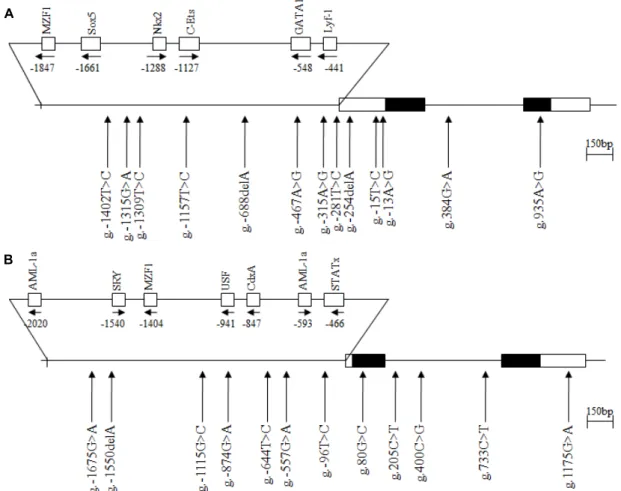
Fig. 1. The locations of each single nucleotide polymorphisms (SNPs) and variation sites in IFITM2 (A) and IFITM5 (B). Coding exons are marked by black blocks and 5′- and 3′-UTR by white blocks. The positions of SNPs were calculated from the translation start site. Putative transcription factor sites were searched at www.cbrc.jp/research/db/TFSEARCH.html. The reference sequence for IFITM2 and IFITM5 was based on the sequence of human chromosome 11, clone RP13-317D12 and RP11-326C3, respectively.
Results
To determine the possible variation sites, in the entire coding regions, and the boundary intron sequences of IFITM2 and IFITM5 that include about 2.2 kb of the pro- moter region, we scanned the genomic DNAs isolated from 24 unrelated UC patients and 24 healthy controls. We identi- fied eleven SNPs and two variation sites in IFITM2 by direct sequencing methods, g.-1402T>C (rs72867735), g.-1315G>A (rs11246061), g.-1309T>C (rs10751647), g.-1157T>C (rs3809112), g.-688delA (novel), g.-467A>G (rs2031090) and g.-281T>C (rs7480474) in the promoter region, g.-254delA (rs34498415), g-15T>C (rs1058873) and g.-13A>G (rs10398) in 5'UTR, g.384G>A (rs909097) in intron 1 and g.935A>G (rs1059091;
V212I) in exon 2 (Fig. 1). We also identified eleven SNPs and one variation sites in IFITM5, g.-1675G>A (rs146940957), g.-1550delA (novel), g.-1115G>C (rs72636981), g.-874G>A
(rs7111803), g.-644T>C (rs7105970), g.-557G>A (rs7112167) and g.-96T>C (rs56069858) in the promoter region, g.80G>C (rs57285449; G27A) in exon 1, g.205C>T (rs116899068), g.400C>G (rs4758636) and g.733C>T (rs2293745) in intron 1 and g.1175G>A (rs2293744) (Fig. 1). The LD coefficients (|
D′|) between all SNP pairs were calculated, and there was no absolute LD (|D′| = 1 and r
2= 1) among the SNPs of the IFITM2 or IFITM5 gene (data not shown). Among the identified polymorphisms, two SNPs (g.-15T>C and g.384 G>A) of IFITM2, and three SNPs (g.-1115G>C, g.-874G>A and g.-96T>C) of IFITM5 were selected for large sample gen- otyping analysis. A SNP, g.122T>C (rs14408) of IFITM2, was also selected from public database for genotype analysis.
Two SNPs, g.935A>G (V212I) of IFITM2, and g.80G>C (G27A) of IFITM5, were not analyzed because of it were dif- ficult to make the Taq-Man probe.
To find out whether the IFITM2 and IFITM5 SNPs are
Table 2 Genotype and allele analyses of the IFITM2 and IFITM5 gene polymorphisms in the UC patients and the healthy controls
Positiona Genotype
/allele Control n (%) UC n (%) Odds ratiob
(95% CI) Pc
IFITM2 g.-15T>C (rs1058873)
CC CT TT C T
263 (51.3) 217 (42.3) 33 (6.4) 743 (72.4) 283 (27.6)
62 (49.2) 57 (45.2) 7 (5.6) 181 (71.8) 71 (28.2)
1.00 1.11(0.75-1.67)
0.90(0.38-2.1) 1.00 1.03(0.76-1.40)
0.81
0.88
g.122T>C (rs14408)
CC CT TT C T
467 (91.6) 43 (8.4) 0 (0.0) 977 (95.8) 43 (4.2)
120 (95.2) 5 (4.0) 1 (0.8) 245 (97.2) 7 (2.8)
1.00 0.45(0.18-1.17)
- 1.00 0.65(0.29-1.46)
0.03
0.37
g.384G>A (rs909097)
GG GA AA G A
479 (91.8) 43 (8.2) 0 (0.0) 1001 (95.9) 43 (4.1)
113 (96.6) 4 (3.4) 0 (0.0) 230 (98.3) 4 (1.7)
1.00 0.39(0.14-1.12)
- 1.00 0.41(0.14-1.14)
0.07
0.08
IFITM5 g.-1115G>C (rs72636981)
GG GC CC G C
297 (58.3) 186 (36.5) 26 (5.1) 780 (76.6) 238 (23.4)
71 (56.3) 48 (38.1) 7 (5.6) 190 (75.4) 62 (24.6)
1.00 1.08(0.72-1.63) 1.13(0.47-2.70)
1.00 1.07(0.78-1.48)
0.92
0.68
g.-874G>A (rs7111803)
GG GA AA G A
190 (40.3) 221 (46.9) 60 (12.7) 601 (63.8) 341 (36.2)
47 (39.2) 57 (47.5) 16 (13.3) 151 (62.9) 89 (37.1)
1.00 1.04(0.68-1.61) 1.08(0.57-2.04)
1.00 1.04(0.77-1.39)
0.97
0.82
g.-96T>C (rs56069858)
TT TC CC T C
381 (71.6) 138 (25.9) 13 (2.4) 900 (84.6) 164 (15.4)
93 (78.2) 21 (17.6) 5 (4.2) 207 (87.0) 31 (13.0)
1.00 0.62(0.37-1.04) 1.58(0.55-4.53)
1.00 0.82(0.54-1.24)
0.11
0.42
aCalculated from the translation start site.
bLogistic regression analyses were used for calculating OR (95% CI; confidence interval).
cValue was determined by Fisher’s exact test or χ2 test from a 2×2 contingency table.
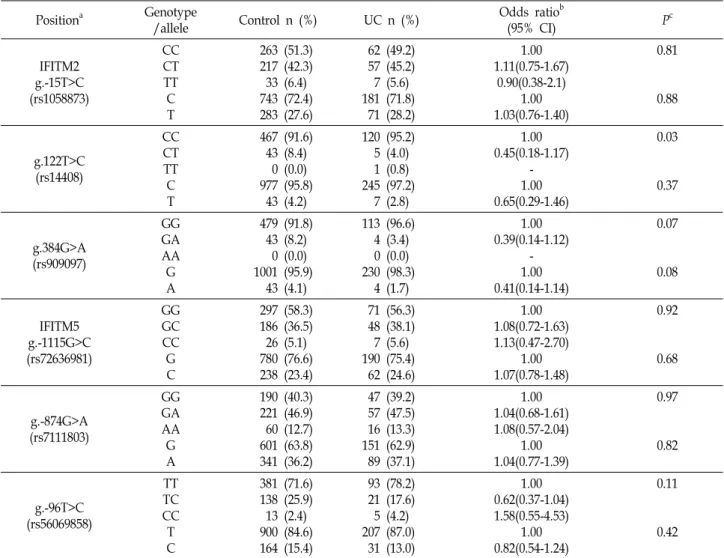
associated with UC susceptibility, the genotypes of the IFITM2 and IFITM5 polymorphisms were analyzed by the PCR-RFLP or TaqMan probe method, and the genotype and allelic frequencies between the groups were compared. The genotype and allelic frequencies of the IFITM2 and IFITM5 SNPs in the UC patient group were not significantly differ- ent from those of the healthy control group (Table 2). These results suggest that the IFITM2 and IFITM5 SNPs appear to be not associated with UC susceptibility.
To judge the possible correlation between the haplotypes associated with rs1058873, rs14408 and rs909097 of the IFITM2 gene and UC susceptibility, we further analyzed haplotype frequencies of the SNPs in the UC patients and the healthy controls (Table 3). However, there are no sig- nificant differences between the two groups. These results
suggest that the haplotype frequency of IFITM2 poly- morphisms might be not associated with UC susceptibility.
We also analyzed haplotype frequencies of the IFITM5 SNPs, rs72636981, rs7111803 and rs56069858, in the UC patients and the healthy controls (Table 4). Although, the distribution of the GGC haplotype frequency was significantly different between the healthy controls and the UC patients (P = 0.05), the major GGT, CAT and GAT haplotypes frequency were not significantly different between two groups (Table 4).
These results suggest that the haplotype frequency of IFITM5 polymorphisms might be not associated with UC susceptibility.
To evaluate whether the combined frequencies of IFITM1,
IFITM2 and IFITM5 SNPs are associated with UC suscepti-
bility, we analyzed the combined frequencies of rs77537847
Table 3 Haplotype frequencies between UC patients and healthy controls in IFITM2 SNPs
Haplotype Frequencya
Chi-square Pb
rs1058873 rs14408 rs909097 Control UC
C T
C C
G G
0.65 0.27
0.67 0.28
0.35 0.26
0.55 0.61
Others 0.08 0.05 - -
aValues were constructed by EM algorithm with genotyped SNPs.
bValues were analyzed by Chi-square.
Table 4. Haplotype frequencies between UC patients and healthy controls in IFITM5 SNPs
Haplotype Frequencya
Chi-square Pb
rs72636981 rs7111803 rs56069858 Control UC
G C G G
G A A G
T T T C
0.55 0.19 0.11 0.09
0.55 0.21 0.11 0.05
1.414E-5 0.24 1.725E-4
3.91
0.10 0.62 0.99 0.05
Others 0.10 0.08 - -
aValues were constructed by EM algorithm with genotyped SNPs.
bValues were analyzed by Chi-square.
Table 5. Combined genotype frequencies of IFITMs SNPs in UC patients and healthy controls
Combined genotypes Frequencya
Chi-square Pb
rs77537847 rs909097 rs56069858 Control UC
A G A
G G G
T T C
0.54 0.26 0.09
0.50 0.36 0.08
1.17 9.57 0.69
0.28 0.002
0.41
Others 0.11 0.06 - -
aValues were constructed by EM algorithm with genotyped SNPs.
bValues were analyzed by Chi-square.
of IFITM1, rs909097 of IFITM2 and rs56069858 of IFITM5 in the UC patients and the healthy controls (Table 5). Although, the distribution of the major combined genotype AGT fre- quency was not significantly different between the healthy controls and the UC patients, the GGT combined frequency in the healthy controls was significantly different from that in the UC patients (p=0.002). This result suggests that the combined genotypes of the IFITMs polymorphisms might be associated with a susceptibility to UC and could be useful genetic marker for UC.
Discussion
IBD is a chronic inflammatory disease of the gastro- intestinal tract [10]. CD and UC are the principal types of IBD, which fall into the class of autoimmune diseases.
Although great advances have been made in the manage-
ment of IBD with the introduction of immune-modulators and monoclonal antibodies, the precise etiology of IBD is unclear [1, 13]. However, IBD is thought to be the result of the interaction of environmental and genetic factors.
Multiple IBD susceptibility loci (referred to as IBD 1-9) have been implicated in genomic studies in human. The most ex- tensively studied genetic region, associated with IBD, among these loci is the IBD1 locus (16p13.1-16q12.2). The NOD2 gene, which has been widely shown to influence both the susceptibility and phenotype of patients with CD, is located at the IBD1 locus [3, 8, 18]. We previously reported that an exon 4 variation of the Tim-1 gene and the SNPs of the IL27, TNFRSF17 and EED genes were associated with UC in a Korean population [5, 6, 9, 19].
The human IFITM2 and IFITM5 gene, a member of the
IFITM family, consist of two exons and one intron. IFITM
proteins were first discovered in T98G neuroblastoma cells
that express the proteins in response to interferon stim- ulation [28]. We have previously identified 4 polymorphisms in the IFITM1 and 7 polymorphisms in IFITM3, and have suggested that the IFITM1 or IFITM3 polymorphisms are as- sociated with a susceptibility to UC [20, 25]. These results led us to determine whether or not the IFITM2 and IFITM5 SNPs are associated with susceptibility to UC in this study.
In this study, we identified a total of thirteen polymorphisms (eleven SNPs and two variations) in the IFITM2 gene and twelve polymorphisms (eleven SNPs and one variation) in IFITM5 gene (Fig. 1). However, the genotype and allele fre- quencies of IFITM2 SNPs as well as IFITM5 SNPs in UC patients were not significantly different from those of the healthy control group (Table 2). These results suggest that SNPs of IFITM2 and IFITM5 may be not associated with sus- ceptibility to UC. Although it is not clear how the IFITM1 and IFITM3 gene polymorphisms are related to the suscepti- bility of UC, our previous [20, 25] and this present study suggest that the IFITM gene family might be differently asso- ciated with the pathogenesis of UC.
We also analyzed haplotype frequencies using the IFITM2 and IFITM5 SNPs in the UC patients and the healthy con- trols (Table 3). However, there are no significant differences between the two groups. These results suggest that the hap- lotype frequency of IFITM2 and IFITM5 polymorphisms might be not associated with UC susceptibility. These results led us to evaluate whether the combined frequencies of IFITM1, IFITM2 and IFITM5 SNPs are associated with UC susceptibility. Therefore, we analyzed the combined fre- quencies of rs77537847 of IFITM1, rs909097 of IFITM2 and rs56069858 of IFITM5 in the UC patients and the healthy controls (Table 5). Although, the distribution of the major combined genotype AGT frequency was not significantly different between the healthy controls and the UC patients, the GGT combined frequency in the healthy controls was significantly different from that in the UC patients (Table 5). This result suggests that the combined genotype of the IFITMs polymorphisms might be associated with a suscepti- bility to UC and could be useful genetic marker for UC.
There are several limitations to our study. We did not check the expression levels of IFITMs in UC patients and did not show the clinical impact of IFITMs SNPs on UC.
Although there are several limitations, our results provide useful information for further functional studies of the IFITM gene family, and gastrointestinal disease such as col- orectal cancer and inflammatory responses.
Acknowlegements
The DNA samples used in this study were provided by the Biobank of Wonkwang University Hospital, a member of the National Biobank of Korea; this Biobank is supported by the Ministry of Health and Welfare. This research was supported by Wonkwang University in 2012.
References
1. Andreu, P., Colnot, S., Godard, C., Laurent-Puig, P., Lamar- que, D., Kahn, A., Perret, C. and Romagnolo, B. 2006.
Identification of the IFITM family as a new molecular mark- er in human colorectal tumors. Cancer Res. 66, 1949-1955.
2. Brass, A. L., Huang, I. C., Benita, Y., John, S. P., Krishnan, M. N., Feeley, E. M., Ryan, B. J., Weyer, J. L., van der Weyden, L., Fikrig, E., Adams, D. J., Xavier, R. J., Farzan, M. and Elledge, S. J. 2009. The IFITM proteins mediate cel- lular resistance to influenza A H1N1 virus, West Nile virus, and dengue virus. Cell 139, 1243-1254.
3. Blumberg, R. S., Saubermann, L. J. and Strober, W. 1999.
Animal models of mucosal inflammation and their relation to human inflammatory bowel disease. Curr. Opin. Immunol.
11, 648-656.
4. Chae, S. C., Song, J. H., Pounsambath, P., Yuan, H. Y., Lee, J. H., Kim, J. J., Lee, Y. C. and Chung, H. T. 2004. Molecular variations in Th1-specific cell surface gene Tim-3. Exp. Mol.
Med. 36, 274-278.
5. Chae, S. C., Yu, J. I., Oh, G. J., Choi, C. S., Choi, S. C., Yang, Y. S. and Yun, K. J. 2010. Identification of single nucleotide polymorphisms in the TNFRSF17 gene and their association with gastrointestinal disorders. Mol. Cells 29, 21-28.
6. Cho, T. J., Lee, K. E., Lee, S. K., Song, S. J., Kim, K. J., Jeon, D., Lee, G., Kim, H. N., Lee, H. R., Eom, H. H., Lee, Z.
H., Kim, O. H., Park, W. Y., Park, S. S., Ikegawa, S., Yoo, W. J., Choi, I. H. and Kim, J. W. 2012. A single recurrent mutation in the 5’-UTR of IFITM5 causes osteogenesis im- perfecta type V. Am. J. Hum. Genet. 91, 343-348.
7. Daniel-Carmi, V., Makovitzki-Avraham, E., Reuven, E. M., Goldstein, I., Zilkha, N., Rotter V., Tzehoval, E. and Eisenbach, L. 2009. The human 1-8D gene (IFITM2) is a nov- el p53 independent pro-apopototic gene. Int. J. Cancer. 125, 2810-2819.
8. Fiocchi, C. 1998. Inflammatory bowel disease: etiology and pathogenesis. Gastroenterology 115, 182-205.
9. Friedman, R. L., Manly, S. P., McMahon, M., Kerr, I. M.
and Stark, G. R. 1984. Transcriptional and posttranscrip- tional regulation of interferon-induced gene expression in human cells. Cell 38, 745-755.
10. Fuss, I. J., Neurath, M., Boirivant, M., Klein, J. S., de la Motte, C., Strong, S. A., Fiocchi, C. and Strober, W. 1996.
Disparate CD4+ lamina propria (LP) lymphokine secretion profiles in inflammatory bowel disease. Crohn's disease LP cells manifest increased secretion of IFN-gamma, whereas
ulcerative colitis LP cells manifest increased secretion of IL-5. J. Immunol. 157, 1261-1270.
11. Hampe. J., Cuthbert, A., Croucher, P. J., Mirza, M.M., Mascheretti, S., Fisher, S., Frenzel, H., King, K., Hasselmeyer, A., MacPherson, A. J., Bridge,r S., van Deventer, S., Forbes, A., Nikolaus, S., Lennard-Jones, J. E., Foelsch, U. R., Krawczak, M., Lewis, C., Schreiber, S. and Mathew, C. G.
2001. Association between insertion mutation in NOD2 gene and Crohn’s disease in German and British populations.
Lancet 357, 1925-1928.
12. Hanagata, N., Li, X., Morita, H., Takemura, T., Li, J. and Minowa, T. 2011. Characterization of the osteoblast‐specif- ic transmembrane protein IFITM5 and analysis of IFITM5‐
deficient mice. J. Bone Miner. Metab. 29, 279-290.
13. Huang, I. C., Bailey, C. C., Weyer, J. L., Radoshitzky, S. R., Becker, M. M., Chiang, J. J., Brass, A. L., Ahmed, A. A., Chi, X., Dong, L., Longobardi, L. E., Boltz, D., Kuhn, J. H., Elledge, S. J., Bavari, S., Denison, M. R., Choe, H. and Farzan, M. 2011. Distinct patterns of IFITM-mediated re- striction of filoviruses, SARS coronavirus, and influenza A virus. PLoS Pathog. 7, e1001258.
14. Hugot, J. P., Chamaillard, M., Zouali, H., Lesage, S., Cézard, J. P., Belaiche, J., Almer, S., Tysk, C., O'Morain, C. A., Gassull, M., Binder, V., Finkel, Y., Cortot, A., Modigliani, R., Laurent-Puig, P., Gower-Rousseau, C., Macry, J., Colom- bel, J. F., Sahbatou, M. and Thomas, G. 2001. Association of NOD2 leucinerich repeat variants with susceptibility to Crohn’s disease. Nature 411, 599-603.
15. Lange, U. C., Saitou, M., Western, P. S., Barton, S. C. and Surani, M. A. 2003. The fragilis interferon-inducible gene family of transmembrane proteins is associated with germ cell specification in mice. BMC Dev. Biol. 3, 1.
16. Lewin, A. R., Reid, L. E., McMahon, M., Stark, G. R. and Kerr, I. M. 1991. Molecular analysis of a human interfer- on-inducible gene family. Eur. J. Biochem. 199, 417-423.
17. Li, C. S., Zhang, Q., Lee, K. J., Cho, S. W., Lee, K. M., Hahm, K. B., Choi, S. C., Yun, K. J., Chung, H. T. and Chae, S.
C. 2009. Interleukin 27 polymorphisms are associated with inflammatory bowel diseases in a Korean population. J.
Gastroenterol. Hepatol. 24, 1692-1696.
18. Lu, J., Pan, Q., Rong, L., He, W., Liu, S. L. and Liang, C.
2011. The IFITM proteins inhibit HIV-1 infection. J. Virol.
85, 2126-2137.
19. Mo, J. S., Na, K. S., Yu, J. I. and Chae. S. C. 2013.
Identification of the polymorphisms in IFITM1 gene and their association in a Korean population with ulcerative
colitis. Immunol. Lett. 156, 118-22.
20. Ogura, Y., Bonen, D. K., Inohara, N., Nicolae, D. L., Chen, F. F., Ramos, R., Britton, H., Moran, T., Karaliuskas, R., Duerr, R. H., Achkar, J. P., Brant, S. R., Bayless, T. M., Kirschner, B. S., Hanauer, S. B., Nuñez, G. and Cho, J. H.
2001. A frameshift mutation in NOD2 associated with sus- ceptibility to Crohn’s disease. Nature 411, 603-606.
21. Park, Y. R., Choi, S. C., Lee, S. T., Kim, K. S., Chae, S. C.
and Chung, H. T. 2005. The association of eotaxin-2 and eotaxin-3 gene polymorphisms in a Korean population with ulcerative colitis. Exp. Mol. Med. 37, 553-558.
22. Plevy, S. E., Landers, C. J., Prehn, J., Carramanzana, N. M., Deem, R. L., Shealy, D. and Targan, S. R. 1997. A role for TNF-alpha and mucosal T helper-1 cytokines in the patho- genesis of Crohn's disease. J. Immunol. 159, 6276-6282.
23. Podolsky, D. K. 2002. Inflammatory bowel disease. N. Engl.
J. Med. 347, 417-429.
24. Sällman Almén, M., Bringeland, N., Fredriksson, R. and Schiöth, H. B. 2012. The dispanins: a novel gene family of ancient origin that contains 14 human members. PLoS ONE 7, e31961
25. Semler, O., Garbes, L., Keupp, K., Swan, D., Zimmermann, K., Becker, J., Iden, S., Wirth, B., Eysel, P., Koerber, F., Schoenau, E., Bohlander, S. K., Wollnik, B. and Netzer, C.
2012. A mutation in the 5-UTR of IFITM5 creates an in-frame start codon and causes autosomal-dominant osteo- genesis imperfect type V with hyperplastic callus. Am. J.
Hum. Genet. 91, 349-357.
26. Seo, G. S., Lee, J. K., Yu, J. I., Yun, K. J., Chae, S. C. and Choi, S. C. 2010. Identification of the polymorphisms in IFITM3 gene and their association in a Korean population with ulcerative colitis. Exp. Mol. Med. 42, 99-104.
27. Targan, S. R., Deem, R. L., Liu, M., Wang, S. and Nel, A.
1995. Definition of a lamina propria T cell responsive state.
Enhanced cytokine responsiveness of T cells stimulated through the CD2 pathway. J. Immunol. 154, 664-675.
28. Yang, Y., Lee, J. H., Kim, K. Y., Song, H. K., Kim, J. K., Yoon, S. R., Cho, D., Song, K. S., Lee ,Y. H. and Choi, I.
2005. The interferon-inducible 9-27 gene modulates the sus- ceptibility to natural killer cells and the invasiveness of gas- tric cancer cells. Cancer Lett. 221, 191-200.
29. Yu, J. I., Kang, I. H., Seo, G. S., Choi, S. C., Yun, K. J. and Chae, S. C. 2012. Promoter polymorphism of the EED gene is associated with the susceptibility to ulcerative colitis. Dig.
Dis. Sci. 57, 1537-1543.