직접메탄올 연료전지의 운전 조건이 성능에 미치는 영향
한창화*, 김남훈*, 이중희*,**,***†
*전북대학교 수소·연료전지 특성화대학원, **전북대학교 고분자나노공학과, ***전북대학교 BIN융합공학과
Effects of the Operating Conditions on the Performance of Direct Methanol Fuel Cells
CHANGHWA HAN*, NAMHOON KIM*, JOONGHEE LEE*,**,***†
*Dept. of Hydrogen and Fuel Cell Engineering, Chonbuk National University, 567 Baekje-daero, Deokjin-gu, Jeonju, Jeonbuk, 561-756, Korea
*BIN Fusion Research Team, Dept. of Polymer & Nano Engineering, Chonbuk National University, 567 Baekje-daero, Deokjin-gu, Jeonju, Jeonbuk, 561-756, Korea
*Dept. of BIN Fusion Technology, Chonbuk National University, 567 Baekje-daero, Deokjin-gu, Jeonju, Jeonbuk, 561-756, Korea
ABSTRACT
This study examines the effects of the ambient temperature (AT), methanol feeding temperature (MFT), methanol concentration (MC) and methanol flow rate (MFR) on the performance and cell temperature (CT) of a 5-stacked direct methanol fuel cell (DMFC). The AT, MFT, MC, and MFR are varied from -10°C to +40°C, 50°C to 90°C, 0.5M to 3.0M and 11.7 mL min-1 to 46.8 mL min-1, respectively. The performance of the DMFC under various operating conditions is analyzed from the I-V polarization curve, and the methanol crossover is estimated by gas chromatography (GC). The performance of the DMFC improves significantly with increasing AT. The open circuit voltage (OCV) decreases with increasing MC due to the enhanced likelihood of methanol crossover. The cell performance is improved significantly when the MFR is increased from 11.7 mL min-1 to 28.08 mL min-1. The change in cell performance is marginal with further increases in MFR. The CT increases significantly with increasing AT. The effect of the MFT and MFR is moderate, and the effect of MC is marginal on the CT of the DMFC.
KEY WORDS : Direct methanol(직접 메탄올), Optimization(최적화), Methanol flow rate(메탄올 유량), Methanol crossover(메탄올 크로스오버), Open circuit voltage(개로전압)
†Corresponding author : [email protected]
[ 접수일 : 2011.5.30 수정일 : 2011.6.13 게재확정일 : 2011.6.20 ]
1. Introduction
Direct methanol fuel cells (DMFCs) are strong
candidates for portable electric devices for auto- mobile and stationary applications. Methanol is used as the fuel in DEMFCs, which has several advantages, such as no requirement of any fuel reforming equipment, can be operated at low tem-
peratures, easily handled and stored conveniently1). However, the use of methanol has disadvantages, such as a low efficiency, low power density, carbon monoxide (CO) poisoning of the catalyst, slow electrochemical kinetics at the anode, methanol crossover through membrane etc.2). Therefore, many studies were carried out on the effect of the different operating conditions on the performance of DMFCs.
The performance of DMFCs depends on the different operating conditions, such as the cell temperature, methanol concentration, and methanol flow rates3). The cell temperature has the most pronounced effect on the performance of DMFCs because the electrical energy in these cells is generated by an electrochemical reaction, which is temperature dependant. Therefore, most research in this area has been carried out by varying the cell temperature4). The methanol concentration on the anode side has also a decisive effect on the performance of DMFCs.
Therefore, extensive studies on the effect of the methanol concentration on the performance of DMFCs have been carried out5).
Surampidi et al.6) reported the effect of the cell temperature and methanol concentration on the performance of DMFCs. The performance was measured at 30, 60, 90°C, respectively, and a marked increase in performance with increasing temperature was reported. The methanol concent- ration was varied from 0.5 to 4.0M and the maximum performance was obtained with a methanol con- centration of 2.0M. Jung et al.7) reported the effect of the operating temperature (60-120°C) and methanol concentration (0.5-4.0M) on the performance of a single DMFC. The cell performance increased with increasing temperature and the optimum methanol concentration was 2.5M. Nakagawa and Xiu8) reported the effect of the operating temperature (30-100°C) and flow rate of oxidant gas (air and oxygen, respectively) on the performance of a liquid-feed
DMFC. Although the cell voltage of DMFCs increases with increasing operating temperature and oxygen flow rate9), the tendency for methanol crossover was also increased10).
Generally, in active DMFCs, the cell temperature at the open circuit voltage (OCV) increases appro- ximately from 25 to 60ºC when the stack operates at room temperature due to methanol crossover and direct oxidation at the cathode11). For each mole of methanol diffusing through the membrane, 726 kJ of energy is released during cathodic com- bustion12). The ambient temperature affects the cell temperature, which in turn affects the power output13).
Therefore, the effect of the different operating conditions including the ambient temperature was investigated to determine the optimal operation conditions.
In DMFCs, the use of a high methanol concent- ration leads to high methanol permeation. Methanol permeation not only reduces the mass efficiency but is also responsible for the formation of a mixed potential at the cathode, which reduces the cell voltage and cell efficiency 14). In addition, the cell membrane deteriorates in presence of high methanol concentrations (>2.5M). Too low methanol concentration prevents methanol losses and mixed potential, but increases the anodic diffusion overvoltage15). Therefore, the methanol concentration while feeding the cell needs to be optimized.
2. Experiment
A 5-stacked DMFC was prepared using a com- mercial membrane electrode assembly (MEA) (Johnson
& Matthy). The MEA consists of a Nafion® 115 membrane with a catalyst loaded gas diffusion layer (GDL) (Toray, TGP-H-060) attached to both sides of the membrane. The anode and cathode
Fig. 1 Photograph of the direct methanol fuel cell composed of five stacks
Fig. 2 Schematic diagram of the experimental apparatus
Table 1 Variables range and constant values of operating conditions
Operating conditions Variable range
Constant values Ambient temperature (°C) -10 to +40 30 Methanol feeding temperature (°C) +50 to +90 70 Methanol concentration (M) 0.5 to 2.0 1.0 Methanol flow rate (mL min-1) 11.7 to 46.8 11.7
side contains a Pt-Ru catalyst (loading 4 mg/cm2) and Pt catalyst (loading 2 mg/cm2), respectively.
Each cell had an active area of 10 x 10 cm2. The stack was assembled using gold-coated copper plates as current collectors. The assembled stack is shown in Fig. 1.
A Temperature and Climate Test Chamber (C4-180, WEISS Inc.) was used to maintain a constant ambient temperature around the stack. After the stack was placed into the chamber, all experi- ments were performed at a fixed ambient temperature without humidity.
A schematic diagram of the experimental apparatus is presented in Fig. 2.
A DMFC system consists mainly of fuel cell stacks, anode feed loop with a heat exchanger and
a compressor/expander unit. The heat taken from the anode feed loop affects the temperature gradient and power gradient in the stack16). Therefore, a heat bath was placed outside of the chamber to realize the anode feed loop. A heat insulator was wrapped on the vent line connecting the cathode vent to prevent the freezing of water (at sub-zero temperatures). After completing the experimental set, the performance was measured using a test station (P&P Energy Tec, South Korea).
3. Results and discussion
The variable range and constant values of the operating conditions are listed in Table 1. The effect of four operating conditions, namely the ambient temperature, methanol feeding tem- perature, methanol concentration and methanol flow rate, on the performance of a 5 stacked direct methanol fuel cells (DMFCs) was studied. When one operating condition was varied, the other con- ditions were kept constant. The membrane (Nafion®
115) used for this study showed the best perfor- mance around 70∼80°C. Therefore, the feeding temperature was maintained from 50℃ to 90℃.
3.1 Effect of operating conditions 3.1.1 Ambient temperature
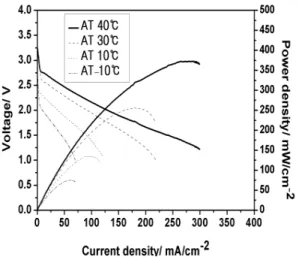
The effect of ambient temperatures(AT) on the performance of DMFC was evaluated by varying
Fig. 3 Performance (voltage and power density) of a 5-stacked DMFC at different ambient temperatures
Fig. 4 Performance (voltage and power density) of a 5-stacked DMFC at different methanol feeding temperatures
Fig. 5 Performance (voltage and power density) of a 5-stacked DMFC at different methanol concentrations
the ambient temperature from -10 to +40°C keeping the other operating conditions constant (MFT=70°C, MC=1.0 M, MFR=11.7 mL/min), as shown in Fig. 3.
With decreasing ambient temperature, the cell voltage and power density decreased simul- taneously. This is due to the activation loss, which led to low kinetics on the catalyst layer by de- creasing the ambient temperature. This suggests that the ambient temperature plays a major role in the performance of DMFCs. The power output of the DMFC increased with increasing ambient temperature.
3.1.2 Methanol feeding temperature The performance of the 5-stacked DMFC at different methanol feeding temperatures(MFT) (50 to 90°C) with the other operating conditions kept constant (AT=30°C, MC=1.0M, MFR=11.7 mL/min) is shown in Fig. 4. The cell voltage and stack power increased with gradual increases in the methanol feeding temperature from 50 to 90°C.
This was expected because a high feeding
temperature of methanol would result in rapid kinetics on the catalyst layer and improved DMFC performance. Therefore, the performance of a DMFC can also be controlled by controlling the feeding temperature of the methanol.
3.1.3 Methanol concentration
The effect of the methanol concentration (MC) (0.5 to 3.0 M) on the performance of the 5-stacked
Fig. 6 Performance (voltage and power density) of a 5-stacked DMFC at different methanol flow rates
Fig. 7 Effects of the operating conditions on the cell temperature (CT) of a 5-stacked DMFC
DMFC with the other operating conditions kept constant (AT = 30°C, MFT = 70°C, MFR= 11.7 mL/min) is shown in Fig. 5.
The OCV decreased with increasing methanol concentration due to the mixed potential caused by methanol crossover and CO poisoning of the catalyst17). The cell voltage and stack power was highest with 2.0 M methanol. On the other hand, with 0.5 M methanol, the cell voltage and stack power decreased at a lower current density than those at higher methanol concentrations (1.0 M and 2.0 M) due to methanol starvation.
3.1.4 Methanol flow rate
The performance of the 5-stacked DMFCs at different methanol flow rates (MFR) (11.7 to 56.16 mL/min) with the other operating conditions kept constant (AT= 30°C, MFT= 70°C, MC=1.0 M) is presented in Fig. 6. The cell voltage and power density was low when the methanol flow rate was very low (11.7 mL/min). On the other hand, the cell voltage and power density were increased sub- stantially when the methanol flow rate was increased
to 46.8 mL/min. However, the change in cell voltage and power density was marginal with further increases in methanol flow rate. This suggests that a particular flow methanol rate (in this case 46.8 mL/min) is needed to obtain the maximum performance.
3.2 Cell temperature of DMFC
The performance (voltage and power output) of a DMFC can be improved by increasing the cell temperature. The cell temperature (CT) of a DMFC can be controlled directly. However, different operating conditions, such as the ambient temperature, methanol feeding temperature, methanol concentration and methanol flow rate also affect the cell temperature, which in turn affect the performance. Thus far, there are no reports of the effect of these operating conditions on the cell temperature of a DMFC. In this study, the cell temperature under different operating conditions was measured, as shown in Fig. 7. The cell tem- perature increased almost linearly with increasing magnitude of each operating condition, even though
the rate of the increase differed according to the operating conditions. The cell temperature increased significantly with increasing ambient temperature.
The effect of the methanol feeding temperature and methanol flow rate on the cell temperature of the DMFC was moderate, whereas the effect of the methanol concentration was marginal. The increase in cell temperature with increasing environ- mental temperature and methanol feeding temperature is understandable. When the methanol flow rate is increased, the mass transport loss and heat dissi- pation by methanol is reduced, leading to an increase in cell temperature. These results suggest that the operating conditions affect the performance of the DMFCs. Moreover, all these conditions should be considered when determining the required per- formance.
3.3 Methanol crossover
The level of methanol crossover in an assembled DMFC is most commonly determined by monitoring the CO2 content in the cathode exhaust gas flux.
The CO2 level in the cathode exhaust gas flux was determined by gas chromatography (GC, Agilent Technologies)18).
The CO2 concentration at the cathode with 0.5, 1.0 and 2.0 M methanol was 1396, 4220 and 9650 ppm, respectively. This indicates that the methanol crossover increases with increasing methanol con- centration. In addition, the open circuit voltage (OCV) also decreased with increasing methanol concentration (Fig. 5). This is due to the tendency for an increase in methanol crossover with increasing methanol concentration.
4. Conclusions
This study examined the effect of the different operating conditions, such as ambient tem-
peratures (AT, -10°C to +40°C), methanol feeding temperatures (MFT, 50°C to 90°C), methanol con- centrations (MC, 0.5 M to 3.0 M), and methanol flow rates (MFR, 11.7 mL min-1 to 56.16 mL/min) on the performance of a 5-stacked direct methanol fuel cell (DMFC).
The performance of the DMFC increased signi- ficantly with increasing AT. There was an increase in cell voltage and stack power when the MFT was increased from 50 to 90°C. The open circuit voltage (OCV) decreased with increasing methanol concentration due to the increased methanol cross- over tendency. However, at lower methanol con- centrations (0.5M), the cell voltage and stack power decreased at a lower current density than those at higher methanol concentrations (1.0 M and 2.0 M).
The cell voltage and stack power was also low when the methanol flow rate was quite low (11.7 mL/min). Both the cell voltage and stack power increased with increasing methanol flow rate to 46.8 mL/min. However, the change in cell voltage and stack power was marginal with further increases in methanol flow rate. The cell temperature increased significantly with increasing ambient temperature. The effect of the methanol feeding temperature and methanol flow rate was moderate, whereas the effect of the methanol concentration on the cell temperature of the DMFC was marginal.
Acknowledgements
This study was supported by the Human Resource Training Project for Regional Innovation through the National Research Foundation funded by the Ministry of Education, Science and Technology of Korea.
References
1) C. C. Yang, S. J. Chiu, C. T. Lin, “Electro-
chemical performance of an air-breathing direct methanol fuel cell using poly (vinyl alcohol)/
hydroxyapatite composite polymer membrane”, J. Power Sources, Vol. 177, No. 1, 2008, pp.
40-49.
2) S. Eccarius, B. L. Garcia, C. Hebling, J. W.
Weidner, “Experimental validation of a methanol crossover model in DMFC applications”, J. Power Sources, Vol. 179, No. 2, 2008, pp. 723-733.
3) H. S. Lee, B. C. Bae, J. Y. Lee, S. A. Hong, H. Y. Ha, “Analysis of Long-term Stability of Direct Methanol Fuel Cell and Investigation of the Methods to Improve its Performance”, Trans.
of the Korea Hydrogen and New Energy Society, Vol. 16, No. 1, 2005, pp. 31-39.
4) S. V. Andrian, J. Meusinger, “Process analysis of a liquid-feed direct methanol fuel cell system”, J. Power Sources, Vol. 91, No. 2, 2000, pp.
193-201.
5) B. Gurau, E. S. Smotkin, “Methanol crossover in direct methanol fuel cells: a link between power and energy density”, J. Power Sources, Vol. 112, No. 2, 2002, pp. 339-352.
6) S. Surampidi, S. R. Narayanan, E. Vamos, H.
Frank, G. Halpert, A. LaConti, J. Kosek, G. K.
Surya Prakash, G. A. Olah, “Advances in direct oxidation methanol fuel cells”, J. Power Sources, Vol. 47, No. 3, 1994, pp. 377-385.
7) D. H. Jung, C. H. Lee, C. S. Kim, D. R. Shin,
“Performance of a direct methanol polymer electrolyte fuel cell”, J. Power Sources, Vol.
71, No. 1-2, 1998, pp. 169-173.
8) N. Nakagawa, Y. Xiu, “Performance of a direct methanol fuel cell operated at atmospheric pressure”, J. Power Sources, Vol. 118, No. 1-2, 2003, pp.
248-255.
9) T. I. Valdez, S. R. Narayanan, “Recent studies on methanol crossover in liquid-feed direct methanol fuel cells,” 194th meeting of the electrochemical society, Boston, Nov. 1998.
10) X. Ren, M. S. Wilson, S. Gottesfeld, “On direct and indirect methanol fuel cells for transportation applications,” Electrochem. Soc. Proc., Vol. 95, No. 23, 1995, pp. 252.
11) A. Oedegaad, C. Hentschel, “Characterisation of a portable DMFC stack and a methanol-feeding concept”, J. Power Sources, Vol. 158, No. 1, 2006, pp.177-187.
12) W. Vielstich, “Handbook of Fuel Cells”, Vol.
1, John Wiley and Sons Ltd., Chichester, United Kingdom, 2003, Chapter 4.
13) R. Jiang, C. Rong, D. Chu, “Determination of energy efficiency for a direct methanol fuel cell stack by a fuel circulation method”, J. Power Sources, Vol. 126, No. 1, 2004, pp. 119-124.
14) K. Scott, W. M. Taama, P. Argyropoulos, K.
Sundmacher, “The impact of mass transport and methanol crossover on the direct methanol fuel cell”, J. Power Sources, Vol. 83, No. 1-2, 1999, pp. 204-216.
15) M. K. Ravikumar, A. K. Shukla, “Effect of methanol crossover in a liquid-feed polymer -electrolyte direct methanol fuel cell,” J. Electro- chem. Soc., Vol.143, No. 8, 1996, pp. 2601-2606.
16) H. Dohle, J. Merge, D. Stolten, “Heat and power management of a direct- methanol- fuel-cell (DMFC) system”, J. Power Sources, Vol. 111, No. 2, 2002, pp. 268-282.
17) K. Scott, W. M. Taama, P. Argyropoulos, K.
Sundmacher, “The impact of mass transport and methanol crossover on the direct methanol fuel cell”, J. Power Sources, Vol. 83, No. 1-2, 1999, pp. 204-216.
18) T. Schaffer, V. Hacker, T. Hejze, T. Tschinder, J. O. Besenhard, P. Prenninger, “Introduction of an improved gas chromatographic analysis and comparison of methods to determine methanol crossover in DMFCs”, J. Power Sources, Vol.
145, No. 2, 2005, pp. 188-198.