Reproductive Performance according to Ovarian Status, Postpartum Uterine Treatment, and Calving Season in Estrus Synchronized Dairy Cows
Hyun-Gu Kang
*, Ill-Hwa Kim and Woo-jae Choi
Veterinary Medical Center, Chungbuk National University, Cheongju 361-763, Korea
ABSTRACT
A study on estrus synchronized dairy cows using progesterone intravaginal device was done to classify each cow’s reproductive status from calving to synchronization and to evaluate the reproductive performance according to ovarian and uterine status, and calving season. From calving to estrus synchronization, silent heat or error of estrus detection among ovarian status and endometritis among uterine disorders were exposed in the most distribution (75.4% and 48.3%, respectively). The pregnancy rate of cows with inactive ovaries was lower than those in the follicular and luteal phase. And according to the uterine status before estrus synchronization, the pregnancy rate was similar in three groups; normal, endometritis, and pyometra (70.9, 69.1 and 100%, respectively). The interval from calving to concep- tion was shorter (p<0.05) in cows calved during autumn than in cows calved during spring and winter.
(Key words : estrus synchronization, CIDR, calving season, pregnancy rate, ovarian and uterine status)
†
This work was supported by the research grant of the Chungbuk National University in 2011.
*
Correspondence : E-mail : [email protected]
INTRODUCTION
Dairy cow is economic animal, and its productive and repro- ductive performance is very important in order to maximize the income of the dairy farm. The factors affecting in produc- tivity include the increased calving interval, abortion, dystocia and metabolic disorder. Ideal calving interval for high repro- ductive performance of dairy cows is 365 days (Houghton et al., 2000; Asimwe and Kifaro, 2007). The female beef cattle should be pregnant within 80~85 days to have 12-month calving interval.
An increased calving to conception interval is correlated with a few factors, including the late involution of uterus (Short et al., 1990), inadequate nutrition (Spitzer et al., 1995; Morrison et al., 1999; Moreira et al., 2000; Wettemann et al., 2003), short estrous cycle (Short et al., 1990), calving season (Asimwe and Kifaro, 2007; Gebeyehu et al., 2007; Ansari-Lari and Abbasi, 2008), poor estrus detection (Son et al., 2001; Melendez et al., 2008), parity (Asimwe and Kifaro, 2007; Walsh et al., 2007; Kim et al., 2009), and high incidence of silent heat or subestrus (Kang et al., 1995). Causes of prolonged open days were hou- sing management as error of estrus detection (Melendez et al., 2008), ovarian disorders as ovarian cysts, and uterine disorders as uterine involution, endometritis, and pyometra (Short et al., 1990; Deutscher et al., 1991).
Rapid progress in genetics and management in the dairy industry has resulted in increased milk production per cow (Sakaguchi, 2011). Metabolic demands for more milk produc- tion negatively impact the reproductive function of postpartum cows (Beam and Butler, 1999). The exact detection of estrus is essential component of postpartum breeding programs that depend on overt signs of estrus for optimal timing of inse- mination (Alnimer et al., 2009; Roelofs et al., 2010). Con- sequently, postpartum dairy cow has a short estrus behavior, deferred commencement of ovulation and estrus expression, declined estrus detection, reduced pregnancy rate, and also in- creased postpartum anestrus and subestrus cow (Honparkhe et al., 2008). The inefficiency in estrus detection can increase the average interval between successive insemination to limits both reproductive efficiency and profitability. Timed artificial insemination (TAI) has been advised to overcome the problem of inefficiency estrus detection (Pursley et al., 1995; Martinez et al., 2001; Kim et al., 2005; Alnimer et al., 2009).
Loyacano et al. (1974) demonstrated that the cows calved
during the winter had higher conception rates than the cows
calved during the summer, even though the body weight loss
in the winter was larger than in the summer. Kim et al. (2009)
reported that interval from calving to conception in summer
was the shortest in four seasons in Korean Native cows. Me-
lendez et al. (2008) reported that conception risk within season
was lower during summer within the third period than during the rest of the seasons. The negative effect of heat stress on conception in dairy cattle, especially from the day of service to 6 d after breeding, is well established (Wolfenson et al., 2000; Morton et al., 2007).
This study was carried out to evaluate the subsequent repro- ductive performance according to ovarian status at controlled internal drug releasing (CIDR) administration, history of ute- rine treatment, and calving season in postpartum estrus synchro- nized dairy cows, using data collected over a period of 5 years.
MATERIALS AND METHODS
1. Experimental Animals
This study was performed from February 2006 through to April 2010 at two dairy farms located in Chungbuk province, Korea. The lactating cows were maintained in free-stall faci- lities, fed a total mixed ratio and milked twice daily. Cow were observed for the estrus condition twice daily. One hundred four- teen lactating Holstein-Friesian cows were selected as postpar- tum and postinsemination subestrus dairy cows for this study.
Postpartum and postinsemination subestrus dairy cows were defined as cows were not detected estrus postinsemination or during above 60 days postpartum. All experiments were per- formed with the approval of the Animal Ethics Committee at the College of Veterinary Medicine, Chungbuk National Uni- versity (Cheongju, Chungbuk, Korea).
2. Estrus Synchronization
All selected postpartum dairy cows were synchronized as described in modified CIDR-based TAI protocol (Kim et al., 2007). Briefly, treatment consisted of insertion of a CIDR de- vice containing 1.9 g progesterone (CIDR
TMInterAg, Hamil- ton, New Zealand) with injection of 250 μg gonadorelin (GnRH;
Fertagyl, Intervet, Holland) or 2 mg estradiol benzoate (EB) (SY Esrone; Samyang, Seoul, Korea; Day 0), injection of 5 mg PGF
2α(Lutalyse
ⓇUpjeon, USA) and removal of the device on Day 7, injection of 250 μg GnRH or 2 mg EB on Day 9, and TAI 17 h later. All hormone injection were intramuscu- larly administered. Pregnancy diagnosis was determined at 30 to 60 days after TAI using both ultrasonography and rectal palpation. Pregnancy rate per TAI was defined as the percen- tage of cows confirmed to be pregnant in a single pregnancy diagnosis after one TAI.
3. Examination of Reproductive Tract
The animal’s reproductive tract were examined by rectal pal- pation and transrectal ultrasonography (Sonoace 600 with a 7.5 MHz linear array transducer; Medison, Seoul, Korea). The ova- rian status was classified into luteal or follicular phase, and inactive ovaries based on ovarian structures (corpus luteum, follicle, cysts, cystic wall thickness) by rectal palpation and ultrasonography. The cows with uterine disorders were treated by infusion of 100~150 ml povidone-iodine or injection of 5 mg PGF
2α. before CIDR administration. The uterine status was classified into endometritis and pyometra based on echoge- nicity of the uterine cavity.
4. Statistical Analysis
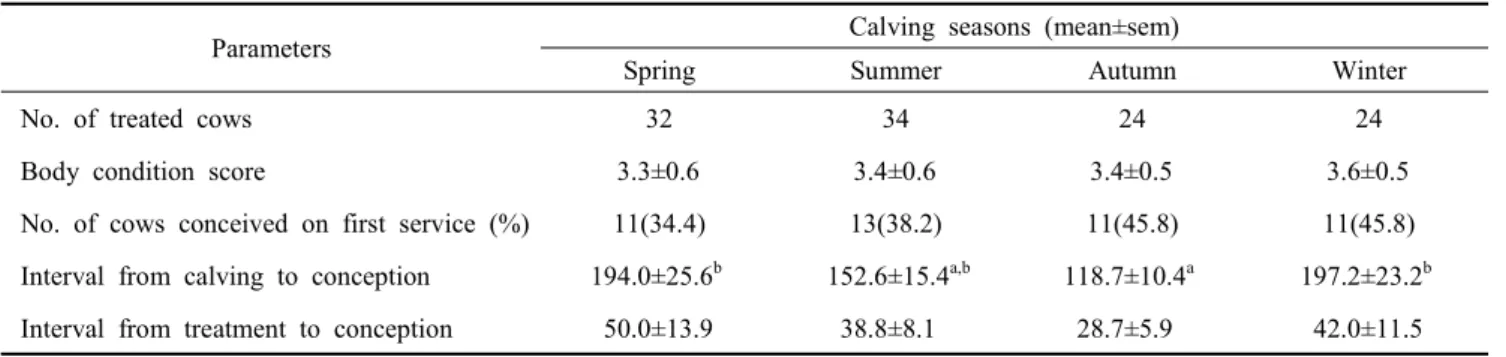
The reproductive performance items: number of conceived cows on first service, days from estrus synchronization to con- ception, and interval from treatment to conception. The research items of this study: ovarian and uterine status and calving sea- sons. SPSS ver.12.0 was used for statistics analysis of these data. The ANOVA was performed for the analysis between calving seasons and 1) interval from calving to conception, 2) interval from treatment to conception, 3) number of cows con- ceived on first services. The reproductive performance accor- ding to ovarian, and uterine status before CIDR application were analysed using the chi-square. A probability level of p<
0.05 was considered significant.
RESULTS
1 Incidence of Reproductive Disorders
The incidence of reproductive disorders according to the ova- rian status examined by rectal palpation and ultrasonography in 114 synchronized dairy cows was 86 (75.4%) in silent heat or error of estrus detection, 16 (14.0%) in inactive ovaries, 3 (2.6%) in persistent corpus luteum, 8 (7.0%) in follicular cysts and 3 (2.6%) in luteal cyst (Table 1). The incidence of uterine disorders was 55 (48.3%) in endometritis and 4 (3.5%) in pyo- metra (Table 2).
2. Reproductive Performance according to Ovarian Status
The conception rate according to the ovarian status at estrus
synchronization was shown in Fig. 1. The conception rate was
40.5 % (34/84 cows) on luteal phase, and was 42.1% (8/19
cows) on follicular phase. The cows with inactive ovaries had
tendencies that conception rate was low as 36.4% (4/11 cows).
Table 1. Incidence of reproductive disorders according to the ova- rian status in 114 synchronized dairy cows
Parameter No. of cows Percentage
Silent heat or EED
*86 75.4
Inactive ovaries 16 14.0
Persistent corpus luteum 3 2.6
Follicular cyst 8 7.0
Luteal cyst 1 0.1
Total 114 100.0
*