Identification of a High-yield Technique for Isolating Endometrial Epithelial Cells from the Mouse Uterus :
A Comparison of Mechanical and Sedimentation-adherence Methods
Jie Ohn Sohn
1,2, Yoon Mi Jo
1, Hye Jin Park
3, Ji Yeon Ahn
2, Hyun Jin Song
1, Jeong Mook Lim
2,4,†and Seung Tae Lee
3,5,†1
Fertility Medical Center, Seoul Women’s Hospital, Bucheon 420-864, Korea
2
Dept. of Agricultural Biotechnology, Seoul National University, Seoul 151-921, Korea
3
Dept. of Animal Life Science, Kangwon National University, Chuncheon 200-701, Korea
4
Stem Cell and Bioevaluation, WCU Biomodulation Program, Seoul National University, Seoul 151-921, Korea
5
Division of Applied Animal Science, Kangwon National University, Chuncheon 200-701, Korea
ABSTRACT
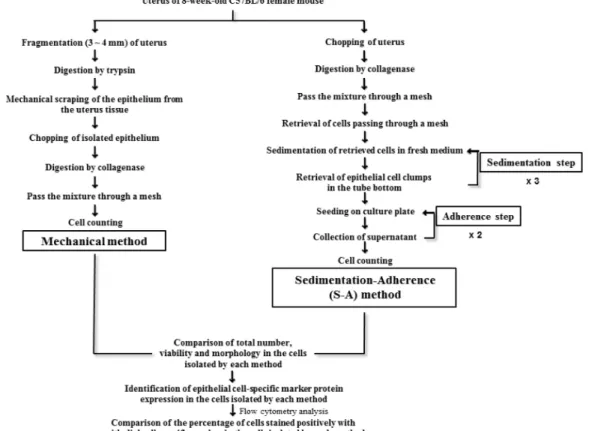
An in vitro assay following culture of endometrial epithelial cells is essential for understanding epithelial cell function in reproduction. Several diverse techniques have been developed for isolating endometrial epithelial cells, although an optimal technique has not been identified. In this study, we describe a sedimentation-adherence (S-A) isolation technique with a high-yield cell-separating ability to isolate endometrial epithelial cells from 8-week-old female C57BL/6 mice. We analyzed total cell number, viability, morphology, and expression of cytokeratin 18 as an endometrial epithelial cell-specific marker in cells isolated using a mechanical method compared to the S-A technique.
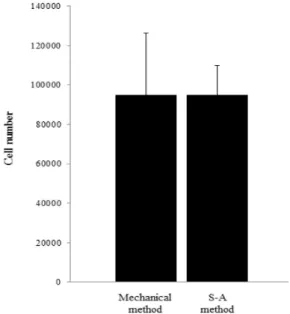
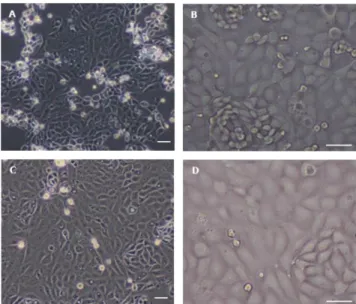
There were no significant differences in the total number, viability, or morphology of the putative endometrial epithelial cells with either method. In contrast, significantly more endometrial epithelial cells harvested using the S-A method were positively stained for cytokeratin 18 than those isolated using the mechanical method. These results confirm that the S-A method is more efficient for retrieving endometrial epithelial cells than a mechanical method.
(Key words : mouse, sedimentation-adherence method, isolation, endometrial epithelial cells, uterus)
This research was supported by a grant of the Korea Health Technology R&D Project (HI12C1404(A121515)), Ministry of Health and Welfare, Republic of Korea.
†