Joumal ofthe Korean Chemical Society 1999, Vol. 43, No. 4
Printed in the Republic of Korea
제올라이트 X의 두 개의 무수물 Ca18 TlstSil뻐AI920384 와
Ca32TI쟁5;il�1920384으| 결정구조
崔銀媒·金
洋*
부산대학교 화학과 (1999. 3. 9 접수)
1\vo Anhydrous Zeolite X Crystal Structures,
Ca18 TI56Sil�1920384 and Ca32 Th8SilOoAI920384
Eun young Choi and Yang Kim*
Department of Chemistη\ Pusan National University, Pusan 609-735, Korea
(Received March 9, 1 999)요
약. Ca2+ 이온과 T1+ 이온으후 치환되고 완전히 진공 탈수된 제올라이트 X 결정 Ca'8TI56Si,ooAl920384 (Ca'8TI56-X; a=24.883(4) Á)와 CaηT!"SilOoAI920384 (CaηT!,,-X; a=24.973(4) Á)의 구조를 21(1) oC에서 입방공간꾼 Fd3을 사용하여 단결정 X건 회절법으로 해석하고
그
구조를 정밀화 하였다. Ca'8TI56-X 결정은0.045 M Ca(N03)2와 0.005 M πN03 혼합용액으혹 흐름법을 이용하여 이온 교환하였다. Ca32TI28-X는 이와 유사하게 0여95 M Ca(N03)2와 0.0005 M TIN03 혼합용액을 사용하였다. 각 결정은 360 oC, 2
X
1 0-6 TOIT에서 탈수시 켰다. Ca'8다6-X 벚 Ca32T!,,-X 결정 구조는 각각 1 > 30" (1)언 382 및 472개의 회절 반사 점을 사용하여 각각 R,=0.039, R2=0.036 빛 R,=0.046, R2=0.045의 최종 오차 지수 값을 얻었다. 탈수된 Ca18TI56-X 벚 Ca32η28-X 결정 구조에서, Ca2+ 이온과 η+ 이온은 서로 툴리는 6개의 결청학적 자리에 위치한 다 16개의 Ca2+ 이온은 D6R의 중심인 팔면체 자리 I을 채운다 (Ca'8T1s6-X : Ca-0=2.42(1) Á 빛 O-Ca- 0=93.06(4)"; Ca32T!,,-X : Ca-0=2.4 0(1) Á 빛 0-Ca-0=93.08(3)"). Ca'8η56-X 구조에서는 2개의 Ca2+ 이온은 자리 II (Ca-0=2.35(2) Á 및 0-Ca-0=1l1.69(2)")를 점유하고 26개의 TI+ 이온은 큰 동공 내 마주보는 S6R의 자리 R에 점유한다. 각기 째의 산소로 만출}지는 평면으로부터 1.493 Á 떨어져 있다(T1-0=2.70(8)
A 및 0-η-0=92.33(4)"). 약 4개의 η+ 이온은 셰 개의 산소로 만들어지는 평면으로부터 소다라이트 동공쪽 으로 1.695 Á 떨어진 자리 II에 위치해 있다(η-0=2.81 (1) Á 벚 0-TI-0=87.48(3)"). 나머지 26개의 T1+
이온들은 자리 III’에 분포된다(T1-0=2.82 (1) Á 및 η-0=2.88(3) Á). Ca32TI28-X 결정 구조에서는 167�의 Ca2+ 이온과 15개의 η+ 이온들이 자리 II를 점유하고 었다(Ca-0=2.26(1) Á 및 0-Ca-0=1l9.14(4)O; π- 0=2.70(1) Á 빛 0-T1-0=92.380). 한 개의 TI+ 이온들은 자리 II’를 점유한다. 나머지 1 2개의 T1+ 이온들은
자리III’에 분포된다.
ABSTRACT.
Two anhydrous crystal structures of fully dehydrated, Ca2+_ and TI+-exchanged zeo1ite X,Ca18TI56Si,이 AI920384-(Ca18T!,6-X; a=24.883(4) Á) and Ca32T!"Si,ωA1920384 (Ca32TI28-X; a=24.973(4) Á) per unit cell, have been deterrnined by sing1e-crystal X-ray diffraction techniques in the cubic space group Fd3 at 21(1)
oc.
Ca18T1s6-X was prepared by ion exchange in a flowing stream of 0.045 M aqueous Ca(N03)2 and 0.005 M TIN03. CaηTI28-X was prepared similar1y using a rnixed solution of 0.04 95 M Ca(N03)2 and 0.0005 M T1N03. Each crystal was then dehydrated at 360 oC and 2 x ]()용 Torr for 2 days. Their structures were refined to the fina1 error indices, R,=0.039 and R2=0.036 with 382 reflections for Ca'8T1s6-X,
and R,=0.046 and R2=O.045 with 472 reflections for CaηTI28-X for which 1>30"(1). In the structures of dehydrated Ca'8η56-X and Ca32Tbs-X, Ca2+ and T1+ ions are 10cated at six crystal10graphic sites. Sixteen Ca2+ ions fill the octahedra1 sites→384-
1
at the centers of double six rings (Ca18TI56-X : Ca-0=2.42(1) and 0-Ca-0=93.06(4)0; Ca32 TIzs-X: Ca- 0=2.40(1) Å and 0-Ca-0=93.08(3)").In
the structur,ε of Ca18 TI56-X, another two Ca2+ ions occupy site11
(Ca- 0=2.35(2) Å and O-Ca- O=IIJ
.69(2)0) and twenty six T1+ ions occupy site II opposìte sìngle six-rings in the supeπage; each is 1.493 Å from the plane of three oxygens ( TI-0=2.70(8) Å and 0- T1-0=92.33(4)O). About four TI+ ions are found at site 11’, 1.695 Å into sodalite cavity from their three oxygen plane (TI-0=2.81 (1) and 0-T1-0=87.48(3)). The remainìng twenty six T1+ ions are distributed over site m'(TI-0=2.82 ( 1) Å and TI-0=2.88(3)"). In the structure of Ca32 Tb,-X, sixteen Ca2+ ìons and fifteen T1+ ions occupy site m’ (Ca- 0=2.26(1) Å and 0-Ca-0=1 l 9.14(4)O; TI-0=2.70(1) Å and 0- T1-0=92.380) and one T1+ ion occupies site 11’.The remaining twelve Tl+ ions are disσibuted over site m’. It appears that Ca2+ ions prefer sites
1
and11
ìn that order and Tl+ ions occupy. the remaining sites.INTRODUCTION
Zeolites are materials with unique properties which fmd uses in such diverse fields as oil cracking, nuc1ear waste treatment, and animal feed supplementation.1 Especially, zeolites have been the subject of numerous investigations because of theìr importance in adsorption and catalysis. Most efforts have been placed into zeolite modification whereby the ìntroduction of cations,
usually by ion exchange, has been used to modify the catalytic or molecular sieving actions of the parent zeolite.
The catalytic properties of σansition metal ion exchanged zeolites are well-known. A variety of structures have been studied over transition metal ion exchanged zeolites.2.1O Smolin, Shepelev, and Anderson studied the crystal structures of hydrated and dehydrated Ca2+-exchanged zeolite X.2
In
the ìnitial hydrated fonn,Ca2+ ions are located ìn the sodalite cavities and supercages. Upon dehydratìon, the Ca2+ ions migrate into
D6R and to sites in the single six- oxygen rings.
Recently the structures of Cd.wX3’ Ca",-X4, Mg46-X4,
BawX5, K92-X6 and T192-X7 were determined by using sìngle-crystal X-ray di엔'raction techniques. These cations generally occupy site
1
preferentially except for the largest and the smallest. Ca2+ ions in C�6-X4 and K+ ions . in K92-X6 fully occupy site 1 position but only 1 3 Ba2+ions (relatively 1따ge) in Ba",-X5 and and 1 4 Mg2+ ions (relatively small) in Mg.6-X4 occupy the 16-fold site 1 positions. In T192-X7, Tl+ ions are found at four different crystallographic sìtes. Tl+ ions do not occupy site
1;
that remains empty. Also, several structural studies of mixed cation system of mono- and divalent ion exchangedzeolite A and X have been reported.3'7 These works have been perfonned to study the site selectivity of v따ious catlOns
In our recent work, Ca32K28-X8, Ca31Rb30-X9, Cd245 T143- X3, Sr31K30-XJO and Sr8.5 T175-XJO have been determined?'lO
In these structure, the smaller and more highly charged Cd2+, Ca2+ and S�+ ions occupy site 1, the center of a hexagonal prism, with the remainder going to sìte
IJ.
The larger T1+ and K+ ions, which are less able to balance the anionic charge of the zeolite framework because of their size, finish satisfying the double six ring with some occupancy at 1’, and finish filling sìte 11, with the remainder goìng to site m, the least suitable cation site in the structure.In this work, the occupancy numbers and locations of cations in the structure of dehydrated Ca18 T156-X are compared with those of dehydrated Ca32 Th8-X. We would 떠so leam the relatìve preference of the cation for the coordination sìtes available within the zeolite. It is easy to distinguish between Ca2+ and T1+ because of the large difference ìn their atomic scattering factors (8Oe for Tl+ and 18e- of Ca2+) and ionic radiì ( TJ+=1.47 Å and Ca2+=0.99 Å).
EXPERllWENTALSECTION
Large single crystals of sodium zeolite X with stoichiomeσy Na92SilOoA1920384 were prepared in St.
Petersburg, Russia.11 One of these, a colorless 0αahedron about 0.2 mm in cross-section, was lodged in a fine
Pyrex capi11ary.
Ca18 T156-X (crystal 1) and Ca32Tbs-X (crystal 2) were prepared using exchange solutions whose Ca(N03)2:
Joumal ofthe Korean Chemical Society
386
崔銀曉 · 金 洋
TIN O, mole ratios were 1 0: I and 100 : 1, respectively,
with a tota1 concentration of 0.05 M. The solution was a110wed to flow past the crystal at a velocity of approximately 15 mmJs for 4 d at 21(1)
oc.
After dehydration at 360 "C 뻐d 2x
1 0-6 Torr for 2 d, both crystals were yellow. After cooling to room temperature,each crystal, still under vacuum, was sea1ed in its capillary by torch. Subsequent diffraction experiments were performed at 2 1 (1)
oc.
The cubic space group Fd3 was used throughout this work. This choice is supported by (a) the low SiJAl ratio which in tum requires, at least in the short range,
a1temation of Si and AI, and (b) the observation that these crysta1s, like a11 other crystals from the same batch,
do not have intensity symmeσy across (1 1 0) and there
fore lacks that mirror plane. Diffraction data were col\ected with an automated Enraf-Nonius fourcircle computercontrolled CA D-4 diffractometer equipped with a pulseheight ana1y zer and graphite monochro
mator, using Mo radiation (Ku\, λ=0.70930; KU2,
=0.71359 Â). The cubic unit cell constant at 2 1(1) oC,
determined by least-squares re finement of 25 intense reflections for which 140 < 28 < 2 20, are a=24.988(4) Â for Ca18T156-X and 24.973(4) Â for CaηTh,-X. All unique reflections in the positive octant of an F-centered unit cell for which 28 < 500,
1
> h, andk
>h
were recorded. Of the 1392 unique reflections measured for Ca lRT1s6-X and 1386 for Ca3 2TJ,,-X, only the 382 and 472 reflections, respectively, for which1
> 3cr(J) were used in subsequent structure deterrnination. An absorptio:l correction (μR=0.080,
p,띠
=1.680 밍cm3 and F(OOO)=7288)12 was made empirica1ly using a
ψ
scan. The ca1culated transrnission coefficients ranged from 0.985 to 0.995. This correction had little effect on the fina1 R indices. Other detai1s are the same as previously reported.13STRUCTURE DETERMINATION
Ca18Tl56-X (crystal 1).
Full-matrix least-squares re finement was initiated by using the atornic parameters of the framework atoms [Si, AI, 0(1), 0(2), 0(3), and 0(4)]in dehydrated Ca.6-X.4 Anisotropic refmement converged to an unweighted R l index, (LFo-IF,I)lLFo), of 0.57 and a weighted R2 index, (:Ew(Fo-IF,I?lLwFo2)112, of 0.63.
1999, Vol. 43, No. 4
A difference Fourier function revealed two large peaks at (0.255, 0.255, 0.255) and (0.0, 0.0, 0.0) with heights of 9.0 eÂ←3 and 1 0.5 eÂ-3, respectively. Anisotropic re finement including these as TI+ ion at Tl(1) and Ca2+
ion at Ca(l) converged to R ,=0.2 1 3 and R2=O.317 with occupancies of 16.7(6) and 26.3(1), respectively. These va1ues were reset and fixed at 1 6 Ca2+ and 26 Tl+ ions,
respectively.
It is not difficult to distinguish Ca2+ from Tt ion for several reasons. First, their atomic scattering factors are qu따 different, 18e- for Ca2+ and 80e- for TI+. Secondly,
their ionic radii are different, Ca2+=0.99 Â and Tt=1.47 Â.22 Also, the approach distances between those ions and zeolite oxygens in dehydrated TJ,z-A'4 and Ca,,-AI5 have been deterrnined and are indicative. Finally, the requirement that the cationic charge sum to +92 per unit cell does not allow the major positions to refine to acceptable occupancies with an altemating assigrunent of ionic identities.
A subsequent difference Fourier synthesis revea1ed a peak at Tl(3), (0.178, 0.178, 0.178) of height 1 1 .6 ek3•
Anisotropic refinement of the framework atoms, Ca( 1),
TI(1), TI(3) (see
Table
1) converged to R,=O.19 and R2=0.23.A subsequent difference Fourier synthesis showed a peak at Ca(2), (0.24 , 0.24, 0.24), with a peak height 7.1 ek3 and a peak at Tl(2), (0.4 1 , 0.1 0, 0.12), with a peak height 5.3 ek3• Anisotropic refinement of the frame
work atoms, Ca(2), and Tl(2) converged to R1=0.053 and R2=0.058. From successive difference Fouriers, one peak was found at (0.4 1 , 0.08, 0.08) with a height 2.5 ek3 and refined Tl+ ions at Tl(4). Anisotropic refinement of framework atoms and all the cations converged to R l = 0.038 and R2 = 0.035. πle occupancies of Ca(2),
T1(2), TI(3), and TI(4) were fixed at the va1ues shown in the
Table
1 considering the cationic charge per unit cell.The sum of occupancy numbers at Ca(2), TI(I), and TI(3) were fixed at 32.0, the maximum number of ions per unit cell at these positions. The final error indices for the 382 reflections for which
1
> 3cr(J) were R I=O.039 and R2=0.036. The shift in the fina1 cycle of least-squares refinement were less than 0.1%
of their corresponding standard deviations. Atornic scattering factors 16.17 for Si,AI, 0-, Ca2+, and TJ+ were used. All scattering factors were modi fied to account for anoma1ous dispersion.18
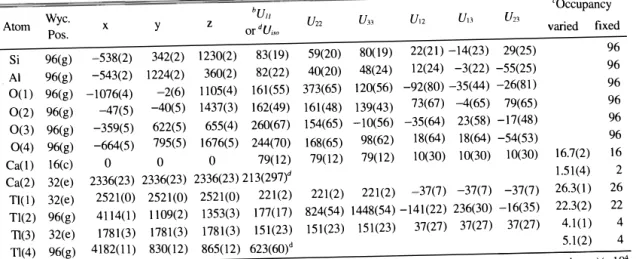
Table
1. Positional, thennal, and occupancy parametersa for dehydrated Ca'8Tls6-XAtom Wyc. x
ZbUIJ U22 U33 U'2 U13 U23 'Occupancy
Pos. y ordUiso varied fixed
Si 96(g) 538(2) 342(2) 1230(2) 83(19) 59(20) 80(19) 22(21) -14(23) 29(25) 96 AI 96(g) -543(2) 1224(2) 360(2) 82(22) 40(20) 48(24) 12(24) -3(22) -55(25) 96 0(1) 96(g) -1076(4) 2(6) 1105(4) 161(55) 373(65) 120(56) -92(80) -35(44) -26(81) 96 0(2) 96(g) -47(5) -40(5) 1437(3) 162(49) 161(48) 139(43) 73(67) -4(65) 79(65) 96 0(3) 96(g) -359(5) 622(5) 655(4) 260(67) 154(65) -10(56) -35(64) 23(58) -17(48) 96 0(4) 96(g) -664(5) 795(5) 1676(5) 244(70) 168(65) 98(62) 18(64) 18(64) -54(53) 96
Ca(1) 16(c) 0 0 0 79(12) 79(12) 79(12) 10(30) 10(30) 10(30) 16.7(2) 16
Ca(2) 32(e) 2336(23) 2336(23) 2336(23) 213(297t 1.51(4) 2
TI(I) 32(e) 2521(0) 2521(0) 2521(0) 221(2) 221 (2) 221(2) 37(7) -37(7) -37(7) 26.3(1) 26 TI(2) 96(g) 4114(1) 1109(2) 1353(3) 177(17) 824(54) 1448(54) -141(22) 236(30) -16(35) 22.3(2) 22 Tl(3) 32(e) 1781(3) 1781(3) 1781(3) 151(23) 151(23) 151(23) 37(27) 37(27) 37(27) 4.1(1) 4
11(4) 96(g) 4182(11) 830(12) 865(12) 623(60)d 5.1(2) 4
“a=25.2oo(3) Å, space group Fd3 origin at center of symmetry. Positional and anisotropic therma1 p앙뻐하.ers are given
X104•
Numbers in parentheses are the esds in the units of the least significant digit given for the corresponding pararneter. bThe
없I1S0-tropic temperature factor=exp[ (-2
π2/a
2) (UlJh2
+u221i
+UJ3P
+UI2hk
+Ul3hl
+U23kl)). 'Occupancy factors are given as the number of atoms or ions per unit cell. dU
;,o=(
B"J8
π2)
Table
2. Positional, thennal, and occupancy parametersa for dehydrated Caηη28-XAtom Wyc.
Pos Si 96(g) Al 96(g)
x Y
Z-542(2) 338(2) 1229(19) 554(2) 1220(2) 365(2)
bUIJ
U22 Uη U'2 U13
or d U
IWJ141(19) 93(19) 84(18) -10(21) -35(28) 119(20) 78(20) 98(21) 10(29) 11(22)
U23 'Occupanεy varied fixed
-19(24) 96
-23(26) 96
0(\) 96(g) -1077(4) -0(6) 1122(4) 177(53) 176(48) 153(59) -38(70) 91(42) -112(73) 96 0(2) 96(g) -47(5) -39(5) 1435(3) 124(44) 93(41) 198(46) 100(57) -62(60)
0(3) 96(g) -354(4) 609(4) 651(4) 110(51) 58(53) 124(59) 64(54) -11 (54) 0(4) 96(g) 637(4) 772(5) 1675(4) 385(73) 198(62) 95(56) -31(67) 152(68)
Ca(l) 16(c) 0 0 0 8α13) 80(13) 8α13) 2α29) 20(29)
Ca(2) 32(e) 2227(4) 2227(4) 2227(4) 338(34) 338(34) 338(34) 190(46) 190(46) T1(1) 32(e) 2518(1) 2518(1) 2518(1) 251(4) 251(4) 251(4) -44(12) -44(12) T1(2) 96(g) 4098(4f) 1195(12) 1373(5) 56(40) 2227(178) 534(132) 20(139) 139(58) TI(3) 32(e) 1813(10) 1813( 10) 1813(10) 577(109)d
TI(4) 96(g) 4182(11) 750(7) 750(7) 1064(77)d
-71(63) 96
8(48) 96
-90(51) 96
20(29) 16.5(3) 16 190(46) 15.8(4) 16 -44(\2) 15.7(5) 15 23(118) 6.7(12) 7
0.5(6) 5.3(2) 5
“a=25.2oo(3) Å, space group Fd3 origin at center of symrnetry. Positiona1 and anisotropic therma1 p따arneκrs are given
X104•
Numbers in parentheses are the esds in the units of the 1east significant digit given for the corresponding pararneter. �e aniso- πopic temperature factor=exp[ (
-2
π2/a 2 ) (UlJh2
+U221i
+UμP
+Ul2hk
+UJ3hl
+Unkl)). 'Occupancy factors are given as the number of atoms or ions per unit cell.
dU;,o=(B;d8π2)The final strnctural parameters and selected interatomic (0.0, 0.0, 0.0) with a height 16.93 ek3 and (0.253, 0.253,
distances and angles are presented in
Tables
1 and 3. 0.253) with a height 11.3 ek3. Anisotropic refinementCa32Ths-X (crystal 2).
Full-matrix least-squares including these as Ca2+ ions at Ca(l) and TJ+ ions at Tl(l) refinement was initiated by using the atomic par없neters converged to R,=O.I77 and R2=ü.212 with occupancies of the framework atoms for the previous crystal of of 13.7(9) at Ca(l) and 14.4(2) at Tl(2).Ca"Tls6-X (crystal l). Anisotropic refinement converged A subsequent difference Fourier function revealed two to an unweighted R,=0.47 and a weighted R2=0.53. A additional peaks, at (0.2201, 0.2201, 0.2201) with a difference Fourier function revealed two large peaks at height 7.19 ek3, and at (0.08, 0.08, 0.08) with a height
Joumal ofthe Korean Chemical Socieη
388
崔銀曉 ·金 洋
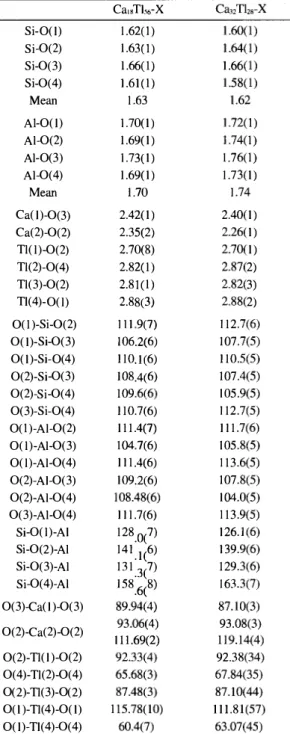
Table
3. Selected interatomic distance ( Á ) and angles and R2=O.092. The occupancy numbers at Ca(2) and(deg) Tl(4) were refined to 14.5(6) and
7.9(3),
respectivelySi-O(l) Si-0(2) Si-0(3) Si-0(4) Mean AI-O(l) Al-0(2) Al-O(3) Al-0(4)
M않nCa(l)-0(3) Ca(2)-0(2) Tl(l)-0(2) Tl(2)-0(4) Tl(3)-0(2) Tl(4)-O(l) O( 1 )-Si-0(2) 0(1 )-Si-0(3) 0(1 )-Si-O( 4) 0(2)-Si-0(3) 0(2)-Si-0(4) 0(3)-Si-0(4) O( 1 )-Al-0(2) O(l)-Al-0(3) O(l)-Al-0(4) 0(2)-Al-0(3) 0(2)-Al-0(4) 0(3)-Al-0(4) Si-O(l)-Al Si-0(2)-Al Si-0(3)-Al Si-0(4)-Al 0(3)-Ca(l )-0(3) 0(2)-Ca(2)-0(2) 0(2)-Tl(l )-0(2) 0(4)-Tl(2)-0(4) 0(2)-Tl(3)-0(2) 0(1 )-Tl( 4 )-0(1) O(l)-Tl(4)-0(4)
Ca"TI56-X
n n u ” U U U U U 잉 히 ” ” 기 끼 m m 이 m m n m m m ‘” 이 기 m η α이 씨 씨 찌 찌 키 ] M n --@ U % 이 아 지각 아 mm 1 i 이 νι νn αm α각 징 U4 ιj ιu‘ 끼 * η 4 X 얘 끼 α u l @ 예 XN % 께 jn @m @m % m M M M 1 n M n M L μ g η % R R m 뼈 m mm mm m …… w m m R m mμ …… …m 뼈 mt 찌 m E ιω % rω mm - V썽-”””” nUUU UUU잉키잉
mm””””이”히히잉때이이이η
이에뼈% E째m쩨 - α
( ( 뼈뻐 m M 맨 m m 뻐 쨌 M 째 m m m m m 뼈 m m m m m m m 1 때 mm때X2 뼈 많l mm 때m 짧-뻐뼈 끼η αααKαα4URXX 삐 삐uj κ%(、U * mm mA(θ이껴 (m 깨π4%m 11j4% 4
Numbers in parentheses
따eestimated standard deviations in least significant digit for the corresponding Values
3.14 ek3• Ca1culations inc1uding these peaks as ions at Ca(2) and TI(4) lowered the error indices to R,=0.084
1999, Vol. 43, No. 4
From an ensuring Fourier function, the remaining TI+ ion positions were found at (0.4 0, 0.1 2, 0.14) with height
3.73
ek3 and at (0.178, 0.178, 0.178) with a height 2.89 ek3•Anisotropic refmement of framework atoms and a11 the cations converged to
R,=O.04 5
andR2늬1043.
The occupancies of Ca(1), Ca(2), TI(I), TI(2), TI(3), and TI(4) were fixed at the va1ues shown in theTable
2 considering the cationic charge per unit cell. The sum of occupancy numbers at Ca(2), π(1), and TI(3) were fixed at 32.0, the maximum number of ions per unit cell at these positions. Otherwise the fina1 error indices for the 472 reflections for which1
> 30(1) were R,=0.046 andR2=O.045.
The shift in the fina1 cyc1e of least-squares refinement were less than 0.1%
of their corresponding standard deviations. All crysta1lographic ca1culations were done using MoI EN'9 (a sσucture deterrnination program package supplied by Enraf-Nonius). Atomic scattering factors'6.17 for Si, Al, 0-, Ca2+, and TI+ were used. All scattering factors were modified to account for anoma1ous dispersion.18 The fma1 structura1 parameters are listed inTable
2 and selected interatomic distances and angles are presented inTable
3.DISCUSSION
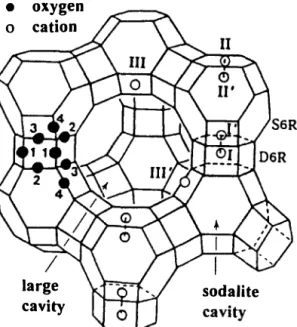
Zeolite X is a synthetic counterp따t of the natura1ly occurring minera1 faujasite. The 14-hedron with 24 vertices known as the sodalite cavity or ß cage may be viewed as the principa1 building block of the a1uminosilicate framework of the zeolite (see Fig. 1).
These -cages are connected tetrahedra1ly at six-rings by bridging oxygens to give double six-rings (D6R’s,
hexagona1 prisms), and, concomitantly, to give an interconnected set of even larger cavities (supercages) accessible in three dimensions through 1 2-ring (24- membered) windows. The Si and Al atoms occupy the vertices of these polyhedra. The oxygen atoms lie approximately midway between each pair of Si and AI atoms, but are displaced from those points to give near tetr삶1잉ra1 angles about Si and Al.
Exchangeable cations that ba1ance the negative charge of the a1uminosilicate framework are found within the
•
oxygeno
cationlarge
cavity sodaHte
cavity
Fig. 1. A stylized draws of the framework structure of zeolite X. Near the center of the each line segment is an oxygen atom. The different oxygen atoms are indicated by the numbers 1 to
4.Silicon and a1uminum atoms altemate at the tetrahedra1 intersections, except that a silicon atom substitutes for a1uminum at about 4% of the
Alpositions.
Exσaframework cation positions are labeled with Roman numerals
zeolite’s cavities. They are usually found at the following sites shown in Fig. 1: site
1
at the center of a D6R, 1’ in the sodalite cavity on the opposite side of one of the D6R’s six-rings from site 1, 11’, inside the sodalite cavity near a single six-ring (S6R) entrance to the supercage,11 in
the supercage adjacent to a S6R, III in the supercage opposite a four-ring between two 12-rings, and III’ in the vicinity of III but off the twofold axiS.20•21CalsTls6-X (crystal 1).
The mean values of the Si-O and AI-O bond lengths are 1.63 and 1.70 Å, respectively.The individual bond lengths, however, show marked variations: Si-O from 1.61(1) to 1.66(1) Å and AI-0 from 1.69(1) to 1.73(1) Å. The Si-O and AI-0 distances depend on Ca2+ ion coordination to framework oxygen;
Ca2+ ions coordinate only to 0(2) and 0(3). As a consequence of these (substantially ionic) interactions,
the Si-0(2), Si-0(3), AI-0(2), and AI-0(3) bonds are somewhat 1engthened (see Table 3). This effect is frequent1y observed, for ex없nple, in dehydrated C146-X.4
In
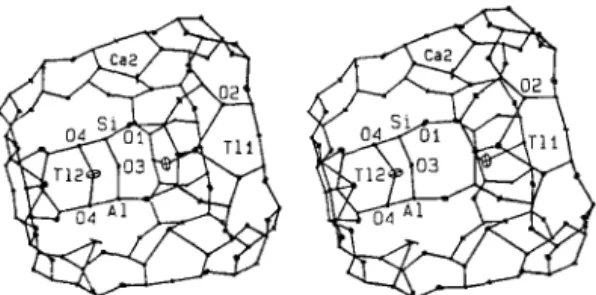
this structure, 18 Ca2+ ions occupy two σystallo-Fig. 2. Sterεoview of a soda1itε cavity with an attached D6R in dehydrated Ca18Tl56-X. One Ca2+ ion at Ca(l) (site
1)and three Tl+ ions at Tl( 1) (site
11)and onε Ca2+ ion at Ca(2) (site
11) areshown. About 25% of sodalite cavities may have this arrangement. Ellipsoids of 20% probability are shown
Fig. 3. Stereoview of a soda1ite cavity with an attached D6R in dehydrated CaI8TI56-X. One Ca2+ ion at Ca(l) (siκ
1)and three Tl+ ions at Tl(1) (site
11)and one Tl+ ion at Tl(3) (site
11’)are shown. About 50% of soda1ite cavities may have this arrangement. The remaining of 20% of sodalite cavities may have 4Tl+ ions at Tl(l). Ellipsoids of 20% probability are shown
graphic sites and 56 Tt ions occupy four sites. The Ca2+
ions at Ca(l) fill the 16-fold site
1.
Sixteen Ca2+ ions at Ca( 1) fill the octahedral site 1, at the centers of the D6R’s (see Figs. 2 and 3). 까le Ca(I)-0(3) distance, 2.42(1) Å,is a little longer than the sum of the ionic radii of Ca2+
and 02-, 0.99 + 1.32=2.31 Å,22 indicating a reasonably good fit. In dehydrated C146-X, the Ca(I)-0(3) distance is similar, 2.429(8) Å.4 The remaining two Ca2+ ions at Ca(2) are at site
11
in the supercage (see Figs. 3 and 5);these Ca2+ ions are 2.35(2) Å from their nearest neighbors, three 0(2) framework oxygens. About 26 Tt ions at Tl(l) occupy the 32-fold site 11 supercage. Tl(1)- 0(2) is 2,70(8) Å, which is a litt1e shorter than the sum of the ionic radii of Tl+ and 02-, 1.47+ 1.32=2.79 N2, and each Tl(l) ion is 1.49 Å from the plane of the three 0(2)
Journal (ifthe Korean Chemμ'al Socieη
390
崔銀曉 ·金 洋
Tll
Fig.
4.Stereoview of a sodalite cavity with an attached D6R in dehydrated CaηTJ,,-X. One Ca2+ ion at Ca(l) (site
1)and two Ca2+ ions at Ca(2) (site
II)and two TI+ ions at η(1) (site
II)are shown. About 87.5% of sodalite cavities may have this arrangement. Ellipsoids of 20% probability are shown.
Fig. 5. Stereoview of the supercage of dehydrated Ca18TIs6- X. 까rree TI+ ions at ions at η(1) (site
II)and one Ca2+ ion at Ca(2) (site
II)and three η ions at η(2) (site
III')are shown. About 25% supercages may have this arrange ment.
Ellipsoids of 20% probability are used.
framework oxygens of the S6R to which it is bound (0(2)-TI-0(2)=92.33( 4)").
The Tl(2)-0(4) bonds occupy site III’ in the supercage with occupancies of 22 and 4, respectively. 1ψenty two
TJ+
ions at Tl(2) occupy the 96-fold position (Tl(2)- 0(4)=2.82(1) Á) This distance is similar to TI-O distances in dehydrated Sr8.5Th5-XIO 뻐d Cd24.5Tl.n-X3 (2.86(2) Á and 2.79(2) Á). The four Tl+ ions at Tl(4) lie in the supercage at site III’.까le remaining four Tl+ ions at TI(3) occupy the 32- fold position at site II' (see Figs. 3 and 6). πle Tl(3 )-0(2) approach distance, 2.81(1) Á, is nearly the same as the sum of the ionic radii of
1γ
and 02., 1.47 Á + 1.32 Á.Recently the. sσuctures of Cd,6-X3, Ca.6-X4, Cd24.5T13- X3, and CaηK28-X8 were determined. From these it app않rs that site
1
is the lowest energy site for most cations, except for the largest and the smallest. Ca2+ ions in Ca.6-X4 and Cd2+ ions in Cd,.-X3 fill site 1, with the1999, Vol. 43, No. 4
Fig. 6. Stereoview of the supercage of dehydrated Ca18ηγ X. ππee TI+ ions at ions at n(l) (site
II)and two TI+ ions TI(2) (site
III’)and onε TI+ ion at TI(3) (site
II’) and one η+
ion at n( 4) (site
III’)are shown. About 25% supercages may have this arrangement. Ellipsoids of 20% probability are used.
remainder going to site II in the supercage, nearly filling it. In Cd24.5T13-X, ion size and charge dominate the competition for sites. The smaller and more highly charged Cd2+ ions select their sites first because they can access more closely to anionic oxygens of the zeolite framework. They nearly fill the site
1
position as in Cd,.X, ascertaining that Cd2+ ions prefer site 1, the D6R sites.
Only after the Cd2+ ions have selected their sites, the Tl+
ions finish filling site II, with the remainder going to the least suitable cation site in the sπucture, site
III.
Ca32 Th8-X (CIγstal 2).
In this structure, 32 Ca2+ ions occupy two crysta110graphic sites and 28 Tl+ ions occupy four sites. The Ca2+ ions at Ca( 1) lie at site1.
Sixteen Ca2+ions at Ca( 1) fill the octahedral site
1
at the centers of the D6R’s (see Fig. 4) (Ca(l)-0(3)=2.40(1) Á and 0(3)- Ca(1)-O(3)=9008(3)oand
87.lO(3)1ions at Ca(2) occupy 32-f이d site
11
in the supercage (see Figs. 7 and 8): The Ca(2)-0(2) distance, 2.26 Á, isFig. 7. Stereoview of the supercage of dehydrated CaηTI갱
X. Two Ca2+ ions at Ca(2) (site
II)and two n+ ions TI(I)
(site
II)and one TI+ ion at η(2) (site
III')and one η+ ion at
n(4) (site
III’) are shown. About 50% supeπages may have
this arrangement. Ellipsoids of 20% probability
뼈used
Fig.
8.Stereoview of the supercage of dehydrated Ca깅TI,,
x. Two Ca2+ ions at Ca(2) (site
11)and two T\+ ions Tl(1) (site
11)and one η+ ion at TI(2) (site
III’)are shown. About 37.5% of the s때ercages may have this arrangement Ellipsoids of 20% probability are used.
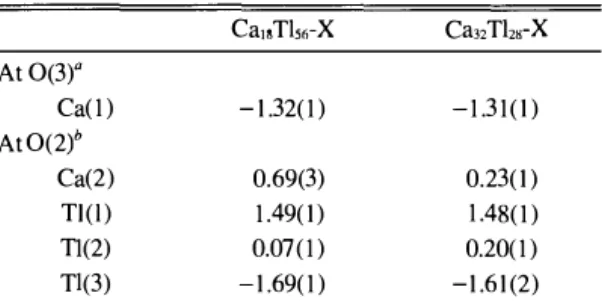
Table
4. Deviations (Á) of cations from six-ring planesCaI8T\S6-X Ca32Tl,s-X At 0(3)"
Ca(1) -1.32(1) -1.31(1)
AtO(2
lCa(2) 0.69(3) 0.23(1)
Tl(l) 1.49(1 ) 1.48(1)
T1(2) 0.07(1) 0.20(1)
T\(3) 1.69(1) -1.61 (2)
a
Anegative deviation indicates that the atom lies in a D6R.
bA positive deviation indicates that the atom lies in the super cage and a negative deviation indicates that the atom lies in the sodalite cavity.
shorter than the sum of the conventiona1 radii22 of Ca2+
and 02-, 2.31 Á, presumably because Ca(2) is only three
coordinate. These Ca2+ ions are slightly recessed, 0.23 Á into the supercage from the plane of the three 0(2) oxygens. (see
Table
3 and 4). πle 0(2)-Ca(2)-0(2) bond angle, 119.1(4)", is nearly trigona1 planar. The Tl(I) position is at site 11, far inside the supercage . Each η(1) ion is 1.48 Á from the plane of the three 0(2) framework oxygens of the S6R to which it is bound. The Tl(1 )-0(2) distances are 2.70(1) Á. In dehydrated SrI6TI8.8-A23 andn2_AI4,
similar TI-0 distances (2.66(1) Á and 2.62(1) Á) and Tl+ displacements from six-ring planes (1.51 Á and 1.56 Á) have also been obseπed. The Tl+ ions at Tl(2) lie in the supercage at site III’. About seven Tl+ ions at Tl(2) occupy 96-fold position and the five Tl+ ions at Tl( 4) lie in the supercage at site III’. 까le Tl(3) position is at site 11’, on a threefold axis inside the soda1ite unit at the single six-oxygen ring. This is 32-fold position, but it is occupied by only one Tl+ ion. 까le Tl(3)-0(2)1àble 5. Distribu디on of nonframework atoms over sites
�
Cryst떠S
�.
、ζ;← CaI8TJ,6-X
Sites
、~‘16Ca(1)
H’
4TI(3)
n 2Ca(2)
26Tl(1)
III’
22Tl(2)
4T1(4)
Ca32T\28-X 16Ca(l )
1Tl(3) 16Ca(2)
15T\(l ) 7Tl(2) 5TI(4)
distances are 2.82(3) Á, similar to the sum of the corresponding ionic radii, 1.47+1.32=2.79 N2.
CONCLUSION
This work indicates not only that a11 of Na+ ions in zeolite X can readily be replaced by Tl+ and Ca2+ ions but a1so that full dehydration to yield relatively simple structures is possible.
Table 5 shows that there was no competition for site 1 in Ca18T156-X and Ca32Ths-X but there was only competition for site 11. πùs is the reason that Tl+ ions are too 1따ge to occupy site 1. η1Ìs is not a kinetic or sieving effect; because Tl+ ions are found in the soda1ite units of zeolite A24.25, they must have entered through 6-rings.
Therefore ca2+ ions nearly fill site 1 without competition and the remainder going to the site 11 as in Ca18T156-X and Ca32Ths-X. The size and charge of ions appear to control the competition for site 11. 까le sma11er and more highly charged Ca2+ ions preferentia11y occupy site 11 and larger Tl+ ions are less able to ba1ance anionic charge of the zeolite framework because of their size.
Acknowledgement.
까le Authors wishto
acknowledge the financial support of the Korea Research Foundation made in the program year of 1998.Supporting Information Available.
Tables of calculated and obseπed sσucture factors (11 pages). Ordering information is given on any current masthead page.
REFERENCES
1.
Barr히., R. M.Zeolites and Clay Minerals and Sorbents and Molecular Sieves;
Academic Press:London,
1978.2.
Smo1in, Y. I.; Shepe1ev, Y. F.; Anderson, A. A.Acta
Jounull of the Korean Chemical Socieη
392
崔銀曉 ·金 洋
crγstallogr., Sect. B
1989, 45, 1 24.3. Kwon, J. H.; Jang, S. B.; Kim,
Y.;
Seff, K.J. Phys.
Chem.
1996, 100, 13720.4. Yeom,
Y.
H.; Jang, S. B.; Song, S. H.; Kim, Y. ; Seff, KJ. Phys. Chem.
1997, 101,6914.
5. Jang, S. B.; Kim,
Y. Bull. Korean. Chem. Soc.
1995, 16,248.
6.
Jang, S. B.; Kim,Y. Bull. Korean. Chem. Soc.
1995, 16,539.
7. Han, Y.
w.;
Kim,Y.;
Seff, K.Zeolites.
1997, 18, 325.8. Jang, S. B.; Song, S. H.; Kim, Y.
J. Korean. Chem.
Soc.
1995, 39,1.
9. Jang, S. B.; Kim, M. S.; Han,
Y. w.;
Kim,Y. Bull.
Korean. Chem. Soc.
1996, 17, 7.1 0. Kim, M.
1.;
Kim,Y.;
Seff, K.Korean. J. Cηstallogr.
1997,8, 1
1 1 . Bogomo1ov,
V.
N.; Petranovskii,V.
P.Zeolites
1986, 6,418
12.1nternational Tables for X-ray Crystallography;
Kynoch Press: Binningham, England, 1944; Vol. 11,P
302.
13. Yeom,
Y.
H.; Kim,Y.;
Seff, K.J. Phys. Chem. B
1997,101.53 1 4
1999,
�서1.
43, No. 41 4. Firor, R.
L.;
Seff, K.J. Am. Chem. Soc.
1977,9 9,4039.15. Jang, S. B.; Han,
Y. w.;
Kim,D.
S.; Kim,Y. Korean J.
Cηst.
1990, 1, 76.16. Cromer,
D. T. Acta Cηstallogr.
1965, 18, 1 7.17.
1nternational Tables for X-ray Crystallogr.α'Phy;
Kynoch Press: Birmingham, Eng1and, 1 974; Vol. IV, pp 73-87.18. Reference 1 7, pp 149-150.
19. Calculations were performed using the software package Mo1EN supp1ied by Enraf-Nonius, πle Netherlands, 1990.
20.
Sun, T.; Seff, K.; Heo, N. H.; Petranovskii,V. P.
Science
1993, 259, 495.2 1 . Sun,
T.;
Seff, K.Chem. Rev.
1994, 94, 859.22. Handbook of Chemistry and Physics;
70fuEd.;
까le Chemical Rubber Co.: Cleveland, Ohio, 198911990. P F-1 8723.
Yang,W.
J.; Park, J.Y.;
Kim,U.
S.; Kim,Y. Bull.
Korean Chem. Soc.
1989, 10,6.
24.
Kim,Y.;
Seff, K.J. Phys. Chem.
1978,82, 1 307.25.
Riley, P. E.; Seff, K.; Shoemaker,D.
P.J. Phys. Chem.
1972, 76,