차세대염기서열방법을 이용한 경북 봉화군 장군봉 소나무림의 토양 박테리아 군집 구성
이병주⋅어수형* 공주대학교 산림자원학과
Soil Bacterial Community in Red Pine Forest of Mt. Janggunbong, Bonghwa-Gun, Gyeongbuk, Korea,
Using Next Generation Sequencing
Byeong-Ju Lee and Soo Hyung Eo*
Department of Forest Resources, Kongju National University, Yesan 32439, Korea
요 약: 토양미생물은 산림 생태계 구성 요소로써 산림 내 물질 순환 및 식물 생장 등에 중요한 역할을 한다. 그러나 국내 산림과학분야에서는 토양 균류 일부 종에 대한 연구가 주로 실시되어졌으며, 박테리아를 포함한 미생물 군집에 대한 연구 는 부족한 실정이다. 본 연구에서는 16S rRNA gene 영역에 대한 차세대염기서열분석법을 통해, 장군봉 천연 소나무림 토양 내 존재하는 박테리아 군집 구성을 파악하였다. 분석 결과, phylum 수준에서 Proteobacteria, Acidobacteria, Actinobacteria, Planctomycetes 등이 나타나, 전형적인 토양 박테리아 군집 구성을 보였다. 또한, 부영양 환경을 선호하는 Proteobacteria가 가장 높은 비율을 차지하였는데, 다른 인공림과 비교하여 장군봉 천연 소나무림 토양 유기물량이 상대적으로 풍부한 것이 원인으로 생각된다. 한편, 토양 내 질소 순환에 기여를 하는 뿌리혹박테리아 분류군을 살펴본 결과, Burkholderia, Bradyrhizobium, Rhizobium 속이 주로 존재하는 것을 확인하였다. 토양 물리 · 화학적 특성과 박테리아 군집 구성간의 상관 관계를 분석한 결과, 토양 내 pH가 박테리아 군집 구성과 관련된 주요 토양 특성인 것으로 확인되었다.
Abstract: The soil microbiome plays important roles in material cycling and plant growth in forest ecosystem.
Although a lot of researches on forest soil fungi in Korea have been performed, the studies on forest soil bacterial communities have been limited. In this study, we conducted next generation sequencing (NGS) targeting 16S rRNA gene to investigate the soil bacterial communities from natural red pine (Pinus densiflora) forest in Mt. Janggunbong, Bonghwa-gun, Gyeongbuk, Korea. Our results showed that the entire bacterial communities in the study sites include the phyla Proteobacteria, Acidobacteria, Actinobacteria, Planctomycetes, which have been typically observed in forest soils. The composition ratio of Proteobacteria was the highest in the soil bacteria community. The results reflect that Proteobacteria is copiotroph, which generally favors relatively nutrient-rich conditions with abundant organic matter.
Some rhizobia species such as Burkholderia, Bradyrhizobium, Rhizobium, which are known to contribute to soil nitrogen-fixation, exist in the study sites. As a result of correlation analysis between soil physicochemical characteristics and bacteria communities, the soil pH was significantly correlated with the soil bacteria compositions.
Key words: Pinus densiflora, pyrosequencing, soil bacterial community, soil microbiome, soil physicochemical characteristics
서 론
1)
산림 생태계에 있어서 토양 미생물은 매우 중요한 역 할을 한다. 토양 미생물은 산림 내 식물의 낙엽, 고사된
* Corresponding author E-mail: [email protected]
뿌리, 동물의 시체 등을 분해하고, 축적된 영양물질의 가 용성을 증가시킨다(Štursová et al., 2012; Bowles et al., 2014). 또한, 뿌리혹박테리아나 균근균과 같이 식물과 공 생 관계를 맺는 토양 미생물은 식물의 질소, 인 등 영양 물질 흡수 촉진에 직접적으로 기여하며(Van Der Heijden et al., 2008), 식물의 생장량과 stress에 대한 내성을 증가 시킨다(Panke-Buisse et al., 2015; Lareen et al., 2016). 토양
J OURNAL OF K OREAN F OREST S OCIETY ISSN0445-4650(Print), ISSN2289-0904(Online) http://e-journal.kfs21.or.kr
121
미생물 군집 내 종간 경쟁은 식물 병원성 미생물의 증식과 감염에 영향을 미치는 것으로 알려져 있다(Berendsen et al., 2012). 이러한 토양 미생물의 다양한 기능들은 산림 환경 특성과 긴밀히 상호 작용하여 조절되며, 토양 미생 물과 산림 환경의 관계를 규명하기 위한 노력은 지속적 으로 이루어지고 있다.
생태계의 전반적인 이해를 위해 그 계를 구성하는 군집 의 구성을 명확히 파악하는 것이 매우 중요하다(Lyashevska and Farnsworth, 2012). 토양 미생물 연구에 주로 활용되는 배양 의존 방법은 미생물의 생리적, 생태적 특성을 이해하 기 위한 주요 수단이지만(Palleroni, 1997), 배양에 어려움 이 있는 난배양성 종이 포함된 전체 미생물 군집 구성을 파악하는 것에는 한계가 있다(Bloomfield et al., 1998).
최근 들어 미생물 군집 구성을 유전자 분석을 통해 파악하 기 위한 방법으로 차세대염기서열분석법(Next Generation Sequencing technology; NGS)이 시행되고 있으며, 특히 16s rRNA gene에 대한 차세대염기서열분석법을 통해 배 양 방법으로 확인할 수 없었던 Acidobacteria, Chloroflexi, Actinobacteria 등의 분류군이 토양 박테리아 군집의 높은 구성 비율을 갖고 있음을 확인하였다(Janssen, 2006). 최 근에는 산림 과학 분야에서도 차세대염기서열분석법을 이용하여 임분 특성에 따른 토양 미생물 군집 특성 파악, 자연적 또는 인위적 산림 환경 변화에 따른 토양 미생물 군집 변화 등의 분석을 시도하고 있다(Uroz et al., 2010;
Oh et al., 2012; Lee-Cruz et al., 2013; Hartmann et al., 2014; Li et al., 2014).
소나무는 전국 산림 면적 63,346 km
2
중 대략 25%에 해당하는 15,628 km2
의 가장 넓은 분포 면적을 갖는 국 내 대표 수종이지만(Korea Forest Service, 2016), 소나무 임분 내 토양 미생물과 관련된 국내 연구는 매우 부족하 다. 국내 산림 과학 분야에서는 소나무를 포함한 식물 종 과 공생 관계를 맺는 균근성 버섯류와 같은 일부 미생물 에 대한 연구가 주로 이루어져 왔지만, 군집 차원에서의 토양 미생물 연구는 거의 이루어지지 않고 있다. 특히, 토양 박테리아는 토양 내 존재하는 미생물 중 높은 구성 비율과 생태적 주요 기능을 가지고 있음에도 불구하고 (Van Der Hejiden et al., 2008), 소나무림을 포함한 산림 내 토양 박테리아와 관련된 연구는 국내 산림 과학 분야 에서 거의 다루어지지 않고 있다(Park et al., 2012).기후 변화, 산림 병해충 등에 의해 국내 소나무림은 최 근까지 지속적으로 감소하고 있다(Lee and Hong, 2004).
소나무림의 보존과 지속 가능한 산림 경영을 위해서는 토양 미생물을 포함한 소나무림 생태계 구성 요소들에 대한 이해가 필요하다. 특히, 인간에 의해 관리되지 않고 자연 상태로 남겨진 산림은 생태계를 이해하고, 지속 가
능한 산림 경영을 실시하기 위한 중요한 자료가 된다 (Chapman and Koch, 2007; Paillet et al., 2010). 본 연구 에서는 차세대염기서열분석법을 활용하여 천연 소나무 림 내 토양 박테리아 군집 특성을 구명하는 것을 목적으 로 하였다. 또한, 천연 소나무림 내 영양 물질 순환에 기 여하고 있는 토양 박테리아 분류군을 알아보기 위해, 토 양 내 질소 고정에 중요한 역할을 하는 뿌리혹박테리아 분류군에 대하여 살펴보았다. 한편, 산림 환경 특성 중 하나인 토양 물리 · 화학적 특성과 토양 박테리아 군집 구 성간의 상관관계를 살펴보았다.
재료 및 방법
1. 조사지 개황
본 연구에서 조사 지역으로 선정한 경상북도 봉화군 장 군봉은 고도 1,139 m, N36°45’~37°00’, E128°59’~129°15’
에 위치하며, 연평균기온은 9.9℃이고, 연평균강수량은 1,195.4 mm으로 온대 중부 산림대에 속한다(변성엽 외, 2016). 전체 장군봉 지역 중 산림경영단지 65임반(N36°54, E129°01; 600ha)내에서 인위적인 영향 없이 보존되고 있 는 수림대 소나무림에서 토양 시료를 채취하였다. 수림대 내 교목층은 주로 소나무(Pinus densiflora)가 차지하고 있 었으며, 소나무의 평균수고는 14.2 m, 평균경급은 23.4 cm, 평균수령은 64년생이었다. 소나무 이외의 일부 신갈나무 (Quercus mongolica)와 굴참나무(Quercus variabilis)의 개 체가 생장하여 상층 임관까지 도달해 있었다. 교목층 하 부의 식생은 신갈나무, 굴참나무, 진달래(Rhododendron mucronulatum), 쪽동백나무(Stryax obassia), 생강나무 (Lindera obtusiloba) 위주로 구성되어 있었다.
2. 토양 시료 채취
조사지역의 토양 박테리아 군집 특성을 알아보기 위하 여 총 8개의 토양 시료를 채취하였다. 토양 시료 채취는 2015년 8월에 이루어졌으며, 조사 당시의 일평균 기온은 23.2℃, 일평균 강수량은 11.0 mm였다. 각 토양 채취 지 점은 최소 20 m 이상 간격을 두었으며, 특정 식물 개체 에 의한 영향을 최소화하기 위해 개체목으로부터 최소 3 m 이상의 거리를 두었다. 토양 채취 지점에서 약 5 cm의 유기물층을 삽으로 제거한 뒤, 원통형 토양채취기를 사 용하여 표면으로부터 30 cm 깊이 내에서 1 kg의 토양을 채취하였다. 채취된 토양 시료들은 얼음팩과 함께 아이 스박스에 보관하여 실험실로 운반하였다. 토양 시료들은 실험실에서 2 mm 채로 거른 후 토양 구성 성분이 균일 하게 되도록 섞은 뒤, 후속 분석을 할 때까지 -20℃에서 냉동 보관하였다.
Sample Soil texture (%)
pH OM(%) TN(%) AP
(ppm)
CEC (cmol/kg)
Exchangeable cations (cmol/kg)
Sand Silt Clay K
+
Na+
Ca2+
Mg2+
1 24.8 55.3 19.9 5.2 4.5 0.14 5.0 11.4 0.17 0.08 1.49 0.49
2 31.5 47.9 20.6 4.9 4.7 0.13 5.0 13.2 0.19 0.09 1.29 0.29
3 33.5 48.9 17.7 4.8 5.3 0.14 7.0 13.9 0.24 0.12 0.95 0.20
4 16.6 61.9 21.5 5.0 5.2 0.14 6.0 14.1 0.16 0.07 1.04 0.40
5 28.6 53.1 18.3 5.2 5.0 0.16 4.0 12.3 0.17 0.08 2.12 0.67
6 45.5 33.6 20.9 5.4 5.9 0.18 3.0 13.4 0.27 0.07 3.10 0.86
7 18.4 66.8 14.8 5.1 5.0 0.16 5.0 12.3 0.21 0.06 1.27 0.35
8 20.9 61.5 17.7 5.4 5.1 0.16 3.0 13.6 0.22 0.09 2.74 1.11
Mean 27.5 53.6 18.9 5.1 5.1 0.15 4.8 13.0 0.20 0.08 1.75 0.55
SD 8.4 9.2 2.0 0.2 0.4 0.02 1.2 0.8 0.03 0.02 0.71 0.27
※ abbreviation: OM: organic matter, TN: total nitrogen, AP: available phosphorus, CEC: cation exchange capacity, SD: standard deviation
Table 1. Soil physiochemical characteristics of each sample from natural red pine forest of Mt. Janggunbong.3. 토양 물리· 화학적 특성 분석
토양 물리 · 화학적 특성을 파악하기 위해, 토양 및 식 물체 분석법(Korea Forest Research Institute, 2014)에 따 라 토양 입도(Hydro-meter 법), pH (pH-meter 법), 유기물 (건식산화법), 전질소(건식산화법), 유효인산(Lancaster 법), 양이온치환용량(1N-초산암모늄 침출법), 치환성양이 온(K
+
, Na+
, Ca2+
, Mg2+
; 원자흡광광도법)의 양을 측정하 였다. 토양 물리 · 화학적 특성 분석은 한국임업진흥원에 서 이루어졌다.4. 토양 박테리아 군집 분석
토양 시료 0.5 g으로부터 Power Soil DNA extraction kit (Mobio laboratories, Carlsbad, CA, USA)를 사용하여 토 양 속에 존재하는 전체 DNA를 추출하였다. 추출된 DNA 는 박테리아의 16s rRNA gene V1-V3 영역을 증폭시킬 목적으로 9F(5’-CCTATCCCCTGTGTGCCTTGGCAGTC -TCAG-AC-AGAGTTTGATCMTGGCTCAG-3’; 밑줄 친 염기서열이 primer의 target region을 뜻한다.)와 541R(5’- CCATCTCATCCCTGCGTGTCTCCGAC-TCAG-X-AC-A TTACCGCGGCTGCTGG-3’; ‘X’ 부위에는 각 샘플을 구분 하기 위한 barcode 염기서열이 포함된다.) 프라이머(primer) 를 사용하여 PCR (Polymerase Chain Reaction; 중합효소 연쇄반응)을 실시하였다(http://oklbb.ezbiocloud.net/conte nt/1001). PCR 조건은 다음과 같다. 우선 초기 변성(initial denaturation)을 95℃에서 5분간 실시하였다. 다음으로 변 성(denaturation)을 95℃에서 30초, 프라이머 결합(primer annealing)을 55℃에서 30초, 중합(extension)을 72℃에서 30초로하여 30회 반복하였다. 최종 신장(final elongation) 은 72℃에서 5분간 실시하였다.
PCR 증폭 산물은 Chunlab, Inc (Seoul, Korea)의 GS
Junior Sequencing system (Roche, Branford, CT, USA)을 사용하여 차세대염기서열분석법으로 진행하였으며, 결과 분석은 선행 연구들의 사례(Chun et al., 2010; Hur et al., 2011; Kim et al., 2012a)를 따랐다. 토양 DNA의 계통 분 류를 하기 위해 박테리아 분류군들의 정보가 저장된 EzTaxon-e database (http://eztaxon-e.ezbiocloud.net) (Kim et al., 2012b)를 이용하여 BLASTN 검색을 실시하였다.
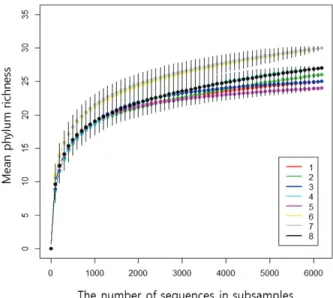
토양 박테리아 군집에 대한 분석에 앞서, 분석된 sequence 수의 차이에 따른 다양성의 편이를 줄이기 위해, 토양 시료 내 가장 적은 sequence 수에 따라 재추출(resampling)을 실 시하였다. 토양 시료로부터 분석된 sequence의 수가 실제 토양 시료 내 박테리아 phylum 수를 근접하게 나타내는 지 알아보기 위해 rarefaction 분석을 실시하였다. 토양 내 박테리아 분류군들의 구성과 그들의 근연 관계를 나타내 기 위해, 계통수(phylogenetic tree)를 작성하였다. 계통수 작성에는 유전 분석 프로그램인 MEGA v7.014 (Kumer et al., 2015)를 활용하였다. 토양 박테리아 분류군(특히, phylum)간의 군집 내 구성 비율을 비교하기 위해, SAS (ver 9.3)을 사용하여 ANOVA분석과 Tukey 사후 검정을 실시하였다. 박테리아 분류군 구성 비율을 정규화 하기 위 해, 아크사인변환[arcsin(
)]을 실시하였다. 또한, 토양 내 질소 고정과 관련된 박테리아들을 알아보기 위해, 토양 내 질소 고정 박테리아 분류군으로 가장 잘 알려진 뿌리혹 박테리아(rhizobia)가 얼마나 존재하는 지 살펴보았다. 뿌 리혹박테리아 탐색에는 Shamseldin et al.(2016)이 제시한 뿌리혹박테리아(rhizobia) 분류군 목록 중 속(genus) 목록 을 참고하였다.한편, 토양 물리 · 화학적 특성과 토양 박테리아 군집 구성간의 상관관계를 살펴보기 위해, R VEGAN package 를 사용하여, CCA (Canonical Correspondence Analysis)
Number of sequences 114,716 Total length of sequences (bp) 42,838,145 Average length of sequences (bp) 373 Table 2. Summary of Pyrosequencing result from Mt.
Janggunbong.
Figure 1. Rarefaction analysis for each soil sample at natural red pine forest of Mt. Janggunbong.
및 pearson correlation 분석을 실시하였다. CCA 분석에 앞서 토양 물리 · 화학적 특성간의 다중공산성을 나타내 는 VIF (variance inflation factor) 수치를 측정하였다. 각 토양 물리 · 화학적 특성의 VIF 수치들이 10미만이 될 때 까지, VIF 수치가 높은 물리 · 화학적 특성을 순서대로 하 나씩 제외하였다. 선택된 토양 물리 · 화학적 특성 중 토 양 박테리아 군집 구성과 유의한 상관관계를 갖는 특성 을 찾기 위해, CCA 분석 후 permutation test를 실시하였 다. 이후, CCA 분석과 permutation test에서 최종적을 선 택된 토양 물리 · 화학적 특성과 토양 박테리아 군집 구성 간의 상관관계를 살펴보기 위해 SAS (ver 9.3)을 통해 Pearson correlation coefficient(r)를 측정하였다.
결과 및 고찰
1. 토양 물리· 화학적 특성 분석 결과
경상북도 봉화군 장군봉 산림 토양의 조사 연구지 토 양은 모래(Sand)가 평균 27.5%, 미사(Silt)가 53.6%, 점토 (Clay)가 18.9%로 미사질 양토로 구성되어 있었다. 토양 산도는 평균 pH 5.1으로 강산성에 속한다. 유기물량(OM) 은 평균 5.1%, 전질소량(TN)은 평균 0.15%, 유효인산 (AP)은 평균 4.8 ppm, 양이온치환용량(CEC)은 평균 13.0 cmol/kg의 양이 있는 것으로 나타났다. 치환성 양이온은 K
+
이 평균 0.20 cmol/kg, Na+
는 0.08 cmol/kg, Ca2+
는 1.75 cmol/kg, Mg2+
는 평균 0.55 cmol/kg으로 나타났다. Park et al.(2009)의 연구에서는 중부 지방 소나무림의 토양 내 유기물양과 유효인산양은 각각 2.1%, 21.0 ppm으로 조사 되었는데, 이 조사 결과에 비해 장군봉 소나무림 유기물 량은 상대적으로 높고, 유효인산은 적은 것으로 나타났 다. 인간에 의한 관리가 이루어지지 않는 천연림에서는 일반적으로 많은 양의 낙엽 · 낙지와 고사목이 잔존하게 되는데(Paillet et al., 2010), 이러한 천연림의 특징에 의해 장군봉 천연 소나무림 토양 유기물량이 기타 중부지방 소나무림 토양의 평균 유기물량보다 상대적으로 높게 나 타난 것으로 판단된다.2. 토양 박테리아 분석 결과
차세대염기서열분석법을 이용하여, 경북 봉화군 장군 봉에서 채취한 전체 8개 토양 샘플에서 114,716개의 박
테리아 16s rRNA gene 염기서열 단편들을 생산하고 분석 하였다. 분석된 염기서열의 전체 길이는 총 42,838,145 bp 로 염기서열 단편의 길이는 평균 373 bp였다.
재추출 결과, 시료 별로 6,183개의 sequence가 부표본 (subsample)으로 추출되었다. 추출된 부표본의 sequence 수로부터 phylum 수에 대한 rarefaction 분석을 실시한 결 과(Figure 1), rarefaction curve가 점근선에 가까워지므로, 분석 결과가 실제 토양 시료 내 박테리아 phylum의 수를 대부분 나타내고 있다는 것을 알 수 있었다.
3. 토양 박테리아 군집 구성
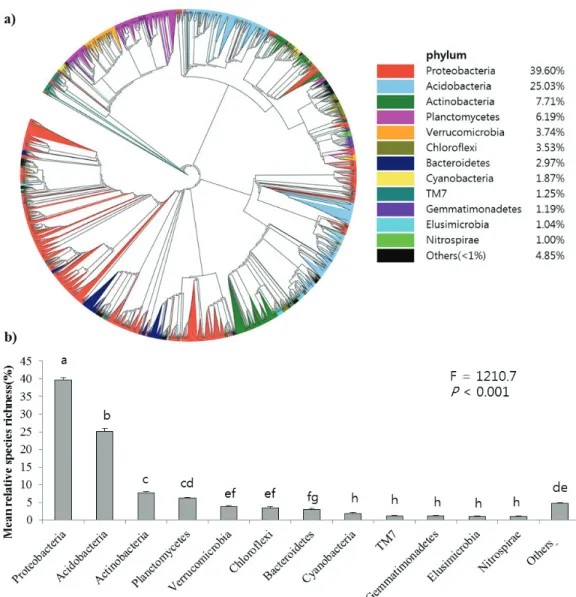
장군봉 산림 토양 내 전체 박테리아 군집에는 2,909개의 종이 포함되어 있었으며, 각 시료당 평균 1,044개의 종이 존재하였다. 박테리아 군집 내 Proteobacteria가 39.60%, Acidobacteria가 25.03%로, 군집 내 가장 우점하는 분류 군으로 나타났다(Figure 2). 그 밖에 Actinobacteria 7.71%, Planctomycetes 6.19%, Verrucomicrobia 3.74%, Chloroflexi 3.53%, Bacteriodetes 2.97%, Cyanobacteria 1.87%, TM7 1.25%, Gemmatimonadetes 1.19%, Elusimicrobia 1.04%, Nitrospirae 1.00% 순으로 구성 비율을 이루고 있었으며, 구 성비 1% 미만 기타 분류군(Others)은 4.85%를 차지하였다.
장군봉 토양 박테리아 종들 대부분이 속해 있는 Proteobacteria와 Acidobacteria는 기존의 토양 박테리아 군집 연구에서도 주로 우점하는 분류군으로 나타났었다 (Janssen, 2006; Uroz et al., 2010; Hartmann et al., 2014).
특히, Proteobacteria는 탄소와 질소 함량이 높은 부영양 환경에서 우점하고, Acidobacteria는 탄소 및 질소 함량이 낮은 빈영양 환경에서 높게 나타나는 것으로 알려져 있
Figure 2. Soil bacteria composition rate in phylum level at nutural red pine forest of Mt. Janggunbong. a) Phylogenetic tree constructed with all soil bacterial species at Mt. Janggunbong, using neighbor joining method. The colors of each tip represent bacterial taxa in the phylum level. b) Result of comparing the composition rate (%) among each bacterial phyum. The same letters above bars indicate no significant differences at p<0.05.
다(Fierer et al., 2007). 장군봉 소나무림 토양 내에서는 Proteobacteria가 Acidobacteria에 비해 상대적으로 높은 구성비율을 갖고 있는데, 이는 장군봉 소나무림의 유기 물량이 상대적으로 높기 때문으로 생각된다. 또한, 장군 봉 소나무림의 토양 pH는 평균 5.13으로 Proteobacteria가 선호하는 조건이며(Lauber et al., 2009 참고), 이 또한 Acidobacteria에 비해 Proteobacteria의 구성 비율이 높은 이유 중 하나로 판단된다. 이 외에도 장군봉 산림 토양처 럼 낮은 pH의 토양에서 균류(fungi)의 생물량이 박테리아 의 생물량보다 높게 나타나며 기질 분해에 중요한 역할 을 하는 것으로 알려져 있다(Blagodatskaya and Anderson, 1998; Rousk et al., 2009). 따라서 소나무림 토양 균류의
특성과 박테리아 및 균류의 토양 내 상호관계에 대한 연 구가 추후 진행되어야 할 것이다.
뿌리혹박테리아류(rhizobia)에 속하는 것으로 알려진 박테리아 분류군들의 종수를 살펴본 결과(Table 3), Bradyrhizobium 속이 5.3종으로 α-Proteobacteria에 속하 는 분류군 중 가장 많은 종 수를 가지고 있는 것으로 나 타났다. Rhizobium는 평균 1종, Devosias는 평균 1종, Mesorhizobium는 0.6 종으로 일부 시료에만 적은 수로 존 재하였다. 한편, β-Proteobacteria에 속하는 분류군 중 Burkholderia 속은 평균 22.8종으로 모든 시료에서 가장 많은 종 수를 차지하는 것으로 나타났다. Cupriavidus 속 은 평균 0.4종으로 일부 시료에서만 나타났다.
Class Genus Soil sample
1 2 3 4 5 6 7 8
α-Proteobacteria
Bradyrhizobium 5 5 4 4 7 6 5 6
Rhizobium 1 2 0 0 1 2 2 0
Devosia 0 0 2 0 1 2 3 0
Mesorhizobium 0 1 1 0 1 0 1 1
β-Proteobacteria
Burkholderia 26 24 22 19 22 22 28 19
Cupriavidus 0 0 0 1 1 0 0 1
Table 3. The number of species within rhizobia bacterial genus at natural red pine forest of Mt. Janggunbong.
Phylum r
†
p-valueProteobacteria 0.91 0.00 *
Acidobacteria -0.68 0.06
Actinobacteria -0.06 0.89
Planctomycetes -0.09 0.83
Verrucomicrobia 0.31 0.46
Chloroflexi 0.59 0.12
Bacteroidetes -0.05 0.90
Cyanobacteria -0.72 0.04 *
TM7 0.13 0.76
Gemmatimonadetes -0.02 0.96
Elusimicrobia -0.18 0.66
Nitrospirae 0.73 0.04 *
†
Pearson’s correlation coefficient.* correlation coefficient (r) is significant (p<0.05).
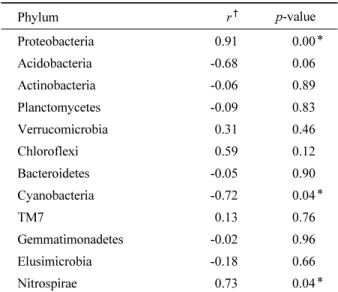
Table 4. Correlation between composition rate of soil bacteria phylum and soil pH.
뿌리혹박테리아류는 주로 콩과(legume) 식물 뿌리에 뿌리혹을 형성하여 공생 관계를 맺으며(Shamsledin et al., 2016), 질소 고정 능력을 갖고 식물에게 질소를 공급하는 박테리아 분류군을 뜻한다(Sprent, 2001). 하지만, 뿌리혹 박테리아류에 속하는 모든 분류군들이 콩과 식물에 뿌리 혹을 형성 하는 것은 아니다(Winarno and Lie, 1979). 뿌 리혹을 형성하진 않지만, 뿌리혹을 형성하는 다른 박테 리아 분류군들과 경쟁하고, 질소 고정 능력을 통해 식물 에게 영향을 미치는 분류군들도 다수 존재한다(Tanaka and Nara, 2009). 뿌리혹박테리아를 형성하지 않는 식물 들과 뿌리혹박테리아류의 관계 대한 연구를 예를 들면, Tanaka and Nara (2009) 연구에서는 소나무의 뿌리에서 뿌리혹박테리아에 속하는 Burkholderia, Bradyrhizobium, Rhizobium 속이 다수 존재하는 것을 확인하였다. Uroz et al.(2010)연구에서는 참나무 근권 안과 근권 밖 토양에
Burkholderia, Bradyrhizobium 속에 속하는 박테리아 종이 다수 존재하는 것으로 나타났으며, 근권 안의 Burkholderia 분류군의 수가 근권 밖보다 유의하게 높은 것으로 나타 났다. 장군봉 산림 토양 박테리아 군집의 뿌리혹박테리 아 분류군들도 소나무림 내 식물들과 상호작용하며, 임 분 내 질소 순환과 식물 생육에 중요한 역할을 하고 있을 것으로 판단된다.
4. 토양 화학적 특성과 박테리아 구성의 상관관계
VIF 수치를 통해 다중공선성 문제가 있는 토양 물리·
화학적 특성을 제거한 결과, 토양 입도 중 Sand와 Clay의 구성비율과 토양 화학적 특성 중 pH, 유효인산(AP), 유기 물량(OM)이 다중공선성 정도가 적은 변수로 선택되었 다. 선택된 토양 물리 · 화학적 특성과 토양 박테리아 군 집 구성간의 관계를 CCA 분석과 permutation test를 실시 한 결과, 최종적으로 토양 pH가 토양 박테리아 군집 구성 을 설명하는 유의한 변수로 선택되었다(F=1.92, p<0.05).
토양 pH는 토양 박테리아 군집 구성을 결정하는 주요 특 성으로 알려져 있으며(Fierer and Jackson, 2006; Lauber et al., 2009), 장군봉 천연 소나무림 토양 박테리아 군집 구성 또한 토양 pH에 의해 결정되는 것으로 판단된다.
토양 pH와 phylum 수준에서의 토양 박테리아 군집 구성 간의 상관관계를 살펴본 결과, Proteobacteria, Cyanobacteria, Nitrospirae 분류군이 토양 pH와 유의한 상관관계를 보였 다(Table 4). Proteobacteria 구성비율은 양의 상관관계를 나타냈다(r=0.91, p<0.01). Cyanobacteria는 토양 pH와 음 의 상관관계를 나타냈으며(r=-0.73, p<0.05), Nitrospirae 는 토양 pH와 양의 상관관계를 보였다(r=0.73, p<0.05).
Acidobacteria는 유의 수준(α) 0.05에서 유의하진 않았지 만 pH가 증가할수록 구성 비율이 감소하는 경향을 보였 다(r=-0.68, p<0.1).
Proteobacteria는 중성에 해당하는 pH 6까지 pH가 증가 할수록 구성 비율이 증가하는 것으로 알려져 있으며,
Acidobacteria는 pH 4부터 pH가 증가할수록 지속적으로 감 소하는 것으로 알려져 있다(Lauber et al., 2009). Nitrospirae 의 주요 에너지 대사 방법인 nitrite oxidation은 pH 5.3 이상 에서 활성화되는 것으로 알려져 있다(Ste-Marie and Pare, 1999). 한편, Cyanobacteria는 토양 pH가 증가할수록 번 식이 활발해지는 것으로 알려져 있지만(Prasanna, 2007), 본 분석 결과에서는 토양 pH와 음의 상관관계를 나타냈 다. 이 결과는 pH와 공선성을 나타내는 다른 토양 물리
·화학적 특성이 Cyanobacteria 군집 구성을 결정하는 주 요 변수일 가능성이 있음을 보여준다. 또한, 토양 박테리 아 분류군의 구성뿐만 아닌 각 분류군의 기능적 측면과 토 양 pH의 관계를 파악하여 이들이 산림 생태계에서 차지하 는 역할을 분석하는 것도 후속 연구로 필요할 것이다.
결 론
장군봉 천연 소나무림의 토양은 Proteobacteria, Acidobacteria가 우점하는 전형적인 토양 박테리아 군집 구성을 나타냈다. 또한, 장군봉 천연 소나무림의 토양 박테 리아 군집 구성은 Proteobacteria가 선호하는 부영양 조건 을 갖고 있는 것으로 보여진다. 장군봉 천연 소나무림의 유기물량은 기타 중부지방 소나무림 토양의 평균 유기물 량보다 상대적으로 높았는데, 이 결과는 인간의 관리가 이 루어지지 않는 천연림 내 풍부한 낙엽과 고사목 등이 유기 물량을 높게 유지시킨다는 견해와 일치하였다. 한편, 토양 내 질소 순환과 관련하여 Burkholderia, Bradyrhizobium, Rhizobium 속이 존재하며, 산림 식생의 생육에 기여를 하 고 있는 것으로 보인다. 토양 물리 · 화학적 특성과 토양 박테리아 군집 구성 간의 상관관계를 살펴본 결과, 토양 pH가 박테리아 군집 구성을 결정하는 주요 특성인 것으로 판단된다.
본 연구는 차세대염기서열 분석법을 통해 장군봉 소나 무림의 박테리아 군집만을 분석 대상으로 하였다. 그러나 박테리아는 산림 토양 내 생물다양성의 일부이며, 소나무 림 토양의 생태적 특성을 전반적으로 파악하기 위해서는 토양 균류에 대한 추가적인 조사도 필요할 것이다. 또한, 활엽수림 또는 혼효림 등 소나무림 이외의 토양 박테리아 군집 특성을 소나무림 토양과 함께 비교 분석하는 것이 소나무림을 포함한 다양한 형태의 산림에서 토양 박테리 아 군집 특성을 더 잘 이해할 수 있는 방법일 것이다.
감사의 글
본 연구는 산림청 ´임업기술연구개발사업(과제번호: S21131 6L020130)´의 지원에 의하여 이루어진 것입니다.
References
Banning, N.C., Gleeson, D.B., Grigg, A.H., Grant, C.D., Andersen, G.L., Brodie, E.L. and Murphy, D.V. 2011.
Soil microbial community successional patterns during forest ecosystem restoration. Applied and Environmental Microbiology 77(17): 6158-6164.
Berendsen, R.L., Pieterse, C.M. and Bakker, P.A. 2012. The rhizosphere microbiome and plant health. Trends in Plant Science 17(8): 478-486.
Blagodatskaya,E. V. and Anderson,T. 1998. Interactive effects of pH and substrate quality on the fungal-to-bacterial ratio and qCO2 of microbial communities in forest soils. Soil Biology and Biochemistry 30(10): 1269-1274.
Bloomfield, S.F., Stewart, G.S., Dodd, C.E., Booth, I.R. and Power, E. 1998. The viable but non-culturable phenomenon explained? Microbiology 144(1): 1-3.
Bowles, T.M., Acosta-Martínez, V., Calderón, F. and Jackson, L.E. 2014. Soil enzyme activities, microbial communities, and carbon and nitrogen availability in organic agroecosystems across an intensively-managed agricultural landscape.
Soil Biology and Biochemistry 68: 252-262.
Byeon, S.Y and Yun, C.W. 2016. Stand structure of actual vegetation in the natural forests and plantation area of Mt. Janggunbong, Bonghwa-Gun. Korean Journal of Environment and Ecology 30(6): 1032-1046.
Chapman, S.K. and Koch, G.W. 2007. What type of diversity yields synergy during mixed litter decomposition in a natural forest ecosystem? Plant and Soil 299: 153-162.
Chun, J., Kim, K.Y., Lee, J. and Choi, Y. 2010. The analysis of oral microbial communities of wild-type and toll-like receptor 2-deficient mice using a 454 GS FLX titanium pyrosequencer. BMC Microbiology 10: 101.
El Zahar Haichar, F., Marol, C., Berge, O., Rangel-Castro, J.I., Prosser, J.I., Balesdent, J., Heulin, T. and Achouak, W. 2008. Plant host habitat and root exudates shape soil bacterial community structure. The ISME Journal 2(12):
1221-1230.
Fierer, N., Bradford, M.A. and Jackson, R.B. 2007. Toward an ecological classification of soil bacteria. Ecology 88(6): 1354-1364.
Fierer, N. and Jackson, R.B. 2006. The diversity and biogeography of soil bacterial communities. Proceedings of the National Academy of Sciences of the United States of America 103(3): 626-631.
Hartmann, M., Niklaus, P.A., Zimmermann, S., Schmutz, S., Kremer, J., Abarenkov, K., Lüscher, P., Widmer, F. and Frey, B. 2014. Resistance and resilience of the forest soil microbiome to logging-associated compaction. The
ISME Journal 8(1): 226-244.
Hartmann, M., Howes, C.G., VanInsberghe, D., Yu, H., Bachar, D., Christen, R., Henrik Nilsson, R., Hallam, S.J.
and Mohn, W.W. 2012. Significant and persistent impact of timber harvesting on soil microbial communities in northern coniferous forests. The ISME Journal 6(12):
2199-2218.
Hur, M., Kim, Y., Song, H.R., Kim, J.M., Choi, Y.I. and Yi, H. 2011. Effect of genetically modified poplars on soil microbial communities during the phytoremediation of waste mine tailings. Applied and Environmental Microbiology 77(21): 7611-7619.
Janssen, P.H. 2006. Identifying the dominant soil bacterial taxa in libraries of 16S rRNA and 16S rRNA genes.
Applied and Environmental Microbiology 72(3): 1719- 1728.
Kamilova, F., Kravchenko, L.V., Shaposhnikov, A.I., Azarova, T., Makarova, N. and Lugtenberg, B. 2006.
Organic acids, sugars, and l-tryptophane in exudates of vegetables growing on stonewool and their effects on activities of rhizosphere bacteria. Molecular Plant Microbe Interactions 19(3): 250-256.
Kim, B., Kim, J.N., Yoon, S., Chun, J. and Cerniglia, C.E.
2012a. Impact of enrofloxacin on the human intestinal microbiota revealed by comparative molecular analysis.
Anaerobe 18(3): 310-320.
Kim, O., Cho, Y., Lee, K., Yoon, S., Kim, M., Na, H., Park, S., Jeon, Y.S., Lee, J. and Yi, H. 2012b. Introducing EzTaxon-e: A prokaryotic 16S rRNA gene sequence database with phylotypes that represent uncultured species.
International Journal of Systematic and Evolutionary Microbiology 62(3): 716-721.
Korea Forest Research Institute. 2014. Soil tests and plant analysis. Korea Forest Research Institute, Seoul, Korea.
Korea Forestry Service (KFS). 2016. Statistical yearbook of forestry. Korea Forest Service, Seoul, Korea. pp. 418.
Kumar, S., Stecher, G. and Tamura, K. 2016. MEGA7:
Molecular evolutionary genetics analysis version 7.0 for bigger datasets. Molecular Biology and Evolution 33(7):
1870-1874.
Lareen, A., Burton, F. and Schäfer, P. 2016. Plant root-microbe communication in shaping root microbiomes. Plant Molecular Biology 90(6): 575-587.
Lauber, C.L., Hamady, M., Knight, R. and Fierer, N. 2009.
Pyrosequencing-based assessment of soil pH as a predictor of soil bacterial community structure at the continental scale. Applied and Environmental Micro- biology 75(15): 5111-5120.
Lee, J. and Hong, S. 2004. Community types and population
structures of Pinus densiflora forest around the Bulyeongsa valley in Uljin-gun Southeastern Korea.
Journal of Korean Forestry Society 93(1): 59-66 Lee-Cruz, L., Edwards, D.P., Tripathi, B.M. and Adams, J.M.
2013. Impact of logging and forest conversion to oil palm plantations on soil bacterial communities in Borneo.
Applied and Environmental Microbiology 79(23): 7290- 7297.
Li, H., Ye, D., Wang, X., Settles, M.L., Wang, J., Hao, Z., Zhou, L., Dong, P., Jiang, Y. and Ma, Z.S. 2014. Soil bacterial communities of different natural forest types in Northeast China. Plant and Soil 383: 203-216.
Lyashevska, O. and Farnsworth, K.D. 2012. How many dimensions of biodiversity do we need? Ecological Indicators 18: 485-492.
Micallef, S.A., Shiaris, M.P. and Colon-Carmona, A. 2009.
Influence of Arabidopsis thaliana accessions on rhizobacterial communities and natural variation in root exudates. Journal of Experimental Botany 60(6): 1729- 1742.
Oh, Y.M., Kim, M., Lee-Cruz, L., Lai-Hoe, A., Go, R., Ainuddin, N., Rahim, R.A., Shukor, N. and Adams, J.M.
2012. Distinctive bacterial communities in the rhizoplane of four tropical tree species. Microbial Ecology 64(4):
1018-1027.
Paillet, Y., Bergès, L., Hjältén, J., Ódor, P., Avon, C., Bernhardt- Römermann, M., Bijlsma, R., De Bruyn, L., Fuhr, M.
and Grandin, U. 2010. Biodiversity differences between managed and unmanaged forests: Meta‐analysis of species richness in Europe. Conservation Biology 24(1): 101-112.
Palleroni, N.J. 1997. Prokaryotic diversity and the importance of culturing. Antonie Van Leeuwenhoek 72(1): 3-19.
Panke-Buisse, K., Poole, A.C., Goodrich, J.K., Ley, R.E. and Kao-Kniffin, J. 2015. Selection on soil microbiomes reveals reproducible impacts on plant function. The ISME Journal 9(4): 980-989.
Park, C.Y., Lee, S.K., Kim, J.H., Lee, S.Y. and Lee, J.K.
2012. Effect of soil environment on diversity and population of aerobic soil bacteria from Baekdudaegan mountain forests in Gyeongsangbuk-do, Korea. Journal of Korean Forest Society 101(3): 501-508.
Park, N., Lee, K. and Jung, S. 2009. Estimation of site productivity of Pinus densiflora by the soil physico- chemical properties. Korean Journal of Soil Science and Fertilizer 42(3): 160-166.
Prasanna, S.N. 2007. Soil pH and its role in cyanobacterial abundance and diversity in rice field soils. Applied Ecology and Environmental Research 5(2): 103-113.
Rousk,J., Brookes,P. C. and Baath,E. 2009. Contrasting soil
pH effects on fungal and bacterial growth suggest functional redundancy in carbon mineralization. Applied and Environmental Microbiology 75(6): 1589-1596.
Shamseldin, A., Abdelkhalek, A. and Sadowsky, M.J. 2016.
Recent changes to the classification of symbiotic, nitrogen-fixing, legume-associating bacteria: A review.
Symbiosis 71(2): 91-109.
Shi, C., Wang, C., Xu, X., Huang, B., Wu, L. and Yang, D. 2015. Comparison of bacterial communities in soil between nematode-infected and nematode-uninfected Pinus massoniana pinewood forest. Applied Soil Ecology 85: 11-20.
Sprent, J.I. 2001. Nodulation in legumes. John Wiley and Sons. Oxford, United Kingdom. pp. 200.
Ste-Marie, C. and Paré, D. 1999. Soil, pH and N availability effects on net nitrification in the forest floors of a range of boreal forest stands. Soil Biology and Biochemistry 31(11): 1579-1589.
Štursová, M., Žifčáková, L., Leigh, M.B., Burgess, R. and Baldrian, P. 2012. Cellulose utilization in forest litter and
soil: Identification of bacterial and fungal decomposers.
FEMS Microbiology Ecology 80(3): 735-746.
Tanaka, M. and Nara, K. 2009. Phylogenetic diversity of non-nodulating Rhizobium associated with pine ectomycorrhizae. FEMS Microbiology Ecology 69(3):
329-343.
Uroz, S., Buée, M., Murat, C., Frey‐Klett, P. and Martin, F. 2010. Pyrosequencing reveals a contrasted bacterial diversity between oak rhizosphere and surrounding soil.
Environmental Microbiology Reports 2(2): 281-288.
Van Der Heijden, M.G., Bardgett, R.D. and Van Straalen, N.M. 2008. The unseen majority: Soil microbes as drivers of plant diversity and productivity in terrestrial ecosystems.
Ecology Letters 11(3): 296-310.
Winarno, R. and Lie, T. 1979. Competition between Rhizobium strains in nodule formation: Interaction between nodulating and non-nodulating strains. Plant and Soil 51(1): 135-142.
(Received: February 7, 2017; Accepted: April 11, 2017)