ISSN 1225-0988 | EISSN 2234-6457 <Research Letter>
Optimal Frame Aggregation Level for Connectivity-Based Multipolling Protocol in IEEE 802.11 Wireless LANs
Woo-Yong Choi†*
Department of Industrial and Management Systems Engineering, Dong-A University
IEEE 802.11 무선랜에서 연결정보 기반의 멀티폴링 프로토콜을 위한 최적의 프레임 애그리게이션 레벨
최 우 용
동아대학교 산업경영공학과
When the PCF (Point Coordinated Function) MAC protocol is combined with the frame aggregation method to enhance the MAC performance in IEEE 802.11 wireless LANs, the formulae for the optimal frame aggregation level for best PCF MAC performance were derived in our previous study. We extend the formulae for the PCF protocol to derive the optimal frame aggregation level for the connectivity-based multipolling MAC protocol in IEEE 802.11 wireless LANs. By simulations, we compare the performances of IEEE 802.11 wireless LANs with the optimal and random frame aggregation levels. Compared with the random frame aggregation level, the optimal frame aggregation level significantly improves the performance of IEEE 802.11 wireless LANs.
Keywords: IEEE 802.11 Wireless LAN, Multipolling, Frame Aggregation, Connectivity
1. Introduction
IEEE 802.11 wireless LANs have been widely implemented in the world to provide the customers with the high speed wireless internet service. As the service data rate demanded by the customers grows, the technologies for the PHY and MAC protocols have been advanced in the directions of en- hancing the PHY data rate and the MAC transmission effi- ciency.
After the release of the initial standard for IEEE 802.11 wireless LAN supporting the PHY data rate of 1 or 2 Mbps in 1997, IEEE 802.11a, IEEE 802.11b, IEEE 802.11g and IEEE 802.11n were released to support respectively 54 Mbps in 5GHz frequency band, 11 Mbps in 2.4GHz frequency band, 54Mbps in 2.4GHz frequency band and about 600 Mbps in 2.4 or 5GHz frequency band (IEEE Std 802.11 (1997), IEEE
Std 802.11a (1999), Std 802.11b (1999), IEEE Std 802.11g (2003), IEEE Std 802.11n (2009)). To enhance the MAC transmission efficiency of the DCF (Distributed Coordination Function) and PCF (Point Coordination Function) MAC pro- tocols specified in IEEE Std 802.11 (1997), the frame ag- gregation method was developed in IEEE Std 802.11n (2009).
Additionally, in Li et al. (2009), the AFR (Aggregation with Fragment Retransmission) scheme was proposed to aggregate multiple fragments into a single MPDU (MAC Protocol Data Unit) and allow the fragments to be selectively retransmitted by inserting the additional fragment headers. The AFR scheme and the IEEE 802.11n frame aggregation method were opti- mized to be combined with the DCF protocol in Li et al.
(2009) and Lin and Wong (2006), the IEEE 802.11 frame ag- gregation method was combined with the connectivity-based multipolling MAC protocol in Choi (2011), and the formulae for the optimal frame aggregation level for best PCF MAC
This paper is a product of Dong-A university sabbatical leave of the author.
†Corresponding author : Professor Woo-Yong Choi, Department of Industrial and Management Systems Engineering, Dong-A University, Busan, 604-714, Korea, Tel : +82-51-200-7696, Fax : +82-51-200-7697, E-mail : [email protected]
Received June 16, 2014; Revision Received July 8, 2014; Accepted July 30, 2014.
performance were derived in Choi (2012a).
When the connectivity-based multipolling MAC protocol, where the dynamic search algorithm to solve the TSP (Travel- ling Salesman Problem) is employed, is combined with the frame aggregation method, it was shown that the connectivity- based multipolling MAC protocol can significantly enhance the PCF MAC performance by reducing the necessary polling over- head in Choi (2011). Therefore, the research for the optimal frame aggregation level for the connectivity-based multipolling MAC protocol combined with the frame aggregation method is important to optimally combine the connectivity- based multi- polling MAC protocol and the frame aggregation method.
In this paper, we extend the formulae in Choi (2012a) to de- rive the optimal frame aggregation level for the connectivity- based multipolling MAC protocol. By computer simulations, we show that the derived optimal frame aggregation level sig- nificantly enhances the MAC performance of the connectivity- based multipolling MAC protocol in IEEE 802.11 wireless LANs.
This paper is organized as follows. In the next section, we briefly explain the connectivity-based multipolling MAC protocol in Choi (2011). In Section 3, we derive the formulae for the optimal frame aggregation level for the connectivity- based multipolling MAC protocol combined with the frame aggregation method. In Section 4, numerical examples are presented to show the MAC performance enhancement by the derived optimal frame aggregation level. Finally, con- clusions are presented in Section 5.
2. Connectivity-Based Multipolling MAC Protocol
S represents the set of nodes associated with an AP (Access Point) in an IEEE 802.11 wireless LAN. The PCF protocol requires the AP to transmit separate polling frames to the no- des to grant the transmission opportunities. To reduce the polling frame transmissions, the AP collects from the nodes the updated connectivity information during the polling cycles.
At the initial time when the AP has no connectivity in- formation, the AP separately polls the nodes to grant the trans- mission opportunities to the nodes. However, as the AP collects the connectivity information, the AP tries to find the minimal number of sequentially connected multipolling sequences to construct the set S. The nodes in each connected multipolling se- quence can be polled by a single multipolling frame. In response to the multipolling frame, the first node starts the transmission of the response data or null frame an SIFS (Short Inter-Frame Space) period after the reception of the multipolling frame.
Each node except the first node in the sequence starts the trans-
mission of the response data or null frame an SIFS period after the end of the transmission of just the previous node. When any node fails to respond, the AP retransmits the multipolling frame including the MAC addresses of the remaining nodes a PIFS (PCF Inter-Frame Space) period after the end of the previous transmission. If the node failing to respond is the last recipient of the multipolling frame, the AP transmits a new multipolling frame a PIFS period after the end of the previous transmission.
In order to provide the reliable uplink real-time transmission service, the AP piggybacks on the multipolling frame the MAC addresses of the transmitters of the successfully received uplink data frames that were transmitted in response to the previous multipolling frame.
To add the capability of the downlink data transmission to the connectivity-based multipolling MAC protocol, the AP can piggyback its downlink data frame destined to the first recipient of the multipolling frame, on the multipolling frame. If the first recipient receives the piggybacked data frame correctly, the first recipient acknowledges the reception of the data frame by the response frame to the multipolling frame.
It is assumed that the retry bit in the frame control field is set to 1 in the multipolling frames retransmitted by the AP for the error recovery, and the retry bit is set to 0 in the initial (not re- transmitted) multipolling frames. It is assumed that the down- link data frames can be piggybacked on the initial multipolling frames, but not on the multipolling frames retransmitted by the AP for the error recovery.
Recently, the connectivity-based multipolling method was employed to develop the efficient reliable multicast MAC pro- tocol for IEEE 802.11 wireless LANs (Choi, 2012b).
3. Optimal Frame Aggregation Level
To determine the optimal frame aggregation level, the AP and each node periodically perform the transmission proce- dure without the frame aggregation method, monitor the traf- fic in IEEE 802.11 wireless LAN and estimate the following traffic parameters :
⦁ : mean transmission time of an MPDU, on which an MSDU (MAC Service Data Unit) is piggybacked, without the frame aggregation (seconds).
⦁ : mean transmission time of the MAC header in an MPDU without the frame aggregation (seconds).
⦁ : mean transmission time of the PLCP (PHY Layer Convergence Procedure) preamble and the PHY header (seconds).
⦁E : transmission error probability of an MPDU, on which an MSDU is piggybacked, without the frame aggregation.
⦁ : mean transmission time of a multipolling frame re- transmitted by the AP for the error recovery, including the transmission time of the PLCP preamble and the PHY header (seconds).
⦁ : mean number of recipients of an initial multipolling frame.
⦁ : ratio of the number of initial multipolling frames with a single recipient to the number of all the initial multi- polling frames.
⦁ : ratio of the number of initial multipolling frames, on which no MSDU is piggybacked, to the number of all the initial multipolling frames.
Each node can obtain TERR by averaging the transmission times of the multipolling frames with the retry bit of 1.
When node i transmits the MPDUs into which Gi MSDUs are aggregated, using the approach in Choi (2012a), mean time Ti
(seconds), which includes the inter-frame spacing, taken to complete a single MPDU transmission can be easily derived as follows :
≈ (1) where TSIFS (seconds) denotes SIFS time. Using the approach in Choi (2012a), we can also derive the transmission error proba- bility Ei of each MPDU, into which Gi MSDUs are aggregated, and the mean number Ni of transmissions necessary to success- fully transmit an MPDU as
(2)
(3)
If an MPDU of node i, which is transmitted as a response to a multipolling frame, is erroneously received by the next node j in the polling sequence of the multipolling frame, the node j fails to automatically respond to the multipolling frame and the AP retransmits the multipolling frame including the MAC ad- dresses of the remaining nodes a PIFS period after the end of the transmission of node i. If the node j failing to respond is the last recipient of the multipolling frame, one additional time slot is necessary before the transmission of a new multipolling frame.
Therefore, assuming that with independent probability Ei an MPDU of a node is erroneously received by the next node in the polling sequence of a multipolling frame, the mean total of the transmission time of node i, the retransmission time of the multi- polling frames, which is due to the failure of the transmission of node i to the next node j, and the additional time slots before the transmission of a new multipolling frame to successfully trans- mit an MPDU can be derived as
(4)
≈
where
is the probability that node i is not the last or the second last recipient of an initial multipolling frame,
the probability that node i is the second last recipient of a multipolling frame, TPIFS (seconds) denotes PIFS time, and TSLOT denotes time slot.If an initial multipolling frame of the AP, on which a down- link data frame destined to the first recipient k of the multi- polling frame is piggybacked, is erroneously received by the re- cipient k, the AP retransmits the multipolling frame including the MAC addresses of the remaining nodes a PIFS period after the end of the previous transmission. If the recipient k failing to receive the downlink data frame is the only recipient of the mul- tipolling frame, one additional time slot is necessary before the transmission of a new multipolling frame. When the AP trans- mits the MPDUs into which GAP MSDUs are aggregated, the mean total of the transmission time of initial multipolling frames of the AP, the retransmission time of the multipolling frames, which is due to the failure of the transmission of the AP, and the additional time slots before the transmission of a new multipolling frame to successfully transmit an MPDU can be derived as
≈
(5)
where
is the mean number of transmission failures for each successful transmission of an MPDU of the AP,
is the mean number of transmissions of initial multi- polling frames, on which no MSDU is piggybacked, between two consecutive transmissions of initial multipolling frames, on which MSDUs are piggybacked, and the last term is for the
mean transmission time of the initial multipolling frames, on which no MSDU is piggybacked. If Q0 = 1, SAP is not defined.
We can note that the formulae (4) and (5) become the same as those in Choi (2012a) when M = 1, Q0 = 0 and P1 = 1, which is the case of the PCF protocol with the AP transmitting every poll- ing frame on which an MSDU is piggybacked. The formulae in Choi (2012a) were derived under the traffic condition of Q0 = 0.
Generally when Q0≠ 0, that is, the AP has not always the data frames destined to every node associated with itself, the trans- mission time of the AP, which is specified by (5), is much short- er than the transmission time of the AP using the PCF protocol to transmit its traffic and poll the nodes because the con- nectivity-based multipolling MAC protocol needs much small- er number of polling frame transmissions than the PCF protocol (Choi, 2011).
Using the approach in Choi (2012a), we can estimate the mean total transmission time to transmit MAP MSDUs in the transmission buffer of the AP and Mi MSDUs in the trans- mission buffer of each node i by
≈
⌈
⌉
⌈
⌉
(6)Therefore, we can deduce that the optimal frame aggregation levels and to minimize the transmission delay are the frame aggregation levels such that and
are minimized. If Q0 = 1, is not defined, how- ever, obtained by minimizing Ii is valid.
When the values of TD, TH, TPHY, E, TERR, M, P1, Q0, TSIFS, TPIFS
and TSLOT are given, IAP and Ii can be numerically computed fast in terms of GAP and Gi. We can obtain the optimal aggregation levels and as the second last frame aggregation levels when we compute IAP and Ii for gradually increasing GAP = 1, 2,
… and Gi = 1, 2, … until the first increases of IAP and Ii are detected.
4. Simulation Results
To show the performance improvement of the connectivity- based multipolling MAC protocol by the optimal frame ag- gregation level, we consider three IEEE 802.11a wireless LANs with Z = 10, 30 and 50 nodes for E = 0.1%, 0.5%, 1%, 2% and 3%. Small MSDUs of 100 bits are transmitted from the nodes to the APs in each IEEE 802.11a wireless LAN. We assume that all the multipolling and the response frames are transmitted with the peak rate of 54 Mbps. It is assumed that the APs have no data frame to transmit and all the multipolling frames are success- fully transmitted with no transmission error.
The performance of the connectivity-based multipollong MAC protocol is affected by the connectivity among the nodes.
To estimate the conservative performance of the connectivity- based multipolling MAC protocol, for each Z = 10, 30 and 50, we chose the IEEE 802.11a wireless LAN requiring about two times multipolling frame transmissions as the average out of at least ten IEEE 802.11a wireless LANs, where the APs are lo- cated at the centers of the circular service area, the nodes are lo- cated randomly in the service area and each node has the trans- mission range of the radius of the service area. Actually, in the chosen IEEE 802.11a wireless LANs, the APs should transmit 2, 5 and 12 multipolling frames to poll Z = 10, 30 and 50 nodes, respectively.
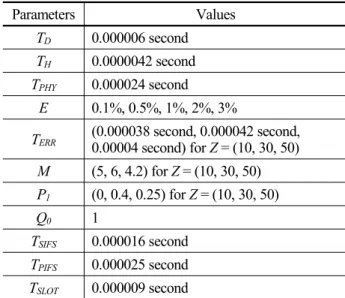
For three IEEE 802.11a wireless LANs, assuming that each node has the same probability E that its MPDU, on which an MSDU is piggybacked, is erroneously transmitted, we can ob- tain the values of TD, TH, TPHY, E, TERR, M, P1, Q0, TSIFS, TPIFS and TSLOT for each node as shown in <Table 1>.
Table 1. Values of parameters
Parameters Values
TD 0.000006 second TH 0.0000042 second TPHY 0.000024 second
E 0.1%, 0.5%, 1%, 2%, 3%
TERR (0.000038 second, 0.000042 second, 0.00004 second) for Z = (10, 30, 50) M (5, 6, 4.2) for Z = (10, 30, 50) P1 (0, 0.4, 0.25) for Z = (10, 30, 50) Q0 1
TSIFS 0.000016 second TPIFS 0.000025 second TSLOT 0.000009 second
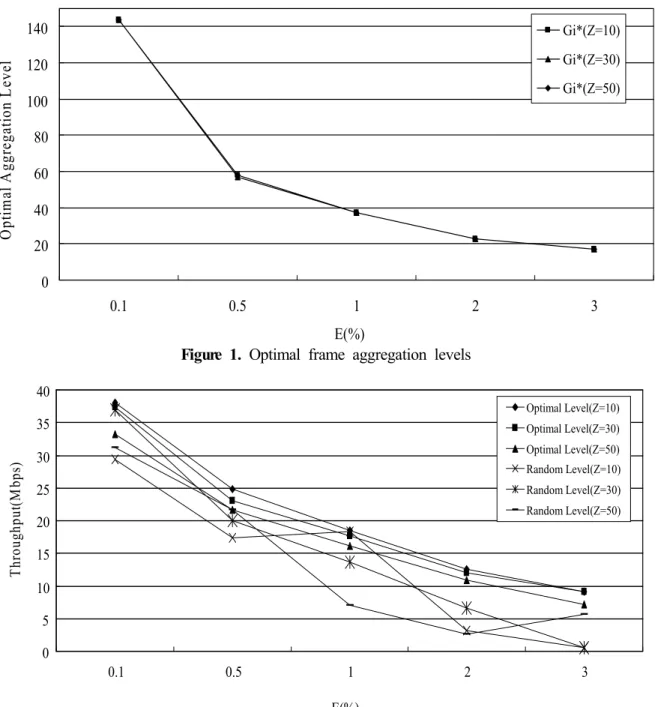
Using the values of the parameters in <Table 1>, we can de- rive the optimal frame aggregation level for each node with respect to the transmission error probability E as shown in
<Figure 1>. We cannot define the optimal frame aggregation level for the AP because Q0 = 1.
From <Figure 1>, we can see that the optimal frame ag- gregation levels for Z = 10, 30 and 50 are almost the same and the optimal frame aggregation levels become smaller as the transmission error probability E becomes larger. As E becomes larger, the retransmission overhead becomes larger, therefore, the optimal frame aggregation levels need to be smaller to re- duce the retransmission overhead.
For each combination of Z = 10, 30 and 50 and E = 0.1%, 0.5%, 1%, 2% and 3%, in <Figure 2>, we compare two bound-
0 20 40 60 80 100 120 140
0.1 0.5 1 2 3
E(%)
Optimal Aggregation Level
Gi*(Z=10) Gi*(Z=30) Gi*(Z=50)
Figure 1. Optimal frame aggregation levels
0 5 10 15 20 25 30 35 40
0.1 0.5 1 2 3
E(%)
Throughput(Mbps)
Optimal Level(Z=10) Optimal Level(Z=30) Optimal Level(Z=50) Random Level(Z=10) Random Level(Z=30) Random Level(Z=50)
Figure 2. Bounded-delay MAC throughput versus error probability E ed-delay throughputs of the connectivity-based multipolling
MAC protocol combined with the frame aggregation method.
The compared MAC throughputs are the MAC throughput maximums with the MSDU arrival rate to each node con- strained such that the transmission delay is upper bounded by 100 ms when the optimal frame aggregation levels in <Figure 1> and the random frame aggregation levels in the range [1, 150]
are used. For the simulation run for each combination of Z and E, at least 100,000 MSDUs are generated to periodically arrive to each node. The selected random frame aggregation levels for the comparison with the optimal frame aggregation method for each combination of Z and E are presented in <Table 2>.
Table 2. Selected random frame aggregation levels
Z E Random Levels
10 (0.1%, 0.5%, 1%, 2%, 3%) (41, 17, 34, 100*, 119*) 30 (0.1%, 0.5%, 1%, 2%, 3%) (108, 112, 14, 5, 95*) 50 (0.1%, 0.5%, 1%, 2%, 3%) (61, 41, 145*, 92*, 27*)
For the cases with six random frame aggregation levels in- dicated by ‘*’ in <Table 2>, we cannot find the bounded-delay MAC throughputs with the transmission delay limit of 100 ms because six random frame aggregation levels are too large for the given transmission error probabilities for each MSDU E =
1%, 2% and 3% so that the maximum transmission delay for the MPDUs, in which many MSDUs are aggregated, goes beyond the delay limit of 100 ms. Therefore, we applied the delay limit of at most about 995 ms to obtain the bounded-delay MAC throughputs for the cases with six random frame aggregation levels.
From <Figure 2>, we can see that as the error probability E in- creases, the performance of the connectivity-based multi- polling MAC protocol with the optimal frame aggregation level decreases, however, that with the random frame aggregation level fluctuates. If we do not consider the random frame ag- gregation levels with ‘*’ in <Table 2>, the fluctuation of the per- formance of IEEE 802.11 wireless LANs becomes evident when the random frame aggregation level fluctuates away from the optimal frame aggregation level. One of such fluctuation patterns can be observed when Z = 10 and E = 0.5% and 1%.
From the fluctuation of the performance of IEEE 802.11 wire- less LANs with the random frame aggregation level, we can de- duce that the frame aggregation level affects the performance of IEEE 802.11 wireless LANs, therefore the frame aggregation level should be optimized for best MAC performance of IEEE 802.11 wireless LANs. We can see that the connectivity-based multipolling MAC protocol with the optimal frame aggregation level significantly outperforms that with the random frame ag- gregation level at almost all cases. The gaps between the MAC throughputs of IEEE 802.11 wireless LANs with the optimal and random frame aggregation levels are on the average about 3.74Mbps, 3.5Mbps, 4.38Mbps, 7.68Mbps and 6.13Mbps at E
= 0.1%, 0.5%, 1%, 2% and 3%, respectively.
5. Conclusions
In this paper, the optimal frame aggregation level was provided for the connectivity-based multipolling MAC protocol com- bined with the frame aggregation method. For deriving the opti-
mal frame aggregation level for the connectivity-based multi- polling MAC protocol, we extended the formulae for the opti- mal frame aggregation level for the PCF MAC protocol. By computer simulations, we showed that the optimal frame ag- gregation level significantly improves the performance of the connectivity-based multipolling MAC protocol.
References
Choi, W.-Y. (2011), Combining Multipolling Method with Frame Aggre- gation for Collecting RFID Tag Information in IEEE 802.11 Wireless LANs, AEU-International Journal of Electronics and Communica- tions, 65(4), 345-348.
Choi, W.-Y. (2012a), Optimal Frame Aggregation Level for IEEE 802.11 PCF Protocol, AEU-International Journal of Electronics and Com- munications, 66(1), 23-27.
Choi, W.-Y. (2012b), Tighter Throughput Lower Bounds of Connectivity- Based Reliable Multicast MAC Protocol for IEEE 802.11 Wireless LANs, Journal of Korean Institute of Industrial Engineers, 38(4), 285-288.
IEEE Std 802.11 (1997), Wireless LAN Medium Access Control (MAC) and Physical Layer (PHY) Specifications.
IEEE Std 802.11a (1999), Wireless LAN Medium Access Control (MAC) and Physical Layer Specifications : High Speed Physical Layer in the 5GHz Band.
IEEE Std 802.11b (1999), Wireless LAN Medium Access Control (MAC) and Physical Layer Specifications : Higher Speed Physical Layer (PHY) Extension in the 2.4GHz Band.
IEEE Std 802.11g (2003), Wireless LAN Medium Access Control (MAC) and Physical Layer Specifications : Higher Speed Physical Layer (PHY) Extension in the 2.4GHz Band.
IEEE Std 802.11n (2009), Wireless LAN Medium Access Control (MAC) and Physical Layer (PHY) Specifications : Enhancements for Higher Throughput.
Li, T., Ni, Q., Malone, D., Leith, D., Xiao, Y., and Turletti, T. (2009), Aggregation with Fragment Retransmission for Very High-Speed WLANs, IEEE/ACM Transactions on Networking, 17(2), 591-604.
Lin, Y. and Wong, V. W. S. (2006), Frame Aggregation and Optimal Frame Size Adaptation for IEEE 802.11n WLANs, Proc. IEEE GLOBECOM 2006, 1-6.