KISEP Original Article Sleep Medicine and Psychophysiology
•••••••••••••••••••••••••••••••••••••••••••••••••••••••••••••••••••••••••
수면·정신생리 8(2): 129-137, 2001
Effects of Total Sleep Deprivation on Fine Motor Performance
Heon-Jeong Lee,1 Hyung-Seok Song,1 Byung-Joo Ham,2 Kwang-Yoon Suh,2 Leen Kim2
■ABSTRACT
Objectives: The purpose of this study is to investigate the effects of 38-hour sleep deprivation on fine motor performance. The Motor Performance Series (MPS) in the Vienna Test System (computerized neurocognitive function tests) was used in this study.
Methods: Twenty four subjects participated in this study. Subjects had no past history of psychiatric disorders and physical illness.
Subjects had normal sleep-waking cycle without current sleep disturbances and were all right-handed (Annett’s Hand Preference Questionnaire:above +9 points). To minimize the learning effects, familiarization with the Vienna Test System was performed one day before the study. Subjects were to get up at 6:00 in the morning after getting enough sleep according to his or her usual sleep-wake cycle. After awakening, subjects remained awake for 38 hours under continuous surveillance. During two consecutive study days, the subjects tested MPS at 7 AM and 7 PM each day, which means the MPS was done four times in total. During the experiment, anything that could affect the subjects' sleep such as coffee, tea, alcohol, a nap, tiring sports, and all medications were prohibited.
Results: In MPS, the fine motor functions of both hands decreased after 38 hours of sleep deprivation. The decrement in motor performance was prominent in the dominant right hand. In the right hand, the total number of tapping was reduced (p<.005), and the number of misses (p<.05) and the length of misses (p<.05) of line tracking, the total length of inserting a short pin (p<.01), the total length of inserting a long pin (p<.05), and the number of misses in aiming (p<.05) increased. Such performance decrement was distinct in the morning sessions.
Conclusions: These results suggest that fine motor performance decrement during sleep deprivation is predominant in the right hand, which exerts maximal motor function. The finding of decrement in motor function in tapping during sleep deprivation also suggested that the time required for exhaustion of muscles is shortened during sleep deprivation. More deterioration of motor performance was shown in the morning, which could be explained as circadian rhythm effects. Sleep Medicine and Psycho-physiology 2001;8(2):
129-137
Key words: Total sleep deprivation·Fine motor performance·Motor Performance Test Series.
INTRODUCTION
Sleep loss or restrictions occasionally happens in modern lives. Workers such as shift worker, civil servant and health
care practitioners are under the pressure to endure sleep restrictions or disturbances. Many researches on sleep depri- vation show that sleep restrictions or disturbances cause the decrement in reaction time and vigilance, deviation in per- ception and cognitive functions, and mood disturbance(1-4).
Although cognitive decline and mood disturbance observed during prolonged wakefulness are well established, the in- fluences of sleep loss on motor function are not clearly established.
Few authors have focused their research on the ability to perform submaximal and maximal exercise after disturbed sleep. Some studies have demonstrated that prolonged wake- fulness or disturbed sleep lead to decrement in motor per- formance(5,6) whereas others reported no decline of exercise
••••••••••••••••••••••••••••••••••••••••••••••••••••••••••••••••••••••••••••••••••••••••••••••••••••••••••••••••••••
1음성정신병원 정신과
Department of Neuropsychiatry, Eum-Sung Mental Hospital, Eum- sung, Korea
2고려대학교 의과대학 정신과학교실
Department of Psychiatry, Korea University College of Medicine, Seoul, Korea
Corresponding author: Leen Kim, Department of Neuropsychiatry, Korea University, Anam Hospital, 126-1 Anam-dong, Seongbuk-gu, Seoul 136-705, Korea
Tel: 02) 920-5355, Fax: 02) 927-2836 E-mail: [email protected]
capacity after sleep deprivation(7-11).
One of the reasons for this discordance among the results of previous studies is the difficulty in reproducing the same experimental conditions in different laboratories. Another pro- blem for such a comparative study on the sleep deprivation effects on physical performance arises from the differences in the periods of sleep deprivation. Some research were done with total sleep deprivation(11-14), others were performed with partial sleep deprivation(15,16). The length and method of sleep deprivation are critical when examining the effect of sleep deprivation on mental and physical performance.
Another problem in comparing sleep deprivation studies is the difference in experimental designs. Almost every study employs a different experimental protocol. In some studies, the subjects remain sedentary except for their physical per- formance testing(11,12), while in other studies subjects are continuously active(13,17). In the latter case, the amount and intensity of the activity differs from one study to another.
These differences of the experimental design also gave rise to the discordance among the results of the previous studies.
One of the problems of previous studies is that circadian rhythm of physical performance has not been considered.
Human motor performance also has circadian variation, wh- ich means that considering the circadian rhythm is essential in the evaluation of the change in physical performance during sleep deprivation.
The research on the effect of sleep deprivation on motor performance which have been carried out so far are concerned with effects on gross motor performance, such as treadmill running, weight lifting, and muscular strength(11-13,15,17).
However, minute motor performance is more important in daily life and occupational works. Fine motor performance may be more vulnerable to sleep deprivation. Until now, no study has been exclusively designed to examine the effect of sleep deprivation on fine motor performance.
The purpose of this study is to investigate the effect of 38 hour sleep deprivation on fine motor performance of upper extremities objectively by means of quantifiable methods.
Computerized neuropsychological tests (Vienna Test Sys- tem) were used to evaluate motor performance after sleep deprivation.
SUBJECTS AND METHODS
1. Subjects
Twenty four medical students (21 men, 3 women, 24.75±
1.49 years of age) from Korea University College of Medi- cine participated in this study. They were all volunteers and had neither past history of psychiatric disorders nor major physical illness. They were all right-handed (Annett’s Hand Preference Questionnaire:above +9 points). All of the sub- jects completed sleep logs for two weeks to exclude those suffering from chronic sleep deprivation and sleep disturb- ances.
2. Designs
To minimize the learning effect, familiarization with the motor performance series (in the following called the MPS for short) in the Vienna Test System was performed. In other words, the same categorized tests were given a day before the actual test. The subjects were to get up at 6:00 in the morning after getting enough sleep as his or her normal cy- cle. the MPS was performed at 7:00 (Session 1:marked as S1 below). At 19:00, the MPS was operated once more (Session 2:marked as S2 below). After that, the subjects were made to stay awake until 7:00 the next day when the tests were held again (Session 3:marked as S3 below). The final session was held at 19:00 (Session 4:marked as S4 below), when, the MPS was conducted once again. During the experiment, anything that could affect the subjects' sleep such as coffee, tea, alcohol, a nap, and tiresome sports and any medications were prohibited.
3. Test instrument
As a computerized neuropsychological test, the Vienna Test System, version IX was used. The MPS in the Vienna Test System was performed during sleep deprivation. The MPS uses electronic test equipment to assess minute motor skills objectively to assess the maximum number of minute motor activity factors, which should have relevance to pra- ctical work. Tests were performed in right-hand, left-hand, and ambidextrous mode. The MPS task board combined facilities for 6 basic types of motor tests;steadiness, line tracking, aiming, tapping, inserting (long and short) pins and pursuit rotor.
To test an endurance for the steadiness, subject inserts a pen correctly into the 4.8mm diameter hole and hold the pen as steadily as possible without touching the edge for 16 se- conds. The number of misses and length of misses are mea- sured automatically. For the aiming test, subject is instructed to touch each of the circles in a row (20 small circles) with the pen just once as quickly as possible. The number of
misses, length of misses, number of hits, and total length are measured automatically. In line tracking, subject has to move the pen along a punched line, without touching the edges.
The speed and errors are measured automatically. For the tapping, subject is instructed to tap against a plate with the pen as frequently as possible. The total number of tapping is measured automatically. In inserting long pins, subject has to pick up 25 long pins from the holes of the plate and insert them into the holes in the task board. Inserting short pins is same as above, but the pins are so short that it is difficult for subject to handle them. Therefore finer execution is reques- ted here. In pursuit rotor, subject is asked to follow a lumi- nous rotating (15 r/min) bar with a pen. Total number and length of misses are measured automatically.
4. Statistical analysis
All the data obtained from the four test sessions taken by each subject were analyzed by ANOVA for repeated mea- sures. Considering the circadian rhythm of the subjects, data from the tests taken in the morning (S1 and S3) and tests taken in the evening (S2 and S4) were divided into two groups. Then, the data were analyzed by paired t-test in each groups.
RESULTS
In the MPS during sleep deprivation, the decrements of the fine motor performance of upper extremity were mainly in the dominant right hand. The results of the MPS were presented as below in the order of left-hand, right-hand and ambidextrous mode.
1. Left-hand Mode
In the left-hand mode, there was no obvious trait of change in motor performance in the case of sleep deprivation.
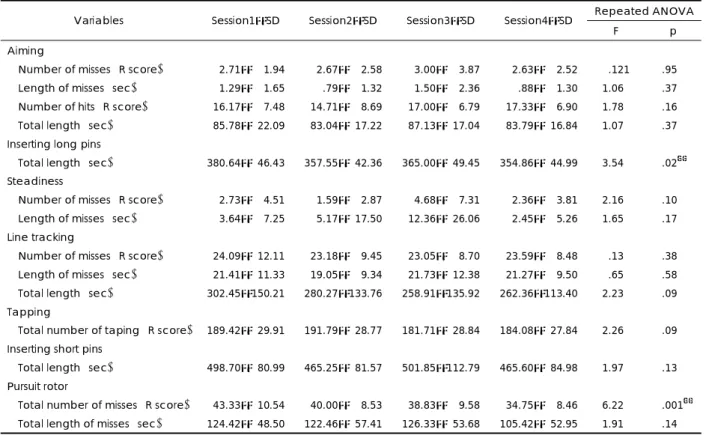
But the total length of 'inserting short pin’ was significantly shortened (p<.05) while the total number of misses of ‘pur- suit rotor’ was significantly decreased (p=.001)(Table 1).
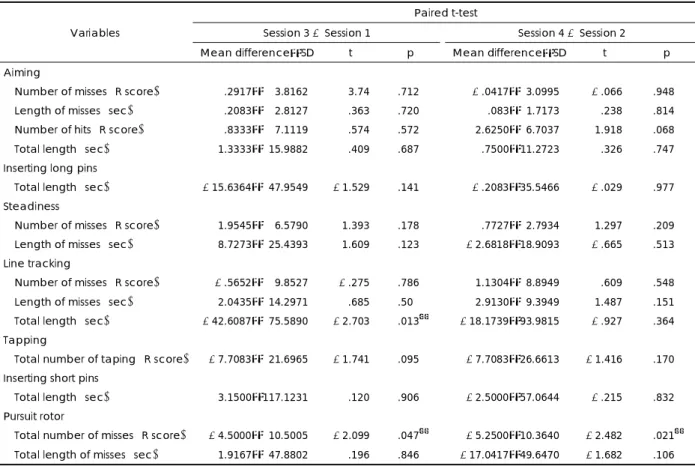
In paired t-test, which compared sessions taken in the mo- rning and evening for two days, the results of left-hand mode was unremarkable. But the total length of ‘line tracking’ was significantly decreased in the morning session (S3-S1=
-42.6087±75.5890, t=-2.703, p<.05), the total numbers of misses in ‘pursuit rotor’ in both morning and evening session were significantly decreased (S3-S1=-4.5000±10.5005, t=-2.099, p<.05;S4-S2=-5.2500±10.3640, t=-2.482, p<.05)(Table 2).
Table 1. The results of Motor Performance Series during sleep deprivation in each sessions (Lt hand)
Repeated ANOVA Variables Session1±SD Session2±SD Session3±SD Session4±SD
F p
Aiming
Number of misses (R score)
002.71±001.94 002.67±002.58 003.00±003.87 002.63±002.52 0.121 .95
Length of misses (sec)001.29±001.65 000.79±001.32 001.50±002.36 000.88±001.30 1.060 .37
Number of hits (R score)016.17±007.48 014.71±008.69 017.00±006.79 017.33±006.90 1.780 .16
Total length (sec)085.78±022.09 083.04±017.22 087.13±017.04 083.79±016.84 1.070 .37
Inserting long pinsTotal length (sec) 380.64±046.43 357.55±042.36 365.00±049.45 354.86±044.99 3.540 .02§
Steadiness
Number of misses (R score)
002.73±004.51 001.59±002.87 004.68±007.31 002.36±003.81 2.160 .10
Length of misses (sec)003.64±007.25 005.17±017.50 012.36±026.06 002.45±005.26 1.650 .17
Line tracking
Number of misses (R score)
024.09±012.11 023.18±009.45 023.05±008.70 023.59±008.48 0.130 .38
Length of misses (sec)021.41±011.33 019.05±009.34 021.73±012.38 021.27±009.50 0.650 .58
Total length (sec) 302.45±150.21 280.27±133.76 258.91±135.92 262.36±113.40 2.230 .09Tapping
Total number of taping (R score) 189.42±029.91 191.79±028.77 181.71±028.84 184.08±027.84 2.260 .09 Inserting short pins
Total length (sec) 498.70±080.99 465.25±081.57 501.85±112.79 465.60±084.98 1.970 .13
Pursuit rotor
Total number of misses (R score)
043.33±010.54 040.00±008.53 038.83±009.58 034.75±008.46 6.220 .001
§ Total length of misses (sec) 124.42±048.50 122.46±057.41 126.33±053.68 105.42±052.95 1.910 .14§:significantly better performance, *:significantly worse performance
Table 2. The Comparisons of Motor Performance Series between session 1 and session 3, session 2 and session 4 (Lt hand)
Paired t-test
Variables Session 3 - Session 1 Session 4 - Session 2
Mean difference±SD t p Mean difference±SD t p Aiming
Number of misses (R score) .2917±003.8162 3.74 .712 -.0417±03.0995 -.066 .948 Length of misses (sec) .2083±002.8127 .363 .720 .083±01.7173 .238 .814 Number of hits (R score) .8333±007.1119 .574 .572 2.6250±06.7037 1.918 .068 Total length (sec) 1.3333±015.9882 .409 .687 .7500±11.2723 .326 .747 Inserting long pins
Total length (sec) -15.6364±047.9549 -1.529 .141 -.2083±35.5466 -.029 .977 Steadiness
Number of misses (R score) 1.9545±006.5790 1.393 .178 .7727±02.7934 1.297 .209 Length of misses (sec) 8.7273±025.4393 1.609 .123 -2.6818±18.9093 -.665 .513 Line tracking
Number of misses (R score) -.5652±009.8527 -.275 .786 1.1304±08.8949 .609 .548 Length of misses (sec) 2.0435±014.2971 .685 .50 2.9130±09.3949 1.487 .151 Total length (sec) -42.6087±075.5890 -2.703 .013§ -18.1739±93.9815 -.927 .364 Tapping
Total number of taping (R score) -7.7083±021.6965 -1.741 .095 -7.7083±26.6613 -1.416 .170 Inserting short pins
Total length (sec) 3.1500±117.1231 .120 .906 -2.5000±57.0644 -.215 .832 Pursuit rotor
Total number of misses (R score) -4.5000±010.5005 -2.099 .047§ -5.2500±10.3640 -2.482 .021§ Total length of misses (sec) 1.9167±047.8802 .196 .846 -17.0417±49.6470 -1.682 .106
§:significantly better performance, *:significantly worse performance
Table 3. The results of Motor Performance Series during sleep deprivation in each sessions (Rt hand)
Repeated ANOVA Variables Session1±SD Session2±SD Session3±SD Session4±SD
F p
Aiming
Number of misses (R score)
000.39±000.50 001.13±001.49 001.26±001.66 000.78±001.57 2.94 .04*
Length of misses (sec)
000.09±000.29 000.26±000.62 000.26±000.54 000.09±000.42 1.42 .25
Number of hits (R score)019.96±000.55 019.92±000.41 019.79±001.06 019.13±004.09 0.84 .48
Total length (sec)069.29±015.47 066.54±012.99 070.71±012.37 074.75±034.76 1.07 .37
Inserting long pinsTotal length (sec) 347.75±041.14 323.42±034.18 353.96±058.33 341.58±061.43 3.10 .03*
Steadiness
Number of misses (R score)
001.26±002.42 000.95±002.04 003.05±005.10 001.84±002.73 2.13 .11
Length of misses (sec)001.05±002.51 000.63±001.57 005.84±017.39 002.11±005.33 1.28 .29
Line tracking
Number of misses (R score)
013.75±006.26 015.96±006.92 016.92±007.92 017.25±006.88 3.66 .017*
Length of misses (sec)
011.83±006.70 013.21±007.79 015.88±010.47 015.67±008.66 3.81 .014*
Total length (sec) 281.00±129.54 245.71±122.03 257.88±133.94 226.38±128.10 5.26 .003§
Tapping
Total number of taping (R score) 219.04±033.89 222.63±032.02 209.58±035.51 213.71±031.82 5.30 .002*
Inserting short pins
Total length (sec) 407.75±054.46 390.29±067.59 444.87±089.55 400.62±063.80 5.72 .001*
Pursuit rotor
Total number of misses (R score)
037.46±012.85 035.38±010.57 035.38±008.45 032.67±006.69 1.49 .225
Total length of misses (sec) 133.42±070.45 109.33±056.66 129.38±063.45 124.63±066.05 1.81 .153§:significantly better performance, *:significantly worse performance
2. Right-hand Mode
The performance of the right-hand mode was more rapid and exact than that of the left-hand mode. However, as the sleep deprivation progressed, the accuracy and speed of mo- tor performance decreased, while hasty execution was pro- minent. The number of misses in ‘aiming’ (p<.05), the number of missed (p<.05) and the length of misses (p<.05) in ‘line tracking’ were significantly increased, in other words, accuracy of performance was deteriorated. The total length in ‘inserting short pin’ (p=.001) and the total length in ‘in- serting long pin’ (p<.05) were significantly increased. The total number of ‘tapping’ was lessened (p<.005) and the to- tal length of ‘line tracking’ was decreased (p<.005)(Table 3).
In paired t-test with the data from the right-hand mode, the accuracy of motor performance was decreased, especially in the morning session under the condition of sleep deprivation.
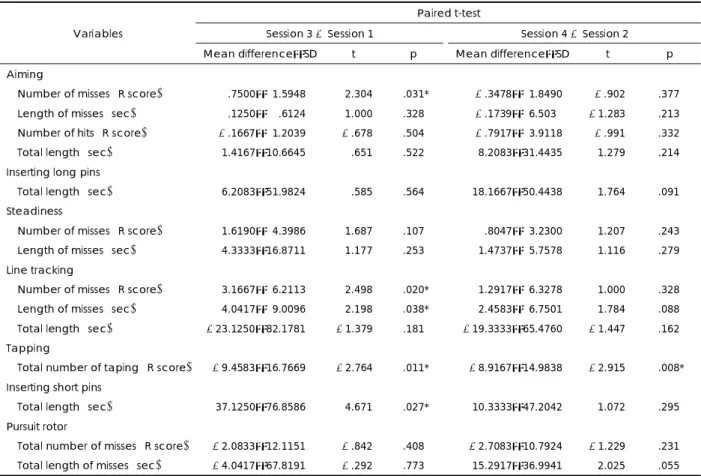
The number of misses in ‘aiming’ in the morning session (S3-S1=.7500±1.5948, t=2.304, p<.05) and the number of misses (S3-S1=3.1667±6.2113, t=2.498, p<.05) and length of misses (S3-S1=4.0417±9.0096, t=2.198, p<.05) in ‘line tracking’ in the morning session were increased. The
total length of ‘inserting short pin’ in the morning session was lengthened (S3-S1=37.1250±76.8586, t=4.671, p<.05).
The total number of ‘tapping’ was decreased in both morning and evening session (S3-S1=-9.4583±16.7669, t=-2.764, p<.05;S4-S2=-8.9167±14.9838, t=-2.915, p<.01)(Ta- ble 4).
3. Ambidextrous Mode
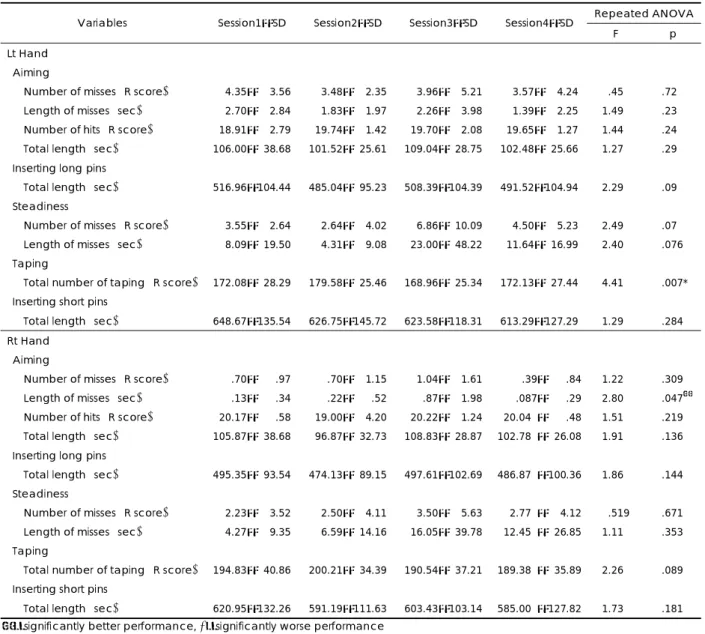
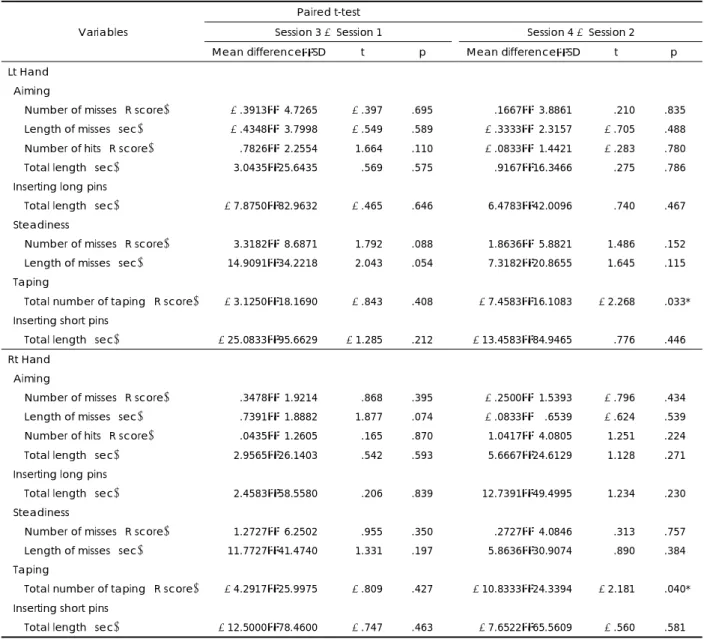
In the ambidextrous mode, there were no obvious trait of change in motor performance under the condition of sleep deprivation in the right or left hands. But the total number of
‘tapping’ was generally decreased in both hands, especially in the left hand (p<.01)(Table 5).
In paired t-test with the data from the ambidextrous mode, there was no obvious trait of change in motor performance with sleep deprivation in both hands. However, the total number of ‘tapping’ was significantly decreased in both hands in the evening session (Lt hand:S4-S2=-7.4583±
16.1083, t=-2.268, p<.05;Rt hand:S4-S2=-10.8333±
24.3394, t=-2.181, p<.05)(Table 6).
Table 4. The Comparisons of Motor Performance Series between session 1 and session 3, session 2 and session 4 (Rt hand)
Paired t-test
Variables Session 3 - Session 1 Session 4 - Session 2
Mean difference±SD t p Mean difference±SD t p
Aiming Number of misses (R score) .7500±01.5948 2.304 .031* -.3478±01.8490 -.902 .377
Length of misses (sec) .1250±00.6124 1.000 .328 -.1739±06.5030 -1.283 .213 Number of hits (R score) -.1667±01.2039 -.678 .504 -.7917±03.9118 -.991 .332 Total length (sec) 1.4167±10.6645 .651 .522 8.2083±31.4435 1.279 .214 Inserting long pins
Total length (sec) 6.2083±51.9824 .585 .564 18.1667±50.4438 1.764 .091 Steadiness
Number of misses (R score) 1.6190±04.3986 1.687 .107 .8047±03.2300 1.207 .243 Length of misses (sec) 4.3333±16.8711 1.177 .253 1.4737±05.7578 1.116 .279 Line tracking
Number of misses (R score) 3.1667±06.2113 2.498 .020* 1.2917±06.3278 1.000 .328 Length of misses (sec) 4.0417±09.0096 2.198 .038* 2.4583±06.7501 1.784 .088 Total length (sec) -23.1250±82.1781 -1.379 .181 -19.3333±65.4760 -1.447 .162 Tapping
Total number of taping (R score) -9.4583±16.7669 -2.764 .011* -8.9167±14.9838 -2.915 .008*
Inserting short pins
Total length (sec) 37.1250±76.8586 4.671 .027* 10.3333±47.2042 1.072 .295 Pursuit rotor
Total number of misses (R score) -2.0833±12.1151 -.842 .408 -2.7083±10.7924 -1.229 .231 Total length of misses (sec) -4.0417±67.8191 -.292 .773 15.2917±36.9941 2.025 .055
§:significantly better performance, *:significantly worse performance
DISCUSSION
Some investigators have focused their research on the ability to perform motor function after sleep deprivation.
However there are some discordance among the results of the previous studies. Reilly and Deykin(15) experimented on partial sleep deprivation (2.5 hours of sleep every night over 3 nights). As a result of the experiment, partial sleep deprivation did not affect hand grip, the broad jump, ratings of perceived exercise during the treadmill run, lung function measures and endurance capacity. However, anaerobic power decreased as well as the 2-choice visual reaction time. Thus, partial sleep deprivation does not affect gross motor functions which include muscular strength, lung power and treadmill
endurance running. On the other hand, decrements in psy- chomotor functions are altered after only the first night.
Symoms et al(11) evaluated the effects of 60 hours of sleep deprivation and exposure to prolonged physical activity in 11 male subjects. The results of the studies suggested that sleep deprivation of at least 60 hours does not impair the capability for aerobic or anaerobic physical performance, or electromechanical response times and muscle strength. Ro- dgers et al(13) examined the effect of a 48-hour period of sleep deprivation on the performance of selected physical work tasks (30-45% of maximum oxygen consumption:
VO2 max). The results of the experiment implied that con- tinuous physical tasks at 35-40% VO2 max are inhibited by 48 hours of sleep deprivation, but maximal efforts can still be achieved. Martin(12) studied the effects of 36 hour sleep
Table 5. The results of Motor Performance Series during sleep deprivation in each sessions (Both hand)
Repeated ANOVA Variables Session1±SD Session2±SD Session3±SD Session4±SD
F p
Lt Hand
Aiming
Number of misses (R score)
004.35±003.56 003.48±002.35 003.96±005.21 003.57±004.24 0.450 .72
Length of misses (sec)002.70±002.84 001.83±001.97 002.26±003.98 001.39±002.25 1.490 .23
Number of hits (R score)018.91±002.79 019.74±001.42 019.70±002.08 019.65±001.27 1.440 .24
Total length (sec) 106.00±038.68 101.52±025.61 109.04±028.75 102.48±025.66 1.270 .29 Inserting long pinsTotal length (sec) 516.96±104.44 485.04±095.23 508.39±104.39 491.52±104.94 2.290 .09
Steadiness
Number of misses (R score)
003.55±002.64 002.64±004.02 006.86±010.09 004.50±005.23 2.490 .07
Length of misses (sec)008.09±019.50 004.31±009.08 023.00±048.22 011.64±016.99 2.400 .076
Taping
Total number of taping (R score) 172.08±028.29 179.58±025.46 168.96±025.34 172.13±027.44 4.410 .007*
Inserting short pins
Total length (sec) 648.67±135.54 626.75±145.72 623.58±118.31 613.29±127.29 1.290 .284
Rt Hand
Aiming
Number of misses (R score)
000.70±000.97 000.70±001.15 001.04±001.61 0000.39±000.84 1.220 .309
Length of misses (sec)000.13±000.34 000.22±000.52 000.87±001.98 000.087±000.29 2.800 .047
§ Number of hits (R score)020.17±000.58 019.00±004.20 020.22±001.24 020.040±000.48 1.510 .219
Total length (sec) 105.87±038.68096.87±032.73
108.83±028.87 102.780±026.08 1.910 .136 Inserting long pinsTotal length (sec) 495.35±093.54 474.13±089.15 497.61±102.69 486.870±100.36 1.860 .144
Steadiness
Number of misses (R score)
002.23±003.52 002.50±004.11 003.50±005.63 002.770±004.12 0.519 .671
Length of misses (sec)004.27±009.35 006.59±014.16 016.05±039.78 012.450±026.85 1.110 .353
Taping
Total number of taping (R score) 194.83±040.86 200.21±034.39 190.54±037.21 189.380±035.89 2.260 .089 Inserting short pins
Total length (sec) 620.95±132.26 591.19±111.63 603.43±103.14 585.000±127.82 1.730 .181
§:significantly better performance, *:significantly worse performance
deprivation on heavy exercise performance with controlled study design. The author found that 36 hour of acute sleep deprivation reduced the ability to maintain heavy submaxi- mal exercise. This decrease occurred in the face of unchanged exercise-heart rate and metabolic rate. Sleep loss significantly elevated the exertion perceived during exercise.
As mentioned above, there are some disagreement among the results from the previous studies. This disagreement bet- ween the previous studies is due to the differences in experi- mental conditions, evaluation items, and evaluation methods.
Combining the results from the previous research all together, it is likely that the long-term sleep deprivation may contribute to decreased motor function, especially in prolonged motor performance.
Naitoh(18) found that sleep deprivation of less than 46 hours is usually too short to have substantial effect on co- gnitive function and motor tasks, while Koslowsky and Babkoff(19) have also shown that more than 45 hours of sleep deprivation is required to cause deterioration in per- formance using meta-analysis of data from 27 previous sleep deprivation research. However, this study shows the deterio- ration in fine motor performance of upper extremities after only 38 hour sleep deprivation.
Martin(6) concluded that the effect of sleep deprivation depends on the type and length of the motor task. He repor- ted that performance on certain endurance tasks is decreased by sleep deprivation(12). However, the fine motor tasks in this study only take several seconds or minutes. In addition,
Table 6. The Comparisons of Motor Performance Series between session 1 and session 3, session 2 and session 4 (Both hand)
Paired t-test
Variables Session 3 - Session 1 Session 4 - Session 2
Mean difference±SD t p Mean difference±SD t p Lt Hand
Aiming
Number of misses (R score) -.3913±04.7265 -.397 .695 .1667±03.8861 .210 .835 Length of misses (sec) -.4348±03.7998 -.549 .589 -.3333±02.3157 -.705 .488 Number of hits (R score) .7826±02.2554 1.664 .110 -.0833±01.4421 -.283 .780 Total length (sec) 3.0435±25.6435 .569 .575 .9167±16.3466 .275 .786 Inserting long pins
Total length (sec) -7.8750±82.9632 -.465 .646 6.4783±42.0096 .740 .467
Steadiness Number of misses (R score) 3.3182±08.6871 1.792 .088 1.8636±05.8821 1.486 .152
Length of misses (sec) 14.9091±34.2218 2.043 .054 7.3182±20.8655 1.645 .115 Taping
Total number of taping (R score) -3.1250±18.1690 -.843 .408 -7.4583±16.1083 -2.268 .033*
Inserting short pins
Total length (sec) -25.0833±95.6629 -1.285 .212 -13.4583±84.9465 .776 .446 Rt Hand
Aiming
Number of misses (R score) .3478±01.9214 .868 .395 -.2500±01.5393 -.796 .434 Length of misses (sec) .7391±01.8882 1.877 .074 -.0833±00.6539 -.624 .539 Number of hits (R score) .0435±01.2605 .165 .870 1.0417±04.0805 1.251 .224 Total length (sec) 2.9565±26.1403 .542 .593 5.6667±24.6129 1.128 .271 Inserting long pins
Total length (sec) 2.4583±58.5580 .206 .839 12.7391±49.4995 1.234 .230
Steadiness Number of misses (R score) 1.2727±06.2502 .955 .350 .2727±04.0846 .313 .757
Length of misses (sec) 11.7727±41.4740 1.331 .197 5.8636±30.9074 .890 .384 Taping
Total number of taping (R score) -4.2917±25.9975 -.809 .427 -10.8333±24.3394 -2.181 .040*
Inserting short pins
Total length (sec) -12.5000±78.4600 -.747 .463 -7.6522±65.5609 -.560 .581
§:significantly better performance, *:significantly worse performance
the decrement of motor function occurred in even such short tasks. This result indicates that finer motor performance is easily influenced by sleep deprivation. In addition, this study shows the following remarkable results.
The decrement of motor performance of upper extremities after sleep deprivation was more prominent in the right hand than the left. This finding suggests that motor performance decrement during sleep deprivation are distinct in the dominant right hand, which exerts maximal motor function.
In the left or ambidextrous mode, there were some unex- pected functional improvements. It may be due to learning effect acquired as a result of repeated performance. It also means that the learning effect is more distinct in the unskilled left hand or ambidextrous tasks than sleep deprivation effect.
The decrement of motor function in ‘inserting short pin’ is more distinct than that in ‘inserting long pin’. It shows that finer motor function is easily influenced by sleep deprivation.
Handling shorter pins is more difficult and cautious task than handling longer pins.
With regard to the decrement of motor function in ‘tapp- ing’, we concluded that the work time for muscle exhaustion decreases after sleep deprivation. In an extensive review of the sleep deprivation and exercise performance literatures, VanHelder and Radomski(20) observed that sleep deprivation up to 72 hours does not affect muscle strength or reaction, but does decrease time for exhaustion. But in this study, such a short sleep deprivation (38 hours) decreased the time taken to exhaust the muscles of upper extremities.
In ‘line tracking’ in the right-hand mode, the total length was decreased, resulting higher performance rate. However, the number of misses and the length of misses were also increased. Therefore, we concluded that sleep deprivation makes motor execution to become impetuous and imprecise.
Consideration of circadian rhythm is important in the study of sleep deprivation. Motor function is under the influence of circadian rhythm. By testing and comparing the data at the same time specifically, the results obtained in the morning and evening, this research has been controlled the variations that may result from circadian rhythm. As a result, more deterioration of fine motor performance was shown in the morning data. This dictates that in conducting repeated simple tasks after 38 hours of sleep deprivation, circadian rhythm has a greater influence on fine motor performance than the duration of sleep deprivation. Hence, it was disco- vered that one becomes more vulnerable to effect of sleep
deprivation in the morning hours. From this result, we con- cluded that it is very dangerous to operate machinery early in the morning after overnight work.
R
EFERENCES1. Leung L, Becker CE. Sleep deprivation and house staff performance.
Update 1984-1991. J Occup Med 1992;34(12):1153-1160 2. Pilcher JJ, Huffcutt AI. Effects of sleep deprivation on performance:
a meta-analysis. Sleep 1996;19(4):318-326
3. Ford CV, Wentz DK. The internship year: a study of sleep, mood states, and psychophysiologic parameters. South Med J 1984;77(11):
1435-1442
4. Krueger GP. Sustained work, fatigue, sleep loss and performance: a review of the issues. Work Stress 1989;3:129-141
5. Copes K, Rosentswieg J. The effects of sleep deprivation upon motor performance of ninth-grade students. J Sports Med Phys Fitness 1972;12:47-53
6. Martin BJ. Sleep loss and subsequent exercise performance. Acta Physiol Scand Suppl;1988. p.28-32
7. Pickett GF, Morris AF. Effects of acute sleep and food deprivation on total body response time and cardiovascular performance. J Sports Med Phys Fitness 1975;15:49-56
8. Brodan V, Vojtechovsky M, Kuhn E, Cepelak J. Changes of mental and physical performance in sleep deprivated healthy volunteers. Act Nerv Super 1969;11:175-181
9. Harris W, O’Hanlon JF. A study of recovery functions in man. In:
US Army Technical Memorandum. Aberdeen Research & Develop- ment Center: Maryland;1972. p.10-72
10. Horne JA, Pettitt AN. Sleep deprivation and the physiological res- ponse to exercise under steady-state conditions in untrained subjects.
Sleep 1984;7:168-179
11. Symons JD, VanHelder T, Myles WS. Physical performance and physiological responses following 60 hours of sleep deprivation. Med Sci Sports Exerc 1988;20(4):374-380
12. Martin BJ. Effect of sleep deprivation on tolerance of prolonged ex- ercise. Eur J Appl Physiolv 1981;47(4):345-354
13. Rodgers CD, Paterson DH, Cunningham DA, Noble EG, Pettigrew FP, Myles WS, Taylor AW. Sleep deprivation: effects on work cap- acity, self-paced walking, contractile properties and perceived exertion.
Sleep 1995;18(1):30-38
14. Goodman J, Ramdomski M, Hart L, Plyley M, Shephard RJ. Maxi- mal aerobic exercise following prolonged sleep deprivation. Int J Sports Med 1989;10(6):419-423
15. Reilly T, Deykin T. Effects of partial sleep loss on subjective states, psychomotor and physical performance tasks. J Hum Mov Stud 1983;
9:157-170
16. Mougin F, Simon-Rigaud ML, Davenne D, Renaud A, Garnier A, Kantelip JP, Magnin P. Effects of sleep disturbance on subsequent physical performance. Eur J Appl Physiol 1991;63:77-82
17. Haslam DR. The military performance of soldiers in sustained ope- rations. Aviat Space Environ Med 1984;55(3):216-221
18. Naitoh P. Sleep deprivation in human subjects: A reappraisal. Waking Sleeping 1976;1:56-60
19. Koslowsky M, Babkoff H. Meta-analysis of the relationship between total sleep deprivation and performance. Chronobiol Int 1992;9(2):
132-136
20. VanHelder T, Radomski MW. Sleep deprivation and the effect on exercise performance. Sports Med 1989;7(4):235-247
전수면박탈이 정상인의 미세운동수행 능력에 미치는 영향
이헌정1·송형석1·함병주2·서광윤2·김 린2
목 적:일상생활에서 하루 밤의 수면박탈은 흔히 있을 수 있다. 저자들은 전산화 신경인지검사를 통하여 38시간의 수면 박탈이 상지의 미세 운동수행능력에 어떠한 변화를 주는지를 연구하고자 하였다.
방 법:고려대학교 의과대학에 재학중인 학생중 정신적, 신체적으로 건강한 지원자 24명(M:F=21:3, mean age:
24.67±1.37)을 대상으로 하였으며 모두 오른 손잡이었다. 또한 수면일지를 작성하게 하여 평소에 수면부족을 보이는 군은 배제하였다. Vienna Test System에서 나타날 수 있는 학습효과를 최소화하기 위하여 검사 하루 전에 미리 같은 검사를 시 행하였다. 검사 전날 밤에 피험자들은 충분한 수면을 취하였으며, 검사 당일 오전 6시경에 기상하였다. 실험 첫날 오전 6시 부터 다음날 오후 8시까지 38시간동안 수면을 박탈하였으며, 검사 첫날과 둘째 날의 오전 7시와 오후 7시, 총 4차례 Vienna Test System중 Motor Performance Series를 시행하였다. 실험기간 중에 모든 피험자에게 수면에 영향을 줄 수 있는 약물의 복용은 금지되었으며, 과도한 운동도 금지되었다. 자료는 SPSS를 이용하여 피험자당 4회 시행한 검사 결과를 Repeated ANOVA를 시행하였으며, 일중리듬을 고려하여 각 아침, 저녁 session끼리의 검사 결과를 paired t-test를 시행 하여서 비교하였다.
결 과:Motor Performance Series에서 수면박탈에 따라서 상지의 오른손의 운동 기능에 있어 수행능력의 저하가 나타 났다. 각 소검사를 보면 tapping의 total number(p<.005), line tracking의 number of misses(p<.05), length of misses (p<.05), inserting short pin의 total length(p<.01), inserting long pin의 total length(p<.05), aiming의 number of misses (p<.05)에서 통계적으로 유의미한 기능의 저하가 나타났다.
결 론:이상의 결과는 38시간의 수면박탈만으로도 유의미한 운동기능의 저하가 나타난다는 것을 보여준 것이며, 특히 가
장 예민하게 미세 운동기능을 발휘할 수 있는 우세한 오른손에서 기능저하가 나타났다. Inserting long pin보다는 inserting short pin 검사에서 기능이 저하되었고, line tracking, aiming에서 검사 결과의 수행 저하가 두드러진 것으로 보아서, 미세한 운동기능일수록 영향을 많이 받는다고 할 수 있겠으며, line tracking에서 전체 검사 시간은 감소되며, 수행에서 실수가 늘어 난 것으로 보아, 수면박탈에 따라서 조급한 수행이 이루어진다고 보여진다. 또한 주어진 32초간의 시간 안에 최대한의 속도 로 펜을 두드리는 tapping 검사에서 두드러진 저하를 보인 점에서, 수면박탈에 의하여 근육의 피로가 쉽게 나타난다고 생각 할 수 있겠다.
중심 단어:전수면박탈·미세운동수행능력·Motor Performance Test Series.
초 록