Regular Paper 404 J. Korean Inst. Electr. Electron. Mater. Eng.
Vol. 29, No. 7, pp. 404-407 July 2016
DOI: http://dx.doi.org/10.4313/JKEM.2016.29.7.404 ISSN 1226-7945 (Print), 2288-3258 (Online)
저온소결 (Ba
0.86Ca
0.14)(Ti
0.85Zr
0.12Sn
0.03)O
3계 세라믹스의 미세구조와 유전 특성
류주현a
세명대학교 전기공학과
Microstructure and Dielectric Properties of Low Temperature Sintering (Ba
0.86Ca
0.14)(Ti
0.85Zr
0.12Sn
0.03)O
3System Ceramics
Ju-Hyun Yooa
Department of Electrical Engineering, Semyung University, Jecheon 27136, Korea
(Received April 16, 2016; Revised May 6, 2016; Accepted May 9, 2016)
Abstract: In this study, to develop low temperature sintering capacitor composition ceramics with the good dielectric properties, (Ba0.86Ca0.14)(Ti0.85Zr0.12Sn0.03)O3 (BCTZ) ceramics were prepared by the conventional solid-state reaction method. The effects of B2O3 addition on the dielectric properties and microstructure was investigated. The XRD patterns demonstrated that all the specimens showed Perovskite phase, and secondary phases are indicated in the measurement range of XRD. And also, temperature coefficient of capacitance(TCC) of all the specimen sintered at 1,180℃ showed +3∼-56% except for x=0.006. For all the specimens, observed one peak was tetragonal cubic difuse phase transition temperature(Tc), which is located in the vicinity of room temperature.
Keywords: Dielectric properties, Microstructure, BCTZSO3, B2O3
1. 서 론
BaTiO3는 기존의 탄탈륨 계열의 유전체보다 상대적 으로 비유전율이 높으며 제조 공정이 비교적 간단하다.
고압용 콘덴서 재료로는 비유전율이 7,000∼8,000 정도 이며, 온도 커패시턴스 변화(temperature coefficient of capacitance, TCC)가 EIA (electronic industries association)의 Y5U의 특성을 만족하여야 한다 [1].
일반적으로 BaTiO3는 Ba2+ 이온자리에 Ca2+ 이온을 치 환시키고, Ti4+이온자리에 Zr4+와 Sn4+를 치환하여 큐리온
a. Corresponding author; [email protected] Copyright ©2016 KIEEME. All rights reserved.
This is an Open-Access article distributed under the terms of the Creative Commons Attribution Non-Commercial License (http://creativecommons.org/licenses/by-nc/3.0) which permits unrestricted non-commercial use, distribution, and reproduction in any medium, provided the original work is properly cited.
도를 상온으로 이동하여 상온에서의 유전상수를 증가시키 고 TCC 특성을 제어한다. 따라서 (Ba,Ca)(Ti,Zr)O3계 무 연 세라믹스에 관한 연구가 최근 활발히 되고 있다 [2-6]. 그러나 이 조성 세라믹은 소결온도가 1,350℃
이상으로 매우 높아 Ti, Sn 등의 휘발로 인하여 변색 이 생기는 등 많은 문제점을 가지고 있다. 만약 소결 온도를 1,200℃ 미만으로 하게 되면 변색이 안 생겨 시 편의 특성이 일정하며, 가격 경쟁력도 있게 된다. 세라믹 콘덴서용 세라믹 조성은 원료의 조성과 저온소결 및 소결성 향상을 위한 소결조제의 종류와 첨가량에 따라 소결 특성 및 전기적 특성이 변한다. 이러한 소결 특 성과 전기적 특성은 시편의 미세구조에 의존하며, 시편 의 미세구조는 세라믹의 입자 크기에 관련이 있는 것 으로 사료된다 [7].
따라서 본 연구에서는 1,200℃ 미만의 낮은 온도에
전기전자재료학회논문지, 제29권 제7호 pp. 404-407, 2016년 7월: 류주현 405
소결되는 콘덴서용 세라믹 조성을 개발하기 위하여 소결 조재로서 melting point가 매우 낮은 B2O3 (m.p.=460℃) 를 (Ba0.86Ca0.14)(Ti0.85Zr0.12Sn0.03)O3+Sintering aids (Bi2O3+MnO2+CuO) [8] 조성에 첨가하여 B2O3 변화가 미세구조와 유전 특성에 미치는 영향을 조사하였다.
2. 실험 방법
본 실험에서는 다음의 조성식을 이용하여 일반적인 산화물 혼합법으로 시편을 제조하였다.
(Ba0 . 8 6Ca0 . 1 4)(Ti0 . 8 5Zr0 . 1 2Sn0 . 0 3)O3+Sintering aids(Bi2O3+MnO2+CuO) + x mol B2O3
(x= 0, 0.003, 0.006, 0.009, 0.012, 0.015)
99% 이상의 순도를 가지는 원료를 10-4 g까지 칭량 하였고, 분산매를 아세톤으로 하여 24시간 동안 3 Φ zirconia ball을 사용하여 혼합·분쇄하였다. 혼합·분쇄 된 시료는 1,120℃에서 2시간 30분 하소하였다. 하소 된 시료에 첨가제 Bi2O3, MnO2, CuO, B2O3를 소결조 제로 첨가하여 2차 혼합·분쇄 후 건조하였다. 건조된 시료에 PVA 수용액을 5 wt% 첨가하고 직경 17 Φ의 몰더로 15 MPa의 압력을 가하여 성형하였다. 성형된 시편은 1,180℃에서 2시간 소결하였다. 소결된 시편은 1 mm의 두께로 연마하고, Ag 전극을 스크린 프린트 법으로 도포한 뒤, 600℃에서 10분간 열처리 하였다.
시편의 미세구조 및 결정구조는 각각 미세구조와 결정 구조는 각각 SEM (S-4300, Japan, HITACHI)과 XRD (D/MAX 2,500 V Japan, Rigaku)를 통해 분석하였 다. 또한 사편의 유전상수는 LCR meter(Instek LCR-819)를 이용하여 1 kHz의 주파수로 C(capacitance) 를 측정하여 계산하였다.
3. 결과 및 고찰
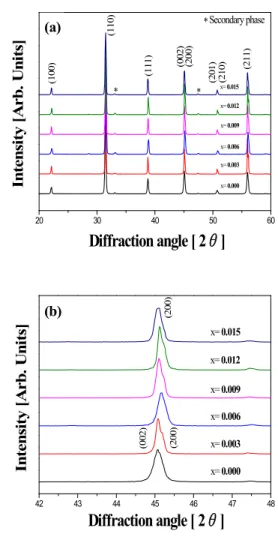
그림 1은 B2O3 첨가량에 따른 XRD 패턴을 나타낸 것이다. 그림 1(a)는 20℃에서 60℃의 범위의 XRD 패 턴을 보여주고 있다. 모든 시편은 전형적인 Perovskite 구조를 나타내고 있으며, 이차상(secondary phase)을 나타내고 있다.
본 실험에서는 소결조재로서 B2O3 (m.p.=460℃) 이 외에도 Bi2O3(m.p.=825℃), CuO(m.p.=1,060℃)가 함께
20 30 40 50 60
*
*
(002) (201)(200) (211)
(210)
(111)
(110)
Diffraction angle [ 2θ]
Intensity [Arb. Units]
x= 0.000 x= 0.003 x= 0.006 x= 0.009 x= 0.012 x= 0.015
(100)
*
Secondary phase
(a)
42 43 44 45 46 47 48
(200)
(002) (200)
x= 0.000 x= 0.003 x= 0.006 x= 0.009 x= 0.012 x= 0.015
Diffraction angle [ 2θ]
Intensity [Arb. Units]
(b)
Fig. 1. XRD (X-ray diffraction patterns) of specimens as a function of B2O3 addition.
첨가되었다.
따라서, 이차상은 이들 상인 것으로 보여지며 이들 이 (Ba0.86Ca0.14)(Ti0.85Zr0.12Sn0.03)O3 격자로 완전히 치환 되지 못하고 석출된 것으로 사료된다. 그림 1(b)는 42˚
에서 48˚까지 확대한 XRD 패턴을 보여주고 있다. x=0 첨가되었을 때 peak intensity가 약하여 소결성이 떨 어진 것으로 생각되며, B2O3가 첨가됨에 따라 peak가 오른쪽으로 약간 이동하는 것을 보였으나 x=0.015 첨 가되었을 때 능면체상을 나타내었다. 이는 B3+ 이온은 원자반경이 작아 치환이 잘 안되고, Bi3+의 이온및 Cu3+ 이온이 각각 A-site, B-site로 되어 [9], 약한 정 방정계상에서 입방상을 나타내는 것으로 사료된다.
406 J. Korean Inst. Electr. Electron. Mater. Eng., Vol. 29, No. 7, pp. 404-407, July 2016: J.-H. Yoo
(a) (b)
10 µm
(c) (d)
10 µm
(e) (f)
10 µm
Fig. 2. The scanning electron microscopy(SEM) of specimens as a function of B2O3 addition ((a) x=0, (b) x=0.003, (c) x=0.006, (d) x=0.009, (e) x=0.012, and (f) x=0.015).
그림 2는 B2O3 첨가량에 따른 SEM을 나타낸 것이 다. 그림 2(a)∼(e)까지 점차 그레인이 커지는 것을 나 타내고 있다. 그림 2(f)에서 그레인이 작아지는 것으로 나타내고 있다. B2O3의 첨가량에 따라 증가하는 그레 인 사이즈는 그림 2(e)에서 최댓값인 14.81 μm를 나 타내며 그 후 감소되는 그림 2(f)는 8.77 μm의 값을 나타냈다. 이는 B2O3의 낮은 융점(460℃)으로 소성과 정 중에 액상의 형성으로 인해 그레인이 커진 것으로 사료된다. 그러나 x=0.015 첨가됐을 때 감소하는 이유 는 과잉 첨가로 인해 그레인 경계의 지나친 액상으로 인하여 오히려 소결성이 떨어져서 그레인 사이즈의 감 소가 된 것으로 사료된다.
그림 3은 B2O3 첨가량에 따른 유전상수를 나타낸 것이 다. B2O3의 첨가로 증가하다 미소하게 감소하는 경향을 나 타내고 있다. x=0.009에서 최댓값인 9,088의 값을 나타 내었다. 이는 B2O3의 첨가가 소결조재 Bi2O3, CuO와 액상을
0.000 0.003 0.006 0.009 0.012 0.015
3000 4500 6000 7500 9000 10500
x
Dielectric constant
Fig. 3. Dielectric constant(εr) of specimens as a function of B2O3 addition (x axis =B2O3 mol).
-20 0 20 40 60 80
0 3000 6000 9000 12000 15000
Dielectric constant
Temperature[℃]
x= 0 x= 0.003 x= 0.006 x= 0.009 x= 0.012 x= 0.015
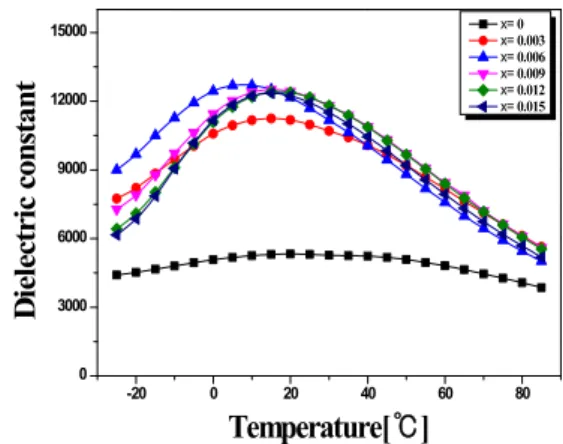
Fig. 4. Temperature dependence of dielectric constant of specimens as a function of B2O3 addition.
-20 0 20 40 60 80
-80 -60 -40 -20 0 20 40
x= 0 x= 0.003 x= 0.006 x= 0.009 x= 0.012 x= 0.015
Temperature[℃]
Temperature coefficient of capacitance[%]
Fig. 5. Variation of temperature coefficient of capacitance with temperature for specimens as a function of B2O3 addition.
전기전자재료학회논문지, 제29권 제7호 pp. 404-407, 2016년 7월: 류주현 407
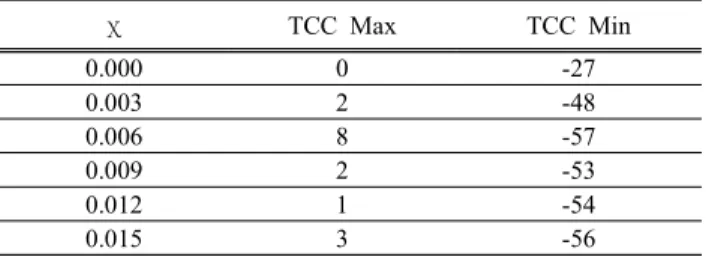
Table 1. TTC properties of specimens as a function of B2O3
addition.
χ TCC Max TCC Min
0.000 0 -27
0.003 2 -48
0.006 8 -57
0.009 2 -53
0.012 1 -54
0.015 3 -56
형성하여 그레인 성장을 유도하여 유전상수가 증가하였 다. 그 이유는 그레인이 성장되면 저유전율층인 그레인 바운데리(grain boundary) 영역이 감소하고, 고유전율층 인 그레인 영역이 많아지기 때문이다.
그림 4는 B2O3 첨가량에 따른 1,180℃에서 소성된 시 편의 유전상수 온도 의존성을 –25℃∼85℃까지 범위에서 1 kHz의 주파수로 측정하여 나타낸 것이다. B2O3의 첨가 량에 따라 큐리온도(Tc)는 미소하세 감소하며, 모든 시편 에서 10∼20℃의 상온 부근에서 존재하는 것으로 사료된 다. 첨가량이 증가함에 따라 유전상수는 증가하다 미소하 게 감소하는 특성을 보였다. 이러한 이유는 그림 3에서 나타낸 것같이 사료된다.
그림 5는 B2O3 첨가량에 따른 시편의 온도 안정성을 평가하기 위해 1,180℃에서 소성된 시편의 유전상수 온도 의존성을 –25℃∼85℃까지 범위에서 측정한 후 다음의 식 (1)을 이용하여 TCC 특성을 구하여 나타낸 것이다.
℃
℃
× (1)
온도-커패시턴스 변화 TCC가 EIA의 Y5U 온도 특성 범위 +22∼-56%를 만족해야 한다. 이는 큐리온도를 상온 부근으로 이동시키면서 상온에서의 유전율을 증가시키며, TCC 특성을 제어하여 구현할 수 있다. 측정 결과로부터 온도 변화에 따른 커패시턴스 변화율은 x=0.006 첨가된 시편에서만 –56%를 넘 어갔으며 나머지 시편들에서는 +3∼-56% 사이로 측정되 었고, 이는 EIA 규격에 만족하고 있는 것으로 사료된다.
표 1은 B2O3 첨가량에 따른 TCC 특성을 표로 정리 한 것이다.
4. 결 론
본 연구에서는 온도-커패시턴스 변화(TCC)를 작게 하
여 온도 특성이 우수하면서 동시에 고유전 상수를 갖고 1,200℃ 미만 저온에서 소결되는 세라믹 콘덴서 조성을 개발하고자 (Ba0.86Ca0.14)(Ti0.85Zr0.12Sn0.03)O3+Sintering aids(Bi2O3+MnO2+CuO) 조성에 B2O3의 첨가량 변화에 따른 상구조, 미세구조와 유전 특성에 미치는 영향에 대 하여 조사한 결과는 다음과 같다.
1. 모든 시편은 전형적인 Perovskite 구조를 나타내 고 있으며, 이차상이 관찰되었다. 이차상은 B2O3로 사 료되며, 첨가량에 따라 정방정계(tetragonal)상에서 x=0.015일 때 입방정계(cubic)상을 나타내었다.
2. B2O3 첨가량에 따라 시편의 미세구조는 x=0.012 까지 그레인이 성장하였으며, 그 이상 첨가 시에는 감 소하였다.
3. 온도 변화에 따른 커패시턴스 변화율(TCC)는 x=0.006을 제외한 모든 시편에서 +3∼-56%로 측정됐 으며, EIA 규격에 만족하고 있다.
REFERENCES
[1] S. H. Shin, J. D. Han, and J. H. Yoo, Mater. Lett., 154, 120 (2015). [DOI: http://dx.doi.org/10.1016/j.matlet.2015.03.121]
[2] S. H. Shin, J. H. Yoo, and S. D. Lee, Ferroelectr. Lett.
Section, 41, 1 (2014).
[DOI: http://dx.doi.org/10.1080/07315171.2014.908678]
[3] S. M. Rhim, S. M. Hong, H. J. Bak, and O. K. Kim, J.
Korean Ceram. Soc., Lett., 36, 767 (1999).
[4] D. K. Yim, J. R. Kim, D. W. Kim, K. S. Hong, J. Eur.
Ceram. Soc. Lett., 27, 3053 (2007).
[DOI: http://dx.doi.org/10.1016/j.jeurceramsoc.2006.11.029]
[5] J. G. Fisher, D. G. Lee, H. H. Oh, H. N. Kim, D.
Nguyen, J. H. Kim, J. S. Lee and H. Y. Lee, J. Korean Ceram. Soc. Lett., 50, 157 (2013).
[6] Q. Zeng, W. Li, J. L. Shi, J. K. Guo, H. Chen, M. L.
Liu, J. Eur. Ceram. Soc.. Lett., 27, 261 (2007).
[DOI: http://dx.doi.org/10.1016/j.jeurceramsoc.2006.04.174]
[7] B. J. Kim, M. H. Kim, S. Nahm, H. T. Kim, J. H. Kim, J. H. Paik, H. Ryu, H. J. Lee, J. Eur. Ceram. Soc.. Lett., 27, 1065 (2007).
[DOI: http://dx.doi.org/10.1016/j.jeurceramsoc.2006.05.060]
[8] S. H. Shin, J. H. Yoo, and D. C. Shin, Korean Inst.
Electr. Electron. Mater. Eng., 27, 797 (2014).
[9] G. M. Lee, J. H. Yoo, and J. Y. Lee, J. Korean Inst.
Electr. Electron. Mater. Eng., 28, 690 (2015).