KIEAE Journal
Korea Institute of Ecological Architecture and Environment 66
1)
Impact by Estimation Error of Hourly Horizontal Global Solar Radiation Models on Building Energy Performance Analysis
Kim, Kee Han*⋅Oh, John Kie-Whan**
* Corresponding author, Department of Architecture, Graduate School, Texas A&M University, U.S.A. ([email protected])
** Department of Architectural Design, Dongseo University, South Korea. ([email protected])
A B S T R A C T K Y E W O R D S
Impact by estimation error of hourly horizontal global solar radiation in a weather file on building energy performance was investigated in this study. There are a number of weather parameters in a given weather file, such as dry-bulb, wet-bulb, dew-point temperatures; wind speed and direction; station pressure; and solar radiation. Most of them except for solar radiation can be easily obtained from weather stations located on the sites worldwide. However, most weather stations, also including the ones in South Korea, do not measure solar radiation because the measuring equipment for solar radiation is expensive and difficult to maintain. For this reason, many researchers have studied solar radiation estimation models and suggested to apply them to predict solar radiation for different weather stations in South Korea, where the solar radiation is not measured. However, only a few studies have been conducted to identify the impact caused by estimation errors of various solar radiation models on building energy performance analysis. Therefore, four different weather files using different horizontal global solar radiation data, one using measured global solar radiation, and the other three using estimated global solar radiation models, which are Cloud-cover Radiation Model (CRM), Zhang and Huang Model (ZHM), and Meteorological Radiation Model (MRM) were packed into TRY formatted weather files in this study. These were then used for office building energy simulations to compare their energy consumptions, and the results showed that there were differences in the energy consumptions due to these four different solar radiation data. Additionally, it was found that using hourly solar radiation from the estimation models, which had a similar hourly tendency with the hourly measured solar radiation, was the most important key for precise building energy simulation analysis rather than using the solar models that had the best of the monthly or yearly statistical indices.
ⓒ 2014 KIEAE Journal
Horizontal global solar radiation, CRM (Cloud-cover Radiation Model), ZHM (Zhang and Huang Model), MRM (Meteorological Radiation Model), Estimation of solar radiation, Weather file, Analysis of building energy performance, Building energy simulation program, DOE-2.2/eQUEST.
A C C E P T A N C E I N F O
Received October 30, 2013 Final revision received April 14, 2014 Accepted April 17, 2014
1. Introduction
The precise building energy performance analysis using a building energy simulation program requires accurate input data such as information of building envelope and HVAC systems of a building as well as an appropriate weather file. The appropriate weather file means the file contains highly reliable data of weather information that has been measured for a long-term at the building located.
In general, it is an hourly weather data file, including data of general meteorological parameters such as dry-bulb temperature, wet-bulb temperature, dew-point temperature, wind direction, wind speed, atmospheric pressure, cloudiness, precipitation and sunshine duration as well as
pISSN 2288-968X, eISSN 2288-9698 http://dx.doi.org/10.12813/kieae.2014.14.2.003
actually measured solar radiation or estimated solar
radiation from the measured data. Most of building energy
simulation program requires at least two radiation data
from the followings: horizontal global solar radiation,
horizontal diffuse solar radiation and normal direct solar
radiation data. In South Korea, the general meteorological
information can be obtained from the “Meteorological
Agency (http://www.kma.go.kr/)” website that provides
measured hourly weather information from 92 manned
weather stations located all over the nation. However, only
22 weather stations
1), including big cities such as Seoul,
Busan, Daegu and Kwangju measure horizontal global
solar radiation data. For solar radiation data for the other
regions, horizontal global solar radiation and normal direct
solar radiation data which derived from reliable solar
radiation estimation models have been used.
- Nomenclature - I
gHorizontal Global Solar Radiation (Wh/m
2) I
bHorizontal Direct Solar Radiation (Wh/m
2) I
dHorizontal Diffuse Solar Radiation (Wh/m
2) I
eExtraterrestrail Nornal Direct Solar Radiation (Wh/m
2) I
oSolar Constant (1,367 Wh/m
2)
k
THourly Clearness Index (I/I
o) n N
thDay of the Year (n/365) Φ Latitude (Degree) δ Solar Declination (Degree) ω Hour Angle (Degree) f(t
n) Time Step to Fill
f(t
1),f(t
2) The Value around the Missing Time Step f(t
n-d) The Offset Back to the Previous Valid Day
In the previous study
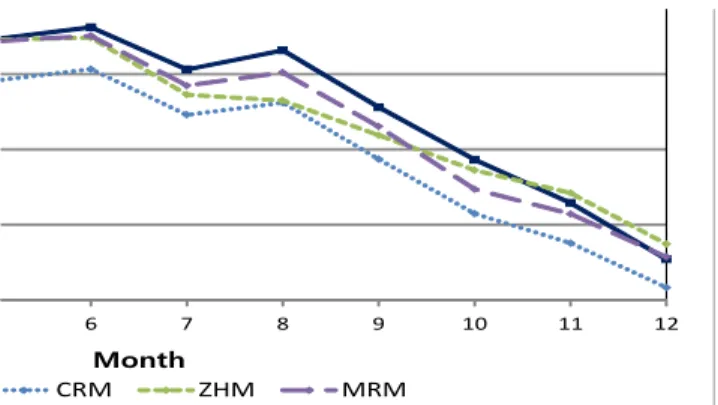
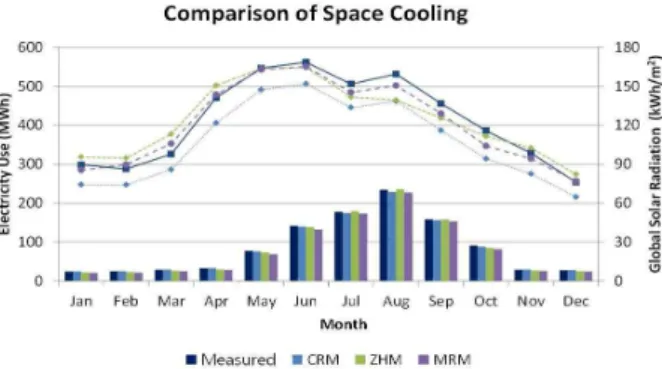
2)that the authors recently conducted to improve the accuracy of the hourly horizontal global solar radiation model in the Busan area, three estimation models that have been most commonly used and acknowledged with their reliabilities and accuracies in the United States were selected, and their estimated solar radiation data were compared with the data from the measured horizontal global solar radiation using the CMP 21 Pyranometer at the Busan weather station. From the result of the comparative analysis, it was found that developing a new hybrid solar estimation model that reflects seasonal characteristics is needed, and it can enhance a reliability of estimated solar radiation to a great extent. Additionally, it was expected to enable more accurate energy performance analysis of a building located in the area of which horizontal global solar radiation is not measured. However, it has not been studied enough yet for what amount of the data errors of weather files created by the estimation solar models have influenced on a computer-based building energy performance analysis.
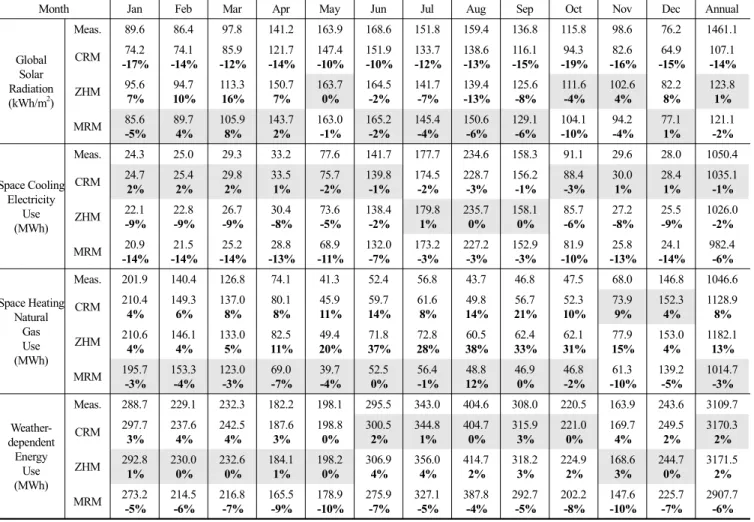
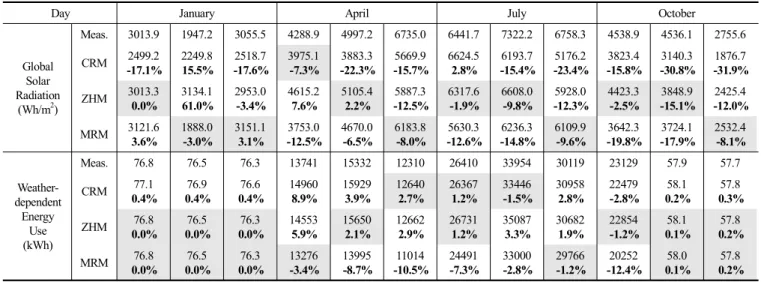
Therefore, this study aims to identify actual impact of the errors derived from the three solar estimation models on building energy performance analysis. To conduct this, four different weather data files were packed using the four different horizontal global solar radiation derived from the measured and three different solar estimation models. These three solar estimation models were selected from the 24 models proposed in the research report of the American Society of Heating, Refrigerating and Air-Conditioning Engineers, Inc. (ASHRAE)
3).
Then, these weather files were used for running a series of building energy simulations to compare differences of the simulated energy consumption results caused by estimation errors in the calculation of solar radiation against the measured solar radiation data.
2. TRY Formatted Weather Files
2.1. Meteorological Parameters
The main purpose of this study is to identify the impact of estimation errors of horizontal global solar radiation models on the simulation results by the computer-based building energy performance analysis process. To prepare for the weather files usable for DOE-2.1e and DOE-2.2/
eQUEST simulation programs, the hourly weather data was packed as the TRY formatted weather files using the real data measured at the Busan weather station (25° north latitude, 35.1° east longitude, 69.6m altitude) in 2010.
Each TRY file contains general meteorological parameters such as dry-bulb temperature, wet-bulb temperature, dew-point temperature, wind speed, wind direction, atmospheric pressure as well as solar radiation data such as horizontal global solar radiation and normal direct solar radiation.
Each weather file contains the same data for the meteorological parameters except for the four different horizontal global solar radiation data. The details for the calculations of the solar estimation models were explained in the previous study
2). In addition, the normal direct solar radiation data was calculated using the measured horizontal global solar radiation and the Erbs’ equation
4), and the acquired normal direct solar radiation data was contained to all the four TRY weather files.
The following equations (1) to (6) show the Erbs’
equations for calculating normal direct solar radiation.
The equation (1) is applicable when a clearness index (
) is ≤ 0.22; equation (2) is applicable when it is 0.22<
≤0.8; and equation (3) is applicable when it is
>0.8.
(1)
(2)
(3)
cos
60 90 120 150 180
1 2 3 4 5 6 7 8 9 10 11 12
G lo b a l S o la r R a d ia t io n ( k W h /m
2