• 검색 결과가 없습니다.

An International Freshman Exchange Program: A Trial for Engineering Design Education

N/A
N/A
Protected

Academic year: 2021

Share "An International Freshman Exchange Program: A Trial for Engineering Design Education"

Copied!
6
0
0

로드 중.... (전체 텍스트 보기)

전체 글

(1)

An International Freshman Exchange Program: A Trial for Engineering Design Education

Elizabeth Webeck

*

․ Fumihiko Imamura

*

․ Fuming Wang

**

․ Hongmin Zhu

**

․ Tetsuya Nagasaka

*

**

Graduate School of Engineering, Tohoku University, Sendai, Japan

**
School of Metallurgical&Ecological Engineering, University of Science&Technology Beijing, Beijing, China

ABSTRACT

The Engineering school of Tohoku University has been offering a Team-based Engineering Design Course to its first year students since 1996 in order to increase the level of both motivation and interest in engineering. Freshmen are required to select one of approximately 150 topics and do some research on this topic. This course also provides opportunities for students to participate in exchange programs with the University of Washington (UW) and the University of Science and Technology Beijing (USTB). In the Tohoku-UW exchange program, which began in 1999, between 10 and 25 students of Tohoku visit the UW annually to present the results of the subjects the school has appointed in advance in the Team-based Engineering Design Course.

In the Tohoku-USTB exchange program, which began in 2007, about 15 students from each university participate in a one day meeting organized by the students themselves. They give a presentation on either the results of the subject they selected in the course, or on an engineering related topic both groups have agreed to in advance. In this paper, a detailed history, the objectives, a schedule and the budget in these unique exchange programs is introduced together with an outline of the course and its contribution to the engineering design education.

Keywords: Engineering education, Freshman education, Presentation skill, International exchange

I. Introduction 1)

The Japan Accreditation Board for Engineering Education (JABEE), which was established in 1999 and became a signatory member of the Washington Accord in 2005, works in close cooperation with engineering associations and societies when accrediting programs in engineering education. Up till now, 409 engineering programs in total from 158 educational institutions have been accredited. In the accreditation process, JABEE evaluates whether the programs in engineering education conducted by institutions of higher education reach the levels expected by society and accredits only those programs that meet the required standards. The details of the accreditation criteria and process are described elsewhere [1] but, briefly, the most important factors for well-designed education program are 1) the quality of the educational curriculum based on the

Received 4 October, 2011; Revised 12 June, 2012 Accepted 17 July, 2012

† Corresponding Author: [email protected]

learning and educational objectives set by the institutions themselves, 2) the PDCA (Plan, Do, Check and Act) cycle considered vital for quality education and for continuous achievements and improvement, and 3) engineering design education. Among them, engineering design is regarded as perhaps the most important pillar of engineering education [2]. In the Washington Accord Signatories [3], also, this component is considered one of the most important criteria when accrediting the program.

Engineering design is not about simple picture drawing

but involves a team of engineers to be able to integrate

their knowhow in a variety of areas and perform as a team

to satisfy their customer’s demands [4]. The graduation

research project required of seniors in Japanese universities

is widely recognized as a highly effective engineering design

education program. The same principals are applied in the

engineering design education program for freshmen in

our university. Actually, Tohoku University’s Team-based

Engineering Design Course was planned in the context of

a broad international interest in providing unique and

effective freshmen education for engineers.

(2)

II. The Team-based Engineering Design Course in Tohoku University

1. Outline

The educational mission of the School of Engineering, Tohoku University, is to nurture creative professionals capable of thinking and acting independently with a broad perspective, a strong sense of humanity and awareness of nature so that they are capable of advancing the development and innovation of science and technology in the twenty-first century based on Tohoku University's traditional philosophy, “Research First”. The School of Engineering actively pursues the fundamental goal of engineering: contribute to the welfare of humankind. It does this through competitive cooperation in research involving the application of science and technology on the foundation of basic science, which in effect improves life for all mankind and enriches people’s lives. As the first step of such engineering education policy, the school has been offering a Team-based Engineering Design Course to its first year students since 1996 [5]. The primary objective of this course is to motivate the participants and arouse a strong and interest in engineering in them during the early stage of engineering education.

2. Research subjects

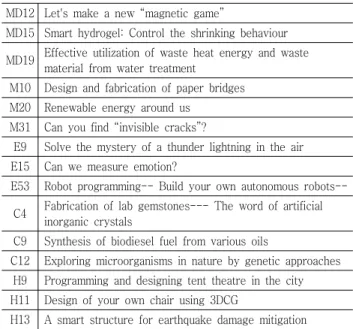
In 2010, 153 subjects were offered from the entire engineering school, which in Tohoku University is composed of five departments. From 1996 to 2010, 8473 students (796 for 2010) took this two credit course. Students are free to select from the whole range of topics on the list and carry out research, and are in no way confined by the department the students are actually enrolled in. This makes it possible for students from different departments to work together. Table 1 lists some examples of interesting subjects. MD-12 is a subject provided from the department of Materials Science and Engineering. Students who select this subject first learn both the fundamental properties of magnetic materials and the principles of various magnetic devices. Then they work together to design and develop a new magnetic game utilizing magnetic phenomena. M-10

Table 1 Some examples of subjects for Team-based En- gineering Design Course in Tohoku University (2010) MD12 Let's make a new “magnetic game”

MD15 Smart hydrogel: Control the shrinking behaviour

MD19 Effective utilization of waste heat energy and waste material from water treatment

M10 Design and fabrication of paper bridges M20 Renewable energy around us

M31 Can you find “invisible cracks”?

E9 Solve the mystery of a thunder lightning in the air E15 Can we measure emotion?

E53 Robot programming-- Build your own autonomous robots--

C4 Fabrication of lab gemstones--- The word of artificial inorganic crystals

C9 Synthesis of biodiesel fuel from various oils

C12 Exploring microorganisms in nature by genetic approaches H9 Programming and designing tent theatre in the city H11 Design of your own chair using 3DCG

H13 A smart structure for earthquake damage mitigation Departments MD: Materials Science and Engineering, M: Mechanical and Aerospace Engineering, E: Information and Intelligent Systems, C:

Applied Chemistry, Chemical Engineering and Biomolecular Engineering, H: Civil Engineering and Architecture

is a subject provided from the department of Mechanical Engineering. Students are required to design and fabricate bridge models using paper and bonding agents only. The design procedures involve some simulations using software for improving the strength of the bridges. Finally, the final products of the various groups are evaluated in a competition based on their strength.

In principle, no concrete solutions are provided for any of the subjects and the students work hard to find their own unique solutions to the task they have chosen. Their results are presented at the end of the second semester.

Expectations with regard to these results is not high: the emphasis is entirely on the process required to complete the task they choose.

III. International Freshmen Exchange Program 1. History

The Team-based Engineering Design Course in Tohoku

University provides opportunities for students to participate

in exchange programs with the University of Washington

(3)

(UW) and the University of Science and Technology Beijing (USTB) [5]. This program allows for selected freshmen to experience international collaboration on engineering topics. At this early stage in their undergraduate careers, the attendees develop both their communication skills and their teamwork ability by working with their foreign partners. The school recognizes this program as a kind of leadership training program, and that participants are given a jump start which is a distinct advantage for them when they embark on other pursuits in their future research and education.

The Tohoku-UW exchange program began in 1999 [6]

with the support of the Integrative Graduate Education and Research Traineeship Program, which was funded by the NSF for 6 years. Between 10 and 25 students from Tohoku University visit the UW annually to present their results in certain subjects decided by the university. A total of 87 Tohoku University students visited the UW and 11 UW students visited Tohoku to present 49 topics from 1999 to 2009.

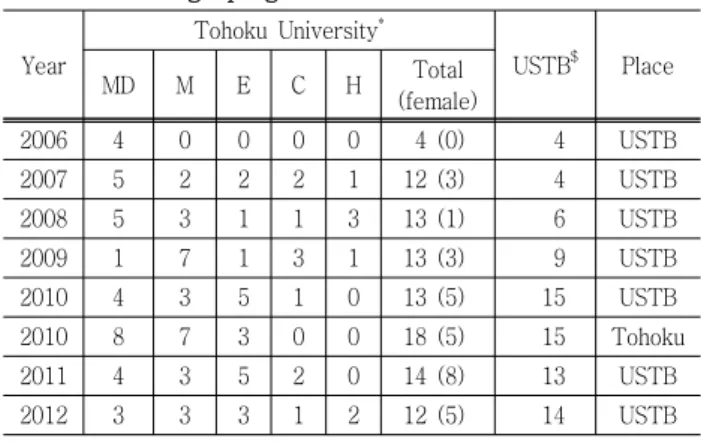
In the Tohoku-USTB exchange program, which began in 2007, about 15 students from each university (Table 2) participate in a one-day meeting organized by the students themselves in either the middle March at USTB or in August at Tohoku University. They give a presentation on either the results of the subject they selected in the course, or on an engineering related topic both groups have agreed to in advance. Most of the travel expense is supported from both schools, with approximately $1200

Table 2 Trend of number of attendees of Tohoku-USTB exchange program

Year

Tohoku University

*

USTB

$

Place

MD M E C H Total

(female)

2006 4 0 0 0 0 4 (0) 4 USTB

2007 5 2 2 2 1 12 (3) 4 USTB

2008 5 3 1 1 3 13 (1) 6 USTB

2009 1 7 1 3 1 13 (3) 9 USTB

2010 4 3 5 1 0 13 (5) 15 USTB

2010 8 7 3 0 0 18 (5) 15 Tohoku

2011 4 3 5 2 0 14 (8) 13 USTB

2012 3 3 3 1 2 12 (5) 14 USTB

* MD, M, E, C and H are as in Table 1

$ departments of Metallurgy, Ecology or Computer Science

allocated per student in the case of Tohoku University (flight fee between Sendai and Beijing by the Japanese carrier is approximately $1000-1150). The students are supervised by 3 or 4 faculty members and a couple of teaching assistants (TA), but, as of 2010, most of the activities are organized by the students themselves.

2. Schedule

Presentation topics given in the 7th Tohoku-USTB

Table 3 Presentation topics of 7th Tohoku-USTB exchange program held in 2011 at USTB

Speaker Topic

J-Leader Brief introduction of Japanese team and this program J-1 Joint Theme 1: Engineering approach to natural disasters

– 1: Energy saving C-1

J-2 Joint Theme 1: Engineering approach to natural disasters – 2: Early warning system

C-2

J-3 Joint Theme 1: Engineering approach to natural disasters – 3: Estimation of damage

C-3

J-4 Joint Theme 1: Engineering approach to natural disasters – 4: Reduction of damage of infra-structure

C-4

J-5 Joint Theme 2: How to be a more international University?

C-5

J-6 Fabrication of luminescent glass phosphors by sol-gel method

C-6 Removal of iron by magnetic separation from bauxite tailings

J-7 Let’s enjoy music with your own making audio systems C-7 Go ahead, environmentally friendly cars!

J-8 Make a solar cell!

C-8 Utilization of vanadium and titanium from magnetite containing vanadium and titanium

J-9 Extracting bio-active compounds from various fruits pericarp by supercritical CO

2

!

C-9 Energy and environmental problems in metallurgical processes

J-10 Exploring microorganisms in nature by genetic approaches C-10 Extract titanium from EAF slag of Pan Steel Group J-11 Let’s clean water using minerals and clays

C-11 Development of welding technology for ITO target materials J-12 Science of heat-resistant alloys

C-12 Synthesis of ceria microspheres

J-13 Micromachines for the medical field ~What is done in Biomedical Engineering?~

C-13 Study about production of granular iron by rotary furnace

direct reduction

(4)

exchange program (2011) are summarized in Table 3. That of the Tohoku-UW exchange program, also, is similar to that indicated in Table 3. Basically, students present their own subjects in English within 10 min, including Q&A.

Since the Tohoku area was hit by a huge earthquake in the middle March in 2011 and incurred serious damage, the students decided to include some earthquake related engineering topics. Professors at Tohoku University and the USTB award the most impressive presentations in terms of the content, their visual appeal and the ease with which they can be understood. The chance to win this award contributes to the students’ motivation to achieve.

In every program, students communicate with each other in advance (generally from about two months beforehand) through the internet to discuss their mutual interests, and the content of their presentations and they work with each other to improve their slides. The only one hour time difference between Sendai and Beijing is an advantage for good communication of both students while 16 hours time difference between Sendai and Seattle sometimes makes the real time communication difficult.

In the last week or 10 days before the one-day meeting, the Japanese students are required to undergo some rather intensive polishing and training with a native English- speaking teacher familiar with engineering concepts who works in the Engineering Department of Tohoku University.

The first in a number of steps in the polishing process is a one on one meeting, in which the students and the teacher go through both the presentation file, one visual at a time, and the transcript, and every effort is made to improve the presentation and to maximize the learning opportunity provided to the students. It is important to note here that the presentation is not fundamentally changed, and that the intention is not to make it perfect. The focus is on improving on what the students themselves have done in their preparations only to the extent that they can learn from the improvements and perform with greater confidence. Emphasis is placed on correct expression, the flow of ideas and logic development, and the organization and use of the visuals.

3. Educational effect

In almost all cases, these programs are the first ex-

perience for students to communicate with students from other countries about engineering matters. For students of Tohoku University and the USTB, it is also their first experience to give a presentation in English. In the Tohoku-USTB exchange program, none of the students are native speakers of English. While it is somewhat true that this impedes on the students’ ability to communicate smoothly with each other, the huge effort they make to communicate well with each other and explore avenues for better communication has enormous advantages for them as language learners. For example, they tend to use a creative combination of Chinese characters together with English technical terms in their presentation. Obviously, the students of the UW have no problem in terms of their English communication ability, but some of them independently study Japanese and they reflect the results of their efforts in their presentations. The mutual effort made by students themselves to communicate effectively is without doubt the most impressive point of this program.

Through their communication efforts, not only do these freshmen develop a heightened awareness of international issues, but their interest in engineering research is consolidated, and they develop a deeper understanding of different cultures.

Besides the communication and sharing between the students from the different countries involved in the pro- gram, the Japanese students benefit enormously from the one on one time with the native English teacher, and from the input of that teacher in the last week or so of intensive practicing with the group. While the students all make an impressive effort to complete their research task and organize their information and prepare a transcript, they typically require a significant amount of help from a native English speaker. Even when the grammar is correct, their expression is often unclear, and sentences need to be rephrased. Logic markers and expressions need to be used appropriately, and this logical flow of ideas has to be represented clearly in the visuals.

Another problem students need specific help with is

difficulty referring to their visuals appropriately. One on

one training helps students bridge the gap between their

transcript and their visuals by helping them develop good

(5)

explanations of information and results provided in graphs and tables. The confidence gained from understanding how to explain information well, and how to develop ideas effectively has long-term implications for their future careers.

Once the visuals and the transcript are ready, the students and the native English teacher work together to improve actual presentation skills. This involves each student literally standing in front of the audience and performing from start to finish like a dress rehearsal. In order to do this well, students need to control their pro- nunciation, their intonation, their pace, their use of pausing, and their interaction with their visuals and the audience.

It is remarkable how difficult it is for the students to keep good posture and maintain a steady confident voice and keep speaking at an appropriate pace from beginning to end. Needless to say, pointers from a native English speaker are valuable at this stage, but the greatest benefit from this team effort to help the speaker is the awareness in the audience of what makes a good presentation, and the process of advising and encouraging the speaker. This awareness and advice is then inevitably incorporated into their own presentations when their turn to perform comes around.

The onus is put on the students to work together to decide what to add or delete to make their presentations fit their time limit. This was inevitably necessary after their first full rehearsal after editing, and was extremely effective in building good teamwork skills. By the end of these intensive practice sessions, each student was keenly aware of the particular points they needed to keep in mind, and how to proceed to perform well, and hopefully, had developed the confidence to do so.

The school of Engineering in Tohoku University provides other opportunities for students to participate in exchange activities with other foreign universities, including POSTECH (Korea), Tsinghua Univ. (China), NTU (Taiwan), and INSA- Lyon (France) in the later stage of their undergraduate studies and in graduate school. Attendees of the Tohoku- USTB and Tohoku-UW exchange programs tend to join such exchange activities. In fact, 4 of the students who attended the 5th Tohoku-USTB exchange program (2010)

attended the engineering summer school in Silicon Valley, CA, USA, organized by the International Affairs Department of Tohoku University, or participated in an international engineering exchange program in Switzerland. On the other hand, some attendees of the USTB came to Tohoku years later as scholars of the Direct Enrollment Exchange Program or as Ph.D students. This indicates that freshmen exchange programs such as Tohoku-USTB or Tohoku-UW exchange program in the early stage of engineering edu- cation program are quite effective in that they enhance a strong sense of international cooperation among the participants.

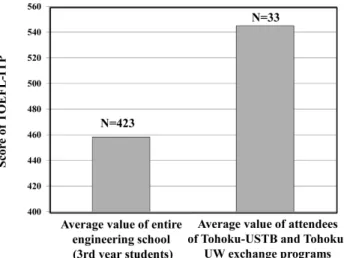
In Fig. 1, TOEFL-ITP scores of the general engineering students and those of the attendees of exchange programs in Tohoku University are compared. Even though the sampling number is rather small, the scores of the atten- dees are obviously significantly higher than those of general students, indicating that attendees of exchange program tend to have higher English ability and higher motivation.

The Team-based Engineering Design Course is recognized as a bottom-up approach of for students while the exchange program itself can definitely be described as pull-top approach, or a leadership training program. USTB also started the Team-based Engineering Design Course for freshmen from 2010. A more detailed analysis including USTB and UW students should be done in the future with the aim of improving the manner in which freshmen are educated.

Fig. 1 Comparison of TOEFL-ITP scores

(6)

IV. Conclusion

The Team-based Engineering Design Course in Tohoku University is an effective Engineering Design Course. In the process of completing their tasks, the students have many experiences which serve to develop their sense as engineers, consolidate good teamwork and communication skills, build on their confidence and develop an awareness of themselves as members of the international community.

The authors wish to thank Tohoku University, the University of Washington and University of Science and Technology Beijing for their financial support.

Reference

1. Web-site of JABEE: http://www.jabee.org/english/ Open HomePage/e_process.htm.

2. Engineering Design in Engineering Education, Minutes of JABEE Symposium/Workshop 2004 Dec. 2004.

3. Web-site of Washington Accord, in International Engineering Alliance: http://www.washingtonaccord.org/Washington-Ac cord/.

4. For example, Engineering Fast in Northwestern University, USA, http://www.mccormick.northwestern.edu/undergradua tes/curriculum/engineering_first/about.html.

5. Web-site of Team-based Engineering Design Course, School of Engineering, Tohoku University, http://www.eng.tohoku.

ac.jp/edu/?menu=ip&ce=2010&w=e.

6. Web-site of ENGR-100, Washington University, http://

courses.washington.edu/engr100/3. Evans, R. N.(1996).

Vocational Education. Columbus, Ohio: Publishing Company.

4. Evans, R. N. et al.(1996). Characteristics of Teacher.

Journal of Vocational Education , 25(3): 51-67.

5. Lenn, M. P. & Campos, L.(1997). Globalization of the professions and the quality imparative:

6. Professional accreditation, certification, and licensure.

Madison, WI: Magna Publications, Inc.

Elizabeth Webeck

Research Associate, English Support Staff at the Department of Metallurgy, Material Science and Materials Processing, Tohoku University. Besides being responsible for English education in the Materials Science Department, she has more than twenty years of experience editing technology reports. She graduated from Sydney University in 1986.

Phone: +81-22-795-7331

E-mail: [email protected]

Fumihiko Imamura

Professor of Tsunami Engineering Laboratory Disaster Control Research Center in Tohoku University. He graduated with a Ph.D in Civil Engineering from Tohoku University in 1989.

Phone: +81-22-795-7513

E-mail: [email protected]

Fuming Wang

Professor and Vice Dean (in charge of undergraduate teaching affairs) of the School of Metallurgical and Ecological Engineering in USTB. He graduated with a Ph.D in metallurgy from USTB in 1993.

Phone: +86-10-82375103 E-mail: [email protected]

Hongmin Zhu

Professor of Metallurgy, USTB. He graduated with a Ph.D in metallurgy from Tohoku University in 1989. Formerly he was a Dean of School of Metallurgical and Ecological Engineering, and now he is an Assistant President at USTB.

Phone: +86-010-62332652 E-mail: [email protected]

Tetsuya Nagasaka

Professor of Eco-material Processing, the Department of Metallurgy, Graduate School of Engineering, Tohoku University. He graduated with a Ph.D in ferrous process metallurgy from Tohoku University in 1989. He is a chairperson in the material science and related area of the Japan Accreditation Board for Engineering Education.

Phone: +81-22-795-7300

E-mail: [email protected]

수치

Table  1  Some  examples  of  subjects  for  Team-based  En- En-gineering  Design  Course  in  Tohoku  University  (2010) MD12 Let's  make  a  new  “magnetic  game”
Table  3  Presentation  topics  of  7th  Tohoku-USTB  exchange  program  held  in  2011  at  USTB
Fig.  1  Comparison  of  TOEFL-ITP  scores

참조

관련 문서