• 검색 결과가 없습니다.

Systematic study of Korean Asparagus L. based on morphology and nuclear ITS sequences

N/A
N/A
Protected

Academic year: 2021

Share "Systematic study of Korean Asparagus L. based on morphology and nuclear ITS sequences"

Copied!
12
0
0

로드 중.... (전체 텍스트 보기)

전체 글

(1)

Systematic study of Korean Asparagus L. based on morphology and nuclear ITS sequences

Seong-Hyun Cho and Young-Dong Kim*

Department of Life Science, Hallym University, Chuncheon 200-702, Korea (Received 24 August 2012; Revised 6 September 2012; Accepted 14 September 2012)

외부형태와 ITS 염기서열에 기초한 한국산 비짜루속 식물의 분류학적 고찰

조성현·김영동*

한림대학교 생명과학과

ABSTRACT : Morphological and geographical examinations as well as phylogenetic analyses using ITS sequences were performed for Asparagus L. in Korea. A total of five species of Asparagus were confirmed to be distributed in South Korea. The shape of cladophylls, length of pedicels, and shape of perianth were considered to be important characteristics for the identification of Koran Asparagus species. A monophyly of each species was evident in the ITS phylogenetic trees in which multiple accessions (5 to 24, depending on species) repre- sented each of the five Korean species. A. rigidulus Nakai, once considered conspecific to A. schoberioides Kunth, formed a distinct lineage in the ITS trees. Pedicels of A. rigidulus, which is distributed mainly in coastal areas, were about two times longer than those of A. schoberioides occurring in inland areas, suggesting that they should be treated as distinct taxa.

Keywords: Asparagus, A. davuricus, A. rigidulus, A. schoberioides, ITS phylogeny

적 요: 한국산 Asparagus L. (비짜루속)을 대상으로 외부형태 형질을 재검토하고 ITS 염기서열을 사용한 계 통분석을 실시하였다. 외부형태를 분석한 결과 엽상경의 형태, 소화경의 길이, 화피의 형태 등이 종을 식별 하는 데 중요한 형질이었으며, 남한에는 최근에 분포가 확인된 A. davuricus Fisch. and Link (망적천문동)을 포함하여 총 다섯 종의 Asparagus가 자생하는 것으로 확인되었다. 각 분류군별로 5 내지 24 개체를 포함하여 수행한 ITS 염기서열 계통분석에서 각 분류군은 모두 단계통군을 이루었다. 특히 A. schoberioides Kunth (비 짜루)의 이명으로 처리되고 있는 A. rigidulus Nakai (노간주비짜루)는 A. shoberioides와 8개의 뉴클레오티드 자리에서 차이를 보이면서 독자적인 단계통군을 형성하였다. 독도, 제주도 및 중남부 해안에 주로 자라는 A.

rigidulus 의 소화경은 내륙에 분포하는 A. schoberioides에 비해 약 2배 길었다. 두 종의 형태적, 지리적, 계통 유전학적 차이는 A. rigidulus를 A. schoberioides와 다른 독립된 종으로 인정해야 함을 말해준다.

주요어: 비짜루속, 망적천문동, 노간주비짜루, 비짜루, ITS 분자계통

Asparagus L. (Asparagaceae) is comprised of about 160 species distributed in Europe, Asia, Africa, and Australia (Kubitzki and Rudall, 1998). Among the total number of species, 35 species occur in NE Asia (Il ’ in, 1968; Ohwi, 1972;

Chen and Tamaian, 2000). Currently, Asparagus is classified

into three subgenera: subgen. Asparagus, with dioecious taxa is distributed mainly throughout Asia; subgen. Myrsiphyllum Willd. and subgen. Protasparagus Oberm., both with hermaphroditic taxa occur in Africa (Clifford and Conran, 1987). Although both the male and female flowers of the dioecious species in subgen. Asparagus have pistil and stamen

*Author for correspondence: [email protected]

(2)

in their early developmental stage, sexual differentiation occurs by the selective abortion of the pistil or stamen in the male and female flowers, respectively (Dellaporta and Calderon- Urrea, 1933; Galli et al., 1993). Thus subgen. Asparagus is considered to be derived from a hermaphroditic ancestor (Clifford and Conran, 1987).

Research on Korean Asparagus plants was initiated by Palibin (1901) and Komarov (1901) who reported A. schoberioides Kunth and A. oligoclonos Maxim., respectively. Yabe (1903) reported A. lucidus Lindle. (= A. cochinchinensis (Lour.) Merr.) and Nakai (1913) reported A. rigidulus Nakai, A. tamaboki Yatabe, A. davuricus Fisch. ex Link. Nakai (1923) newly described A. verrucosus Nakai from Sorae (Incheon) in southern Korea, and Kitagawa (1939) reported A. brachyphyllus Turz.

in northern Korea. These two species, however, were considered conspecific and were merged under the name of A.

brachyphyllus (Noda, 1971). Ohwi (1972) treated A. tamaboki and A. rigidulus as a synonym of A. oligoclonos and A.

schoberioides, respectively. It was evident that A. tamaboki was a male plant of A. oligoclonos having the rudimentary ovary (Makino, 1905). However, A. rigidulus was merged into A.

schoberioides for reasons which are unknown (Ohwi, 1972).

Recently, Lee (2007) recognized only three native species of Asparagus in Korea: A. cochinchinensis, A. oligoclonos, and A. schoberioides. Reexamination on the herbarium specimens deposited in several different herbaria, however, revealed that A. davuricus, once known to occur only in North Korea, was also distributed in South Korea (Gyeonggi-do, Chungcheonnam- do, Gangwon-do, Gyeonsangbuk-do), suggesting the need for reexamination of the species diversity and distribution of Korean Asparagus. In addition, the taxonomic entity of A.

rigidulus, which has been considered conspecific to A.

schoberioides (Ohwi, 1972) needs further examination, since the taxonomic treatment was performed without specific reasons.

There have been comparative anatomy (Kim and Lee, 1985) and karyological studies (Kim and Oh, 1985) for three species of Asparagus in Korea. Although these studies provided some basic information for the identification of the examined species, major systematic issues, especially phylogenetic relationship and geographic distribution of the species were not addressed.

There have also been comparative studies on the genus Asparagus using the RFLP (Restriction Fragment Length Polymorphism) of nuclear ribosomal ITS (Internal Transcribed Spacer) region (Stajner et al., 2002) and plastid DNA (Lee et al., 1997). However, these studies were mainly about the selection of close relatives of A. officinalis L. to produce useful cultivar through hybridization process, and no Korean taxa

were included in the analyses. A phylogenetic study based on DNA sequences of the plastid genome for 26 taxa (including some Korean species) of Asparagus has been undertaken by Fukuda et al. (2005). However, they chose petB intron and petD-rpoA IGS (intergenic spacer) regions which show extremely low sequence variation, resulting in no resolution for the species relationship and only limited discussion on the subgeneric relationship.

This study aimed to reexamine the distribution and mor- phological characters of Korean Asparagus taxa, and to discuss their phylogenetic relationships using the DNA sequences of nuclear ribosomal ITS regions.

Materials and Methods

A total of one hundred specimens, obtained either from several herbaria (KWNU, KNU, KH, IUI, TI) or from the field collection, were examined for morphological characters of all Korean Asparagus species except for A. brachyphyllus, which is known to be distributed mainly in North Korea (Appendix I).

Multiple accessions representing each species (5 −24 individuals depending on species) were employed for molecular phylogene- tic analyses. The collection data and voucher information are provided in Table 1. A voucher specimen is missing for some accessions collected from a population with very limited number of individuals.

Morphological characters which have been thought to be important for the classification of Asparagus (Lee, 2007) were carefully examined for the selected taxa. Several diagnostic characters, including the type of roots, the shape and length of cladophylls, the length of pedicels, the shape of perianth and the length of tepals, were chosen for species comparison. The same position or part of each organ was measured to avoid variation due to varying developmental stages.

Total DNA was isolated from fresh leaves or dried herbarium specimens using the DNeasy plant mini kit according to the manufacturer ’ s manual (Qiagen, Germany). The ITS regions were amplified and sequenced using primers designed by White et al. (1990) except ITS1, which differed by the two underlined bases (5'-GGAAGGAGAAGTCGTAACAAGG-3').

PCR amplifications were carried out in a total reaction volume

of 50 µ L containing 5 × GoTaq Flexi buffer 10 µ L, 25 mM

MgCl

2

4 µ L, 2.5 mM dNTPs 4 µ L, forward and reverse primers

each 0.5 µ L, 5 units/ µ L Taq polymerase 0.25 µ L, 10 to 20 ng

template DNA, and distilled water to the final volume. The

thermocycling profile consisted of an initial denaturation step

at 95

o

C for 5 min, followed by 30 cycles of 1 min at 95

o

C,

1 min at 55.5

o

C, 1 min at 72

o

C, and a final extension step of

(3)

Table 1. Voucher information and distribution of Asparagus taxa included in this study. Province abbreviations: CB (Chungcheongbuk-do), CN (Chungcheongnam-do), GB (Gyeongsangbuk-do), GG (Gyeonggi-do), GN (Gyeongsangnam-do), GW (Gangwon-do), JB (Jeollabuk-do), JJ (Jeju-do), JN (Jeollanam-do).

Accession No. Voucher information Locality GenBank No.

Asparagus cochinchinensis (01) S.H. Cho et al. ChoSH-001 (HHU) JN, Naju-gun JN171595

A. cochinchinensis (02) S.H. Cho et al. ChoSH-002 (HHU) JN, Hwasun-gun JN171596

A. cochinchinensis (03) no voucher JN, Hwasun-gun JN171597

A. cochinchinensis (04) no voucher JN, Hwasun-gun JN171598

A. cochinchinensis (05) no voucher JN, Hwasun-gun JN171599

A. davuricus (01) S.H. Cho and Y.I Kim ChoSH-006 (HHU) CN, Taean-gun JN171600

A. davuricus (02) S.H. Cho and Y.I Kim ChoSH-007 (HHU) CN, Taean-gun JN171601

A. davuricus (03) S.H. Cho and Y.I Kim ChoSH-008 (HHU) CN, Taean-gun JN171602

A. davuricus (04) no voucher CN, Taean-gun JN171603

A. davuricus (05) S.H. Cho and Y.I Kim ChoSH-009 (HHU) GG, Hwaseong-si JN171604

A. davuricus (06) S.H. Cho and Y.I Kim ChoSH-010 (HHU) GG, Hwaseong-si JN171605

A. davuricus (07) S.H. Cho et al. ChoSH-020 (HHU) GW, Samcheok-si JN171606

A. davuricus (08) S.H. Cho et al. ChoSH-025 (HHU) CN, Boryoeng-si JN171607

A. davuricus (09) no voucher CN, Boryoeng-si JN171608

A. davuricus (10) S.H. Cho et al. ChoSH-027 (HHU) CN, Boryoeng-si JN171609

A. falcatus C.H. Oh Yeomiji-398 (KH) Botanical Garden Yeomiji JN171610

A. oligoclonos (01) S.H. Cho and Y.I Kim ChoSH-028 (HHU) GG, Hwaseong-si JN171611 A. oligoclonos (02) S.H. Cho and Y.I Kim ChoSH-029 (HHU) GG, Hwaseong-si JN171612

A. oligoclonos (03) no voucher GG, Hwaseong-si JN171613

A. oligoclonos (04) no voucher GG, Hwaseong-si JN171614

A. oligoclonos (05) S.H. Cho et al. ChoSH-030 (HHU) GW, Pyeongchnag-gun JN171615

A. oligoclonos (06) S.H. Cho et al. ChoSH-031 (HHU) GW, Yeongwol-gun JN171616

A. oligoclonos (07) S.H. Cho et al. ChoSH-032 (HHU) GW, Yeongwol-gun JN171617

A. rigidulus (01) S.H. Cho et al. ChoSH-039 (HHU) GN, Sacheon-si JN171618

A. rigidulus (02) S.H. Cho et al. ChoSH-040 (HHU) JJ, Jeju-si JN171619

A. rigidulus (03) no voucher JJ, Seogwipo-si JN171620

A. rigidulus (04) S.H. Cho et al. ChoSH-041 (HHU) JJ, Seogwipo-si JN171621

A. rigidulus (05) no voucher JJ, Seogwipo-si JN171622

A. rigidulus (06) no voucher JJ, Seogwipo-si JN171623

A. rigidulus (07) S.H. Cho et al. ChoSH-044 (HHU) JJ, Seogwipo-si JN171624

A. rigidulus (08) S.H. Cho et al. ChoSH-045 (HHU) JJ, Jeju-si JN171625

A. rigidulus (09) S.H. Cho et al. ChoSH-046 (HHU) JJ, Jeju-si JN171626

A. rigidulus (10) S.H. Cho et al. ChoSH-047 (HHU) JJ, Jeju-si JN171627

A. rigidulus (11) S.H. Cho et al. ChoSH-048 (HHU) JN, Haenam-gun JN171628

A. rigidulus (12) S.H. Cho et al. ChoSH-049 (HHU) CN, Taean-gun JN171629

A. rigidulus (13) no voucher CN, Taean-gun JN171630

A. rigidulus (14) S.H. Cho et al. ChoSH-050 (HHU) JJ, Jeju-si JN171631

A. rigidulus (15) S.H. Cho et al. ChoSH-051 (HHU) JJ, Jeju-si JN171632

A. rigidulus (16) S.H. Cho et al. ChoSH-052 (HHU) GB, Uljin-gun JN171633

A. rigidulus (17) S.H. Cho et al. ChoSH-053 (HHU) GB, Uljin-gun JN171634

A. rigidulus (18) Pak and Lee 8349 (KNU) GB, Ulleung-gun (Dok-do) JN171635

A. rigidulus (19) Pak and Lee 8329 (KNU) GB, Ulleung-gun (Dok-do) JN171636

A. rigidulus (20) S.H. Cho and J.H Lee ChoSH-168 (HHU) JN, Shinan-gun (Gageo-do) JN171637 A. rigidulus (21) S.H. Cho and J.H Lee ChoSH-170 (HHU) JN, Shinan-gun (Gageo-do) JN171638

A. rigidulus (22) no voucher JN, Shinan-gun (Gageo-do) JN171639

A. rigidulus (23) S.H. Cho and J.H Lee ChoSH-196 (HHU) JN, Shinan-gun (Heuksan-do) JN171640

A. rigidulus (24) S.H. Cho and J.H Lee ChoSH-197 (HHU) JN, Shinan-gun (Heuksan-do) JN171641

(4)

10 min at 72

o

C (Applied Biosystems Gene Amp. PCR system 9700). The PCR products were purified with a QIAqiuck PCR purification kit according to the manufacturer ’ s protocol (Qiagen, Germany). Purified double-stranded PCR products were used for determining the DNA sequences of ITS regions using 3730xl DNA analyzer (Automatic Biosystems). All sequences were deposited in GenBank (Table 1).

The DNA sequences were aligned with CLUSTAL X (Thompson et al., 1997). The alignment was further examined and slightly edited using MacClade 4.03 PPC (analysis of phylogeny and character evolution. 4.03 PPC; Maddison and Maddison, 2002) as necessary. Gaps introduced from the alignment were treated as missing characters in subsequent analyses. Both Neighbor Joining (NJ) and Maximum Parsimony (MP) analyses were conducted using PAUP* 4.0 (Phylogenetic Analysis Using Parsimony, version 4.0b10, Swofford, 2001).

For the NJ tree Kimura ’ s 2 parameter method (Kimura, 1980) was selected for estimating the genetic distance among the OTUs. The maximum parsimony analyses were conducted using heuristic searches with the MULTREES option, 10 random entries of taxa, and TBR (Tree Bisection and Reconnection) branch swapping. Bootstrap analyses (Felsenstein, 1985) with 1000 replicates were conducted to

evaluate the degree of support for given clades of NJ and MP trees (PAUP* ver. 4.0b10, Swofford 2001). The trees were rooted using Asparagus falcatus L. as an outgroup (Fukuda et al., 2005).

Results

1. Distribution of Asparagus in South Korea The distribution of Asparagus species in South Korea is shown in Fig. 1. A. davuricus which had been known only to occur in China, Russia, Mongol, and North Korea was confirmed to be widely distributed along the east and west coasts of South Korea (Fig. 1). A. schoberioides is distributed in inland areas, while its closely related species A. rigidulus has been found mostly along coastal areas including Dok-do (Fig. 1). A. cochinchinensis was observed mainly in south- western part of South Korea, whereas A. oligoclonos is widely distributed throughout the country, though not in Jeju-do or Ulleung island.

2. Morphological characteristics of Korean Asparagus

The morphological characteristics, including the shape, Table 1. Continued.

Accession No. Voucher information Locality GenBank No.

A. schoberioides (01) S.H. Cho and N.R Kim ChoSH-127 (HHU) GW, Samcheok-si JN171642 A. schoberioides (02) S.H. Cho and N.R Kim ChoSH-054 (HHU) GW, Samcheok-si JN171643 A. schoberioides (03) S.H. Cho and N.R Kim ChoSH-055 (HHU) GW, Samcheok-si JN171644 A. schoberioides (04) C.G. Lee and J.H Lee ChoSH-056 (HHU) GW, Chuncheon-si JN171645

A. schoberioides (05) no voucher CB, Danyang-gun JN171646

A. schoberioides (06) no voucher GB, Cheongsong-gun JN171647

A. schoberioides (07) M.S. Choi et al. 902028 (KH) GB, Bonghwa-gun JN171648

A. schoberioides (08) Kim et al. KHB1182720 (KH) JB, Muju-gun JN171649

A. schoberioides (09) Kim et al. KHB1182721 (KH) JB, Muju-gun JN171650

A. schoberioides (10) H.-J. Choi et al. CHJ60036 (KH) CN, Cheonan-si JN171651 A. schoberioides (11) E.-H. Jung & H. K. Moon K0525-031 (KH) GW, Hwacheon-gun JN171652 A. schoberioides (12) B.O. Oh et al. CBU-070023 (KH) GB, Bonghwa-gun JN171653 A. schoberioides (13) B.O. Oh et al. CBU-070148 (KH) CB, Cheongwon-gun JN171654 A. schoberioides (14) J.H. Kim et al. KHB1183679 (KH) GG, Pocheon-si JN171655

A. schoberioides (15) Kim et al. KHB1182722 (KH) CB, Gyeosan-gun JN171656

A. schoberioides (16) S.H. Cho et al. ChoSH-167 (HHU) GG, Gapyeong-gun JN171657 A. schoberioides (17) W.K. Paik VP-KB-377063-0206 (KB) GG, Namyangju-si JN171658

A. schoberioides (18) Hui KIM HKIM3145 (KB) JN, Gokseong-gun JN171659

A. schoberioides (19) S.H. Cho et al. ChoSH-185 (HHU) JJ, Seogwipo-si JN171660

A. schoberioides (20) S.H. Cho et al. ChoSH-190 (HHU) JJ, Jeju-si JN171661

A. schoberioides (21) S.H. Cho et al. ChoSH-192 (HHU) JJ, Jeju-si JN171662

A. schoberioides (22) S.H. Cho et al. ChoSH-194 (HHU) JJ, Jeju-si JN171663

(5)

average length, standard deviation, and maximum-minimum measured values of major parts of the examined species are shown in Table 2.

The root was terete in all examined species except for A.

cochinchinensis which had a fusiform root. In terms of the shape of cladophylls, two types were observed: straight type (A.

oligoclonos, A. davuricus) and falcate type (A. cochinchinensis,

A. schoberioides, A. rigidulus). The cladophyll was longest in A. oligoclonos which was followed by A. davuricus, A.

rigidulus, A. schoberioides, and A. cochinchinensis.

The number of cladophyll in the fascicle varied depending on the taxa. A. oligoclonos had 3 −6 cladophylls while A.

davuricus generally had 1 or 2 −5 cladophylls, yet the number was extremely variable depending on the individual. A.

cochinchinensis had 2−3 cladophylls and A. rigidulus generally had 2 −5 cladophylls. A. schoberioides mostly had 2−3 cladophylls, but more rarely 4 −5 cladophylls were found in fascicles of this species.

The length of pedicels exhibited significant differences among the examined taxa. Pedicels of Asparagus oligoclonos were ca. 17.31 mm long while those of A. schoberioides were ca. 0.87 mm long. The pedicel length of A. rigidulus was ca.

1.61 mm, about two times longer that of A. schoberioides. A.

davuricus and A. cochinchinensis had pedicel lengths of ca.

4.47 mm and ca. 3.96 mm, respectively. No significant length difference was observed between pedicels of male and female flowers in each species.

The flowers of the examined taxa were either tubular or campanulate. In A. oligoclonos and A. davuricus the male flowers were tubular, while the female flowers were campanulate with reflexed tepal tips. Both male and female flowers of A. rigidulus and A. schoberioides were campanulate and the tip of the tepal was straight. A. cochinchinensis has

Table 2. Morphological characteristics of the Korean Asparagus species examined in the present study.

A. oligoclonos A. davuricus A. cochinchinensis A. schoberioides A. rigidulus

Plant height (cm) 57 − 150 33120 71 49100 57190

Shape of root terete terete fusiform terete terete

Shape of cladophyll straight straight falcate falcate falcate

Cladophyll length (mm) 27.99 ± 8.82

(12 − 58)* 25.62 (4± 60) 11.02 12.75 (4± 33) 7.37 15.38 (6± 35) 5.65 17.96 (6± 55) 6.84 Number of cladophyll

in a fascicle 3 − 6 15 23 23 [45] 24 [5]

Pedicel length (mm) 17.31 ± .05

(8.1 − 25) (1.99 4.47 ±0.99 7.04) (2.8 3.96± 5.95) 0.81 0.87 (0.6 ±0.23 1.2) (1.2 1.61± 2.73) 0.35 Number of flower 2, rarely 1 2, rarely 1 or 3 − 4 2, rarely 1 or 3 2 − 4, rarely 1 2 − 4

Shape of flower male tubular tubular widely campanulate campanulate campanulate

female campanulate campanulate no data campanulate campanulate

Shape of tepal with reflexed tip with reflexed tip spreading with straight tip with straight tip

Tepal length (mm)

male 7.31 ± 1.35

(5 − 10) (4.67 5.43 ±0.39 6.2) (2.55 3.00 ±0.53 3.87) (1.80 2.60 ±0.46 3.13) (2.54 3.08 ±0.29 4.14) female 7.01 ± 0.70

(6 − 8) (2.1 2.84± 3.65) 0.50 no data (3.00 3.02 ±0.02 3.04) (2.31 2.42 ±0.10 2.50)

Fruit length (mm) 8 − 10 58 67 67 67

Number of seed per fruit 1 − 5 14 1 12 12

*Minimum and maximum lengths are in parentheses.

Fig. 1. Distribution of Asparagus species in South Korea.

(6)

widely campanulate flowers in male individuals with the tepals spread fully. We were unable to observe or collect a specimen with pistillate flower in the present study.

The length of tepals was variable depending on species and differed between male and female flowers in each species. The tepal lengths of A. oligoclonos were ca. 7.31 and 7.01 mm in male and female flowers, respectively. The tepal length of A.

davuricus was ca. 5.43 mm in male flowers, while that females was ca. 2.84 mm. A. cochinchinensis has a tepal length of ca.

3.00 mm in male flowers. In A. schoberioides the tepal length of male flowers was shorter (ca. 2.60 mm) than those of female flowers (ca. 3.02 mm), whereas the tepals of male flowers in A. rigidulus were longer than those of female flowers.

The fruit of A. oligoclonos was the longest, followed by A.

cochinchinensis, A. schoberioides, A. rigidulus, and that of A.

davuricus was the shortest. The number of seeds was variable within each species (1−2, 1−4, 1−5 depending on species) except for A. cochinchinensis, which consistently had only one seed.

The following key distinguishes Asparagus examined in this study.

Key to Asparagus species distributed in South Korea

1. Cladophylls straight

2. Pedicels longer than 8.1 mm, fruit diam. 8−10 mm

··· A. oligoclonos 방울비짜루 2. Pedicels shorter than 7.1 mm, fruit diam. 5 −8 mm

··· A. davuricus 망적천문동 1. Cladophylls falcate

3. Woody vine, pedicels 3.0−6.8 mm long, tepals of female flower reflexed

··· A. cochinchinensis 천문동 3. Perennial herb, pedicels 0.6−2.7 mm long, tepals of

female flower straight 4. Pedicels ca. 0.87 mm long

··· A. schoberioides 비짜루 4. Pedicels ca. 1.61 mm long

··· A. rigidulus 노간주비짜루 Table 3. ITS sequence variations observed from the accessions of

Asparagus schoberioides and A. rigidulus. A dot indicates that the sequence is the same as the first accession listed. Refer to Table 1 for information of each accession. (Nucleotide ambiguity codes : R = A/G, W = A/T, Y = C/T, K = G/T, M = A/C, S = C/G).

Accession

Nucleotide position

9 35 38 154 172 183 394 413

A. schoberioides (01) G C C A A G T T

A. schoberioides (02) . . . . . . . .

A. schoberioides (03) . . . . . . . .

A. schoberioides (04) . . . . . . . .

A. schoberioides (05) . . . . . . . .

A. schoberioides (06) . . . . . . . .

A. schoberioides (07) . . . . . . . .

A. schoberioides (08) . . . . . . . .

A. schoberioides (09) . . . . . . . .

A. schoberioides (10) . . . . . . . .

A. schoberioides (11) . . . . . . . .

A. schoberioides (12) . . . . . . . .

A. schoberioides (13) . . . . . . . .

A. schoberioides (14) . . . . . . . .

A. schoberioides (15) . . . . . . . .

A. schoberioides (16) . . . . . . . .

A. schoberioides (17) . . . . . . . .

A. schoberioides (18) . . . . . . . .

A. schoberioides (19) R . . . . . . .

A. schoberioides (20) R . . . . . . .

A. schoberioides (21) R . . . . . . .

A. schoberioides (22) . . . . . . . .

A. rigidulus (01) A T T C T A G C

A. rigidulus (02) A T T C T A G C

A. rigidulus (03) A T T C T A G C

A. rigidulus (04) A T T C T A G C

A. rigidulus (05) A T T C T A G C

A. rigidulus (06) A T T C T A G C

A. rigidulus (07) A T T C T A G C

A. rigidulus (08) A T T C T A G C

A. rigidulus (09) A T T C T A G C

A. rigidulus (10) A T T C T A G C

A. rigidulus (11) A T T C T A G C

A. rigidulus (12) A T T C T A G C

A. rigidulus (13) A T T C T A G C

A. rigidulus (14) A T Y C T R G Y

A. rigidulus (15) A T T C T A G C

A. rigidulus (16) A T T C T A G C

A. rigidulus (17) A T T C T A G C

A. rigidulus (18) A T T C T A G C

A. rigidulus (19) A T T C T A G C

Table 3. Continued.

Accession Nucleotide position

9 35 38 154 172 183 394 413

A. rigidulus (20) A T T C T A G C

A. rigidulus (21) A T T C T A G C

A. rigidulus (22) A T T C T A G C

A. rigidulus (23) A T Y C T A G C

A. rigidulus (24) A T T C T A G C

(7)

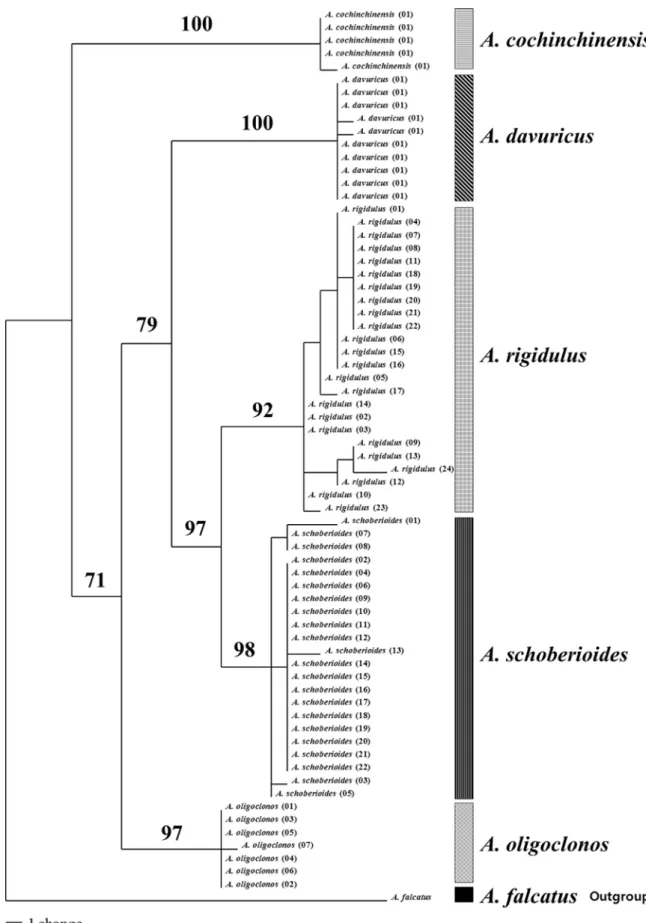
Fig. 2. Phylogenetic tree of Korean Asparagus reconstructed by the neighbor-joining method. Bootstrap supports are indicated on the

branches. Refer to Table 1 for information of each accession.

(8)

Fig. 3. A strict consensus tree of 546 equally parsimonious trees based on ITS sequences of Korean Asparagus. Bootstrap supports are

indicated on the branches. Refer to Table 1 for information of each accession.

(9)

3. ITS sequences and phylogeny

The lengths of ITS regions (including 5.8S) of the examined taxa were 619 bp for Asparagus cochinchinensis, 621 bp for A. davuricus, 622 bp for A. schoberioides and A. rigidulus, and 625 bp for A. oligoclonos. A. schoberioides and A.

rigidulus, which are often treated conspecific, exhibited differences in a total of eight nucleotide sites. Of the eight sites, a weak polymorphism was observed in four sites, while the rest of the sites were unambiguous (Table 3).

Phylogenetic trees based on the aligned ITS sequences exhibited identical topology in neighbor-joining (NJ) and the maximum-parsimony (MP) trees, in which all examined taxa with multiple accessions formed clades supported by high bootstrap values (Figs. 2, 3). In MP analysis, a total of 546 equally parsimonious trees with the length of 97, CI (excluding uninformative characters) of 0.887, and RI of 0.979 was obtained. In both of the MP and NJ trees, A. cochinchinensis was identified as basal clade, followed by A. oligoclonos which showed a sister group relationship with the rest of the species.

A. schoberioides and A. rigidulus formed a strong clade together, and then grouped with A. davuricus (Figs. 2, 3).

Discussion

1. Distribution and morphology of Korean Asparagus

This study provided updated information on the geographic distribution of Asparagus in Korea, especially for Asparagus davuricus, which has long been known to occur only in East Siberia, Far East, Mongolia, China, and North Korea. Although the species has been precisely referred to in the floristic literatures of neighboring countries including China (Chen and Tamaian, 2000), Russia (Il'in, 1968), North Korea (Im, 2000), it has been either missing from the major floristic works of South Korea (Lee, 1979; Lee, 2007) or only briefly mentioned (Lee, 1996), making the distribution of the species in South Korea questionable. This study clearly indicates that the distribution area of the species should be extended to the southern Korean Peninsula (coastal areas of Gyeonggi-do, Chungcheongnam-do, Gangwon-do, Gyeongsangbuk-do; Fig. 1).

The distribution of A. brachyphyllus in South Korea was not confirmed in the present study. We visited Sorae, the type locality of A. verrucosus (= A. brachyphyllus), but the original habitat seemed to be destroyed during the urbanization and expansion of Incheon city.

Morphological data indicates that the shape of the cladophyll (straight vs. falcate) is the primary character distinguishing Korean Asparagus (Table 2; also refer the key for the examined

taxa). The morphological examination also revealed that the shape of the perianth and the length of pedicels and tepals (of female flowers) are important characteristics which can be used to distinguish between Korean Asparagus taxa. Two closely allied species A. schoberioides and A. rigidulus differed in the length of pedicels, supporting the taxonomic treatment of Nakai (1913), who noticed the length of pedicels in taxonomic delimitation. On the other hand, the length of the cladophyll, the position of articulation (not shown in Table 2), and the length of tepals in male flowers exhibited continuous variation (Table 2), which may be the reason why A. davuricus has been misidentified as A. oligoclonos in many herbarium specimens.

Our data indicates that the lengths of pedicels and tepals (in female flowers) are the most important characteristics discerning differences between the two species (Table 2).

2. Taxonomic status of Asparagus rigidulus This study provided important information for discussing the systematic issues pertaining Korean Asparagus, especially the taxonomic status of Asparagus rigidulus, which was described by Nakai (1913) but was later merged into A. schoberioides (Ohwi 1972). A. rigidulus is morphologically very similar to the more widely distributed species of A. schoberioides, except that the former species has slightly longer pedicels (A. rigidulus : 1.2 −2.7 mm, A. schoberioides : 0.6−1.2 mm; Table 2) and a higher number of aerial shoots than the latter ones (personal observation). Considering the lack of distinct diagnostic characters, Ohwi (1972) treated A. rigidulus as a synonym of A. schoberioides. The molecular data was based on a large number of individuals (24 and 22 from A. rigidulus and A. schoberioides, respectively) collected from the whole distribution area in Korea, however, it suggested that they are well separated evolutionary lineages, supporting recognition of A. rigidulus as a distinct species within the genus Asparagus.

In this study, the plant collection data also indicated that A.

rigidulus occurred only in coastal areas of the Korean peninsula, Jeju-do, and Dok-do while A. schoberioides was distributed mainly in inland areas (Fig. 1). Despite the molecular and geographical differences between the two species, they exhibit very weak morphological differences, which suggest that A.

rigidulus is either a cryptic taxon (Okuyama and Kato, 2009) or a recently diverged taxon from the common ancestor of A.

schoberioides and A. regidulus. Additional collections of A.

rigidulus from Japan are needed for a more robust conclusion to the evolution and taxonomy of the species.

3. Phylogenetic utility of ITS sequence

DNA sequences of ITS regions were very useful in the

(10)

construction of phylogenetic trees for the examined taxa. All ITS regions of the examined accessions showed no severe within-individual polymorphism permitting direct sequencing without any cloning procedure. All individuals representing each taxon formed strongly supported clades, respectively (Figs. 2, 3). A total of 77 nucleotide sites observed from the four taxa Asparagus cochinchinensis, A. davuricus, A.

oligoclonos, A. schoberioides (aligned sequence data not shown). This contrasts with the results from the examination of plastid DNA sequence data (petB intron and petD-rpoA intergenic spacer; Fukuda et al. 2005) in which extremely low variation (six sites were variable for the four taxa) was detected.

Fukuda et al. (2005) postulated that an adaptive radiation was attributable to the low sequence variation in Asparagus.

Recently, Kim and Kim (2011) showed that ITS sequence data were very useful when plastid DNA data fail to resolve phylogenetic relationships in Chrysosplenium. This study ascertains that the nuclear ribosomal ITS sequences, despite several drawbacks for phylogeny reconstruction (lvarez and Wendel, 2003), still produce insightful results in phylogenetic studies, provided that they are used carefully (Feliner and Rossell, 2007). Nuclear ribosomal ITS DNA sequence data with extended taxon sampling will provide significant implications for the phylogenetic relationship and character evolution of Asparagus.

Acknowledgement

We thank to the staff of herbaria (KWNU, KNU, KH, IUI, TI) for allowing examination of valuable specimens, and to Mr. Dong Hyeok Lee for providing locality information about Asparagus davuricus. We also thank two anonymous reviewers for their critical comments. This paper is a part of an MS thesis of the first author. This research was supported by a grant from the Korea Research Foundation (2009-0075898) and an internal grant from Hallym University Research Fund (HRF- 201111-002).

Literature Cited

Álvarez, I. and J. F. Wendel. 2003. Ribosomal ITS sequences and plant phylogenetic inference. Molecular Phylogenetics and Evolution 29: 417-434.

Chen, X. and K. G. Tamaian. 2000. Asparagus L. In Flora of China Vol. 24. Wu, Z. -Y. and P. H. Raven (eds.), Science Press, Beijing. Pp. 208-213.

Clifford, H. T. and J. G. Conran. 1987. Asparagaceae. In Flora of Australia. George, A. S. (ed.), Australian Government Pub- lishing Service, Canberra. Pp. 159-164.

Dellaporta, S. L. and A. Calderon-Urrea. 1933. Sex determination in flowering plants. The Plant Cell 5(10): 1241-1251.

Feliner, G. N. and J. A. Rossell. 2007. Better the devil you know?

Guidelines for insightful utilization of nrDNA ITS in species- level evolutionary studies in plants. Molecular Phylogenetics and Evolution 44: 911-919.

Felsenstein, J. 1985. Confidence limits on phylogenies: an approach using bootstrap. Evolution 39: 783-791.

Fukuda, T., H. Ashizawa, R. Suzuki, T. Ochiai, T. Nakamura, A.

Kanno, T. Kameya and J. Yokoyama. 2005. Molecular phy- logeny of the genus Asparagus (Asparagaceae) inferred from plastid petB intron and petD-rpoA intergenic spacer sequences. Plant Species Biology 20: 121-132.

Galli, M. G., M. Bracale, A. Falavigna, F. Raffaldi, C. Savini and A. Vigo. 1993. Different kinds of male flowers in the dioe- cious plant Asparagus officinalis L. Sexual Plant Reproduc- tion 6: 16-21.

Il’in, M. M. 1968. Asparagus L. In Flora of U.S.S.R. Vol. 4.

Komarov, V. L. (ed.), Bishen sigh Mahendra Pal Singh and Koeltz Scientific Books. Pp. 325-339.

Im, R. J. 2000. Flora Coreana. The Science and Technology Pub- lishing House. Pyongyang, Korea.

Kim, Y.-I. and Y.-D. Kim. 2011. Molecular systematic study of Chrysosplenium series Pilosa (Saxifragaceae) in Korea. Jour- nal of Plant Biology 54: 396-401.

Kim, Y. S. and B. U. Oh. 1985. A systematic study on Liliaceae in Korea III. Karyology of genus Asparagus. Korean Journal of Plant Taxonomy 15: 1-12. (in Korean)

Kim, Y. S. and W. T. Lee. 1985. A systematic study on Liliaceae in Korea IV. Anatomical study of genus Asparagus. Korean Jour- nal of Plant Taxonomy 15: 13-24. (in Korean)

Kimura, M. 1980. A simple method for estimating evolutionary rate of the base substitution through comparative studies of nucleotide sequence. Journal of Molecular Evolution 16: 111- 120.

Kitagawa, M. 1939. Lineamenta Florae Manshuricae. Institute of Scientific Research. Manchoukuo. 3 (Appendix): 133-134.

Komarov, V. L. 1901. Flora Manshuriae I. Acta Horti Petropoli- tani. 20: [I]-559.

Kubitzki, K. and P. J. Rudall. 1998. Asparagaceae. In The Fami- lies and Genera of Vascular Plants. Kubitzki, K. (ed.), Berlin.

3: 125-129.

Lee, N. S. 2007. Asparagus L. In The Genera of Vascular Plants of Korea. Park, C.-W. (ed.), Academy Publishing Co., Seoul, Korea. Pp. 1292-1293.

Lee, T. B. 1979. Illustrated Flora of Korea. Hyangmunsa, Seoul, Korea. (in Korean)

Lee, W. T. 1996. Lineamenta Florae Korea. Academy Press,

(11)

Seoul, Korea. (in Korean)

Lee Y. O., A. Kanno and T. Kameya. 1997. Phylogenetic relation- ships in the genus Asparagus based on the restriction enzyme analysis of the chloroplast DNA. Japanese Journal of Breed- ing 47: 375-378.

Maddison, D and W. Maddison. 2002. MacClade*. Analysis of Phylogeny and Character Evolution. 4.03 PPC ed. Sinauer Associates, Sunderland, Massachusetts, U.S.A.

Makino, T. 1905. Observations on the flora of Japan. 5: 1-73.

Nakai, T. 1913. De nonnulis Asparagis et Alliis Japonicis et Core- anis. Botanical Magazine (Tokyo) 27: 213-216.

Nakai, T. 1923. Notulae ad plantas Japoniae et Koreae XXX.

Botanical Magazine (Tokyo) 37: 69-82.

Noda, M. 1971. Flora of the North-Eastern province (Manshuria) of China. Kazama, Tokyo. Pp. 272-274.

Ohwi, J. 1972. Flora of Japan. Tokyo. Pp. 1560.

Okuyama, Y. and M. Kato. 2009. Unveiling cryptic species diver- sity of flowering plants: successful biological species identifi-

cation of Asian Mitella using nuclear ribosomal DNA sequences. BMC Evolutionary Biology 9: 105.

Palibin, J. 1901. Conspectus Florae Koreae IV. Acta Horti Petro- politani 19: 101-151.

Stajner, N., B. Bohanec and B. Javornik. 2002. Genetic variability of economically important Asparagus species as revealed by genome size analysis and rDNA ITS polymorphisms. Plant Science 162: 931-937.

Swofford, D. L. 2001. PAUP*. Phylogenetic Analysis Using Par- simony (*and Other Method) ver.4.0b10. Sinauer Associates, Sunderland, Massachusetts.

Thompson J. D., T. J. Gibson, F. Plewniak, F. Jeanmougin, D. G.

Higgins. 1997. The CLUSTAL_X windows interface: flexible strategies for multiple sequence alignment aided by quality analysis tools. Nucleic Acids Research 25: 4876-4882.

Yabe, Y. 1903. Liliaceae Koreae Uchiyamanae. Botanical Maga-

zine (Tokyo) 17: 133-136.

(12)

Appendix I. Herbarium specimens examined for morphology.

Asparagus cochinchinensis (Lour.) Merr.

Korea: D.K. Lee s.n. (specimen no. 14814) (IUI), S.H. Cho et al. ChoSH-001 (HHU), S.H. Cho et al. ChoSH-002 (HHU), S.H. Park ParkSh51607 (KH), W.C. Lee 0022932 (KWNU), W.C. Lee 0022956 (KWNU), Y.H. Cho WR-070530-127 (KH), Y.H. Cho WR-070606-101 (KH).

Asparagus oligoclonos Maxim.

Korea: B.G. Yoon 0022940 (KWNU), B.H. Choi 1365 (IUI), B.H. Choi et al. 5066 (IUI), B.H. Choi et al. 177 (IUI), B.H.

Choi et al. 6217 (IUI), B.H. Choi et al. 6220 (IUI), B.H. Choi et al. 6221 (IUI), B.H. Choi et al. 6224 (IUI), J.S. Lee & S.K.

Cho 883 (IUI), J.S. Lee 5112 (IUI), K.O. Yoo 0001062 (KWNU), K.O. Yoo 0001063 (KWNU), K.O. Yoo 058378 (KWNU), K.O. Yoo 061205 (KWNU), K.O. Yoo 061208 (KWNU), K.O. Yoo 061210 (KWNU), S.H. Cho & Y.I. Kim ChoSH-028 (HHU), S.H. Cho & Y.I. Kim ChoSH-029 (HHU), S.H. Cho et al. ChoSH-030 (HHU), S.H. Cho et al. ChoSH- 031 (HHU), S.H. Cho et al. ChoSH-032 (HHU), W.C. Lee 0022939 (KWNU), W.C. Lee et al. 066494 (KWNU), Y.M.

Yang 82 (IUI).

Asparagus rigidulus Nakai

Korea: B.H Choi & J.H. Lee 68056 (IUI), B.H Choi & J.H.

Lee 68912 (IUI), B.H. Choi et al. 65025 (IUI), B.H. Choi et al. 65026 (IUI), B.H. Choi et al. s.n. (specimen no. 035514) (IUI), D.S. Ryu WR-070523-162 (KH), E.S. Jeon 40595 (KH), H.S. Cho s.n. (specimen no, 039360) (IUI), H.S. No s.n.

(specimen no. 5818) (IUI), J.H. Lee 68126 (IUI), M.K. Yoo s.n. (specimen no. 0021) (IUI), S.C. Park s.n. (specimen no.

0022) (IUI), S.C. Park s.n. (specimen no. 15125) (IUI), Seo 30827 (IUI), S.H. Cho et al. ChoSH-039 (HHU), S.H. Cho et al. ChoSH-040 (HHU), S.H. Cho et al. ChoSH-041 (HHU), S.H. Cho et al. ChoSH-044 (HHU), S.H. Cho et al. ChoSH- 045 (HHU), S.H. Cho et al. ChoSH-046 (HHU), S.H. Cho et al. ChoSH-047 (HHU), S.H. Cho et al. ChoSH-048 (HHU), S.H. Cho et al. ChoSH-049 (HHU), S.H. Cho et al. ChoSH- 050 (HHU), S.H. Cho et al. ChoSH-051 (HHU), S.H. Cho et al. ChoSH-052 (HHU), S.H. Cho et al. ChoSH-053 (HHU), S.H. Park 70459 (KH), T. Nakai 1349 (TI), T. Nakai 4874 (TI), T. Nakai 10848 (TI), T. Nakai 10849 (TI), W.C. Lee

0022948 (KWNU), W.C. Lee 0022960 (KWNU), W.C. Lee 0022961 (KWNU), W.C. Lee 0022963 (KWNU), Y.H. Cho WR-070530-186 (KH), Anonymous s.n.-23 Jul 2003 (specimen no. 033732) (IUI).

Japan: T. Nakai 1438 (TI), T. Nakai 2625 (TI).

Asparagus schoberioides Kunth

Korea: B.H. Choi et al. 230 (IUI), B.H. Choi et al. 4712 (IUI), B.H. Choi et al. s.n. (specimen no. 032053) (IUI), B.U.

Oh CBU-070666 (KH), B.U. Oh 060824-014 (KH), B.U. Oh 060528-001 (KH), B.U. Oh 040508-115 (KH), E.K. Jeong s.n.

(specimen no. 033110) (IUI), H.H. Hong 056098-a (KH), J.S.

Lee 639 (IUI), J.Y. Jung & S.G. Kwon s.n. (specimen no. 15921) (IUI), K.O. Yoo 058334 (KWNU), S.G. Yang s.n. (specimen no. 00413131) (IUI), W.C. Lee 0022952 (KWNU), W.C. Lee 0022953 (KWNU), W.C. Lee et al. 064119 (KWNU), W.C.

Lee et al. 064146 (KWNU), W.C. Lee et al. 066496 (KWNU), Y.D. Kim 0505704-265 (KH), Y.H. Cho WR-060603-014 (KH), Y.H. Cho WR-071031-058 (KH), Y.M Kim s.n. (specimen no.

032146) (IUI).

Asparagus davuricus Fisch. ex Link

Korea: B.H. Choi et al. s.n. (specimen no. 033777) (IUI), B.H. Choi et al. s.n. (specimen no. 0037087) (IUI), B.H. Choi et al. s.n. (specimen no. 0037486) (IUI), B.H. Choi s.n.

(specimen no. 033607) (IUI), C.H. Shin s.n. (specimen no.

16348) (IUI), Choi et al. 609 (IUI), H.B. Shim s.n. (specimen no. 034890) (IUI), H.J. Choi s.n. (specimen no. 12690) (IUI), J.H. Lee 73063 (IUI), J.H. Lee 73065 (IUI), J.K. Lee s.n.

(specimen no. 017882) (IUI), M.K. Choi s.n. (specimen no.

16369) (IUI), S.H. Cho & Y.I. Kim ChoSH-006 (HHU), S.H.

Cho & Y.I. Kim ChoSH-007 (HHU), S.H. Cho & Y.I. Kim ChoSH-008 (HHU), S.H. Cho & Y.I. Kim ChoSH-009 (HHU), S.H. Cho & Y.I. Kim ChoSH-010 (HHU), S.H. Cho et al.

ChoSH-020 (HHU), S.H. Cho et al. ChoSH-025 (HHU), S.H.

Cho et al. ChoSH-027 (HHU), S.H. Park p0112 (KH), S.H.

Park p0263 (KH), S.Y. Yoo et al. s.n. (specimen no. 16346) (IUI), S.Y. Yoo et al. s.n. (specimen no. 16357) (IUI), W.C. Lee 0022933 (KWNU), W.C. Lee 0022934 (KWNU), W.C. Lee 0022935 (KWNU), W.C. Lee 0022936 (KWNU), W.C. Lee 0022937 (KWNU), W.C. Lee 0022938 (KWNU), W.C. Lee 0022942 (KWNU), W.C. Lee 0022943 (KWNU), Y.S Seok s.n.

(specimen no. 029909) (IUI).

수치

Table 1. Voucher information and distribution of Asparagus taxa included in this study
Table 2. Morphological characteristics of the Korean Asparagus species examined in the present study.
Fig. 2. Phylogenetic tree of Korean Asparagus reconstructed by the neighbor-joining method
Fig. 3. A strict consensus tree of 546 equally parsimonious trees based on ITS sequences of Korean Asparagus

참조

관련 문서