A Comparison of the Use of Multicolored Stripes in Tibetan Folk Costumes and the Traditional Korean Saekdong
Ji-Soo Kim
1, Young-Joo Na
2†
Abstract
Tibet has a long history and many traditions that feature colorful costumes. This study analyzes the similarities and differences in the use of multicolored stripes in the Korean Saekdong (색동: stripes of many colors) and Tibetan folk costumes. The analyses were done within the framework of Tibet’s cultural and religious background and the characteristics of the region’s traditional costumes. For this study, literature and photographs from books and the Internet that record the history of Tibet’s traditional costumes were analyzed. The results show that the use of various colorful stripes was common in the Bangjeon (帮典) apron, one of the greatest costumes in Tibetan history. A Bangjeon is made of wool of multiple colors and has horizontal lines as compared with the silk Saekdong’s vertical lines. In addition, they have a multicolored striped band on the sleeves which reminds one of the traditional Korean jacket with its Saekdong sleeves. However, these multicolored stripes appear in more parts of the Saekdong (such as the hemline and front collar) when compared with contemporary Korean costumes. Moreover, the multicolored bands are noticeable in several ornaments from the time, which suggests that Tibetans and Koreans were very fond of using multicolored stripes. Costumes from the Goguryeo (高句麗) dynasty indicate that Tibetans, like the Mongols and Manchus, were very similar to Koreans as they had multicolored garments and Paji pants in common.
Key words: Bangjeon, Saekdong, Tibet, Korea, Traditional Costume
1. Introduction
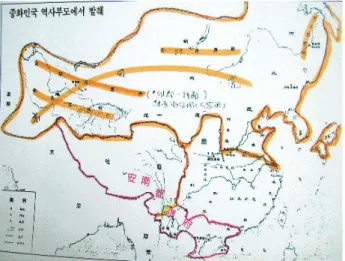
1)Tibetans (藏族) have a long history and traditional culture, a unique natural environment and an extensive population. The Tibetan Plateau, Sichuan (四川) prov- ince, Yunnan (雲南 ) Province and the current Tibet Autonomous Region have a long history, traditional culture and a wide range of natural environments. Tibet is located on a high plateau in Central Asia, but has been engaged in historical and cultural exchanges with China, Mongolia, and other neighboring countries since the first unified country, Tobeon (吐藩). This has had a great impact on clothing and society as a whole.
Tibetan has adapted themselves to a climate and a harsh environment that does not conform to human sur- vival and has built a self-sustaining culture. At one time the territory stretched beyond the Himalayas to Nepal, extending to central Asia, to Changan (長安) in Tang Dynasty. Even now, the world calls them “Tibet”
because the Tobeon (吐藩) empire was a powerful country at the time (Fig. 1) (Chen & Suh, 2014).
Modern society is emphasizing the status of tradi- tional culture as a medium for sustainable development of the nation. The fashion industry has been constantly studying Saekdong (색동, stripes of many colors) as a traditional material. The beauty of rhythm, which ap-
※ This research was supported by Inha University fund (2019).
1
김지수: 인하대학교 일반대학원 의류학과 박사과정
2
†(교신저자) 나영주: 인하대학교 의류디자인학과 교수 / E-mail:[email protected] / TEL:032-860-8136
Vol.22, No.3, pp.91-102, 2019
https://doi.org/10.14695/KJSOS.2018.22.3.91
pears in color repetition, has been settled in Korea and passed down until now (Geum, 1994), though Saekdong has been seen from ancient times in Korea, Chinese mi- norities, and some areas of Japan.
It is assumed that Koreans and Tibetans had relation- ships in cultural convergence. Tibet's Saekdong seems to be affected or closely related to the Korean people's clothes. The reason for this is Goguryeo (高句麗 ) was the largest north country in AD 4~6 century to the west bor- der of Persia, lasting almost 900 years as the world's greatest Tartary empire (BC200~AD668) (Fig. 1). Some of Goguryeo (高句麗 ) people moved and settled after late 7
thC, migrating to Sichuan (四川省 ), Tsinghai (靑海省 ) and Kansu (甘肅省 ) (Cho et al., 2012) as well as Japan.
Regarding the origin of Saekdong, the theory that the Mongolians called Korea ‘Solongos (rainbow country)’
supports the fact that they formed today's Saekdong.
Fig. 1. Documents of history textbooks testifying the territory of Goguryeo and Tobeon
(http://m.pluskorea.net/a.html?uid=13373)
Although there are current studies on Tibetan and Saekdong (stripes of many colors), there is little re- search on Saekdong found in Tibetan. Therefore, this study is meaningful in that it is a study on clothes with stripes of many colors in costume in Tibet.
This study investigated Tibetan's cultural background and techniques on costume characteristics. Literature and photographic materials were analyzed in photo- graphs related to Saekdong in ‘Tibetan Costume And
Ornaments’. And the pictures and data from internet searching were collected. The Internet survey was con- ducted from August to September 2018. Image collec- tion was performed on about 500 images through key- word search (Tibetan, Tibet people, Tibetan clothing, Tibet clothes, Tibetan costume) on Google images. This study analyzed twelve pictures in a book and twenty five pictures through internet image search. This study focused how the color stripes of Tibetan is different to those which are found in Korean Saekdong and what are the characteristics of multicolor stipes in Tibetan costume.
2. Tibet climate and Tibetan Costume
The terrain is generally tilted from northwest to southeast based on vast plateaus. The climate is very cold and dry in the northwestern part and warm and wet in the southeast. Although winter is long and there is no summer, the amount of sunshine is sufficient, ra- diant heat is high, average temperature for the year is low, and daily temperature range of day and night time is large (Moon, 1998). In addition, population density is very low because of high barriers and poor geographical environment. Most of the inhabitants use Tibetan, they mostly believe religions in Tibetan Buddhism, and there are some Buddhist religions (Choi & Hwang, 2016).
Tibetans have adapted to a climate and environment that does not fit human survival and have built a self-sus- taining culture. Tibet is located on the high plateau of Central Asia, but has been engaged in historical and cul- tural exchanges with India, Nepal, China, Mongolia and other neighboring countries since the first unified country, Tobeon ( 吐藩 ). This has influenced both the costumes and society as a whole. In this history, Buddhism is the center of maintaining Tibetan society and culture (Choi &
Hwang, 2016).
Tibetan is the most populous ethnic group in China
with a population of 18 million, and has a simple and
beautiful culture of costume (Wang et al., 2017). Tibetan
is a vast and complex area with a long history, and
beautiful and diverse styles are formed in living environ- ment based on this complex terrain.
Clothing in particular provides useful grounds for re- sistance as it is a taken for granted aspect of everyday life (Yangzom, 2014). In authoritarian regimes such as China where collective expressions of dissent are quickly suppressed by the state through military means, wearing Tibetan clothing is seen a more sustainable and non-vio- lent way of long-term engagement in the struggle for freedom (Yangzom, 2014).
Tibetan clothing is developed by local people in a long-term practice in the unsteady environment of the Tibetan plateau (Guo et al., 2013). The average differ- ence in air temperature in this area is near 15 °C in a day because of its high altitude and strong solar radia- tion (Guo et al., 2013). Based on the wearer’s thermal sensation, Tibetan clothing can be adjusted into several styles (Guo et al., 2013).
The features of general Tibetan costume vary with the region and life style, but the patterns that appear on the costume are used over a wide area to represent good luck and the spread of Buddhist teachings (Choi & Hwang, 2016). The costumes for religious rites vary with religious sects, but most of the patterns are commonly used (Choi
& Hwang, 2016). The symbolism of pattern is a form of figure that represents the human psyche and physical world (Choi & Hwang, 2016). The symbolism of pattern implies meanings such as compensation or futuristic wish (Choi & Hwang, 2016). First, the lucky omen normally means long life, happiness and peace, and means religious salvation in Buddhist perspective (Choi & Hwang, 2016).
Second, warding off evil spirits (辟邪) normally means avoiding misfortune, and means dignity and self-pro- tection, and protection of Buddhadharma in Buddhist per- spective (Choi & Hwang, 2016).
The clothes of Tibetan is basically composed of Zangpao (藏袍) (caftan), jacket, pants, long boots and accessories. They call pants as ‘Paji or Baji’, in the same sound like Korean, Tibetan women put on pants with Bangjeon (帮典 ) in daily life just like Korean women. And Tibetan woman wears Zangpao (藏袍 ) of which length is about ankle while wearing the long sleeved jacket, and
also puts on Bangjeon (帮典 ), which is an item shaped like an apron (Park, 2004). Tibetan man wears the pants and jacket and also wears Zangpao (藏袍) of which length is about the knee and also fastens waste with waistband and puts on a headgear and lastly has on long boots (Park, 2004). Clothing of Tibetan man is dignified, large and comfort and clothing of Tibetan woman is delicate, beau- tiful and colorful.
According to a study by Wang et al. (2018), red (17.9%) was the most abundant in Bangjeon (帮典), followed by achromatic (14.3%) and purple (12.8%).
The lowest frequency was greenish (1.9%). Frequently used tones were Vivid (28.2%) and Deep (12.5%), while those with relatively low usage were Dull (0.5%) and Light (2.0%). Bangjeon (帮典) features red, green, blue colors and achromatic colors to make them look colorful. Bangjeon (帮典)'s hue is the most commonly used vivid color, similar to the color of clothing.
The preceding research related to the costume regard- ing Tibetan are as follows. Kim & You (2009) has stud- ied the costumes that are most revealing the phenomenon of globalization centering on Tibetan in order to explain the changes caused by globalization of Tibet. Choi &
Hwang (2016) conducted an intensive analysis of the costumes worn during performances performed during the holidays in a research on Tibetan costumes. Kwon
& Lee (2012) also studied the types and characteristics of official hat worn by Tibetan monks. Qiao & Soh (2010) studied the characteristics of Tibetan costume through analysis of unique Tibetan culture. And they pre- sented a new fashion design which is combined with modern fashion from the form of traditional costume. In the study of Wang et al. (2017), the characteristics of the costume of Tibetan were analyzed. Based on the col- orful characteristics of Tibetan costumes, they had devel- oped and produced new fashion designs and proposed directions about various and creative fashion design.
Unlike Korea’s five color, the five colors of Tibetan
are red, yellow, green, blue, and white. They have
green instead of black in Korea. Black is one of the
most sophisticated and complicated colors in Tibetan
people's lives. In Sichuan (四川) province a high-ranked
Tibetan man often wore black apparel because black is a symbol of earth and there were black tents used in the homes of nomads made of yak wools. And a pair of black crane costume worn by men and women in ru- ral areas festivals. According to Goguryeo (高句麗 ) tomb wall paintings, wearing black jacket comes first in a row regarded as a high rank. In Tibet province, most of men wear black for they like black and black yaks provides their furs. Red represents the color of fire and is regarded as a symbol of power, recently. When thinking about red flags in Tibet, they think of the dragon as a symbolic color. Dark blue symbolizes the eldest son, or ChangCheong (藏靑), being the most fre- quently worn color of the Tibetan region.
Dark blue represents mystery and the plateau, with the color of blue skies and lakes. Green is the most common color, meaning vitality in the color of grass. Green color is closer to the public, and it is more frequent in a wide range of nomadic areas. Gold and silver represent wealth and dignity, and clothes with those colors represent the wealth and riches of the family. Since white symbolizes life and luck, it is one of the most frequently used colors.
Yellow as the representative color of earth symbolizes hope and light, and the meaning of Buddha’s grace as well.
3. Saekdong of Korea
3.1. Meaning of Saekdong
Saekdong's literal meaning is the sleeve or narrow cloth of a Korean traditional jacket that is dyed in an autumnal color or made up of colored silk pieces.
Saekdong cloth means various colors of cloth like rainbow. Saekdong consisted of an array of colors similar to a rainbow. A collection of various colors is a set of colors that can be naturally encountered in the surround- ing living environment and blends happiness and color of Korean style.
The colors used in the Saekdong are bright and dark with crossed arrangements, with a cheerful feeling, with the hope of the advent and joy of happiness. Saekdong
is pursuing harmonious beauty through the use of color- ful colors. Saekdong used more than two colors, and em- phasized colors from ancient times (Geum, 1994).
Saekdong is also made possibly by collecting and con- necting remnants of colored patches.
Saekdong was worn during the big events of life such as marriage, sixtieth birthday and holiday, and was treated as a sign of pleasure and precious color. The aesthetic joy can be extracted as a basis for establishing the splen- did beauty that admires the beauty of multicolor, the max- imization of the difference of brightness and saturation, the use of various colors for the atmosphere of such a festival. On the other hand, Saekdong has been put on casual wear for children, and Saekdong has appeared in shamanist costumes. Saekdong is not only a celebration of joy and auspicious day, but also has other cultural meanings. Therefore, the symbolic meaning of Saekdong is religious, protective and desires.
3.2. Saekdong of Goguryeo (高句麗) dynasty
In the prehistoric Goguryeo (高句麗) Murals, women in Saekdong skirt were found. The origin of Mongolia's call for Korea as ‘Solongos’ can be found on the outside of evidence for Saekdong of Korean costume's endemism. ‘Solongos’ means rainbow in Mongolian. It is said that the color resembles the color of the rainbow and that Goryeo (高麗) is called ‘rainbow country’ (Cho et al., 2012). Indeed, there is a significant similarity be- tween the colors of Tibet, Mongolia, and Korea, and it can be presumed to be derived from the stripe form com- mon to Mongolian peoples.
Fig. 2 shows the women dressed in Saekdong skirt shown in the Deokheung-ri ( 德興里 ) tomb murals and the Susan-ri (水山里) tomb murals. Fig. 3 is an Astana ancient tomb mural showing Saekdong in the Xinjiang autonomous region (新疆自治區) museum.
The original Saekdong were made with colored threads
of warps when weaving. And this is a fabric, Kyung-
Geum (經錦) of vertical stripes with same thickness fab-
ricated by warp arrangement. By connecting remnants of
cloth, connecting fabrics of color stripes came in later gen-
erations, such as connectivity and quilting, which was
longing for the past abundant time. Thus, Saekdong is not remnants of cloth but Kyung-Geum (經錦) fabric woven from the beginning with a colored thread.
Fig. 2. Saekdong skirt in the Goguryeo (高句麗) tomb mural (http://www.k-heritage.tv/brd/board/275/L/menu/2476?brdType
=R&bbIdx=2966)
Fig. 3. Astana Saekdong in Xinjiang autonomous region (新疆自治區) museum
(http://blog.naver.com/PostView.nhn?blogId=nishachoi&logNo=
220910159367&parentCategoryNo=&categoryNo=&viewDate=
&isShowPopularPosts=false&from=postView)
Kyung-Geum (經錦 ) is made using warp threads of two or more colors and weft threads of only one color.
The colored warp threads are picked up individually or as a group by the weft thread to make the desired pattern. Weft-patterned Geum (錦), We-geum (緯錦) is just the reverse of warp-patterned Geum (錦), the warp threads, are all of one color, while the weft threads are of two or more colors.
Kyung-Geum (經錦) comes out in the 11th century B.C. at Gojoseon (古朝鮮). In the Gulf of Pohai (渤海) and the downstream of Yellow River, each house breeds silkworms. In Tibet, silk road meadow roads were cre-
ated, namely silk fabrics were delivered naturally before the 5th century B.C. In the South Siberian grasslands, the Tatarys rode horses early and the East Tatarys (Buyeo 夫餘 and Goguryeo 高句麗 ) exchanged frequently. Gojoseon (古朝鮮), a multi-ethnic alliance country might give the ally a silk fabric and virtue of Gojoseon (古朝鮮) who respected peace and well-being.
Current Saekdong is a warp satin, and it is a simplified and modernized version of the ancient Kyung-Geum (經 錦) which was a variation of plain or leno structure. The Saekdong consists of complementary colors, and its color scheme is harmonious, delightful, simple yet active. Since Saekdong was thought to produce supernatural powers, it is still being used in shaman’s costumes, and in chil- dren’s Hanbok for a purpose of warding off evil spirits (Kim & Na, 2018).
Saekdong is arranged by pre-arranging the warp so that the color spacing is the same, and dyeing each yarn separately. Saekdong has a regular sense of rhythm and also inserts a pattern, which is a fabric that can be made with a high degree of sophistication (Kim & Na, 2018).
Saekdong's meanings are: First, women made a girl's jacket with sleeves of multicolored stripes with the re- maining cloths, putting them on children's first-birthday parties and festivals. It means five primary substances (metal, wood, water, fire, and earth), and a good health and long life. Second, in the folklore aspect, Saekdong is derived from Obangsinjanggi (five colored flags) accord- ing to Yin-Yang and the Five Elements theory (Kwon, 2001). Obangsinjanggi is a flag of black, red, yellow, blue, and white representing five orientations. It is a func- tion tool that is used mainly to divide the transportation used by the shamans in the gut and to expel evil spirits.
It is a theory that clothes is worn in five colors to get
dressed. This means that Saekdong is based on Yin-Yang
and the Five Elements theory and has a meaning of color
consciousness. The five colors based on Yin-Yang and
the Five Elements theory are red in the south, black in
the north, blue in the east, white in the west, and yellow
in the center (Kim, 1998).
3.3. Color of Saekdong
In ancient time, Saekdong used 2~3 basic colors, but today’s Saekdong includes a larger variety of colors.
Adding white creates space and a sense of relaxation, also emphasizing the pattern and accentuating the neighboring colors. And adding colors on the opposite side of the col- or wheel enhances the color scheme. The ancient people of Korea were ingenious in assembling the Saekong pat- tern with their unique aesthetics. The vivid color is bor- dering another vivid color, but they do not collide with each other, forming a harmonious mood. This type of ar- rangement is crucial in making patterns, since a wrong arrangement can induce a sense of discomfort. Saekdong pattern cleverly avoids this, and on top of being harmo- nious, it even has a delightful touch to it.
Even with only two or three colors, the complex ar- rangement of them makes the Saekdong pattern far from monotonous. Recent Saekdong has smaller patterns and longer intervals, compared to the past. Fig. 4 (a) is the jacket with sleeves of multicolor stripes and Fig. 4 (b) is Durumagi (두루마기, traditional Korean overcoat) by children in the late 19th century.
(a)
(b)
Fig. 4. (a) Jackets with sleeves of multicolored stripes and (b) many-colored outer coat worn by children on New Year's Day
by the late 19th century Joseon Dynasty (Museum of Korean Embroidery (韓國刺繡博物館), Seoul,
South Korea)
Fig. 5 is Jeogori (저고리, the upper garment of Korean traditional clothes) in the Joseon Dynasty and Fig. 6 is Korea's 1940s Jeogori. Fig. 7 shows a baby
Fig. 5. Korean traditional jacket in the Joseon period (Sookmyung women's university museum, Seoul, South Korea)
Fig. 6. Korean traditional jacket in the 1940s (Sookmyung women's university museum, Seoul, South Korea)
Fig. 7. Baby wearing Korean traditional jacket in 1992
(Personal data of author)
(a) (b)
Fig. 8. (a), (b)A boy's hanbok in the 2000s (http://www.parkjeongwook.com/index.php?mid=gallery&docu
ment_srl=439&category=131)
having a first-birthday party in Korea in the 1992 with Hanbok (한복, traditional Korean clothing). Fig. 8 is Hanbok of Korean boy in the 2000s. Fig. 9 is a variety of Saekdong Hanbok currently sold in Korea.
(a)
(b) (c)
(d) (e)
Fig. 9. (a)~(e) Korean Modern Saekdong Hanbok (https://orimi.co.kr/)
4. Results
4.1. Color stripes in Bangjeon (帮
典)For the analysis of color stripes found in the costume of Tibetan is as follows. First, various color stripes were found in Bangjeon ( 典帮 ) (Fig. 10). Bangjeon ( 帮典 ) is the ornament of Tibetan ladies. It has a variety of colors at the waist and many attractive aprons are called
‘Ppangttan (邦單)’. They are also called ‘Bangjeon (幫
典)’ and ‘Bangsuk (邦塾)’. Bangjeon (帮典) are made of wool of various colors with horizontal line patterns (Choi & Hwang, 2016). Bangjeon (帮典) has a variety of vivid colors. In Fig. 10 (a) ~ (k), the fabric of color stripes is divided into two or three in Bangjeon (帮典) and the number of colors varies.
(a) (b)
(c)
(d) (e)
(f) (g)
(h) (i)
(j) (k)
Korea uses dark color and light color in an alter- nation, but Tibetans use progressive order, from pale tone to vivid tone. Based on five colors of red, yellow, green, blue, and white weave was with 14 ~ 20 colors.
The more elegant the color is, the higher the nobility of the wearer is.
Color stripes in Bangjeon (帮典 ) is a unique Tibetan folk costume, which shows the difference from one color of apron of Korea tomb wall paintings. Korea weave Saekdong into one piece of fabric, but Tibetans connect color stripes with several pieces of fabric. And Tibetans use so many colors and put colors gradually in the order, while Korean Saekdong use 5~7 colors only and the order is bright-dark alternatively with harmony. Most of all, Tibetans use the color stripes in horizontal direction, while Korea Saekdong is vertical.
4.2. Color stripes in Tibetan sleeve
The costume was shown with the color stripes pat- tern on the sleeves (Fig. 11). It could be seen as a cos- tume that points to color stripes on a sleeve that re- minds of Korea's traditional jacket (Jeogory) with sleeves of multicolor stripes, Saekdong.
Tibetan folk costumes actively used black in color stripes, which, together with the characteristics of the people who worshiped black, expresses a majestic and polite meaning (Cho et al., 2012). In Korea, according
to the Yin-Yang and the Five Elements theory, black symbolizes death or dignity, so the use of clothes as the main color is insignificant.
In Fig. 11 (a), there is an overall color stripes of the sleeves, with a floral pattern at the end of the sleeve and a dot pattern in the middle. (b) shows color bands in sleeves as a whole but puts another pattern in the middle. In (c), color stripes are seen on the upper part of the sleeves of the garments worn by both men and
(l)
Fig. 10. Color stripes in Bangjeon (帮典) (a)~(e) Tibetan Costume And Ornaments
(f) http://96.0.224.140/tibet/costumes-and-ornaments.html (g) https://www.exploretibet.com/blog/tibetan-women-a-divine-an
d-generous-heart/
(h) https://www.eastwestbank.com/ReachFurther/News/Article/Re cipes-of-China-Tibetan-Beef-Dumplings
(i) http://chinatibet.people.com.cn/7927649.html (j) & (k)https://baike.baidu.com/item/藏族
(l) A display of Tibetan nomadic life at the Ethnic Museum in Beijing, China. Source: China Ethnic Museum, n.d.
(a)
(b) (c)
(d) (e)
(f) (g)
Fig. 11. Color stripes in sleeves (a)~(c) Tibetan Costume And Ornaments
(d) & (e) http://www.dajiazhao.com/yuce/minzu/tuzu/minzu1197 8.html
(f) https://m.365aikan.com/ctwh/56geminzu/1963.html
(g) http://en.kangbatv.com/ly/mfms/201612/t20161202_3170929.
html
women. In (d), color stripes were made of shiny mate- rial, and (e) and (f) sleeves were designed with varying sizes of color stripes. (g) shows costumes designed by color stripes on one side of the sleeves.
Tibetan use color stripes in sleeves in both large and small scale, differently from uniform width of Korea Saekdong. Also they use black color in their color stripes (Fig. 11-f), while Koreans don’t use black in Saekdong. Black is symbol of north bearing and means death or dignity, so Koreans don’t use black in Saekdong. Because Saekdong represents hap- piness, pleasure, harmony, blessing, and equality in Korea (Kim & Na, 2018).
Tibetans use color stripes partially or at the end of sleeves, while Koreans use them in entire sleeves. We think Tibetans put some meaning or importance on the use of joyful vivid color or have free style, while Koreans have used Saekdong as a standard code of costume of structure.
But Tibetans have white color at the end of sleeve similarly with our Hansam, which is a white end to cover the hand. Tibetans put on the costume of very long sleeves when they dance flail their arms (Fig.
11-c, e & j).
4.3. Color stripes in accessory
There were various color stripes decorations in head- dresses and clothes. Tibetan's glamorousness is re- vealed through various accessories, especially hair ac- cessory (Fig. 12) and dress ornament made of various ornaments (Fig. 9). In Fig. 12 (a), Color stripes ap- peared in the hood on the female head. In (b), a head- band was produced by braiding a hood in four colors.
(c) ~ (g) show color band of various colors at the end of the women's hats.
In the traditional hat of Tibetan people, we can see beautiful color stripes. Unlike Chinese, Tibetans are nomadic, and they have developed ornaments as they move. The ornaments are highlighted in brilliant color, and the colorful clothes highlight richness.
(a) (b)
(c)
(d)
(e) (f) (g)
Fig. 12. Color stripes in hair accessory (a) & (b) Tibetan Costume And Ornaments
(c) & (d) https://www.3rdpoletour.com/siguniangshan-travel-guide /jiarong-tibetans.html (e)https://sophieschiller.blogspot.c om/2015/01/race-to-tibet-meet-characters.html (f) https://www.pinterest.co.kr/pin/332703491214775894/
(g) http://en.people.cn/n/2015/0421/c98649-8881162.html
Tibetans wear a twisted hair ornament or braiding their hair (Fig. 12-b & 13-c), while Koreans braid hair on both side at most. And sometimes they put hair fix in a frame of heart shape. Koreans had similar frames on the headdress which remains in queen’s costume.
Also there are some similar accessories with Tibetan
headdress, front Daenggis (댕기 , pigtail ribbon) and
back large Daenggis ribbon. We put on a pigtail ribbon after braiding hair with Binyeo (비녀, traditional orna-
mental hairpin), large Daenggis in the center back of head when wedding ceremony, and these Daenggis have lots of decoration and silver dishes on them. These Daenggis seem the same as the head decoration of Tibetans, Fig. 12-a.
Fig. 13 (a) shows color stripes at the center and at the end of the back. (b) shows color stripes of various colors on the waist, and (c) shows color stripes on the decoration of the baby's neck. In (d), color band appears at the middle and ends of the female collar and sleeves, and (e) appears at the decoration of the breast. (f) shows color stripes at the end of the skirt, and (g) shows color stripes as a whole on the front of the clothes. (h) shows color stripes in vest and Bangjeon ( 帮典 ), (i) shows col- or stripes in both sleeves and shoulders.
5. Discussions and Conclusion
Saekdong is based on the philosophical ideas of Yin-Yang and Five Elements of the Universe. The for- mative art and sense of colors of Korean ancestors are artistically harmonized and expressed (Yang, 2013).
They are the representative colors of Korea containing the Korean emotion by the harmony of various brilliant colors (Yang, 2013).
Saekdong is one of the most typical decorative ele- ments used to represent the traditional Korean cultural image (Suh, 2017). Its vibrant and colorful aesthetic is imbued with the talismanic meaning of praying for happi- ness (Suh, 2017). In the form of repeated stripes in a few simple color combinations, Saekdong presents a harmo- nious amalgamation of splendid color matches. Since the saekdong color palette is a time-honored token of tradi- tional Korean beauty and equality, studying it with mod- ern sensibilities will be of great significance.
The beauty of Saekdong appeared in Tibetan. The re- sults of this study are as follows. First, Bangjeon ( 帮典 ) (帮典), which means apron made with wool, is a Tibetan folk costume. Bangjeon (帮典) is a waist adornment that Tibetan women wear like an apron. Tibetan girl wears a
(a) (b)
(c) (d) (e)
(f) (g)
(h) (i) Fig. 13. Color stripes in dress ornament
(a) & (b) Tibetan Costume And Ornaments (c)https://www.pinteres t.co.kr/clahud/tibet/
(d) http://local-moda.blogspot.com/2015/02/tibetan-and-sherpa-cos tumes-at-lhosar.html
(e) http://en.people.cn/90782/8376795.html (f) https://pxhere.com/fi/photo/1031725
(g) & (h) http://korean.cri.cn/1767/2012/04/24/1s183955.html (i) https://www.tibettravel.org/tibetan-people/tibetan-clothing-and-
accessories.html
colored Bangjeon (帮典) for the first time at the waist when she is five years old. The technology to produce such Bangjeon ( 帮典 ) was listed as a national non-material cultural heritage in 2006. Bangjeon (帮典 ) symbolizing Tibetan traditional costume was able to be seen as a beau- tiful color stripes. The appearance of color stripes in Bangjeon (帮典 ) shows the difference from the Korean folk costume. Unlike Saekdong of Korea, Tibetans arranged col- or stripes in gradual order, colors are more varied and sev- eral cloths were connected. The color bands are used in hori- zontal way differently with Korea Saekdong, because they weave a fabric using color threads as wefts not warps.
Second, color stripes appeared in the sleeve of Tibetan tradition. A colorful sleeve is visible as a point of costume. This is similar with the upper garment of Korean traditional clothes of Saekdong with stripes of many colors. We use colors in a constant thickness with moder- ation, but they use multicolor in a variety of width in the sleeve of Tibetan costume, not fixed but with more freedom.
Third, color stripes can be seen in head and clothes orna- ments and many accessories. Tibetans like to decorate themselves with ornaments and they usually have hair or- naments, necklaces, earrings and rings. Most Tibetans, es- pecially women, like to dress up gorgeously from head to toe. In these Tibetan ornaments, a variety of colored bands appeared. The Tibetan people are nomadic, and the orna- ments have been developed for the movement. The orna- ment is emphasized in brilliant color, and it is rich in clothes. The Saekdong of Korea was spread in these color- ful clothes of Tibet and showed splendor.
Fourth, black was difficult to find in Saekdong in Korea, while black was in common in color stripes in Tibet. The elimination of black from the colors of Korean traditional costumes is based on the Yin-Yang and the Five Elements theory and five cardinal colors.
Black was intentionally excluded or not actively used because it symbolized death or dignity, neither pleasure nor happiness.
There are some kinds of Tibetan apparel which are rep- resentative in the ethnic minorities of China. Because of the lack of research on Tibetan clothing for now, it is
more necessary to study this aspect. By analyzing their color stripes, we can see the use of all the colors. Among them, red, orange, yellow, green, indigo, and purple are more likely to be used than other colors. And many color applications were used as well. These different senses of color represent different religions, whose different charac- teristics appear also on the traditional clothes.
In ancient time, Korea had a high level of culture to weave colorful Saekdong. Gojoseon (古朝鮮) and Goguryeo (高句麗) had a very developed society for a long period of about each 2000 and 900 years and high technology to make Kyung-Geum (經錦) and DaNuSeMuGyung (多紐細文鏡 ), the finest bronze mir- rors of the world. This beautiful high culture of Goguryeo (高句麗) had spread to east and west as well as south Siberia through the Tartary horse riding.
Korea's Saekdong appeared in the traditional costumes of ethnic Tibetan. It seems that the vivid hue contrast worn from dress and ornaments of the ancient history of Korea was transmitted. Color stripes means the pros- perity of society and people are happy in no pain. Thus Saekdong seems to have been propagated, reflecting a special eye for the color of Tibetan people.
REFERENCES
An, X. (Ed.). (2002). Tibetan Costume And Ornaments, China Intercontinental Press, Beijing.
Chen, Q. Qi., & Suh, S. H. (2014). Study on the Fashion Design by Utilizing the Chinas Tibetan Dress Culture.
Journal of the Korean Society of Costume, 64(4), 131-149. DOI: 10.7233/jksc.2014.64.4.131
Cho, W. H., & Kim, M. J. (2010). Genealogy of the Rainbow Stripe in Ethnic Costumes in East Asia.
Journal of the Korean Society of Costume, 60(4), 113-125.
Choi, M. J., & Hwang. S. O. (2016). A Study on Reli- gious Symbolism of the Costume Pattern of Tibet.
Journal of the Korean Society of Costume, 66(1), 42-57. DOI: 10.7233/jksc.2016.66.1.042
Geum, K. S. (1994). Korean Traditional Costume Art.
Yeolhawdang, Paju.
Guo, X. F., Wang, Y. Y., & Li, J. (2013). Evaluation of adjustable thermal insulations of Tibetan clothing by manikin testing. Fibres & Textiles in Eastern Europe, 1(97), 87-91.
Kim, J. S., & Na, Y. J. (2018). The Origin and Emotion of Saekdong in Our Surroundings. Korean Journal of the Science of Emotion & Sensibility, 21(1), 97-112.
DOI: https://doi.org/10.14695/KJSOS.2018.21.1.99 Kim, Y. R., & You, T. S. (2009). An Analysis of the
Changes in the Commercial Sphere of Lhasa Fashion Derived from the Globalization in Tibet. Journal of the Korean Society of Costume, 59(7), 127-139.
Kim, Y. S. (1998). Korean costume dictionary, Misulmunwha, Seoul.
Kwon, Y. G. (2001). Colorful world, Kukje Publishing House, Seoul.
Kwon, Y. S., & Lee, K. H. (2012). The Types and Features of Formal Ritual Hats for Tibetan Buddhist Priests. Journal of the Korean Society of Costume, 62(5), 16-30. DOI: 10.7233/jksc.2012.62.5.016 Moon, S. C. (1998). Research of Tibetan Society and
Buddhist Culture: Tibet's Feature of Nature and Human Environment. East Asian Studies, 36(0), 249-250.
Park, S. Y. (2004). A study on the Clothes of Zangzu.
Chung-Ang University Graduate School of Master's thesis.
Qiao, D., & Soh, H. O. (2010). A Study on Tibetan Folk Costume on the Stage-Focused on the CCTV Spring Festival Gala. Journal off the Korean Society of Costume, 60(9), 26-40.
Suh, O. K. (2017). A study on Necktie Design inspired by Saekdong. Journal of Communication Design, 60(0), 76-87.
Wang, C., Kim, J. S., & Na, Y. J. (2018). A study on the color sensation and symbolism of Tibet costume.
Korean Journal of the Science of Emotion & sensibility, 21(3), 115-128.
DOI: https://doi.org/10.14695/KJSOS.2018.21.3.115 Wang, Y. F., Lee, J. K., & Lee, Y. H. (2017). Fashion
design applying to the features of the Chinese Zhuang costume. The Research Journal of the Costume Culture, 25(5), 694-707.
DOI: https://doi.org/10.29049/rjcc.2017.25.5.694 Yang, J. N. (2013). A Study on Women`s Clothing Design
Using the Image of Korean Saekdong. Journal of the Korean Society of Design Culture, 19(3), 437-445.
Yangzom, D. (2014). Clothing and Social Movements:
The Politics of Dressing in Colonized Tibet. The City University of New York Graduate School of Master's thesis.
원고접수 : 2019.07.02 수정접수 : 2019.08.09 게재확정 : 2019.09.03
ⓒ 2019 (by) the authors. This open access article is distributed under the terms and conditions of the Creative Commons Attribution license (http://creativecommons.org/licenses/by/3.0), which permits unrestricted use, distribution, and reproduction in any medium, provided that the original work is properly cited.