이종 모바일 기기들의 인터넷 접속을 개선할 수 있는 가상 모바일 애드혹 네트워크 모델
1)지아 우딘*, 김 종 면*
A Virtual Mobile Ad-Hoc Network Model to Improve Internet Connectivity among Heterogeneous Mobile Devices
Jia Uddin*, Jong-Myon Kim*
요 약
본 논문은 IEEE 802.11g, IEEE 802.11b, 주파수 도약과 같은 서로 다른 네트워크 동작 모델의 통신 용량에 따라 이종 모바일 디바이스들을 서로 다른 네트워크 그룹으로 자동적으로 분리하는 가상 모바일 애드혹 네트워크(VMANET) 모델을 제안한다. 또한 제안하는 모델은 VMANET들의 각 그룹 을 위한 특정 라우팅 알고리즘을 지원함으로써 다중 라우팅 알고리즘이 VMANET의 서로 다른 그룹에 서 동시에 동작 가능하다. 네트워크 정체를 줄이고 네트워크 부하 밸런스를 향상시키기 위해 고정 MANET 게이트웨이가 각 VMANET에서 이용되며, 이러한 게이트웨이는 MANET과 IP 네트워크를 통합 가능케 한다. 모의실험결과, 제안하는 모델은 기존 IMANET보다 상당한 처리량을 증가시켰고, 네트워크 정체 및 네트워크 지연 또한 감소시켰다.
▸Keywords : 인터넷, 멀티프로토콜 라벨 스위칭, 모바일 애드혹 네트워크, 인터넷 기반 애드혹 네트워크
Abstract
This paper proposes a virtual mobile ad-hoc network (VMANET) model that automatically divides heterogeneous mobile devices of a MANET into a number of network groups depending on the communication capacity(data rate) of different network operational models such as IEEE 802.11g, IEEE 802.11b, and Frequency Hopping. In addition, it supports a distinct routing
∙제1저자 : Jia Uddin ∙교신저자 : 김종면
∙투고일 : 2013. 07. 30, 심사일 : 2013. 09. 02, 게재확정일 : 2013. 11. 06.
* 울산대학교 전기전자컴퓨터공학과(School of Electrical, Electronics, and Computer Engineering, University of Ulsan)
※ This work was supported by the National Research Foundation of Korea(NRF) grant funded by the Korea government(MEST) (No. NRF-2013R1A2A2A05004566).
protocol for each network group of VMANETs, resulting in running multiple routing protocols concurrently on different groups of VMANETs. To reduce the network congestion and improve the network load balance, a default MANET gateway is configured in each VMANET and these gateways are responsible for integrating the MANET and IP networks. Experiment results show that the proposed model outperforms the conventional IMANET by significantly increasing throughput and reducing network congestion and network delay.
▸Keywords : Internet, multiprotocol label switching (MPLS), mobile ad-hoc network (MANET), Internet based mobile ad-hoc network (IMANET)
I. INTRODUCTION
With the advancement of mobile communication and Internet technology, access of Internet service at any time and any location using mobile devices continues to influence our daily lives. For examples, above 90% American use a cell phone, 56% of adults use smartphones that include Android, iPhone, Blackberry, tablet computer and above 50% of total users use their mobile devices for accessing internet [1]. However, the conventional wireless network infrastructure fails to support internet services in some scenarios, such as the world cup soccer match, olympic games, congested metropolitan area, museum or large shopping mall, where large number of mobile devices are used. It is noted that people of these scenarios use electronic devices having various network operational models with numerous communication capacities. These are the considerable factors in the design of an efficient network.
As an alternative of conventional wireless network, mobile ad-hoc network (MANET) is playing a significant role as it is an autonomous system of mobile routers and associated hosts connected by wireless links [2]. The wireless entities and nodes are not physically fixed. Thus, the network topology can be changed dynamically due to the random mobility of nodes. Mobile nodes can access and offer
applications for other nodes located in the wireless range.
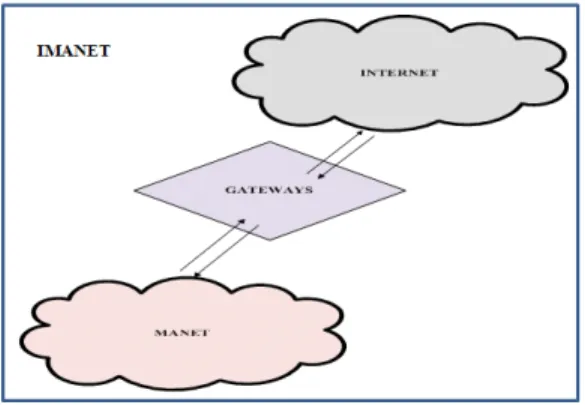
The conventional MANETs only deal with data communication between mobile devices within the network. Conversely, the internet-based mobile ad-hoc network (IMANET) is an emerging network model which supports internet connectivity between portable devices by integrating an infrastructure IP network and a MANET [3]. A sample scenario of IMANET is depicted in Fig. 1.
Fig. 1. A scenario of an Internet based Mobile Ad-hoc Network
A number of models proposed for IMANET and
these models showed reasonable performance in
some network scenarios with small amounts of
nodes, low density networks, homogenous networks,
but they can not cover a high dense network with
heterogeneous devices. Moreover, conventional
models did not address the issues regarding the
Network Operational
Model Capacity Examples of devices Applications VMANET
Frequency Hopping 2 Mbps Military radios, Walkie-Takies
High-reliable communications for military applications, low data rate, low power, and
anti-jam system VMANET1
IEEE 802.11b 11 Mbps Wi-Fi Routers in
WLAN Wi-Fi internet radio, WiFi AUTOdoc VMANET2 IEEE 802.11g 54 Mbps High speed Routers High data rate applications VMANET3
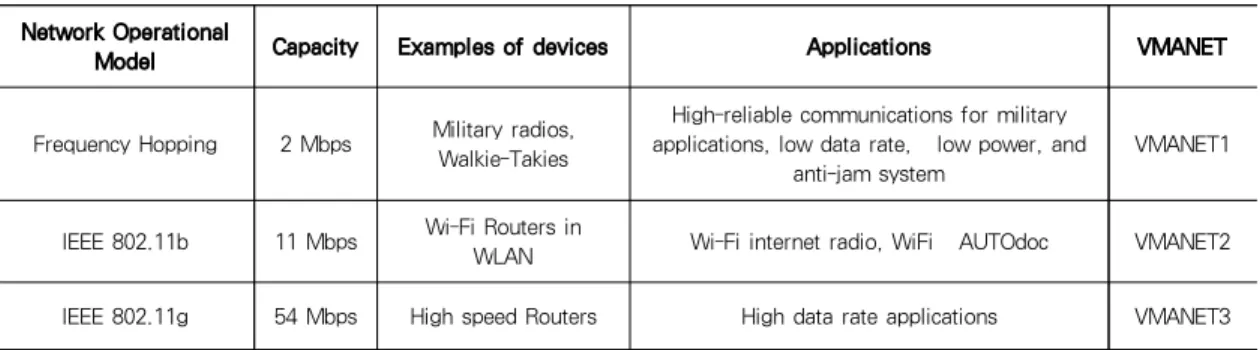
Table 1. Detailed statistics of different wireless networks
selection of routing protocols in a heterogeneous MANET and complexity and additional congestion in selecting optimal gateways.
To address these issues, we propose a virtual mobile ad-hoc network (VMANET) model for internet connectivity among heterogeneous mobile devices, where a clustering technique is used to cluster mobile devices into different groups (called VMANETs) depending on the device capacity.
Contributions of this paper are as follows:
1. The proposed model automatically classifies the mobile nodes into different clusters based on the communication capacity of numerous network operational models. This clustering approach distributes the total network load into different clusters and reduces the network congestion.
2. The proposed model is verified for an MPLS (multi-protocol level switching) backboned IMANET along with an IP-backbone network for internet connectivity, where the MPLS supports giga date rate for a high dense network and has additional features such as traffic engineering and label switching to support reliable data communication with better QoS.
3. Multiple gateways are considered in the proposed model. To reduce the additional congestion and complexity, one default gateway is configured for each VMANET. Therefore, no additional complexity is occurred in selecting a gateway to communicate with outside the VMANET.
4. In the proposed model, multiple routing protocols are concurrently performed on a large MANET scenario since each routing protocol independently run on an individual VMANET. In addition, the gateways handle the mismatch of routing protocols in different VMANETs. The consideration of the multiple routing protocols may significantly improve the overall performance.
The remainder of the paper is organized as follows. Section 2 presents the related works and Section 3 describes the proposed VMANET model in IMANET. Section 4 describes the experimental environment of the proposed model, and Section 5 presents experimental results and analysis. Finally, Section 6 concludes the paper.
II. RELATED WORKS
Many researchers have explored aspects of the
IMANET structure for internet connectivity between
mobile users [4-20] and addressed the issues of
designing network architecture, mobility
management, caching mechanisms, and design of
routing protocols for destination nodes and
gateways. For example, Capone et al. proposed a
Mobi-MESH network architecture for designing
internet connectivity in MANETs [4], which
provides a complete framework for analyzing,
studying, and testing the behavior of a mesh
network in the real-life environment. Special mesh
routers are responsible for integrating the wireless
backbone and other networks. Trung et al. discussed the required functionalities of internet connectivity and mobility management in MANETs [5]. Jeroen et al. discussed three possible approaches of internet connectivity among mobile users using a mobile IP, a subnet, and a network address translation (NAT) [6]. Shiv et al. proposed a network model that serves as an intermediate node between mobile nodes, where each base station acts as a gateway to access the internet traffic [7]. Yuan et al. proposed a two-tier hierarchical architecture model for accessing internet by mobile users [8]. Kumar et al.
proposed an Internet connectivity model using different gateways for both fixed and mobile users [9]. Pedro et al. proposed an adaptive gateway discovery algorithm, called maximal benefit coverage, which works based on the dynamic adjustment of gateway advertisement packets [10].
Prashant et al. proposed a gateway discovery method using the Hello message and observed that the mobile IP and on-demand routing protocols in a MANET can work together to set up a multi-hop path for internet connectivity [11]. Trung et al.
proposed a Quasi-tree mobility management approach for internet connectivity among mobile devices [12].
III. THE PROPOSED VMANET MODEL IN IMANET FOR INTERNET
CONNECTIVITY
In our proposed model, we use a clustering approach to cluster a finite set of VMANETs depending on the characteristics of the mobile devices such as communication capacity of numerous network operational models. In general, the key objective of clustering is maximizing both the homogeneity within each cluster and heterogeneity among different clusters [21]. Table 1 shows detailed statistics of the communication capacity of different network operation models. As depicted in
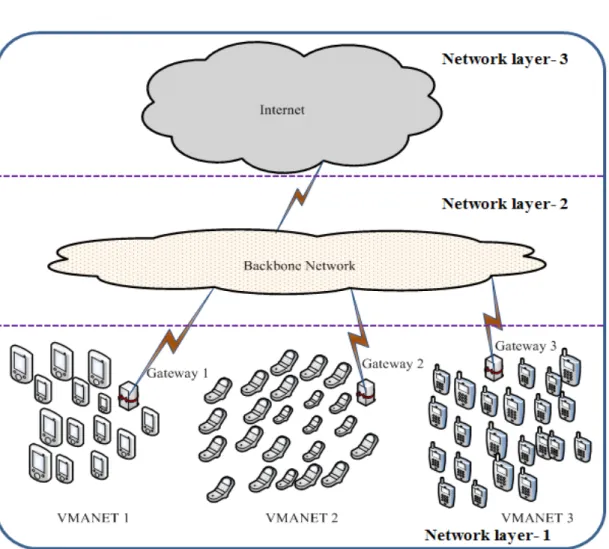
Figure 2, our proposed model can automatically classify the mobile devices into three homogeneous groups such as VMANET1, VMANET2, and VMANET3 depending on the range of capacity of three different network operational models, where devices having the communication capacity less than or equal to 2Mbps automatically go to VMANET1, devices with the communication capacity ranging from 2Mbps to 11Mbps go to VMANET2, and the rest of devices with the communication capacity above 11Mbps belong to VMANET3.
The proposed model supports a distinct protocol for each VMANET depending on the VMANET characteristics, where DSR is utilized for handling low data rate devices in VMANET1 and VMANET2, while AODV is used for handling high data rate devices in VMANET3. DSR uses few control packers to complete its routing operation and uses a route cache to keep the record of routing paths, which is suitable for low data rate applications. On the other hand, AODV does not utilize the route cache to keep the record of routing path, resulting in low control overheads and better dynamic adaptability towards link failure due to its low re-routing time, which is suitable for handing large amount of traffic. Overall, the proposed model supports multiple routing protocols concurrently at different VMANETs in a MANET.
A backbone network with single or multiple
IP-gateways placed as an intermediary network
between the MANET and the internet. Although the
use of multiple gateways in a MANET improves the
overall network performance, the selection of an
appropriate gateway requires additional complexity
and network congestion. For the simplicity, one
dedicated gateway in the proposed model is
configured for an individual VMANET for accessing
the traffic from neighbor VMANET/other
MANET/internet. If the destination node is placed
within the same VMANET, the source node uses the
same routing protocol using the multi-hop
communication. Otherwise, the source node directly
Fig. 2 The proposed VMANET model in an internet-based MANET
connects to the default gateway to access the traffic from a node placed outside the VMANET via the backbone network.
Overall, the proposed model automatically distributes the homogeneous devices into different VMANETs depending on the communication capacity, where multiple routing protocols are concurrently performed in a MANET, and a default gateway is configured in each VMANET. This improves the overall performance significantly by improving the network load balances while reducing the network congestion.
IV. EXPERIMENTAL ENVIRONMENT
The proposed VMANET model is implemented using the operational network evaluation tool (OPNET) modeler, version 14.5 [22]. To setup the experiment in the OPNET simulator, we configure the following components: mobile workstation, MANET gateway (e.g. manet_gtwy_wlan_ethernet_
slip4), mobility configuration, and subnets. The fixed wireless router (e.g. wlan_ethernet_slip4_adv) is configured as an IP router for the IP-backbone. In addition, label edge router (LER) (e.g.
ethernet2_slup8_ler) and label switch router (LSR)
(e.g. ethernet2_slip8_lsr) are configured for the
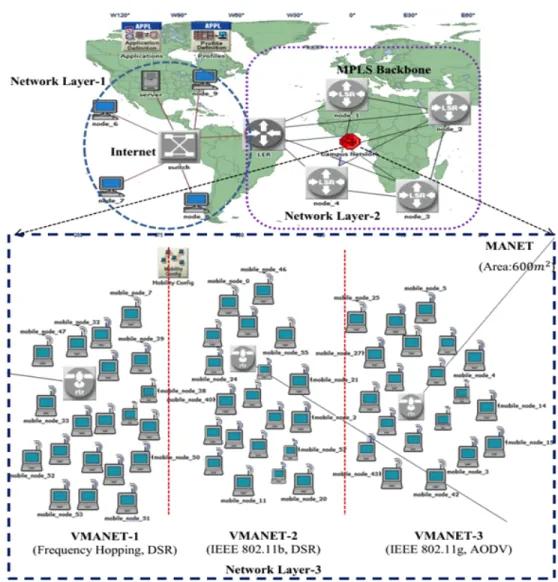
Fig.3. A scenario of an IMANET including Internet, MPLS-backbone and a MANET with three VMANETs for 60 mobile nodes within the campus network
MPLS-backbone. The backbone routers are interconnected using the point-to-point protocol digital signal duplex link-0 (PPP DS0) with a maximum bandwidth of 0.064Mbps. In the experiment, we deploy an IP-network using some Ethernet devices along with an Ethernet server. As a communication channel we use the 10BaseT duplex physical link in the IP network. The IP network is attached to the intermediary backbone network via the Ethernet switch. Figure 3 presents
a scenario of our experimental model, where the intermediary MPLS-backbone of an IMANET lies between the MANET (campus network) and the IP network.
Table 2 presents network parameters for varying
number of nodes. In the first case, mobile nodes are
randomly placed in the network workspace, where
the random way point mobility (RWPM) model is
considered. A customized traffic is generated for all
the cases, and a commonly used AODV routing
Parameter Value Transmitted power of each mobile node 0.005 W
Memory size in each gateway and mobile device 256 MB
Routing protocols in MANET AODV, DSR
Routing protocols in Internet RIP
Node placement in MANET Random
Mobility model Random Waypoint
Network address IPv4
Node mobility Uniform (0-10 m/sec)
Network metrics Throughput, Network load, and Network delay
Destination IP address Random
Generated traffic Packet size: exponential 1024 bits,
Packet inter arrival time: exponential 100 sec
Table 2: Network parameters used in the studyprotocol is considered for all MANET scenarios to find the destination nodes and gateways.
In the second case, we divide all mobile devices into three different VMANETs using the proposed model to evaluate the performance as shown in Figure 3, where the widely used AODV and DSR reactive protocols concurrently run in different VMANETs. DSR is utilized for handling low data traffic in VMANET1 and VMANET2 since it is suitable for handling low traffic due to the use of the route cache mechanism. On the other hand, AODV is used for handling high traffic in VMANET3 due to the absence of the route cache, low control overheads, and low re-routing time.
V. EXPERIMENTAL RESULTS AND ANALYSIS
In conventional IMANET models, a backbone network with numerous IP routers placed as an intermediary network between the MANET and some constraints such as lack of security, congestion control problem, use of a large size IP address as an identifier, and inefficient for handling large amount of data. On the other hand, the MPLS is an extension of the IP architecture with new functionalities including the use of a short label
identifier, forward equivalence class (FEC), and traffic engineering (TE). The TE automatically establishes and maintains label switch paths (LSPs) across the backbone using the resource reservation protocol (RSVP). This mechanism helps to achieve optimal use of traffic resources and control the traffic flows between congestion nodes. In addition, FEC classifies the incoming packet with different priority and higher priority FEC is assigned to higher LSP and vice versa. It also uses a 20 bit label instead of a large IP address such as 32/64 bit (for IPv4/ IPV6). These additional features of MPLS support the reliable communication for high speed and massive data by ensuring quality of service [23]. Therefore, we evaluate the performance of the proposed model in both conventional IP-backbone and MPLS-backbone IMANET.
The network congestion usually increases if the
number of nodes increases. To reduce the network
congestion in a scenario with large number of nodes,
we employ a clustering technique that clusters a
finite set of VMANETs depending on the
communication capacity of different network
operational models. This technique also results in
reducing the communication overhead, improving
load-balancing, and increasing connectivity.
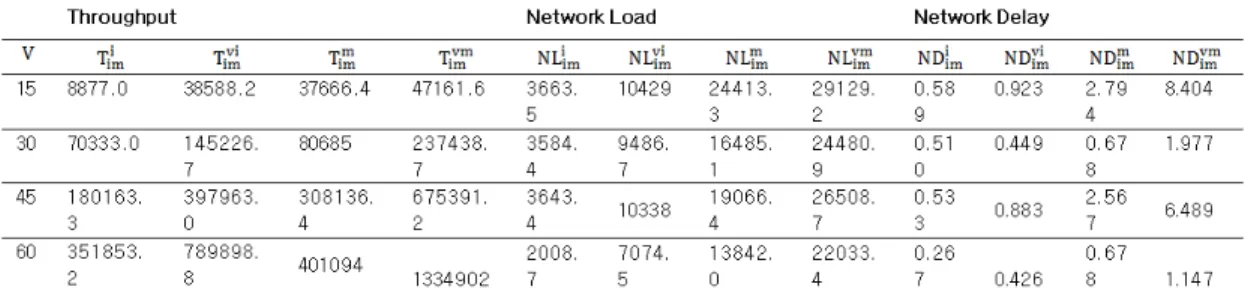
Table 3. Throughput, network load, and network delay over varying the number of mobile nodes
Fig 4. Throughput of the proposed VMANET model in an IMANET for varying the number of nodes
Fig 5. Network load of the proposed VMANET model in IMANET for varying the number of nodes
Fig 6. Network delay of the proposed VMANET model in IMANET for varying the number of nodes
In our experiments, we consider 15, 30, 45, and 60 mobile nodes with three different physical characteristics, such as IEEE 802.11g, IEEE 802.11b, and Frequency-hopping having different data-rates 54Mbps, 11Mbps, and 2Mbps, respectively. We divide the number of mobile nodes into three VMANETs depending on the data rate of network operational models. Figures 4, 5, and 6 illustrate throughput, network load, and network delay of the proposed model in IMANETs for varying the number of nodes, respectively. Table 3 shows detailed statistics of the proposed model in different IMANETs.
The proposed model outperforms the conventional
IMANET model in increasing throughput for varying
the number of nodes due to the use of the clustering
technique and multiple gateways as shown in Figure 4, where the significant increment has experienced in a scenario with large amount of nodes. Figures 5 and 6 show additional data presenting the network load and network delay of the proposed model, respectively. Both network load and network delay exhibit an inverse behavior of throughput with the number of nodes. The proposed model achieves a comparatively lower network load and delay than the conventional IMANET models for various numbers of nodes due to the consideration of an automatic clustering approach based on the communication capacity and concurrent multiple routing protocols in a MANET. In addition, the proposed model achieves higher performance in MPLS-backbone rather than in IP-backbone IMANETs especially in large amount of nodes.
VI. CONCLUSIONS
In this paper, we proposed an effective VMANET model with a clustering technique, which automatically divides mobile devices into different groups depending on their similar characteristics/homogeneity. In addition, one routing protocol is used for each VMANET based on the network characteristics. Thus, multiple routing protocols can run concurrently in a MANET.
Furthermore, a default gateway is used for each VMANET, which reduces the additional delay of selecting a gateway and network congestion. The proposed VMANET model was evaluated in terms of throughput, network load, and network delay in the conventional IP-backbone and MPLS-backbone IMANET. Experimental results showed that the proposed model outperformed the state-of-art IMANET models by significantly increasing throughput, decreasing network load, and decreasing network delay.
REFERENCES
[1] http://pewinternet.org/Reports/2013/Smartphone -Own ersh ip-2013/Findings.aspx [Jan 7, 2013]
[2] L. Qin, and T. Kunz, “Adaptive MANET Routing:
A Case Study. Ad-hoc, Mobile and Wireless Networks,” in Ad-hoc, Mobile and Wireless Networks, LNCS, vol. 5198, pp. 43-57, 2008.
[3] R. Kumar, A.K. Sarje, and M. Misra, “Review strategies and Analysis of Mobile Ad hoc Network-Internet Integration Solutions,”
International Journal of Computer Science, vol.
7, no. 6, pp. 18-28, 2010.
[4] P. Ratanchandani, and R. Kravets, “A hybrid approach to Internet connectivity for mobile ad hoc networks,” in IEEE conference on Wireless Communications and Networking, vol. 3, pp.
1522-1527, 2003.
[5] J. Hoebeke, I. Moerman, B. Dhoedt, and P.
Demeester, “An overview of Mobile Ad hoc Networks: Applications and Challenges,” Journal of Communications Network, vol. 3, pp. 60-66, 2004.
[6] Q. L. Trung, and G. Kotsis, “Reducing problems in providing internet connectivity for mobile ad hoc networks,” in Wireless systems and mobility in next generation internet, LNCS, vol. 5122, pp. 113-127, 2008.
[7] S. Mehra, and C. Yu, “Enhancing the performance of mobile ad hoc networks with the aid of internet gateways,” in International Conference on Wireless Networks, vol. 1, pp.
1-5, 2004.
[8] A. Capone, M. Cesana, and A. Pollastro,
“MobiMESH: a complete solution for Wireless Mesh Networking,” in IEEE International Conference on Mobile Adhoc and Sensor Systems, pp. 1-3, 2007.
[9] R. Kumar, A. K. Sarje, and M. Misra, “Review
strategies and Analysis of Mobile Ad hoc
Network-Internet Integration Solutions,”
International Journal of Computer Science, vol.
7, no. 6, pp. 18-28, 2010.
[10] S. Lim, W. C. Lee, G. Cao, and C. R. Das, “A novel caching scheme for improving Internet based mobile ad hoc networks performance,”
Journal of Ad Hoc Networks, vol. 4, no. 2, pp.
225-239, 2006.
[11] Q. L. Trung, P. E. Engelstad, V. Pham, T.
Skeie, A. Taherkordi, and F. Eliassen,
“Providing internet connectivity and mobility management for MANETs,” International Journal of Web Information Systems, vol. 5, no. 2, pp. 239-263, 2009.
[12] T. D. Han, and H. Oh, “Quasi-tree mobility management for internet connectivity of mobile ad hoc networks” Journal of wireless networks, vol. 17, no. 2, pp. 493-506, 2011.
[13] S. Kim, P. Shin, and H.C. Lim “A Design of the Ontology for Enhanced Semantic Retrieval of Multimedia Contents," The Journal of Internet Information Society, vol. 13, no. 1, pp.
107-115, 2012.
[14] P. M. Ruiz, and A. F. G. Skarmeta, “Enhanced Internet connectivity for hybrid ad hoc networks through adaptive gateway discovery,” in 29th Annual IEEE International Conference on Local Computer Networks, pp. 370- 377, 2004.
[15] S. Bin, H. Yangcheng, and H. Zhonggong,
“Optimization gateway discovery mechanisms for hybrid ad hoc networks,” in International Conference on Consumer Electronics, Communications and Networks, pp. 5101-5104, 2011.
[16] Y. Y. Hsu, Y. C. Tseng, C. C. Tseng, C. F.
Huang, J. H. Fan, and H. L. Wu, “Design and implementation of two-tier mobile ad hoc networks with seamless roaming and load-balancing routing capability,” in 1st International Conference on Quality of service in Heterogeneous Wired/Wireless networks, pp.
52-58, 2004.
[17] W. K. G. Seah, L. Y. Yeo, Z. A. Eu, W. K. Tan,
and K. S. Tan, “Performance modeling of MANET Interconnectivity,” International Journal of Wireless Information Networks, vol.
13, no. 2, pp. 115-126, 2006.
[18] J. Lee, J. Kim, and D. Won, “Yi et al.‘s Group Key Exchange Protocol: A Security Vulnerability and Its Remediation," Journal of the Korea Society of Computer and Information, vol. 17, no.
4, pp. 91-98, April 2012.
[19] C.-Y. Lee and Y.-H. Shin, “An Energy-aware dynamic source routing algorithm for mobile ad-hoc networks,” Journal of the Korea Society of Computer and Information, vol. 16, no. 10, pp. 165-173, Oct. 2011.
[20] P. E. Engelstad, A. Tonnesen, A. Hafslund, and G. Egeland, “Internet connectivity for multi-homed proactive ad hoc networks,” in IEEE International Conference on Communications, vol. 7, pp. 4050-4056, 2004.
[21] E. R. Hruschaka, R. J. G. B Campello, A. A.
Freitas, and A. C. P. L. Carvalho, “A survey of evolutionary algorithm for clustering” IEEE transactions on Systems, MAN, and Cybernetics, vol. 39, no. 2, pp. 133-155, 2009.
[22] OPNET Application and Network Performance.
Internet:http://www.opnet.com/university_pro gram/research_with_opnet/ [March 16, 2013]
[23] [Online]. http://www.ietf.org/rfc/rfc3032.txt
[Jan 12, 2013]
저 자 소 개 Jia Uddin