https://doi.org/10.12997/jla.2016.5.2.121
pISSN 2287-2892 • eISSN 2288-2561
JLA
Prevalence, Treatment Pattern and Resource Use in Patients with Mixed Dyslipidemia Using Lipid Modifying Agents in Korea (PRIMULA): An Observational Study
Chan Seok Park1, Hyo-Soo Kim2, Sang-Hak Lee3, Ki Hoon Han4, Sang-Hyun Kim5, Doo-Il Kim6, Moon-Kyu Lee7, Ji Dong Sung8, Young-Keun Ahn9, Jae-Hyeong Park10, Sang-Hong Baek1
1Division of Cardiology, Department of Internal Medicine, The Catholic University of Korea, Seoul,
2Division of Cardiology, Department of Internal Medicine, Seoul National University, Seoul National University Hospital, Seoul,
3Cardiology Division, Department of Internal Medicine, Yonsei University College of Medicine, Severance Cardiovascular Hospital, Seoul,
4Department of Cardiology, University of Ulsan College of Medicine, Asan Medical Center, Seoul,
5Division of Cardiology, Department of Internal Medicine, Seoul Boramae Hospital, Seoul,
6Division of Cardiology, Department of Internal Medicine, Inje University Haeundae Paik Hospital, Busan,
7Division of Endocrinology and Metabolism, Department of Internal Medicine, Samsung Medical Center, Seongkyunkwan University School of Medicine, Seoul,
8Division of Cardiology, Department of Internal Medicine, Samsung Medical Center, Seongkyunkwan University School of Medicine, Seoul,
9Division of Cardiology, Department of Internal Medicine, Chonnam National University Hospital, Chonnnam National University, Gwangju,
10Cardiology Division of Internal Medicine, Chungnam National University, Chungnam National University Hospital, Daejeon, Korea
Objective: Limited information is available on the effectiveness of lipid-modifying therapy (LMT) for low-density lipoprotein cholesterol (LDL-C), high-density lipoprotein cholesterol (HDL-C), and triglyceride (TG) in the Korean population. The objective of this study was to describe the prevalence of different types of lipid disorders in Korean patients using LMT.
Methods: Eight hundred seventy-one dyslipidemia patients, who were LMT-naive for >1 year prior to retrospective enrollment, were included for analysis. Serum levels of LDL-C, HDL-C, TG and total cholesterol (TC) were assessed after >1 year of LMT. We also analyzed the therapeutic effects of LMT in the subjects with high cardiovascular risk factors (n=629), atherosclerotic cardiovascular disease (ASCVD) (n=296) or diabetes without ASCVD (n=316).
Results: The rates of elevated LDL-C without other abnormal lipids levels, elevated TG or decreased HDL-C (with normal LDL-C levels) and high LDL-C combined with elevated TG and/or decreased HDL-C were 33.4%, 13.0% and 53.6%, respectively.
After at least one year on LMT (statin alone: 81%, statin and cholesterol absorption inhibitor: 10%, fibrates alone: 3%, others: 3%), 61% of patients had at least one lipid abnormality, with 3.4% failing to reach the therapeutic LDL-C target level or a normal level of HDL-C and TG. After LMT, 64.9% of patients with high cardiovascular risk factors, 64.5% of those with ASCVD or and 64.2% of those with diabetes without ASCVD also had at least one lipid abnormality.
Conclusion: Approximately two-thirds of patients did not reach the target or normal lipid profile after taking LMT, irrespective of combining disease and high cardiovascular risk factors. Tight lipid control is required, especially in patients with dyslipidemia and high cardiovascular risk factors or comorbid diseases. (J Lipid Atheroscler 2016 December;5(2):121-131)
Key Words: Dyslipidemias, LDL Cholesterol, HDL Cholesterol, Triglyderide, Primary care
Received:
Revised:
Accepted:
April 27, 2016 June 9, 2016 June 15, 2016
Corresponding Author: Sang-Hong Baek, Division of Cardiovascular Medicine, Seoul St. Mary’s Hospital, College of Medicine, The Catholic University of Korea, 222 Banpodae-ro, Seocho-gu, Seoul 06591, Korea
Tel: +82-2-2258-6030, Fax: +82-2-951-1506, E-mail: [email protected]
This is an Open Access article distributed under the terms of the Creative Commons Attribution Non-Commercial License (http://creativecommons.org/licenses/by-nc/3.0) which permits unrestricted non-commercial use, distribution, and reproduction in any medium, provided the original work is properly cited.
INTRODUCTION
Low-density lipoprotein cholesterol (LDL-C) is a well-established risk factor for atherosclerotic cardio- vascular disease (ASCVD) and the use of statins to lower LDL-C levels has been proved to have beneficial effects on ASCVD risk reduction.1-4 High-density lipoprotein cholesterol (HDL-C) is inversely correlated with ASCVD risk5,6 and some studies have shown that an increase in HDL-C with the use of fibrate or statins can lower the ASCVD risk.7,8 High levels of triglycerides (TGs) are much more common in Koreans than in whites, although whites usually have high levels if the total cholesterol (TC) and LDL-C are also elevated.9 Currently there is accumulating evidence that elevated serum TG levels are associated with an increased risk of ASCVD10 although some previous trials have demonstrated that this association is weaker than associations with LDL-C and HDL-C.11
Limited information is available on the prevalence of dyslipidemia and the effectiveness of lipid-modifying therapy (LMT) related to LDL-C, HDL-C, and TG in the Korean population. Identifying the prevalence of dyslipi- demia in specific population subgroups, such as those with high cardiovascular risk, ASCVD or diabetes without ASCVD may aid in the prevention of ASCVD and improve the quality of care. Mixed dyslipidemias in these populations, which are related to high ASCVD risk,12 can provide the rationale for targeting mixed dyslipidemia.
The objective of this study was to describe the prevalence of different types of lipid disorders in Korean patients using LMT. We also evaluated potential associations between patient characteristics, including diabetes, history of ASCVD, multiple CV risk factors and different types of dyslipidemias and the effects and patterns of LMT in these populations.
PATIENTS AND METHODS
1. Patients
The medical records of patients who were older than 35 years and using LMT were retrospectively reviewed from 16 hospitals in the Republic of Korea between July and December 2008. Patients with continuous medical records for at least 1 year before and 1 year after the index date and who did not receive a prescription for any lipid-modifying medications before the index date, were followed for 1 year after the index date. They were required to have at least one value for TC, TG, HDL-C and LDL-C before and after the follow-up period. Subjects that used LMT within 12 months before the study enrollment were excluded.
2. Definition of dyslipidemia
The National Cholesterol Education Program Adult Treatment Panel Third Report (NCEP ATP III) and the 2014 National Lipid Association (NLA) recommendations were used to identify high LDL-C, low HDL-C and elevated TG levels. Elevated LDL-C was defined as LDL-C >100 mg/dL in patients with diabetes and/or clinically established ASCVD, and LDL-C >130 mg/dL in other patients. Low HDL-C was defined as <40 mg/dL. Hypertriglyceridemia was defined as a fasting TG level >150 mg/dL.6,13
3. Risk factors and disease groups
LDL-C and non–HDL-C goals were based on the NCEP and NLA guidelines taking into consideration age ≥45 years if male or ≥55 years if female, hypertension (systolic blood pressure ≥140 mm Hg or diastolic blood pressure
≥90 mm Hg or ≥130/80 mm Hg if diabetic or on antihypertensive medication), HDL-C ≤40 mg/dL, cigarette smoking, or a positive family history of ASCVD. 6 Disease group strata examined included ASCVD, diabetes and high cardiovascular risk factors. ASCVD was identified by self-report or previous medical records. Diabetes was defined by self-report, taking hypoglycemic medication,
or a fasting glucose ≥126 mg/dL. High cardiovascular risk subjects were defined as patients with a >20% 10-year risk of ASCVD calculated using the NCEP/ATP III.6
4. Recommended lipid levels
Recommended LDL-C levels were adapted from the NCEP and NLA guidelines (<160 mg/dL if <2 risk factors,
<130 mg/dL if ≥2 risk factors, or <100 mg/dL if preexisting cardiovascular disease (CVD) [myocardial infarction, congestive heart failure, ASCVD, peripheral artery disease, or stroke], diabetes, chronic kidney disease (CKD),14 or
≥20% 10-year risk of ASCVD in those with ≥2 risk factors, based on the Framingham Risk Scoring), with recom- mended non-HDL-C levels of <190 mg/dL if <2 risk factors,
<160 mg/dL if ≥2 risk factors, or <130 mg/dL if preexisting CVD, diabetes, CKD or >20% Framingham risk among those with ≥2 risk factors. Recommended levels of HDL-C and TGs were designated as those considered to be normal: ≥40 mg/dL if male and ≥50 mg/dL if female for HDL-C, and 150 mg/dL for TGs. In addition, a high TG level was designated as ≥200 mg/dL and a high (optimal) HDL-C as >60 mg/dL.6,13
5. Statistical Analysis
Descriptive analyses evaluated baseline patient characteristics and the prevalence of elevated LDL-C, elevated TGs, and low HDL-C (not mutually exclusive).
The prevalence of dyslipidemia was also evaluated in the subgroups with ASCVD, diabetes, and a projected 10-year primary CVD risk of >20%. Further descriptive analyses evaluated the prevalence of 4 mutually exclusive lipid disorders, defined as all possible combinations of normal or abnormal LDL-C, HDL-C, and TGs. The 4 categories included isolated elevated LDL-C, elevated TG or decreased HDL-C with normal LDL-C levels, high LDL-C combined with elevated TG and/or decreased HDL-C and no lipid abnormalities.
The differences between treatment patterns according
to the risk factors were analyzed using chi-square test.
To calculate distance to goal, target value was deducted from the value of cholesterol of the patient. If the values of cholesterol reached the target level after the treatment, distance to goal was considered as zero.
Multiple logistic regression models were used to evaluate the association between achieving the target goal in at least 2 of the following: TG, HDL-C, non-HDL-C and LDL-C or LDL-C only. Covariates included in these models were age, sex, body mass index (BMI), smoking status, hypertension, ASCVD, diabetes and a 10-year ASCVD risk greater than 20%. Most patients with dyslipidemia in Korea are treated with statins, as represented in this study.
The choice of treatment was taken into consideration when calculating the adjusted odds of experiencing a particular type of mixed dyslipidemia for each high risk group (diabetes, ASCVD, or high CV risk).
RESULTS
A total of 911 patients were enrolled in the original study and 40 patients were excluded. Reasons for exclusion included: under 35 years of age (n=4), normal lipid profile values during the baseline period (n=14), no available medical records during the baseline period (n=1), LMT for less than 1 year (n=1) and no available lipid profile values before and after the follow-up period (n=17). The mean age was 58.7±10.1 years and 51.6% of the patients were men. Hypertension was present in 80.0% (n=697) of the study population. The rate of diabetes patient without history of ASCVD was 36.2% (n=316). More than three-quarters of the study population (76.7% [n=668]) was at high CV risk according to the Framingham risk score. Approximately one-third (34.0% [n=296]) of patients had a history of ASCVD. Baseline mean (SD) values for LDL-C, HDL-C, and TGs were 146.7±36.5 mg/dL, 48.3±
12.5 mg/dL and 193.9±119.4 mg/dL, respectively (Table 1).
Among the patients who had significant lipid disorders
Table 1. Characteristics of patients before initiating pharmacotherapy for dyslipidemia Variable Total sample No high-risk
conditions
High-risk conditions ASCVD DM without
ASCVD FRS>20% without ASCVD & DM
n (%) 871 (100.0) 242 (27.8) 296 (34.0) 316 (36.2) 17 (2.0)
Age (year) 58.7±10.1 58.1±10.0 60.8±10.0 57.0±9.8 62.4±12.2
Men (n (%)) 449 (51.6) 102 (42.2) 189 (63.9)** 144 (45.6) 14 (82.4) Current smokers 147 (16.9) 26 (10.7) 79 (26.7)** 36 (11.4) 6 (35.3)**
Body mass index (kg/m2) 25.2±3.0 25.1±2.9 25.3±3.0 25.1±3.2 25.8±2.7
Systolic blood pressure (mmHg) 123.0±17.4 130.2±17.1 126.8±17.6 132.9±17.3 135.8±8.1 Diastolic blood pressure (mmHg) 79.3±11.2 80.6±10.9 77.3±11.5 80.3±10.9 82.4±8.4 Hypertension (n (%)) 697 (80.0) 174 (71.9) 271 (91.6)** 236 (74.7) 16 (94.1) Total cholesterol (mg/dL) 223.0±38.7 239.9±36.1 205.8±38.8** 225.6±34.1** 233.9±34.0 LDL-C (mg/dL) 146.7±36.5 161.9±33.5 138.1±35.1** 142.4±36.6** 157.1±35.9 TG (mg/dL) 193.9±119.4 189.9±120.8 166.5±99.1 221.0±124.9 225.2±192.8 HDL-C (mg/dL) 48.3±12.5 52.8±12.6 44.7±12.3** 48.5±11.6** 41.8±6.8**
Non-HDL-C (mg/dL) 174.7±35.3 187.1±4.3 161.0±34.9** 177.1±32.1* 192.2±32.5 Fasting plasma glucose (mg/dL) 127.6±49.2 100.5±13.8 122.6±47.8** 151.9±55.1** 98.3±16.4 Data are expressed as number (percentage) or as mean±SD.
**Significantly different from those with no high-risk conditions (p<0.0001)
*Significantly different from those with no high-risk conditions (p<0.001)
ASCVD; Atherosclerotic cardiovascular disease, DM; Diabetes mellitus, FRS; Framingham risk score, LDL-C; Low-density lipoprotein cholesterol, TG; Triglyceride, HDL-C; High-density lipoprotein cholesterol
Table 2. Distribution of lipid abnormalities
Variable Total sample No high-risk conditions
High-risk conditions ASCVD DM without
ASCVD FRS>20% without ASCVD & DM
(n=871) (n=242) (n=296) (n=316) (n=17)
Baseline
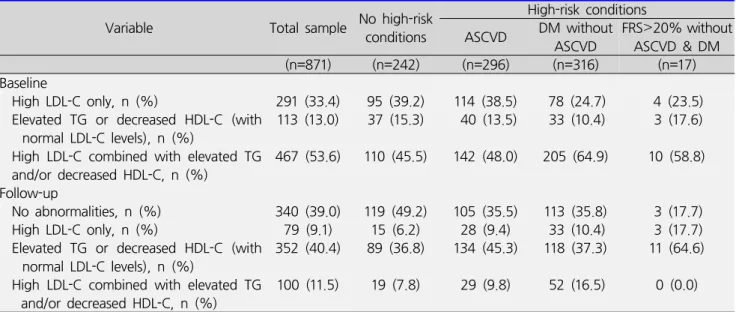
High LDL-C only, n (%) 291 (33.4) 95 (39.2) 114 (38.5) 78 (24.7) 4 (23.5) Elevated TG or decreased HDL-C (with
normal LDL-C levels), n (%) 113 (13.0) 37 (15.3) 40 (13.5) 33 (10.4) 3 (17.6) High LDL-C combined with elevated TG
and/or decreased HDL-C, n (%)
467 (53.6) 110 (45.5) 142 (48.0) 205 (64.9) 10 (58.8) Follow-up
No abnormalities, n (%) 340 (39.0) 119 (49.2) 105 (35.5) 113 (35.8) 3 (17.7) High LDL-C only, n (%) 79 (9.1) 15 (6.2) 28 (9.4) 33 (10.4) 3 (17.7) Elevated TG or decreased HDL-C (with
normal LDL-C levels), n (%)
352 (40.4) 89 (36.8) 134 (45.3) 118 (37.3) 11 (64.6) High LDL-C combined with elevated TG
and/or decreased HDL-C, n (%) 100 (11.5) 19 (7.8) 29 (9.8) 52 (16.5) 0 (0.0) ASCVD; Atheroscleotic cardiovascular disease, DM; Diabetes mellitus, FSR; Framingham risk score, LDL-C; Low-density lipoprotein cholesterol, TG; Triglyceride, HDL-C; High-density lipoprotein cholesterol
(n=871), the rates of isolated elevated LDL-C without other abnormal lipid levels, elevated TG or decreased HDL-C (with normal LDL-C levels) and high LDL-C combined with elevated TG and/or decreased HDL-C were 33.4%
(n=291), 13.0% (n=113) and 53.6% (n=467), respectively (Table 2).
Statin monotherapy was used by 81.3% (n=708) of patients, followed by statin plus cholesterol absorption
Table 3. The patterns of pharmacotherapy for dyslipidemia Total sample,
n (%)
No high-risk conditions,
n (%)
High-risk conditions ASCVD,
n (%)
DM without ASCVD,
n (%)
FRS>20%
without ASCVD and DM, n (%)
(n=871) (n=242) (n=296) (n=316) (n=17)
Statin alone, n (%) 708 (81.3) 198 (81.8) 234 (79.1) 262 (82.9) 14 (82.3)
Fibrate alone, n (%) 26 (3.0) 6 (2.5) 2 (0.7) 18 (5.7) 0 (0.0)
Niacin alone, n (%) 2 (0.2) 0 (0.0) 1 (0.3) 1 (0.3) 0 (0.0)
Omega-3 fatty acid alone, n (%) 1 (0.1) 0 (0.0) 0 (0.0) 1 (0.3) 0 (0.0) Cholesterol absorption inhibitor alone, n (%) 3 (0.3) 1 (0.4) 1 (0.3) 1 (0.3) 0 (0.0)
Statin+fibrate, n (%) 16 (1.8) 8 (3.3) 4 (1.3) 4 (1.3) 0 (0.0)
Statin+niacin, n (%) 3 (0.3) 0 (0.0) 1 (0.3) 2 (0.6) 0 (0.0)
Statin+Omega-3 fatty acid, n (%) 11 (1.3) 3 (1.2) 7 (2.4) 1 (0.3) 0 (0.0) Statin+cholesterol absorption inhibitor, n (%) 91 (10.4) 25 (10.4) 44 (14.9) 21 (6.7) 1 (5.9)
Statin+others, n (%) 4 (0.5) 1 (0.4) 2 (0.7) 0 (0.0) 1 (5.9)
Fibrate+omega-3 fatty acid, n (%) 2 (0.2) 0 (0.0) 0 (0.0) 1 (0.3) 1 (5.9) Fibrate+cholesterol absorption inhibitor n (%) 0 (0.0) 0 (0.0) 4 (1.3) 0 (0.0) ASCVD; Atherosclerotic cardiovascular disease, DM; Diabetes mellitus, FRS; Framingham risk score
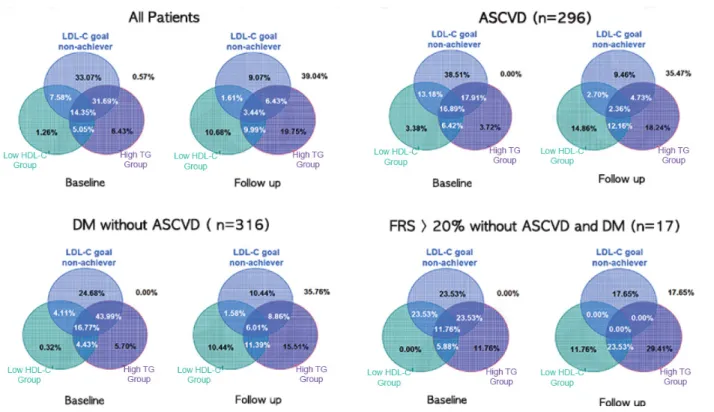
Fig. 1. Distribution of dyslipidemia according to the underlying diseases and risk factors. Abbreviations: Atherosclerotic cardiovascular disease (ASCVD), Diabetes mellitus (DM), FRS (Framingham risk score), Low-density lipoprotein cholesterol (LDL-C), Triglyceride (TG), High-density lipoprotein cholesterol (HDL-C).
inhibitor in 10.4% (91) and fibrate monotherapy in 3.0%
(26). Niacin monotherapy, omega-3 fatty acid mono- therapy and combination therapy using more than two lipid-lowering medications were used in a minority of the
patients (Table 3). The treatment patterns were not different whether the patients had high-risk conditions or not. (p=0.86) After LMT, the rates of an isolated elevated LDL-C without other abnormal lipids levels,
Table 4. Number of patients not at lipid goals or normal levels and mean distance to goals or normal levels
Variable Total sample,
n (%) No high-risk conditions
High-risk conditions ASCVD DM without
ASCVD
FRS>20% without ASCVD & DM
(n=871) (n=242) (n=296) (n=316) (n=17)
LDL-C
No. not at goal, n (%) 179 (20.6) 34 (14.11) 57 (19.3) 85 (26.9) 3 (17.7) Distance to goal, mg/dL 24.2±25.1 28.2±24.2 20.7±27.5 25.0±23.9 20.2±24.9 Mean percentage of the patients who did
not reach the treatment goal
23.4% 24.0% 20.7% 25.0% 20.2%
TG No. not at goal, n (%) 345 (39.6) 93 (38.4) 111 (37.5) 132 (41.8) 9 (52.9) Distance to goal, mg/dL 71.3±86.0 64.3±66.3 77.6±105.9 70.6±79.6 76.3±89.1 Mean percentage of the patients who did
not reach the treatment goal
47.5% 42.8% 51.8% 47.1% 50.9%
HDL-C
No. not at goal, n (%) 224 (25.7) 30 (12.4) 95 (32.1) 93 (29.4) 6 (35.3)
Distance to goal, mg/dL 4.4±3.9 3.9±4.1 4.0±3.6 5.0±4.0 3.3±4.5
Mean percentage of the patients who did
not reach the treatmentgoal 10.9% 9.7% 10.1% 12.4% 8.3%
Non-high-density lipoprotein
No. not at goal, n (%) 157 (18.0%) 32 (13.2%) 48 (16.2%) 75 (23.7%) 2 (11.8%) Distance to goal, mg/dL 23.7±19.2 23.1±16.9 30.2±21.7 19.3±16.7 44.5±36.1 Mean percentage of the patients who did
not reach treatment goal 17.8% 15.8% 23.3% 14.8% 29.2%
ASCVD; Atherosclerotic cardiovascular disease, DM; Diabetes mellitus, FRS; Framingham risk score, LDL-C; Low-density lipoprotein cholesterol, TG; Triglyceride, HDL-C; High-density lipoprotein cholesterol
elevated TG or decreased HDL-C (with normal LDL-C levels) and high LDL-C combined with elevated TG and/or decreased HDL-C were 9.1%, 40.4% and 11.5%, respectively. All lipid parameters were within normal limits in 39.0% of the patients. These distributions were similar in the sub-population groups who were combined with patients with ASCVD, diabetes and hypertension. The distribution of lipid abnormalities pre- and post-LMT are shown in Table 2 and Figure 1.
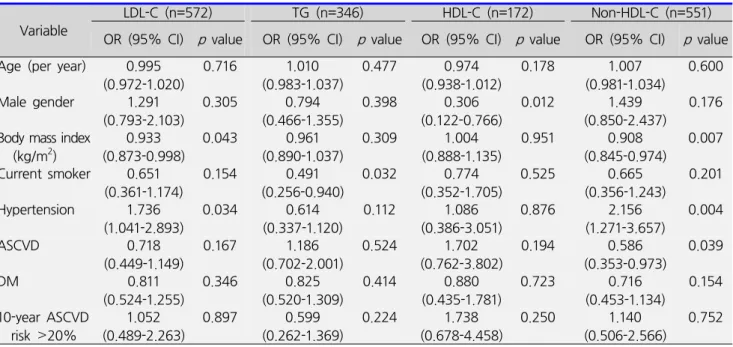
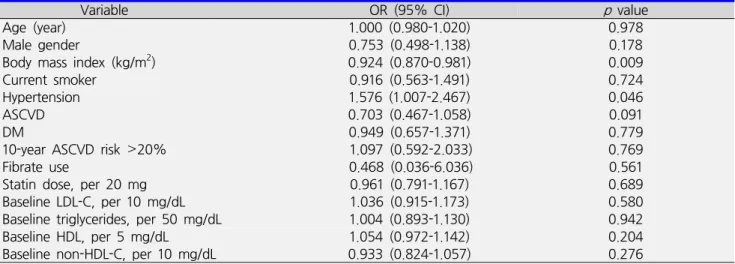
Table 4 outlines the number of the subjects who did not achieve the target lipid levels and their distance to the goal. The distance to goal of LDL-C in total population was 24.2±25.1. Sub-population groups according to high-risk conditions showed similar results. All other variables showed similar distance to goal values irrespective of cardiovascular risk factors. Table 5 and 6 display the results of the logistic regression analysis regarding the components that affect lipid goal
attainment. Logistic regression analysis showed that BMI was the strongest risk factor for the controlling the levels of LDL-C and non-HDL-C. Age and the presence of ASCVD and diabetes did not affect lipid levels after taking medications. The presence of hypertension revealed a relationship with well-controlled LDL-C. However, other lipid profiles were not affected by the presence of hypertension (Table 5). In mixed dyslipidemia patients, who have at least two abnormalities in LDL-C, TGs, non-HDL-C or HDL-C, lipid goal attainment was only affected by BMI and hypertension.
DISCUSSION
This PRIMULA study revealed a high frequency of lipid abnormalities despite receiving LMT, which is consistent with previous studies.15,16 Among the patients, 9.1% had isolated elevated LDL-C without other abnormal lipids
Table 5. Logistic regression of attainment of lipid goals or normal levels according to individual lipid profiles
Variable LDL-C (n=572) ㅤ TG (n=346) HDL-C (n=172) ㅤ Non-HDL-C (n=551)
OR (95% CI) p value ㅤOR (95% CI) p value OR (95% CI) p value ㅤ OR (95% CI) p value Age (per year) 0.995
(0.972-1.020) 0.716 ㅤ 1.010
(0.983-1.037) 0.477 0.974
(0.938-1.012) 0.178 ㅤ 1.007
(0.981-1.034) 0.600 Male gender 1.291
(0.793-2.103)
0.305 0.794
(0.466-1.355)
0.398 0.306
(0.122-0.766)
0.012 1.439
(0.850-2.437)
0.176 Body mass index
(kg/m2)
0.933 (0.873-0.998)
0.043 0.961
(0.890-1.037)
0.309 1.004
(0.888-1.135)
0.951 0.908
(0.845-0.974)
0.007 Current smoker 0.651
(0.361-1.174)
0.154 0.491
(0.256-0.940)
0.032 0.774
(0.352-1.705)
0.525 0.665
(0.356-1.243)
0.201 Hypertension 1.736
(1.041-2.893)
0.034 0.614
(0.337-1.120)
0.112 1.086
(0.386-3.051)
0.876 2.156
(1.271-3.657)
0.004
ASCVD 0.718
(0.449-1.149)
0.167 1.186
(0.702-2.001)
0.524 1.702
(0.762-3.802)
0.194 0.586
(0.353-0.973)
0.039
DM 0.811
(0.524-1.255) 0.346 0.825
(0.520-1.309) 0.414 0.880
(0.435-1.781) 0.723 0.716
(0.453-1.134) 0.154 10-year ASCVD
risk >20% 1.052
(0.489-2.263) 0.897 0.599
(0.262-1.369) 0.224 1.738
(0.678-4.458) 0.250 1.140
(0.506-2.566) 0.752 LDL-C; Low-density lipoprotein cholesterol, TG; Triglyceride, HDL-C; High-density lipoprotein cholesterol, ASCVD; Atherosclerotic cardiovascular disease, DM; Diabetes mellitus
levels, 40.4% had elevated TG or decreased HDL-C (with normal LDL-C levels) and 11.5% had high LDL-C combined with elevated TG and/or decreased HDL-C after LMT. So only one-third of the patients attained the therapeutic target of all lipid parameters after LMT. Although LDL-C goal levels were relatively well achieved compared to a prior study, the results show that the proportion of high TGs or low HDL-C was elevated after taking LMT.16 There remains a significant gap in overall lipid control, particularly for persons with cardiovascular comorbidities such as ASCVD, diabetes mellitus and hypertension. Our study is the first report examining the status of all lipid fractions separately among Korean adults with a wide range of cardiovascular comorbidities. To the best of our know- ledge, these results regarding the prevalence of different combinations of lipid abnormalities and the distance from the recommended lipid levels in the Korean population have not been previously reported.
As the primary focus of dyslipidemia treatment has been HMG-CoA reductase therapy, largely due to the significant evidence-based support of its use in both primary and
secondary prevention,6 most efforts have been directed at achieving LDL-C goals. A reduced incidence of additional ASCVD events has been observed after improvement in HDL-C levels with LMT in ASCVD patients.17 The importance of raising HDL-C levels is evident from the recent recommendation by the European Consensus Panel to achieve an HDL-C level of at least 1.03 mmol/L in patients with ASCVD, patients with an ASCVD-equivalent condi- tion, or those at high risk of an ASCVD event.18 Elevated TGs are one of the earliest manifestations of insulin resistance, also resulting in an increase in apolipoprotein B levels and atherogenic small dense LDL-C particles.19 Mounting evidence from a number of sources supports an independent association between hypertriglyceri- demia and ASCVD.20 Both fasting and, more recently, non-fasting21 TGs have been shown to be associated with an increased CVD risk. A joint effect of low HDL-C and elevated TG levels is also important in association with cardiovascular events.22
Our study showed that approximately two-thirds of patients had high TG or low HDL-C levels, irrespective
Table 6. Logistic regression of attainment of lipid goals in subjects with at least two abnormalities in LDL-C, triglycerides, non-HDL-C or HDL-C
Variable OR (95% CI) p value
Age (year) 1.000 (0.980-1.020) 0.978
Male gender 0.753 (0.498-1.138) 0.178
Body mass index (kg/m2) 0.924 (0.870-0.981) 0.009
Current smoker 0.916 (0.563-1.491) 0.724
Hypertension 1.576 (1.007-2.467) 0.046
ASCVD 0.703 (0.467-1.058) 0.091
DM 0.949 (0.657-1.371) 0.779
10-year ASCVD risk >20% 1.097 (0.592-2.033) 0.769
Fibrate use 0.468 (0.036-6.036) 0.561
Statin dose, per 20 mg 0.961 (0.791-1.167) 0.689
Baseline LDL-C, per 10 mg/dL 1.036 (0.915-1.173) 0.580
Baseline triglycerides, per 50 mg/dL 1.004 (0.893-1.130) 0.942
Baseline HDL, per 5 mg/dL 1.054 (0.972-1.142) 0.204
Baseline non-HDL-C, per 10 mg/dL 0.933 (0.824-1.057) 0.276
ASCVD; Atherosclerotic cardiovascular disease, DM; Diabetes mellitus, LDL-C; Low-lipoprotein cholesterol, HDL-C; High- lipoprotein density cholesterol
of LDL-C levels. Although approximately one-third of patients attained optimal lipid profiles and nearly 80%
of patient reached LDL-C target after LMT, high TG or low HDL-C levels remained in about half of the patients.
The increased proportion of elevated TG and low HDL-C with low LDL-C levels contributed to this result. Van Ganse et al. reported that only 27% of dyslipidemia patients cared by primary physician reached LDL-C goal after LMT.15 This difference from our study may be due to more strict concerns about LDL-C levels by individual physicians, newly developed medications or diet and patient concerns.
Another study16 showed that the proportion of patients that were well controlled was significantly lower in the high risk patients with cardiovascular disease or diabetes.
However, our study revealed that the percentage of patients that achieved target lipid levels were the same irrespective of the number of risk factors. This result supposed to be the participated physicians were cardiologists or endocrinologists who were concerning the importance of achievement of targeted lipid goals in high risk patients. Therefore, this result cannot be generalized to all physicians, such as general physicians in Korea.
In this study, about 20% of the patients were not using statin monotherapy and instead were treated with a statin plus cholesterol absorption inhibitor, fibrate mono- therapy, niacin monotherapy, omega-3 fatty acid monotherapy or a combination of these. High levels in TG are more common in Korean population9 so fibrate and omega-3 fatty acid are expected to be more commonly used in this study population. The recently published NLA recommendations emphasized the importance of non-statin therapy for achieving non-HDL-C and LDL-C goals.13 So adequate selection of therapeutic options should be applied to the patients according to the various types of dyslipidemia.
Several limitations should be considered. First, this study is retrospective and observational. This study is also performed at the tertiary care center so it cannot reflect all the dyslipidemia care in real world. Recently, non-fasting remnant cholesterol, calculated as non-fasting total cholesterol minus HDL-C minus LDL-C, has been found to be associated with low-grade inflammation and ischemic heart disease (IHD).23,24 It also acts as a mediator from obesity to IHD.25 However, we did not measure non-fasting cholesterol levels in this study, so future
studies using non-fasting cholesterol levels will be helpful in understanding their role as a risk factor for ASCVD in the Korean population. The 2013 American College of Cardiology (ACC)/American Heart Association (AHA) Guidelines recommend shifting from LDL-C targets to focusing in on the intensity of statin therapy.26 It does not recommend an LDL-C target value or other lipid profiles. These guidelines are more complex to implement in daily practice compared to the NCEP ATP III and NLA recommendations. This study was performed before the publication of the 2013 ACC/AHA guidelines. So further study according to this guideline can help to understand that how LMT is applied to dyslipidemia patients who have various cardiovascular risks.
In summary, almost two-thirds of patients who were taking LMT in Korea did not achieve the goal lipid levels for all lipids, irrespective of complicating disease. LDL-C levels were relatively well controlled, but TG or HDL-C levels were not controlled appropriately even after LMT.
Greater use of proven efficacious dosages of lipid-lowering agents as well as an intensified consideration of combination therapy to address multiple lipid disorders should be considered, particularly among persons with cardiovascular and related high-risk co-morbidities.
ACKNOWLEDGEMENT
The authors wish to thank for other investigators Sang Yong Kim, Division of Metabolism and Endo- crinology, Department of Internal Medicine, Chosun University, Gwangju, Korea
Seong Soo Gung, Division of Metabolism and Endo- crinology, Department of Internal Medicine, Chungbuk National University, Cheongju, Korea
Bong-Soo Cha, Division of Metabolism and Endocri- nology, Department of Internal Medicine, Yeonsei University College of Medicine, Seoul, Korea
Hyeong-Woo Lee, Division of Metabolism and Endocri-
nology, Department of Internal Medicine, Yeongnam University College of Medicine, Daegu, Korea
Kwan Woo Lee, Division of Metabolism and Endo- crinology, Department of Internal Medicine, Ajou University College of Medicine, Suwon, Korea
Doo-Man Kim, Department of Internal Medicine, Kangdong Sacred Heart Hospital, Seoul, Korea
Young Won Yoon, Department of Cardiology and Cardiovascular Center, Kangnam Severance Hospital, Yeonsei University College of Medicine, Seoul, Korea
Seok Man Son, Division of Metabolism and Endo- crinology, Department of Internal Medicine, Pusan National University College of Medicine, Pusan, Korea
Disclosure: This study was supported by MSD, Korea
REFERENCES
1. Randomised trial of cholesterol lowering in 4444 patients with coronary heart disease: the Scandinavian Simva- statin Survival Study (4S). Lancet 1994;344:1383-1389.
2. Shepherd J, Cobbe SM, Ford I, Isles CG, Lorimer AR, MacFarlane PW, et al. Prevention of coronary heart disease with pravastatin in men with hyperchole- sterolemia. West of Scotland Coronary Prevention Study Group. N Engl J Med 1995;333:1301-1307.
3. Heart Protection Study Collaborative Group. MRC/BHF Heart Protection Study of cholesterol lowering with simvastatin in 20,536 high-risk individuals: a randomised placebo-controlled trial. Lancet 2002;360:7-22.
4. Baigent C, Keech A, Kearney PM, Blackwell L, Buck G, Pollicino C, et al. Efficacy and safety of cholesterol- lowering treatment: prospective meta-analysis of data from 90,056 participants in 14 randomised trials of statins. Lancet 2005;366:1267-1278.
5. Gordon DJ, Probstfield JL, Garrison RJ, Neaton JD, Castelli WP, Knoke JD, et al. High-density lipoprotein cholesterol and cardiovascular disease. Four prospective American studies. Circulation 1989;79:8-15.
6. Grundy SM, Cleeman JI, Merz CN, Brewer HB Jr, Clark LT, Hunninghake DB, et al. Implications of recent clinical
trials for the National Cholesterol Education Program Adult Treatment Panel III Guidelines. J Am Coll Cardiol 2004;44:720-732.
7. Robins SJ. Targeting low high-density lipoprotein cholesterol for therapy: lessons from the Veterans Affairs High-density Lipoprotein Intervention Trial. Am J Cardiol 2001;88:19N-23N.
8. Wilhelmsen L, Pyörälä K, Wedel H, Cook T, Pedersen T, Kjekshus J. Risk factors for a major coronary event after myocardial infarction in the Scandinavian Simvastatin Survival Study (4S). Impact of predicted risk on the benefit of cholesterol-lowering treatment. Eur Heart J 2001;22:1119-1127.
9. Cho HK, Shin G, Ryu SK, Jang Y, Day SP, Stewart G, et al. Regulation of small dense LDL concentration in Korean and Scottish men and women. Atherosclerosis 2002;164:187-193.
10. McBride PE. Triglycerides and risk for coronary heart disease. JAMA 2007;298:336-338.
11. Haim M, Benderly M, Brunner D, Behar S, Graff E, Reicher-Reiss H, et al. Elevated serum triglyceride levels and long-term mortality in patients with coronary heart disease: the Bezafibrate Infarction Prevention (BIP) Registry. Circulation 1999;100:475-482.
12. De Backer G, Ambrosioni E, Borch-Johnsen K, Brotons C, Cifkova R, Dallongeville J, et al. European guidelines on cardiovascular disease prevention in clinical practice:
third joint task force of European and other societies on cardiovascular disease prevention in clinical practice (constituted by representatives of eight societies and by invited experts). Eur J Cardiovasc Prev Rehabil 2003;10:
S1-S10.
13. Jacobson TA, Ito MK, Maki KC, Orringer CE, Bays HE, Jones PH, et al. National Lipid Association recommen- dations for patient-centered management of dyslipidemia:
part 1 - executive summary. J Clin Lipidol 2014;8:473- 488.
14. K/DOQI clinical practice guidelines for management of dyslipidemias in patients with kidney disease. Am J Kidney Dis 2003;41:I-IV, S1-S91.
15. Van Ganse E, Laforest L, Burke T, Phatak H, Souchet T.
Mixed dyslipidemia among patients using lipid-lowering therapy in French general practice: an observational study. Clin Ther 2007;29:1671-1681.
16. Ghandehari H, Kamal-Bahl S, Wong ND. Prevalence and extent of dyslipidemia and recommended lipid levels in US adults with and without cardiovascular comorbidities:
the National Health and Nutrition Examination Survey 2003-2004. Am Heart J 2008;156:112-119.
17. Robins SJ, Collins D, Wittes JT, Papademetriou V, Deedwania PC, Schaefer EJ, et al. Relation of gemfibrozil treatment and lipid levels with major coronary events:
VA-HIT: a randomized controlled trial. JAMA 2001;285:
1585-1591.
18. Chapman MJ, Assmann G, Fruchart JC, Shepherd J, Sirtori C; European Consensus Panel on HDL-C. Raising high-density lipoprotein cholesterol with reduction of cardiovascular risk: the role of nicotinic acid--a position paper developed by the European Consensus Panel on HDL-C. Curr Med Res Opin 2004;20:1253-1268.
19. Julius U, Leonhardt W, Schulze J, Schollberg K, Haller H. Insulin resistance in diabetics and non-diabetics with impaired triglyceride removal. Exp Clin Endocrinol 1984;83:225-230.
20. Hokanson JE, Austin MA. Plasma triglyceride level is a risk factor for cardiovascular disease independent of high-density lipoprotein cholesterol level: a meta- analysis of population-based prospective studies. J Cardiovasc Risk 1996;3:213-219.
21. Bansal S, Buring JE, Rifai N, Mora S, Sacks FM, Ridker PM. Fasting compared with nonfasting triglycerides and risk of cardiovascular events in women. JAMA 2007;
298:309-316.
22. Jeppesen J, Hein HO, Suadicani P, Gyntelberg F. Relation of high TG-low HDL cholesterol and LDL cholesterol to the incidence of ischemic heart disease. An 8-year follow-up in the Copenhagen Male Study. Arterioscler Thromb Vasc Biol 1997;17:1114-1120.
23. Varbo A, Benn M, Tybjærg-Hansen A, Jørgensen AB, Frikke-Schmidt R, Nordestgaard BG. Remnant chole- sterol as a causal risk factor for ischemic heart disease.
J Am Coll Cardiol 2013;61:427-436.
24. Varbo A, Benn M, Tybjærg-Hansen A, Nordestgaard BG.
Elevated remnant cholesterol causes both low-grade inflammation and ischemic heart disease, whereas elevated low-density lipoprotein cholesterol causes ischemic heart disease without inflammation. Circulation 2013;128:1298-1309.
25. Varbo A, Benn M, Smith GD, Timpson NJ, Tybjaerg-Hansen A, Nordestgaard BG. Remnant cholesterol, low-density lipoprotein cholesterol, and blood pressure as mediators from obesity to ischemic heart disease. Circ Res 2015;116:665-673.
26. Stone NJ, Robinson JG, Lichtenstein AH, Bairey Merz CN, Blum CB, Eckel RH, et al. 2013 ACC/AHA guideline on
the treatment of blood cholesterol to reduce athero- sclerotic cardiovascular risk in adults: a report of the American College of Cardiology/American Heart Asso- ciation Task Force on Practice Guidelines. J Am Coll Cardiol 2014;63:2889-2934.
27. ATP acquisition broadens IHS’ footprint in Europe, Asia and Middle East. Electron Inf Rep 2005;26:1-2.