
Vol. 12, No. 10 pp. 4660-4665, 2011
Synthesis of Li
1.6[MnM]
1.6O
4(M=Cu, Ni, Co, Fe) and Their Physicochemical Properties as a New Precursor for Lithium
Adsorbent
Yang-Soo Kim
1, Won-Jin Moon
1, Soon-Ki Jeong
2, Dae-Hee Won
3, Sang-Ro Lee
4, Byoung-Gyu Kim
5and Kang-Sup Chung
5*1Korea Basic Science Institute
2Dept. of Chemical Engineering,Soonchunhyang University
3Hub Univ. for industrial collaboration, Sooncheon University,
4KFNET. Co. LTD.
5Korea Institute of Geoscience and Mineral Resources
Li
1.6[MnM]
1.6O
4(M=Cu, Ni, Co, Fe)의 합성 및 리튬 흡착제용 신규 전구체로서의 물리화학적 성질
김양수
1, 문원진
1, 정순기
2, 원대희
3, 이상로
4, 김병규
5, 정강섭
5*1한국기초과학지원연구원, 2순천향대학교 공업화학과
3순천대학교 산학협력중심대학, 4(주)KFNET, 5한국지질자원연구원
Abstract New precursors as a Li adsorbent, Li1.6(MnM)1.6O4 (M=Cu, Ni, Co, Fe), were synthesized by hydrothermal method and their physicochemical properties were discussed. XRD and HRTEM results revealed that the original spinel structure was stabilized by cobalt-doping while Cu-, Ni- and Fe-doping led to structural changes. Such a structural stabilization by Cobalt-doping was maintained after lithium leaching by acid treatment. Li absorption efficiency from seawater was significantly enhanced by using the Cobalt-doped spinel manganese oxide, Li1.6[MnCo]1.6O4, compared to the commercially available Li1.33Mn1.67O4; the adsorbed amount of Li from 1g-adsorbent was 35 and 16 mg by Li1.6[MnCo]1.6O4, and Li1.33Mn1.67O4, respectively.
요 약 리튬 흡착제용 신규 전구체인 Li1.6(MnM)1.6O4 (M=Cu, Ni, Co, Fe)을 수열법에 의해 합성한 후에, 물리화학적인 성질을 고찰하였다. XRD와 HRTEM을 이용한 분석 결과로부터 Co를 도핑한 경우에는 본래의 스피넬 구조가 유지되는 반면에, Cu, Ni, Fe를 도핑한 경우에는 구조적인 변화가 발생하는 것을 확인하였다. Co 도핑에 의해 확인된 구조의 안정화
는 산처리에 의해 리튬을 침출시킨 후에도 유지되었다. 해수에 함유된 리튬을 흡착하는 효율은 Co가 도핑된 망간 산화물
인 Li1.6[MnCo]1.6O4가 상업적으로 적용 가능한 Li1.33Mn1.67O4 보다 우수한 특성을 나타내었다. 해수 1g으로부터 흡착되는 Li의 양은 Li1.6[MnCo]1.6O4를 사용했을 경우에 35mg이었고, Li1.33Mn1.67O4을 사용했을 경우에는 16mg 이었다.
Key Words : Li-adsorbent, Spinel-type managanese oxide. Co-dopant, Li absorption efficiency
This work was supported by Ministry of Land Transport and Maritime Affairs (2011)
*Corresponding Author : Chung, Kang-Sup([email protected])
Received September 20, 2011 Revised October 4, 2011 Accepted October 6, 2011
1. Introduction
Lithium is a soft, silver-white metal that belongs to the alkali metal group of chemical elements. It is a very
important element as raw materials in several industrial fields, e.g., ceramics, lithium batteries. lubricating greases, coolant adsorbent, pharmaceuticals etc. Recently, there is an increasing demand for further lithium production
because of the widespread hopes of using rechargeable lithium batteries in electric vehicles and dispersed energy storage systems. However, the whole amount of lithium from the land is limited. Therefore, alternative resources should be found to satisfy the increasing demands.
Seawater, which contains 250 billion tons of lithium in total, has thus recently been noticed as possible resources of lithium.
It is a very useful and promising method to use adsorbents that has the high selectivity for lithium ion for recovering the lithium from the seawater. Lithium manganese oxides with spinel structure have been extensively investigated as adsorption materials for lithium [1-6]. Materials such as γ-MnO2, H1.33Mn1.67O4, and MnO2․0.5H2O derived from the precursors LiMn2O4, Li1.33Mn1.67O4 and Li1.6Mn1.6O4, respectively, are known as lithium ion selective adsorbents [7-14].
In this work, new precursors Li1.6(MnM)1.604 (M=3d tramsition metal) with spinel structure were prepared by hydrothermal method. Their structure and chemical properties as a precursor of lithium adsorbent were analyzed and discussed.
2. Experimental
Reagent grade LiOH and γ-MnOOH were used as starting materials to synthesize orthorhombic LiMnO2 by hydrothermal method. Then the LiMnO2 was calcined at 450°C for 10 hours in air with or without transition metal to get Li1.6(MnM)1.6O4 (M=3d transition metal). Lithium ion-sieve, H1.6(MnM)1.6O4, was obtained by leaching the Li1.6(MnM)1.6O4 with dilute hydrochloric acid (below 1 moldm-3). The structural information of the Li1.6(MnM)1.6O4 was obtained with X-ray Diffractometer (XRD, Panalytical Xpert-MPD coupled with a Cu-Kα radiation tube) and high resolution transmission electron microscopy (HRTEM, JEOL, JEM-2100F). The extraction of lithium ion from the Li1.6(MnM)1.6O4 was achieved by acid-treatment to get the information on acid intensity of lithium ion. The Li1.6(MnM)1.6O4 powder was dissolved in a mixture of H2SO4 and H2O2. And then each content of lithium, transition metal and manganese in the Li1.6(MnM)1.6O4 was determined by AAS(atomic absorption spectrometry) and inductively coupled plasma coupled
mass spectrometer (ICP-AES) from the solution. The available oxygen of each sample was determined by the standard oxalic acid method [15]. The mean oxidation number (ZMn) of manganese was evaluated as described in the literature [6].
3. Results and Discussion
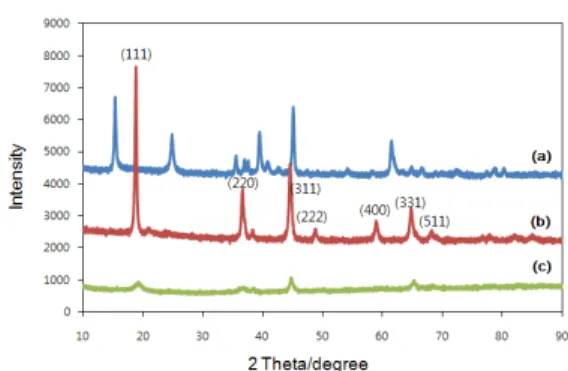
In order to know the structure of the synthesized Li1.6Mn1.6O4 and its structural stability of after leaching, X-ray diffractions have been performed, as shown in Fig.
1. The indexing results indicate that the Li1.6Mn1.6O4 (Fig.
1(b) obtained by calcination of LiMnO2 (Fig. 1(a) has a spinel structure. The intensity and sharpness of the spinel peaks greatly decreased, as shown in Fig. 3(c), after lithium was leached out from the Li1.6Mn1.6O4 by acid treatment. This means that the structural stability is not good, and the H1.6Mn1.6O4 given by acid treatment is not effective as a lithium adsorbent. In other words, the quality of the synthesized Li1.6Mn1.6O4 as a precursor is not good. To improve the precursor performance, Mn was substituted by other 3d transition metals such as Cu, Ni, Fe, Co.
[Fig. 1] XRD patterns of the (a) LiMnO2, (b) Li1.6Mn1.6O4
and (c) acid-treated Li1.6Mn1.6O4.
Figure 2 shows the XRD patterns of the 3d transition metal-doped Li1.6Mn1.6O4. The spinel structure of the Li1.6Mn1.6O4 was not changed by Cobalt doping (Fig 2(c), whereas new XRD peaks originating from structural changes were observed in the case of Cu or Ni or Fe doping (Fig. 2(a), (b), (d)). The Cobalt ions are located in 16d octahedron site of Mn, which is in fair agreement with that of the cubic structure (space group ).
This results clearly reveals that Cobalt is very effective as a doping element because the spinel is a favorable structure to precursor as a lithium adsorbent.
[Fig. 2] XRD patterns of 3d transition metal-doped Li1.6Mn1.6O4.
On the basis of the XRD results shown in Fig. 2, Cobalt is selected as a dopant toward Li1.6Mn1.6O4. The content of Cobalt was between 5 and 25 %. In the content range, no structural changes in the Cobalt-doped Li1.6Mn1.6O4 powders were observed from its XRD (not shown here). Lithium was leached out from the Cobalt-doped Li1.6Mn1.6O4 powders by acid treatment, and then XRD analysis was performed to know their chemical property as a precursor of Li adsorbent. Their XRD patterns are shown in Fig. 3. All the peaks were in fair agreement with those of cubic structure of . Also they could be marked with of spinel structure.
Thus it is considered that the Cobalt-doped Li1.6Mn1.6O4
powders after acid treatment have a well arranged spinel structure. These XRD results indicate that Li maintains the spinel structure, when it goes into the Mn site.
[Fig. 3] XRD patterns of Cobalt-doped Li1.6Mn1.6O4 after acid treatment.
Additional information on the structure of the Cobalt-doped Li1.6Mn1.6O4 was confirmed with HRTEM.
Figure 4 shows a electron diffraction pattern taken from the sample of Li1.6[MnCo]1.6O4. As the result of phase identification of Fig.4, this pattern was identified as B=[011] of the single crystalline having spinel structure (a=8.2Å).
[Fig. 4] An HRTEM image of the Li1.6[MnCo]1.6O4.
Chemical analysis was carried out with an AAS and ICP-AES system to know the performance as a adsorbent according to the amount of Cobalt doping. Metal ion eruption in the samples proceeded in 0.5 moldm-3 HCl aqueous solution for 3 days. The AAS and
ICP-AES results are shown in Table 1. It is known that appropriate oxidation number of Mn is +4 for high qualified lithium adsorbent. Therefore, the AAS and ICP-AES results, those are close to +4, indicate that the Li1.6[MnCo]1.6O4 is a good precursor. Consequently Coblat could be ionized best of all in 3d transition metal used in this work. Lithium ion extracted from Li1.6[MnCo]1.6O4
spinel was produced by ion exchange method. This result shows that lithium ion was extracted selectively from this materials.
[Table 1] Chemical composition for the original and acid-treated sample
Sample Chemical
Formula
Average Oxidation state
of Mn Li+ type
Li1.6[MnCo]1.6O4 Li2.1Mn1.37Co0.15O4 3.87 H+ type
H1.6[MnCo]1.6O4 Li0.08Mn1.32Co0.18O4 3.75
Figure 5 shows the extractibility of the Li1.6[MnCo]1.6O4
spinels. To extract the lithium ion and 3d transition metal from the spinels, the samples were soaked in the HCl aqueous solution for 3 days. The amount of extracted manganese ion was quite small compared to that of lithium ion. The ability of extraction of lithium ion has a increasing tendency with the decrease the amount of Cobalt-doping. The amount of Li adsorbed was estimated to be 35 mg per 1g-adsorbent from Fig. 5. This value is much larger than that obtained by commercially available Li1.33Mn1.67O4, in which relatively small amount of Li (16 mg per 1g-adsorbent) was adsorbed.
[Fig. 5] Extractibility of the acid-treated Cobalt-doped Li1.6Mn1.6O4.
4. Conclusions
In this work, a spinel-type manganese oxide, Li1.6[MnCo]1.6O4, was synthesized by hydrothermal method with good reproducibility. The Li1.6[MnCo]1.6O4 showed extraordinarily excellent property as a new precursor of Li adsorbent.
Acknowledgements : This research was supported by a grant (PGB047) from the Development of Technology for Extraction of Resources Dissolved in Sea Water Program funded by Ministry of Land Transport and Maritime Affairs (2011).
References
[1] J. C. Hunter., "Preparation of a new crystal form of manganese dioxide: λ-MnO2" Journal of Solid State Chemistry, 39, pp. 142-147, September, 1981.
[2] K. Ooi, Y. Miyai. and S. Katoh., “Preparation and ion-exchange properties of ion-sieve manganese oxide based on Mg2MnO4” Solvent Extr. Ion Exch., 5, pp.
561-572, 1987.
[3] Q. Feng, Y. Miyai, H. Kanoh. and K. Ooi., “Li+ Exracntion/Insertion with Spinel-Type Lithium Manganese Oxides, Characterization of Redox-Type and Ion-Exchange -Type Sites” Langmuir., 8, pp. 1861-1867, 1992.
[4] Q. Feng, H. Kanoh. and K. Ooi., "Manganese oxide porous crystals" J. Mater. Chem., 9, pp. 319-333, 1999.
[5] R. Chitrakar, H. Kanoh, Y. Miyai. and K. Ooi., "A New Type of Manganese Oxide (MnO2.0.5H2O) Derived from Li1.6Mn1.6O4 and Its Lithium Ion-Sieve Properties"
Chem. Mater., 12, pp. 3151-3157, September, 2000.
[6] Qi Feng, Yoshitaka Miyai, Hirofumi Kanoh, Kenta Ooi.,
"Lithium(1+) and magnesium(2+) extraction and lithium(1+) insertion reactions with lithium magnesium manganese oxide (LiMg0.5Mn1.5O4) spinel in the aqueous phase", Chem. Mater., 5 (3), pp 311-316, 1993.
[7] Y. -S. Kim, H. Kanoh, T. Hirotsu and K. OOi,
"Determination of the Chemical Bonding of Ionic Lithium and Proton Exchange in Spinel-Type Manganese Oxides", Bull. Chem. Soc. Jpn., 75, pp. 55-58, April, 2002.
[8] Y. -S. Kim, H. Kanoh, T. Hirotsu and K. OOi.,
"Chemical bonding of ion-exchange type sites in spinel-type manganese oxides Li1.33Mn1.67O4", Mater.
Res. Bull., 37, pp. 391-396, September, 2002.
[9] Y. -S. Kim, H. Kanoh, Ramesh Chitrakar, T. Hirotsu and K. OOi., "Electronic Structure and Chemical Bonding of Li and Protons in Spinel Type Manganese Oxides by Cluster Calculation", Chem Lett., pp.
1224-1225, July, 2000.
[10] B. Ammundsen, G. R. Burns, M. S. Islam, H. Kanoh.
and J. Roziere., "Lattice Dynamics and Vibrational Spectra of Lithium Manganese Oxides" A Computer Simulation and Spectroscopic Study"J. Phys. Chem. B., 103, pp. 5175-5180, JUNE, 1999.
[11] B. Ammundsen, J. Roziere. and M. S. Islam.,
"Atomistic Simulation Studies of Lithium and Proton Insertion in Spinel Lithium Manganates" J. Phys. Chem.
B., 101, pp. 8156-8163. October, 1997.
[12] B. Ammundsen, D. J. Jones, J. Roziere. and G. R.
Burns., "Mechnism of Proton Insertion and Characterization of the Proton Sites in Lithium Manganate Spinels"
Chem. Mater., 7, pp. 2151-2160, 1995.
[13] B. Ammundsen, D. J. Jones, J. Roziere. and G. R.
Burns., "Effect of Chemical Extraction of Lithium on the Local Structure of Spinel Lithium Manganese Oxides Determined by X-ray Absorption Spectroscopy", Chem. Mater., 8, pp. 2799-2808, 1996.
[14] B. Ammundsen, D. J. Jones. and J. Roziere., "Ion Exchange in Manganese Dioxide Spinel: Proton, Deuteron, and Lithium Sites Determined from Neutron Powder Diffraction Data", Chem. Mater., 10, pp.
1680-1687, MAY, 1998.
[15] Japan Industrial Standard (JIS), M8233, 1969
Yang-Soo Kim
[Regular member]• Feb. 1991: Chonbuk Univ., Metallurgical Eng., MS
• Mar. 1999: Kyoto Univ., Mater.
Sci. End., PhD
• June. 2006 ~ Current : Korea Basic Science Institute, Principal Researcher
<Research Interests>
New Li energy materials design using DFT
Won-Jin Moon
[Regular member]• Feb. 1995: DongA Univ., Metallurgical Eng., MS
• Mar. 2000: Nagoya Univ., Quantum Mechanics, PhD
• Apr. 2000 ∼ Dec. 2001 : IBM/ITES, Japan, Researcher
• Mar. 2005 ∼ Current : Korea Basic Science Institute, Principal Researcher
<Research Interests>
FE-TEM, Energy materials
Soon-Ki Jeong
[Regular member]• Aug. 1996 : Hanyang Univ. Dept.
of Industrial Chemistry, MS
• Mar. 2002 : Kyoto Univ. Dept.
of Energy & Hydrocarbon Chemistry, PhD
• Feb. 2005 ∼ current : Soonchunhyang Univ., Dept. of Chemical Engineering, Associate Professor
<Research Interests>
Primary & Secondary Batteries, In-situ SPM
Dae-Hee Won
[Regular member]• Feb, 1996 : Chonbuk National Univ., M.S.
• Feb. 1999 : Chonbuk National Univ., Ph.D.
• July. 2007 ~ Oct. 210 Hub Univ. for industrial collaboration, Professor
<Research Interests>
Energy materials, information, biomaterials
Sang-Ro Lee
[Regular member]• Feb. 1994 : Korea Univ., Metallurgical Eng., MS
• Feb. 1994 ∼ Aug. 2003 : POSCO Tech.Lab. Researcher
• Sep. 2003∼ July. 2010 : A1 Engineering. Engineer
• Aug. 2010~ current : KFNET.
Co. LTD. Researcher
<Research Interests>
Ore dressing, Solvent Extraction, Rechargeable Battery
Byoung-Gyu Kim
[Regular member]• Feb. 1985 : Chonbuk Univ., Industrial Chemistry, MS
• Mar. 1993 : Tohoku Univ., Applied Chemistry, PhD
• Oct. 1993 ∼ current : Korea Institute of Geoscience and Mineral Resources, Mineral Resources Research Division, Principal Researcher
<Research Interests>
Seawater-Dissolved Resources Recovery, Metal Adsorbent Synthesis
Kang-Sup Chung
[Regular member]• Feb. 1991 : Seongkyunkwan Univ., Inorganic Chemistry, MS
• Feb. 1995 : Seongkyunkwan Univ., Inorganic Chemistry, PhD
• Sep. 1986 ∼ current : Korea Institute of Geoscience and Mineral Resources, Mineral Resources Research Division, Principal Researcher
<Research Interests>
Seawater-Dissolved Resources Recovery, Inorganic Syntheses and Evaluation
![Figure 4 shows a electron diffraction pattern taken from the sample of Li 1.6 [MnCo] 1.6 O 4](https://thumb-ap.123doks.com/thumbv2/123dokinfo/5385593.206757/3.799.93.373.197.374/figure-shows-electron-diffraction-pattern-taken-sample-mnco.webp)
![Figure 5 shows the extractibility of the Li 1.6 [MnCo] 1.6 O 4](https://thumb-ap.123doks.com/thumbv2/123dokinfo/5385593.206757/4.799.100.366.374.671/figure-shows-extractibility-li-mnco-o.webp)