肩ㆍ頸項部 동태손상증후군에서의 동씨침 혈위 활용 방안
윤우석
1, 박영재
1,2, 박영배
1,2,*
1경희대학교 학과간협동과정 한방인체정보의학과
2경희대학교 한의과대학 진단 ․ 생기능의학과학교실
[Abstract]
A Study on the Use of Dong-Si Acupuncture Points at Movement System Impairment Syndrome of Shoulder and Cervical Spine
Woo Suck Youn1, Young Jae Park1,2 and Young Bae Park1,2,*
1Department of Human Informatics of Oriental Medicine, Interdisciplinary Programs, Kyung Hee University
2Department of Biofunctional Medicine & Diagnostics, College of Oriental Medicine, Kyung Hee University
Objectives : The purpose of this study was to present clinical utility of therapeutic exercise on the neck and shoulder parts based on the movement system impairment syndrome(MSIS) as Dong-Qi therapy of the Dong-Si Acupuncture and was to examine which Dong-Si acupoints were most effective and non-invasive when performing therapeutic exercise of the MSIS.
Methods : Totally eight therapeutic exercises correspondent to eight neck and shoulder MSIS were summarized and tabulated from the Diagnosis and Treatment of Movement Impairment Syndrome and Movement System Impairment Syndromes Of The Extremities, Cervical and Thoracic Spines by Sahrmann SA. Together with the MSIS summaries, acupuncture points and Dong-Qi therapy were summarized and tabulated from Yangweijiequanji 1 and Yangweijiequanji 2 by Yangweijie. According to the posture and movement of the MSIS exercise, effective and non-invasive acupoints were selected. Thereafter, clinical pilot study which five normal volunteers participated in were performed to examine whether these acupoints resulted in any side effects of acupuncture therapy such as pain and distortion of the needle during the MSIS exercises.
Results : Through clinical pilot study, ZhongZi, ZhongXian, ZhengJin, ZhengZong and MuLiu in a sitting position, and HuaGuYi, ZhongZi and ZhongXian in a supine position were finally determined as safe and non-invasive Dong-Si acupoints to treat cervical pain. In terms of shoulder pain, ZuQianJin, ZuWuJin, HuaGuEr and JianZhong in a supine position, SiHuaZhong, ZuQianJin, ZuWuJin, QuLing, JianZhong, ShenGuan and JiuLi in a standing position, and ZuQianJin, ZuWuJin, HuaGuEr, QuLing and JianZhong in a prone position were finally accepted as safe and non-invasive Dong-Si acupoints.
Conclusion : It is concluded that Dong-Si acupoints can be safely and non-invasively used together with therapeutic exercises of the MSIS to treat cervical and shoulder pains.
Key words :
Movement system impairment syndrome;
MSIS;
Dong-Si acupuncture;
Dong-Qi therapy
Received : 2013. 07. 17.
Revised : 2013. 11. 21.
Accepted : 2013. 11. 25.
On-line : 2013. 12. 20.
✱ Corresponding author : Department of Biofunctional Medicine & Diagnostics, College of Korean Medicine, Kyung Hee University, 26, Kyungheedae-ro 6-gil, Dongdaemun-gu, Seoul 130-701, Republic of Korea
Tel : +82-2-958-9195 E-mail : [email protected]
This is an Open-Access article distributed under the terms of the Creative Commons Attribution Non-Commercial License (http://creativecommons.org/licenses/by-nc/3.0) which permits unrestricted non-commercial use, distribution, and reproduction in any medium, provided the original work is properly cited.
The Acupuncture is the Journal of Korean Acupuncture & Moxibustion Medicine Society. (http://www.TheAcupuncture.or.kr) Copyright © 2013 KAMMS. Korean Acupuncture & Moxibustion Medicine Society. All rights reserved.
Ⅰ. 서 론
근골격계와 관련된 질환을 치료함에 한의학적 침치료법 은 여러 가지 종류가 있다. 체침, 사암침, 동씨침 등이 대 표적이고 최근에는 체질침 요법도 임상에서 선용되고 있 다. 그 중에서도 동씨침법은 시술이 간편하고 실용적이며, 원위 취혈을 함에 그 특징이 있다. 동씨침법이 여러 근골격 계 질환 치료 시 효과적이라는 결과가 그동안 여러 연구를 통해 보고되었다. Lee et al1)은 경항통, You et al2)은 VDT 증후군, Kim et al3)은 만성 견비통, Ha et al4)은 요각통에 각각 동씨침법이 효과적이라는 보고를 한 바 있다.
동씨침의 효과는 동씨기혈의 자침과 동기요법이 병행되 었을 때 효과가 倍加된다고 알려져 있다5). 得氣는 침 치료 과정에서 針刺 부위 또는 경락을 따라 발생하는 독특한 감 각으로서, 유침한 상태에서 염전, 제삽 등의 일정한 手技를 가했을 때 나타나는 經氣의 감응현상을 지칭한다6). 동씨침 법에서도 자침 후 酸ㆍ麻ㆍ脹 등의 감각을 환자가 느끼면 득기가 된 것인데 이러한 상태에서 동기요법은 통처를 움직이 면 통증이 더 경감한다7)고 설명하였다. 그런데 기존 동기 요법에서는 통증의 가중과 관련한 동작을 반복하게 할 뿐 구체적 운동법 제시가 없어서 동기요법을 객관화하기 어려 운 점이 있었다. 다양한 병인으로부터 유발된 근골격계 질 환의 환자에게 일괄적으로 적용되는 기존의 동기요법은 오 히려 통증을 더 유발 할 수도 있다. 따라서 통증의 양상이나 통증 유발 요인을 고려한 운동요법을 바탕으로 동기요법을 구체화하고 이를 동씨침법에 응용하는 것이 중요하다.
Movement system impairment syndrome(동태손상증 후군, 이하 MSIS) 관점에서는 지속적이고 반복되는 잘못 된 동작에 의해서 인체의 정상적인 정렬(alignment)이 무 너지고, 이로 인해 조직에 기계적 손상과 미세손상이 발생 한다8)고 인식한다. 따라서 각종 이학적 검사를 통해서 환 자의 정렬 상태를 파악하고 어떠한 자세가 통증을 유발하 는지, 혹은 통증을 회피하기 위해서 환자가 어떠한 잘 못된 자세를 취하고 있는지를 진단해내는 것이다. MSIS는 진단 개념 자체가 질병상태에 이르게 된 과정 중심이며, 따라서 그 치료법도 과정 중심이다8). 동태손상에 기인한 통증 치 료 시 잘 못된 자세를 교정하고 정상적인 정렬 상태를 회복 하기 위한 운동요법이 필수적이다. MSIS 운동치료 시 앞에 서 언급한 동씨침법을 병행하고, MSIS 각 증후군별 운동치 료방안을 동씨침법 시 사용하였던 동기요법으로 적용한다 면, MSIS 운동 및 동씨침 치료화를 극대화할 수 있을 것으 로 기대된다. 이미 Youn et al9)은 요부, 슬부 통증이 있는
환자에게 MSIS의 운동요법에 동씨침법을 결합하는 방안을 연구 발표했다. Youn은 요통과 슬통의 동씨침 치료에서 MSIS의 운동요법과 결합하는 것이 모호했던 동기요법을 보완할 대안이 될 수 있음을 제시하였다.
본 연구의 목적은 Youn의 연구를 기본 토대로 하여 근 골격계 질환 중 견부 및 경항부의 통증 치료를 위한 MSIS 운동요법을 동씨침법의 동기요법으로써 활용하기 위한 동 씨침 혈위를 제시하는 데 있다. Youn의 기존 연구는 문헌 중심적인 연구였으며, 실제 MSIS 운동 시행 시 침치료로 인한 문제를 살펴보지 않았다. 문헌을 바탕으로 제시된 특 정 동씨침 혈위가 탁월한 효과를 지녔다고 할지라도 실지 로 환자가 운동을 시행 할 때 환자에게 통증을 유발한다면 안전한 치료행위라고 보기 어려운 점이 있다. 따라서 본 연 구에서는 Movement System Impairment Syndromes of the Extremities, Cervical and Thoracic Spines10)와 Diagnosis and Treatment of Movement Impairment Syndromes11),그리고 Yangweijiequanji 17)과 Yangweijie- quanji 212)를 통해서 문헌적으로 목 부위와 어깨 부위 증 후군별 운동 방법과 해당 부위의 통증에 유효하다고 알려 진 혈위를 정리한 후 pilot study를 통해 MSIS 운동치료 시 특정 혈위가 통증 혹은 만침 등의 침 부작용을 유발하는 지 검토하였다. 이를 바탕으로 최종적으로 MSIS 운동치료 와 병행가능하며 안전하고 비침습적인 동씨침 혈위를 선정 하였으므로 이에 보고하는 바이다.
Ⅱ. 대상 및 방법
1. MSIS의 운동법과 동씨침 혈위선정
경항부 및 견부와 관련된 MSIS의 운동법은 요추와 슬관 절을 대상으로 진행한 Youn의 선행연구와 동일한 방식으로 Shirley Sahrmann의 Movement System Impairment Syndromes of the Extremities, Cervical and Thoracic Spines10)와 Diagnosis and Treatment of Movement Impairment Syndromes11)를 기본 교재로 하였고, 해당 부위의 동씨침 혈위는 양유걸의 Yangweijiequanji 17)과 Yangweijiequanji 212)를 기본 교재로 하였다. 본 연구는 견ㆍ경항부 통증에 유효하다고 동씨침에서 제시한 혈위를 각각 Table 1, 7에 정리하였다. 또한 MSIS에서 견ㆍ경항부 에 해당하는 운동법을 자세별로 각각 Table 2~5, 8~11에 정리하였다.
Acupuncture points
Cervical pain
ZhengJin(正筋) : on the center of Achilles tendon, from plantar part, go 3.5 cun up ZhengZong(正宗) : from Zheng Jin, move 2 cun up directly
HuaGuYi(花骨一) : between the first & second metatarsal bone at the plantar part
Shouldr-neck pain
ShenGuan(腎關) : from YinLingQuan(TianHuang) go 1.5 cun down directly
BiGuan(髀關) : on the end of the proximal part of rectus femoris muscle, the concave spot between the sartorius muscle and tensor fasciae latae muscle
LaoZhen
ZhongZi(重子) : at the palm of hand, between the first & second metacarpal bone, from hukou down 1 cun
ZhongXian(重仙) : the point of contact between the first & second metacarpal bone ZhengJin(正筋) : on the center of achilles tendon, from plantar part, go 3.5 cun up ZhengZong(正宗) : from Zheng Jin, move 2 cun up directly
MuLiu(木留) : the connection part between the third and fourth metatarsal bone Table 1. Dong-Si Acupuncture Points About Cervical Part
2. MSIS 운동법에 동씨침의 자침 적합성 평가
MSIS 및 동씨침법 교재를 통해 경항부와 어깨 부위 통 증 치료 시 활용 가능한 동씨침 혈위를 선정한 후 실제로 이 혈위가 해당 운동 시 통증, 혹은 자침 부작용을 유발하 는지 살펴보기 위해서 20대의 건강한 남녀를 대상으로 MSIS의 운동법을 충분히 설명하고 동씨침 혈위에 자침을 시행하였다. 자침 후 운동법을 시행함에 있어서 통증유발 여부를 VAS 척도로 점수화하였고, 발침 후 침병을 기준으 로 침체의 만곡 정도를 조사하였다.
MSIS 운동요법을 시행함에 있어 실제 임상에서 활용 할 수 있는 동씨침 혈위를 Table 6, 12와 같이 선정하였다. 사 용된 침은 직경 0.25 mm, 길이 40 mm인 스테인리스스틸 로 제작된 호침(우전침구제작소, 한국)을 사용하였다. 혈 위 선정의 기준은 피험자들에게 자침 후 운동을 시행함에 불편 정도를 10점 척도를 기준으로 하였다. 경항부 운동에 서는 통증 점수가 1점을 초과하는 혈위는 제외했으며, 견부 운동에서는 운동의 특성상 통증이 0점을 초과하는 혈위는 제외했다. 또한 발침 후 침체의 만곡이 침병을 기준으로 2 mm 이상인 혈위도 제외하였다.
Ⅲ. 결 과
1. 경항부
경항부 통증에 대하여 양이 제시한 혈위는 Table 1과 같다.
① ②
Fig. 1. First, the subject poses a quadruped position in cervical extension syndrome
And then after applying acupuncture on ZhengJin(①), ZhengZong(②), move like this picture.
MSIS에서 각 증후군별 경항부 통증에 제시한 운동법은 Table 2~5와 같다.
5명의 실험 참가자에게 MSIS의 운동법을 설명하고 동 씨침 혈위에 자침을 실행하였다. VAS 10점 척도를 사용하 여 자침 부위가 운동법을 시행함에 통증을 유발하는 정도 를 점수화하게 하였다. 그 결과 경항부 운동법에서 통증 점 수는 0~1.6점 사이였고, 이중에서 통증 유발 점수가 1점을 초과하는 혈위는 제외하였다. 동씨침을 이용하여 MSIS의 경항부와 관련된 운동법을 시행하기에 적합한 혈위는 Table 6, Fig. 1, 2와 같이 정리하였다.
2. 견부
견부 통증과 관련하여 양이 제시한 혈위는 Table 7과 같다.
Movement position Methods Cervical
flexion syndrome
Prone With one hand laid on top of the other, put your forehead on the palm doing neck stretching exercise
Quadruped Keep your back horizontal to the floor and do bending and stretching exercise
Table 4. Cervical Flexion Syndrome
Movement position Methods
Cervical extension syndrome
Sitting on a chair
Leaning head against a wall, supporting both forearms with pillow, do bending exercise not to detach your head from wall
Keeping your head bend and lean against a wall, raise your both arms and put fingers on the wall not to close your elbows. Forearms and wall are in alignment and raise your hands along the wall
Straighten your arms out in front of you and bend both elbow joints at an angle of 90〬. With the palms toward to the face, raise your hands at the ceiling
Quadruped Keep your lumbar, thoracic and cervical vertebrae straight and bend your neck repeatedly
Supine From the ground, with your chin pulled and head bent, raise your head without help. If it is hard, use your both hands
Prone With one hand laid on top of the other, put your forehead on the palm doing neck stretching exercise
Standing Facing the wall, close your ulnar part of both arms to the wall and raise your hands up
Table 2. Cervical Extension Syndrome
Movement position Methods
Cervical extension- rotation syndrome
Sitting on a chair Leaning head against a wall, supporting both forearms with pillow, do bending exercise not to detach your head from wall
Supine Rotate your neck on a vertical axis without stretching and side bending of neck
Standing
Facing the wall, close your ulnar part of both arms to the wall with bending your elbow joints at an angle of 90°. Rotate your neck on a vertical axis without stretching and side bending of neck
Quadruped Keep your back horizontal to the floor and do exercise same with the previous table
Table 3. Cervical Extension-rotation Syndrome
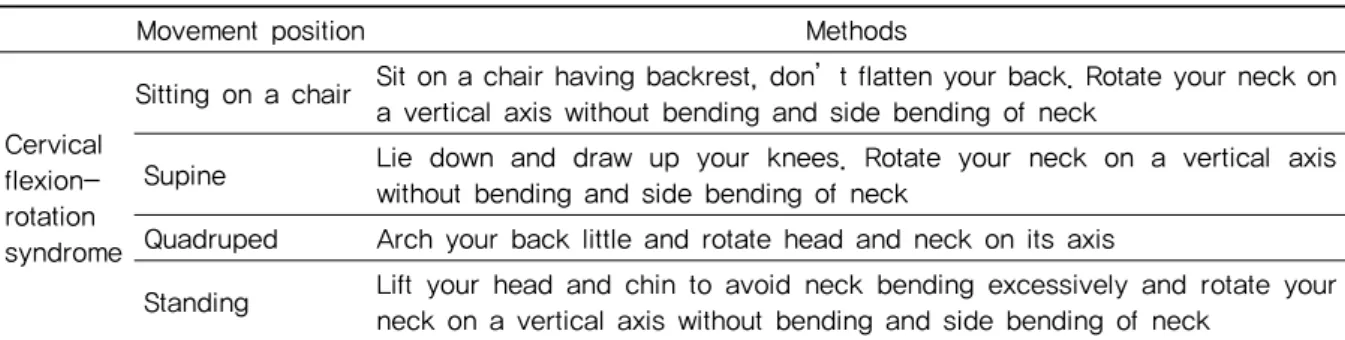
Movement position Methods
Cervical flexion- rotation syndrome
Sitting on a chair Sit on a chair having backrest, don’t flatten your back. Rotate your neck on a vertical axis without bending and side bending of neck
Supine Lie down and draw up your knees. Rotate your neck on a vertical axis without bending and side bending of neck
Quadruped Arch your back little and rotate head and neck on its axis
Standing Lift your head and chin to avoid neck bending excessively and rotate your neck on a vertical axis without bending and side bending of neck
Table 5. Cervical Flexion-rotation Syndrome
Dong-Si acupuncture points ZhengJin(正筋),
ZhengZong(正宗) HuaGuYi
(花骨一) ShenGuan(腎關),
BiGuan(髀關) ZhongZi(重子), ZhongXian(重仙)
ZhengJin(正筋), ZhengZong(正宗),
MuLiu(木留)
Sitting on a chair S Us Us S S
Supine Us S Us S Us
Quadruped S Up Us Us Us
Prone S S Us Us Us
Standing S Us S Up Up
S : suitable when considering movement and pain.
Us : unsuitable because it was not exposed when performing the MSIS exercise.
Up : unsuitable because of the pain.
Table 6. Appropriateness of Acupuncture Points about Cervical Part to the MSIS Movement
Acupuncture points Methods
Movement limitation of the upper limbs due to pain
(手臂不能擧)
ShenGuan(腎關) : from YinLingQuan(TianHuang) go 1.5 cun down directly Painless part SiHuaZhong(四花中) : from SiHuaShang(from DuBi go down 3 cun) go 4.5
cun down directly Painful part
ZuQianJin(足千金) : from ZuSanLi, go 2 cun outside directly and then go 4 cun down
ZuWuJin(足五金) : from ZuTianJin, go 2 cun down
HuaGuEr(花骨二) : between second & third metatarsal bone at the plantar part
QuLing(曲陵) : with ChiZe same Bloodletting
Frozen shoulder
With Movement limitation of the upper limbs due to pain same
JianZhong(肩中) : the outer side at the back of humerus, from the acromion, go 2.5 cun down
Shoulder pain
With frozen shoulder same
ShenGuan(腎關) : from YinLingQuan(TianHuang) go 1.5 cun down directly JiuLi(九里) : the center point of outside of the thigh, with FengShi same Table 7. Dong-Si Acupuncture Points About Shoulder Part
Movement position Methods
Humeral onterior glide syndrome
Supine Bend your elbow joint and do shoulder joint 90 degrees abduction. While do inner rotation, using your hand of painless arm, prevent anterior glide of head of humerus Standing Facing the wall, bend your shoulder joint while do outer rotation at the
same time
Quadruped Do posterior rocking using power of pushing arm, not to use power of bending hip joint
Table 8. Humeral Anterior Glide Syndrome
Movement position Methods
Humeral superior glide syndrome
Supine Repeat inner and outer rotation, limiting movement of head of humerus using painless hand at the same time
Prone Do outer rotation exercise
Standing Put your hand on the wall and push up Table 9. Humeral Superior Glide Syndrome
Movement Position Methods
Shoulder medial rotation syndrome
Supine Bend the elbow joint 90 degrees and do the shoulder joint 90 degrees abduction. And then do outer rotation using 2 pound weight
Standing
Standing against the wall, bend the elbow joint and do bending shoulder joint exercise
Facing the wall, put your hand on the wall and bend your shoulder joint while pushing your hand up
Quadruped Repeat anterior and posterior rocking Table 10. Shoulder Medial Rotation Syndrome
Movement position Methods
Humeral hypomobility syndrome
Standing
Using your hand of painless arm, bend the elbow joint of painful arm and then do your shoulder joint flexion
Put your ulnar part of painful arm on the wall and do your shoulder joint flexion using your hand of painless arm
Supine Do the shoulder joint 50~85 degrees abduction and bend the elbow joint. And then do your shoulder joint bending exercise
Quadruped Do posterior rocking using power of pushing arm, not to use power of bending hip joint
Table 11. Humeral Hypomobility Syndrome
Dong-Si acupuncture points Shen
Guan (腎關)
SiHua Zhong (四花中)
ZuQianJin(足千金),
ZuWuJin(足五金) HuaGuEr (花骨二)
Qu Ling (曲陵)
Jian Zhong
(肩中)
ShenGuan(腎關), JiuLi(九里)
Supine Up Up S S Up S Up
Standing S S S Us S S S
Quadruped Up, Uand Us Up Up Up Uand Up
Prone Up Us S S S S Up
S : suitable when considering movement and pain.
Us : unsuitable because it was not exposed when performing the MSIS exercise.
Up : unsuitable because of the pain.
UAnd : unacceptable because this acupoint resulted in the needle bending over the 2 mm after the MSIS exercise.
Table 12. Appropriateness of Acupuncture Points about Shoulder Part to the MSIS Movement
① ②
Fig. 2. First, the subject poses a supine position in cervical flexion-rotation syndrome
And then after applying acupuncture on ZhongZi(①), ZhongXian(②), move like this picture.
①
Fig. 3. First, the subject poses a prone position in humeral superior glide syndrome
And then after applying acupuncture on JianZhong(①), move like this picture.
②
①
Fig. 4. First, the subject poses a standing position in humeral superior glide syndrome
And then after applying acupuncture on ZuQianJin(①), ZuWuJin(②), move like this picture.
Fig. 5. First, the subject poses a quadruped position and then applying acupuncture on JianZhong, do MSIS exercise
MSIS에서 각 증후군별 경항부 통증에 제시한 운동법은 Table 8~11과 같다.
5명의 실험 참가자에게 MSIS의 운동법을 설명하고 동
씨침 혈위에 자침을 실행하였다. VAS 10점 척도를 사용하 여 자침 부위가 운동법을 시행함에 통증을 유발하는 정도 를 점수화하게 하였다. 그 결과 견부 운동법에서 통증 점수 는 0~3.2점 사이였고 ,이중에서 통증을 느끼지 못했다고 하는 0점에 해당하는 혈위만 선택하였다. 또한 통증 점수 는 0점이었으나 발침 후 침체의 만곡이 2 mm 이상인 혈위 도 제외하였다. 그 결과 동씨침을 이용하여 MSIS의 견부와 관련된 운동법을 시행하기에 적합한 혈위는 Table 12, Fig. 3~5와 같이 정리하였다.
Ⅳ. 고 찰
본 연구는 견ㆍ경항부 통증을 치료하기 위해서 MSIS의 운동요법에 동씨침법을 결합하면 동씨침 치료 효과를 극대 화 할 수 있다는 Youn의 연구를 바탕으로 진행되었다. 그 결과 Table 1, 7에서는 동씨침에서 각 통증별로 유효하다 고 제시한 혈위를 정리하였고, Table 2~5, 8~11에서는 각 통증에 해당하는 MSIS의 운동법을 자세별로 정리하였다.
Table 6, 12에서는 MSIS의 운동법을 시행함에 가장 적합 한 동씨침 혈위을 선정하였다.
동씨침에서 유효하다고 제시한 혈위를 선정하고 MSIS 의 운동요법과 병행하여 시술하였을 때 몇 몇 혈위는 통증 을 유발하거나 침체에 만곡이 생기는 문제점이 발견되었 다. 견부 통증에 활용되는 肩中穴은 문헌적으로 동씨침의 동기요법을 시행하는데 문제점이 없으나 MSIS의 네 발 엎 드린 자세에서의 운동법을 피험자들을 대상으로 시행했을 때 침체가 만곡되는 문제가 발생했다. 이는 운동을 시행함 에 사용되는 주된 근육근에 자침한 경우 작은 range of motion(ROM)에서도 문제가 발생 할 수 있음을 보여 주었 다. 또한 腎關穴은 네 발 엎드린 자세에서 침체의 만곡과 함께 통증을 유발했다. 전후방 락킹 운동(Fig 1과 같은 자 세에서 체간을 앞뒤로 움직이는 운동)에서 하퇴의 근육이 수축하면서 통증과 함께 만곡을 유발한다는 것을 확인하였 다. 따라서 최종적인 혈위 선정의 기준은 운동요법과 침 치 료 병행 시 통증 혹은 침 부작용의 발생 여부를 가장 우선 으로 하였다. 운동요법을 시행할 때 자침 부위에서의 통증 발생 유무를 기준으로 하여 경항부에서는 통증 점수가 평 균 1점을 초과하는 것을 제외하였고, 견부에서는 통증 점수 가 평균 0점을 초과하는 혈위를 제외하였다. 경항부 운동 에서는 경추의 운동이 주를 이루었기 때문에 하지부의 혈 위가 크게 통증을 유발한다고 볼 수는 없었다. 그러나 견관 절 운동은 상지를 움직이는 동작에서 체간의 움직임과 하
지의 움직임을 완벽하게 제한 할 수 없기에 통증의 강도가 경항부에 비해서 크게 나타났다. 따라서 견부 운동에 적합 한 혈위를 선정함에 경항부와는 달리 VAS 척도 0점에 해 당하는 혈위만을 선택하게 하였다. 또한 통증 점수가 각각 1점 이하이거나 혹은 0점일지라도 발침 후 침체의 만곡이 2 mm 이상인 혈위도 제외하였다. 향후 MSIS의 운동에 동 기요법을 활용 할 때는 실질적으로 각 혈위를 검증하는 작 업이 필요할 것으로 사료된다.
본 연구는 동씨침법을 MSIS 운동요법에 응용하기 위해 서 통증을 유발하지 않으면서 만침의 우려가 없는 혈위를 찾고자 피험자를 대상으로 평가하였다. 하지만 피험자의 수가 5명이라는 제한이 있었다. 또한 실제 견ㆍ경항부의 근골격계 질환이 있는 사람을 대상으로 한 것이 아니라는 한계점도 있었다. 따라서 향후 보다 많은 수의 피험자를 대 상으로 직업, 성별, 평소 근력상태에 따른 변수가 동씨침 혈위 자체에 어떤 문제를 일으키는지 확인해보는 과정의 연구가 필요하다. 또 실제 견ㆍ경항부 근골격계 질환이 있 는 환자를 대상으로 한 임상연구가 진행되어야할 필요가 있다.
어깨 통증에 동씨침에서 제시한 曲陵穴은 사혈요법을 시 행하게 되어 있으나 본 연구에서는 다른 혈위와 마찬가지 로 자침 후 운동요법을 시행하였다. 동씨침법에서는 동기 요법을 중요시하고 있지만 사혈요법도 중요한 치료 수단이 다. 본 연구에서는 실제 환자를 대상으로 한 것이 아니기에 曲陵穴에 사혈을 시행할 수 없는 문제가 있었다. 따라서 동 씨침에서 제시한 어깨 통증에 曲陵穴에 자침을 하고 운동요 법을 시행하는 것이 아니라 사혈을 하고 운동요법을 실행 하는 연구도 필요하다고 사료된다.
Ⅴ. 결 론
본 연구는 경항부ㆍ견부와 관련된 MSIS의 운동 치료 시 동씨침의 동기요법을 임상적으로 활용하고자 진행하였다.
그 결과 MSIS 운동요법을 시행함에 치료효과를 높이고 침 치료를 병행하여 부작용을 최소화할 동씨침 혈위를 다음과 같이 제안하였다.
1. 경항부 통증 시 앉은 자세에서는 重子ㆍ重仙ㆍ正筋ㆍ 正宗ㆍ木留穴을 취혈한다. 누운 자세에서는 花骨一ㆍ 重子ㆍ重仙穴을 취혈한다. 네 발 엎드린 자세에서는 正筋ㆍ正宗穴을 취혈한다. 엎드린 자세에서는 正筋ㆍ 正宗ㆍ花骨一穴을 취혈한다. 서있는 자세에서는 正
筋ㆍ正宗ㆍ腎關ㆍ髀關穴을 취혈한다.
2. 견부 통증 시 누운 자세에서는 足千金ㆍ足五金ㆍ花骨 二ㆍ肩中穴을 취혈한다. 서 있는 자세에서는 四花中ㆍ 足千金ㆍ足五金ㆍ曲陵ㆍ肩中ㆍ腎關ㆍ九里穴을 취혈한 다. 엎드린 자세에서는 足千金ㆍ足五金ㆍ花骨二ㆍ曲 陵ㆍ肩中穴을 취혈한다.
향후 본 논문을 바탕으로 전통적 동기요법과 MSIS의 운 동요법에 동씨침을 병행한 임상적 유용성에 관련된 비교연 구가 지속되길 기대한다.
Ⅵ. References
1. Lee CW, Cho TS, Park IB et al. A Clinical Study for The Influence of Dong-Shi Acupuncture on Neck Pain. The Journal of Korean Acupuncture &
Moxibustion Society. 2003 ; 20(2) : 50-67.
2. You JH, Kim DH, Kim JH, Lim SK and Choi DY. A Case Report on Shoulder Pain and Dysfunction of Visual Display Terminal Syndrome Patient Treated with Dong-Shi Acupuncture Therapy. The Journal of Association of the Spine & Joint Korean Medicine. 2010 ; 7(1) : 15-20.
3. Kim CY, Kwon NH, Shin YJ et al. Randomized Controlled Trial: Effect of Master Dong's Acupuncture in Chronic Shoulder Pain Patients.
The Journal of Korean Acupuncture & Moxi- bustion Society. 2007 ; 24(6) : 89-96.
4. Ha CH, Han SG, Park CH et al. A Clinical Study on the Effects of Pain control of Dong-Si acupuncture therapy for the patients with lumbago. The Journal of Korean Acupuncture &
Moxibustion Society. 1996 ; 13(1) : 214-24.
5. Chae WS. Compilation of Dongsiqixue. Seoul: Il joong sa. 1997 : 2.
6. Kim SC. A Study of Literature Review on Needling Sensation and the Flow of the Needling Sensation.
The Journal of Korean Acupuncture & Moxi- bustion Society. 2001 ; 18(3) : 201-14.
7. Yang Wei Jie. Yangweijiequanji 1. Gyeonggi : Dae- sung publishing company. 2005 : 42.
8. Kim HH, Kim JK, Seo JH, Park YJ, Park YB. Fea-
sibility on Evaluation of Movement System Im- pairment Syndromes by MEMS-IMU. J Korean Oriental Medical Diagnostics. 2011 ; 15(3) : 223-34.
9. Youn WS, Park YJ and Park YB. Dong-Qi Therapy of Dong-Si Acupuncture to Movement System Impairment Syndrome of Lumbar Spine and Knee.
The Journal of Korean Acupuncture & Moxi- bustion Society. 2013 ; 30(1) : 13-22.
10. Sahrmann SA. Movement System Impairment Syn-
dromes of The Extremities, Cervical and Thoracic Spines. St Louis, MO : Mosby Inc. 2011 : 69-99.
11. Sahrmann SA. Diagnosis and Treatment of Move- ment Impairment Syndrome. St Louis : Mosby.
2002 : 295-310.
12. Yang Wei Jie. Yangweijiequanji 2, Gyeonggi : Dae- sung publishing company. 2005 : 197, 199, 227, 232.