INTRODUCTION
Breast conserving surgery (BCS) has been approved to treat breast cancer, and this has an equivalent patient survival rate in comparison to mastectomy, and an accep- table cosmetic result can be obtained.(1) Women who undergo breast surgery want to have a better cosmetic outcome and there are several methods to satisfy the patient such as autogenous tissue reconstruction. Yet autogenous tissue reconstruction may require much skill and experience by the surgeon and there is the inevitable
scar.
Wide local excision without immediate volume replace- ment is associated with cosmetic failure in about one third of these patients.(2) Particularly, in case of a small breast, immediate volume replacement is needed for im- proving the cosmetic outcome.
The absorbable synthetic polyglycolic acid mesh was proposed first as a filling material for the defect after breast surgery in 2003.(3) Thereafter, there were some reports about this technique with advantage of a simple procedure and satisfactory cosmetic outcome in Japan.(4- 6) In the present study, we present our surgical methods and the esthetic results of volume replacement using absorbable surgical mesh (Polyglactin 910, Vicryl�, Ethi- con, Norderstedt, Germany), which was expected to fill the postoperative defect by inducing reactive fluid and granulation as a foreign body reaction.
METHODS
Between May 2005 and November 2006, 25 patients underwent partial mastectomy for early breast cancer or Purpose: Partial mastectomy without immediate volume
replacement can be associated with cosmetic failure. The aim of the present study was to assess cosmesis achieved in patients who underwent partial mastectomy and recon- struction using absorbable surgical mesh. Methods: We used absorbable surgical mesh (Polyglactin 910, Vicryl�) to repair defects after performing partial mastectomy in 25 patients.
Endoscopy-assisted partial mastectomy was performed with conservation of the whole skin of the breast and areola. A tailored fan-shape mesh was inserted into the postoperative defect. The cosmetic appearance was evaluated using a
simplified five-grade for five-items scoring system at 3 and 6 months after the operation. Results: An excellent or good cosmetic result was obtained in 82.6% of the patients (19/
23) after 3 and 6 months, and no major complications were noted. Conclusion: This procedure can be easily performed by general surgeons. Insertion of an absorbable surgical mesh into the postoperative defect could be an effective modality for reconstructing a defect after breast surgery.
Key Words: Cosmetic techniques, Mammaplasty, Segmental mastectomy, Seroma, Surgical mesh
Breast Cancer
O R I G I N A L A R T I C L E
The Use of Absorbable Surgical Mesh after Partial Mastectomy for Improving the Cosmetic Outcome
Hyung Ook Kim, Sang Il Hwang, Cha Kyong Yom, Yong Lai Park, Won Gil Bae
Department of Surgery, Kangbuk Samsung Hospital, Sungkyunkwan University School of Medicine, Seoul, Korea
Correspondence: Yong Lai Park
Department of Surgery, Kangbuk Samsung Hospital,
Sungkyunkwan University School of Medicine, 108 Pyung-dong, Jongno-gu, Seoul 110-746, Korea
Tel: 02-2001-2139, Fax: 02-2001-2131 E-mail: [email protected]
Received: December 17, 2008 Accepted: April 21, 2009
This study was not supported by any financial assistance. The content of this manuscript was presented at the 42nd World Con- gress of Surgery of the International Society of Surgery ISS/SCI, International Surgical Week ISW, Montreal, Canada, Aug 26-30, 2007: Poster Exhibition Only presentation.
We presented “Endoscopy-assisted partial mastectomy and repair of defect with mesh graft”at the International Oncoplastic Breast Surgery Symposium, Daegu, Korea, Sep 15, 2007.
151
benign breast disease with using absorbable surgical mesh reconstruction. In patients with benign breast disease, these operations were performed in patients who had the possibility of postoperative asymmetry due to small breast, underwent wide resection due to the possibility of malignancy, or had defect in the lower portion of the breast. The patients were all female and their median age was 46 (range: 32-62) yr. Endoscopy-assisted partial mastectomy with/without sentinel node biopsy was per- formed as described elsewhere.(7) In brief, the retromam- mary space of the quadrant to be excised was dissected gently through the axillary incision by using a Vein Har- vest and Powerstar scissors (Ethicon, Somerville, USA) under the view of an endoscopic monitor. After completing the dissection of the retromammary space, we made the periareolar semicircular incision to create the skin flap and to resect the tumor-containing quadrant by using Visiport (5-11 mm, Auto Suture, Norwalk, USA). The whole skin of the breast and areola was conserved.
Absorbable surgical mesh reconstruction consists of 3 steps: 1) an absorbable surgical mesh (Polyglactin 910, Vicryl�) is folded several times to a 0.8 cm width and this is sutured at one end to become fan-shape; 2) it is wrapp- ed up in oxidized regenerated cellulose (Interceed�, Ethi-
con, Somerville, USA) for prevent adhesion between the skin or the pectoralis muscle and the mesh (Figure 1); and 3) it is inserted into the postoperative defect and fixed to the breast tissue by one point of stitch (Figure 2).
The cosmetic appearance was evaluated at 3 and 6 months after the operation. The cosmetic results of this study were measured using a simplified five-grade for five-items scoring system that consisted of two variables (by patient oneself and a male breast-specialty surgeon) at the time of follow up examination. We modified the five-item-by-four-step method designed by Yamashi- ta.(8) The patients were questioned about five items that consisted of volume symmetry in relation to the other breast, shape, the nipple-areolar complex situation, scar and the overall satisfaction. Subjective patient satisfaction for each five items was scored as excellent (9-10), good (7-8), fair (5-6), poor (3-4) or very poor (0-2). A male breast-specialty surgeon also examined the patients for the same items. Photographs for presentation were taken at about 3 and 6 months after the operation in patients who agreed to be photographed (Figure 3).
RESULTS
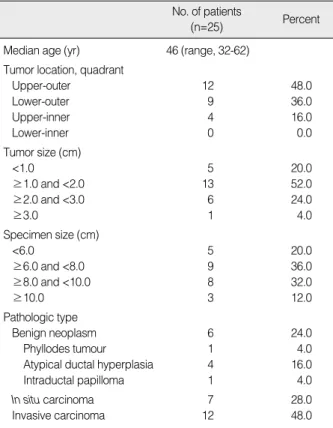
The locations, size and pathologic types of the tumors are summarized in Table 1. The mean follow-up period was 11.5±5.1 months (range, 2-19 months) and no major complication was noted. Ultrasonography of the breast was performed at about 3 and 6 months to survey any
Figure 1. (A) Oxidized regenerated cellulose (Interceed�). (B) Ab- sorbable surgical mesh (Polyglactin 910, Vicryl).
A B
Figure 2. (A) Tumor mass, incisions and the postoperative defect.
(B) Insertion of an absorbable mesh into the postoperative defect.
A B
Figure 3. A 46-yr-old woman with breast cancer on the upper outer quadrant of the left breast. She underwent breast recons- truction using absorbable surgical mesh following endoscopy- assisted breast-conserving surgery and received postoperative radiation therapy. Six-month postoperative views. Score of overall cosmetic satisfaction was 7 (good).
possible event. The ultrasonographic findings showed a firm-walled seroma that contains some reactive fluid and granulation tissue. This finding was confirmed grossly and pathologically in one patient who underwent comple- tion total mastectomy according to postoperative pathol- ogic report; multifocal ductal carcinoma in situ. In five cases, the volume of the seroma was too small to obtain a cosmetic effect, and so sterile saline was injected into the cavity under ultrasonographic guide. In contrast, reac- tive fluid was aspirated in three patients because of too large a seroma volume. Aspiration of the seroma or injec- tion of saline was performed in accordance with the pa- tient’s own cosmetic satisfaction.
Table 2 documents the scores of the parameters of cos- mesis as assessed by the patients and surgeon at 3 and 6 months after surgery. The overall cosmetic satisfactions at the same time are presented in Table 3. When a dis- crepancy in scores between the patients and surgeon was present, then the lower score was adopted. Two (at 3 months) and two (at 6 months) patients were excluded
because of the short follow-up period or completion of total mastectomy. The excellent or good cosmetic results were 82.6% (19/23) after 3 and 6 months. Some skin reac- tions of the breast were noted in those patients treated with radiation therapy, such as erythema or mild to mod- erate hyperpigmentation; however, there were no patients with deformities such as skin retraction or contracture of breast during the follow up periods.
DISCUSSION
Breast conservation has become a standard strategy for early breast cancer.(9) However, BCS does not always have an acceptable cosmetic result, and the tumor cha- racteristics, tumor size, location and nipple-tumor dis- tance are factors that affect cosmesis.(10) A small to modest volume of the breast could disturb the post- operative breast contour and symmetry. Many women who undergo breast surgery may be more intolerant of their breast asymmetry and loss of volume than any nip- Table 1. Clinicopathologic characteristics of the patients
No. of patients
(n=25) Percent
Median age (yr) 46 (range, 32-62) Tumor location, quadrant
Upper-outer 12 48.0
Lower-outer 9 36.0
Upper-inner 4 16.0
Lower-inner 0 0.0
Tumor size (cm)
<1.0 5 20.0
≥1.0 and <2.0 13 52.0
≥2.0 and <3.0 6 24.0
≥3.0 1 4.0
Specimen size (cm)
<6.0 5 20.0
≥6.0 and <8.0 9 36.0
≥8.0 and <10.0 8 32.0
≥10.0 3 12.0
Pathologic type
Benign neoplasm 6 24.0
Phyllodes tumour 1 4.0
Atypical ductal hyperplasia 4 16.0
Intraductal papilloma 1 4.0
In situ carcinoma 7 28.0
Invasive carcinoma 12 48.0
Table 2. Cosmetic scoring after surgery
Mean scores Parameters of cosmesis 3 months after
surgery
6 months after surgery
Volume symmetry 8.13 8.22
Shape 7.57 7.48
Nipple-areolar complex situation 7.87 7.34
Scar 7.52 7.52
Overall satisfaction 7.39 7.35
When a discrepancy in scores between the patients and surgeon was present, then the lower score was adopted.
Table 3. Overall cosmetic satisfaction after surgery
No. of patients (%)
Scores 3 months after
surgery
6 months after surgery
Excellent (9-10) 3 (13.0%) 2 (8.7%)
Good (7-8) 16 (69.6%) 17 (73.9%)
Fair (5-6) 3 (13.0%) 3 (13.0%)
Poor (3-4) 1 (4.3%) 1 (4.3%)
Very poor (0-3) 0 (0.0%) 0 (0.0%)
Total 23 23
When a discrepancy in scores between the patients and surgeon was present, then the lower score was adopted.
ple and scar deformity; therefore, the technique of seroma formation without reconstruction of the defect results in good or excellent cosmesis.(11) We have applied this seroma technique to local excision of benign tumor. How- ever, in the case of large defects owing to large benign tumors or cancers in an effort to obtain clear margins, these defects to fill in with serum may be difficult to main- tain the space for a seroma without somewhat deformity.
Therefore, we modified this technique for women who underwent partial mastectomy to immediately repair the defect. Reconstruction using absorbable surgical mesh has not been published worldwide as yet, although there were some introductions about this thechnique with sat- isfactory cosmetic outcome in Japan.(3-6)
The implantation of absorbable surgical meshes always initiates a perifilamentary inflammation, resulting in a chronic foreign body reaction. Therefore, it provides a fibrosis reaction in order to create a resistant lining struc- ture that is sufficient to maintain the space for reactive fluid and granulation without postoperative dimpling or deformity. The ideal prosthesis should favor the develop- ment of a dense fibrosis, keep its resistance features with time and be easy to use, yet it should not favor the devel- opment of infection. Absorbable surgical mesh, like a polyglactin prostheses, results in the creation of collagen- rich connective tissue.(12,13) Polyglactin loses half of its tensile strength within 2-3 weeks, and is fully absorbed after 3 months.(14,15) Therefore, we evaluated the cos- metic outcome at the time of full absorption of mesh. The tissue support is temporary, and any connective tissue resulting after implantation will remodel over time. The reaction will eventually resolve with no remaining connec- tive tissue. Moreover, the polyglactin 910 mesh is part of the knit construction and its use results in improved intraoperative handling characteristics. Non-absorbable meshes can prolong the resistant lining structure, but it may result in scarring, contracture and distortion of a defect because of the formation of a linear neofascia and the increased risk for late-onset deep prosthetic infec- tion.(16) In reality, the postoperative seroma is somewhat of a complication of mesh insertion.(17) When mesh incor- poration is disordered, the result is a fluid collection. There-
fore, oxidized regenerated cellulose (Interceed�) inter- feres with complete attachment of the mesh, and this may promote the formation of seroma.
The volume of seroma is difficult to adjust in accordance with the native breast volume. However, it is possible that the seroma can be aspirated or sterile saline is injected according to the volume until the formation of granu- lation tissue into the seroma cavity. We performed this procedure without any complications in eight patients.
However, long-term cosmetic evaluation should be per- formed about aspiration of the seroma or injection of saline in future.
Other many methods of autogenous tissue-based recon- struction have been described, but these reconstructions have disadvantages including longer duration of anes- thesia, more blood loss, a longer recovery period, risk of necrosis of portions of the transferred tissue, and problems at the donor site.(18-20) Our technique was the simplest;
can be easily performed by general surgeons without major complication.
CONCLUSION
We obtained the maximized cosmetic outcome with minimal effort. Insertion of an absorbable mesh into the postoperative defect could be an effective modality for reconstructing defects after breast surgery.
REFERENCES
1. Fisher B, Anderson S, Bryant J, Margolese RG, Deutsch M, Fisher ER, et al. Twenty-year follow-up of a randomized trial comparing total mastectomy, lumpectomy, and lumpectomy plus irradiation for the treatment of invasive breast cancer. N Engl J Med 2002;347:1233- 41.
2. Raja MA, Straker VF, Rainsbury RM. Extending the role of breast- conserving surgery by immediate volume replacement. Br J Surg 1997;84:101-5.
3. Sanuki J, Higa K, Wadamori K, Fukuma E. Filling method to defect part of mammary gland after breast-conserving therapy by using polyglycol mesh. J Jpn Surg Soc 2003;104:243.
4. Sanuki J, Fukuma E, Wadamori K, Higa K, Sakamoto N, Tsunoda Y. Volume replacement with polyglycolic acid mesh for correcting breast deformity after endoscopic conservative surgery. Clin Breast Cancer 2005;6:175.
5. Yamashita K, Shimizu K. Video-assisted breast surgery: reconstruc- tion after resection of more than 33% of the breast. J Nippon Med Sch 2006;73:320-7.
6. Takahito S, Tatsuya T, Jun M, Toshinobu A, Junkichi K, Satoshi K.
Endoscopic partial mastectomy and breast reconstruction using 3- dimentional mash. Geka 2007;69:230-2.
7. Lee EK, Kook SH, Park YL, Bae WG. Endoscopy-assisted breast- conserving surgery for early breast cancer. World J Surg 2006;30:
957-64.
8. Yamashita K. Cosmetic assessment. J Jpn Soc Endosc Surg 2005;
10:165-70.
9. Veronesi U, Banfi A, Salvadori B, Luini A, Saccozzi R, Zucali R, et al. Breast conservation is the treatment of choice in small breast cancer:
long-term results of a randomized trial. Eur J Cancer 1990;26:668-70.
10. Fujishiro S, Mitsumori M, Kokubo M, Nagata Y, Sasai K, Mise K, et al. Cosmetic results and complications after breast conserving the- rapy for early breast cancer. Breast Cancer 2000;7:57-63.
11. Lindsey I, Serpell JW, Johnson WR, Rodger A. Cosmesis following complete local excision of breast cancer. Aust N Z J Surg 1997;67:
428-32.
12. Beauchamp PJ, Guzick DS, Held B, Schmidt WA. Histologic res- ponse to microsuture materials. J Reprod Med 1988;33:615-23.
13. Klinge U, Schumpelick V, Klosterhalfen B. Functional assessment and tissue response of short- and long-term absorbable surgical meshes.
Biomaterials 2001;22:1415-24.
14. Bourne RB, Bitar H, Andreae PR, Martin LM, Finlay JB, Marquis F.
In-vivo comparison of four absorbable sutures: Vicryl, Dexon Plus, Maxon and PDS. Can J Surg 1988;31:43-5.
15. Craig PH, Williams JA, Davis KW, Magoun AD, Levy AJ, Bogdan- sky S, et al. A biologic comparison of polyglactin 910 and polyglycolic acid synthetic absorbable sutures. Surg Gynecol Obstet 1975;141:1-10.
16. Hatada T, Ishii H, Ichii S, Ashida H, Yamamura T. Late infection after mesh-plug inguinal hernioplasty. Am J Surg 2000;179:76-7.
17. Yamamoto S, Maeda T, Uchida Y, Yabe S, Nakano M, Sakano S, et al. Open tension-free mesh repair for adult inguinal hernia: eight years of experience in a community hospital. Asian J Surg 2002;25:
121-5.
18. Spear SL, Mardini S, Ganz JC. Resource cost comparison of implant- based breast reconstruction versus TRAM flap breast reconstruction.
Plast Reconstr Surg 2003;112:101-5.
19. Blondeel N, Vanderstraeten GG, Monstrey SJ, Van Landuyt K, To- nnard P, Lysens R, et al. The donor site morbidity of free DIEP flaps and free TRAM flaps for breast reconstruction. Br J Plast Surg 1997;
50:322-30.
20. Son BH, Lee TJ, Lee SW, Hwang UK, Kwak BS, Ahn SH. Increase of fat necrosis after radiation therapy following mastectomy and im- mediate TRAM flap reconstruction in high-risk breast cancer patients.
J Korean Breast Cancer Soc 2004;7:17-21.