Relationship between the Clinical Characteristics and
Intervention Scores of Infants with Apparent Life-threatening Events
We investigated the clinical presentations, diagnostic and therapeutic modalities, and prognosis from follow-up of infants with apparent life-threatening events (ALTE). In addition, the relationship between the clinical characteristics of patients and significant intervention scores was analyzed. We enrolled patients younger than 12 months who were diagnosed with ALTE from January 2005 to December 2012. There were 29 ALTE infants with a peak incidence of age younger than 1 month (48.3%). The most common symptoms for ALTE diagnosis were apnea (69.0%) and color change (58.6%). Eleven patients appeared normal upon arrival at hospital but 2 patients required cardiopulmonary resuscitation during the initial ALTE. The most common ALTE cause was respiratory disease, including respiratory infection and upper airway anomalies (44.8%). There were 20 cases of repeat ALTE and 2 cases of death during hospitalization. Four patients (15.4%) experienced recurrence of ALTE after discharge and 4 patients (15.4%) showed
developmental abnormalities during the follow-up period. The patients with ALTE during sleep had lower significant intervention scores (P = 0.015) compared to patients with ALTE during wakefulness and patients with previous respiratory symptoms had higher significant intervention scores (P = 0.013) than those without previous respiratory symptoms.
Although not statistically significant, there was a weak positive correlation between the patient’s total ALTE criteria and total significant intervention score (Fig. 2, r = 0.330, P = 0.080). We recommend that all ALTE infants undergo inpatient observation and evaluations with at least 24 hr of cardiorespiratory monitoring, and should follow up at least within a month after discharge.
Keywords: Apparent Life-threatening Event; Infant; Hospitalization; Intervention Hee Joung Choi1 and Yeo Hyang Kim2
1Department of Pediatrics, Keimyung University School of Medicine, Daegu; 2Department of Pediatrics, Kyungpook National University School of Medicine, Daegu, Korea
Received: 29 October 2014 Accepted: 18 March 2015 Address for Correspondence:
Yeo Hyang Kim, MD
Department of Pediatrics, Kyungpook National University School of Medicine, 680 Gukchaebosang-ro, Jung-gu, Daegu 700-842, Korea
Tel: +82.53-200-5720, Fax: +82.53-425-6683 E-mail: [email protected]
http://dx.doi.org/10.3346/jkms.2015.30.6.763 • J Korean Med Sci 2015; 30: 763-769
INTRODUCTION
Since the 1970s, many investigators have focused on episodes occurring in infants characterized by an acute and unexpected change in behavior either with or without apnea. These episo- des were referred to as “near-misses” for sudden infant death syndrome (SIDS) (1), and considered a possible cause of SIDS.
In 1986, the National Institutes of Health consensus conference named these episodes apparent life-threatening events (ALTE) and defined them using the following criteria: some combina- tion of central or obstructive apnea; color change; marked chan- ge in muscle tone; and choking or gagging (2). It is a frightening event, occurring predominantly in infancy and accounting for 0.6%-1.7% of all emergency department (ED) visits for infants younger than 1 yr of age and 0.5%-6% of all infant visits (3-6). It is associated with a 0%-6% mortality rate (2).
In some studies, high-risk groups for ALTE were defined as 1) having events during sleep, 2) needing resuscitation, 3) having
a subsequent similar episode, 4) being siblings of SIDS patients, and 5) developing a seizure disorder. In addition, studies report- ed that high-risk groups for ALTE had a high mortality rate of about 25% (7). However, infants with ALTE are often asympto- matic on arrival at the hospital and the natural course of ALTE has recently been reported to be more benign (8). To date, it has been difficult to find reports of ALTE infants in Korea.
In this study, we investigated the clinical presentations, diag- nostic and therapeutic modalities, and prognosis from follow- up of infants with ALTE. In addition, the relationship between the clinical characteristics of patients and significant interven- tion scores was analyzed.
MATERIALS AND METHODS Patients
We enrolled patients younger than 12 months who were diag- nosed with ALTE from January 2005 to December 2012. ALTE Pediatrics
was diagnosed if the patient had least 1 of the following: apnea, color change, change in muscle tone, or choking or gagging. All patients were admitted for evaluation and medical intervention, and patients’ medical records were retrospectively reviewed.
The patients’ characteristics, status upon hospital arrival, de- scription of the event, diagnostic investigation, medical treat- ment, clinical outcome, and final diagnosis were investigated.
Laboratory tests
In order to identify the underlying cause of ALTE, various diag- nostic investigations were performed during hospitalization. On the day of admission, blood samples were analyzed for com- plete blood count (CBC) with bacterial culture, blood gas anal- ysis with electrolytes, and C-reactive proteins. In addition, re- spiratory virus reverse transcription polymerase chain reaction (RV RT-PCR) using nasopharyngeal aspirate, Rotavirus antigen test in stool, urinalysis with culture, cerebrospinal fluid (CSF) analysis, and chest radiography were all utilized. RV RT-PCR in- cluded tests for metapneumovirus, adenovirus (A-F), coronavi- rus 229E/OC43, parainfluenza virus 1/2/3, influenza A/B virus, rhinovirus, respiratory syncytial virus A/B, and bocavirus. Elec- trocardiograms (ECG), 2-dimensional echocardiograms, upper gastrointestinal studies, electroencephalograms (EEG), brain image studies, and tests for metabolic disease were ordered on an individual patient basis.
Scoring for significant intervention
A confirmed bacterial or viral infection, abnormal chest radio- graphic finding, ECG, 2-dimensional echocardiogram, upper gastrointestinal study, EEG, brain image study, and any test to characterize metabolic disease were classified as significant di- agnostic interventions. Supplemental oxygen, stimulation, en- dotracheal intubation, parenteral antibiotics, and cardiopulmo- nary resuscitation (CPR) were classified as significant medical interventions. Recurrence of ALTE and death during hospital- ization were also classified as significant interventions. Each in- tervention was rated 1 point, and we totaled the significant in- terventions on a scale from 0-16.
Statistical analysis
All statistical analyses were performed using SPSS version 21.0 (SPSS for Windows, version 21.0, SPSS Inc., Chicago, IL, USA), and all values were described as frequencies and median with range. The Mann-Whitney U-test was applied to compare sig- nificant intervention scores according to patients’ clinical char- acteristics. Spearman rank correlation coefficient (r) was ap- plied to analyze correlation between patients’ characteristics and significant intervention scores. A value of P < 0.05 was con- sidered statistically significant.
Ethics statement
This study was approved by the institutional review board of the Keimyung University Dongsan Medical Center (IRB No. 2014- 09-054). Informed consent was exempted by the board.
RESULTS
Demographic characteristics of the patients
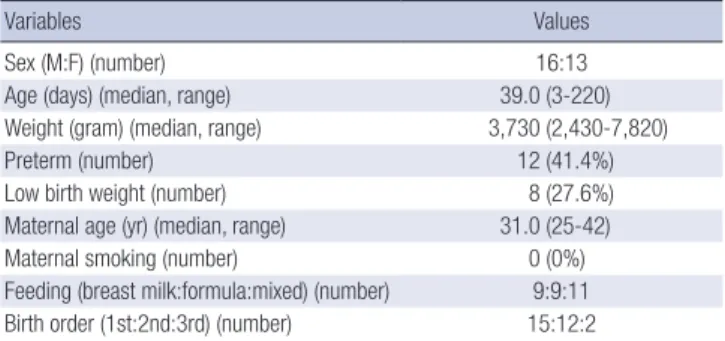
There were 29 patients (16 boys and 13 girls) who met the crite- ria for ALTE (Table 1). The median patient age was 39.0 days (range, 3-220 days), with a peak incidence of age younger than 1 month (48.3%) and 69.0% of patients younger than 2 months (Fig. 1). Twelve patients (41.4%) were preterm infants, and 8 (27.6%) were low birth weight infants. Among 12 preterm in- fants, the median gestational age was 35.5 weeks (range, 27.5- 36.3 weeks), and 2 patients were diagnosed as bronchopulmo- nary dysplasia and 2 patients were diagnosed as apnea of pre- maturity. Fifteen infants (51.7%) were firstborn. The median maternal age was 31.0 yr (range, 25-42 yr) and no mother pre- sented with a history of smoking. There was no history of SIDS
Table 1. Demographic characteristics of the patients
Variables Values
Sex (M:F) (number) 16:13
Age (days) (median, range) 39.0 (3-220)
Weight (gram) (median, range) 3,730 (2,430-7,820)
Preterm (number) 12 (41.4%)
Low birth weight (number) 8 (27.6%)
Maternal age (yr) (median, range) 31.0 (25-42)
Maternal smoking (number) 0 (0%)
Feeding (breast milk:formula:mixed) (number) 9:9:11 Birth order (1st:2nd:3rd) (number) 15:12:2 M, male; F, female; OPD, out-patient department; ED, emergency department.
Fig. 1. Age of patients. Peak incidence of age was younger than 1 month (48.3%);
69.0% of patients were younger than 2 months.
1 month 48%
3 months 17%
4 months 10%
2 months 21%
8 months 4%
or ALTE in their siblings.
Clinical characteristics of the patients’ event
There was a recent history of fever in 2 patients, respiratory symp- toms in 16, and both in 1. Ten patients did not have any specific history. Twenty-seven patients had an event at home. After the event, 12 patients visited an ED, and 17 patients visited an out- patient department (OPD). Twenty patients arrived at the hos- pital during the day, while 9 arrived at night. Eleven patients ap- peared normal upon their clinical examination at the time of arrival, whereas 2 patients required CPR during the initial ALTE and 4 were transferred from other hospitals while intubated.
Other 12 patients showed sick appearance such as cyanosis, grunting, chest retraction and atonic posture.
The predominant symptoms for ALTE diagnosis were apnea and color change in 20 (69.0%) and 19 (58.6%) patients, respec- tively (Table 2). Change in muscle tone occurred in 9 (31.0%), choking in 6 (20.7%), and gagging in 3 (10.3%). The events oc- curred while sleeping in 5 and while awake in 24. Of the 24 pa- tients, the events occurred during and after feeding in 4, and with crying in 3. In the other 17 patients, the specific situation associated with the event was not found in medical records.
Interventions in hospital
Eight patients had confirmed bacterial infections such as En- terobacter or Escherichia coli in urine in 3 patients, Staphylococ- cus or Streptococcus in blood in 3 patients, and Streptococcus in both blood and CSF in 2 patients. Although not statistically sig- nificant, the patients with confirmed bacterial infection showed higher incidence of fever than the other patients (25.0% vs. 4.8%, P = 0.176). Also, in laboratory test, they showed higher level of white blood cell (WBC) count (11,156.3 ± 5,066.3/μL vs. 9,699.0
± 3,543.7/μL, P = 0.388) and C-reactive protein (CRP) (3.4 ± 5.1 mg/dL vs. 0.4 ± 0.5 mg/dL, P = 0.135) than the other patients.
RV RT-PCR was performed for 11 patients, and several viruses were identified in 8 patients: respiratory syncytial virus in 3, hu- man rhinovirus in 3, human parainfluenza virus in 3, and boca- virus in 1. Rotavirus antigen test showed positive result in 1 patient.
Primary medical management for ALTE was supplemental oxygen and stimulation, each given to 18 patients (Table 3). Elev- en patients needed mechanical ventilator support with endo- tracheal intubation because of recurrent apnea in 9 patients, dyspnea in 1, and a CPR situation in 1. The median duration of ventilator care was 2.0 days (range, 1-25 days). Seventeen pa- tients were treated with parenteral antibiotics for a suspected bacterial infection, including culture-confirmed bacterial infec- tion. Infections were suspected to be pneumonia with respira- tory symptoms in 11, sepsis with fever or shock in 4, and urinary tract infections with pyuria in 2. Two patients required CPR be- cause of bradycardia and hypotension during the initial ALTE, but recovered.
After analyzing the relationship between the patients’ clinical characteristics and significant intervention scores, we saw that patients with ALTE during sleep had significantly lower scores (Fig. 2, P = 0.015) compared to patients with ALTE during wake- fulness. We also saw that patients with previous respiratory symp- toms had significantly higher scores (Fig. 2, P = 0.013) than those without previous respiratory symptoms. Although not statisti- cally significant, there was a weak positive correlation between the patient’s total ALTE criteria and total significant interven- tion score (Fig. 3, r = 0.330, P = 0.080).
The causes of ALTE and inpatient outcome
Table 4 summarizes the common causes of ALTE. The most com- mon ALTE cause was respiratory disease, including respiratory infection in 10 patients and upper airway anomalies in 3. The next most common cause was neurologic disease such as a con- vulsive disorder, congenital hypoventilation syndrome, and Had- dad syndrome. Three patients had confirmed bacterial menin- gitis and sepsis. Gastroesophageal reflux (GER)-related ALTE was diagnosed in 3 patients, prematurity-related causes in 2, previously known congenital heart disease-related ALTE in 1, Table 2. Clinical presentation of ALTE event
Clinical findings No. (%) of patients
Pre-event condition Fever URI symptom
3 (10.3) 17 (58.6) Event criteria
Apnea Color change Change in muscle tone Choking
Gagging
20 (69.0) 17 (58.6) 9 (31.0) 6 (20.7) 3 (10.3) Route on hospital (OPD:ED) 12 (41):17 (59) Time of arrival (day:night) 20 (69):9 (31) URI, upper respiratory infection.
Table 3. Therapeutic and diagnostic intervention of the patients
Interventions No. of patients
Diagnostic intervention Confirmed bacterial infection Confirmed viral infection Chest x-ray (normal:abnormal) ECG (normal:abnormal) UGI study (normal:abnormal) EEG (normal:abnormal)
2D-Echocardiography (normal:abnormal) Brain image study (normal:abnormal) Test for metabolic disease (normal:abnormal)
8 9 29 (18:11) 10 (10:0)
8 (1:7) 14 (10:4)
9 (7:2) 14 (8:6) 5 (5:0) Therapeutic Intervention
Oxygen supply Stimulation Tracheal intubation Antibiotics CPR
18 18 11 17 2
ECG, electrocardiogram; UGI, upper gastrointestinal; EEG, electroencephalogram; CPR, cardiopulmonary resuscitation.
and sedative medication-related ALTE in 1. Two cases of ALTE remained unexplained.
The median duration of hospitalization was 8.0 days (range, 2-38 days), and 20 patients (69.0%) showed repeat ALTE in the hospital. There were 2 cases of death, resulting in an overall mor- tality rate of 6.9%. One death caused by group B streptococcal meningitis occurred at 25 days after admission. Both CSF and blood culture confirmed his streptococcal infection, and abnor- mal findings were also seen in his EEG and brain sonography.
The other death with unexplained ALTE occurred at 18 days af- ter admission. She had preterm birth and low birth weight his- tory and diagnosed as bronchopulmonary dysplasia previously.
Prognosis from follow up
Except for 3 patients, 26 patients had a follow-up at an OPD and the median duration of follow-up was 6.0 months (range, 1-52 months). There were no cases of mortality after discharge, al- though 4 cases (15.4%) experienced recurrence of ALTE after
discharge, all of whom also showed recurrent ALTE in the hos- pital. The characteristics of recurrent ALTE are described in Ta- ble 5. Four patients (15.4%) showed developmental abnormali- ties during the follow-up period. Their final diagnoses were pneu- monia with prematurity history in 2, Haddad syndrome in 1, and narrowing of supraglottic larynx with GER grade III in 1.
DISCUSSION
In the present study, we identified the heterogeneity of ALTEs;
some patients often appeared healthy upon arrival in the ED or OPD, while some patients required immediate CPR. This het- Fig. 2. Significant intervention scores according to ALTE situation and recent URI history. The patients with ALTE during sleep had significantly lower scores (P = 0.015) com- pared to patients with ALTE during wakefulness, and the patients with previous respiratory symptoms had significantly higher scores (P = 0.013) than those without previous respiratory symptoms.
Significant intervention score
Situation white ALTE Awake Sleeping 12
10
8
6
4
2
0
P = 0.015
*
*
Significant intervention score
Recent history
URI symptom No URI symptom 12
10
8
6
4
2
0
P = 0.013
Fig. 3. Relationship between total significant intervention scores and number of ALTE criteria. There was a positive correlation between increasing ALTE criteria and total significant intervention score (r = 0.330, P = 0.080).
Number of ALTE composition
Significant intervention
0 5 10 15 7
6 5 4 3 2 1 0
r = 0.330
Table 4. The causes of the ALTE
Causes No. of patients
Respiratory Infection Vocal cord palsy Laryngomalacia
Narrowing of supraglottic larynx
10 1 1 1 Neurologic
Convulsive disorder
Congenital hypoventilation syndrome Haddad syndrome
2 1 1 Infection
GBS meningitis Sepsis
2 1 Gastrointestinal
Gastroesophageal reflux 3
Prematurity related
Apnea of prematurity 2
Cardiovascular
Congenital heart disease 1
Medication
Sedative agent 1
Unknown 2
GBS, Group B Streptococcus.
erogeneity causes difficulties for clinicians deciding how to ma- nage patients with ALTE. The admission rate for ALTE is usually 75%-100% (9-12), reflecting the recommendations of many cen- ters that all patients with ALTE be admitted for a period of inpa- tient observation. Some studies suggested that the major indi- cators of admission and further evaluation were prematurity, age younger than 30 days or older than 60 days, history of other illness, recurrent ALTE, and abnormal result in the initial exam- ination (4, 9, 10). In our study, the admission rate of ALTE infant was 100% and duration of hospital stay was 2-38 days.
In previous studies, the causes of ALTE were grouped into gastrointestinal (50%), neurological (30%), respiratory (20%), cardiovascular (5%), metabolic and endocrine (2%-5%), and others such as child abuse (13, 14). The most common diagno- sis was gastrointestinal disease, including GER. Al Khushi et al.
(15) reported that the most important diagnoses of ALTE inclu- ded serious bacterial infections, seizures, child abuse, metabol- ic disorders, and severe apnea with hypoxemia. Among the in- fectious causes of ALTE, reported prevalences were about 0%- 1.6% for meningitis, 0%-2.5% for bacteremia, 0%-7.6% for uri- nary tract infection, 0%-10% for lower respiratory tract infection, and 9%-82% for bronchiolitis (5, 16-19). About 35%-50% of ALTE cases had no diagnosable cause, despite a medical history and complete evaluation (12, 13). In contrast to previous studies, the present study showed that the most common discharge di- agnosis was respiratory disease, including respiratory infection, followed by neurological disease. Two patients’ ALTEs (6.9%) remained unexplained.
In a review of several studies, Tieder et al. (20) demonstrated that the most frequently evaluated diagnostic tests were for GER, neurologic abnormalities, anemia, infections, toxic ingestions, metabolic disorders, and cardiac dysrhythmias. There was no evidence to recommend routine nonspecific tests such as CBC, serum glucose, or electrolyte levels (20). On the other hand, Van- denplas et al. (21) suggested that, although GER was considered a major cause of ALTE, routine GER testing is unnecessary in children with ALTE. The incidence of GER is generally high in infancy regardless, and a positive result is not a confirmation of a relationship between GER and ALTE. In our study, 8 patients
underwent an upper gastrointestinal study because 4 had been previously diagnosed with GER, 2 had feeding-related ALTE, 1 had a history of esophageal atresia with tracheoesophageal fis- tula, and 1 had recurrent pneumonia. Seven patients showed positive signs of GER (grade I in 2, grade II in 3, grade III in 2), but GER was only confirmed as a cause of ALTE at discharge in 3 patients. In this regard, our results were similar to the previ- ous study.
Many studies have investigated potential predictors of subse- quent events in ALTE patients. Some studies identified a history of prematurity and multiple ALTEs as risk factors for a serious underlying condition or poor prognosis (10, 11). Davies et al. (4) found that more serious diagnosis was associated with a pre- sentation age greater than 2 months, abnormal initial clinical examination, and recurrent ALTE. Mittal et al. (12) reported that 12% of ALTE infants needed significant intervention during hos- pitalization, and that prematurity, abnormal results from the physical examination, color change to cyanosis, absence of symp- toms of upper respiratory tract infection, and absence of chok- ing were all predictors of significant intervention. In order to determine whether to discharge patients from the ED, the au- thors recommended a clinical decision rule based on compo- nents of patient history and examination findings that have been established as significant predictors.
In this study, we analyzed the relationship between the pa- tients’ clinical characteristics and total significant intervention scores. We identified the following results: 1) ALTE occurring during sleep had a low incidence of significant interventions, 2) ALTE with a recent history of respiratory symptoms had a high incidence of significant intervention, and 3) patients with nu- merous signs of ALTE criteria had high scores of significant in- tervention (r = 0.330). Risk factors, such as prematurity, which had been described as poor prognosis factors in previous stud- ies, did not show statistical significance in relation to the signifi- cant intervention scores. This result was somewhat different from previous studies, and we thought that it was caused by the difference of underlying diagnosis of ALTE. In our study, the most common ALTE cause was respiratory disease (44.8%), and these patients may show the more symptoms while awake.
In previous studies of ALTE prognosis after discharge, the mor- tality rate was 0%-0.5% during 12-60 months of follow-up (3, 9, 22, 23). Recently, Kant et al. (24) reported a mortality after dis- charge of 1.1% (2 deaths/174 infants) during 34 months of fol- low-up, with 2 deaths occurring within 15 days of discharge.
Bonkowsky et al. (22) studied the recurrence of ALTE and found that 71% of the initial patients with ALTE returned to the hospi- tal within 1 month with a second event. This study showed the importance of close follow-up after discharge. The authors also found that 5% of patients developed adverse neurological out- comes, including chronic epilepsy and developmental delays.
Nunes et al. (25) reported that among 56 patients with ALTE, Table 5. The patients with recurrent ALTE after discharge
Final diagnosis FU duration (months)
Duration of recurrent
ALTE
Management at home
Develop- ment
1 Pneumonia, BPD 8 -11 days Home O2 Normal
2 Congenital hypoventila-
tion syndrome 16 -4 days Aminophylline Normal 3 Haddad syndrome 1 -4 days Home O2 with
ventilator Delay 4 Narrowing of supraglottic
larynx, GER grade III
24 -22 months Tube feeding Delay
FU, follow up; ALTE, apparent life-threatening event; BPD, bronchopulmonary dyspla- sia; GER, Gastroesophageal reflux; O2, oxygen.
51.5% show ed normal outcome, 4 showed repeated ALTE, and none report ed deaths due to SIDS. The authors concluded that the outcome is generally related to the associated underlying disease. We found no cases of mortality after discharge, but there were 4 cases (15.4%) of recurrent ALTE after discharge occur- ring nearly within 2 weeks. During the median 6-month follow- up period, 4 patients (15.4%) showed developmental abnormal- ities, although we could not definitively identify the relationship between developmental delay and ALTE relapse.
Our study had several limitations. The present study was a small sized retrospective study, and patients’ data were collect- ed only from a retrospective chart review. Accordingly, we could have missed some portion of ALTE patients. The number of dea- ths was too small to analyze any potentially significant difference of clinical course according to death.
Considering that ALTE encompasses a wide range of clinical presentations, we recommend that all ALTE infants undergo inpatient clinical observation and evaluations with at least 24 hr of cardiorespiratory monitoring. In addition, ALTE infants should be followed up at least within a month after discharge.
Long-term follow-up should be decided on an individual basis according to the underlying status of the patients.
DISCLOSURE
The authors have no conflicts of interest in this work.
AUTHOR CONTRIBUTION
Conception and coordination of the study: Kim YH. Design of the study and ethical issues: Kim YH, Choi HJ. Acquisition of data: Kim YH, Choi HJ. Statistical analysis: Choi HJ. Manuscript preparation: Choi HJ. Manuscript approval: Kim YH.
ORCID
Yeo Hyang Kim http://orcid.org/0000-0002-1631-574X Hee Joung Choi http://orcid.org/0000-0002-7119-4194
REFERENCES
1. American Academy of Pediatrics. Task Force on Prolonged Infantile Ap- nea. Prolonged infantile apnea: 1985. Pediatrics 1985; 76: 129-31.
2. National Institutes of Health Consensus Development Conference on In- fantile Apnea and Home Monitoring, Sept 29 to Oct 1, 1986. Pediatrics 1987; 79: 292-9.
3. Gray C, Davies F, Molyneux E. Apparent life-threatening events present- ing to a pediatric emergency department. Pediatr Emerg Care 1999; 15:
195-9.
4. Davies F, Gupta R. Apparent life threatening events in infants presenting to an emergency department. Emerg Med J 2002; 19: 11-6.
5. Mittal MK, Shofer FS, Baren JM. Serious bacterial infections in infants
who have experienced an apparent life-threatening event. Ann Emerg Med 2009; 54: 523-7.
6. Shah S, Sharieff GQ. An update on the approach to apparent life-threat- ening events. Curr Opin Pediatr 2007; 19: 288-94.
7. Oren J, Kelly D, Shannon DC. Identification of a high-risk group for sud- den infant death syndrome among infants who were resuscitated for sleep apnea. Pediatrics 1986; 77: 495-9.
8. Committee on Fetus and Newborn. American Academy of Pediatrics.
Apnea, sudden infant death syndrome, and home monitoring. Pediat- rics 2003; 111: 914-7.
9. De Piero AD, Teach SJ, Chamberlain JM. ED evaluation of infants after an apparent life-threatening event. Am J Emerg Med 2004; 22: 83-6.
10. Claudius I, Keens T. Do all infants with apparent life-threatening events need to be admitted? Pediatrics 2007; 119: 679-83.
11. Al-Kindy HA, Gélinas JF, Hatzakis G, Côté A. C. Risk factors for extreme events in infants hospitalized for apparent life-threatening events. J Pe- diatr 2009; 154: 332-7, 7.e1-2.
12. Mittal MK, Sun G, Baren JM. A clinical decision rule to identify infants with apparent life-threatening event who can be safely discharged from the emergency department. Pediatr Emerg Care 2012; 28: 599-605.
13. Kahn A, European Society for the Study and Prevention of Infant Death.
Recommended clinical evaluation of infants with an apparent life-threat- ening event. Consensus document of the European Society for the Study and Prevention of Infant Death, 2003. Eur J Pediatr 2004; 163: 108-15.
14. Kahn A, Rebuffat E, Franco P, N’Duwimana M, Blum D. Apparent life- threatening events and apnea of infancy. In: Beckerman RC, Brouillette RT, Hunt CE. editors. Respiratory control disorders in infants and chil- dren. Baltimore: Williams & Wilkins, 1992, p178-89.
15. Al Khushi N, Côté A. Apparent life-threatening events: assessment, risks, reality. Paediatr Respir Rev 2011; 12: 124-32.
16. Brand DA, Altman RL, Purtill K, Edwards KS. Yield of diagnostic testing in infants who have had an apparent life-threatening event. Pediatrics 2005; 115: 885-93.
17. Altman RL, Li KI, Brand DA. Infections and apparent life-threatening events. Clin Pediatr (Phila) 2008; 47: 372-8.
18. Semmekrot BA, van Sleuwen BE, Engelberts AC, Joosten KF, Mulder JC, Liem KD, Rodrigues Pereira R, Bijlmer RP, L’Hoir MP. Surveillance study of apparent life-threatening events (ALTE) in the Netherlands. Eur J Pediatr 2010; 169: 229-36.
19. Crowcroft NS, Zambon M, Harrison TG, Mok Q, Heath P, Miller E. Re- spiratory syncytial virus infection in infants admitted to paediatric in- tensive care units in London, and in their families. Eur J Pediatr 2008;
167: 395-9.
20. Tieder JS, Altman RL, Bonkowsky JL, Brand DA, Claudius I, Cunning- ham DJ, DeWolfe C, Percelay JM, Pitetti RD, Smith MB. Management of apparent life-threatening events in infants: a systematic review. J Pediatr 2013; 163: 94-9.e1-6.
21. Vandenplas Y, Rudolph CD, Di Lorenzo C, Hassall E, Liptak G, Mazur L, Sondheimer J, Staiano A, Thomson M, Veereman-Wauters G, et al.; North American Society for Pediatric Gastroenterology Hepatology and Nutri- tion, European Society for Pediatric Gastroenterology Hepatology and Nutrition. Pediatric gastroesophageal reflux clinical practice guidelines:
joint recommendations of the North American Society for Pediatric Gas- troenterology, Hepatology, and Nutrition (NASPGHAN) and the Euro- pean Society for Pediatric Gastroenterology, Hepatology, and Nutrition
(ESPGHAN). J Pediatr Gastroenterol Nutr 2009; 49: 498-547.
22. Bonkowsky JL, Guenther E, Filloux FM, Srivastava R. Death, child abuse, and adverse neurological outcome of infants after an apparent life-threat- ening event. Pediatrics 2008; 122: 125-31.
23. Parker K, Pitetti R. Mortality and child abuse in children presenting with apparent life-threatening events. Pediatr Emerg Care 2011; 27: 591-5.
24. Kant S, Fisher JD, Nelson DG, Khan S. Mortality after discharge in clini- cally stable infants admitted with a first-time apparent life-threatening event. Am J Emerg Med 2013; 31: 730-3.
25. Nunes ML, Costa JC, Ferreira CP, Garcia CC, Marques FC, Spolidoro JV.
Associated and prognosis in apparent life threatening events (ALTE). J Pediatr (Rio J) 1999; 75: 55-8.