Journal of the Korean Chemical Society 2015, Vol. 59, No. 2
Printed in the Republic of Korea
http://dx.doi.org/10.5012/jkcs.2015.59.2.132
-132-
Molecular Bonding Force and Stiffness in Amine-Linked Single-Molecule Junc- tions Formed with Silver Electrodes
Taekyeong Kim
Department of Physics, Hankuk University of Foreign Studies, Yongin, Korea. E-mail: [email protected] (Received February 23, 2015; Accepted March 7, 2015)
ABSTRACT. Bonding force and stiffness in amine-linked single-molecule junctions for Ag electrodes were measured using a home-built conducting atomic force microscope under ambient conditions at room temperature. For comparison, Au elec- trodes were used to measure the rupture force and stiffness of the molecular junctions. The traces of the force along with the conductance showed a characteristic saw-tooth pattern owing to the breaking of the metal atomic contacts or the metal-mole- cule-metal junctions. We found the rupture force and stiffness for Ag are smaller than those for Au electrodes. Furthermore, we observed that the force required to break the amine-Ag bond in the conjugated molecule, 1,4-benzenediamine, is smaller than in 1,4-butanediamine which is fully saturated. These results consist with the previous theoretical calculations for the binding energies of the nitrogen bonded to Ag or Au atoms.
Key words: Molecular conductance, Force spectroscopy, Silver electrodes, Bond rupture, Break-junction
INTRODUCTION
Understanding physical and electrical properties in a metal-molecule junction structure is crucial not only to the realization of molecular devices in nano-scale but also in advancing the performance of organic electronics.1−3
Silver (Ag) is commonly used as an electrode material owing to its atomic and electronic structures which are sim- ilar to gold (Au).4−7
However, the bonding characteristics for the molecular junctions formed with Ag electrodes remains challenging to measure and characterize directly in experiments.
Herein, we used a home-built conducting atomic force microscope (AFM) to measure bond rupture forces and stiffness in single-molecule junctions for Ag electrodes under ambient conditions at room temperature. We observed the saw-tooth pattern due to the metal-metal or metal-molecule ruptures in the force traces. We found that the bond rupture force and stiffness of Ag-molecular junctions were smaller than those of Au-molecular junctions, which is in accordance with previous theoretical calculations. Furthermore, we observed that for single molecule junctions, the amine-Ag bond- rupture force depends on the molecular backbone. These measurements thus provide a quantitative characterization of metal-molecule interactions at the single-molecule level.
EXPERIMENTAL
The experimental process for these measurements con-
sisted of repeatedly forming and breaking of metal point contacts between the Ag-coated AFM tip and the mole- cule-covered Ag substrate. An AFM tip was coated with a 10 nm chromium adhesion layer and 100 nm of Ag (99.999%
purity, Alfa Aesar) served as one electrode. A mechani- cally polished Ag slug (99.99% purity, Alfa Aesar) was used as another electrode.8−13
Once a high-conductance contact is formed by approaching the tip onto the substrate with a conductance greater than 10 G0 (G0 = 2e2/h, quantum conductance), the two elec- trodes are pulled apart at a constant speed of 20 nm/s using a single-axis piezoelectric positioner. The Ag metal atomic channel has a gap between the top and the bottom elec- trodes as soon as the Ag-metal contact is ruptured, where the 1,4-butanediamine molecule can be inserted in the gap, and the metal-molecule-metal junction is formed. The amine (NH2) linker groups bind to the apex Ag atom of the tip and substrate. A constant voltage bias (50 mV) is applied between the tip and substrate while the current through the molecular junction is measured at a data acquisition rate of 40 kHz. The cantilever deflection is measured simul- taneously using AFM optical deflection techniques. This yields a conductance (current/voltage) and a force versus displacement trace. Thousands of curves were collected to allow for detailed statistical analysis.
RESULTS AND DISCUSSION
Fig. 1(a) shows a schematic illustrating the experimen-
Molecular Bonding Force and Stiffness in Amine-Linked Single-Molecule Junctions Formed with Silver Electrodes 133
2015, Vol. 59, No. 2
tal setup of the modified conductive AFM. A single-mole- cule junction is formed with 1,4-butanediamine molecule bound between a Ag substrate and a Ag-coated AFM tip, where blue circles indicate the nitrogen (N) atom bonded to the Ag atom. Fig. 1(b) shows a conductance (red line) as a function of displacement, where it decreases with a stepwise shape. The force trace (blue line) is simultane- ously measured with a saw-tooth pattern owing to revers- ible (elastic) and irreversible (plastic) deformation during conductance plateaus and drops in the Ag metal contact breaking.14
When 1,4-butanediamine is bonded to Ag electrodes right after Ag point contact breaking (1G0), an additional conductance step is observed at a molecule dependent conductance value at ~10−3G0 along with an additional abrupt change in the force trace (gray shaded area). The drop in force at the end of the conductance step corresponds to the bond rupture force of the Ag-molecule bonding (black arrow), while the slope of the force trace over the conductance plateau is related to the stiffness of the molecular junction (dashed green line).
Fig. 2 shows the normalized conductance histogram of the 1,4-butanediamine molecule formed with Ag (gray) and Au (yellow) electrodes using logarithmic bins. The dashed curves are the Gaussian fits to the molecular peaks, as indicated by the arrows. The most probable molecular junction conductance is ~4×10⁻⁴G0 for Ag-molecule junc- tions and ~9×10⁻⁴G0 for Au-molecule junctions. The work function of Ag (4.26−4.74 eV) is lower compared to Au (5.1−5.47 eV) resulting in the lower conductance of the Ag-molecular junctions than that of the Au-molecular
junction for the 1,4-butanediamine that conduct through the highest occupied molecular orbital (HOMO).4,15,16
We analyzed the individual force and simultaneously measured conductance traces to determine bond rupture forces (force drops in individual traces) and molecular junction stiffness (slope of the force ramps) as shown in Fig. 1(b). We obtained the rupture force by determining the force drop at the position where the molecular con- ductance plateau drops abruptly (black arrow, Fig. 1(b)).
We determined the stiffness of the molecular junction by extracting the slope of the force ramp prior to the sharp drop (dashed green line, Fig. 1(b)). The measured stiffness is the stiffness of the entire junction and also includes the Figure 1. (a) Schematic of the modified conductive atomic force
microscope. A molecular junction is formed between Ag-coated tip and substrate. (b) Sample conductance (red) and force (blue) trace. Nitrogen (N) atoms are shown in the blue circle. The gray shaded area represents the molecular junction regime. Rupture force (as indicated by the both side black arrow) is the drop in force when the junction ruptures to an open junction. The stiff- ness is the slope of the force ramp (as indicated by the dashed green line).
Figure 2. (a) Normalized conductance histogram of 1,4-butane- diamine molecule for Ag (gray) and Au (yellow). The dashed curves are the Gaussian fits to the molecular peaks, as indicated by the arrows.
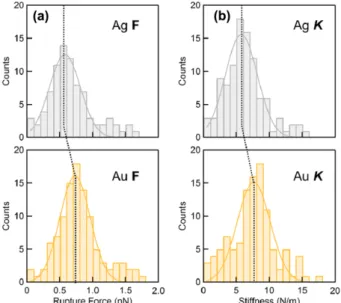
Figure 3. Histograms of rupture force (a) and stiffness (b) for the molecular junctions formed with Ag (gray) and Au (yellow) electrodes. The dashed lines are provided as visual guides con- necting the peak values.
Journal of the Korean Chemical Society
134 Taekyeong Kim
stiffness of the AFM cantilever. To determine the original molecular junction stiffness, we correct the measured value using a series spring model for the measured spring con- stant of the AFM cantilever (~50 N/m) for the entire junc- tion.17
Fig. 3 shows histograms of the rupture force (a) and stiffness (b) for the molecular junctions formed with Ag (gray) and Au (yellow) electrodes. The solid curves are the Gaussian fits to the histogram peaks. The dashed lines connect the peaks of the distributions as visual guides. The widths of the distributions of rupture force and stiffness result from the intrinsic junction-to-junction variations, which are also found even in measurements carried out at 4.2 K in vacuum conditions.18
Fig. 3(a) and (b) along with Gaussian fits were used to determine the mean rupture force and stiffness for each junction type. The results from this analysis are summa- rized in Table 1. We found that the measured bond rupture for Ag-molecule (~0.55 nN) is smaller than that of Au- molecule (~0.72 nN). This is consist with previous the- oretical calculations that the binding energy for Ag-N bonding is smaller by about 0.2 eV that that of Au-N bonding.
The stiffness of Ag-molecule of ~5.6 N/m is also smaller than that of Au-molecule of ~7.1 N/m. The molecular junction
stiffness corresponds to the effective spring constant of the entire metal-molecule-metal junction, where each bond can be modelled as a spring.
We used this same technique to measure bond rupture force in amine-linked single molecule junctions with the different molecular backbones. These are amine (NH2) linked molecules such as 1,4-benzenediamine and 1,4-butanediamine.
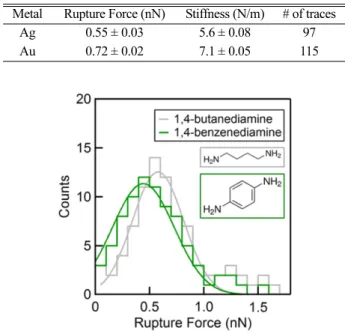
Fig. 4 shows the histograms of rupture forces for amine (NH2) linked molecules of 1,4-benzenediamine (green) and 1,4-butanediamine (gray) formed with Ag electrodes. The solid curves are the Gaussian fitting for the distributions.
We found that the force required to break the N-Ag bond in the conjugated molecule, 1,4-benzenediamine, is smaller than in 1,4-butanediamine which is fully saturated.
CONCLUSION
In summary, we have measured the bond rupture force and junction stiffness of 1,4-butanediamine molecule formed with Ag and Au electrodes using a conductive AFM under ambient conditions at room temperature. We found that the rupture force and stiffness of the molecular junctions for Ag are smaller than those for Au, consistent with the trends of the binding energies between metal and amine (N) atoms based on the previous theoretical calculations.
We also observed that the force required to break the amine- Ag bond in the conjugated molecule is smaller than in the fully saturated molecule. We can expect that our results will allow us to progress in the research about the single mol- ecule junctions with Ag electrodes.
Acknowledgments. This work was supported by Hankuk University of Foreign Studies Research Fund. This research was supported by Basic Science Research Program through the National Research Foundation of Korea (NRF) funded by the Ministry of Education (NRF-2014R1A1A2053848).
REFERENCES 1. Xu, B.; Tao, N. J. Science 2003, 301, 1221.
2. Venkataraman, L.; Klare, J. E.; Nuckolls, C.; Hybertsen, M. S.; Steigerwald, M. L. Nature 2006, 442, 904.
3. Venkataraman, L.; Klare, J. E.; Tam, I. W.; Nuckolls, C.;
Hybertsen, M. S.; Steigerwald, M. L. Nano Lett. 2006, 6, 458.
4. Kim, T.; Vazquez, H.; Hybertsen, M. S.; Venkataraman, L. Nano Lett. 2013, 13, 3358.
5. Jiang, N.; Foley, E. T.; Klingsporn, J. M.; Sonntag, M. D.;
Valley, N. A.; Dieringer, J. A.; Seideman, T.; Schatz, G.
C.; Hersam, M. C.; Van Duyne, R. P. Nano Lett. 2011, 12, Figure 4. Histograms of rupture forces for amine (NH2) linked
molecules of 1,4-benzenediamine (green) and 1,4-butanediamine (gray) formed with Ag electrodes. The solid curves are the Gauss- ian fitting for the distributions.
Table 1. Results of the most frequently measured bond rupture force and stiffness of the molecular junctions formed with Ag and Au electrodes from Fig. 3. The number of sample of measured sample traces and standard deviations are shown.
Metal Rupture Force (nN) Stiffness (N/m) # of traces
Ag 0.55 ± 0.03 5.6 ± 0.08 97
Au 0.72 ± 0.02 7.1 ± 0.05 115
Molecular Bonding Force and Stiffness in Amine-Linked Single-Molecule Junctions Formed with Silver Electrodes 135
2015, Vol. 59, No. 2 5061.
6. van Schrojenstein Lantman, E. M.; Deckert-Gaudig, T.;
Mank, A. J. G.; Deckert, V.; Weckhuysen, B. M. Nat. Nano- technol. 2012, 7, 583.
7. Kaneko, S.; Nakazumi, T.; Kiguchi, M. J. Phys. Chem.
Lett. 2010, 1, 3520.
8. Frei, M.; Aradhya, S. V.; Hybertsen, M. S.; Venkataraman, L. J. Am. Chem. Soc. 2012, 134, 4003.
9. Frei, M.; Aradhya, S. V.; Koentopp, M.; Hybertsen, M.
S.; Venkataraman, L. Nano Lett. 2011, 11, 1518.
10. Aradhya, S. V.; Frei, M.; Halbritter, A.; Venkataraman, L.
ACS nano 2013, 7, 3706.
11. Aradhya, S. V.; Frei, M.; Hybertsen, M. S.; Venkatara- man, L. Nat. Mater. 2012, 11, 872.
12. Morita, T.; Lindsay, S. J. Am. Chem. Soc. 2007, 129, 7262.
13. Cui, X. D.; Primak, A.; Zarate, X.; Tomfohr, J.; Sankey, O. F.; Moore, A. L.; Moore, T. A.; Gust, D.; Harris, G.;
Lindsay, S. M. Science 2001, 294, 571.
14. Marszalek, P. E.; Greenleaf, W. J.; Li, H.; Oberhauser, A.
F.; Fernandez, J. M. Proc. Natl. Acad. Sci. 2000, 97, 6282.
15. Dweydari, A. W.; Mee, C. H. B. Phys. Status Solidi A 1975, 27, 223.
16. Kim, B.; Choi, S. H.; Zhu, X. Y.; Frisbie, C. D. J. Am.
Chem. Soc. 2011, 133, 19864.
17. Hutter, J. L.; Bechhoefer, J. Rev. Sci. Instrum. 1993, 64, 1868.
18. Rubio-Bollinger, G.; Bahn, S. R.; Agraït, N.; Jacobsen, K.
W.; Vieira, S. Phys. Rev. Lett. 2001, 87, 026101.