서 론
1. 연구의 필요성
비만은 건강을 위협하고 삶의 질을 저하시키며, 각종 질병을 유
발시켜 수명을 단축시키는 주요 건강문제가 되고 있다. 과체중과 비 만은 대사증후군, 심혈관계 질환, 암, 근골격계 질환뿐만 아니라 비 알코올성 지방간질환(nonalcoholic fatty liver disease, NAFLD)과 같 은 간 합병증을 일으키기도 한다. NAFLD는 비만과 인슐린 저항성 으로 인한 간내 대사증후군이 발현한 상태로(Cho, 2010), 음주경력 이 없거나 주 40 g 미만의 알코올섭취에도 불구하고 알코올성 간염 과 유사하게 간세포내 중성지방이 과다하게 축적되어 있는 상태를 말한다(Adams, Sanderson, Lindor, & Angulo, 2005). 여기에는 간세포 에 지방의 과도한 축적만 있는 단순 지방간(simple steatosis) 간세포 괴사와 염증 및 섬유화를 동반한 비알코올성 지방간염(nonalcohol- ic steatohepatitis, NASH) 및 이것이 진행되어 간경변증이 초래되는 경우까지 모두 포함된다. 심할 경우에는 간세포암으로까지 진행될
Corresponding author:
Na Hyun Kim , College of Nursing · Research Institute for Nursing Science,
Keimyung University, 1095 Dalgubeol-daero, Daegu 704-701, Korea Tel: +82-53-580-3928 Fax: +82-53-580-3916 E-mail: [email protected]*이 연구는 2009년도 동산의료원 연구비로 이루어졌음.
투고일:
2013년 4월 7일심사의뢰일:
2013년 4월 9일게재확정일:
2013년 5월 14일 This is an Open Access article distributed under the terms of the Creative Commons Attri- bution Non-Commercial License (http://creativecommons.org/licenses/by-nc/3.0) which permits unrestricted non-commercial use, distribution, and reproduction in any medium, provided the original work is properly cited.비알코올성 지방간질환에 대한 이해와 비약물적 중재 및 측정지표에 대한 문헌분석
김나현
계명대학교 간호대학
·계명대학교 간호과학연구소
The Analysis of Non-pharmacological Intervention Study for Nonalcoholic Fatty Liver Disease:
Intervention Types and Measurement Parameters
Na Hyun Kim
College of Nursing · Research Institute for Nursing Science, Keimyung University, Daegu, Korea
Purpose: This study was intended to analyze the types and measurement parameters of non-pharmacological interventional studies
for nonalcoholic fatty liver disease (NAFLD). Methods: NAFLD related literatures were systematically reviewed. The existing literatures were searched electronically using the data base of PubMed, a Medline data base of the National Library of Medicine with the key words of nonalcoholic fatty liver disease, NAFLD, nonalcoholic steatohepatitis, and NASH. The criteria for inclusion in this review were 1) non-pharmacological intervention, 2) human, 3) English. Finally, 20 articles were included in the review. Results: The major find- ings of this study were as follows: 1) the types of non-pharmacological intervention were exercise (35%), caloric restriction (30%), and lifestyle modification with combination both of exercise and caloric restriction (35%), 2) Almost all studies adopted various measure- ment parameters derived from pathophysiological mechanism-based biomarkers such as anthropometric indices, biochemical pa- rameters, body fat mass, and liver biopsy results. Conclusion: Non-pharmacological interventions have been reported to be effective to improve NAFLD status, and many objective biomarkers confirmed supported these findings. Therefore, the development of nurs- ing interventions for NAFLD subjects is needed and the consideration of using mechanism-based biomarkers is suggested to verify nursing outcomes objectively.Key Words: Nonalcoholic fatty liver disease; Non-pharmacological intervention study
국문주요어: 비알코올성 지방간질환, 비약물적 중재 연구수 있어(Sohn & Kim, 2010) 만성 간질환 분야에서 큰 관심을 모으고 있다. 또한 최근의 보고에 의하면 NAFLD는 심혈관질환 및 대사성 질환의 발생 및 진행과정과 관련이 있는 주요 선행 위험지표이기도 하다(Reynoso & Lavine, 2012).
미국의 경우 성인 인구의 약 30%가 NAFLD에 이환되어 있고 (Lazo et al., 2010), 우리나라에서의 성인 유병률은 2004년 11.4%에서 2010년 23.6%로 두 배 가량 증가하였으며 남성이 31.0%로 여성의 16.0%에 비해 약 두 배가 더 높은 것으로 알려져 있다(Ministry of Food and Drug Safety, 2013, January 30). 특히, 당뇨와 비만 성인의 60- 80%에서 NAFLD 소견을 보이기 때문에(Younossi et al., 2011) 비만과 제2형 당뇨병이 증가하면서 서구뿐만 아니라 우리나라에서도 NAFLD의 유병률이 크게 증가하고 있는 추세임을 알 수 있다. 대부 분의 NAFLD 환자는 단순 지방간 상태로 경과가 양호하지만 이들 중 10-20%가 NASH로 진행되며, NASH 환자 중 9-25%가 간경변증으 로 진행되기 때문에(Adams et al., 2005) NAFLD 환자는 간호학 분야 에서도 관심을 가져야할 주요 간호대상자임을 알 수 있다.
NAFLD의 발생에는 인슐린 저항, 산화스트레스, 염증반응 및 유 리 지방산(free fat acid)이 중요한 역할을 하고 그 외 유전과 환경적인 요인도 관련되는 것으로 보고되고 있다(Sohn & Kim, 2010). 현재까 지 널리 알려진 발병기전으로 ‘Two-hit hypothesis’가 있는데, 이 가설 에 의하면 첫 번째 타격(first hit)은 인슐린 저항성으로 인해 간세포 에 지방이 축적되어 단순 지방간이 되는 과정이고, 두 번째 타격 (second hit)은 축적된 지방에서 다양한 산화스트레스(oxidative stress)가 발생하여 지방과산화와 염증성 사이토카인이 과도하게 생 성되면서 간세포 손상 및 염증반응이 유발되어 지방간염으로 진행 된다는 것이다(Day & James, 1998). 최근에는 지방세포에서 분비되 는 유리 지방산이 NAFLD 발병에 직접적인 영향을 미치는 것으로 알려지고 있다(Jou, Choi, & Diehl, 2008; Yamaguchi et al., 2007), 즉, 인 슐린저항성으로 인해 인슐린이 매개하는 근육세포내로의 포도당 섭취장애와 간에서의 포도당 신생 장애, 지방세포에서의 지방분해 억제 장애로 지방세포에서 유리지방산이 과도하게 방출되어 이것 이 간으로 유입된다. 간으로 과다하게 유입된 유리 지방산은 중성지 방으로 에스테르화되어 간에 축적되면서 지방간을 초래한다. 또한 과도한 유리 지방산은 그 자체로 산화스트레스와 염증반응을 유도 하여 간세포에 직접적인 손상을 초래하고(Yamaguchi et al., 2007) 간 세포가 점차 사멸되면서 지방간염과 간경변증으로 진행되는 것으 로 설명하고 있다. 이로 인해 간조직 소견에서 지방간, 염증, 풍선변 성(ballooning degeneration) 및 섬유화가 나타난다(Jou et al., 2008).
인슐린 저항성은 NAFLD의 발생 초기에 나타나는 주요 병태생 리적 징후이자 대사증후군의 발병 과정에서도 유사한 기전으로 작
용하므로 NAFLD는 대사증후군과 흔히 동반되어 나타나며(Rahi- mi & Landaverde, 2013) 대사증후군을 진단하거나 미래 발병 여부 를 예측할 수 있는 강력하고도 독립적인 지표로 간주되고 있다 (Hsiao et al., 2007). 뿐만 아니라 NAFLD는 비만이나 대사증후군의 다른 관련요인들과는 별개로 그 자체로도 대사증후군과 제2형 당 뇨병과 관련이 있어 대사증후군의 초기 매개인자로 추정되고 있다 (Adams, Waters, Knuiman, Elliott, & Olynyk, 2009; Rahimi & Lan- daverde, 2013).
이상에서 보는 바와 같이 NAFLD는 비만, 당뇨병 및 대사증후군 과 유사한 병태생리 기전을 따르며, 이들 질환과의 관련성도 높은 것으로 보고되면서 그동안 많은 연구가 이루어져 왔다. 특히, 2000 년대에 들어서면서 국외에서는 NAFLD를 개선시키기 위한 다양한 중재가 시도되어 왔으며, 식이요법, 운동, 항산화제, 항고지질혈증 제, 인슐린 민감성을 향상시키는 약물 투여 등의 방법으로 제공되 었다. 본 연구에서 사용한 PubMed 데이터베이스에서는 2013년도 1 월 31일까지 총 156편의 중재연구가 발표된 것으로 나타났으나, 국내 에서의 NAFLD 연구는 주로 의학 분야에서 이루어졌으며, 질병의 특성, 발생빈도, 원인, 관련요인 등 NAFLD에 대한 전반적인 이해에 초점을 둔 연구가 대부분을 차지하였다. 국내의 주요 학술지 검색 데이터베이스를 근거로 검색하였을 때 NAFLD에 대한 중재연구는 체육학 분야에서 발표한 1편의 논문 이외에는 찾을 수가 없었다. 또 한 간호학 분야에서의 관심을 알아보기 위하여 CINAHL을 통한
‘nonalcoholic fatty liver disease’ 주제어 검색결과 477편의 논문이 검 색된 반면, 국내 간호학 분야 논문에서는 한 편의 논문도 찾아볼 수 없어 큰 차이를 보였다.
학문간의 경계가 급속히 사라져가고 간호학 분야에서도 기초연 구 혹은 생행동적 연구를 통한 객관적이고 정량적인 지식의 생성에 대한 요구가 커져가고 있는 시점에서 새롭게 주목받고 있는 질병과 이와 관련된 주요 중재 및 측정지표에 대한 폭넓은 이해는 반드시 필요하다고 본다. 최근에 일부 선행연구에서 아디포넥틴이나(Byun, 2010) 랄록시펜과 혈중지질에 관한 연구(Yoo, An, Kim, & Chu, 2010) 를 통해 새로운 중재 및 생리적 지표의 간호학적 적용을 위한 노력 이 있어 왔으나 인접학문 분야에서 관심사가 되고 있는 새로운 간 호대상자를 찾아내고 이들을 위한 간호중재개발 및 효과검증을 위 해 선행문헌 결과에 대한 이해와 심층 분석이 활발하게 이루어져 야 할 것이다. 이에 본 연구에서는 NAFLD 환자를 대상으로 진행된 중재연구 중 비약물적 중재의 내용과 효과측정지표를 분석해 보고 자 한다. 본 연구를 통해 NAFLD에 효과적인 간호중재의 개발을 촉 진하고 간호학 분야에서 적용 가능한 주요 생리적 지표를 찾아 제 시해 보고자 한다.
2. 연구 목적
본 연구는 NAFLD 환자를 대상으로 비약물적 중재연구를 시도 한 논문을 체계적인 절차에 따라 검색한 후 그 논문에서 적용한 중 재내용과 효과측정 지표를 분석하고자 한 것으로, 구체적인 목적 은 다음과 같다.
1) NAFLD 환자를 대상으로 적용한 비약물적 중재연구의 특성을 조사한다.
2) NAFLD 환자를 대상으로 한 비약물적 중재연구에서 제공된 중재내용을 분석한다.
3) NAFLD 환자를 대상으로 한 비약물적 중재연구에서 효과측 정에 이용된 주요 지표를 분석한다.
연구 방법
1. 연구설계
본 연구는 NAFLD 환자에게 제공된 비약물적 중재연구 논문을 대 상으로 중재의 내용과 효과측정 지표를 분석한 문헌고찰 연구이다.
2. 자료 수집 방법
본 연구에서는 국외 학술지에 게재된 연구논문 중 NAFLD 환자 를 대상으로 중재를 적용한 실험논문을 분석하고자 하였으며, 체 계적 문헌고찰 방법인 preferred reporting items for systematic reviews and meta-analysis (PRISMA, 2008) 가이드라인에 따라(Liberati et al, 2009) 자료를 수집하였다. 논문검색은 미국국립의학도서관의 Data base인 PubMed (http://www.ncbi.nlm.nih.gov/)를 사용하였으며, 검 색어로는 ‘NAFLD’, ‘NASH (MeSH terms)’, ‘nonalcoholic fatty liver dis- ease’, ‘nonalcoholic steatohepatitis’를 주요어로 사용하였다. 검색대상 논문은 NAFLD를 주제로 2013년 1월 31일까지 발표된 논문을 모두 포함시켰으며, 그 결과 총 6,055편의 논문이 검색되었다. 이 중 중복 되는 논문을 제외하니 2,748편의 논문이 검색되었으며, 여기에서 중 재연구(clinical trial)로 진행된 논문은 총 156편이었다. 논문에 사용 된 언어가 영어가 아닌 논문과 인간 대상이 아닌 논문을 제외하고, 여기에 full text가 제공되는 논문만을 검색하였을 때 총 144편이 도 출되었다. 이 중 비약물적 중재논문만을 선별하기 위하여 연구자가 논문의 원본을 모두 확인하여, 최종적으로 20편의 논문이 분석대 상 논문으로 선정되었다.
선정한 20편의 논문은 연구자가 직접 논문을 여러 차례 읽으면 서 본 연구의 목적에 따라 중재연구의 특성, 중재내용 및 효과측정 지표를 중심으로 분석하였다. 구체적으로 연구의 특성은 연구설계, 표본수, 연구대상 연령 및 선정기준 등을 분석하였고, 중재내용은
중재의 형태, 중재기간, 중재빈도 및 절차 등을 조사하였으며, 그 외 효과측정 지표 및 주요 결과를 분석하였다. 효과측정 지표는 1차 분 석 후 지표의 특성을 고려하여 크게 신체계측(anthropometry), 생화 학적 지표(biochemical parameters), 체지방 지표(body fat parameters), 간생검지표(liver biopsy) 및 기타지표로 범주화 하여 분석하였다.
한편, 본 연구논문 대상에 포함시키지는 않았으나 국내의 주요 검색 데이터베이스인 학술정보연구서비스(http://www.riss.kr/), 한국 학술정보(http://kiss.kstudy.com/), DBpia (http://www.dbpia.co.kr/)에 서 위의 조건으로 검색한 결과 1편의 논문이 검색되었으나 본 연구 대상 논문에 포함시키지는 않았다. 본 연구에서의 논문검색 및 선 정과정은 (Figure 1)과 같다.
연구 결과
1. 분석대상 논문의 일반적 특성
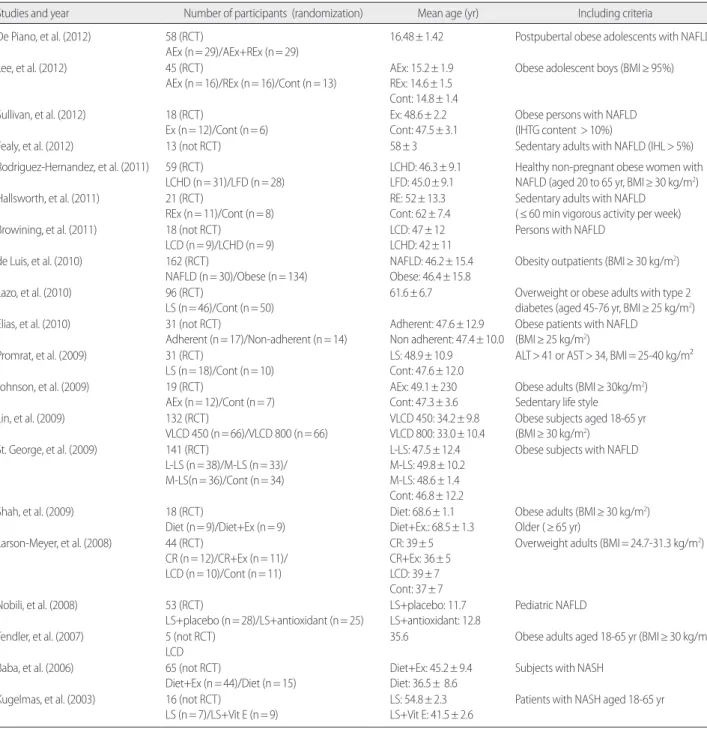
본 연구에서 분석된 논문은 총 20편으로, 무작위대조군 연구 (RCT)가 15편(75%), 그 외 연구가 5편(25%)으로 나타났다. 실험연구 참여 대상자는 최소 5명에서 최대 132명으로 다양하였으며, 단일군 전후설계에서 최대 4개 그룹 간 비약물적 중재의 효과를 비교하는 연구가 있었다. 분석대상 논문에서 대상으로 삼은 연령군은 아동 을 대상으로 한 중재논문 1편과 청소년을 대상으로 한 논문 2편을 제외하고는 모두 성인기 이상의 연령군을 포함시켰으며, 선정기준 에는 NAFLD 혹은 NASH로 진단을 받았거나 BMI 점수로 평가했 을 때 비만인 경우(최소 BMI≥ 24.7) 그리고 간 효소인 ALT나 AST가 정상보다 높거나 간내지질(IHL) 비중이 5-10% 이상인 경우가 해당 되었다(Table 1).
Records identified through PubMed searching
(searching terms: NAFLD, NASH (MeSH terms), nonalcoholic fatty liver disease, nonalcoholic steatohepatitis) (n= 6,055)
Records after duplicates removed
(NAFLD AND NASH (MeSH terms)) OR (NAFLD AND nonalcoholic fatty liver disease) OR (NAFLD AND nonalcoholic steatohepatitis) OR (NASH(MeSH terms) AND nonalcoholic fatty liver disease) OR (NASH(MeSH terms) AND nonalcoholic steatohepatitis) OR (nonalcoholic fatty liver disease AND nonalcoholic steatohepatitis) (n= 2,748)
Records screened
(Limits: Human, English, Clinical trial, Full text articles) (n= 144)
Studies included in review (select including nonpharmacological intervention only) (n= 20)
Records excluded (n= 2,604)
Records excluded (n= 124)
Figure 1. Flow Diagram for Study Selection.
2. 비약물학적 중재내용
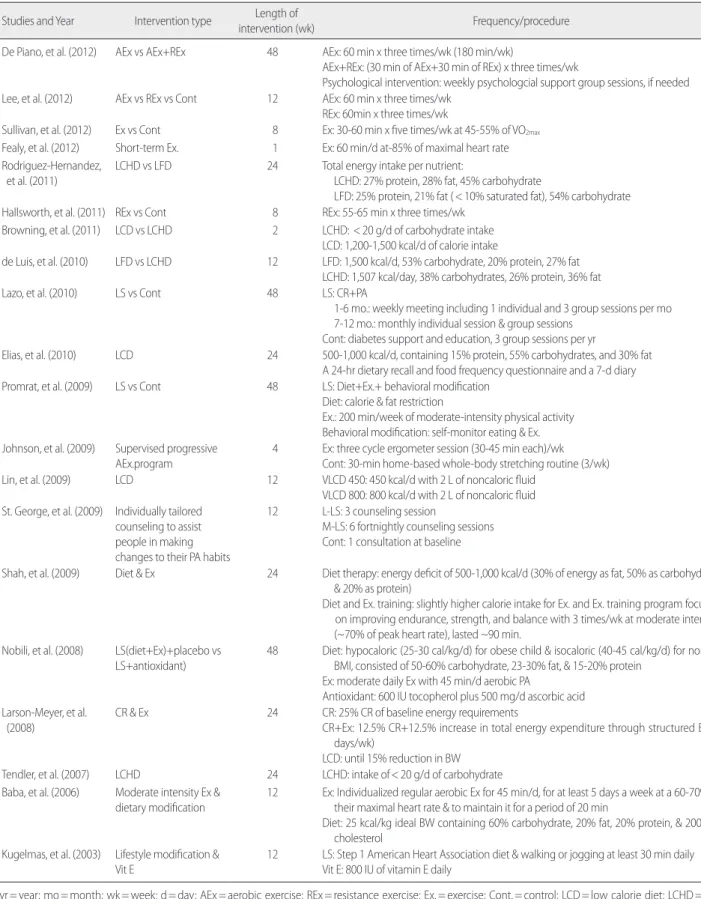
비알코올성지방간 대상자에게 제공된 비약물적 중재로는 운동 중재가 7편(35%), 식이조절 6편(30%), 그리고 운동과 식이조절을 병 합한 생활양식 변경이 7편(35%)으로 분석되었다. 비약물학적 중재 의 기간은 짧게는 연속해서 7일 동안 제공한 논문에서부터 12개월 까지로 범위가 컸으나 3개월 중재기간이 6편으로 가장 많았으며
(30%), 6개월 중재기간이 5편(25%), 1년에 걸쳐 진행된 논문도 3편 (15%)이나 되었다.
운동중재 14편 중 유산소 운동은 11편(78.6%)이었고 저항성 운동 은 1편(7.1%), 유산소운동과 저항성 운동을 함께 제공한 경우가 2편 (14.3%) 있었다. 운동시간은 하루 30-60분, 주 3-5일, 혹은 1주일에 150-200분 정도였으며, 운동의 강도는 활발한 걷기부터 최대심박동
Table 1. Summary of Study Characteristics
(N= 20)
Studies and year Number of participants (randomization) Mean age (yr) Including criteria
De Piano, et al. (2012) 58 (RCT)
AEx (n= 29)/AEx+REx (n= 29)
16.48± 1.42 Postpubertal obese adolescents with NAFLD
Lee, et al. (2012) 45 (RCT)
AEx (n= 16)/REx (n= 16)/Cont (n= 13)
AEx: 15.2± 1.9 REx: 14.6± 1.5 Cont: 14.8± 1.4
Obese adolescent boys (BMI≥ 95%)
Sullivan, et al. (2012) 18 (RCT)
Ex (n= 12)/Cont (n= 6)
Ex: 48.6± 2.2 Cont: 47.5± 3.1
Obese persons with NAFLD (IHTG content > 10%)
Fealy, et al. (2012) 13 (not RCT) 58± 3 Sedentary adults with NAFLD (IHL> 5%)
Rodriguez-Hernandez, et al. (2011) 59 (RCT)
LCHD (n= 31)/LFD (n= 28)
LCHD: 46.3± 9.1 LFD: 45.0± 9.1
Healthy non-pregnant obese women with NAFLD (aged 20 to 65 yr, BMI≥ 30 kg/m2) Hallsworth, et al. (2011) 21 (RCT)
REx (n= 11)/Cont (n= 8)
RE: 52± 13.3 Cont: 62± 7.4
Sedentary adults with NAFLD (≤ 60 min vigorous activity per week) Browining, et al. (2011) 18 (not RCT)
LCD (n= 9)/LCHD (n= 9)
LCD: 47± 12 LCHD: 42± 11
Persons with NAFLD
de Luis, et al. (2010) 162 (RCT)
NAFLD (n= 30)/Obese (n= 134)
NAFLD: 46.2± 15.4 Obese: 46.4± 15.8
Obesity outpatients (BMI≥ 30 kg/m2)
Lazo, et al. (2010) 96 (RCT)
LS (n= 46)/Cont (n= 50)
61.6± 6.7 Overweight or obese adults with type 2 diabetes (aged 45-76 yr, BMI≥ 25 kg/m2)
Elias, et al. (2010) 31 (not RCT)
Adherent (n= 17)/Non-adherent (n= 14)
Adherent: 47.6± 12.9 Non adherent: 47.4± 10.0
Obese patients with NAFLD (BMI≥ 25 kg/m2) Promrat, et al. (2009) 31 (RCT)
LS (n= 18)/Cont (n= 10)
LS: 48.9± 10.9 Cont: 47.6± 12.0
ALT> 41 or AST> 34, BMI= 25-40 kg/m²
Johnson, et al. (2009) 19 (RCT)
AEx (n= 12)/Cont (n= 7)
AEx: 49.1± 230 Cont: 47.3± 3.6
Obese adults (BMI≥ 30kg/m2) Sedentary life style
Lin, et al. (2009) 132 (RCT)
VLCD 450 (n= 66)/VLCD 800 (n= 66)
VLCD 450: 34.2± 9.8 VLCD 800: 33.0± 10.4
Obese subjects aged 18-65 yr (BMI≥ 30 kg/m2)
St. George, et al. (2009) 141 (RCT)
L-LS (n= 38)/M-LS (n= 33)/
M-LS(n= 36)/Cont (n= 34)
L-LS: 47.5± 12.4 M-LS: 49.8± 10.2 M-LS: 48.6± 1.4 Cont: 46.8± 12.2
Obese subjects with NAFLD
Shah, et al. (2009) 18 (RCT)
Diet (n= 9)/Diet+Ex (n= 9)
Diet: 68.6± 1.1 Diet+Ex.: 68.5± 1.3
Obese adults (BMI≥ 30 kg/m2) Older (≥ 65 yr)
Larson-Meyer, et al. (2008) 44 (RCT)
CR (n= 12)/CR+Ex (n= 11)/
LCD (n= 10)/Cont (n= 11)
CR: 39± 5 CR+Ex: 36± 5 LCD: 39± 7 Cont: 37± 7
Overweight adults (BMI= 24.7-31.3 kg/m2)
Nobili, et al. (2008) 53 (RCT)
LS+placebo (n= 28)/LS+antioxidant (n= 25)
LS+placebo: 11.7 LS+antioxidant: 12.8
Pediatric NAFLD
Tendler, et al. (2007) 5 (not RCT) LCD
35.6 Obese adults aged 18-65 yr (BMI≥ 30 kg/m2)
Baba, et al. (2006) 65 (not RCT)
Diet+Ex (n= 44)/Diet (n= 15)
Diet+Ex: 45.2± 9.4 Diet: 36.5± 8.6
Subjects with NASH
Kugelmas, et al. (2003) 16 (not RCT)
LS (n= 7)/LS+Vit E (n= 9)
LS: 54.8± 2.3 LS+Vit E: 41.5± 2.6
Patients with NASH aged 18-65 yr
NAFLD = nonalcoholic fatty liver disease; AEx = aerobic exercise; REx = resistance exercise; Cont = control; Ex = exercise; IHTG = intrahepatic triglyceride; IHL = intrahepatic lipid; LCDH= low carbohydrate diet; LFD= low fat diet; LS= lifestyle intervention; L-LS= low-intensity lifestyle intervention; M-LS= moderate-intensity lifestyle intervention; VLCD= very low calorie diet; CR= caloric restriction; Vit E= vitamin E; NASH= nonalcoholic steatohepatitis.
수의 85% 까지 대상자의 건강상태에 따라 다양하게 제공되었다. 운 동중재의 형태는 구조화된 동일한 내용으로 구성된 운동 프로그 램 대신 대상자 개인의 체력, 평소 활동 및 운동량을 고려한 맞춤형 운동처방을 통해 진행된 것으로 나타났다. 한편, 식이중재는 칼로 리 제한, 탄수화물 제한, 지방섭취제한의 방법을 단독 혹은 병합하 여 제공된 것으로 나타났다. 칼로리 제한 범위는 하루 450 칼로리에 서 1,500 칼로리 범위에서 제한하였고, 탄수화물 섭취는 하루 20g 이하, 혹은 총 섭취 칼로리의 45-60%로 제한하였다. 지방섭취를 제 한하는 경우에는 총 칼로리 섭취량 중 지방섭취량을 제한하거나 지 방의 종류 중 포화지방산을 10% 미만, 혹은 1/3로 제한하는 중재를 제공하였다(Table 2).
3. 비약물학적 중재의 효과측정
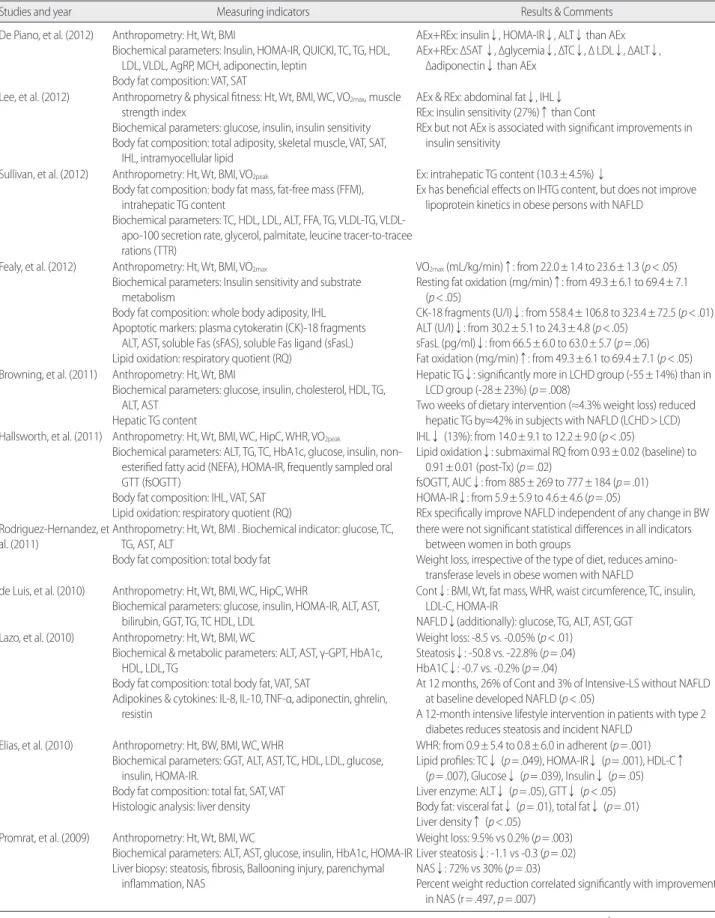
NAFLD 대상자에게 비약물학적 중재를 제공한 후 효과측정을 위한 주요 지표에는 신체계측지표, 생화학적 지표, 체지방 지표, 간 생검지표 및 기타지표가 포함되었으며, 구체적인 항목은 다음과 같 다(Table 3).
1) 신체계측 지표
신체계측 지표로 신장, 체중, 체질량지표는 대부분의 논문에서 측정하였으며, 그 외 허리둘레(WC), 엉덩이 둘레(HipC), 허리둘레 와 엉덩이둘레 비(WHR), 최대산소섭취량(이하 VO2max), 근력 등을 함께 측정하였다.
2) 생화학적 지표
생화학적 지표는 다시 혈장지질지표(plasma lipid profiles), 간효소 (liver enzyme), 포도당대사관련 지표(glucose metabolism related pa- rameters), 염증관련 지표(inflammation related markers), 세포자멸사 지표(apoptotic markers) 등이 측정되었다.
혈장지질지표로는 총콜레스테롤, 초저밀도지단백, 저밀도지단 백, 고밀도지단백, 총중성지방, 지방산(free fatty acids) 등이 포함되었 으며, 간효소에는 알라닌아미노기전달효소(alanine aminotransfer- ase, ALT), 아스파르트산아미노기전달효소(aspartate aminotransfer- ase, AST), 감마글루타밀트란스펩티다제(γ-glutamyl transpeptidase, γ -GPT), 혈장빌리루빈, 혈장 페리틴 등이 측정되었다. 포도당 대사관 련 지표에는 공복혈당, 식후혈당, 경구당부하검사(oral glucose toler- ance test, oral GTT), 당화혈색소, 혈청 페리틴, 철, 공복 인슐린, 인슐 린저항성검사(insulin resistance), 인슐린민감도지표(insulin sensitivi- ty index) 등이 측정되었다. 염증관련 지표에는 인터루킨 6 (IL-6), 인 터루킨-8 (IL-8), 종양괴사인자(tumor necrosis factor, TNF), 아디포넥
틴(adiponectin), 고감도C반응단백(high sensitive C reactive protein, hsCRP), 레지스틴(resistin) 등이 측정되었다. 세포자멸사 지표로는 간효소 지표인 ALT, AST외에 세포자멸사 경로에서 나타나는 cyto- kerain (CK)-18 (CK-18), soluble Fas (sFas) 및 soluble Fas ligand (sFasL) 등 이 이용되었다. 그 외 생화학적 지표로 agouti-related protein (AgRP), melanin- concentration hormone (MCH), VLDL-TG, VLDL-apo-100 secretion rate, glycerol, palmitate, leucine tracer-to-tracee rations (TTR), 총 빌리루빈 등이 측정되었다.
3) 체지방 지표
체지방 지표에는 총체지방량(total body fat mass), 체지방률(%
body fat), 제지방비중(lean body mass), 근육세포내 지질(intramyocel- lular lipid), 피하지방량(subcutaneous adipose tissue, SAT) 및 내장지 방량(visceral adipose tissue, VAT)이 측정되었고, 간내지질 지표로는 간내지질함량(intrahepaic lipid content), 간중성지방함량(hepatic tri- glyceride content)이 포함되었다.
4) 간생검지표
간생검을 통하여 지방간 정도(steatosis score), 간실질 염증정도 (extent necroinflammation), 섬유화 점수(fibrosis score), 풍선변성점수 (ballooning injury score), 간조직활동점수(NASH histological activity score, NAS), 간실질밀도(liver density) 등을 측정하였다.
5) 기타
그 외 일부연구에서는 신체기능 검사로 최대산소섭취량(VO2max) 과 근력을 측정하였고, 지질산화지표인 호흡상(respiratory quotient, RQ), 안정시대사율(resting metabolic rate, RMR) 등의 지표도 중재의 효과측정에 이용되었다.
논 의
간호학 분야에서 NAFLD에 관심을 가져야할 이유는 NAFLD가 단순한 지방간 형태가 가장 많아 자각증상이 없이 건강검진을 통 해 발견하는 경우가 많음에도 불구하고 유병률이 매우 높다는 점 과, 심할 경우 간경변증과 간암과 같이 만성간질환으로 진행될 수 있기 때문이다. 본 연구를 통해 국외에서는 NAFLD 환자를 위한 다 양한 중재가 활발하게 이루어지고 있는 반면, 국내에서의 연구현황 은 매우 저조함을 알 수 있었다. NAFLD와 유사한 병태생리 기전을 가지고 흔히 동반되어 나타나는(Rahimi & Landaverde, 2013) 대사증 후군에 대한 중재연구가 다수 보고된 점과 비교해 보았을 때 의외
Table 2. Summary of Non-pharmacological Intervention Program
(N= 20)
Studies and Year Intervention type Length ofintervention (wk) Frequency/procedure
De Piano, et al. (2012) AEx vs AEx+REx 48 AEx: 60 min x three times/wk (180 min/wk)
AEx+REx: (30 min of AEx+30 min of REx) x three times/wk
Psychological intervention: weekly psychologcial support group sessions, if needed Lee, et al. (2012) AEx vs REx vs Cont 12 AEx: 60 min x three times/wk
REx: 60min x three times/wk
Sullivan, et al. (2012) Ex vs Cont 8 Ex: 30-60 min x five times/wk at 45-55% of VO2max
Fealy, et al. (2012) Short-term Ex. 1 Ex: 60 min/d at-85% of maximal heart rate Rodriguez-Hernandez,
et al. (2011)
LCHD vs LFD 24 Total energy intake per nutrient:
LCHD: 27% protein, 28% fat, 45% carbohydrate
LFD: 25% protein, 21% fat (< 10% saturated fat), 54% carbohydrate Hallsworth, et al. (2011) REx vs Cont 8 REx: 55-65 min x three times/wk
Browning, et al. (2011) LCD vs LCHD 2 LCHD: < 20 g/d of carbohydrate intake LCD: 1,200-1,500 kcal/d of calorie intake
de Luis, et al. (2010) LFD vs LCHD 12 LFD: 1,500 kcal/d, 53% carbohydrate, 20% protein, 27% fat LCHD: 1,507 kcal/day, 38% carbohydrates, 26% protein, 36% fat
Lazo, et al. (2010) LS vs Cont 48 LS: CR+PA
1-6 mo.: weekly meeting including 1 individual and 3 group sessions per mo 7-12 mo.: monthly individual session & group sessions
Cont: diabetes support and education, 3 group sessions per yr
Elias, et al. (2010) LCD 24 500-1,000 kcal/d, containing 15% protein, 55% carbohydrates, and 30% fat A 24-hr dietary recall and food frequency questionnaire and a 7-d diary Promrat, et al. (2009) LS vs Cont 48 LS: Diet+Ex.+ behavioral modification
Diet: calorie & fat restriction
Ex.: 200 min/week of moderate-intensity physical activity Behavioral modification: self-monitor eating & Ex.
Johnson, et al. (2009) Supervised progressive AEx.program
4 Ex: three cycle ergometer session (30-45 min each)/wk Cont: 30-min home-based whole-body stretching routine (3/wk)
Lin, et al. (2009) LCD 12 VLCD 450: 450 kcal/d with 2 L of noncaloric fluid
VLCD 800: 800 kcal/d with 2 L of noncaloric fluid St. George, et al. (2009) Individually tailored
counseling to assist people in making changes to their PA habits
12 L-LS: 3 counseling session
M-LS: 6 fortnightly counseling sessions Cont: 1 consultation at baseline
Shah, et al. (2009) Diet & Ex 24 Diet therapy: energy deficit of 500-1,000 kcal/d (30% of energy as fat, 50% as carbohydrate, & 20% as protein)
Diet and Ex. training: slightly higher calorie intake for Ex. and Ex. training program focused on improving endurance, strength, and balance with 3 times/wk at moderate intensity (~70% of peak heart rate), lasted ~90 min.
Nobili, et al. (2008) LS(diet+Ex)+placebo vs LS+antioxidant)
48 Diet: hypocaloric (25-30 cal/kg/d) for obese child & isocaloric (40-45 cal/kg/d) for normal BMI, consisted of 50-60% carbohydrate, 23-30% fat, & 15-20% protein
Ex: moderate daily Ex with 45 min/d aerobic PA
Antioxidant: 600 IU tocopherol plus 500 mg/d ascorbic acid Larson-Meyer, et al.
(2008)
CR & Ex 24 CR: 25% CR of baseline energy requirements
CR+Ex: 12.5% CR+12.5% increase in total energy expenditure through structured Ex (5 days/wk)
LCD: until 15% reduction in BW
Tendler, et al. (2007) LCHD 24 LCHD: intake of< 20 g/d of carbohydrate
Baba, et al. (2006) Moderate intensity Ex &
dietary modification
12 Ex: Individualized regular aerobic Ex for 45 min/d, for at least 5 days a week at a 60-70% of their maximal heart rate & to maintain it for a period of 20 min
Diet: 25 kcal/kg ideal BW containing 60% carbohydrate, 20% fat, 20% protein, & 200 mg cholesterol
Kugelmas, et al. (2003) Lifestyle modification &
Vit E
12 LS: Step 1 American Heart Association diet & walking or jogging at least 30 min daily Vit E: 800 IU of vitamin E daily
yr = year; mo = month; wk = week; d = day; AEx = aerobic exercise; REx = resistance exercise; Ex. = exercise; Cont. = control; LCD = low calorie diet; LCHD = low carbohydrate diet; LFD = low fat diet; LS = lifestyle intervention; PA = physical activity; VLCD = very low calorie diet; L-LS = low-intensity lifestyle intervention;
M-LS= moderate lifestyle intervention; CR= calorie restriction; BW= body weight; Vit E= vitamin E;
Table 3. Summary of the Measuring Indicators and Results
(N= 20)
Studies and year Measuring indicators Results & Comments
De Piano, et al. (2012) Anthropometry: Ht, Wt, BMI
Biochemical parameters: Insulin, HOMA-IR, QUICKI, TC, TG, HDL, LDL, VLDL, AgRP, MCH, adiponectin, leptin
Body fat composition: VAT, SAT
AEx+REx: insulin↓, HOMA-IR↓, ALT↓ than AEx AEx+REx: ∆SAT ↓, ∆glycemia↓, ∆TC↓, ∆ LDL↓, ∆ALT↓, ∆adiponectin↓ than AEx
Lee, et al. (2012) Anthropometry & physical fitness: Ht, Wt, BMI, WC, VO2max, muscle strength index
Biochemical parameters: glucose, insulin, insulin sensitivity Body fat composition: total adiposity, skeletal muscle, VAT, SAT, IHL, intramyocellular lipid
AEx & REx: abdominal fat↓, IHL↓
REx: insulin sensitivity (27%)↑ than Cont
REx but not AEx is associated with significant improvements in insulin sensitivity
Sullivan, et al. (2012) Anthropometry: Ht, Wt, BMI, VO2peak
Body fat composition: body fat mass, fat-free mass (FFM), intrahepatic TG content
Biochemical parameters: TC, HDL, LDL, ALT, FFA, TG, VLDL-TG, VLDL- apo-100 secretion rate, glycerol, palmitate, leucine tracer-to-tracee rations (TTR)
Ex: intrahepatic TG content (10.3± 4.5%) ↓
Ex has beneficial effects on IHTG content, but does not improve lipoprotein kinetics in obese persons with NAFLD
Fealy, et al. (2012) Anthropometry: Ht, Wt, BMI, VO2max
Biochemical parameters: Insulin sensitivity and substrate metabolism
Body fat composition: whole body adiposity, IHL Apoptotic markers: plasma cytokeratin (CK)-18 fragments ALT, AST, soluble Fas (sFAS), soluble Fas ligand (sFasL) Lipid oxidation: respiratory quotient (RQ)
VO2max (mL/kg/min)↑: from 22.0± 1.4 to 23.6± 1.3 (p< .05) Resting fat oxidation (mg/min)↑: from 49.3± 6.1 to 69.4± 7.1 (p< .05)
CK-18 fragments (U/I)↓: from 558.4± 106.8 to 323.4± 72.5 (p< .01) ALT (U/I)↓: from 30.2± 5.1 to 24.3± 4.8 (p< .05)
sFasL (pg/ml)↓: from 66.5± 6.0 to 63.0± 5.7 (p= .06) Fat oxidation (mg/min)↑: from 49.3± 6.1 to 69.4± 7.1 (p< .05) Browning, et al. (2011) Anthropometry: Ht, Wt, BMI
Biochemical parameters: glucose, insulin, cholesterol, HDL, TG, ALT, AST
Hepatic TG content
Hepatic TG↓: significantly more in LCHD group (-55± 14%) than in LCD group (-28± 23%) (p= .008)
Two weeks of dietary intervention (≈4.3% weight loss) reduced hepatic TG by≈42% in subjects with NAFLD (LCHD> LCD) Hallsworth, et al. (2011) Anthropometry: Ht, Wt, BMI, WC, HipC, WHR, VO2peak
Biochemical parameters: ALT, TG, TC, HbA1c, glucose, insulin, non- esterified fatty acid (NEFA), HOMA-IR, frequently sampled oral GTT (fsOGTT)
Body fat composition: IHL, VAT, SAT Lipid oxidation: respiratory quotient (RQ)
IHL↓ (13%): from 14.0± 9.1 to 12.2± 9.0 (p< .05)
Lipid oxidation↓: submaximal RQ from 0.93± 0.02 (baseline) to 0.91± 0.01 (post-Tx) (p= .02)
fsOGTT, AUC↓: from 885± 269 to 777± 184 (p= .01) HOMA-IR↓: from 5.9± 5.9 to 4.6± 4.6 (p= .05)
REx specifically improve NAFLD independent of any change in BW Rodriguez-Hernandez, et
al. (2011)
Anthropometry: Ht, Wt, BMI . Biochemical indicator: glucose, TC, TG, AST, ALT
Body fat composition: total body fat
there were not significant statistical differences in all indicators between women in both groups
Weight loss, irrespective of the type of diet, reduces amino- transferase levels in obese women with NAFLD de Luis, et al. (2010) Anthropometry: Ht, Wt, BMI, WC, HipC, WHR
Biochemical parameters: glucose, insulin, HOMA-IR, ALT, AST, bilirubin, GGT, TG, TC HDL, LDL
Cont↓: BMI, Wt, fat mass, WHR, waist circumference, TC, insulin, LDL-C, HOMA-IR
NAFLD↓(additionally): glucose, TG, ALT, AST, GGT Lazo, et al. (2010) Anthropometry: Ht, Wt, BMI, WC
Biochemical & metabolic parameters: ALT, AST, γ-GPT, HbA1c, HDL, LDL, TG
Body fat composition: total body fat, VAT, SAT
Adipokines & cytokines: IL-8, IL-10, TNF-α, adiponectin, ghrelin, resistin
Weight loss: -8.5 vs. -0.05% (p< .01) Steatosis↓: -50.8 vs. -22.8% (p= .04) HbA1C↓: -0.7 vs. -0.2% (p= .04)
At 12 months, 26% of Cont and 3% of Intensive-LS without NAFLD at baseline developed NAFLD (p< .05)
A 12-month intensive lifestyle intervention in patients with type 2 diabetes reduces steatosis and incident NAFLD
Elias, et al. (2010) Anthropometry: Ht, BW, BMI, WC, WHR
Biochemical parameters: GGT, ALT, AST, TC, HDL, LDL, glucose, insulin, HOMA-IR.
Body fat composition: total fat, SAT, VAT Histologic analysis: liver density
WHR: from 0.9± 5.4 to 0.8± 6.0 in adherent (p= .001) Lipid profiles: TC↓ (p= .049), HOMA-IR↓ (p= .001), HDL-C↑
(p= .007), Glucose↓ (p= .039), Insulin↓ (p= .05) Liver enzyme: ALT↓ (p= .05), GTT↓ (p< .05) Body fat: visceral fat↓ (p= .01), total fat↓ (p= .01) Liver density↑ (p< .05)
Promrat, et al. (2009) Anthropometry: Ht, Wt, BMI, WC
Biochemical parameters: ALT, AST, glucose, insulin, HbA1c, HOMA-IR Liver biopsy: steatosis, fibrosis, Ballooning injury, parenchymal inflammation, NAS
Weight loss: 9.5% vs 0.2% (p= .003) Liver steatosis↓: -1.1 vs -0.3 (p= .02) NAS↓: 72% vs 30% (p= .03)
Percent weight reduction correlated significantly with improvement in NAS (r= .497, p= .007)
(Continued to the page)
의 결과로 보인다. 국내에서 NAFLD 연구가 본격적으로 이루어지고 학회 등에서 활발하게 논의된 시기가 2010년 전후인 점과 국내에서
보고된 1편의 중재연구가 2012년도에 출판된 점을 감안할 때(Lee, 2012) 추후 NAFLD 환자를 대상으로 한 중재연구가 가속화될 것으 Table 3. (Continued from the previous page) Summary of the Measuring Indicators and Results
(N= 20)
Studies and Year Measuring indicators Results & Comments
Johnson, et al. (2009) Anthropometry: Ht, Wt, BMI, VO2max
Biochemical parameters: TG, glucose, insulin, FFAs, ALT, HOMA-IR, TC Body fat composition: SAT, VAT, hepatic TG content, IMTG
VO2max (mL/kg/min)↑: 3.3 vs 1.1 (p= .017) FFAs (umol/L)↓: -71 vs -23 (p= .047) Hepatic TG (%)↓: -1.76 vs 0.26 (p= .042) VAT area (cm2)↓: -20.7 vs 4.4 (p< .01) Lin, et al. (2009) Anthropometry: Ht, Wt, BMI, WC, HipC, BP
Biochemical parameters: FBS, TC, HDL-C, LDL, TC/HDL, TG Body fat composition: body fat, fat free mass
Resting metabolic rate (RMR)
Improvement rate of NAFLD: 41.4% in the VLCD and 50.0% in the VLCD 800
Both VLCD 450 and 800 kcal/d can effectively and safely reduce weight and improve NAFLD in 12 weeks in obese participants with no serious adverse events in either group
St. George, et al. (2009) Anthrpometry: Ht, Wt, BMI, WC, HipC, BP,
Biochemical parameters: FBS, insulin, HOMA-IR, TG, TC, LDL, ferritin, ALT, AST, γ-GPT
Changes in PA & fitness: VO2max, total physical activity (PA)
PA↑: 9 times more in LS compared to Cont
PA to ≥ 150 min/wk: improvements in liver enzymes & metabolic indices compare to the least active group
Lifestyle counseling interventions are effective in improving PA Maintaining or increasing PA provides health benefits for patients with fatty liver, independent of changes in weight
Shah, et al. (2009) Anthropometry & physical function: Wt, BP, VO2max, muscle strength Biochemical parameters; insulin sensitivity, HOMA-IR, glucose, insulin, TC, TG, LDL, HDL, BP, ALT, AST
Body fat composition: total body mass, mineral-free lean mass, fat mass, trunk fat, IHF
∆Wt: -9± 1% (Diet) vs -10± 2% (Diet+Ex) (both p< .05)
∆Fat mass: -13± 3% (Diet) vs -16± 3% (Diet+Ex) (both p< .05)
∆IHF: -46± 11% (Diet) vs -45± 8% (Diet+Ex) (both p< .05)
∆Insulin sensitivity: 66± 25% (Diet) vs 68± 28% (Ex) (both p< .05) VO2max↑, strength↑, TG↓, HDL↑, BP↓ occurred in the Diet+Ex (all p< .05)
Diet with or without exercise results in significant decreases in IHF content and improvements in insulin sensitivity
Nobili, et al. (2008) Anthropometry: Ht, Wt, BMI
Biochemical parameters; ALT, AST, TC, TG, glucose, insulin, HOMA-IR, ISI, OGTT
Histological parameters: steatosis, inflammation, ballooning, NAS, fibrosis stage
Pre vs post Tx: steatosis↓, inflammation↓, ballooning↓, NAS↓ in both groups
NS in all parameters between groups
Alpha-tocopherol plus ascorbic acid does not seem to increase the efficacy of lifestyle intervention alone
Larson-Meyer, et al.
(2008)
Anthropometry: Ht, Wt, BMI
Biochemical parameters; insulin sensitivity, TC, TG, LDL, HDL, ALT, AST Body composition: VAT, SAT, total body fat, IHL
Inflammation markers: IL-6, TNF-α, hsCRP
IHL↓: CR (p< .05), CR+Ex (p< .05), LCD (p< .05) IHL & TG (r= .52), ALT (r= .42), hsCRP (r= .33)
Tendler, et al. (2007) Anthropometry: Ht, Wt, BMI, BP
Biochemical parameters; ALT, AST, TB, HbA1c, glucose, insulin, TC, LDL, HDL, TG, urinary ketones
Liver biopsy: steatosis, extent of necroinflammation
Body weight (kg)↓: from 102.2 to 94.5, % change (p= .03) SBP (mmHg)↓: from 130.3± 17 to 117.6± 12.9, % change (p= .006) Serum tests: TB↓ (p= .027), TC/HDL ratio↓ (p= .04)
Liver biopsy: Steatosis↓ (p= .02), Inflammation↓ (p= .02) Baba, et al. (2006) Anthropometry: Ht, Wt, BMI, WHR, WC
Biochemical parameters: albumin, ALT, AST, glucose, VLDL, LDL, HDL, TG, iron,
Liver biopsy: steatosis score, necroinflammatory activity, fibrosis stage
BMI↓: from 28.7 to 27.5 (p< .001) WC↓: from 99.4 to 96.1 (p< .001) ALT↓: from 70.5 to 41.5 (p< .001) AST↓: from 104.0 to 63.2 (p< .001)
Kugelmas, et al. (2003) Anthropometry: Ht, Wt, BMI
Biochemical assays: BMI, ALT, AST, Alkaline phosphatase, TC, TB Cytokine & HA analysis: IL-6, IL-8, TNF, plasma hyaluronic acid
Pre vs post Tx: ALT (U/L)↓, AST (U/L)↓, plasma hyaluronic acid (ng/
mL)↓, cytokines (pg/mL)↓
NS in all parameters between groups
Not Vit E, but LS (low-fat & Ex), were associated with improvement in liver enzyme, TC, plasma hyaluronic acid levels in patients with NASH
HOMA-IR = homeostasis model assessment insulin resistance; QUICKI = quantitative insulin sensitivity check index; TC = total cholesterol; TG = triglyceride;
LDL= low density lipoprotein; HDL = high density lipoprotein; VLDL = very low density lipoprotein; VLDL-apo-100 = apolipoprotein B-100; AgRP = agouti-related protein; MCH= melanin-concentrating hormone; VAT= visceral adipose tissue; SAT= subcutaneous adipose tissue; ALT= alanine aminotransferase; AST= aspartate aminotransferase; FFA= free fat acid; IHL= intrahepatic lipid; WC= waist circumference; HipC= hip circumference; WHR= waist to hip ratio; HbAlc= hemoglobin A1c; GTT = glucose tolerance test; intensive-LS = intensive lifestyle intervention; GGT = γ-glutamine transferase; NAS = NASH hitological activity score;
IMTG = intramyocellular triglyceride concentration; Ex = exercise; TB = total bilirubin; SBP = systolic blood pressure; ISI = insulin sensitivity index; hsCRP = high sensitive C-reactive protein; IL= interleukin; NS= not significant.
로 예측되며, 이에 간호학 분야에서 활발한 중재연구 참여가 필요 한 시점이라고 사료된다.
NAFLD 대상자에게 적용된 중재 연구는 크게 약물적 중재연구 와 생활습관 변화에 중점을 둔 비약물적 중재연구로 구분할 수 있 는데, 본 연구에서는 간호학 분야에서 적용가능한 중재를 탐색하 는데 중점을 두었으므로 비약물적 중재내용에 초점을 맞추어 분석 하였다. 연구결과 모두 운동과 식이조절 중재의 범주에 해당되었으 며, 운동중재 단독, 식이조절 단독, 혹은 운동과 식이조절 병용요법 이 거의 유사한 빈도로 제공된 것을 알 수 있었다. 그리고 최근 한편 의 논문에서 비만한 사람에게서 흔히 나타나는 우울, 신체장 장애, 불안 및 자존감저하 등과 같은 심리적인 문제를 중재하기 위해 심 리중재 세션을 추가로 실시하여 생활습관 변경 중재의 효과를 극 대화하려는 시도도 있었다(De Piano et al., 2012). 그러나 이 논문을 제외하고는 사회·심리적 중재를 포함한 연구를 찾아볼 수 없었으 므로, 추후 NAFLD를 개선하기 위한 간호중재연구 계획시에는 이 에 대한 고려가 필요할 것으로 보인다.
NAFLD 환자를 위한 중재 중 생활습관 변화는 일차적으로 고려 할 수 있는 접근법으로 체중감량을 목표로 운동, 칼로리 제한 및 식 이구성 변화가 포함된다(Reynoso & Lavine, 2012), 운동중재는 유산 소운동 혹은 저항성 운동의 형태로 제공되었으며, 운동시간 및 운 동강도는 대체로 미국스포츠의학회(American College of Sports Medicine, ACSM)의 가이드라인을 따르고 있어(Donnelly et al., 2009) 중강도의 운동을 주 3일 이상 제공한 다른 선행논문에서의 운동중 재와 큰 차이를 보이지 않았다. 다만, 이들 논문에서 제공한 운동프 로그램의 형태는 간호학 분야에서 흔히 접근하는 방식인 구조화된 운동프로그램을 동일한 시간에 전체 대상자들에게 일률적으로 제 공하는 형태가 아니라 운동처방사나 운동생리학자의 처방과 모니 터링하에 각 개인의 특성을 고려한 맞춤형 운동내용과 수준으로 구성되어 있었다. 또한 운동중재의 기간은 평균 20.4주로 운동의 효 과를 얻기 위해 필요한 일반적 기간으로 알려진 12주보다 훨씬 긴 기간 동안 진행되었음을 알 수 있었다. 아마도 개별화된 맞춤형 운 동프로그램이 대상자들로 하여금 장기간 운동처방을 이행하고 유 지하는데 도움이 되었을 것으로 보인다.
운동은 식이조절이나 체중감량 없이 단독으로 적용하더라도 NAFLD 환자의 상태개선에 도움이 되는 것으로(Keating, Hackett, &
George, 2012) 보고되고 있다. 운동이 NAFLD 상태개선에 효과를 나 타내는 기전은 지방산과 간내 지질대사를 향상시켜 신체 전반의 지 질 과산화와 지방간 상태를 개선시키며(Fearly et al., 2012), 근육에서 의 인슐린 민감도를 높여 인슐린 저항성을 감소시켜주기 때문으로 (Musso, Cassader, Rostina, & Gambino, 2012) 설명할 수 있다. 특히, 유
산소 운동보다 저항성 운동이 인슐린 저항성을 감소시키는데 효과 적이라는 결과도 있었다(Lee et al., 2012). 또한, 체중감량은 백색지방 량을 감소시켜 인슐린 저항성을 개선시키고 간기능 및 간조직 소 견을 호전시키는 것으로 알려져 있다(Sohn & Kim, 2010; Younossi et al., 2011). 체중감량을 위해 시도된 식이중재로는 총 칼로리 제한식 이나 저탄수화물식이, 저지방식이 등이 적용되었으며, 칼로리 제한 은 탄수화물, 지방, 단백질 섭취량의 조절에 따라 하루 450칼로리의 초저칼로리식이에서 1,500칼로리 범위까지 다양하게 이루어졌다.
저탄수화물식이와 저지방식이의 효과를 비교한 연구가 수편 보고 되었는데, 저탄수화물식이가 저지방식이 및 칼로리 제한식이보다 ALT, AST 및 간내 중성지방 감량에 더욱 효과적이라는 결과와(Fos- ter et al., 2011) 식이종류별로는 차이가 없으며, 단지 체중감량 정도 에 따라 효과가 결정된다는 상이한 결과가(Rodriguez-Hernandez, Cervantes-Huerta, Rodriguez-Moran, & Huerrero-Romero, 2011) 모두 있었다.
본 연구에서 분석한 20편의 논문 중 NASH 환자를 대상으로 생 활양식 변경군과 비타민 E 투여군 간 간효소 및 사이토카인을 비교 분석한 논문 1편을 포함하여 분석하였는데(Kugelmas, Hill, Vivian, Marsano, & McClain, 2003) 생활양식 변경군과 비타민 투여군 간 ALT와 AST같은 간효소 수치와 사이토카인의 변화에는 차이가 없 었으며, 오히려 생활양식 변경군에서 중재 전후 간효소 수치와 혈중 지질 수치가 유의하게 향상된 것으로 보고하고 있어 생활양식 변경 중재의 유효성을 제시해 주었다. 이러한 결과는 현재까지 NAFLD의 치료방법으로 크게 약물학적 접근법과 생활양식 변경 두 가지 접 근법이 있으나 약물투여로 인한 치료효과가 아직까지 제한적이며, 더구나 부작용까지 고려해야 하므로 생활양식 변경이 우선적으로 권장되고 있는(Rahimi & Landaverde, 2013) 이유이기도 할 것이다.
NAFLD 대상자에게 제공한 중재의 효과는 대부분의 연구에서 단일 측정지표가 아니라 크게 신체계측 지표, 생화학적 지표, 체지 방 지표, 간생검지표 등 다양한 측면으로 평가하였음을 알 수 있었 다. 선행연구에서 사용된 효과측정 지표들은 NAFLD의 병태생리 기전이 점차 알려지면서 발병기전에 근거한 생의학적 지표들 (mechanism-based biomarkers)이 대부분 이용되었다(Feldstein &
Nobili, 2010). 비약물적 중재가 이들 기전 중의 특정 경로에 작용하 여 NAFLD의 진행을 억제하거나 호전시키는 결과를 보여주었다. 구 체적으로 거의 모든 연구에서 신체계측 지표인 신장, 체중, BMI, 허 리둘레 및 엉덩이둘레를 측정하여 중재의 효과 유무를 확인하였는 데, 이는 NAFLD가 비만, 특히 중심비만(central obesity)과 관련성이 높기 때문으로(Sohn & Kim, 2010) 보인다. 한편, 생화학적 지표에는 혈장지질지표, 간효소, 포도당 대사관련 지표, 염증관련 지표, 세포
자멸사 지표 등이 포함되었는데, 혈장지질지표와 간효소 지표는 20 편의 논문에서 모두 측정지표로 포함하였다. 간효소 지표 중 ALT, AST 및 γ-GTP는 간세포손상을 나타내고, 이중 ALT와 AST는 간세 포 자멸사를 반영하는 지표로도 이용되었다(Fearly et al., 2012). 포도 당 대사관련 지표들은 직접적으로 인슐린 저항성과 관련이 있을 뿐만 아니라 고혈당과 고인슐린 상태는 결체조직 성장인자의 발현 을 증가시켜 NAFLD의 진행을 촉진하므로(Sohn & Kim, 2010) 많은 연구들에서 이들 지표들을 제시하고 있었다.
염증관련 지표에서 친염증성 사이토카인/아디포카인은 인슐린 신호전달을 교란시켜 인슐린 저항성을 유발하는데, 인터루킨-6는 말초 인슐린 저항성을 유발하고, 인터루킨-8은 강력한 호중구 화학 주성 인자로 작용하여 염증과정을 촉진한다(Sohn & Kim, 2010).
TNF-α는 인슐린 신호전달과정을 저해하는데 핵심적인 역할을 하 며 그 외 염증성 경로를 활성화시키고 세포자멸사 과정도 촉진하 는 것으로 알려져 있다(Lazo et al., 2010). 지방조직과 간에서 분비되 는 아디포넥틴은 TNF-α와 생리적으로 상반된 작용을 나타내며, 간, 골격근과 지방조직에서 인슐린 감작효과(sensitizing effect)를 가지 고 있으며 항염증작용과 간조직의 섬유화를 억제하는 작용도 보고 되어 NAFLD로의 진행을 억제하는 효과가 있다(Marra & Berolani, 2009; Sohn & Kim, 2010). 기타 지표로 렙틴, 그렐린, 레지스틴과 같은 친 염증성 아디포카인 역시 모두 인슐린 저항성 유발에 관여하는 것으로 알려져 있다. 그 외 AgRP는 식욕증진 경로에 반응하고 MCH는 식욕유발 효과를 나타내며(De Piano et al., 2012) VLDL-TG, VLDL-apo-100, glycerol, palmitate 및 TTR은 지질 및 지질대사 관련 산물이다(Sullivan, Kirk, Mittendorfer, Patterson, & Klein, 2012).
한편, 체지방 지표들을 이용한 이유 역시 앞서 설명한 대로 NAFLD가 비만과 관련이 높다는 기전과 연관이 있기 때문이며, 여 기에는 간내지질함량이나 간중성지방함량을 측정한 논문도 5편이 나 되었는데, 간내 지질 함량이 5-10% 이상이면 NAFLD라 볼 수 있 으므로(Adams et al., 2005), 간내지질함량의 감소는 곧 NAFLD 상태 의 호전을 의미한다고 볼 수 있어 중재의 효과를 직접적으로 나타 내주는 타당한 지표라 할 수 있을 것이다. 마지막으로 간생검 지표 는 NAFLD의 병태생리 과정에서 나타나는 간실질조직의 변성을 근 거로 병기(staging)와 등급(grading)을 나눈 Brunt’s criteria에 따라 (Brunt, Janney, Di Bisceglie, Neuschwander-Tetri, & Bacon, 1999) 지방 간, 염증, 섬유화, 풍선변성, NAS, 간실질의 밀도 정도를 측정하여 제 시하였다. 그러나 간생검은 침습적인 방법이라 간손상의 정도, 전반 적인 간구조의 변화, 염증과 섬유화 정도 등에 대한 중요한 정보를 제공해 주지만 침습적인 방법이라 고비용과 합병증의 위험으로 인 해(Feldstein & Nobili, 2010; Rahimi & Landaverde, 2013) 중재의 효과
측정 지표로 이용하기 위해서는 충분한 고려가 있어야 할 것이다.
현재까지 NAFLD 환자에게 선택적인 약물은 개발되어 있지 않으 며, 인슐린 저항성을 개선하는 약물이나 항산화제와 같은 약물을 투여한 후 그 효과를 검증하고 있으나 아직까지 생활양식 개선 이 상으로 효과를 나타내는 제제는 없는 것으로 알려져 있다. 따라서 NAFLD에 초점을 맞춘 간호중재를 개발하고 적용하여 점차 증가 하는 NAFLD 환자들을 위한 간호성과를 축적해 나갈 필요가 있다.
결론 및 제언
본 연구는 NAFLD에 대한 개념을 소개하고 NAFLD 대상자에게 제공된 비약물적 중재 논문을 분석한 연구로, 연구결과 비약물적 중재로는 운동과 식이조절의 2가지 방법이 적용되었으며, 중재의 효과측정은 질병의 병태생리 기전에 근거한 다양한 지표들을 이용 하였음을 알 수 있었다. 여기에는 신체계측지표, 생화학적 지표, 체 지방 지표, 간생검 지표 등이 포함되었으며, 특히 생화학적 지표에 는 혈중지질지표, 간효소지표, 혈당대사관련 지표, 염증관련 지표, 세포자멸사 지표 등을 포괄적으로 측정함으로써 중재의 효과뿐만 아니라 그 효과가 어떠한 기전으로 나타나는지를 설명하고자 한 것 으로 보인다. 타 학문분야에서의 이러한 노력은 우리에게도 시사하 는 바가 크며, 추후 NAFLD 환자를 위한 간호중재 개발 및 효과검증 연구계획시에 이를 적극적으로 검토할 필요가 있다. 또한 선행연구 에서 NAFLD 대상자를 위한 사회심리적 중재가 거의 이루어지지 않았으므로 간호학 분야에서 이러한 부분을 보완한 간호중재의 개 발 및 효과 검증 연구를 수행해 볼 것을 제언한다.
REFERENCES
Adams, L. A., Sanderson, S., Lindor, K. D., & Angulo, P. (2005). The histological course of nonalcoholic fatty liver disease: a longitudinal study of 103 patients with sequential liver biopsies. Journal of Hepatology, 42, 132-138. DOI: 10.1016/
j.jhep.2004.09.012.
Adams, L. A., Waters, O. R., Knuiman, M. W., Elliott, R. R., & Olynyk, J. K. (2009).
NAFLD as a risk factor for the development of diabetes and the metabolic syn- drome: an eleven-year follow-up study. American Journal of Gastroenterology,
104, 861-867. DOI: 10.1038/ajg.2009.67.
Brunt, E. M., Janney, C. G., Di Bisceglie, A. M., Neuschwander-Tetri, B. A., & Ba- con, B. R. (1999). Non-alcoholic steatohepatitis: a proposal for grading and stag- ing the histological lesions. American Journal of Gastroenterology, 94, 2467-2474.
DOI: 10.1111/j.1572-0241.1999.01377.x.
Byun, Y. S. (2010). The analysis of research about adiponectin. Journal of Korean Bi-
ological Nursing Science, 12(3), 175-185.
Cho, Y. K. (2010). Comorbidities and metabolic derangement of NAFLD/NASH.