INTRODUCTION
There is increasing evidence that higher levels of high-sen- sitivity C-reactive protein (hsCRP) is a predictor of cardiovas- cular disease (CVD), and may play an important role in the different stages of the development of atherosclerosis (1, 2).
The predictive value of CRP was found in apparently healthy subjects (3, 4), in patients with established CVD (5), in sev- eral subgroups of the general population (6) and both in men and women (7).
In healthy subjects even a moderate increase of hsCRP within the normal range (hsCRP <5 mg/L) is considered to be predictive for a variety of cardiovascular events, indepen- dent from other cardiovascular risk factors (1, 2, 10). The mechanism responsible for this acute phase response in CVD is not yet completely understood. The association between inflammatory markers and other risk factors of CVD, such as age, gender, smoking habits, obesity, diabetes mellitus, education level and social class, low and high-density lipopro- tein-cholesterol, high levels of triglycerides, insulin resistance and physical activity supports the idea that the inflammato- ry markers might be the expression of intermediate mecha- nisms (7, 9-11).
In order to prevent the incidence of CVD effectively, it is important to weigh the influence of each risk factor on the cardiovascular system. In this context, it must be taken into
consideration that various cardiovascular factors are not inde- pendent of one another, but have direct or indirect relations (7). For example, the prevalence of hypertension increases with age and hyperlipidemia or glucose intolerance lead to hypertension, which is another main risk factor for coronary heart disease. Effective prevention of CVD should be started with unraveling the network of multiple risk factors (7). The reduction of cardiovascular risk by lifestyle changes, such as diet, weight loss, exercise and smoking cessation has been linked to lower hsCRP levels (11, 12).
In this respect, the relation of inflammation markers to other risk factors are not well understood. Few studies, how- ever, have explored interrelations between levels of CRP and other cardiovascular risk factors, and data from these reports have been inconsistent (13). So this study was performed to identify the relationship between serum hsCRP and tradition- al cardiovascular risk factors of the community health-check survey participants in a rural area.
MATERIALS AND METHODS Study subjects
Two-hundred two subjects participated the questionnaire survey and health examination program and aged 50 and over
So Yeon Ryu, Young Sun Lee*, Jong Park, Myeng Geun Kang, Ki Soon Kim
Department of Preventive Medicine, Chosun University College of Medicine, Department of Public Health*, Graduate School of Chosun University, Gwangju, Korea
Address for correspondence So Yeon Ryu, M.D.
Department of Preventive Medicine, Chosun University College of Medicine, 375 Seosuk-dong, Dong-gu, Gwangju 501-759, Korea
Tel : +82.62-230-6483, Fax : +82.62-225-8293 E-mail : [email protected]
*This work was supported by research funds from Chosun University, 2002.
379
Relations of Plasma High-Sensitivity C-Reactive Protein to Various Cardiovascular Risk Factors
This study was performed to evaluate the relation of high-sensitivity C-reactive pro- tein (hsCRP) with several cardiovascular risk factors such as age, blood pressure, smoking habit and serum lipids, body mass index, blood glucose, regular exercise, alcohol drinking, white blood cell counts in a cross-sectional survey. Plasma hsCRP was measured by immunoturbidimetry in 202 subjects, aged over 50 yr, who partic- ipated in health-check survey in a rural area of Jeollanamdo, Korea. Plasma hsCRP level was 1.9±3.0 mg/dL. There were significant associations between hsCRP levels and age, white blood cell counts, blood glucose, diastolic blood pressure, HDL-cho- lesterol, body mass index and smoking status. In stepwise multivariate regression analysis, white blood cell counts, age, blood glucose, smoking status and body mass index were independent correlates of hsCRP levels. In conclusion, plasma hsCRP levels were associated with several cardiovascular risk factors, and these data are compatible with the hypothesis that CRP levels may be a marker for preclinical car- diovascular disease. Further what we need now are prospective studies to evalu- ate the association of C-reactive protein concentrations with subsequent cardiac events.
Key Words : C-Reactive Protein; Cardiovascular Abnormalities; Risk Factors; Cross-Sectional Studies
Received : 20 October 2004 Accepted : 11 January 2005
years. They are residents in Changneong, Singi, Mokchon, Pyungsa and Singeon villages of Suncheon city, Jeollanamdo.
They are supposedly interested in their health state because they voluntarily applied to this survey program. Of 202 sub- jects examined in this study, few subjects had diseases history (coronary heart disease, stroke, chronic renal failure, cancer, etc.) except hypertension and plasma levels of log-transformed hsCRP were not different between subjects without diag- nosed diseases and subjects with diseases. So we analyzed all 202 subjects who participated in this survey.
Data collection methods
The program of this study included the questionnaire sur- vey, physical examination and laboratory examinations, such as, blood cell counts, blood lipid profiles and blood chem- istry. The physical examination and blood sampling were performed by trained study staffs who were composed of med- ical student, nursing students and nurses.
Information about socio-demographic variables such as age, sex, educational level, socioeconomic status, marital status, experiences of cigarette smoking and alcohol consumptions was obtained by a self-administered questionnaire. Body mass index (BMI) was calculated as weight (kg) divided by height squared (m2). Blood pressure was measured twice on at least 5-min interval by mercury sphygmomanometer with the sub- ject in a sitting position and the averaged value was used for analyses.
Antecubital venous blood was collected into a plain tube and a tube containing EDTA (1 mg/mL) in the morning after the subjects had fasted overnight. Plasma was separat- ed by centrifugation at 4℃and stored at -80℃until assayed.
Routine laboratory tests, including blood cell counts, blood lipid profiles and blood chemistry, were performed using auto- matic analyzers. Plasma levels of hsCRP were measured by a
immunoturbidimetry on Cobas Integra 700 analyser (Roche, Germany). For hsCRP, we used reagents containing specific monoclonal (CRP) antibody coated to polystyrene particles (Roche).
Statistical analysis
SPSS, version 9.0 (SPSS Inc., Chicago, IL, U.S.A.) was used for all statistical calculations. Characteristics of the study sub- jects were expressed by means and standard deviations for continuous variables. Categorical variables were presented as absolute and relative frequencies. Due to the skewed dis- tribution of hsCRP levels, we used its natural log-transfor- mation in the analysis and presented geometric mean and geometric standard deviation. Comparisons between general and clinical characteristics and sex were performed by Student t-test and chi-square test. Natural log-transformed hsCRP levels of three or more groups were compared using analysis of variance (ANOVA) followed by Scheffe’s post hoc test. Cor- relation coefficients between hsCRP and continuous variables were calculated by Pearson’s correlation analysis and partial correlation coefficients were computed after adjustment for age. Finally stepwise multiple linear regression analysis was used to evaluate relationships between hsCRP and cardiovas- cular risk factors. The dichotomous variable such as smoking experience was put into categories, 0 (no) and 1 (yes). A p-value of <0.05 was considered to indicate statistical significance.
RESULTS
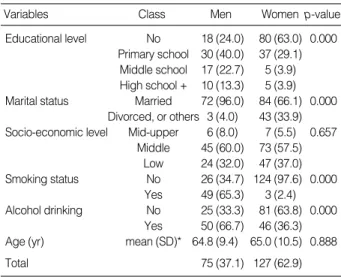
General characteristics of the 202 subjects, 75 men and 127 women, are listed in Table 1. There were statistically differ- ent distributions in general characteristics between men and women. In particular, men had higher educational level, more married status, more frequent smoking and alcohol drinking experiences.
There were well-expected differences in physical and lab- oratory findings between men and women. Men had higher white blood cell count, hemoglobin, hematocrit, and total cholesterol levels and lower HDL-cholesterol and LDL-choles- terol levels than women. HsCRP levels, however, was not sig- nificantly different between men and women (Table 2).
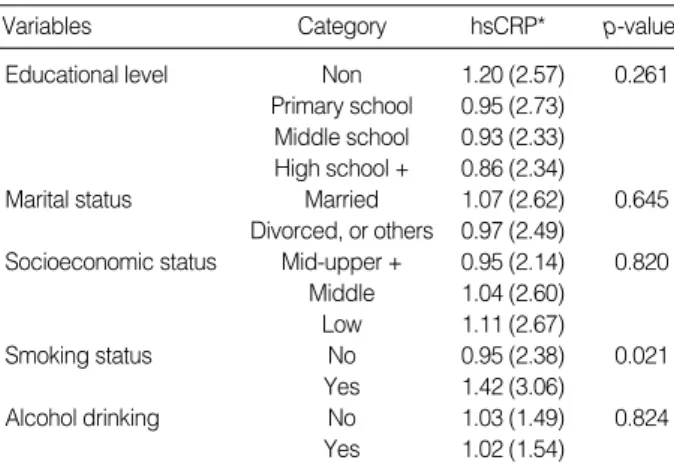
Table 3 shows geometric means and geometric standard deviations of hsCRP levels according to general characteris- tics. HsCRP levels were significantly higher in persons who had smoking experience.
Table 4 shows the results of unadjusted and age-adjusted correlation analyses of factors relating to log-transformed hsCRP level. Plasma hsCRP level had significant positive cor- relation with age, body mass index, diastolic blood pressure, fasting blood glucose and white blood cell counts. Although the correlation between plasma hsCRP and HDL-cholesterol was negatively significant, other blood lipid profile, such as
Variables Class Men Women p-value
Educational level No 18 (24.0) 80 (63.0) 0.000 Primary school 30 (40.0) 37 (29.1) Middle school 17 (22.7) 5 (3.9) High school + 10 (13.3) 5 (3.9) Marital status Married 72 (96.0) 84 (66.1) 0.000
Divorced, or others 3 (4.0) 43 (33.9) Socio-economic level Mid-upper 6 (8.0) 7 (5.5) 0.657
Middle 45 (60.0) 73 (57.5) Low 24 (32.0) 47 (37.0) Smoking status No 26 (34.7) 124 (97.6) 0.000
Yes 49 (65.3) 3 (2.4) Alcohol drinking No 25 (33.3) 81 (63.8) 0.000
Yes 50 (66.7) 46 (36.3) Age (yr) mean (SD)* 64.8 (9.4) 65.0 (10.5) 0.888
Total 75 (37.1) 127 (62.9)
Table 1.General characteristics of the study subjects Unit: No. (%)
mean (SD)*, mean (standard deviation).
total cholesterol, triglyceride and LDL-cholesterol did not significantly correlate with hsCRP. Adjustment for age had minimal impact on these association.
The results of stepwise multiple regression analysis is shown in Table 5. In stepwise multiple regression analysis, white blood cell counts, age, fasting blood glucose, smoking and body mass index remained as factors showing independent association with plasma hsCRP, and these factors accounted for 16.5% of the variance in hsCRP levels.
DISCUSSION
Several prospective epidemiologic studies have demonstrat- ed a positive association between CRP levels and the risk of future cardiovascular disease (14). Risk factors of cardiovas- cular diseases are often related to one another. For example, hypertension is often associated with glucose intolerance and hypercholesterolemia. Simple reduction of blood pressure or
lowering of serum lipids alone may reduce the risk of cardio- vascular diseases to some extent (15). Therefore, in order to prevent the occurrence of cardiovascular diseases more effec- tively, comprehensive reductions of cardiovascular risk fac- tors should be considered, and it is important to understand the interrelationship of each risk factor (7).
With regard to the pathogenesis of cardiovascular diseases, the inflammatory response is now considered to be indepen- dent risk factor to the development of cardiovascular diseases (16). Especially inflammatory components are believed to contribute greatly to instability and rupture of atheromatous plaque that leads to atherothrombotic events (17, 18).
CRP is an acute phase reactant, which is marker for under- lying systemic inflammation. When measured with a high sensitivity assay, CRP levels also appear to have predictive value for cardiovascular morbidity and mortality. Moreover, baseline levels of CRP predict the risk of future myocardial infarction, stroke, and peripheral atherosclerosis, even after adjustment for other known cardiovascular risk factors (14).
So in this study, we investigated the factors relating to the plasma hsCRP level. As a result of our analysis, white blood cell counts, age, fasting blood glucose, smoking and body mass index are the independent factors relating to plasma hsCRP level. In addition, blood pressure (BP) and HDL- cholesterol level also had significant correlations with plasma hsCRP. These results are consistent with current evidence
Variables Men
mean±SD*
Women mean±SDp-value Body mass index (kg/m2) 24.3±2.9 24.9±3.2 0.185 Systolic blood pressure (mmHg) 144.4±24.3 141.6±22.9 0.426 Diastolic blood pressure (mmHg) 87.1±14.0 85.6±12.3 0.418 Pulse pressure (mmHg) 57.3±14.5 56.1±14.8 0.579 White blood cel count (×103/ L) 6.7±1.8 5.8±1.5 0.000 Blood hemoglobin (g/dL) 14.5±1.5 13.0±1.1 0.000 Hematocrit (%) 43.1±6.5 38.4±2.9 0.000 Total cholesterol (mg/dL) 195.7±39.9 212.4±40.4 0.005 Triglyceride (mg/dL) 182.0±107.2 160.6±81.3 0.138 HDL-cholesterol (mg/dL) 48.1±13.7 53.6±11.3 0.002 LDL-cholesterol (mg/dL) 110.2±36.9 126.2±33.6 0.002 Blood glucose (mg/dL) 137.9±47.0 131.7±39.3 0.311
hsCRP (mg/L) 2.4±3.9 1.6±2.3 0.089
Table 2.Physical and laboratory findings of the study subjects
Variables Category hsCRP* p-value
Educational level Non 1.20 (2.57) 0.261
Primary school 0.95 (2.73) Middle school 0.93 (2.33) High school + 0.86 (2.34)
Marital status Married 1.07 (2.62) 0.645
Divorced, or others 0.97 (2.49)
Socioeconomic status Mid-upper + 0.95 (2.14) 0.820 Middle 1.04 (2.60)
Low 1.11 (2.67)
Smoking status No 0.95 (2.38) 0.021
Yes 1.42 (3.06)
Alcohol drinking No 1.03 (1.49) 0.824
Yes 1.02 (1.54)
Table 3.The association of hsCRP with general characteristics
*: Geometric mean (geometric standard deviation).
*mean±SD: mean±standard deviation.
Variables Unadjusted
r p-value
Age-adjusted
r p-value
Age 0.170 0.016 -
Body mass index 0.178 0.011 0.206 0.003
Systolic blood pressure 0.120 0.090 0.080 0.257 Diastolic blood pressure 0.167 0.018 0.153 0.030
Pulse pressure 0.044 0.534 -0.010 0.884
Total cholesterol 0.036 0.608 0.038 0.589
Triglycerides 0.094 0.185 0.111 0.118
HDL*-cholesterol -0.191 0.007 -0.170 0.016 LDL�-cholesterol 0.056 0.432 0.041 0.560 Fasting blood glucose 0.202 0.004 0.192 0.006 White blood cell count 0.227 0.001 0.248 0.000 Table 4.Unadjusted and age-adjusted correlation coefficients between log hsCRP levels and various factors in the subjects
*HDL, high density lipoprotein; �LDL, low density lipoprotein.
Variables Standardized coefficients p-value
White blood cell count 0.163 0.018
Age 0.205 0.002
Fasting blood glucose 0.150 0.026
Smoking (yes/no) 0.184 0.007
Body mass index 0.165 0.016
Table 5.Stepwise multiple regression analysis of relations of var- ious cardiovascular risk factors to hsCRP log transformed in the subjects
R2=16.5%.
supporting the importance of inflammation in atherogenesis.
Similarly, these data suggest important relationships between inflammation and traditional cardiovascular risk factors.
Inflammation has been hypothesized to play a role in the development of hypertension, and several cross-sectional stud- ies demonstrate higher CRP levels among those individuals with elevated BP (14, 19, 20). CRP has been reported to decrease production of nitric oxide by endothelial cells, and thus might indirectly promote vasoconstriction, leukocyte adherence, platelet activation, oxidation, and thrombosis. CRP also has been reported to have proatherosclerotic properties by upregulating angiotensin type I receptor expression, affect- ing the renin-angiotensin system and contributing to the pathogenesis of hypertension (21, 22).
In those studies (14, 19, 20), CRP has been more strongly associated with systolic BP than diastolic BP, which is con- sistent with the emerging importance of systolic BP as a means of cardiovascular risk prediction. But in this study, diastolic BP was more strongly correlated with CRP than systolic BP, and BP was not associated with hsCRP in mul- tivariate analysis.
It is conceivable that components of insulin resistance syn- drome, such as hypertension, glucose intolerance and dyslipi- demia promote atherosclerosis which involves inflammatory process (7). In our study, blood glucose and diastolic blood pressure was associated with levels of plasma hsCRP.
Smoking is well supposed to give chemical and oxidative stimuli to the cardiovascular system and cause inflammation (13). It has recently been reported that moderate alcohol con- sumptions reduces circulating CRP (23). But in the present study, when we divided the subjects according to the alcohol drinking status, the plasma hsCRP level was not significantly affected by the alcohol drinking.
We know from literature that CRP has been positively associated with body weight and fatness in men and women of different ages (24-26). More precisely, central obesity and the presence of visceral adipose tissue might be a key promoter of low-grade chronic inflammation (24). Fat cells produce cytokines, in particular IL-6 that induces the synthesis of CRP by the liver. This may be of pathogenic significance as CRP stimulates the uptake of LDL by macrophages, induces com- plement activation which may cause cellular damage in the artery, and enhances monocyte production of tissue factor, thus enhancing the risk of thrombosis (25). A recent study suggested that both in cross-sectional and in longitudinal studies body mass index but not physical activity is associ- ated with CRP (27). These results are similar to the results we found in multivariate analysis.
We analysed that CRP was negatively related to HDL- cholesterol in correlational analysis, but it was no longer sig- nificant after control for other risk factors. The negative asso- ciation between CRP and HDL-cholesterol might be expla- ined by interaction between CRP and very low density lipo- proteins (28).
Several limitations of these data should be taken into acco- unt. First, because of the cross-sectional design, relationships between hsCRP and other cardiovascular risk factors cannot be deemed causal in nature. Additionally, it is impossible that unmeasured variables may account for the relationships ob- served. Last, because our study subjects consisted of a relatively healthy and older volunteer population in a rural area, caution should be exercised when generalizing these data to other general populations. Despite these limitations, inherent with any cross-sectional studies, our results are consistent with known previous reports and are supported by biological plau- sibility.
In summary, CRP are independently related to several clin- ical cardiovascular risk factors among general population in some rural area. Further what we need now are prospective studies to evaluate the association of C-reactive protein con- centrations with subsequent cardiac events.
REFERENCES
1. Danesh J, Whincup P, Walker M, Lennon L, Thomson A, Appleby P, Gallimore J, Pepys MB. Low grade inflammation and coronary heart disease: prospective study and updated meta-analysis. BMJ 2000; 321: 199-204.
2. Rifai N, Ridker PM. High-sensitivity C-reactive protein: a novel and promising marker of coronary heart disease. Clin Chem 2001; 47:
403-11.
3. Ridker PM, Cushman M, Stampfer MJ, Tracy RP, Hennekens CH.
Inflammation, aspirin, and the risk of cardiovascular disease in appar- ently healthy men. N Engl J Med 1997; 336: 973-9.
4. Ridker PM, Hennekens CH, Buring JE, Rifai N. C-reactive protein and other markers of inflammation in the prediction of cardiovascu- lar disease in women. N Engl J Med 2000; 342: 836-43.
5. Haverkate F, Thompson SG, Pyke SD, Gallimore JR, Pepys MB. Pro- duction of C-reactive protein and risk of coronary events in stable and unstable angina. European Concerted Action on Thrombosis and Disabilities Angina Pectoris Study Group. Lancet 1997; 349:
462-6.
6. Kuller LH, Tracy RP, Shaten J, Meiahn EN. Relation of C-reactive protein and coronary heart disease in the MRFIT nested case-con- trol study. Multiple Risk Factor Intervention Trial. Am J Epidemiol 1996; 144: 537-47.
7. Saito M, Ishimitsu T, Minami J, Ono H, Ohrui M, Matsuoka H. Rela- tions of plasma high-sensitivity C-reactive protein to traditional car- diovascular risk factors. Atherosclerosis 2003; 167: 73-9.
8. Libby P, Ridker PM, Maseri A. Inflammation and atherosclerosis.
Circulation 2002; 105: 1135-43.
9. Hak AE, Stehouwer CD, Bots ML, Polderman KH, Schalkwijk CG, Westendorp IC, Hofman A, Witteman JC. Associations of C-reactive protein with measures of obesity, insulin resistance, and subclinical atherosclerosis in healthy, middle-aged women. Aterioscler Thromb Vasc Biol 1999; 19: 1986-91.
10. Geffken D, Cushman M, Burke GL, Polak JF, Sakkinen PA, Tracy RP.
Association between physical activity and markers of inflammation in a healthy elderly population. Am J Epidemiol 2001; 153: 242-50.
11. Heilbronn LK, Clifton PM. C-reactive protein and coronary artery disease: influence of obesity. J Nutr Biochem 2002; 13: 316-21.
12. Tchernof A, Nolan A, Sites C, Ades PA, Poehlman ET. Weight loss reduces C-reactive protein levels in obese postmenopausal women.
Circulation 2002; 105: 564-9.
13. Mendall MA, Patel P, Ballam L, Strachan D, Northfield TC. C-reac- tive protein and its relation to cardiovascular risk factors: a popula- tion based cross sectional study. BMJ 1996; 312: 1061-5.
14. Rohde LE, hennekens CH, Ridker PM. Survey of C-reactive protein and cardiovascular risk factors in apparently healthy men. Am J Car- diol 1999; 84: 1018-22.
15. Reaven GM. Insulin resistance and compensatory hyperinsulinemia:
role in hypertension, dyslipidemia, and coronary heart disease. Am Heart J 1991; 121: 1283-8.
16. Ross R. Atherosclerosis-an inflammatory disease. N Engl J Med 1999; 340: 115-26.
17. van der Wal AC, Becker AE, van der Loos CM, Das PK. Site of inti- mal rupture or erosion of thrombosed coronary athersclerotic plaques is characterized by an inflammatory process irrespective of the dom- inant plaque morphology. Circulation 1994; 89: 36-44.
18. Maseri A. Inflammation, atherosclerosis, and ischemic events - explor- ing the hidden side of the moon. N Engl J Med 1997; 336: 1014-6.
19. Sesso HD, Bruing JE, Rifai N, Blake GJ, Gaziano JM, Ridker PM.
C-reactive protein and the risk of developing hypertension. JAMA 2003; 290: 2945-51.
20. Bermudez EA, Rifai N, Buring J, Manson JE, Ridker PM. Interre- lationships among circulating interleukin-6, C-reactive protein, and
traditional cardiovascular risk factors in women. Arterioscler Thromb Vasc Biol 2002; 22: 1668-73.
21. Devaraj S, Xu DY, Jialal I. C-reactive protein increases plasminogen activator inhibitor-1 expression and activity in human aortic endothe- lial cells; implications for the metabolic syndrome and atherothrom- bosis. Circulation 2003; 107: 398-404.
22. Wang CH, Li SH, Weisel RD, Fedak PW, Dumont AS, Szmitko P, Li RK, Mickle DA, Verma S. C-reactive protein upregulates angio- tensin type 1 receptors in vascular smooth muscle. Circulation 2003;
107: 1783-90.
23. Imhof A, Froehlich M, Brenner H, Boeing H, Pepys MB, Koenig W.
Effect of alcohol consumption on systemic markers of inflammation.
Lancet 2001; 357: 763-7.
24. Visser M, Bouter LM, McQuillan GM, Wener MH, Harris TB. Ele- vated C-reactive protein levels in overweight and obese adults. JAMA 1999; 282: 2131-5.
25. Heilbronn L, Clifton PM. C-reactive protein and coronary artery disease: influence of obesity, caloric restriction and weight loss. J Nutr Biochem 2002; 13: 316-21.
26. Hwang JS, Lee SH, Park HS. The association between C-reactive protein and obesity among Korean men. J Assoc Fam Med 2003; 24:
58-63.
27. Rawson ES, Freedson PS, Osganian SK, Matthews CE, Reed G, Ock- ene IS. Body mass index, but not physical activity, is associated with C-reactive protein. Med Sci Sports Exerc 2003; 35: 1160-6.
28. Verdaet D, Dendale P, De Bacquer D, Delanghe J, Block P, De Backer G. Association between leisure time physical activity and markers of chronic inflammation related to coronary heart disease. Atheroscle- rosis 2004; 176: 303-10.