서론 I.
(fault tolerant) [1]
.
. 2
.
MIL-HDBK-338B, “Electronic Reliability Design Handbook”
[2] .
RBD (Reliability Block Diagram)
[3-5]. RBD ,
.
,
[6]
.
* (Corresponding Author)
: 2011. 8. 20., : 2011. 9. 5., : 2011. 9. 25.
, , , , :
([email protected]/[email protected]/[email protected]/
[email protected]/[email protected])
( UD100048JD).
RBD
.
100% .
RBD
, .
(RM: Redundancy Management) [7]
.
(voter) ,
/ / (FDI: Fault Detection & Isolation)
. RBD
,
.
(monte carlo) [8-10] .
.
3 .
. ,
Reliability Analysis of a System with Redundancy Management Based on Monte-Carlo Probability Model
*, , , , ,
(Sung-Su Kim1, Sanghyuk Park1, Sung-Hwan Kim1, Keeyoung Choi1, Choon-Bae Park1, and Cheol-Keun Ha2)
1Inha University
2University of Ulsan
Abstract: Critical systems with high reliability feature fault tolerant redundancy. Conventional analytical reliability analysis methods that use the Reliability Block Diagram do not adequately reflect characteristics of the redundancy management system and are not suitable for this applications. This paper uses Monte-Carlo method to calculate the reliability of complicated redundant systems. The method was first validated for cases with analytical solutions. Then, the tool was successfully applied to analyze reliability of the flight control systems with a voter as redundancy management system.
Keywords: reliability, redundancy, monte-carlo, reliability block diagram
Copyright© ICROS 2011
.
신뢰도 해석 모델
II. RBD
(Reliability: ) ()
0 1
. ()
. (1) . 1
RBD (2) , 2
RBD (3) ,
3 RBD (4)
.
(1)
.
.
․ ․ ․ ․
․ ․ ․ ․
(2): , : , : .
. 2
N .
.
․ ․ ․ ․
(3), ,
.
․ ․ ․ (4) 신뢰도 해석 수치 모델
III.
(5)
.
1 .
∩ ∙∙∙ ∩ (5)
(6)
(5) N
, RBD
. N
,
. N
(majority voter)
[11,12] .
N 2
, ,
(ILM: In-Line Monitoring) .
.
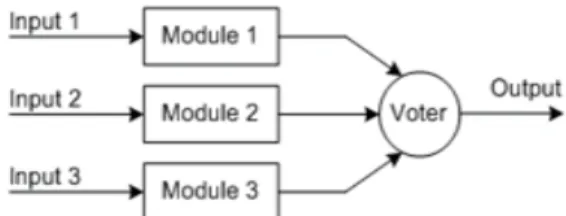
3
. 3
4 TMR (Tribple Modular
1. .
Fig. 1. Serial system.
2. .
Fig. 2. Parallel system.
3. .
Fig. 3. Standby system.
4. 3 .
Fig. 4. TMR system with voter.
Redundancy) , N
NMR (N-Modular Redundancy) .
3
7 1
, ,
. 3
3 ,
3 2
. ,
.
. ,
.
.
(12) 3
∩∩ (13) ,
.
(14)
3 2
∩ ∩
∩
∩∩ (15) ,
.
(16)
3 1
∩ ∩
∩
∩∩
(17)
,
.
(18)
확률모델 기반 신뢰도 해석기법 IV.
(1) .
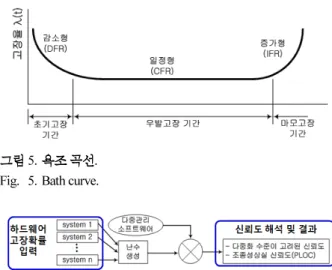
. (life cycle)
5 .
, ,
. ,
(uniform distribution) . ,
. 정리 1: (central limit theorem)
,
()
, .
.
1 [13]
95%
300 .
6 . (failure
rate) , 0
1 .
(MTBF: Mean Time to
Failure) (1) .
1. TMR .
Table 1. Failure combination of TMR.
: , :
5. .
Fig. 5. Bath curve.
6. .
Fig. 6. Configuration of monte-carlo simulation.
.
/ .
. ()
6 300
.
, 7, 8
. 7 3 3
(14)
, 8 3 2
(16) .
,
.
. RBD
,
. 확률모델 기반 신뢰도 해석 결과 V.
3 ,
.
9. 3 [12].
Fig. 9. Triple modular redundancy voter[12].
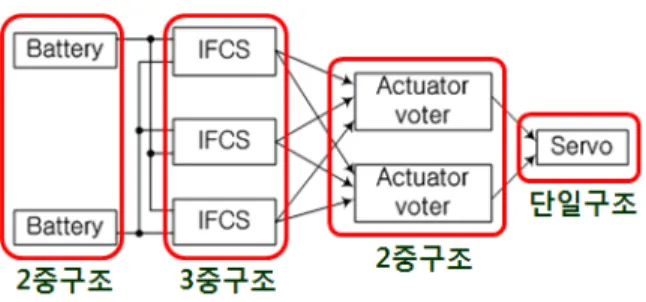
10. .
Fig. 10. Redundant system for reliability analysis model.
3 ,
9 . 3
3
. 3
(threshold) .
,
1 .
, 3
. 1
2
(analytical redundancy method)
, (14) 3
.
. 10 .
2 , (IFCS: Integrate Flight Control
System) 3 , 2 ,
. 9
.
(predator)
× (failure in time) . - -
7. -3 .
Fig. 7. Math model vs probability model- 3module failure.
8. -2 .
Fig. 8. Math model vs probability model- more then 2module failure.
× (failure in time) .
.
2
, 3
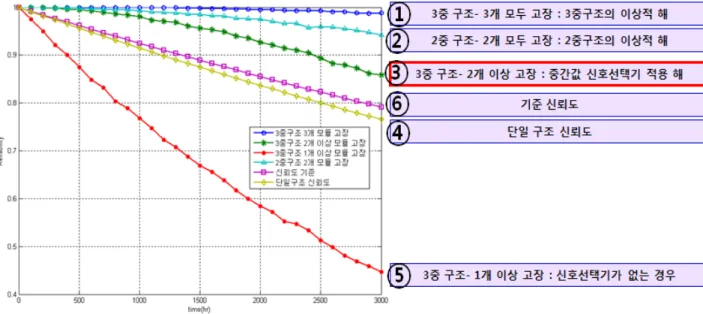
. 5
, 11 .
①3
, ② 2 , ③ 3
2 , ④ ,
3 1 ,
⑤ ⑥
.
⑥
, ④ , ① 3
3 , ②2
2
. 1
3 2
③
3 1
⑤
.
① ②, .
. 3
③ .
결론 VI.
.
RBD ,
,
.
.
.
. 참고문헌
[1] Giorgio Turconi․ Italtel spa ․ Milan, Ermelinda Di Perna ․ Italtel spa․ Milan, “A design tool for fault tolerant sys- tems,” Proc. Annual Reliability and Maintainability Symposium, pp. 317-326, 2000.
[2] MIL-HDBK-338B Electronic reliability design handbook, Department of Defense, 1998.
[3] A. Abd-Allah, “Extending reliability block diagrams to software architectures,” Technical Repor t:USC-SCE-97- 501, 1997.
[4] A. Einstein, “Reliability block diagrams analysis and tac- tics,” Technische Universiteit Eindhoven, 2007.
[5] S. S. Kim, S. H. Park, S. H. Kim, K. Y. Choi, C.-K.
Ha, and C.-B. Park, “Development of Reliability Block Diagram Analysis Tool for H/W Redundancy Structure
based on Unit Module,” KSAS, vol. 37, no. 6, pp.
11. .
Fig. 11. Reliability analysis of redundancy system.
595-601, Jun. 2009.
[6] S. S. Kim and C. B. Park, “Design for flight control system focused on reliability,” KSAS, vol. 33, no. 6, pp.
33-40, Nov. 2005.
[7] D. S. Kim, “FCS flight safety and redundancy manage- ment-triple redundant sensor simultaneous fault detection and isolation,” Gyeongsan National University master pa- per, Dec. 2005.
[8] T. H. Kim, K. H. Chung, and T. K. Oh, “Monte-carlo approach to develop probabilistic reliability assessment program,” KIEE, pp. 533-535, Nov. 2008.
[9] T. Y. Son, “Development of an algorithm for system re- liability calculation based on monte carlo simulation,”
Sungkyunkwan University master paper, Dec. 2009.
[10] B. Korver, “The Monte-Carlo method and software reli- ability theory,” TR94-1, Feb. 1994.
[11] J. M. Ahn, S. S. Lim, J. S. Ko, and C. S. Kim,
“Comparative analysis of voting algorithm for redundant flight control system,” KSAS06-2302, pp. 321-324, Nov.
2006.
[12] J. M. Kim, J. H. Park, S. A. Jang, C. B. Park, and I.
S. Rhee, “Realization of sensor fault and voter model for design of fault tolerance flight control system,”
KSAS06-1105, Apr. 2006.
[13] P. Zarchan, “Comparison of statistical digital simulation methods,” AGARD-AG-273, 1998.
김 성 수
2002 (
) . 2005 .
2011 . 2011 ~
. ,
, .
김 성 환
2001 ( )
. 2003 . 2003 ~
. 2005 ~2006
. ,
, , .
박 춘 배
1974 (
) . 1976 .
1976 ~1980 (
). 1989
( ) . 1980 ~
. 2007 ~
. . ,
.
박 상 혁
2006 ( )
. 2008 . 2008 ~
. ,
, .
최 기 영
1987 ( )
. 1989 . 1994
Stanford University(Ph.D in Aeronautics and Astronautics) . 1993 ~ 1999 Advanced Rotorcraft Technology. Inc, Senior Aerospace Engineering. 2000 ~
. , /
, .
하 철 근
1984 . 1986
. 1993
. 1993 ~ .
, , (UAV)
.