大韓獸醫學會誌(2008) 第48卷 第2號
Korean J Vet Res
(2008) 48(2) : 187~190187
Idiopathic eosinophilic myositis in Korean native cattle ( Bos taurus coreanae )
Seong-Hee Rhee
1, Il-Jeoung Yu
1, Jong-Hoon Kim
1, Jung-Kee Kwon
1, Jinho Park
1, Myung-Jo You
1, Jeong-Won Lee
2, Hee-Jin Park
1, Irina Chekarova
1, Gerry Amor Camer
3,
Chae-Woong Lim
1, Bumseok Kim
1,*
1
Bio-safety Research Institute and College of Veterinary Medicine, Chonbuk National University, Jeonju 561-756, Korea
2
Jeongeup Branch, Institute of Live Stock and Veterinary Research, Jeongeup 580-814, Korea
3
College of Veterinary Medicine, University of Eastern Philippines, 6400, Catarman, Northern Samar, Philippines
(Accepted: April 3, 2008)
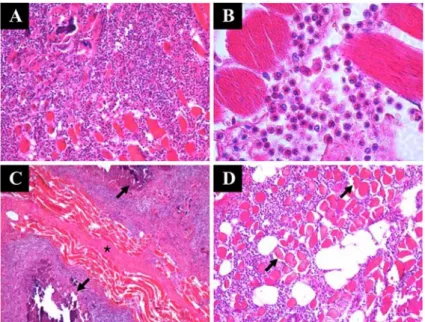
Abstract : Eosinophilic myositis lesions are characterized by severe eosinophil infiltration along muscles of affected animals. The exact cause of the lesion remains controversial and the carcass is condemned once this lesion is seen during meat inspection. A cow slaughtered in Chonbuk province, Korea was observed to have disseminated pale foci throughout the musculature; meat samples were obtained and macroscopically investigated. Cut ends of neck and thigh muscle tissues showed variably sized, multi- focal pale white-grayish nodular lesions. Histopathological examination consistently revealed inflammatory lesions with adjacent infiltration of eosinophilic granulocytes and focal necrotic calcification. However, no parasites, including Sarcocystis sp., could be discerned in the affected carcass. This case was diagnosed as idiopathic eosinophilic myositis in cattle.
Keywords : cattle, eosinophil, eosinophilic myositis, muscle
Introduction
Eosinophilic myositis (EM), a rare idiopathic inflammatory skeletal and cardiac muscle disease associated with eosinophilic infiltrates in cattle and sheep [17], is usually incidentally observed at slaughter. Despite the lack of specific information about its exact nature and etiological cause [15, 17], EM lesions are currently listed as valid grounds for meat condemnation; the unwholesome and unappealing look of the meat apparently justify its condemnation.
Some scientists have detected sarcocyst parasites in the lesions, prompting attribution of eosinophilic infiltrates to a dead or degenerating parasite [1, 5]. Others have reported similar lesions caused by trematodes and
Echinococcus
parasites [16]. Lesions of EM are inducible upon experimental infection of cattle with
Trichinella