* To whom correspondence should be addressed.
E-mail: [email protected] doi:10.7464/ksct.2013.19.2.184
난연성 세정제의 합성 및 평가에 관한 연구
김아나
,
유영,
김석찬* 국민대학교 생명나노화학과 136-702 서울특별시 성북구 정릉로 77
(2013 년 4 월 25 일 접수 ; 2013 년 5 월 18 일 수정본 접수 ; 2013 년 5 월 18 일 채택 )
Synthesis and Evaluation of New Nonflammable Cleaning Agents
Ah Na Kim, Young Yu, and Seok Chan Kim*
Department of Bio & Nano Chemistry, Kookmin University 77 Jeongneung-ro, Seongbuk-gu, Seoul 136-702, Korea
(Received for review April 25, 2013; Revision received May 18, 2013; Accepted May 18, 2013)
요 약
기존 탄화수소계 세정제는 낮은 인화점으로 인하여 화재, 폭발과 같은 문제점을 가지고 있다. 인화점을 높이기 위해 불소가 포함된 난연성 세정제 7종을 개발하였다. 새롭게 합성한 세정제를 한국석유관리원에서 국가산업표준 방법으로 분석하여 물성을 측정하고 세정성 평가를 수행하였다. 물성 측정 결과, 인화점이 탄화수소계 세정제보다 높은 것을 확인하였다. 세정 력 평가를 위하여 가로 60 mm, 세로 40 mm 크기의 스테인리스강 기판에 인발유, 아비에트산, 절삭유, 윤활유를 각각 도포하 여 합성한 세정제(1~7)에 넣어 침적한 후 세정력을 평가하였다. 최대 5분간 침적하였을 때 인발유는 80~96%, 아비에트산은 82~97%, 윤활유는 86~93% 정도의 높은 세정력을 보였다. 그러나 절삭유에서는 60~87% 정도로 다른 오일보다 낮은 세정력 을 보였다. 따라서 약간의 차이는 있지만 대체적으로 우수한 세정력을 보여 산업세정분야에 적용이 가능함을 나타내었다.
주제어 : 난연성, 세정제, 불소화합물, 삼불화초산
Abstract : To increase flash point which is related to flammability, seven unprecedented new cleaning agents containing fluoride atoms have been invented. These newly synthesized cleaning agents’s physical properties which were conducted by Korea Institute of Petroleum Management by using a standard method showed excellent values. Particularly, flash point of newly synthetic cleaning agents is more higher than that of fluoride free compound. A specimen for cleaning ability was prepared by cutting in 60 mm × 40 mm size of stainless steel plate. The surface of the above specimens was applied with four kinds of con- taminants, such as paraffin based drawing oil, flux abietic acid, water-insoluble cutting oil, and lubricating oil. Contaminated specimens were immersed in new compounds (1-7) for 1 to 5 minutes to dissolve oil in the cleaning agent. Although the data indicate that all compounds (1-7) exhibit lower cleaning ability toward cutting oil, it is observed that in the case of the present study more than 80% of pollutants on the surface were almost removed within 5 minutes.
Keywords : Non-flammability, Cleaning agent, Fluorinated compounds, Trifluoroacetic acid (TFA)
1. Introduction
A chlorine-based solvent such as 1,1,2-trichloroethylene (TCE), 1,2-dichloropropane, and methylene chloride has been widely used for its excellent cleaning ability. However, since chlorine- based solvent has high volatility, it is harmful to both human body and environment[1-3]. The hydrocarbon-based cleaning agent has been used as the substitute, but the problems that re- lated to flammability and drying are being blamed. Flammabi-
lity is important because many industrial facilities are not equipped with safely handle flammable hydrocarbons. In addi- tion, hydrocarbon containing an aromatic hydrocarbon, such as benzene, toluene, and xylene are being regulated due to its high toxicity on human body and environmental pollution[4,5]. There- fore, development of new environmentally acceptable cleaning agent would be highly desirable.
Fluorinated organic compound in which hydrogen atoms has been replaced by fluorine atoms has a higher flash point[5] than that of the fluorine free compound. It is also known that ester compounds have an important role in cleaning dirty metal sur- faces[7,8].
184
Table 1. Physical properties of compounds (1-7) Physical pro-
perties Comp.
Flash point
c(℃)
Kinematic viscosity (mm
2/s, at 40 ℃)
Viscosity (cP, at 25 ℃)
Specific gravity (at 20 ℃)
Density (g/cm
3, at 25 ℃)
Surface tension (dyne/cm)
Wetting index
d1 90(86)
a1.339 2.544 1.4860 1.4650 25.7 22.41
2 92(-)
b1.743 3.452 1.4358 1.4247 25.6 16.12
3 95(-)
b2.099 3.183 1.3780 1.3688 27.3 15.75
4 105(-)
b2.249 3.246 1.3348 1.3233 25.8 15.80
5 108(-)
b2.048 3.716 1.2943 1.2850 27.4 12.62
6 145(138)
a8.726 1.243 1.5531 1.5420 27.0 45.95
7 165 (-)
b40.280 13.670 1.5406 1.5303 27.8 4.03
Test Method KS M ISO
2529:2007 KS M 2014:2004 KS M 2014:2004
KS M ISO 12185:2003
KS M ISO 12185:2003
KS M ISO
2525:2005 -
a
Parenthesis indicates the flash point of non-fluorine substituted (hydrogen substitute) compounds.
b
unknown.
c
Flash point was measured with COC method.
d
Wetting index = density × 1000 mviscosity × surface tension
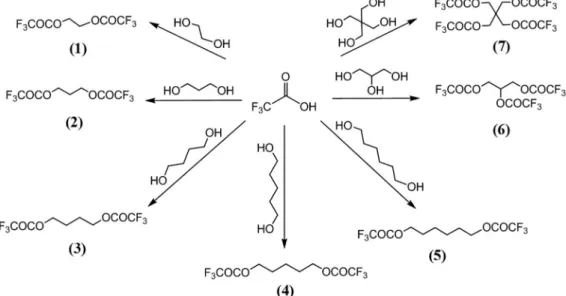
Scheme 1. The synthetic scheme of compounds (1-7) from TFA.
Herein, we describe a synthesis and evaluation of fluorinated ester compounds which exhibit low toxicity to human body due to their low flammability.
The core structure of the new fluorinated target compounds (1-7) is ester group which connected to polyol chain. The syn- thesis of target compounds is outlined in Scheme 1. The ester compounds (1-7) were synthesized by esterification reaction of trifluoroacetic acid (TFA) with polyols in the presence of acid catalysis in moderate yield.
All synthesized ester compounds (1-7) were estimated for their possibility of cleaning agent by examining physical properties which were conducted by Korea Institute of Petroleum Mana- gement by using standard methods. All compounds have various
good physical properties which are almost similar to other clea- ners[9,10]. When flash point of all compounds (1-7) was com- pared with that of non-fluorinated (hydrogen substituted) com- pounds, the data indicated all compounds show high flash point that related to flammability (Table 1). This finding suggests that all synthesized compounds (1-7) can be a new candidate as nonflammable cleaning agent.
2. Experimental Section
2.1. Experimental equipment
All new compounds (1-7) were evaluated for their cleaning
efficiency by simple immersion cleaning method. A specimen
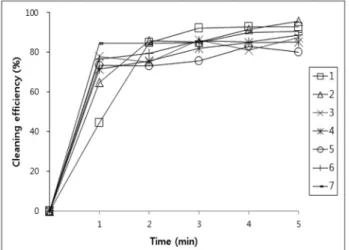
Figure 1. Cleaning efficiency of (1-7) for drawing oil. Figure 2. Cleaning efficiency of (1-7) for abietic acid.
Figure 3. Cleaning efficiency of (1-7) for cutting oil. Figure 4. Cleaning efficiency of (1-7) for lubricating oil.
applied with four kinds of contaminants, paraffin-based drawing oil, flux abietic acid, water-insoluble cutting oil, and lubricating oil which were used for various industrial processing.
2.2. Experimental method
The weight that was added with the specimen was recorded down to four places of decimals. The above specimens were im- mersed in 100 mL of compounds (1-7) for 1 to 5 minutes to dissolve oil in the cleaning agent. After that, the specimens were dried and weights were measured.
3. Result and Discussion
3.1. Result of Cleaning test
Three tests were performed on each compound. Using the above
were calculated and putted on a percentage basis in Figure 1, 2, 3, and 4.
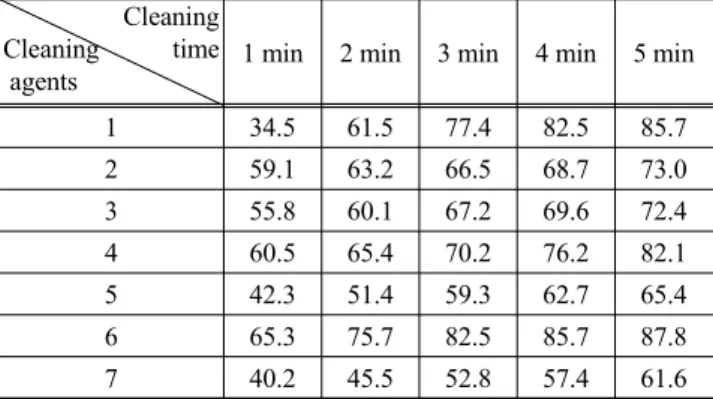
Figure 1, 2, 3 and 4 indicate that all compounds (1-7) show some low cleaning efficiency for four contaminants in 1-2 mi- nutes dipping. However, gradual increment of dipping time can raise cleaning efficiency. Although the data in Figure 3 indi- cate that all compounds exhibit lower cleaning ability toward cutting oil, it is observed that in the case of the present study more than 80% of pollutants on the surface were almost remo- ved within 5 minutes. Accordingly, one might suggest that these compounds (1-7) are suitable for new nonflammable cleaning agents.
3.2. Synthetic methods of cleaning agents
Generally, all proton nuclear magnetic resonance (NMR)
spectra were recorded on a Varian Unity Inova spectrometer at
Table 2. Cleaning efficiency (%) of drawing oil by (1-7) cleaning agents
Cleaning Cleaning time
agents 1 min 2 min 3 min 4 min 5 min
1 44.5 84.9 92.3 92.8 92.8
2 65.0 85.7 85.1 91.5 95.6
3 77.8 74.9 86.1 81.0 87.4
4 71.7 75.7 82.0 84.8 85.1
5 73.4 73.1 75.7 83.1 80.2
6 76.7 79.6 86.0 85.2 88.6
7 84.7 84.5 84.9 89.9 90.6
Table 3. Cleaning efficiency (%) of abietic acid by (1-7) cleaning agents
Cleaning Cleaning time
agents 1 min 2 min 3 min 4 min 5 min
1 45.2 77.2 89.0 90.5 94.5
2 66.7 86.2 87.5 92.0 97.5
3 69.2 84.2 86.3 93.0 93.5
4 72.5 77.5 82.4 86.4 89.2
5 70.1 72.3 75.6 79,7 82.1
6 68.4 83.5 86.5 92.7 94.0
7 84.5 86.8 88.2 91.5 96.4
Table 4. Cleaning efficiency of cutting oil by (1-7) cleaning agents Cleaning
Cleaning time
agents 1 min 2 min 3 min 4 min 5 min
1 34.5 61.5 77.4 82.5 85.7
2 59.1 63.2 66.5 68.7 73.0
3 55.8 60.1 67.2 69.6 72.4
4 60.5 65.4 70.2 76.2 82.1
5 42.3 51.4 59.3 62.7 65.4
6 65.3 75.7 82.5 85.7 87.8
7 40.2 45.5 52.8 57.4 61.6
Table 5. Cleaning efficiency (%) of lubricating oil by (1-7) clea- ning agents
Cleaning Cleaning time
agents 1 min 2 min 3 min 4 min 5 min
1 45.8 67.8 75.8 83.6 86.9
2 67.8 77.8 86.9 91.5 93.1
3 72.5 76.1 84.6 88.1 91.6
4 65.8 75.3 81.5 86.9 92.1
5 42.3 51.4 59.3 62.7 65.4
6 65.3 75.7 82.5 85.7 87.8
7 40.2 45.5 52.8 57.4 89.4
300 MHz and are reported in parts per mllion (ppm) on the δ scale relative to chloroform-d
1. (* δ (chemical shift) = difference between a resonance frequency and that of a reference sub- stance/operating frequency of the spectrometer)
Ethane-1,2-diyl bis(2,2,2-trifluoroacetate)(1)
To a stirred solution of ethylene glycol (2.0 kg, 28.95 mol) and p-TsOH (396 g, 2.89 mol) in toluene (3.0 L) was added slowly TFA (6.65 L, 86.85 mol) at room temperature. The re- sulting mixture was heated to remove water for 3 hours. After cooling, methylene chloride (4.0 L) was added to the reaction mixture. The organic layer was washed with water (2 × 4.0 L) and dried with MgSO
4, filtered, and solvent evaporated under reduced pressure. The crude product was purified by vacuum distillation (20 mmHg, 100-105 ℃) to afford 1 (4.98 kg, 81%);
1