I N T RO D U CTION
Tetanus is a disorder known to interfere with inhibitory modulation of the motor system in h u m a n s .1 The profound disruption of interneu- ronal inhibitory pathways is generally assumed to operate at the level of the spinal cord and brain- t e m .2 , 3The electrophysiologic findings in tetanus are only sparsely described.4 - 8
We report a case of generalized tetanus with characteristic neurophysiological findings includ- ing silent period(SP) studies with transcranial magnetic stimulation(TMS) and cutaneous stimu- lation, and electromyographic findings.
CASE
A 52-year-old man developed stiffness in his right hand 2 weeks after pricking his right hand with a dirty twig of a tree; the stiffness first
came to his right arm. One week after the onset of the symptom, difficulties of mouth opening and swallowing together with neck stiffness devel- oped. Two weeks afterwards, stiffness spread to involve the entire 4 extremities and truck, accompanied by painful spasms
About 3 weeks afterwards, he was admitted to our hospital. Examination revealed a 0.5 cm clus- ter, surrounded by swelling reddish erythematous area on the back of his right hand. He had an extremely poor dentition. Jaw opening was restricted to 1.7 cm with positive spatula test, trismus, and risus sardonicus. Motor powers were normal except weakness of dorsiflexion of right hand(grade IV). Generalized spasms were present, occurring with movement, most severe in his right arm and hand, with truncal rigidity. Muscle tone increased.
He has no previous history of tetanus immu- nization. Human tetanus immunoglobulin(500 IU) was given, together with metronidazole(500 mg iv qid for 10 days), diazepam 5 mg tid, baclopen 10 mg tid, and eperisone 50 mg tid. The Routine hematological and biochemical investigations were normal except for a mild elevation of CPK level(240 IU/L; normal range, 24~195 IU/L).
About 1 week after treatment, the symptoms the
Copyright 2002 by the Korean Society for Clinical Neurophysilology 1
특징적인 신경생리학적 소견을 가진 전신성 파상풍 1례
경북대학교 의과대학 신경과학교실
김정일・이지만・김종열・박성파・서정규
A case of generalized tetanus with characteristic neurophysiological findings
Jung-Il Kim, M.D., Ji-Man Lee, M.D., Jong-Yeol Kim, M.D., Sung-Pa Park, M.D., Chung-Kyu Suh, M.D.
Department of Neurology, School of Medicine, Kyungpook National University, Daegu, Korea
Tetanus is a disorder known to interfere with inhibitory modulation of the motor system in humans. In this report, we describe the characteristic neurophysiological findings in a 52-year-old patient with generalized tetanus. The cutaneous silent period was absent and the silent period evoked in distal upper limb muscles by transcranial magnetic stimulation was shortened. These findings can be interpreted as evidence of impaired inhibitory mechanisms at multiple levels of the nervous system.
Key Words : Tetanus, Silent period
대한임상신경생리학회지 4(1):000~000, 2002 ISSN 1229-6414
Address for correspondence Chung-Kyu Suh, M.D.
Department of Neurology,
School of Medicine, Kyungpook National University, Samduck-dong 2-ga 50, Jung-gu, Daegu, 700-721, Korea Tel : +82-53-420-5765 Fax : +82-53-422-4265 E-mail : [email protected]
81
started to improve.
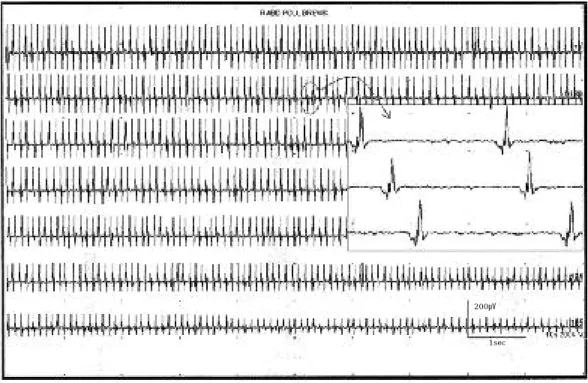
At about 3.5 weeks after symptom onset, we conducted electrophysiological studies including nerve conduction studies, electromyographic nee- dle examination(EMG), blink reflex, F-wave study, repetitive nerve stimulation test, stapedial reflex test, and SP studies by TMS of motor cor- tex and by cutaneous stimulation. EMG revealed the form of trains of motor unit action potential- like discharges, which was induced by needle insertion and slight touch of the muscle. This lasted 2~9 minutes with frequency of 7~10 Hz and gradual decrement of amplitude(Figure 1.).
The cutaneous SP was recorded at the right abductor pollicis brevis muscle with stimulation of the right 5th finger through paired ring elec- trode. The cutaneous SP was absent(Figure 2.).
The SP after TMS recorded at the right abductor pollicis brevis muscle was shortened(Figure 3.).
Nerve conduction studies, blink reflex test, F- wave study, repetitive nerve stimulation test, stapedial reflex test were all non-specific.
DISCUSSION
The clinical syndrome of tetanus is mediated by a toxin, tetanospasmin, produced by the bacteria
Clostridium tetani.9 Tetanospasmin enters peripheral nerves and travels via the axonal ret- rograde transport system to the central nervous system, and then enters presynaptic neurons and disables neurotransmitter release, most impor- tantly, the inhibitory neurotransmitters GABA and glycine.1 0 This results in a disinhibition of end-organ neurons, such as motor neurons and those of the autonomic nervous system.1 0
EMG in our case revealed increased insertional activity in the form of trains of motor unit action potential-like discharges, which lasted several minutes and disappeared during sleep. This find- ing is the same as previous report.6
A single cutaneous electrical stimulus can evoke a period of inhibition in tonic voluntary muscle activity; the period of electrical silence is referred to as the cutaneous SP. It is generally agreed that a nociceptive cutaneous stimulus sufficient to excite A-δfibers is required to evoke a cutaneous SP, and the inhibition of voluntary muscle activi- ty could be produced by the inhibition of motoneurons directly or indirectly. In the previ- ous report, the SP were shortened or absent in t e t a n u s .4 In this case, that is also absent.
Therefore, it represents the disruption of interneuronal inhibitory pathways in the spinal
김정일・이지만・김종열・박성파・서정규
2 J Korean Society for Clinical Neurophysilology / Volume 4 / May, 2002
Figure 1. EMG of the abductor pollicis brevis muscle.(At 3.5 weeks after symptoms onset) There were the form of trains of motor unit action potential-like discharges, which was induced by needle insertion and slight touch of the muscle, and which lasted 2~9 minutes with frequency of 7~10 Hz and gradual decrement of amplitude.
200㎶
1sec
82
cord in the tetanus.
The SP evoked in distal upper limb muscles by TMS of motor cortex is believed to represent the combined influences of recurrent inhibition of spinal motor neurons in the first 50 ms and corti-
cal inhibitory mechanisms thereafter.1 1 The SP was shortened in our case. In the previous report(Warren et al.), shortening or absence of the late phase of EMG silence was observed in tetanus, and which reappeared with clinical
특징적인신경생리학적소견을가진전신성파상풍1례
J Korean Society for Clinical Neurophysilology / Volume 4 / May, 2002 3
Figure 2. Cutaneous silent period elicited in right abductor pollicis brevis muscle with stimulation of the 5th finger.(At 3.5 weeks after symptoms onset) (A) Cutaneous SP in normal subject. (B) Cutaneous SP in tetanus patient.
Figure 3. The silent period elicited in right abductor pollicis brevis muscle by transcranial magnetic stimu- lation.(At 3.5 weeks after symptoms onset) (A) The SP after TMS in normal subject. (B) The SP after TMS in tetanus patient.
200㎷
0.5㎷
20㎳
5㎳
83
r e c o v e r y .5 Cortical inhibitory networks utilizing GABA are the site of action of tetanus toxin in animal models of epilepsy.1 2 Similar intracortical GABAergic networks probably exist in humans.1 3 Disruption of GABAergic transmission by tetanus toxin may be responsible for depression of the cortical SP in the present case.
In conclusion, shortened or absent silent period in this case can be interpreted as evidence of impaired inhibitory mechanisms at multiple levels of the nervous system, including the spinal cord and cerebral cortex. We think that silent period study and electromyographic needle examination is a very useful tool in the understanding of the pathophysiology of tetanus and in the diagnosis of tetanus.
REFERECES
01. Auger RG. AAEM minimonograph #44: Diseases associ- ated with excess motor unit activity. Muscle Nerve 1994;17:1250-1263.
02. Brooks VB, Curtis DR, Eccles JC. The action of tetanus toxoid on the inhibition of motoneurons. J Physiol 1957;135:655-672.
03. Stuppler A, Stuppler E, Adams RD. Local tetanus in man.
Its clinical and neurophysiological characteristics. Arch Neurol 1963;8:162-178.
04. S t e i n e g g e r T , W i e d e r k e h r M , L u d i n H P , R o t h F . Electromyography as a diagnostic aid in tetanus. Schweiz Med Wochenschr 1996;126:379-385.
05. Warren JD, Kimber TE, Thompson PD. The silent period
after magnetic brain stimulation in generalized tetanus.
Muscle Nerve 1999;22:1590-1592.
06. Khuraibet AJ, Neubauer D, Noor KZ, Haleem MA, Trontelj JV. A case of neonatal tetanus with characteristic neurophysiological findings. Muscle Nerve 1998;21:971- 972.
07. de Souza C, Karnad D, de Souza R, Mansukhani K, Tilve GH. The stapedial reflex in cephalic tetanus. J Laryngol Otol 1994;108:736-742.
08. Poncelet AN. Blink reflexes and the silent period in tetanus. Muscle Nerve 2000;23:1435-1438.
09. Ernst ME, Klepser ME, Fouts M, Marangos MN. Tetanus:
pathophysiology and management. Ann Pharmacother 1997;31:1507-1513.
10. Hsu SS, Groleau G. Tetanus in the emergency department:
a current review. J Emerg Med 2001;20:357-65.
11. Ziemann U, Lonnecker S, Steinhoff BJ. Paulus W. The effect of lorazepam on the motor cortical excitability in man. Exp Brain Res 1996;109:127-135.
12. Jefferys JG, Whittington MA. Review of the role of inhibitory neurons in chronic epileptic foci induced by intracerebral tetanus toxin. Epilepsy Res 1996;26:59-66.
13. Ziemann U, Lonnecker S, Steinhoff BJ, Paulus W. Effects of antiepileptic drugs on motor cortex excitability in humans: a transcranial magnetic stimulation study. Ann Neurol 1996;40:367-378.
14. Lee JM, Kwon YW, Cho JH. The usefulness of cutaneous silent period in diabetic polyneuropathy. J of Korean Acad of Rehab Med 1998;22:882-888.
15. Kim MS, Yang WH, Park BG. A study of silent periods following transcranial magnetic stimulation in healthy adults. J of Korean Acad of Rehab Med 1996;20:715-720.
김정일・이지만・김종열・박성파・서정규
4 J Korean Society for Clinical Neurophysilology / Volume 4 / May, 2002
84