• 검색 결과가 없습니다.

Characteristics of Pubertal Development and Environment in Girls with Precocious Puberty According to the Level of Peak LH

N/A
N/A
Protected

Academic year: 2021

Share "Characteristics of Pubertal Development and Environment in Girls with Precocious Puberty According to the Level of Peak LH"

Copied!
10
0
0

로드 중.... (전체 텍스트 보기)

전체 글

(1)

Introduction

Precocious puberty appear secondary sex characteristics before the age of 8-year old in girls

and 9-year old in boys, when breast development and testicular enlargement (testicular volume ≥ 4 mL), respectively, generally begin [1]. The released gonadotropin-releasing hormone (GnRH)

Abstract

There are some reports that high incidence of early onset of sexual development is related to improved nutrition, changes in living habits caused by social and economic developments, and especially to obesity. Our prospective study attempted to identify the features by investigating and analyzing the physical development status, results of specific hormone tests, living environment, and dietary habits of 60 girls who visited our university hospital with symptoms of early secondary sexual characteristics, and to explore the elements that could be helpful for future medical examinations and treatments. Patients were divided in two groups due to the result of gonadotropin- releasing hormone stimulation test. In Group 1, peak luteinizing hormone levels of ≥ 5 mIU/mL and the rest of the patients were included in Group 2. In Group 1, there showed early onset of maternal menstruation (menarche), increased intake of chicken-based foods, increased insulin-like growth factor 1 and estradiol. These result showed that precocious puberty was related to genetic and environmental effects, especially diets such as chicken-based foods. Correcting living environments and diet habits will be helpful for prevention of precocious puberty in girls and future study will be needed.

Key Words : Chicken-based food, Development, Environment, Precocious puberty

Corresponding Author: Chul Jin, M.D., Department of Pediatrics, Keimyung University School of Medicine 56 Dalseong-ro, Jung-gu, Daegu 700-712, Korea

Tel : +82-53-250-7524 E-mail : [email protected]
Department of Pediatrics, Keimyung University School of Medicine, Daegu, Korea

Chul Jin, M.D., Heung Sik Kim, M.D., Ji Yoon Kim, M.D.

Characteristics of Pubertal Development and Environment in Girls

with Precocious Puberty According to the Level of Peak LH

(2)

and gonadotropin stimulate the gonads, thereby initiating puberty earlier than the normal onset age [2].

Many studies have reported various causes of precocious puberty, such as genetic factors, nutritional status, obesity and environmental factors; there has been an increasing interest in precocious puberty caused by an early onset of sexual development because it is usually associated with an increase in body weight and height and induces early bone maturation but eventually reduces adult height as a result of premature epiphyseal fusion [3].

As social and economic development has improved the nutritional status and resulted in lifestyle changes, the number of obese girls with precocious puberty has been increasing [4,5].

Obese children have a tendency towards a significantly earlier development of secondary sexual characteristics in comparison with normal- weight children [6] and these results were assumed to be linked with childhood obesity and pubertal trend changes [7]. In Korea, the average height and body weight of children and adolescents has increased due to westernized dietary habits, as well as social and economic development [8].

Accordingly, precocious puberty in girls has also increased. The incidence of precocious puberty in Korea used to range between 1/5,000 and 1/10,000 but has increased recently [9].

A study by Kim et al. [10] reported higher body mass index (BMI) values in children with early puberty than central precocious puberty due to increased body fat. Accordingly, these authors reported that body composition measurements can be used for the management of lifestyle habits in the follow-up of children with central precocious puberty, because excess body fat may be linked to the disease and this link is particularly important in adolescent girls. Yoon et al. [11] reported while the central precocious puberty group had higher height

and lean body mass, the early puberty group had higher body fat percentage and more severe abdominal obesity. This result showed that early puberty is closely associated with body fat percentage and that maintaining an appropriate BMI or body composition for the age through lifestyle management (such as exercise) is important for the management of precocious puberty. And also, different life style habits and environmental factors may also considerably affect precocious puberty.

In this study, we aimed to figure out the characteristics of girls with precocious puberty and the factors that would be useful for their examination and treatment. We investigated not only the physical development status (including height, body weight, BMI, and the levels of sex hormones), but also lifestyle (including sleep, diet, and exercise habits) in girls with precocious puberty.

Materials and Methods

This study enrolled girls who visited the

Department of Pediatrics in Keimyung University

Dongsan Medical Center with early secondary sex

characteristics and underwent a GnRH stimulation

test. The prospective study was designed and

conducted after approval by the institutional review

board (IRB) of Keimyung University Dongsan

Medical Center. The survey of new and follow-up

patients was performed since May 2013. The GnRH

stimulation test, blood test, and the surveys were

conducted for study cases at the department of

pediatrics in Keimyung University Dongsan Medical

center after a written consent form was signed by a

parent or legal guardian. Medical history and

p h y s i c a l e x a m i n a t i o n s w a s d o n e. B r e a s t

development was measured using Tanner stages;

(3)

the height and body weight were also measured.

BMI was defined as the body weight divided by the square of the height (kg/m²). The Korean National Growth Charts 2007(Centers for Disease Control, The Korean Pediatric Society) were used as a reference. The baselines of estradiol, luteinizing hormone (LH) and follicle-stimulating hormone (FSH) were assessed. LH and FSH were measured at 30, 60, 90, and 120 min after an injection of 100 µg of GnRH. Thyroid function tests were also performed to exclude hypothyroidism that may associated with weight problem. X-ray studies of the left hand were conducted to evaluate the bone age using the Greulich and Pyle method. The uterus and ovaries were examined with pelvic ultrasound.

The survey was completed by filling out a case report form (CRF) under the permission of a parent or a guardian. CRF included questions about family history, height, body weight, and BMI of parents.

In addition, housing type, family size, exercise frequency, sleep time, meal frequency, breakfast frequency, average mealtime, taking a night snack, and the presence of underlying diseases were assessed to analyze the lifestyle. CRF is presented in the appendix pages of this study.

According to the literature, in the GnRH stimulation test, girls who had peak LH levels of

≥ 5 m I U / m L w i t h e a r l y s e c o n d a r y s e x characteristics start the treatment [12,13].

Therefore, girls who had peak LH levels of ≥ 5 mIU/mL were classified as Group 1; those with LH peak levels of less than 5 mIU/mL were classified as Group 2. And two groups were compared to know significant differences between them.

The results were expressed as median values and P values less than 0.05 were considered statistically significant. Median values and standard d e v i a t i o n s w e r e c o m p a r e d u s i n g t h e Mann–Whitney U test for comparison of two groups. Categorical data were compared using the

Pearson's chi-squared test and statistically analyzed using SPSS for Windows (version 19.0).

Results

Out of total 60 patients, 42 patients were classified as Group 1 and 18 patients as Group 2.

The median age value was 7.8 years for both groups combined. There was no significant difference in the median age between the two groups (8.0 in Group 1 and 7.4 in Group 2). The median BMI value was 17.3 for both groups combined and there was no significant difference between the two groups (17.6 in Group 1 and 16.7 in Group 2). The median Tanner stage was 2.7 in both groups combined; there was a significant difference (p<0.05) between the two groups (2.8 in Group 1 and 2.4 in Group 2). According to family histories, the mothers’ menarche age was significantly lower (p<0.01) in Group 1 than in Group 2 (12.5 and 13.4, respectively) (Table 1).

There were no significant differences between the two groups in the frequency of watching TV, exercise time of more than 20 min per week, average sleep time per day, duration of cell phone use, use of cosmetics, breakfast frequency, average hours per meal, and night snack (Table 2).

Analysis of dietary habits showed that, in Group 1, the average frequency of chicken-based food consumption was higher than in Group 2 (p<0.05).

No significant differences were found in the type of drinking water, average frequency of soybean consumption, frequency of consumption of foods cooked with beef, pork, fish, shellfish, vegetables, or eggs (Table 3).

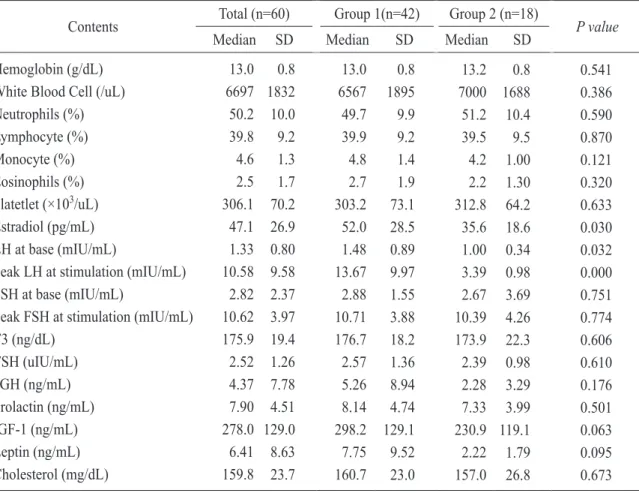
In hormone tests, the median estradiol level was

47.1 pg/mL in both groups combined; it was

significantly higher (p<0.05) in Group 1 than in

Group 2 (52.0 pg/mL vs. 35.6 pg/mL). The median

(4)

value for insulin-like growth factor 1 (IGF-1) was 298.2 ng/mL in Group 1 and 230.9 ng/mL in Group 2, but this difference was not significant (Table 4).

Discussion

Precocious puberty is diagnosed when the secondary sex characteristics appear before the age of 8 years in girls and their bone ages are mostly older than their chronological ages. If the LH levels in the GnRH stimulation test are 3 times the baseline and the peak LH levels are higher than 5 mIU/mL and no underlying organic causes are detected, they will be diagnosed with idiopathic central precocious puberty. Girls with secondary sex characteristics developing between the ages of 8 to 10 years who otherwise satisfy the diagnostic criteria for idiopathic central precocious puberty are diagnosed with early puberty.

Precocious puberty may induce a temporary increase in the growth rate but causes premature epiphyseal fusion by promoting early maturation of growth plates. It eventually reduces the adult height. Girls with precocious puberty suffer from social and psychological problems. Early and accurate diagnosis and treatment are required to solve these problems. However, not every child who has some signs of early sexual maturation needs treatment. Although the GnRH stimulation test is a gold standard in the diagnosis of precocious puberty, its use is difficult because, for example, it requires frequent blood tests and accurate sampling time. Therefore, it is important to select patients who need specific examinations and treatments.

In this study, the median age of girls with precocious puberty was 7.8 years. The reported ages of children around the world who experience early sexual maturation are lower. On average, girls Table 1. Comparision of demographic characteristics in study population

Contents Total (n=60) Group 1(n=42) Group 2 (n=18)

P value

Median SD Median SD Median SD

Age (year) Height (cm) Weight (kg) BMI (kg/m²) BA (year) CA (year) BA-CA (year) Father's Height (cm) Father's Weight (kg) Mother's Height (cm) Mother's Weight (kg) Tanner stage (grade)

Mother's Menache Age (year)

7.8 132.8 30.7 17.3 9.8 8.5 1.4 173.3 72.6 158.9 54.5 2.7 12.7

1.0 7.3 6.1 2.3 1.6 1.0 1.0 4.9 9.3 4.9 6.9 0.7 1.2

8.0 133.86 31.8 17.6 9.9 8.6 1.5 173.2 73.4 158.6 55.1 2.8 12.5

1.0 7.4 6.3 2.4 1.7 1.1 1.1 4.8 9.8 5.1 6.6 0.7 1.1

7.4 130.2 28.2 16.7 9.5 8.4 1.2 173.7 70.7 159.7 53.0 2.4 13.4

0.9 6.5 4.9 2.2 1.1 0.6 0.7 5.3 8.0 6.6 7.5 0.6 1.3

0.058

0.073

0.036

0.150

0.362

0.708

0.302

0.692

0.304

0.397

0.290

0.045

0.005

SD: standard deviation.

(5)

reached puberty by the age of 12 to 13 in the middle of the 20th century, but reach it faster nowadays [14]. The number of girls who visit the departments of pediatrics and endocrine clinics has increased in Korea. Kim et al. [15] reported that the data

for boys are unclear, but girls’ puberty (for example, their menarche age) now starts earlier.

The onset of puberty is influenced by environmental factors, including the social and economic level, home environment, nutritional Table 2. Difference related to life styles

Contents Group 1 Group2 P value

Total Exercise

1-2 times/week 3-4 times/week 5-6 times/week 7 times/week Sleep

7-8 hours/day

≥ 9 hours/day

Cell phone (used time)

0-1 hours/day 1-2 hours/day 2-3 hours/day

>3 hours/day Cosmetics

Used Unused Breakfast

Eat Not eat Meal time (average)

<10 minutes 10-20 minutes 20-30 minutes

≥ 30 minutes

Night meal (after p.m 7) 1 time 2 times 3 times 4 times

42(100%) 1(2.4%) 26(61.9%)

9(21.4%) 6(14.3%) 26(61.9%) 16(38.1%) 15(35.7%) 15(35.7%) 8(19.0%) 4(10.0%) 29(69.0%) 13(31.0%) 40(95.2%) 18(100.0%)

9(21.4%) 21(50.0%) 12(28.6%) 0(0.0%) 24(57.1%)

8(19.0%) 5(11.9%) 5(11.9%)

18(100%) 1(5.6%) 7(38.9%) 4(22.2%) 6(33.3%) 11(61.1%)

7(38.9%) 10(55.6%)

6(33.3%) 1(5.6%) 1(5.6%) 11(61.1%)

7(38.9%) 2(4.8%) 0(0.0%) 1(5.6%) 12(66.7%)

4(22.2%) 1(5.6%) 11(61.1%)

2(11.1%) 4(22.2%) 1(5.6%)

0.274

0.954

0.233

0.550 0.346

0.167

0.591

(6)

Table 3. Difference related to food styles

Contents Group 1 Group2 P value

Total Water type

Bottled water Purified water Tap water Etc.

Chicken food

0 time/ week 1 time/ week 2 times / week 3 times / week 4 times / week

42(100%) 3(7.1%) 30(71.4%)

6(14.3%) 3(7.1%) 16(38.1%) 22(52.4%) 1(2.4%) 1(2.4%) 2(4.8%)

18(100%) 2(11.1%) 8(44.4%) 5(27.8%) 3(16.7%) 13(72.2%) 3 (16.7%) 2(11.1%) 0(0.0%) 0(0.0%)

0.253

0.039

Table 4. Comparision of demographic characteristics in study population

Contents Total (n=60) Group 1(n=42) Group 2 (n=18)

P value

Median SD Median SD Median SD

Hemoglobin (g/dL) White Blood Cell (/uL) Neutrophils (%) Lymphocyte (%) Monocyte (%) Eosinophils (%) Platetlet (×10

3

/uL) Estradiol (pg/mL) LH at base (mIU/mL)

Peak LH at stimulation (mIU/mL) FSH at base (mIU/mL)

Peak FSH at stimulation (mIU/mL) T3 (ng/dL)

TSH (uIU/mL) hGH (ng/mL) Prolactin (ng/mL) IGF-1 (ng/mL) Leptin (ng/mL) Cholesterol (mg/dL)

13.0 6697 50.2 39.8 4.6 2.5 306.1 47.1 1.33 10.58 2.82 10.62 175.9 2.52 4.37 7.90 278.0 6.41 159.8

0.8 1832 10.0 9.2 1.3 1.7 70.2 26.9 0.80 9.58 2.37 3.97 19.4 1.26 7.78 4.51 129.0 8.63 23.7

13.0 6567 49.7 39.9 4.8 2.7 303.2 52.0 1.48 13.67 2.88 10.71 176.7 2.57 5.26 8.14 298.2 7.75 160.7

0.8 1895 9.9 9.2 1.4 1.9 73.1 28.5 0.89 9.97 1.55 3.88 18.2 1.36 8.94 4.74 129.1 9.52 23.0

13.2 7000 51.2 39.5 4.2 2.2 312.8 35.6 1.00 3.39 2.67 10.39 173.9 2.39 2.28 7.33 230.9 2.22 157.0

0.8 1688 10.4 9.5 1.00 1.30 64.2 18.6 0.34 0.98 3.69 4.26 22.3 0.98 3.29 3.99 119.1 1.79 26.8

0.541

0.386

0.590

0.870

0.121

0.320

0.633

0.030

0.032

0.000

0.751

0.774

0.606

0.610

0.176

0.501

0.063

0.095

0.673

SD: standard deviation.

(7)

status, stress, and exposure to endocrine-disrupting chemicals (such as environmental hormones), as well as genetic factors including race and gender.

Genetic factors have a more critical role, especially in developed countries [16]. In this study, the median mothers’ menarche age was 12.7 years. It was significantly lower (12.5 years) in Group 1 patients. According to other reports, central precocious puberty is linked to the lower gestational age or mothers’ younger age at menarche [17], probably because of genetic influences or mothers and their daughters growing up in similar environments.

Girls with precocious puberty showing significant results on the GnRH stimulation test tended to consume more chicken-based foods. Our study that involved 30 patients reported similar results for soybean consumption; this effect is thought to be due to phytoestrogens present in soybean. However, Maskarinec et al. [18] reported that drinking soymilk was not significantly associated with hormone levels in women and our study that involved 60 patients reported no significant differences in soybean consumption too. More studies with larger numbers of subjects are needed that would also take into account more specific information, for example, types of chicken and soybeans or how to intake those.

Various ways to drink water, such as from water purifiers or bottled water, have been developed. In this study, there was no significant difference between Groups 1 and 2, but 71.4% of girls in Group 1 (30/42) drank purified water compared with only 44.4% in Group 2 (8/18). More research is required to figure out whether the difference in the peak LH levels between the groups was due to purified water itself, which contained less minerals, or to the water-purifying filters. If these results are reproduced in large-scale studies in the future, additional research may be conducted to clarify the

differences between water purifier types and the relationship between water composition and precocious puberty.

Nutritional status is also known to affect the onset of puberty. In particular, nutrition should reach a certain level and body fat accumulation is very important [19]. Park et al. [20] reported that, among 170 Korean children, the onset of puberty was earlier in obese children. In our study, the median BMI was 17.3 in both groups combined and there was no significant difference between the two groups (17.6 in Group 1 and 16.7 in Group 2).

If precocious puberty can be induced by the sex hormone that is directly activated in the body fat, the body composition analysis, such as body fat calculation, is more critical than calculating only BMI. Papadimitrious et al. [21] reported that obesity affects the early onset of puberty in girls and that body fat plays a key role. Kim et al. [22] analyzed the data for 988 Korean girls and found that the BMI standard deviation score was significantly higher in girls with central precocious puberty. The authors insisted that regular follow-up is more important for children who are taller or heavier than normal children. Hyperinsulinemia in obese children promotes precocious puberty by stimulating the secretion of androgen, activating aromatase in adipose tissue and reducing the production of sex hormone–binding globulin in the liver [23].

According to the study by Nam et al. [24],

children with central precocious puberty showed

an increased growth rate, older bone age and

higher baselines of LH, FSH and estradiol; the

growth rate was the most important factor. Kim et

al. [25] also reported that the yearly growth rate,

bone age, an increased LH baseline and peak LH

and FSH levels after GnRH stimulation were

significantly associated with precocious puberty.

(8)

The median IGF-1 level was 278.0 ng/mL in both groups; it was significantly higher in Group 1 than in Group 2. Other studies also reported that IGF-1 was increased in children with central precocious puberty measured on the basis of early breast development [26,27].

According to a study by Na et al. [28], early puberty was observed in 36.3% of children with early onset of sexual development, central precocious puberty in 30.4%, premature thelarche in 29.1%, pseudo precocious puberty in 3.7%, and premature adrenarche in 0.5%. Although girls had negative results in the initial GnRH stimulation test, they may have positive results in a follow-up test.

Kilic et al. [29] reported that 22.1% of girls were transferred from other clinics because of wrong signs of precocious puberty. Therefore, there will be many cases of early puberty, early breast development and early onset of pubic hair that are different from central precocious puberty required the treatment. If we prevent unnecessary examinations and treatment in precocious puberty by identifying the lifestyle habits typical for patients with hypertension and diabetes, we can reduce the economic and social losses from it. It is also very important to diagnose the disease correctly and to educate the patients with precocious puberty and their parents regarding treatment options.

Summary

I n t h i s s t u d y, w e a n a l y z e d p h y s i c a l development, laboratory findings and living environment of girls with precocious puberty.

There were significant differences in mothers’

menarche ages, the frequency of consumption of chicken-based foods, and the levels of IGF-1 and estradiol between Group 1 and Group 2 patients

(who had the peak LH levels of ≥ 5 mIU/mL and <

5 mIU/mL, respectively). However, the limitations of this study were the small number of subjects and a possibility of survey errors. Because this study was designed as a prospective study, it should be possible to perform further evaluations during the follow-up period, including the relationship between the lifestyle habits of the girls and their response to treatment, and the analysis of test results in Group 2. Additional studies will be required to analyze by classifying girls who visit the hospital because of an early onset of sexual development related to central precocious puberty, early puberty, early breast development or early onset of pubic hair development. It is also very important to select patients who need specific examinations or treatments, and to modify the risk factors for the early onset of sexual development in the living environment and lifestyle habits.

Acknowledgement

This study was done with the partial support of the research fund of Ferring company.

Conflict of Interest

The authors report no conflict of interest in this work.

References

1. Kliegman RM, Stanton B, St. Geme J, Schor N, Behrman RE. Nelson Textbook of Pediatrics. 19th ed.

Philadelphia: Elsevier Saunders; 2011. p.1887-9.

2. Carel JC, Lahlou N, Roger M, Chaussain JL.

Precocious puberty and statural growth. Hum Reprod

(9)

Update 2004;10:135-47.

3. Magiakou MA, Manousaki D, Papadaki M, Hadjidakis D, Levidou G, Vakaki M, et al. The efficacy and safety of gonadotropin-releasing hormone analog treatment in childhood and adolescence. A single center, long-term follow-up study. J Clin Endocrinol Metab 2010;95:109- 17.

4. Kaplowitz PB, Slora Ej. Wasserman RC, Pedlow SE, Herman-Giddens ME. Earlier onset of puberty in girls.

relation to increased body mass index and race.

Pediatrics 2001;108:347-53.

5. Rosenfield RL, Lipton RB, Drum ML. Thelarche, pubarche, and menarche attainment in children with normal and elevated body mass index. Pediatrics 2009;123:84-8.

6. Ahmed ML, Ong KK, Dunger DB. Childhood obesity and the timing of puberty. Trends Endocrinol Metab 2009;20:237-42.

7. Marshall WA, Tanner JM. Variations in pattern of pubertal changes in girls. Arch Dis Child 1969;44:291- 303.

8. Park YS, Lee DH, Choi JM, Kang YJ, Kim CH. Trend of obesity in school age children in Seoul over the Past 23 Years. Korean J Pediatr 2004;47:247-57.

9. Kaplowitz P. Precocious puberty: update on secular trends, definitions, diagnosis, and treatment. Adv Pediatr 2004;51:37-62.

10. Kim HJ, Kim YH, Chung SC. Growth status and body composition in children with central precocious puberty and early puberty. Ann Pediatr Endocrinol Metab 2012;17:169-74.

11. Yoon JR, Ahn JH, Huh K, Park MJ. Body composition in girls with precocious puberty. Korean J Obes 2010;19:95-100.

12. Park MJ. Update in the etiology and treatment of sexual precocity. Korean J Pediatr 2006;49:718-725.

13. Kim YJ, Lee HS, Lee YJ, Lim JS, Kim SY, Kim EY, et al. Multicenter clinical trial of leuprolide acetate depot (Luphere depot 3.75mg) for efficacy and safety in girls with central precocious puberty. Ann Pediatr

Endocrinol Metab 2013;18:173-8.

14. Ritzen EM. Early puberty: what is normal and when is treatment indicated. Horm Res 2003;60(Suppl 3):31-4.

15. Kim JH, Shin CH, Lee SY. Observed trends for an earlier onset of puberty: when is the need for treatment indicated. J Korean Med Assoc 2009;52:1189-200.

16. Parent AS, Teilmann G, Juul A, Skakkebaek NE, Toppari J, Bourguignon JP. The timing of normal puberty and the age limitis of sexual precocity:

variation around the world, secular trends, and change after migration. Endocr Rev 2003;24:668-93.

17. Ibanez L, Lopez-Bermejo A, Diaz M, Marcos MV.

Endocrinology and gynecolocy of girls and women with low birth weight. Fetal Diagn Ther 2011;30:243- 9.

18. Maskarinec G1, Morimoto Y, Novotny R, Nordt FJ, Stanczyk FZ, Franke AA. Urinary Sex steroid excretion levels during a soy intervention among young girls: a pilot study. Nutr Cancer 2005;52:22-8.

19. Frisch RE, Revelle R, Cook S. Components of weight at menarche and the initiation of the adolescent growth spurt in girls:estimated total water, lean body weight and fat. Hum Biol 1973;45:469-83.

20. Park YJ, Moon CM, Yoo HJ. A study of factors influencing advanced puberty. Korean J Pediatr 2010;53:146-151.

21. Papadimitrious A, Nicolaidou P, Fretzayas A, Chrousos GP. Clinical review: constitutional advancement of growth, also known as early growth acceleration, predicts early puberty and childhood obesity. J Clin Endocrinol Metab 2010;95:4535-41.

22. Kim DS, Cho SY, Maeng SH, Yi ES, Jung YJ, Park SW, et al. Diagnosis and constitutional and laboratry features of Korean girls referred for precocious puberty. Korean J Pediatr 2012;55:481-6.

23. Kim SH, Park MJ. Childhood obesity and pubertal development. J Pediatr Gastroenterol Nutr 2012;15:151-9.

24. Nam HK, Rhie YJ, Son CS, Park SH, Lee KH. Factor

to predict positive results of gonadotropin releasing

(10)

hormone stimulation test in girls with suspected precocious puberty. J Korean Med Sci 2012;27:194-9.

25. Kim TH, Coe HJ, Kim S, Lee SW, Chae HW, Kim YS, et al. Clinical and endocrinologic characteristics of children referred for precocious puberty. J Korean Soc Pediatr Endocrinol 2007;12:119-26.

26. Sales DS, Moreira AC, Camacho-Hubner C, Ricco RG, Daneluzzi JC, Campos AD, et al. Serum insulin- like growth factor (IGF)-I and IGF-binding protein-3 in girls with premature thelarche. J Pediatr Endocrinol Metab 2003;16:827-33.

27. Lee HS, Yu JE, Yi KH, Hwang JS. Clinical and biochemical factors associated with GnRH stimulation

test in the idiopathic central precocious puberty and early puberty girls. J Korean Soc Pediatr Endocrinol 2008;13:41-9.

28. Na JM, Lee YJ, Kim MS, Lee DY, Yeo CY, Kim CJ, et al. Causes of precocious puberty : multicenter study in Honam area. J Korean Soc Pediatr Endocrinol 2009;14:30-7.

29. Kilic A, Durmus MS, Unuvar E, Yildiz I, Aydin BK,

Ucar A, et al. Clinical and laboratory characteristics of

children referred for early puberty: preponderance in

7-8 years of age. J Clin Res Pediatr Endocrinol

2012;4:208-12.

수치

Table 4.  Comparision of demographic characteristics in study population

참조

관련 문서