• 검색 결과가 없습니다.

A Study on the Causal Relationships of Quality of Life according to the Mobile Phone Overdependence of University Students

N/A
N/A
Protected

Academic year: 2021

Share "A Study on the Causal Relationships of Quality of Life according to the Mobile Phone Overdependence of University Students"

Copied!
8
0
0

로드 중.... (전체 텍스트 보기)

전체 글

(1)

JKSCI

A Study on the Causal Relationships of Quality of Life according to the Mobile Phone Overdependence of University Students

1)

Woo-Hong Cho*

*Professor, Dept. of Social Welfare, Seowon University, Chungbuk, Korea

[Abstract]

The purpose of this study was to investigate the effect of university students' mobile phone Overdependence on their quality of life. To achieve the purpose of the study, a survey was conducted on 348 male and female students attending a four-year college in C city. Data were analyzed using the structural equation model of SPSS 19.0 and AMOS 18.0. As a result, male students showed higher Overdependence on mobile phone than female students, and male students used games, videos, and searches in order.

Academic satisfaction showed higher male and female students in all majors, rather than liberal arts, mobile phone excessive Overdependence appeared to affect academic satisfaction. In addition, the overdependence of mobile phone of university students has a significant effect on academic satisfaction, and academic satisfaction has an effect on life satisfaction. In particular, college students entering adulthood remained intact in their adolescence, affecting college life due to mobile phone overdependence.

▸Key words: Overdependence, Quality of Life, Mobile Phone, University Life, Information Society

[요 약]

본 연구는 대학생의 휴대폰 과의존에 따른 삶의 질에 어떠한 영향을 미치는지 파악하고자 하였 다 . 연구의 목적을 달성하기 위해 C도의 4년제 대학에 다니고 있는 남·여학생들을 348명을 대상 으로 설문조사를 실시하였다. 연구방법으로 SPSS 19.0과 AMOS 18.0의 구조방정식모형을 사용하 여 자료분석 등을 실시하였다 . 분석결과 남학생이 여학생에 비해 휴대폰 과의존이 높게 나타났고, 남학생의 경우 게임 , 동영상, 검색 등 순으로 이용을 많이 하는 것으로 나타났다. 학업성적 만족 도는 남·여학생 모두 교양보다는 전공에서 높게 나타났으며, 휴대폰 과의존은 학업성적 만족도에 영향을 미치는 것으로 나타났다 . 또한, 대학생의 휴대폰 과의존은 학업성적 만족도에 유의미한 영 향을 미치고 학업성적 만족도는 삶의 만족도에도 영향을 미치는 것으로 나타났다 . 특히, 성인기에 접어든 대학생들은 기존 청소년기의 습관이 그대로 남아있어 휴대폰 과의존으로 인한 대학생활에 영향을 미치고 있는 것으로 나타났다 .

▸주제어: 과의존, 삶의 질, 휴대폰, 대학생활, 정보사회

∙First Author: Woo-Hong Cho, Corresponding Author: Woo-Hong Cho

*Woo-Hong Cho ([email protected]), Dept. of Social Welfare, Seowon University

∙Received: 2018. 01. 10, Revised: 2018. 01. 26, Accepted: 2018. 01. 29.

Copyright ⓒ 2020 The Korea Society of Computer and Information http://www.ksci.re.kr pISSN:1598-849X | eISSN:2383-9945

(2)

I. Introduction

The development of information and communication technology is changing our whole life. The development and dissemination of new information and communication devices, represented by smartphones, is not only making individual lives convenient, but also reshaping the structure of our society through the construction of new social networks[1].

It is no exaggeration to say that mobile phones are a necessity of life for almost everyone in our society. In particular, for the digital generation of teenagers, mobile phones have become a tool of practical use and a kind of ego for play, leisure, learning, communication, and social relations.

In a society where material abundance and relative deprivation are crossing in modern society, the phenomenon of addiction requires a fundamental reflection on the life perspective of our society. Representative addictions such as drugs, alcohol, gambling, etc. are not only hard to bear to addiction to individuals and their families, but also pose a serious threat to the life culture of our society due to the enormous social costs and conflicts caused by addiction. In particular, cell phone addiction of college students is appearing as various social problems.

assortment

‘12

year ‘13year ‘14year ‘15year ratio ratio num

eral ratio num

eral ratio num eral smart

phone overdepen

dence risk

18.4 25.5 1,117 29.2 1,562 31.6 1,704

high risk 2.7 2.4 104 3.3 174 4.0 215 potential

risk 15.7 23.1 1,013 25.9 1,388 27.6 1,489 source: National Information Society Agency(2016) Table 1. Percentage and number of youth smartphone overdependence risk groups by year (Unit:%, thousand)

As shown in Table 1, the Korea Information Society Agency (2016)[2] shows that the smartphone -dependent risk ratio was 18.4% in 2012, 31.6% in

2015, and the high risk ratio was 2.7% in 2012, 4.0% in 2015, Potential risk ratios nearly doubled from 15.7% in 2012 to 27.6% in 2015.

The dictionary definition of overuse is “too much, not written to fit a certain neck or function.

Or such excessive use. When this meaning is applied to mobile phones, it can be understood that overuse of mobile phones involves excessive use of social communication by the neck, which entails dependent or compulsive behavior[3].

University students meet their needs by using mobile phones, and the use of mobile phones is used for various purposes such as information acquisition, knowledge and information retrieval, leisure use, entertainment, habits, relaxation, social interaction, social interaction, communication, and communication. It is done.

In this regard, how does cell phone dependence on college students affect life satisfaction? When college students use cell phones, their purpose and motivation will be met, which may lead to increased satisfaction in life. But inadequate or undesirable cell phone use and overdependence may have the effect of lowering life satisfaction.

The purpose of this study is to suggest that life satisfaction according to the dependence of the cell phone on the cell phone will be different.

Above all, it is important to identify the factors that affect the prevention of cell phone dependence problems and the solution[4]. Intervention to improve the healthy use of mobile phones and the improvement of life satisfaction by setting up a conceptual causal relationship that explains how college students' dependence on cell phones affects life satisfaction and how academic satisfaction affects life satisfaction. You may be able to provide some basic information that will help you develop a plan.

II. The Research Method

1. Mobile phone dependence and life satisfaction

Previous studies that studied the effects of cell

phone dependence on life satisfaction also found

(3)

that cell phone use frequency and cell phone dependence have a significant effect on the life satisfaction of university students. Although they were confirmed, their influences differed. The frequency of cell phone use by college students can have positive and negative effects on life satisfaction of college students.

Mobile phones have become useful in human life in many ways, making them more convenient, faster, and more enjoyable and energizing. In particular, adolescents who are the most sensitive to information and communication devices may have more serious problems with cell phones[5].

(HeeSook, L & SoonKyung, K, 2018), according to a study by a smartphone-dependant teenager, eating habits such as sleep, drinking, smoking, and other harmful health habits such as sleep, drinking, smoking, unbalanced eating, overeating, and fast eating It was observed that the need for improvement of[6].

Smartphone overdependence can have a significant effect on the life satisfaction of college students. The life satisfaction of smartphone high risk users and potential risk users was significantly lower than that of general users. Mobile phone dependence, social atrophy, and neglectful rearing attitude[7] have significant influences.

Ego-resilience is also a factor affecting smartphone dependence. The level of ego elasticity was high[8].

2. Relationship between cell phone dependence, academic performance, and life satisfaction

Currently, domestic and foreign prior studies verifying the complex relationship between cell phone usage frequency, academic performance, and life satisfaction have not been searched, but few previous studies have verified the relationship among certain variables.

(GyooYeong, C & YunHee, K, 2014)showed that the smartphone high-risk users group was 6.2%, the potential risk users group was 21.2%, and the smartphone addiction rate was 27.4%. The more

girls, the more weekly and weekend average smartphone usage time, and the more weekend average smartphone usage time, the wrist pain during smartphone use, the accident during mobile phone use, the lower the sociality, the impulse and SNS addiction The higher the degree, the more likely it is that college students are addicted to smartphones. Therefore, in order to effectively prevent college student cell phone addiction, it is necessary to develop and apply differentiated intervention strategies according to the degree of addiction in consideration of these factors[9].

At the same time as the penetration rate of mobile phones in Korea has grown rapidly, awareness of social problems has been raised continuously[10]. Mobile phones have a side that is difficult to see from other lines such as other poisonous substances, and people who have been used a lot by learning or searching through mobile phones are not addicted. Cell phone addiction is excessive in view of the obsessive symptoms and physical discomforts of people who have to work to collect and deliver information quickly and anywhere, regardless of the place. Therefore, recent studies tend to use the concept of smartphone dependency or overdependence instead of the concept of addiction[11].

It is necessary to discuss information sharing and communication, education and revitalization measures for the creation of a global social cell phone culture, and to verify the relationship between variables so that they can adapt well and live affluent lives in society.

III. Results of the study

1. Measuring Tool Verification

Nine questions were surveyed according to the frequency of cell phone use and cell phone usage.

Each item was composed of “1 point: frequently

used” to “4 points: not used at all” on the Likert 4

(4)

point scale. According to the confirmatory factor analysis, the standardized factor loading was used statistically and the confidence level was Cronbach's α = 0.697.

The level of “life satisfaction” in this study was measured by adding together the subjective evaluation of one's life. Each question consists of the Likert 4 point scale from “1 point: very much” to “4 points: very not dissatisfied”. It is meant to be higher.

The reliability index was Cronbach's α = 0.725.

In addition, the control variables in this study are gender and subjective family economic level.

Gender was measured as “1: male” and “2: female”.

In the analysis step, the dummy variable was processed. Subjective household conditions were measured on a Likert 7-point scale, ranging from

“1 point: very well lived” to “7 points: very poorly lived.” The higher the score, the better the economic condition of the family.

2. Inspection and analysis of data

In order to check the normality distribution of the data distribution, the distortion and kurtosis of individual and summed items of each variable were measured at the data inspection stage. Was carried out. In the analysis phase of data, the concentration validity of the measurement items and the discriminant validity between variables were analyzed to verify the suitability of the measurement model. In addition, to verify the relevance of the research model and the significance of the research hypothesis, the fitness index of the research model was calculated and the significance of the path coefficient was verified.

Ⅳ. Analysis result

1. Collection of Survey Subjects and Data This study surveyed students at college C. The investigation period was conducted for two weeks from October 16 to 27, 2017. Cases that were

inappropriately answered, such as insincere or collective responses, or responses with regular patterns, were deleted from the data. A total of 348 respondents were selected in this way. Among the survey subjects, 161 male students(46.3%) and 187 female students(53.7%) were used for the final statistical analysis. Their personal characteristics, such as their gender, grade type, and subjective family circumstances, are presented in Table 2.

variable assortment Frequency

(person) ratio(%)

gender male 161 46.3

female 187 53.7

academic year

1grade 70 20.2

2grade 94 26.9

3grade 123 35.3

4grade 61 17.6

home economy (Subjectivity)

live very

well 2 0.7

live well 15 4.3

live slightly

well 32 9.2

medium (medium)

level

228 65.4

some can't

live 53 15.2

can't live 16 4.5

very can't

live 2 0.7

Table 2. Socio-demographic characteristics of survey subjects

2. Correlation Analysis Results and Descriptive Statistics

According to the correlation analysis results of

<Table 3>, the frequency of mobile phone use has

a significant negative correlation with academic

satisfaction (r = -0.126, p<0.01). The correlation

between frequency and life satisfaction was not

significant. There was also a significant positive

correlation between academic satisfaction and life

satisfaction (r = 0.147, p<0.01).

(5)

frequency of cell phone use

academic satisfaction

life satisfaction frequency of

cell phone

use 1

academic

satisfaction -0.126** 1

life

satisfaction -0.006 0.147** 1

number of

cases 348 348 34864

average 2.95 3.13 3.17

standard

deviation 0.69 0.72 0.73

maximum

value 5 4 4

minimum

value 1 1 1

skewness -1.125 0.146 0.089

kurtosis 0.953 0.357 0.112

** p<0.01

Table 3. Result of correlation analysis and descriptive statistics between major variables

The average frequency of cell phone use is 2.95 points (standard deviation 0.69), which is equivalent to '1 point: often used' and '2 points: sometimes used.' The average grade of academic satisfaction is 3.13 points (standard deviation 0.72), which is close to '3 points: moderate.' The average life satisfaction is 3.17 points (standard deviation 0.73), slightly above 'two points: that'. In addition, the analysis of the skewness and kurtosis of the main variables revealed that the absolute value of the skewness exceeds 3 or the absolute value of the kurtosis exceeds 10.

3. Measurement Model Verification

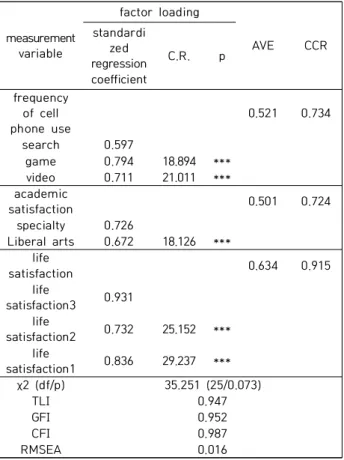
As shown in Table 4, the goodness of fit of the measurement model was verified to ensure that the variables were properly measured by the sub -measurement items.

measurement variable

factor loading

AVE CCR

standardi zed regression coefficient

C.R. p

frequency of cell phone use

0.521 0.734

search 0.597

game 0.794 18.894 ***

video 0.711 21.011 ***

academic

satisfaction 0.501 0.724

specialty 0.726

Liberal arts 0.672 18.126 ***

life

satisfaction 0.634 0.915

life

satisfaction3 0.931 life

satisfaction2 0.732 25.152 ***

life

satisfaction1 0.836 29.237 ***

χ2 (df/p) 35.251 (25/0.073)

TLI 0.947

GFI 0.952

CFI 0.987

RMSEA 0.016

*** p<0.001

Table 4. Results of intensive validity test of measured variables

The goodness-of-fit index of the measurement model was χ2 = 35,251, df = 25, p = 0.073, which supported the zero hypothesis that there was no difference between the reproduced data and the actual population data through this measurement model(TLI = 0.947, GFI = 0.952, CFI = 0.987, RMSEA

= 0.016).

As shown in <Table 4>, the standardized factor loading of three items measuring the frequency of using mobile phones, three items measuring academic satisfaction, and three items measuring life satisfaction were statistically significant and acceptance criteria. (β = 0.5 or more) was satisfied.

In addition, the average variance extraction values

of mobile phone usage frequency and academic

performance satisfaction were 0.521 and 0.501,

respectively. The conception credibility of the

frequency of use of mobile phones, academic

satisfaction, and life satisfaction were found to

meet the acceptance criteria(0.7 or more).

(6)

Path coefficient AVE r r2 frequency of cell

phone use

↔ academic satisfaction

requency of cell phone use=0.526

academic satisfaction=0.482

-0.172 0.026

frequency of cell phone use

↔ life satisfaction

requency of cell phone use=0.526

life satisfaction=0.614

-0.016 0.000

academic satisfaction

↔ life satisfaction

academic satisfaction=0.482

life satisfaction=0.614

0.233 0.051 Table 5. Judgment validity test results among potential variables

The discriminant validity test between the latent variables in Table 5 is performed by comparing the mean variance extraction of each variable with the square of the correlation coefficient.

In the case of mobile phone usage and academic satisfaction, both the average variance extraction of smartphone usage frequency(0.526) and the average variance extraction of academic satisfaction(0.482) were larger than the square of the correlation coefficient between two variables. In addition, it can be confirmed that discrimination validity exists between the frequency of use of the mobile phone and the satisfaction of life, and between the academic achievement and the life satisfaction, respectively.

4. Validation of Research Model

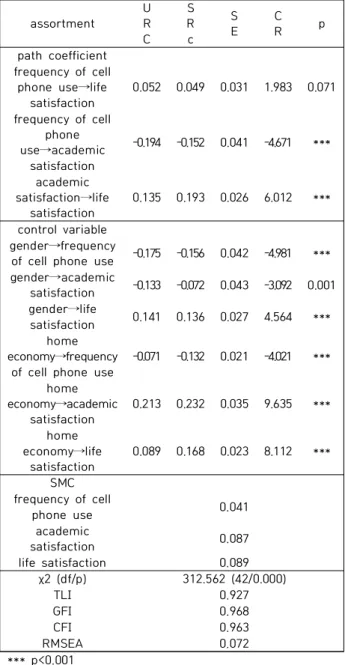
As shown in Table 4, the suitability of the measurement model was verified. The goodness -of-fit index of the measurement model was(χ2 = 312.562, df = 42, p = 0.000). The final study model was confirmed.

As a result of verification of the research model, the effect of the frequency of using the mobile phone on the life satisfaction was not significant (β

= 0.049, p> 0.05). The frequency of use of mobile phones has a significant negative influence on academic satisfaction (β = -0.152, p<0.001). (Β = 0.193, p<0.001).

assortment

U R C

S R c

S E

C

R p

path coefficient frequency of cell

phone use→life

satisfaction 0.052 0.049 0.031 1.983 0.071 frequency of cell

phone use→academic

satisfaction

-0.194 -0.152 0.041 -4.671 ***

academic satisfaction→life

satisfaction

0.135 0.193 0.026 6.012 ***

control variable gender→frequency

of cell phone use -0.175 -0.156 0.042 -4.981 ***

gender→academic

satisfaction -0.133 -0.072 0.043 -3.092 0.001 gender→life

satisfaction 0.141 0.136 0.027 4.564 ***

home economy→frequency

of cell phone use

-0.071 -0.132 0.021 -4.021 ***

home economy→academic

satisfaction 0.213 0.232 0.035 9.635 ***

home economy→life

satisfaction

0.089 0.168 0.023 8.112 ***

SMC frequency of cell

phone use 0.041

academic

satisfaction 0.087

life satisfaction 0.089

χ2 (df/p) 312.562 (42/0.000)

TLI 0.927

GFI 0.968

CFI 0.963

RMSEA 0.072

*** p<0.001

Table 6. Validation of research model

Ⅴ. Conclusions

Overdependence has the advantage of being more

expressive of pathological severity than 'dependency'

and without suggesting negative feelings like

'addiction' and suggesting the possibility of client's

state change. Also, unlike the individualist Western

society that emphasizes individual initiative, 'over

dependence' may be appropriate to express the

pathological aspect in an interdependent and

communitarian living culture like Korea[12].

(7)

Not only in Korea, but also throughout the world, the penetration rate of mobile phones is rapidly growing, and the rapid penetration rate is the net function, but the awareness of social problems about dysfunction is constantly appearing. In particular, college students entering adulthood remain in their adolescent habits, which affects college life due to cell phone dependence.

The purpose of this study is to examine how the interdependence of college students, the center of the mobile phone generation, has an impact on life in the rapidly changing information and communication society.

First, it was found that it affects academic satisfaction according to the cell phone dependence of college students. This has the advantage of quick information search and quick access to tasks, but male students are more attracted to mobile phones because of game exposure than girls. Therefore, the cell phone dependence of college students was found to have a negative effect on academic performance rather than the merits of task performance. College students appear to use smartphones by various motivations, which can be interpreted as a result of a phenomenon that prioritizes motivations other than motivation for learning.

Second, the cell phone dependence of college students had a significant effect on academic satisfaction and academic satisfaction had a significant effect on life satisfaction. If adolescents' cell phones are not easily restrained in college life, it affects their life satisfaction. Considering practical conditions, it is difficult to have a low frequency of cell phone use in daily life of college students. It can be interpreted that the higher the satisfaction level of college students, the higher the satisfaction of life, and this should be prepared to increase the academic grade and life satisfaction through the correct use habit of mobile phone.

REFERENCES

[1] JinOh, C., “The Impacts of University Students’ Academic Stress on Smartphone Overdependence: he Multiple Mediating Effect of Job-seeking Stress and Depression Symptom”, Korea Institute of Youth Facility & Environment, vol. 15, No. 4, pp. 65-73(9 pages), 2017.

[2] National Information Society Agency, “Internet in 2015 Overdependence Survey”, Seoul: National Information Society Agency, 2016.

[3] MiSun, Y., “Comparing the Mobile-phone Overuse by Gender and School Levels”, Journal of Digital Convergence, Vol.15, No. 1, pp. 1-9, 2017.

[4] Eunju, K., “Factors Influencing the Smartphone Overdependence on Male Middle School Students in Era of Convergence”, Journal of the Korea Convergence Society, Vol. 8. No. 8, pp. 177-183, 2017.

[5] YoungSuk, P & AhnNa, L., “Influence of Neglectful Parenting Attitude on the Mobile Phone Dependency Mediated by Social Withdrawal”, The Correction Welfare Society of Korea, Vol. 0.

No. 57, pp. 57-84, 2018.

[6] HeeSook, L & SoonKyung, K., “Analysis of health habit and hair mineral nutrition status of media addicted adolescent”, Journal of Nutrition and Health (J Nutr Health), 51(4): pp. 295-306(305 pages), 2018.

[7] YoungSuk, P & AhnNa, L., ibid, p. 74.

[8] Eunju, K., ibid, p. 181.

[9] GyooYeong, C & YunHee, K., “Factors Affecting Smartphone Addiction among University Students”, Journal of the Korea Academia-Industrial cooperation Society, Vol. 15, No. 3, pp.

1632-1640, 2014.

[10] MiSun, Y., ibid, p. 6.

[11] JinWook, K & Jin, K., “The Study on relationship between mobile phone dependency and self-control of adolescents”, Studies on Life and Culture, Vol.50, pp. 325-360, 2018.

[12] Ministry of Gender Equality and Family., “Youth Internet,

Smartphone Dependence Counseling Healing Program

Evaluation and Performance Indicator Development”, 2017.

(8)

Authors

Woo-Hong Cho Received the Ph.D. degrees

in Social Welfare department of Chosun

University, in 2007. Dr. Cho joined the

faculty of the Department of Social Welfare

at Seowon University, Chungbuk, Korea, in

2014. The main interesting fields are social welfare and

social welfare policy, social welfare administration, elderly

welfare, community welfare.

수치

Table 2. Socio-demographic characteristics of survey  subjects
Table 3. Result of correlation analysis and descriptive  statistics  between  major  variables
Table  6.  Validation  of  research  model

참조

관련 문서