JKSCI
A Study on an Efficient and Robust Differential Privacy Scheme Using a Tag Field in Medical Environment
1)
Soon-Seok Kim*
*Associate Professor, Dept. of Computer Engineering, Halla University, Wonju, Korea
[Abstract]
Recently, the invasion of privacy in medical information has been issued following the interest in the secondary use of mass medical information. The mass medical information is very useful information that can be used in various fields such as disease research and prevention. However, due to privacy laws such as the Privacy Act and Medical Law, this information, including patients' or health professionals' personal information, is difficult to utilize as a secondary use of mass information. To do these problem, various methods such as k-anonymity, l-diversity and differential-privacy that can be utilized while protecting privacy have been developed and utilized in this field. In this paper, we discuss the differential privacy processing of the various methods that have been studied so far, and discuss the problems of differential privacy using Laplace noise and the previously proposed differential privacy. Finally, we propose a new scheme to solve the existing problem by adding a 1-bit status field to the last column of a given data set to confirm the response to queries from analysts.
▸Key words: De-identification, Differential Privacy, Medical Information, Privacy Protection, Tag.
[요 약]
최근 의료분야에서 대용량 의료정보의 이차적인 활용에 관심이 대두되고 있다 . 대용량 의료정
보의 경우 질병에 대한 연구나 예방 등에 활용되어 의료분야의 발전에 기여할 수 있는 유용한 정
보이다 . 그러나 개인정보보호법이나 의료법 등으로 인해, 의료정보는 환자나 의료진 등의 개인정
보를 포함하고 있기 때문에 이차적인 활용에 많은 제한이 발생한다 . 이러한 문제를 해결하기 위 해 현재까지 k-익명성[1], l-다양성[2], 그리고 차분 프라이버시[3] 등 다양한 방법들이 제안되어 왔 다 . 본 논문에서는 지금까지 연구된 다양한 방법들 중 라플라스 노이즈를 이용한 그리고 이전에
제안된 차분 프라이버시 방법들의 문제점들에 대해 논의해보고자 한다 . 끝으로 우리는 분석가들
로부터의 질의에 대한 응답을 확인하기 위해 주어진 데이터 집합의 마지막 컬럼에 1 비트의 상태 필드를 추가하여 기존의 문제점을 해결하는 새로운 방법에 대해 제안해 보고자 한다 .
▸주제어: 할당량, 작업량, 이송, 부하균형, 시뮬레이션
∙First Author: Soon-Seok Kim, Corresponding Author: Soon-Seok Kim
*Soon-Seok Kim ([email protected]), Dept. of Computer Engineering, Halla University
∙Received: 2019. 08. 21, Revised: 2019. 10. 14, Accepted: 2019. 10. 14.
Copyright ⓒ 2019 The Korea Society of Computer and Information http://www.ksci.re.kr pISSN:1598-849X | eISSN:2383-9945
I. Introduction Introduction
Recently, attention to the secondary utilization of mass medical information has been focused on the medical field. In the case of mass medical information, it is useful information because it contributes to the development of the medical field by being utilized for research and the prevention of diseases. However, in spite of this advantage, since medical information includes the personal information of the patient or the medical staff, there are many restrictions on the secondary utilization. To solve this problem, various methods such as k-anonymity[1], l-diversity[2], and differential privacy[3] have been proposed. However, since privacy and the use of medical information are an antinomy relation, previous methods do not fully protect privacy. In this regard, a new protocol has been proposed that improves the safety and efficiency of the differential privacy scheme, which is well known as a de-identification privacy model, in a paper [4] published by Kim et al. However, in the case of the previously proposed method[4], there is an advantage that it is possible to prevent the conspiracy for the number of K and usability of the data, but there are disadvantages including the pre-distribution according to the use of the secret sharing technique, the symmetric encryption-decryption process, update to shared secret key and a calculation process of finding secret information S through Lagrange interpolation[5] is additionally generated, which results in a deterioration in efficiency. In this paper, we would like to solve this drawback by adding a 1-bit tag field, which is a status field, to the last column of a given dataset in the privacy guard database. At this time, the tag field performs the role of checking whether all records containing individual patient medical information in the requested data set from the analysts are responded / provided.
In Section Ⅱ of this paper, we will discuss existing differential privacy methods and their problems as related research. In Section Ⅲ, we propose a new
method to improve these problems and analyze the safety, and then we describe the conclusion and future direction of the research in Section Ⅳ.
II. Related works
1. Differential privacy method[3]
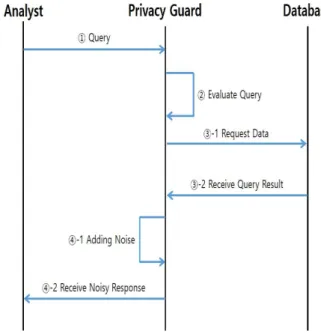
First, the processing procedure of differential privacy in the general environment of online interactive[6] is as follows (see Fig. 1).
Fig. 1. Differential Privacy Process
[Step 1: Query] The analyst asks the intermediary software called the differential privacy guard for a query
[Step 2: Evaluate Query] The differential privacy guard uses a special algorithm to evaluate the degree of privacy impact of the requested query.
[Step 3: Receive Query Result] The differential privacy guard receives the response based on the undistorted data ([Step 3-2] in [Fig. 1]) by transmitting the query to the database containing various kinds of medical information, including personal information ([Step 3-1] in [Fig. 1]).
[Step 4: Noisy Response] The differential privacy
guard adds an appropriate amount of noise due to
the privacy effect. In other words, to protect the
Subject
x x1
+xi Random
number
yi
Ri =
(
x1 +
xi )+
yi
x
1
estimated value
1 0.96302
2 0.04926 1.01228 0.09201 -1.69271 -0.68043 -0.72969
3 0.16718 1.1302 0.10861 -1.52684 -0.39664 -0.56382
4 0.24433 1.20735 0.77353 0.791996 1.999346 1.755016
5 0.54524 1.50826 0.90748 1.687183 3.195443 2.650203
6 0.30453 1.26755 0.04928 -2.31709 -1.04954 -1.35407
7 0.21408 1.1771 0.49193 -0.01627 1.160828 0.946748
8 0.45657 1.41959 0.68066 0.448352 1.867942 1.411372
9 0.31829 1.28131 0.88277 1.45047 2.73178 2.41349
10 0.1653 1.12832 0.85335 1.226559 2.354879 2.189579
11 0.73505 1.69807 0.90475 1.658103 3.356173 2.621123
12 0.48531 1.44833 0.09813 -1.62831 -0.17998 -0.66529
13 0.93479 1.89781 0.65985 0.385221 2.283031 1.348241
14 0.18673 1.14975 0.24145 -0.72795 0.421804 0.235074
15 0.23665 1.19967 0.96307 2.605584 3.805254 3.568604
16 0.38331 1.34633 0.9761 3.04073 4.38706 4.00375
17 0.7895 1.75252 0.00648 -4.34589 -2.59337 -3.38287
18 0.64746 1.61048 0.0219 -3.12812 -1.51764 -2.1651
19 0.51577 1.47879 0.76515 0.755661 2.234451 1.718681
20 0.44142 1.40444 0.04655 -2.37408 -0.96964 -1.41106
21 0.60352 1.56654 0.09416 -1.66961 -0.10307 -0.70659
22 0.07297 1.03599 0.97904 3.171992 4.207982 4.135012
23 0.78175 1.74477 0.21973 -0.82221 0.922561 0.140811
24 0.40297 1.36599 0.80222 0.927453 2.293443 1.890473
25 0.35075 1.31377 0.87472 1.384057 2.697827 2.347077
0.933198 Table 1. Problem Example of The Laplace Noise
confidentiality of the personal information in the database, it produces inaccurate results with noises added ([Step 4-1] in [Fig. 1]). And then it delivers the results to the analyst (See [Step 4-2] in [Fig. 1]).
Through the above process, the analyst can receive the result of applying noise that satisfies the differential privacy of the query that he/she has requested.
2. Problems of existing differential privacy methods using laplace noise[3]
R. Sarathy and K. Muralidhar[7] pointed out the problem of the Laplace noise method[8], which is one of the methods of implementing differential privacy, and proposed a solution to this problem. In the paper [7], the implementation of differential privacy using Laplace noise is based on the assumption that if the attacker knows all other data except one data (assuming that 49 different data out of 50 are known in the paper [7]), and in the worst case, the degree of privacy is lowered by 1/q per q-th query for each query, the problem that the differential privacy is not satisfied as the query is repeated is generated. For
example, suppose a database has a total of 50 data.
Let's say that one data that the attacker does not know is α, the remaining 49 data that are already known are β i (1≤i≤49), and the noise value is y i (1≤i
≤49). The attacker requests the query of α+β i using β i and subtracts β i from the query result as much as the number of i to obtain each α+y i value (e.g. if i
= 1, the query result is α+β 1 +y 1 , and the attacker obtains α+ y 1 by subtracting the value of β 1 from the resultant value), so that it is possible to estimate α using the averaging of the values.
This is a problem that occurs when the amount of noise obtained by substituting into the equation (1) for obtaining the Laplace noise value using a random number value between 0 and 1 is insignificant enough to be negligible (assume as μ
=0, b=Δf/ε =1). Taking advantage of this problem, the attacker can estimate the information about the target that the attacker is aiming at.
X = μ - bsqn(U)(1-2|U|) (1)
As a solution to the above-mentioned problem,
the solution presented in the paper [7] is that we
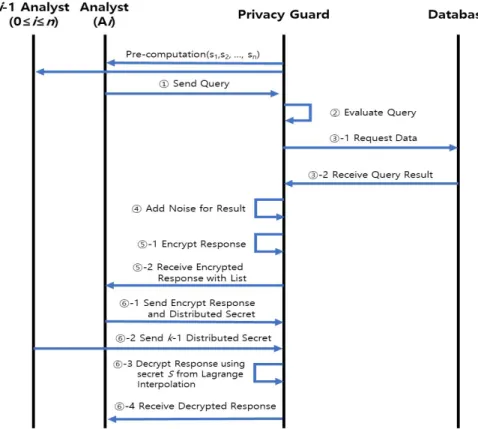
Fig. 2. The Previously Proposed Differential Privacy Process
propose a method to satisfy the differential privacy if the analyst (assuming a malicious attacker here) requests a series of queries, it applies q times noise to each q-th query by canceling the privacy, which is reduced by 1/q times for each q-th. The solution through this method is lowered in usability because the amount of noise is increased by q times so that too much noise is applied. In other words, we cannot actually utilize the value obtained from the result of the requested query. [Table 1] is an example made to show the problem described above. In [Table 1], x is an arbitrary real number between 0 and 1, y i is a noise value generated according to a random number (arbitrary real number between 0 and 1), R i is a value obtained by adding a noise value (y i ) to x 1 +x i and the estimated value of x 1 is a value obtained by performing R i -x i . In this case, it can be seen that the average value of the x 1 estimated values can be estimated as the approximate value of x 1 (that is, the average value 0.933198 of the x 1 estimated value column and the value 0.96302 of x 1 are similar values).
3. Problems of existing differential privacy method using secret sharing scheme[4]
The differential privacy method using the secret sharing scheme suggested by Shamir[9] solved the problem that the result of the averaging of the x 1
estimated values described in Section Ⅱ.2 can be estimated as the approximate value of x 1 . The protocol for this technique is as follows (See [Fig. 2]).
[Preliminary step: pre-computation] In order to prevent conspiracy among various differential privacy analysts, n number of distributed secret information (referred as s 1 , s 2 , ... s n ) for the privacy guard and the shared secret key S among the analysts is generated using the (k, n) secret sharing technique and distributed to the n differential privacy analysts (referred to as A 1 , A 2 , ..., A n ).
[Step 1: Send Query] Analyst A i asks the intermediary software called the differential privacy guard for a query.
[Step 2: Evaluate Query] The differential privacy guard uses a special algorithm to evaluate the degree of privacy impact of the requested query.
[Step 3: Receive Query Result] The differential
privacy guard receives the response based on the undistorted data ([Step 3-2] in [Fig. 2]) by transmitting the query to the database containing a variety of medical information, including personal information ([Step 3-1] in [Fig. 2]).
[Step 4: Add Noise for Result] The differential privacy guard adds an appropriate amount of noise according to the privacy effect on the result of the query received from the database. That is, it creates inaccurate results with added noise to protect the confidentiality of personal information in the database.
[Step 5: Encrypt Response] For the query requested by the analyst Ai, the noise-clipped result in [Step 4] is encrypted with a symmetric encryption algorithm such as AES[10] using the secret key S generated in the preliminary step ([Step 5-1] in [Fig. 2]). The differential privacy guard designates k-1 arbitrarily in n number of analysts who have the distributed secret generated in the [Preliminary step]. After that, the encrypted results are sent to the corresponding differential privacy analyst A i who requested the query in [Step 1], along with a list of k-1 differential privacy analysts assigned ([Step 5-2] in Fig. 2).
[Step 6: Decryption Response] The analyst A i who has received the result sends the encrypted result and his/her distributed secret to the privacy guard ([Step 6-1] in [Fig. 2]) and transmits the distributed secret of k-1 analysts corresponding to the list of differential privacy analysts specified in [Step 5] to the privacy guard ([Step 6-2] in [Fig. 2]). Then, the privacy guard calculates the secret information S using the Lagrange interpolation[5] and then decrypts the encrypted result using the symmetric encryption algorithm such as AES[10] ([Step 6-3] in [Fig. 2]). Then, the final result is sent to analyst Ai who has transmitted the encrypted result ([Step 6-4] in [Fig. 2]). At this time, the designation of k-1 differential privacy analysts except for the analyst A i is arbitrary, but when the designation of k-1 is made to all n persons at least once, the secret key S generated by the privacy guard may be exposed to the differential privacy analysts, so the secret key
S must be updated by performing the aforementioned preliminary steps again.
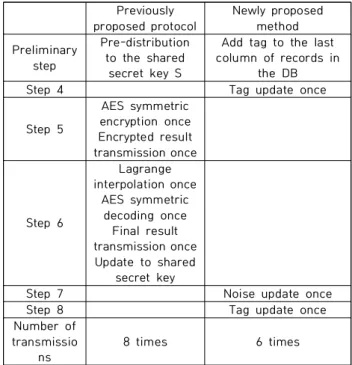
However, compared with the method proposed in Section Ⅱ.2, the proposed secret distribution technique[4] has the advantage of data usability and preventing conspiracy against the k persons, but because of the pre-distribution, the process of symmetric encryption and decryption, updating the shared secret key and the calculation process of finding the secret information S through the Lagrange interpolation method[5] are additionally incurred, the efficiency is deteriorated. In this paper, we try to solve this drawback by adding a 1-bit tag field, which is a status field, in the last column of a given dataset in the privacy guard's database to be able to know whether requested records by analysts were responded / given.
Ⅲ. The proposed Scheme
In this paper, we propose a method to add a 1-bit tag field, which is a status field, to the last column of a given dataset in the privacy guard database to solve the problems of the methods proposed in Sections Ⅱ.2 and Ⅱ.3. At this time, the tag field performs the role of checking whether or not there was a response (provision) of all m records, including individual patient medical information in the requested data set from the analysts. The problem with the method presented in Section Ⅱ.2 is that if the m-1 of record information among m records is provided to at least n of analysts, the remaining one piece of information can be found through conspiracy. Therefore, we would like to check whether up to m-2 records of the total m records are provided to the analysts through the tag field. If it is provided, we intend to prevent the conspiracy against analysts by updating the noise addition process (corresponding to [Step 4] in Section Ⅱ.3).
This is because R. Sarathy and K. Muralidhar[7] have
already demonstrated the problem in Section Ⅱ.2
when a maximum of m-1 records are provided. In
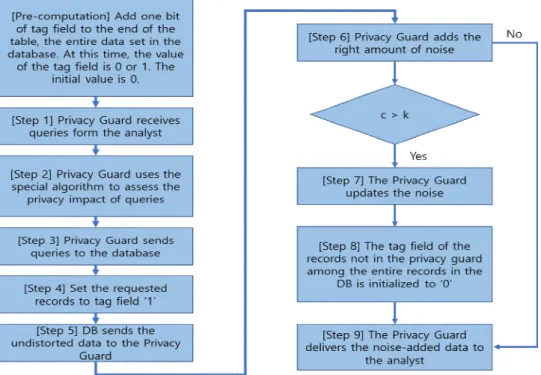
Fig. 3. Flow of The Proposed Scheme
fact, the privacy guard will be able to provide the analysts with records within a range of at least 1 to a maximum of m-2 of all m records. Of course, the smaller the number of records provided in terms of personal information protection, the safer it is.
Therefore, it is left to the policy choice of the relevant institution about the number of records of the data set to be provided to the analyst by the privacy guard in this paper and it will not be discussed in this paper.
[Table 2], [Table 3] shows two examples of de-identifying data sets. At this time, Data set 2 is assumed to be the data requested to analyst B since Data set 1 was provided to analyst A. Data set 1 contains data for patients A, C, D, E and F and Data set 2 contains data for patients A, B, C, G and H. In the second requested Data set 2, the tag field of patients A and C has been changed to 1. At this time, if the value of the tag field is 1 among the entire records, it can be known that the record is requested by the analyst at least once.
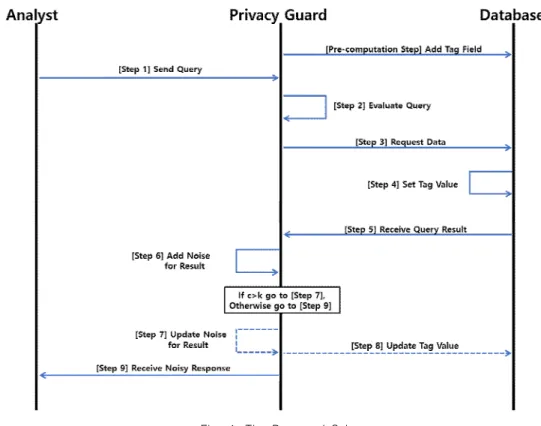
The proposed method in this paper improves the differential privacy procedure[4] in Section Ⅱ.4 and the detailed procedure is as follows (see [Table 4]
[Fig. 3] and [Fig. 4]).
Name Sex Code
type Code
Format Type of insurer Tag
Patient A 2 11 021 4 0
Patient C 1 28 201 9 0
Patient D 1 81 071 4 1
Patient E 2 11 041 4 1
Patient F 2 11 131 7 0
Table 2. Examples of De-identification Data Set 1
Name Sex Code
type Code
Format Type of insurer Tag
Patient A 2 11 021 4 1
Patient B 1 81 071 4 1
Patient C 1 28 201 9 1
Patient G 2 71 071 4 1
Patient H 2 61 061 5 0
Table 3. Examples of De-identification Data Set 2
Acronyms Contents
m
As the integer value, it is the total number of records in the dataset in the database and the initial value is zero.
k
As an integer value, the threshold value, the initial value is 0, used for determining whether to add a new noise or not is arbitrarily determined by the user within the range of minimum 1 to maximum
m-2 according to the security policy.
c