• 검색 결과가 없습니다.

Research on the Influence of the Use of VR Technology in Dance Creation on the Willingness of Dance Directors to Use: Focusing on the Ease of Cognition and the Mediating Effect of Usefulness

N/A
N/A
Protected

Academic year: 2021

Share "Research on the Influence of the Use of VR Technology in Dance Creation on the Willingness of Dance Directors to Use: Focusing on the Ease of Cognition and the Mediating Effect of Usefulness"

Copied!
8
0
0

로드 중.... (전체 텍스트 보기)

전체 글

(1)

Research on the Influence of the Use of VR Technology in Dance Creation on the Willingness of Dance Directors to Use: Focusing on the

Ease of Cognition and the Mediating Effect of Usefulness

1)

Nuowa Wu*

Abstract

In the field of dance creation, the use of film and television skills, cyberspace, action sets, computer graphics and other technology and media technology have made the creative environment for dance art that it rapidly improves and presents a new situation. Especially in the dance creation part, VR technology can show many possibilities and can be used as a tool to fully satisfy the choreographer's intention and imagination. Therefore, this study analyzes the acceptance model of virtual reality technology in dance creative education, and we will examine the effect of social influence, shared trust, innovation, interest, and self-efficacy on perceived usefulness and perceived ease. Second, we will examine the effect of perceived usefulness and perceived ease on intention to use. The study is targeted at ordinary dance creators who currently reside in Hebei Province, China.

The survey was conducted for approximately 30 days from March 16th to April 17th. The total number of valid samples collected was 377.

The results of the identification of the hypotheses between variables based on the questionnaire data are as follows: Firstly, social influence, shared trust, innovation, interest, and self-efficacy have a positive impact on perceived usefulness, perceived ease. Secondly, perceived usefulness, perceived ease has a positive effect on the intention to use. In view of the above research results, the theoretical significance and limitations of this research and the future research directions are discussed in depth.

▸Keyword: Creative Dance, VR Technology, Technology Acceptance Model, Perceived Usefulness, Perceived Ease, Intention to Use

I. Introduction

The development of information and communications technology is dramatically changing our life. Computer technology enables us to live an extremely convenient and efficient life. With the accelerating development and gradually expanding fields of these technologies, not only new changes have emerged in the fields of industry, economy and culture, but also the proportion of

information and communications technology has been gradually increasing in the field of art.

With the accelerating development of digital technology, the application of digital technology expands continuously, and the application of new media that utilizes digital technology is also increasing in the field of dance. Technology and media can be used as tools of

∙First Author: Nuowa Wu, Corresponding Author: Nuowa Wu

*Nuowa Wu ([email protected]), School of Anshan Normal University.

∙Received: 2019. 05. 30, Revised: 2019. 06. 24, Accepted: 2019. 06. 24.

(2)

new forms and new field of dance in the creation of dance works, and it is of great artistic significance to expand dancing knowledge through these processes to provide unprecedented aesthetic experience. In dance creation, the environment for dance creation has made rapid progress and taken on a new look through the application of film and television technology, network, computer graphics and media technology.

Among these new technologies and media, the latest

“fourth industrial revolution” enables the new generation of information and communications technology to integrate into industry, with Virtual Reality (VR) being the hot topic of the entire industrial circle. Virtual Reality (VR) refers to IT technology which enables the public to experience

“virtual reality that does not exist”. Recently, with the development of intelligent media and image technology, representative VR devices have come into use.. “Virtual Reality (VR) has a wide range of applications in games, sports, movies, entertainment, education and other fields, and it is expected to have an enormous impact on the entire field.” In particular, virtual reality technology, as a technology to enhance users’ sense of involvement and presence, has aroused tremendous attention.

Consequently, it has been applied in many fields.Moreover, a variety of attempts have been made to break through difficulties in combining virtual reality technology with education..

The value of dance creation education based on this virtual reality may well break away form the previous secondary three-dimensional creation education, and present itself as a new four-dimensional stimulus.The experience of virtual reality (VR) can generate creative stimulation and free thinking, thereby delivering a large number of new creations. Especially in dance creation, the application of virtual reality (VR) technology displays various possibilities through the expansion of performance, and thus VR will serve as a tool to fully meet the intention and imagination of choreographers.

Therefore, it is essential to explore the possibilities of new dance techniques using VR technology to break the previous perception of dance and initiate new dance creation.

However, based on the previous research on dance creation education, it can be found that dance creation education is emerging, for instance, “scanning” and compromise dance education, education based on thinking, dialogue and discussion, stimulation, and so on. The reality

is that, in spite of the development of media and digital technology, the two-dimensional approach remains in use in education currently. In addition, although the latest digital technology has been actively applied in dance assignments and academic concerns, it is mainly based on research related to technical examples, conceptual characteristics and media aesthetic views. In spite that it has its own meaning, it is specifically VR technical medium.

Therefore, considering the possibility of new dance creation brought by new technologies and media utilizing VR technology, it is essential to provide influencing factors and understanding of the decision-making process of VR technology acceptance with the aim of accepting new VR technology in dance creation education.

Consequently, this study aims to analyze the acceptance model of virtual reality technology in dance creation education and verify the influences and factors in the acceptance process on this basis.

II. Theoretical literature

1. Dance Creation

Creativity in dance means to fuse and form relevant elements appropriate for dance. It is an artistic process and an outcome that draws the ideal of life and nature from the body as an original activity expressing artistic inspiration as ability to move appropriately in various environments as a dance work. In order to accomplish this goal, it is necessary to continuously study motion using elements of all basic movements. Developing kinesthetic sense is also an important factor in creative dance.

2. Virtual Reality

VR(Virtual Reality) means 'virtual reality' if you translate it into a combination of two words, virtual and reality. The origin of virtual reality is the use of 'virtual reality' in the book by Antonini Artaud, a French playwright, poet, actor and director.

This virtual reality is generally defined as "human being feels realistic in cyberspace created by computer."

Virtual reality technology for realizing this is "to make the

user feel very similar to real world, A three-dimensional

virtual environment is created, and a user can freely

manipulate various input / output devices in the virtual

environment and provide a corresponding means.

(3)

3. Technology Acceptance Model

The Technology Acceptance Model(TAM) was first designed and presented by Davis FD in 1986, and it is the theory to explain the acceptance process of innovation technology. It is followed by Warsaw, (TAM) and the planned behavior theory (TRA), which are the theoretical bases of the technology acceptance model (TAM), have been studied together with various scholars such as Prof.

Dr. Bagozzi and Venerates Theory of Reasoned Action (TRA) is designed to "substantiate the behavior of any human being." The Theory of Planned Behavior (TPB), Subjective norms, and perceived behavioral control influence behavioral intentions.

4. The Main Variables of the Technology Acceptance Model (TAM)

4.1 perceived usefulness

Perceived usefulness is the subjective belief that the productivity and efficiency of work will be increased by introducing new technologies or systems. Davis (1989) The use of the system is defined as the degree of helping to improve the work, and it can be understood as an evaluation of the result that the information technology users will select and use the specific technology related to the productivity and efficiency of the work, have. The perceived usefulness used in the study listed the perception that the new VR technology does not require much effort and can be easily performed.

4.2 Perceived ease

Perceived ease of use is a subjective belief that using a new system will not require much emotional and physical effort. Davis (1989) defined that the perceived ease of use in the initial technology acceptance model is the degree to which an individual believes that the use of a particular system is not difficult, and that the less physical and mental endeavor required to learn and use the new information technology, It can be understood as an evaluation of the process of being. In this study, The results showed that the perceived ease of use influenced the intention to use VR.

4.3 Intent to use

The intention to use is the ultimate dependent variable of the technology acceptance model, which means that the existing user intends to continue to use the innovative product, or the intention that the potential user intends to

use for the innovative product. In the present study, the intention to use VR was defined as a degree of intention to use VR technology and was used as a dependent variable of the study.

External variables influencing the perceived usefulness and perceived ease of use of the exogenous variable technology acceptance model for the extension of the technology acceptance model (TAM) Based on the previous studies on the successful acceptance of computer or web-based mediaInterest, and self-efficacy.

(1) social influence

Social influence is perceived pressure received by an individual to perform a specific action. In most of the previous studies, social influence is limited to subjective norms, and many scholars believe that subjective norms.

This social influence is the perception of what a colleague or friend thinks is valuable. In the end, the influence of actors around actors and how important people think influences behavior or perception of actors.

(2) shared trust

Shared trust has been shown to have a positive effect on the actual use of information technology as a concept of individual confidence in the effect of using new VR technology.

(3) Innovation

Individual informativeness represents the degree to which an individual is relatively receptive to innovation.

The degree to which a recipient can easily and quickly accept a new one has an important impact on whether a consumer accepts a new product. Therefore. In this paper, we propose a new methodology for the analysis of information systems.

(4) Interestingness

Interestingness represents a degree of joyful thought or amusing immersion while using new media technologies.

Interest in the acceptance of information technology has been

confirmed as an important factor. Koufaris(2002) classifies

the concept of flow into intrinsic fun and perceived control

and attention. Among them, the intrinsic fun could have a

significant effect on the use of technology. In the state of

flow, humans have sincerely fallen into action, narrowing the

focus of perception and have developed it. Therefore, interest

is the degree of enjoyment that can be felt when using VR.

(4)

(5) Self-efficacy

Self-efficacy has been analyzed as an important variable that directly affects the use of information technology, meaning confidence in the user's own ability and efficiency in new dance media and technology.

Self-efficacy is a theoretical basis of Bandura's social cognitive theory. It is the individual's belief and confidence that he or she can succeed when doing something with a certain purpose. The results of this study are as follows. This new media and technology self-efficacy will have a significant impact on VR usage.

III. research method

1. Research Model

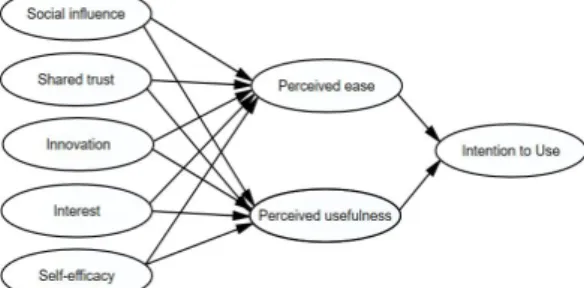
The research model based on hypotheses used to achieve these research goals is shown in Figure 1 below.

Fig. 1. Research model

2. Research Hypothesis

H1: Social influence will have a positive effect on perceived ease.

H2: Shared trust will have a positive effect on perceived ease.

H3: Innovation will have a positive effect on perceived ease.

H4: Interestingness will have a positive effect on perceived ease.

H5: Self-efficacy will have a positive effect on perceived ease.

H6: Social influence will have a positive effect on perceived usefulness.

H7: Shared trust will have a positive effect on perceived usefulness.

H8: Innovation will have a positive effect on perceived usefulness.

H9: Interestingness will have a positive effect on perceived usefulness.

H10: Self-efficacy will have a positive effect on perceived usefulness.

H11: Perceived ease will have a positive effect on Intent to use.

H12: Perceived usefulness will have a positive effect on Intent to use.

3. Data Sources

The subject of this study is a general dance creator who resides in. Therefore, we conducted a survey through off - line to investigate the attitude of accepting VR technology in creative dance education. The questionnaire was collected for about 30 days from March 16, 2019 to April 17, 2019. A total of 377 samples were collected.

4. Operable Instructions of Variables

In this study, questionnaire was used as a measurement tool to examine the attitude analysis of VR technology acceptance of dance creators. The results of this study are as follows. First, the questionnaire consisted of the following items: social influence, shared trust, innovation, interest, self-efficacy, perceived Usefulness, perceived ease of use, and use. Table 1 summarizes the variables measured.

variable Justice

Social influence

Perceptions of the influence of reference groups such as colleagues, friends, and professors in relation to the use of new VR technology Shared trust The degree of confidence in the effectiveness of

the new VR technology

Innovation The extent to which we accept new VR technologies and accept them

Interest The user's interest in using the new VR technology

Self-efficacy

Confidence in ability to use VR technology in creative dance with a good understanding of information technology and use

Perceived ease

The recognition that there is no need for much effort in using the new VR technology and that it can be done easily

Perceived usefulness

The user's perception that using the new VR technology will increase educational and learning outcomes

Intention to Use Intent to actively embrace new VR technology

Table 1. Operable Instructions of Variables

(5)

Ⅳ. Analysis Result

1. Demographic Characteristics of the Specimens As for the general characteristics of the study subjects, the demographic characteristics of the respondents were male 52 (13.8%) and 325 (86.2%) of the total 377 respondents. The proportion of women was higher than that of men. In addition, the highest age group was 140 (37.1%) aged 40 to 49. Followed by 114 (30.2%) respondents aged 20 to 29 years. Followed by 78 respondents (20.7%) aged between 30 and 39 years. Four (1.1%) of the respondents with the lowest response rate were younger than 20 years old. 178 respondents (47.2%) answered that they were the college graduates. Followed by 79 college graduates (21.0%) and 66 high school graduates (17.5%). 54 respondents (14.3%) answered that they had the lowest response rate. The results of the occupational survey were the highest (148 persons, 39.3%). Followed by 77 of respondents (20.4%). Followed by 59 respondents (15.6%). 38 respondents (10.1%) responded that they had the lowest response rate. The survey results showed that the respondents with 300 ~ 4 million won were the highest with 128 (34.0%). Followed by 81.5% (21.5%) of respondents between 4 and 5 million.

Followed by 77 respondents (20.4%) with more than 5 million won. The respondents with the lowest response rate ranged from 200 to 3 million, with 39 respondents (10.3%).

2. Data Quality Inspection

2.1 Exploratory Factor Analysis and Reliability Analysis

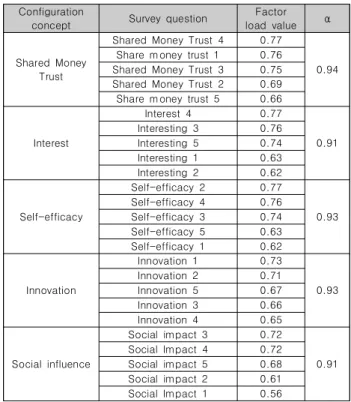
First, exploratory factor analysis was conducted to examine whether each measurement tool used in this study was the same as the intention of this study.

Principal component analysis was performed to minimize the loss of information while minimizing the number of factors and to prevent the validity of the measurement. In order to clarify the factor classification of the variables, the orthogonal rotation method(varimax) was used. Factor extraction criteria were eigenvalue of 1 or more, factor load of 0.5 or more, and eigenvalue of 1 or more as a whole. The Cronbach's Alpha coefficient, which is a measure of internal consistency, was measured to ensure the reliability of the measured variables. If the value is more than 0.6, it is judged to be relatively reliable. If the value is more than 0.7, it is considered to be high.

Configuration

concept Survey question Factor

load value α

Shared Money Trust

Shared Money Trust 4 0.77

0.94 Share money trust 1 0.76

Shared Money Trust 3 0.75 Shared Money Trust 2 0.69 Share money trust 5 0.66

Interest

Interest 4 0.77

0.91 Interesting 3 0.76

Interesting 5 0.74 Interesting 1 0.63 Interesting 2 0.62

Self-efficacy

Self-efficacy 2 0.77

0.93 Self-efficacy 4 0.76

Self-efficacy 3 0.74 Self-efficacy 5 0.63 Self-efficacy 1 0.62

Innovation

Innovation 1 0.73

0.93

Innovation 2 0.71

Innovation 5 0.67

Innovation 3 0.66

Innovation 4 0.65

Social influence

Social impact 3 0.72

0.91 Social Impact 4 0.72

Social impact 5 0.68 Social impact 2 0.61 Social Impact 1 0.56

Table 2. Exploratory Factor Analysis and Reliability Analysis of Exogenous Variants

As shown in Table 2, all factors are more than 0.5, and the shared money trust is 17.56%, interest is 16.03%, self-efficacy is 15.25%, innovation is 15.10%, and social influence is 13.54% . As a result, Cronbach's Alpha coefficient was 0.9 or more, which is a general tolerance, as shown in Table 3. As a result, the reliability of the measured variables was secured.

Configuration

concept Survey question Factor

load value α Intention to

Use

Intention to Use2 0.81

0.90 Intention to Use1 0.80

Intention to Use3 0.76 Perceived

ease

Perceived ease2 0.78

0.88 Perceived ease3 0.77

Perceived ease1 0.74 Perceived

usefulness

Perceived usefulness1 0.82

0.91 Perceived usefulness2 0.82

Perceived usefulness3 0.66

Table 3. Exploratory Factor Analysis of Measured Variable

As shown in Table 3. all factors were more than 0.5, 28.69%, 27.61%, and 26.72%, respectively, indicating a useful explanatory power of 83.02%. As a result, Cronbach's Alpha coefficient was 0.8 or more, which is a general tolerance value as shown in Table 4, and the reliability of the measured variables was secured.

2.2 Confirmatory Factor Analysis

Confirmatory factor analysis was conducted to verify

(6)

convergence validity and discriminant validity of measured variables. As can be seen in Table 4, the fit of the measurement model is GFI = .872, AGFI = .847, NFI = .928, IFI = .966, CFI = .966, RMR = .029. The fit of a measurement model can be evaluated as a relatively satisfactory fit. In the mean time, X² (df) = 916.978 (499) and X² / df is 1.838 (when the number of samples is large, the maximum is 5.0 or less, usually 2 to 3 or less is recommended), it is confirmed that the measurement model used in this study is superior.

In addition, factor loadings of confirmatory factor analysis showed statistically significant t-values and convergence validity was confirmed. At the same time, the combined reliability was evaluated through Amos. In all items, the result was more reliable than the general allowance of 0.6. On the other hand, another measure of convergent validity is the average variance extraction (AVE) value, which is known to be valid only if the magnitude of variance is 0.5 or greater, In this study, we found that the convergence validity was obtained because the mean variance extraction (AVE) value of all factors was over 0.5.

Configuration concept

Standard

factor load T value Complex reliability AVE

Social influence

0.845 0.836 0.798 0.799 0.789

20.420 18.508 18.515 18.163

.953 .811

Shared trust

0.864 0.897 0.888 0.835 0.859

24.483 23.821 21.225 22.354

.905 .743

Innovation

0.817 0.819 0.831 0.920 0.887

18.935 19.246 22.631 21.321

.927 .772

Interest

0.810 0.858 0.860 0.785 0.813

19.683 19.628 17.163 18.097

.930 .726

Self-efficacy

0.828 0.875 0.882 0.873 0.794

21.336 21.218 21.047 18.296

.938 .786

Perceived ease

0.900 0.885 0.866

25.768 23.721

.905 .743

Perceived usefulness

0.809 0.861 0.852

19.327 18.878

.927 .772

Intention to Use

0.856 0.896 0.842

23.243 20.377

.930 .726

X²=916.978, P=.000, DF=499 CMIN/DF =1.838,GFI=.872 AGFI=.847 NFI=.928 IFI=.966, CFI=.966 RMR=.029 Table 4. Analysis of Certainty Factor

3. Research hypothesis verification

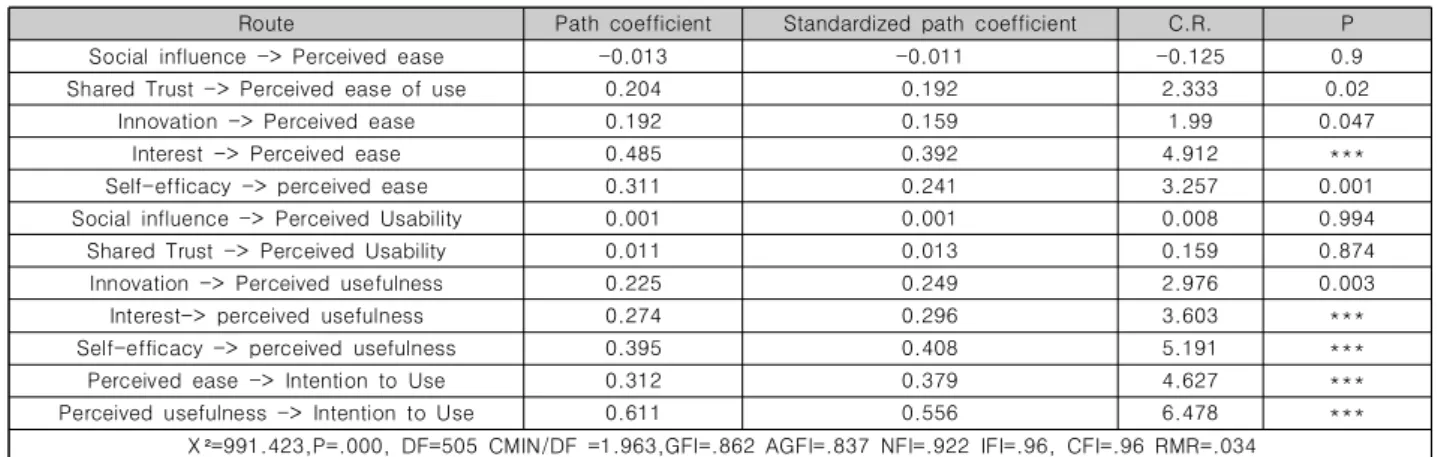
A structural model was used to verify the hypothesis. The path coefficient of the structural motel to verify the hypothesis can be found in Table 5. The fit index for the structural model used in this study is X2 = 546.950, P = .000, DF = 182, CMIN/DF = 3.005, GFI = .870, AGFI = .835, NFI = .911, IFI

= .939, CFI = .938 and RMR = .091 respectively. The fit of the structural model in this study has no major problems and can be evaluated to an acceptable level.

As can be seen in Table 5, social influence has an effect on perceived ease -0.013. These results were not statistically significant at the 0.05 level (C.R=-0.125, p>0.05). Hypothesis 1 was therefore rejected. Shared trust has a 0.204 effect on perceived ease of use. These results are statistically significant at the 0.05 level (C. R

= 2.333, p <0.05). Therefore, Hypothesis 2 was verified as expected. Innovation has an effect on perceived ease of use of 0.192. These results were statistically significant at the 0.05 level (C R = 1.99, p <0.05).

Therefore, Hypothesis 3 was verified as expected.

Interest has an effect on perceived ease of use of 0.485.

These results are statistically significant at the 0.05 level (C R = 4.912, p <0.05). Therefore, Hypothesis 4 was verified as expected. Self-efficacy has an effect on perceived ease of use of 0.311. These results are statistically significant at the 0.05 level (C. R = 3.257, p <0.05). Therefore, Hypothesis 5 was verified as expected. Social influence has an effect on perceived usefulness of 0.001. These results are not statistically significant at the 0.05 level (C. R = 0.008, p>

0.05). Hypothesis 6 was therefore rejected. Shared trust has a 0.011 effect on perceived usefulness. These results were not statistically significant at the 0.05 level (C = 0.159, p>

0.05). Therefore, Hypothesis 7 was rejected. Innovation has an effect on perceived usefulness of 0.225. These results were statistically significant at the 0.05 level (C = 2.976, p <0.05). Therefore, Hypothesis 8 was verified as expected.

Interest has an effect on perceived usefulness of 0.274. These

results are statistically significant at the 0.05 level (C.R =

3.603, p <0.05). Therefore Hypothesis 9 was verified as

expected. Self-efficacy has an impact on perceived

usefulness of 0.395. These results are statistically significant

at the 0.05 level (C R = 5.191, p <0.05). Therefore, Hypothesis

10 was verified as expected. Perceived ease has an effect

on intention to use of 0.312. These results are statistically

significant at the 0.05 level (C.R= 4.627, p <0.05). Therefore,

Hypothesis 11 was verified as expected. Perceived usefulness

has an effect on the intention to use 0.611. These results

(7)

Route Path coefficient Standardized path coefficient C.R. P

Social influence -> Perceived ease -0.013 -0.011 -0.125 0.9

Shared Trust -> Perceived ease of use 0.204 0.192 2.333 0.02

Innovation -> Perceived ease 0.192 0.159 1.99 0.047

Interest -> Perceived ease 0.485 0.392 4.912 ***

Self-efficacy -> perceived ease 0.311 0.241 3.257 0.001

Social influence -> Perceived Usability 0.001 0.001 0.008 0.994

Shared Trust -> Perceived Usability 0.011 0.013 0.159 0.874

Innovation -> Perceived usefulness 0.225 0.249 2.976 0.003

Interest-> perceived usefulness 0.274 0.296 3.603 ***

Self-efficacy -> perceived usefulness 0.395 0.408 5.191 ***

Perceived ease -> Intention to Use 0.312 0.379 4.627 ***

Perceived usefulness -> Intention to Use 0.611 0.556 6.478 ***

X²=991.423,P=.000, DF=505 CMIN/DF =1.963,GFI=.862 AGFI=.837 NFI=.922 IFI=.96, CFI=.96 RMR=.034

*P<0.05

Table 5. Structural model analysis result

are statistically significant at the 0.05 level (C.R = 6.478, p <0.05). Therefore Hypothesis 12 was verified as expected.

V. Conclusions

In this study, based on the technology acceptance model of VR technology and system acceptance in creative dance education, we set up a theoretical model of factors and decision process affecting decision of acceptance of new dance technology and media using VR technology Based on the surveyed data, the research goal is to analyze the relationship between variables using path analysis.

The hypothesis of the hypothesis among the variables based on the questionnaire data is as follows. First, hypothesis of the study that external variables on technology acceptance will have a significant effect on perceived ease of use, social influence, shared trust, interest, innovation, Have a significant (+)effect on perceived ease of use.

Second, social influences, shared trust, innovation, interest, and self-efficacy have a significant (+) influence on the hypothesis that external variables on technology acceptance will have a significant effect on perceived usefulness.

Third, it was found that the perceived ease of use had a significant effect on the hypothesis of the study that it had a significant effect on the intention to use.

Fourth, the hypothesis that the perceived usefulness will have a significant effect on the intention to use has been concluded to be significant.

Based on these conclusions, this study suggested the following.

First, in this study, only dance students' acceptance attitude toward VR technology was analyzed. In order to

utilize the new VR technology and media acceptance more actively in the curriculum of creative dance, it is necessary to study how to use VR technology in specific creative dance education based on this research.

Second, the perceived ease and perceived usefulness of the new VR technology, which has a decisive influence on the intention to use, is strongly influenced by the psychological attitudes of users such as reliability, innovation, and interest in VR technology. The teacher should be aware of this point in class.

Third, in the follow-up research, it is necessary to provide a variety of practical programs and learning materials so that students have an interest in VR technology acceptance in the curriculum of creative dance, and research will be carried out in order to increase confidence in the ability to use VR technology There is a need.

Fourth, the market size is not large enough for the dance students to understand the characteristics of VR.

There is a high possibility that the questionnaire was conducted through expectation without accurate recognition of VR technology. When the VR market expands, the fields are segmented, and users have an accurate perception of VR, empirical research on new technologies should be done.

REFERENCES

[1] R. Pedro, K. Stevens, & C. Scheu, "Creating a cultural dance community of practice: Building authentic Latin American dance experiences." Research in Dance Education, Vol. 19, No. 3, pp. 199-215, Mar. 2018.

[2] B. H. Martin, B. Snook, & R. Buck, "Creating the Dance

(8)

and Dancing Creatively: Exploring the Liminal Space of Choreography for Emergence." Journal of the Canadian Association for Curriculum Studies, Vol. 16, No. 1, pp.

162-174, Jan. 2018.

[3] S. Chung, "A Study on Activation Strategy of Musical Market through Analysis of Virtual Reality Fusion Industry Ecosystem: Focusing on UTAUT Model," Vol. 9, No. 3, pp. 187-201, Mar. 2017.

[4] M. R. Zitomer, "Always being on your toes: Elementary school dance teachers’ perceptions of inclusion and their roles in creating inclusive dance education environments." International Journal of Inclusive Education, Vol. 21, No. 4, pp. 428-440, Dec. 2017.

[5] D. Z. Dumpit, & C. J. Fernandez, "Analysis of the use of social media in Higher Education Institutions (HEIs) using the Technology Acceptance Model." International Journal of Educational Technology in Higher Education, Vol. 14, No. 1, pp. 5, Jan. 2017.

[6] P. Disztinger, S. Schlögl, & A. Groth, "Technology acceptance of virtual reality for travel planning."

Information and Communication Technologies in Tourism, Vol. 27, No. 2, pp. 255-268, Feb. 2017.

[7] Y. K. Dwivedi, N. P. Rana, A. Jeyaraj, M. Clement, &

M. D. Williams, "Re-examining the unified theory of acceptance and use of technology (UTAUT): Towards a revised theoretical model." Information Systems Frontiers, Vol. 9, No. 3, pp. 1-16, Mar. 2017.

[8] N. M. Suki, & M. S. Norazah, "Determining students’

behavioural intention to use animation and storytelling applying the UTAUT model: The moderating roles of gender and experience level." The International Journal of Management Education, Vol. 15, No. 3, pp. 528-538, Mar. 2017.

[9] S. Samar, M. Ghani, & F. Alnaser, "Predicting customer’s intentions to use internet banking: the role of technology acceptance model (TAM) in e-banking." Management Science Letters, Vol. 7, No. 11, pp. 513-524, Dec. 2017.

[10] J. Mütterlein, & T. Hess, "Immersion, Presence, Interactivity: Towards a Joint Understanding of Factors Influencing Virtual Reality Acceptance and Use." , Vol.

36, No. 5, pp. 21-21, May. 2017.

[11] D. Gefen, & L. Kai, "Controlling for lexical closeness in survey research: A demonstration on the technology acceptance model." Journal of the Association for Information Systems, Vol. 18, No. 10, pp. 727-757, Dec.

2017.

[12] N. K. Jokar, S. A. Noorhosseini, M. S. Allahyari, & C.

A. Damalas, "Consumers' acceptance of medicinal herbs:

An application of the technology acceptance model (TAM)." Journal of ethnopharmacology, Vol. 36, No. 2,

pp. 203-210, Feb. 2017.

[13] S. Rahi, M. Ghani, F. Alnaser, & A. Ngah, "Investigating the role of unified theory of acceptance and use of technology (UTAUT) in internet banking adoption context." Management Science Letters, Vol. 8, No. 3, pp. 173-186, Mar. 2018.

[14] O. Isaac, Z. Abdullah, T. Ramayah, A. M. Mutahar, &

I. Alrajawy, "Integrating User Satisfaction and Performance Impact with Technology Acceptance Model (TAM) to Examine the Internet Usage Within Organizations in Yemen." Asian Journal of Information Technology, Vol. 17, No. 1, pp. 60-78, Jan. 2018.

[15] D. Liu, W. Lu, & Y. Niu, "Extended technology-acceptan ce model to make smart construction systems successful." Journal of Construction Engineering and Management, Vol. 144, No. 6, pp. 18-35, Jun. 2018.

[16] A. R. Roberts, S. De, B. K. Franks, & M. E. “Radina, Older adults’ experiences with audiovisual virtual reality: Perceived usefulness and other factors influencing technology acceptance,” Clinical gerontologist, Vol. 42, No. 1, pp. 27-33, Jan. 2019.

[17] J. Mallya, & L. Sethumadhavan, "Factors influencing usage of internet for academic purposes using technology acceptance model." Journal of Library and Information Technology, Vol. 37, No. 2, pp.119-124, Feb. 2017.

[18] L. Huang, "Application Status & Design Requirements of Virtual Reality Technology in Dance Teaching.", Vol.

23, No. 1, pp. 129-153, Jan. 2018.

Authors

Nuowa Wu received the B.A. degree in

Music, M.A. degree in Music from

Northeast Normal University, China, in

2003 and 2010, respectively. She has been

a Ph.D. student in Performing Art at

Kyonggi University, South Korea, since

2017. Professor Wu joined the faculty of the Department

of Department of Music at Anshan Normal College in Anshan,

China, in 1996. She is currently an associate professor in

the Department of Music at Anshan Normal College. She

is interested in traditional dance, and Reconstruction of the

Chinese Dance in Song dynasty through the Korean dance.

수치

Fig.  1.  Research  model
Table  2.  Exploratory  Factor  Analysis  and  Reliability  Analysis  of  Exogenous  Variants
Table  5.  Structural  model  analysis  result

참조

관련 문서