A Meta-Analysis on the Correlation between Job Satisfaction, Turnover Intention and Organizational Commitment among Nurses
1)Hong-Ki Lee*, Sungmin Myoung**
Abstract
The purpose of this study was to evaluate the effect of job satisfaction on turnover intention and organizational commitment in nurses through a systematic literature review and meta-analysis. For the study purpose, 26 studies were selected through a systematic process of using several databases and used to estimate the effect size of correlation between 3 variables. Meta-analysis was applied by usingcrandom effects model, and effect sizes on three types were calculated. Results are as follows.
First, the effect size of correlation between job satisfaction and turnover intention is -.58. Second, the effect size of correlation between job satisfaction and organizational commitment is .77. Third, for the organizational commitment and turnover intention relationship, the effect of correlation is –0.68.
Furthermore, publication bias analysis were assessed the results by using the funnel plot, Egger’s regression test, fail-safe N, and trim-and-fill test. Based on these results, implications for the study were discussed.
▸ Keyword : Meta analysis, job satisfaction, turnover intention, organizational commitment
I. Introduction
병원조직은 의사, 간호사, 행정직원 등과 같은 서로 다른 특성 을 가지는 전문가들이 분야별로 권한과 책임을 가지면서 의료서 비스를 제공하고 있다. 양질의 의료서비스를 제공하기 위해서는 우수한 병원조직 구성원들이 유지되어야 할 것이며, 이를 위해서 는 각 분야별 구성원들의 직무만족과 조직몰입을 증대 시켜야 하 며, 이직 등의 조직이탈을 최소화 할 때 조직효과가 극대화 될 것이라 알려져 있다 [1]. 특히, 간호사의 경우 병원조직의 구성원 중 약 30%이상을 차지하고 있으나, 간호사의 이직률은 2013년 평균 16.99%로 매우 높게 나타났다 [2]. Kim et al. (2011) 은 이직의도의 예측요인을 탐색하기 위해 최근 10년 간 (2001~2010년) 발표된 간호사 이직 관련 연구 30편을 고찰하였 으며, 그 결과 연령, 근무형태, 조직몰입, 직무만족, 직무스트레스 등이 이직의도에 영향을 주는 인자라고 제시하였다 [3].
직무만족 (job satisfaction)은 조직구성원들이 직무와 조직
에 대한 평가에 반영된 애정적 반응 또는, 조직구성원들의 직무 를 수행해 나가는 과정에서 개인의 내재적/외재적 욕구가 어느 정도 충족되어 있는가에 대한 구성원의 지각된 반응을 의미한 다 [4]. 또한 조직몰입 (organizational commitment)은 세 가 지 요소들로 특징지어질 수 있는데, 첫째로는 조직의 가치와 목 표에 대한 강한 신뢰, 둘째, 조직을 위해 노력하고자 하는 의지, 셋째, 계속 조직의 구성원으로 남고자 하는 욕구를 의미한다 [5]. 이러한 직무만족 및 이직의도, 조직몰입에 대한 기존의 선 행연구들은 많이 수행되어 왔는데, 특히 Oh et al. (2007)이 수 행했던 연구는 국내 종업원을 대상으로 직무만족, 조직몰입, 성 과 및 이직의도간의 관련성에 대하여 메타분석을 수행하여 관 계의 강도를 추정하였다. 그 결과, 직무만족과 조직몰입 및 성 과, 조직몰입과 성과 간에는 정(+)의 관계가 존재하였으며, 이 직의도와 나머지 변인들 간에는 부(-)의 관계가 존재하였고, 이
∙First Author: Hong-Ki Lee, Corresponding Author: Sungmin Myoung
*Hong-Ki Lee ([email protected]), Dept. of Management, Jungwon University
**Sungmin Myoung ([email protected]), Dept. of Health Administration, Jungwon University
∙Received: 2017. 03. 07, Revised: 2017. 03. 16, Accepted: 2017. 04. 10.
∙ This research was supported by Jungwon University in 2016
는 북미지역의 메타분석결과와 동일하다는 결론을 주장하였다 [5].
메타분석 (meta-analysis)이란 동일한 주제에 대한 다양한 선행 연구결과의 정량적인 결과들을 체계적이고 계량적으로 분 석하는 통계적 통합 분석 방법(research synthesis)이며, 다음 과 같이 4가지 장점을 갖는다고 알려져 있다 [6].
• 모수를 더 정확하게 추정한다
• 다중 결과를 분석, 평가할 수 있다
• 결과에 영향을 줄만한 요인에 대한 분석
• 오류와 왜곡을 최소화 할 수 있다
많은 연구들이 간호사들을 대상으로 직무만족 및 이직의도, 조직몰입의 관계에 대하여 수행되었으나 개별 연구를 종합한 메타분석 연구는 전무한 실정이다. 따라서 본 연구에서는 위에 서 논의된 간호사를 대상으로 직무만족, 이직의도, 조직몰입과 의 관계에 대하여 문헌고찰을 통하여 기존 연구결과를 정량적 으로 통합한 메타분석을 적용하여 해석가능한 시사점을 도출하 고자 한다. 이러한 연구목적을 달성하기 위한 구체적인 연구내 용은 다음과 같다.
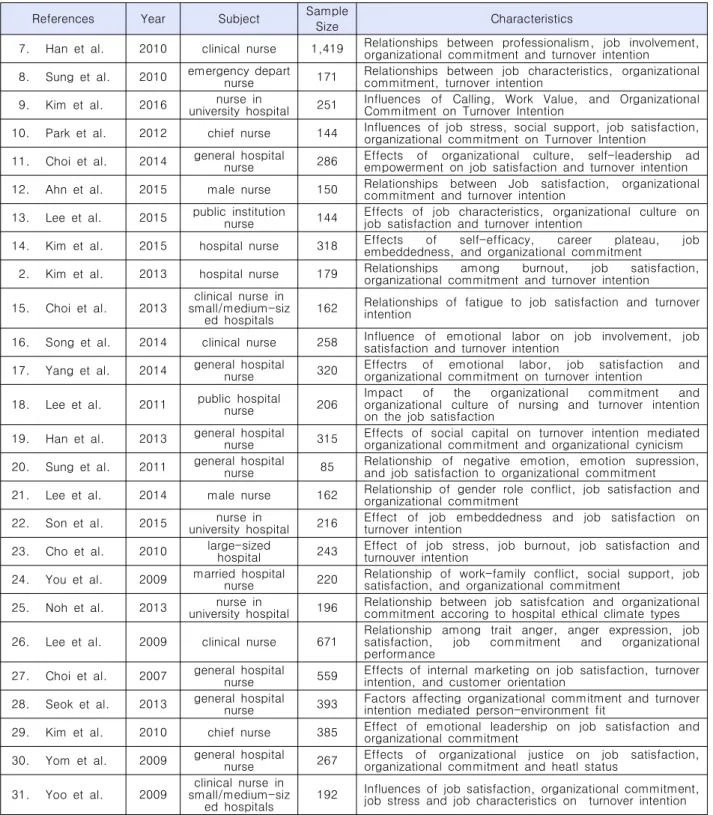
첫째, 체계적 문헌고찰을 통한 연구들을 선별하고, 이에 대 한 일반적인 특성을 파악한다.
둘째, 직무만족, 이직의도, 조직몰입의 관계에 대한 효과크기 를 산출한다.
셋째, 산출된 효과크기의 이질성을 확인하고 조절변수(출판 년도)에 대한 각 관계 유형별 효과크기의 영향력 여부를 확인 한다.
II. Material and Methods
1. Data Collection and Selection
본 연구는 간호사를 대상으로 직무만족, 이직의도, 조직몰입 간의 연관성을 메타분석하기 위하여 2007년 1월부터 2016년 12월까지 국내에서 발표된 KCI 등재 학술지를 연구대상으로 설정하였으며, 학위논문(석/박사) 및 학술대회 발표논문은 연 구의 질을 고려하여 분석대상에 포함하지 않았다. 이들 자료를 수집하기 위하여 한국교육학술정보원 (RISS), 한국학술정보 (KISS)를 이용하였다. 포함기준은 다음과 같이 설정하였다.
• 검색키워드는 ‘직무만족’, ‘조직몰입’, ‘이직의도’ 로 설정하 며, 최소 2개의 변수를 포함하고 있어야 함
• 검색된 논문 중 중복된 논문에 대해서는 제외하였고, 선별 된 자료에서 ‘간호사’로 결과 내 검색을 수행함
• 수집된 논문들은 상관관계를 통해 독립변수와 종속변수의 관계를 연구한 논문으로 선정하였으며, 상관계수, 표본수가 표 시된 논문을 선택함
이와 같은 방법으로 분석대상 논문을 고찰한 결과, 26편이
메타분석에 최종 선택되었다 [7-31]. 분석에 포함된 연구들의 일반적 특성은 III. Result 항목에서 제시한다.
2. Statistical Analysis Method 2.1 Coding of Selected Data
위 절에서 메타분석 대상으로 선정된 26편 연구논문의 메타 분석을 위하여 코딩 sheet를 작성하였다. 코딩 sheet는 연구번 호, 저자, 출판년도, 연구대상, 표본수, 각 유형별 척도명, 상관 계수 값으로 코딩표를 구성하고 정리하였다. 또한 각 연구에서 나타낸 기본적인 기술통계량 (평균, 표준편차, 표본크기)들은 별도로 취합하였다 (Table 1). 각 유형별 (직무만족과 이직의 도, 직무만족과 조직몰입, 이직의도와 조직몰입) 하위변인은 사 례수가 적어 분석에서 제외하였다.
2.2 Analysis Method
메타분석 절차는 다음과 같이 수행하였다. 첫째, 연구결과들 을 통합분석하기 위해 기존 통계치인 상관계수 을 이용하여 효과크기를 산출하는데, 기존 상관계수보다 더 정규분포를 따 르는 Fisher’s 으로 전환하였다. 전환된 효과크기 공식은 다 음과 같다.
× ln
또한 개별연구들이 다양하게 수행되었으므로 가중치 계산은 분산의 역수 (inverse variance)를 이용하여 계산하였다 [6].
전환된 효과크기 및 역분산가중치를 이용하여 평균효과크기
를 산출하는데, 이는 개별 가중효과크기 들의 합을 가 중치 들의 합으로 나눈 값이다.
상관계수 효과크기는 0.5 이상이면 크다고 할 수 있으며, 0.3~0.50미만의 경우 중간크기, 0.1미만이면 작은 크기라고 구 분한다 [6]. 또한 추정한 평균효과크기의 표준오차와 신뢰구간 을 계산하며, 이를 이용하여 통계적 유의성을 검정한다.
둘째, 개별연구의 이질성 검정을 수행하는데, 이는 각 연구 간 효과크기가 일관되지 않은 정도를 의미하며, 이질성 통계치
을 통하여 확인한다. 일반적으로 값이 25% 이면 이질성 이 작은 것으로, 50%이면 중간 크기, 75%이상이면 이질성이 매우 큰 것으로 해석한다. 또 다른 방법으로 -통계치를 통하 여 효과크기의 동질성(homogeneity)을 검정할 수 있다 [32-33].
셋째, 평균효과크기 계산 시 무선효과모형 (random effect model)을 이용하였다. 일반적으로 무선효과모형은 서로 상이한 개별집단의 효과크기 분포의 평균을 추정할 때 이용하는데, 본
Table 1. General characteristics of studies included in meta-analysis
References Year Subject Sample
Size Characteristics
7. Han et al. 2010 clinical nurse 1,419 Relationships between professionalism, job involvement, organizational commitment and turnover intention
8. Sung et al. 2010 emergency depart
nurse 171 Relationships between job characteristics, organizational commitment, turnover intention
9. Kim et al. 2016 nurse in
university hospital 251 Influences of Calling, Work Value, and Organizational Commitment on Turnover Intention
10. Park et al. 2012 chief nurse 144 Influences of job stress, social support, job satisfaction, organizational commitment on Turnover Intention
11. Choi et al. 2014 general hospital
nurse 286 Effects of organizational culture, self-leadership ad empowerment on job satisfaction and turnover intention 12. Ahn et al. 2015 male nurse 150 Relationships between Job satisfaction, organizational
commitment and turnover intention 13. Lee et al. 2015 public institution
nurse 144 Effects of job characteristics, organizational culture on job satisfaction and turnover intention
14. Kim et al. 2015 hospital nurse 318 Effects of self-efficacy, career plateau, job embeddedness, and organizational commitment
2. Kim et al. 2013 hospital nurse 179 Relationships among burnout, job satisfaction, organizational commitment and turnover intention
15. Choi et al. 2013 clinical nurse in small/medium-siz
ed hospitals 162 Relationships of fatigue to job satisfaction and turnover intention
16. Song et al. 2014 clinical nurse 258 Influence of emotional labor on job involvement, job satisfaction and turnover intention
17. Yang et al. 2014 general hospital
nurse 320 Effectrs of emotional labor, job satisfaction and organizational commitment on turnover intention
18. Lee et al. 2011 public hospital
nurse 206 Impact of the organizational commitment and organizational culture of nursing and turnover intention on the job satisfaction
19. Han et al. 2013 general hospital
nurse 315 Effects of social capital on turnover intention mediated organizational commitment and organizational cynicism 20. Sung et al. 2011 general hospital
nurse 85 Relationship of negative emotion, emotion supression, and job satisfaction to organizational commitment 21. Lee et al. 2014 male nurse 162 Relationship of gender role conflict, job satisfaction and
organizational commitment 22. Son et al. 2015 nurse in
university hospital 216 Effect of job embeddedness and job satisfaction on turnover intention
23. Cho et al. 2010 large-sized
hospital 243 Effect of job stress, job burnout, job satisfaction and turnouver intention
24. You et al. 2009 married hospital
nurse 220 Relationship of work-family conflict, social support, job satisfaction, and organizational commitment
25. Noh et al. 2013 nurse in
university hospital 196 Relationship between job satisfcation and organizational commitment accoring to hospital ethical climate types 26. Lee et al. 2009 clinical nurse 671 Relationship among trait anger, anger expression, job
satisfaction, job commitment and organizational performance
27. Choi et al. 2007 general hospital
nurse 559 Effects of internal marketing on job satisfaction, turnover intention, and customer orientation
28. Seok et al. 2013 general hospital
nurse 393 Factors affecting organizational commitment and turnover intention mediated person-environment fit
29. Kim et al. 2010 chief nurse 385 Effect of emotional leadership on job satisfaction and organizational commitment
30. Yom et al. 2009 general hospital
nurse 267 Effects of organizational justice on job satisfaction, organizational commitment and heatl status
31. Yoo et al. 2009 clinical nurse in small/medium-siz
ed hospitals
192 Influences of job satisfaction, organizational commitment, job stress and job characteristics on turnover intention 연구에서는 비록 대상자가 큰 범주에서는 간호사로 동일하나
세부적으로는 공공기관간호사, 남자간호사, 수간호사 등으로 각각 독립적인 성격을 가진다고 판단하여 상이한 개별집단이라 판단하여 무선효과모형을 선택하였다.
넷째, 연구결과의 속성이나 방향에 따라 연구결과가 출간되 거나 출간되지 못하는 오류여부를 확인하기 위하여 출판편향 (publication bias)를 funnel 도표, Egger의 회귀분석 및 안전
성 계수인 fail-safe N값을 통하여 확인하였다. 또한 trim and fill 기법을 적용하여 오류가 결과에 미치는 영향을 확인하였다.
다섯째, 개별 연구가 보여주는 효과크기의 이질성에 대한 추 가적인 분석을 위하여 출판연도를 조절변수로 하는 메타회귀분 석을 수행하였다.
Table 3. Overall meta-analytic results
Relationship between No. of studies
Total sample
size
Combined correlation coefficient*
(95% CI) Heterogeneity
Test
Fail- Safe Fixed Effect N
Model
Random Effect Model Job Satisfaction and
Turnover Intention 13 3,059 -0.57
(-0.60, -0.53) -0.58 (-0.67, -0.48)
I2=84.9%, Q(12)=79.52,
p<0.001 63 Job Satisfaction and
Organizational Commitment 14 3,505 0.73
(0.70, 0.77) 0.77
(0.66, 0.88)
I2=90.7%, Q(13)=139.14
p<0.001 94 Organizational Commitment and
Turnover Intention 13 4,314 -0.72
(-0.75, -0.69)
-0.68 (-0.81, -0.55)
I2=94.1%, Q(12)=202.11
p<0.001 76
*mean effect size of Fisher’s z transformed correlation
III. Results
1. General Characteristics for selected research 선정된 26편의 연구논문의 특성은 Table 1와 같다. 26편 논 문의 발표년도는 2007년, 2012년, 2016년 각 1편, 2009년, 2010년, 2014년, 2015년에는 각 4편씩 나타났으며, 2013년에 는 5편 등 지속적으로 출판되고 있었다. 간호사의 유형별 분포 를 보면, 수간호사, 남자간호사, 공공기관간호사 2편, 응급실 간 호사, 기혼간호사 각 1편, 임상간호사 5편, 중소규모 병원 간호 사 2건 이었으며, 종합병원 간호사 대상이 13편으로 가장 높게 나타났다. 또한 선정된 26편의 논문에서 최소 2편이상 나타난 척도의 현황은 Table 2.에 제시하였다. 가장 많이 나타난 척도 는 직무만족으로 20편으로서 77%이었으며, 그 다음으로 조직 몰입 19편 (73%), 이직의도 18편 (69%) 이었다. 또한 조직문 화, 직무스트레스, 직무특성이 각각 3편 (12%)로 나타났으며, 사회적지지, 직무몰입, 직무배태성, 직무소진, 감정노동이 2편 (8%)으로 나타났다.
Table 2. Type of measurement of studies in meta-analysis
Measurement N percent
emotional labor 2 0.08
job burnout 2 0.08
job embeddedness 2 0.08
job involvement 2 0.08
social support 2 0.08
job characteristics 3 0.12
job stress 3 0.12
organizational culture 3 0.12
turnover intention 18 0.69
organizational commitment 19 0.73
job satisfaction 20 0.77
2. Effect size of correlation between job satisf action, turnover intention and organizational co mmitment
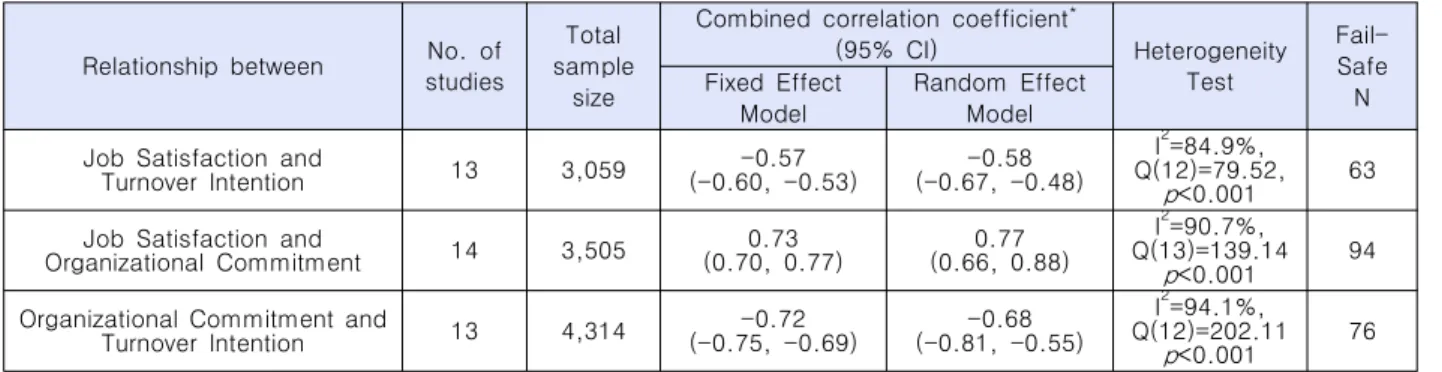
분석기준 선정기준에 적합한 간호사의 직무만족, 이직의도, 조직몰입 관련 논문 26편에서 각 상관관계별 연구논문 수 및
효과크기 데이터 수, 고정/랜덤효과별 표준화된 상관관계 평균 효과크기 및 신뢰구간, 이질성 검정, 안전성 계수를 Table 3.에 제시하였다.
먼저 직무만족과 이직의도 간에 대하여 13개의 개별연구를 검토한 결과 상관이 존재하였다 (N=3,059). 직무만족과 이직의 도 간 상관효과 크기는 고정효과모형의 경우 –0.57, 랜덤효과 모형의 경우 –0.58로 비슷하게 나타났으며, 중간이상의 효과크 기로 나타났다. 또한 95% 신뢰구간이 0을 포함하고 있지 않아 통계적 유의성을 확인할 수 있었다. 또한 이질성 검정 결과 Q=79.52 (p<0.001)로서 이질성이 존재한다고 판정되었으며, I2=84.9%로서 상당히 높게 나타났다.
다음으로 직무만족과 조직몰입 간의 상관은 14개의 개별연 구에서 찾을 수 있었으며 (N=3,505), 상관효과크기는 고정효 과모형 0.73, 랜덤효과모형 0.77로 중간이상이었으며, 통계적 으로 유의하였다. 이질성 검정결과 Q(13)=139.14 (p<0.001), I2=90.7%로 유의하게 나타났다.
조직몰입과 이직의도와의 상관은 13개의 개별연구를 통해 상관이 존재하였다 (N=4,314). 효과크기는 고정효과모형 – 0.72, 랜덤효과모형 –0.68로 중간이상이었으며 통계적으로 유 의하였다. 이질성 검정결과 Q(13)=139.14 (p<0.001) 으로 유 의확률이 0.1보다 작게 나타났으며, I2=90.7%로 50%이상으로 나타나서 각 문헌들 간의 이질성은 높은 것으로 나타났다.
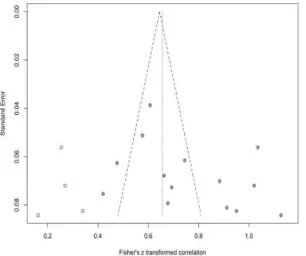
Fig. 1. Funnel plot for the effects of job satisfaction and turnover intention
2. Analysis of Publication Bias
메타분석결과의 타당성 확보를 위하여 funnel 도표를 이용하 여 효과크기의 좌우대칭여부를 시각적으로 확인하였으며, Egger 등이 제안한 회귀분석을 통한 출판편향 검정결과를 수행 하였다.
본 메타분석에 이용한 26편의 논문에 대한 funnel 도표는 Fig 1.~Fig 3.에 제시하였으며, 확인결과 점선을 중심으로 q비 교적 대칭적인 형태로 나타나서 출판편향은 존재하지 않는 것 으로 판단하였다.
Fig. 2. Funnel plot for the effects of job satisfaction and organizational commitment
Fig. 3. Funnel plot for the effects of organizational commitment and turnover intention
Egger의 회귀분석결과는 Table 4.에 제시하였으며, 검정결 과 3가지 유형 – 직무만족과 이직의도, 직무만족과 조직몰입, 조직몰입과 이직의도 – 모두 p-값이 0.6308, 0.1473, 0.2421 로서 통계적으로 유의하지 않게 나타나서 효과크기와 표준오차 와의 유의미한 관계가 존재하지 않다고 나타났다.
또한 메타분석 결과의 안정성을 평가하기 위해 안전성 계수 인 fail-safe N값을 확인한 결과 직무만족과 이직의도의 경우
63, 직무만족과 조직몰입 94, 조직몰입과 이직의도 76으로 신 뢰성을 확인하였다 (Table 3).
비록 funnel 도표 및 Egger 회귀분석 및 안전성 계수 fail-safe N을 통하여 출판오류가 존재하지 않음을 확인했지 만, 추가적으로 Duval and Tweedie [34]가 제안한 trim and fill 의 보정 전/후의 평균효과를 Table 5.에 제시하였다.
Table 4. Result of Egger’s regression analysis
Type* bias se
(bias) t p-value
JS and TI -1.79 3.63 -0.49 0.6308
JS and OC 5.57 3.60 1.55 0.1473
OC and TI 3.89 3.15 1.24 0.2421
* JS: Job satisfaction, TI: Turnover intention, OC:
organizational commitment
직무만족과 이직의도의 경우 trim and fill 이 적용되지 않았 으며, 나머지 2개 유형들의 경우 보정 전과 후의 효과크기 차이 가 그리 크지 않아 연구결과에 영향을 줄 정도의 오류는 아니 라고 보여진다.
종합적으로, 출판편향의 가능성은 작다고 판단되며 본 연구 결과의 타당성을 의심할만한 근거는 없다고 볼 수 있다.
3. Meta Regression: Year of Publication
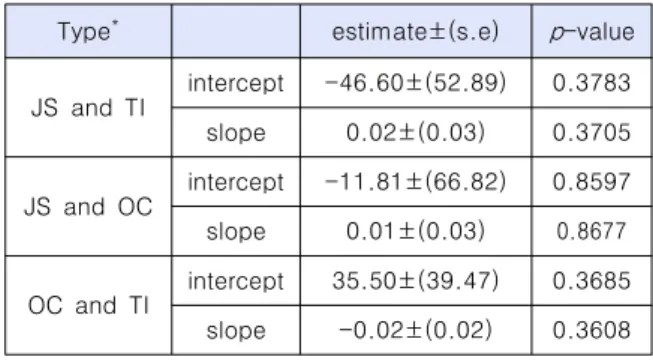
3가지 유형 – 직무만족과 이직의도, 직무만족과 조직몰입, 조직몰입과 이직의도 – 간 상관효과 크기와 출판변수간의 관계 여부를 확인하기 위하여 메타회귀분석을 수행하였다. 각 연구 의 상관효과크기를 종속변수로, 개별연구의 출판연도를 독립변 수로 하여 분석한 결과가 Tabe 6.와 같다.
Table 5. Adjusted effect sizes by trim and fill method
Type* category k ES**
(95% CI) JS and TI Observed 13 -0.58 (-0.67, -0.48)
Adjusted no need adjusted
JS and OC Observed 14 0.77 (0.66, 0.88) Adjusted 18 0.66 (0.53, 0.78)
OC and TI
Observed 13 -0.68 (-0.81, -0.55) Adjusted 17 -0.58 (-0.67, -0.48)
* JS: Job satisfaction, TI: Turnover intention, OC:
organizational commitment
** ES: Effect size(random effect),
출판연도에 따른 메타분석회귀분석 결과에서 3가지 유형모 두 효과크기가 시간에 따른 영향력이 없다고 나타났다 (p-value>0.05). 즉, 직무만족과 이직의도의 관계와 직무만족 과 조직몰입의 경우 기울기가 각각 0.02, 0.01로 양의 방향으
로 나타났으나 유의하지 않았다. 또한 조직몰입과 이직의도의 경우에서는 기울기가 음의 방향으로 나타났으나 유의하지 않았 다.
Table 6. Meta regression: year of publication
Type* estimate±(s.e) p-value
JS and TI
intercept -46.60±(52.89) 0.3783
slope 0.02±(0.03) 0.3705
JS and OC intercept -11.81±(66.82) 0.8597
slope 0.01±(0.03) 0.8677
OC and TI intercept 35.50±(39.47) 0.3685 slope -0.02±(0.02) 0.3608
* JS: Job satisfaction, TI: Turnover intention, OC:
organizational commitment
IV. Discussion and Conclusion
본 연구는 직무만족과 이직의도, 조직몰입들의 관계에 대하 여 간호사를 대상으로, 수행되었던 국내 학술지에 출판된 26편 의 논문들에 기초하여 상관계수에 주된 관심을 두어 메타분석 을 수행하였다.
구체적인 분석결과를 살펴보면 다음과 같다. 첫째로 직무만 족과 이직의도는 상호간의 매우 강한 음의 관계(랜덤효과 모형 상관효과크기 –0.58)로 나타났다. 기존의 Tett and Meyer (1993)가 수행한 북미권역에서의 대규모 메타분석결과에서도 –0.58로 나타났으며 [35], 국내에서 예전에 수행했던 오인수 등 (2007)의 연구에서는 –0.39로서 중간정도의 효과크기로 나 타났다. 직무만족과 조직몰입의 경우 본 연구와 오인수 등의 연 구는 효과크기가 비슷하게 나타났으며, Cooper-Hakim and Viswesvaran(2005)의 북미권역 연구 [36]에서는 비록 본 연 구보다 값이 낮게 나타났으나 매우 높은 수준의 관계로 나타났 음을 확인할 수 있었다. 그리고 조직몰입과 이직의도의 경우에 는 상관관계에 대한 효과크기가 3 연구 모두 비슷한 값으로 나 타남을 알 수 있었다.
이는 대체적으로 기존에 수행되었던 메타분석 결과와 유사 하게 나타났으며, 본 연구에서의 상관효과크기가 타 연구들에 비해 높게 나타났다는 점은 간호사라는 직종의 특수성 때문이 라고 예상할 수 있다. 이러한 연구결과는 타 직종들에 대한 조 절효과 등의 비교를 통하여 알아볼 필요가 있을 것이라 판단된 다.
직무만족의 관점에서 봤을 때 조직몰입과 이직의도 중 더 큰 효과크기를 가지는 변인은 조직몰입이었으며, 이직의도의 관점 에서도 조직몰입이 직무만족보다 더 큰 효과크기를 가지는 변 인으로 나타났다. 이와 같이, 조직몰입은 직무만족과 이직의도 에 큰 영향을 미치는 중요한 변인이라는 점에서 간호사들의 조 직에 대한 몰입정도를 강화하기 위한 노력이 필요할 것이라 생
각된다.
Table 7. Comparison this study with results of other meta analysis
Type* This study Study1† Study2‡
JS and TI -0.58
(N=3,059) -0.39
(N=47,003) -0.58 (N=35,494) JS and OC 0.77
(N=3,505) 0.76
(N=14,003) 0.59 (N=490,624) OC and TI -0.68
(N=4,314) -0.61
(N=7,683) -0.57 (N=136,270)
* JS: Job satisfaction, TI: Turnover intention, OC:
organizational commitment
† Oh et al. (2007)
‡ JS and TI is referred Tett and Meyer(1993)
‡ JS and OC, OC and TI are referred Cooper-Haki m and Viswesvaran(2005)
결론적으로 본 연구는 직무만족, 이직의도, 조직몰입간의 관 련성을 다룬 국내 간호사를 대상으로 26개의 개별연구를 기반 으로 계량적으로 종합분석 한 체계적 문헌고찰 및 메타분석을 수행하였다는 점에 그 연구의의가 있다. 또한 출판연도의 조절 변수 가능성 여부를 확인하였고, 추가적으로 본 연구에서 보고 된 메타분석결과와 기존의 외국연구 및 국내연구에서 제시된 메타분석 결과를 비교하였다. 하지만 본 연구에서 몇 가지 제한 점이 존재하는데, 첫째, 추가적인 조절변수의 탐색이 필요할 것 이다. 예를 들면, 평균 근속연한 및 다른 인구사회학적 요인 등 을 고려한다면 더욱 유용한 결과를 제공할 수 있을 것이라 판 단된다. 둘째, 보건직 종사자에 대한 직무만족, 이직의도, 조직 몰입에 대한 연구물이 많이 부족하므로 이에 대한 연구가 필요 할 것이며, 향후 보건직 종사자로 확대하여 메타분석을 수행할 필요가 있다. 셋째, 향후 연구에서는 직무만족, 이직의도 및 조 직몰입에 대한 다차원 척도별 효과크기를 분석할 필요가 있다.
본 연구에서는 단일차원으로 구성된 척도를 이용하여 효과크기 를 분석하였으나, 이는 다각적 연구를 저해하는 요인이 될 수 있으므로 추후 더 많은 연구 자료가 축적된다면 영역별 다차원 척도를 사용해야 할 것이다.
REFERENCES
[1] Jang, H., "The impacts of working in the hospital empowerment, job satisfaction and organizational commitment turnover intention " The Korean Journal of Health Service Management, Vol. 6, No. 1, pp. 65-75, Mar 2012.
[2] Lee, Y., Kim, S. H., Lee, T., “Effects of job characteristics, organizational culture on job satisfaction and turnover intention in public institution nurses”, J Korean Acad Nurs Admin, Vol. 21, No. 4,
pp. 354-365, September 2015.
[3] Kim, J. K. and Kim, M. J., “A review of research on hospital nurses’ turnover intention”, J Korean Acad Nurs Admin, Vol. 17, No. 4, pp. 538-550, September 2011.
[4] Kim, K. K., Suh, C. and Joo, H., “The impact of hotel employee job characteristic on organization commitment, job satisfaction, and citizenship behavior”, Korean Journal of Business Administration, Vol. 19, No.
2, pp. 469-488, April 2006.
[5] Oh, I., Kim, K., Darnold, T. C., Hwang, J., Yoo, T., Park, Y. and Park, L. H., “Relationship among job satisfaction, organizational commitment, job performance, and turnover intention: A literature review and meta-analysis with Korean samples”, Korean Journal of Management, Vol. 15, No. 4, pp. 43-86, Dec 2007.
[6] Hwang, S. D., ”Meta-Analysis using OpenMeta, R, or RevMan” Kyungpook National University Press, pp.26 –75, 2016.
[7] Han, Y., Sohn, I. S., Park, K. O., Kang, K. W., "The relationships between professionalism, job involvement, organizational commitment and turnover intention among clinical nurses", Journal of Korean Clinical Nursing Research, Vol. 16, No. 2, pp. 17-31, Aug 2010.
[8] Sung, M. H., Cho, S. Y., "The relationship between job characteristics and organizational commitment, and turnover intention in emergency department nurses“, Korean Acad Fundam Nurs, Vol. 17, No. 4, pp. 566-574, November 2010.
[9] Kim, M., Kim, S., “Influences of calling, work value, and organizational commitment on turnover intention in nurses employed at university hospitals in a region”, The Korean Journal of Health Service Management, Vol.
10, No. 1, pp. 67-77, March 2016.
[10] Park, K., Kim, J. K., Kim, S. Y., Chang, S., “A model on turnover intention of chief nurse officers”, J Korean Acad Nurs, Vol. 42, No. 1, pp. 9-18, Feb 2012.
[11] Choi, S., Jang, I., Park, S., Lee, H., “Effects of organizational culture, self-leadership and empowerment on job satisfaction and turnover intention in general hospital nurses”, J Korean Acad Nurs Adm, Vol. 20, No. 2, pp. 206-214, March 2014.
[12] Ahn, M. K., Lee, M. H., Kim, H. K., Jeong, S. H., “Job satisfaction, organizational commitment and turnover intention among male nurses”, J Korean Acad Nurs Adm, Vol. 21, No. 2, pp. 203-211, March 2015.
[13] Kim, Y., Kang, Y., “Effects of self-efficacy, career plateau, job embeddedness, and organizational commitment on the turnover intention of nurses”, J Korean Acad Nurs Adm, Vol. 21, No. 5, pp. 530-541, December 2015.
[14] Kim, M. R., Seomun, G., “Relationships among burnout, job satisfaction, organizational commitment and turnover intention to resign in hospital nurses”, Korean J Occup Health Nurs, Vol. 22, No. 2, pp. 93-101, May 2013.
[15] Choi, S., Kim, S., “Relationships of fatigue to job satisfaction and turnover intention among clinical nurses at small & medium-sized hoispitals, Journal of the Korean Academia-Industrial cooperation Society, Vol. 14, No. 9, pp. 4128-4226, September 2013.
[16] Song, M., “Influence of emotional labor on job involvement, job satisfaction, and turnover intention of clinical nurses”, Journal of the Korean Academia-Industrial cooperation Society, Vol. 15, No.
6, pp. 3741-3750, June 2014.
[17] Yang, J., Jeoung, K., “Effects of emotional labor, job satisfaction and organizational commitment on turnover intention in nurses”, Journal of the Korean Academia-Industrial cooperation Society, Vol. 15, No.
12, pp. 7170-7178, December 2014.
[18] Lee, J., Jin, S. J., Ju, H. J., “Impact of the organizational commitment and organizational culture of nursing and turnover intention on the job satisfaction of public hospital nurses”, Health and Social Science, Vol. 30, pp. 199-230, December, 2011.
[19] Han, J., Woo, H., Ju, E., Lim, S., Han, S., “Effects of nurses’ social capital on turnover intention: focused on the mediating effects organizational commitment and organizational cynicism”, J Korean Acad Nurs, Vol. 43, No. 4, pp. 517-525, August 2013.
[20] Sung, M. H., Choi, W. J., Chun, H. K., “The relatiopship of negative emotion, emotion supression, and job satisfaction to organizational commitment in hospital nurses”, Journal of the Korean Academy of Fundamentals of Nursing, Vol. 18, No. 2, pp. 258-266, May 2011.
[21] Lee, K. J., Kim, M., “The relationship of gender role conflict and job satisfaction upon organizational commitment in male nurses”, Korean Journal of Adult Nursing, Vol. 26, No. 1, pp. 46-57, Feb 2014.
[22] Son, S., Choi, J. S., “Effect of job embeddedness and job satisfaction on turnover intention in nurses”,
Korean Journal of Adult Nursing, Vol. 27, No. 2, pp.
180-187, April 2015.
[23] Cho, C., Kim, M., “An effect of nurses’ job stress and job burnout, job satisfaction and turnover intention:
focus on large-sized hospital in DaeguGyeongbuk area, The proceeding of Korean Journal of Business Administration, pp. 366-380, November 2010.
[24] You, M., Son, Y., “The relationships of work-family conflict, social support, job satisfaction, and organizational commitment in Korean married hospital nurses, Journal of the Korean Academy of Fundamentals of Nursing, Vol. 16, No. 4, pp. 515-523, November 2009.
[25] Noh, Y. G., Jung, M. S., Lee, Y. S., “Nurse’s job satisfaction and organizational commitment according to hospital ethical climate types”, J Korean Acad Nurs Adm, Vol. 19, No. 4, pp. 513-524, September 2013.
[26] Lee, W., Song, J., Kim, J., Kim, H., Lee, J., Kim, U.,
“The relationships among trait anger, anger expression, job satisfaction, job commitment, and organizational performance in clinical nurses”, Journal of the Korean Academy of Nursing Administration, Vol.
15, No. 4, pp. 539-549, December 2009.
[27] Choi, J., Ha, N. S., “The effects of clinical nurse’s internal marketing on job satisfaction, turnover intention, and customer orientation”, Journal of the Korean Academy of Nursing Administration, Vol. 13, No. 2, pp. 231-241, June 2007.
[28] Seok, H. S., “Factors affecting organizational commitment and turnover intention of hospital nurses: focused on the medicating effects of Person-environment fit”, Journal of the Korean Academy of Nursing Administration, Vol. 19, No. 3, pp. 361-371, June 2013.
[29] Kim, M. H., Jung, M. S., “The effect of head nurse’s emotional leadership on nurse’s job satisfaction &
organizational commitment”, Journal of the Korean Academy of Nursing Administration, Vol. 16, No. 3, pp.
336-347, September 2010.
[30] Yom, Y., “The effects of organizational justice on job satisfaction, organizational commitment and health status among nurses”, Journal of the Korean Academy of Nursing Administration, Vol. 15, No. 2, pp. 216-224, June 2009.
[31] Yoo, S. J., Choi, Y. H., “Predictive factors influencing turnover intention of nurses in small and medium-sized hospitals in Daegu city”, Journal of the Korean
Academy of Nursing Administration, Vol. 15, No. 2, pp.
216-224, June 2009.
[32] Cohen, J., ”Statistical power analysis for the behavior science (2nd ed.)” Routledge, pp.467-481, 1988.
[33] Higgins, J. and Green, S., ”Cochrane handbook for systematic reviews of interventions” Wiley, pp.276- 282, 2008.
[34] Duval, S. and Tweedie, R., "A nonparametric ‘trim and fill’ method of accounting for publication bias in meta analysis" Journal of the American Statistical Association, Vol. 95, No. 449, pp. 89-98, Mar 2000.
[35] Tett, R. P. and Meyer, J. P., “Job satisfaction, organizational commitment, turnover intention, and turnover: Path analysis based on meta-analytic findings” Personnel Psychology, Vol. 46, No. 2, pp.
259-293, June 1993.
[36] Cooper-Hakim, A. and Viswesvaran, C., “The construct of work commitment: Testing an integrative framework” Psychological Bulletin, Vol. 131, No. 2, pp.
241-259, Mar 2005.
Authors
Hong-Ki Lee received the Ph.D.
degrees in Management from Kyonggi University, Korea, in 2002.
Dr. Lee joined the faculty of the department of Management at Jungwon University, Chungbuk, Korea in 2009.
His interest includes hospital management, leadership and organizational management.
Sungmin Myoung received the Ph.D.
degrees in Biostatistics and Computing from Yonsei University, Korea, in 2006.
Dr. Myoung joined the faculty of the department of Health Administration at Jungwon University, Chungbuk, Korea, in 2009. His interest includes medical informatics, biostatistical data analysis, and medical data mining.