This work was carried out by the 2015 school year will Chosun University College Grant
* Department of Department of Electronic Communication Engineering, Catholic Kwan-Dong University
**Corresponding Author : Department of Electronics Engineering, Chosun University ([email protected])
Received Septempber 12, 2016 Revised Septempber 19, 2016 Accepted Septempber 19, 2016
Characteristic of Transient Response in Nonuniform Instability with Optically Controlled Fiber
Pan-Lin Han*, Kwang-Chea Park**
광학적으로 제어된 섬유를 가진 비균일 불안정성의 과도 응답의 특성
판린한*, 박광채**
Abstract In this paper we study the effect of chaos in nonuniform instability with optical fiber based IoT networks. The transient response of optically controlled fiber has also described. Nonlinear optical fiber effects especially fiber scattering in networks has emerged as the essential means active optical devices.
The paradigm instability in fiber Internet serves as a test for fundamental study of chaos and its suppression and exploitation in practical application in optical communication. This paper attempts to present a survey and some of our research findings on the nature of chaotic effect on Internet based optical communication. The transient response in optical fiber has been evaluated theoretically by calculating the variation of the scattering function. The lines has used under open ended termination containing optically induced region. The scattered optical waves in a fiber used in optic communications are temporally unstable above certain threshold intensity.
Key Words : Transient Response, Instability, Nonlinear Effect, Optical Fiber, IoT, Optical Communication, Visible Light Communication.
1. Introduction
The IoT is the fastest growing technology on the Earth today, and this is mainly possible because of fiber optics, the hair thin glass wires that carry laser light communication signals around the globe. Fiber optics is thus a very important technology to the IoT networks. Our future depends upon the effectiveness of this fiber communication on the Internet, through the installation of optical networks, and advances in the fiber optic technology [1-3]. Important
advances have been made in the purity of the fibers themselves, so the light signal can travel as far as thousands of kilometers without being amplified. However, current electrical and optical amplifiers still institute lossy interfaces that backscattered incident light signal. Large input signals are thus required and these lead to nonlinear optical phenomenon in optical fibers. If the input power into fiber exceeds the some critical threshold level, then a nonlinear effect can occur, which may be converted into
reflected lightwave, traveling backwards towards the transmitter. The theoretical and physical background of this nonlinear process is provided to describe its nonlinear effect in optical networks [4-5]. The combination of nonuniform optical feedback in networks, has a prescription for inherent deterministic instabilities that may ultimately lead to optical chaos in fiber optic Internet [6].
Many computers on the Internet are connected via optical fibers to support the optoelectronic communications, file transport protocol access, etc for interactive exchange of information data between computers. The networks are used to connect computers for purposes of resource and file sharing as well as opto electronic communications [7-8]. In this paper we study the effect of chaos in non uniform instability with optical fiber based IoT networks.
2. Nonuniform pattern effect in Optical Fiber
The nonlinearity most readily present in the optical fiber is Brillouin scattering and the Kerr effect. Scattering which has light reflection by laser induced acoustic wave in the optical fiber.
In single mode fibers has been extensively investigated theoretically and experimentally by many others [9-12]. The backward scattering nature of optical fiber scattering has long been viewed as an ultimate intrinsic loss mechanism in long haul fibers, since optical threshold decreases with increasing effective fiber length.
On the other hand, the very back scattering nature of this process and the existence of a threshold, provide potential optical device functions, such as optical switching, channel selection, sensing, amplification, arithmetic and
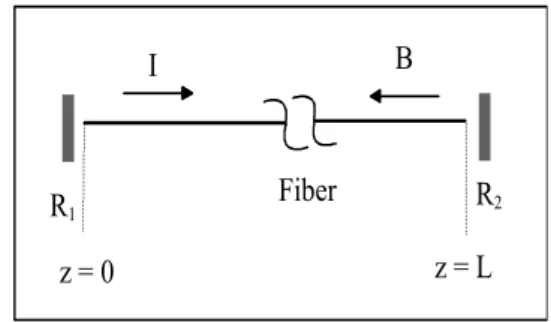
neural functions in networks. The backward scattering scheme in optical networks is shown in Fig.1.
Backwards scattering has the lowest threshold among nonlinear optic phenomena and hence has attracted the greatest interest in small core, low loss single mode fibers for next generation communication networks. It turns out optical scattering is a paradigm in the field of nonlinear dynamics in any networks, in which a signal originating from noise evolves into deterministic dynamical behavior through a nonlinear interaction. The question is whether the originating noises have any effect on the evolved dynamics. This is a fundamental question in the field of nonlinear optical phenomenon in a network system, in which many interactions originate from stochastic processes, the sources of which are either thermal fluctuation or quantum noise in a IoT days[11-12].
I B
R 1 R 2
z = 0 z = L
Fiber
Fig. 1. Configuration of the optical network with counter-propagation signals.
If the optical power launched into the fiber coding line exceeds some critical threshold level, then optical effect can occur. The optical effect causes a significant proportion of the optical power traveling through the fiber transmission line to be converted into a reflected lightwave, shifted in frequency. The characteristics of
Isolator
LASER
Detector
v
pv
pv
pv
s'
S.A
1 2
3
1 2
3
v
n''
v
n''
v
s'
v
s' v
s' v
n''
Loss 0.9 dB
Connector Loss 0.7 dB
Loss 0.9 dB SOA
v
n''
10/90
v
pswitch
v
p10/90
DEp,s,n
Fiber
Fig. 2. Schematic diagram of controlling Instability with LITESPEC fiber. R is the mirror reflectivity and B are beam splitters.
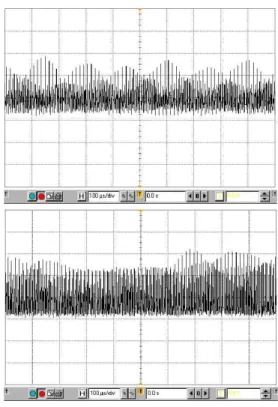
Fig. 3. Temporal structures of fiber instability in a LITESPEC G ZEANQ2 Fiber.(a) before threshold, (b) high above threshold.
backward scattering in fiber, such as frequency shift, linewidth, gain, and threshold can be established using same approach as that for a bulk materials. A typical optical spectrum of the backscattered signal in frequency shift, showing a narrow linewidth of less than 15
MHz
. In experimental setup, the continuous wave single pass backwards effect has been observed in low loss single mode optical fibers of lengths, varying from a few kilometer to 50 meter. It is to be noted, since Brillouin scattering is a backs cattering process, there is a thresholdg
=g 0 P 0 L/A
= 21 for a straight fiber, and is lowered in a fiber-ring to 2/10.3. Instability with Optically Controlled Fiber
An active device in network systems in general requires the employment of non linearity, and possibly feedback for increased efficiency in device function. However, the presence of nonlinearity together with intrinsic delayed feedback has repeatedly demonstrated to lead to instabilities and ultimate optical chaos [8-10].
Instabilities are unavoidable in optical scattering due to its intrinsic nonlinearity and feedback. Our
effort is then to exploit device function, design for optimization and the promotion of such deterministic instabilities. The other for novel data transmission in optical communications.
If the optical power launched and designed to a setup for analyzing optical instabilities in a fiber configuration. The main advantage of fiber ring has already been given above. A schematic of the setup for analyzing instability and chaos has shown in Fig. 2. Some level of temporal instability and chaotic behavior in the backscattered intensity and also in its spectral line shift will be observed. It is thus essential whether such an amplifier will further destabilize optical networks. Since our proposed fiber sensor is based on monitoring the optical spectral line shift with varying temperature and strain, the origin of the temporal chaotic behavior must be
(a)
(b)
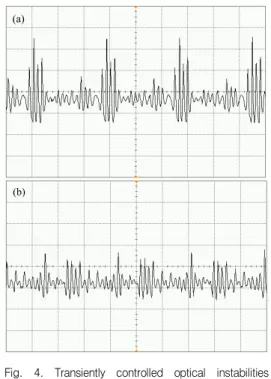
Fig. 4. Transiently controlled optical instabilities before threshold(a) and high above threshold(b).
The example of sequences are assigned by ‘on’
and ‘off’ symbols.
understood and its correlation to spectral line shift examined[3]. The detected sensor line is further analyzed with a spectrum analyzer, which permits better resolution of the fine structure of the detected line, and also on a fast scope for better interpretation of the process that leads to pulse generation.
The backward signal is detected with a fast detector as the laser pump power is progressively increased to maximum of 20mw.
When the pump power reaches a threshold value, a temporal structure arises in the backward signal, consisting of a periodic train of backwards wave pulses as shown in Fig.
3(a).The temporal repetition rate of which corresponds to a pulse round trip time in the fiber ring taken to be less than 10 nsec. When the observation is made using a time scale 0.5msec/division, the optical output exhibits randomly distributed trains of periodic pulses.
The most partial stabilization of amplitude fluctuations is achieved as laser pump power approaching maximum value. The experimental feature is shown in Fig. 3(b) as a function of time. In the data predicted, mechanical vibrations could be partially responsible for temporal instabilities, because small amplitude fluctuations with similar frequencies were observed below the backwards threshold as compared to our numerical results. The results attribute these optical fiber instabilities to phase fluctuations between direct and coupled pump intensity in the fiber networks.
4. Proposed Instability Control and Optical Memory
The possibility of controlling optical fiber instability using periodic pulse train has recently
stimulated much theoretical analysis. The principal idea is the stabilization of unstable periodic waves using a instability suppressor and bandpass filtering. Since these proposed systems are very effective as suppressor and controlled filter in digital networks, a successful controller may also serve as a generator, as encoding decoding message of rich forms of periodic waves, thus turning the presence of chaos to advantage. We propose to employ continuous optical feedback for the control in which coherent interference of the chaotic optical signal with itself, when delayed, is used in achieving signal differencing for feedback (see Fig.2). Much work needs to be done to test this theory. If successful, we will then be able to perform encoding and decoding of messages in real time communications. The site receives the information from the local computer at the
center, and downloads the nonlinear effect files.
In the high above threshold. The time scale has then used in 0.5msec/division. The also x-axis represents time scale (msec/div) and y-axis is optical amplitude in arbitrary units.
We proposed to employ continuous optical feedback for the control in which coherent interference of the chaotic optical signal with itself, when delayed, is used in achieving signal differencing for the feedback. If fiber suppressing by attractor proves to control chaos then, fiber suppressing under natural chaos can be exploited as a means for sensing structural instabilities. Multistable periodic states make transition to logic ‘0’ or ‘1’. That’s, the examples of sequence of suppression are assigned by ‘0’
and ‘1’ symbols. It can make theoretically potential large memory capacity as like input bit streams in IoT systems. Its implementation still requires much engineering improvements, such as arriving at a spatial resolution that is comparable to the references or speckle, and suppression of its potential to instability.
5. Conclusion
We have demonstrated that backward waves in a optical fiber used in fiber networks are temporally unstable above certain threshold intensity. The characteristic of nonuniform pattern has also studied with temporal structures. We have also shown how the threshold for the onset of instability varies as a function of the ratio between the input signal intensities for various values of the output in networks. Transiently Control of chaotic induced instability in optical systems has been also proposed and implemented experimentally.
Multistable periodic states, makes transition to
logic ‘0’ or ‘1’. It can make theoretically potential large memory capacityIt is theoretically possible to apply the multi stability regimes as an optical memory device for encoding decoding messages and complex data transmission in the optic communications and IoT networks in the future.
REFERENCES
[1] L. Wei, J. Danping, and L. Yingwen, “A study on fiber optic remote temperature measurement system based on the Internet”, Proc. of SPIE, vol. 4220, pp.
326-329, 2000.
[2] Do-Sun Choi, “Design of Algorithm for maximum Signal Sensing by Optical System“, KIECT 3(4), 70 –75. 2010.
[3] Y.K. Kim, “Effect of Chaos and Instability of Brillouin Active Fiber Based on Optical Communication Networks”, KIECT 6(4), 272-277, 2013.
[4] Harry J. R. Dutton,
Understanding Optical Communications
, IBM, Prentice Hall, New Jersey, 2014.[5] G. P. Agrawal,
Nonlinear Fiber Optics
, 3rd, Academic Press, London, 2001.[6] Sung-Chul Kim, Seo-Yong Shin, “An Encoder-Decoder for Optical CDMA
System by Using an array of
Superstructured Fiber Bragg Gratings”, KIECT 1(1), 75-78, 2008.
[7] Pain, H.J.
Physics of Vibrations and Waves 6/E
, Wiley, 2016.[8] Choi, S. Baek, C.K. Park, S. Park, YJ,
“An Analysis of the Field Dependence of Interface Trap Generation under Negative Bias Temperature Instability Stress using Wentzel-Kramers Brillouin with Density Gradient Method”, Japanese Journal of
Applied Physics, 50(1), 014302, 2011.
[9] Hinkley, N. et al. An atomic clock with 10−18 instability. Science 341, 1215–1218, 2013.
[10] Lopez, O. et al. Simultaneous remote transfer of accurate timing and optical frequency over a public fiber network.
Appl. Phys. B 110, 3–6, 2013.
[11] Lopez, O. et al. Ultra-stable long distance optical frequency distribution using the Internet fiber network. Opt.
Express 20, 23518–23526, 2012.
[12] Chen, X. et al. Feed-forward digital phase compensation for long-distance precise frequency dissemination via fiber network. Opt. Lett. 40, 371–374, 2015.
Author Biography
박 광 채(Kwang-Chea Park) [종신회원]
•1975년 조선대학교 전자공학과 (공학사)
•1980년 조선대학교 대학원전자 공학과 (공학석사)
•1994년 광운대학교 대학원전통 신공학과 (공학박사)
•2013년 현재 조선대학교전자정 보공과대학 전자공학과 교수
<Research Interests> Network security, Internet security, IoT Big Data
판 린 한(Pan-Lin Han) [일반회원]