706
FOREST SOCIETY
Analysis of Chemical Compositions and Energy Contents of Different Parts of Yellow Poplar for Development
of Bioenergy Technology
Soojeong Myeong
1, Sim-Hee Han
2and Soo-Jeong Shin
3*1Division of Climate Change, Korea Environment Institute, Seoul, 122-706, Korea
2Department of Forest Resources & Development, Division of Forest Genetic Resources, Korea Forest Research Institute, Suwon 441-350, Korea
3Department of Wood and Paper Science, College of Agricultural, Life & Environment Sciences, Chungbuk National University, Cheongju 361-763, Korea
Abstract :Understanding of chemical composition and energy contents in tree is important to develope strategies of renewable energy policy to cope with climate change. Residual biomass as renewable energy source was evaluated and focused on the bark-containing branches. Chemical analysis studies were conducted for different part of yellow poplar (Liriodendron tulipifera), which were partitioned to inner bark, outer bark, small branches, medium branches, big branches and trunk. The variations in hydrophobic extractives, hydrophilic extractives, lignin, carbohydrate compositions, energy contents (higher heating value) and the ash content were determined. The inner and outer bark had higher ash content, hydrophobic and hydrophilic extractives content, and higher energy content than those of tree trunk. Polysaccharides content in inner and outer bark was quite lower than those of stem or branches. Based on the energy content of residual biomass, replacement of fossil fuel and greenhouse gas emission abatement were calculated.
Key words :yellow poplar, bark, branch, elementary analysis, energy content, ash
Introduction
Human-being has accumulated CO2, the major green- house gas in the air since industrial revolution. These increased greenhouse gas brought climate change. It is estimated that the unprecedented natural disasters occur- ring over the world lately are to be the negative impact of climate change. IPCC (Intergovernmental Panel on Climate Change) also expressed their concern about the impact of climate change in their 4th climate change assessment report. Greenhouse gases such as CO2 and CH4 block thermal energy from radiating out into space and trap heat within Earth's atmosphere, which conse- quently brought global warming effect to the Earth. Cli- mate Change is one of the main environmental issues that we are facing presently. Under the UNFCCC (Unite Nations Framework Convention of Climate Change), every country has the pressure to reduce greenhouse gas and Korea is also under the strong pressure of green- house gas emission reduction (IPCC, 2007).
To solve this global environmental problem, we should
reduce greenhouse gas emission, and absorb greenhouse gas in the air as much as possible. One of the main solu- tions for this global environmental problem is to capture the atmospheric carbon into some kind of carbon stor- age. The most suitable types of carbon storage can be plants and soil. Especially trees can be good carbon stor- age as long as we maintain trees growing well. Another solution can be converting main energy source from fos- sil fuel into renewable energy. Developing renewable energy can be good solutions for climate change: wind energy, solar energy, and bioenergy are some examples.
One of the best examples can be bio-energy. In Korea, it is known that there are lots of available tree residuals from forest thinning activities. Wood became the main source of renewable energy in many countries such as United States, because generating bioenergy from waste wood can be a good substitute for burning fossil fuels such as coal, oil, and gas. Korea forest is 65% of land.
It is reported that forest absorbs about 6.3% of green- house gas emissions in Korea. If we manage forest and waste wood more efficiently, we can reduce greenhouse gas emission. Therefore, it is necessary to develop tech- nologies that can convert trees into bioenergy.
In addition, the increase of world population and the
*Corresponding author E-mail: [email protected]
improvement of living standard require more amount of woody biomass as energy sources or wood products forms. The wood processing industries use the raw material selectively. In forest harvesting, most of top unmerchantable stem, branches, stump and roots are nei- ther harvested nor collected due to less economically attractive (Hakkila, 1989). Those less attractive biomass can be defined as residual biomass. Residual biomass has lower commercial values as wood product industry, but it can be used as bioenergy resources. Compared to wood trunk, bark has different anantomical and chemical characteristics (Usia and Kara, 1997). The most of resid- ual biomass has difficulty in debarking, because the pro- cess that can control bark containing biomass are essential.
Effective uses of residual biomass can overcome the short- age of biomass in renewable energy resources. Chemical compositional analysis and elementary analysis can esti- mate the biomass as a potential feedstock for biofuel production (Hallac et al., 2009; Hu et al., 2010; Madakadze
et al., 1999; Yan et al., 2010)
In this study, we investigated the chemical composi- tion of tree trunk, inner and outer bark and different size of branches. With chemical compositional analysis and elementary composition analysis, we evaluated the resid- ual biomass values as biosolid fuels and their impact of carbon dioxide emission abatement.
Material and Methods 1. Wood materials
Twenty-year old yellow poplar grown at Chungbuk National University campus (Cheongju, South Korea) was cut, debarked, chipped and air-dried for one week.
Air-dried chip were milled to less than 20 meshes for chemical analyses. Inner bark and outer bark were sep- arated by debarking process. Branches were collected and grouped to small branches (diameter less than 1.0 cm), medium branches (diameter 1-3 cm), and big branches (diameter bigger than 3 cm). Collected barks and branches were cut and milled to less than 20 meshes.
2. Extractives content
Extractives content was measured according to TAPPI procedure T 204-om 82 for hydrophobic extractives (TAPPI, 1989a) and T 207-om 88 for hydrophilic extrac- tives (TAPPI, 1989b). Due to high carcinogenic property of benzene, ethanol-benzene solvent extraction was replaced by acetone. Extractives content was calculated based on the difference between oven-dried weight of un-extracted and extracted samples. Air-dried samples were extracted by acetone (for hydrophobic extractives) followed by hot-water (for hydrophilic extractives) as successive extraction.
3. Monosaccharides and lignin content analysis:
Extractives-free samples (200 mg) were hydrolyzed with 72% sulfuric acid (1.5 mL) for 2 hours at 20oC.
The hydrolyzate was diluted to 4.0% sulfuric acid with distilled water and boiled for 3 hours. The boiled hydro- lyzate solution was cooled to room temperature for over- night and filtered through 1G4 porcelain crucible filter and the residue was calculated as Klason lignin content.
For monosaccharide compositional analysis, experiment was run as 1/10 scale down and 2nd stage hydrolysis was diluted by deuterium oxide instead of distilled water for 1H-nuclear magnetic resource spectroscopic analysis (Shin and Cho, 2008). Operating conditions are listed in Table 1.
4. Ash analysis
The ash content of unextracted samples was analyzed according to TAPPI method T211 om-85 (TAPPI, 1989c).
5. Energy content
The higher heating value (HHV) for the yellow poplar was analyzed according to TAPPI method T684 pm-84 in an adiabatic oxygen bomb calorimeter (TAPPI, 1989).
Results and Discussion
Tree crowns, unmerchantable tops, stumps, and roots form a huge reserve of renewable raw material. Com- pared with merchantable stems, some additional biomass is potentially available from these unutilized tree com- ponents in silviculturally managed forests, and undersized trees and defected stem parts include a considerably higher percentage in overmature, unmanaged forests.
Utilization of the residual biomass is constrained and frequently totally prevented by many economic, techni- cal, and ecological barriers (Hakkila, 1989). A critical factor is the high cost of recovery due to the small unit size, low areal yield, low bulk density and need for spe- cial equipment. In conventional use of raw material, Table 1. Operating conditions of 1H-NMR Spectroscopy for monosaccharide composition.
1H-NMR
Model Bruker, AVACE NMR
Spectrometer (500 MHZ)
Solvent D2O
Pulse 11 µsec
Delay between pulse 10 s Acquistiton time 2.73 sec
Sweep width 10 ppm
Center of spectrum 4.5 ppm
Temperature 295.6 K
high content and irregular variation of bark and foliage are serious drawbacks as well. This problematic situation is reflected in the perspective of wood technology research, which is traditionally aimed at improved utilization of stem wood. Only a very small fraction of the efforts is directed toward the utilization of other components of the tree.
In branch, softwood forms compression wood as eccentric growth rings, which appears on the lower side of branch.
However, hardwood branch forms tension wood as eccentric growth rings, which appear on the upper side of branch. These tension wood and compression wood have different anantomical and chemical composition compared with stem (Okuyama et al., 1994). Compres- sion wood has less cellulose and galactoglucomannan but more lignin and galactan than those in normal wood.
Tension wood has more cellulose and less lignin than those in normal wood.
From the utilization point of view, in some tree spe- cies juvenile and mature woods may be considered as two different materials in the same stem. The duration of the juvenile period, usually from 5 to 20 years, is quite variable among species (Hakkila, 1989).
The bark locates external to vascular cambium, which is composed of phloem, cortex, periderm and remnants of the epidermis. This complex structure and composi- tion allows the multiple functions, such as photosynthe- sis, sap conduction, tissue aeration and protection from external stresses (Niklas, 1999). The outer bark forms a protective barrier between plant axis and the abiotic and biotic environment. The inner bark (phloem) serves as sugar transport and defend against herbivores or cells
and tubes filled with bitter or toxic chemicals. Due to these characteristics, bark has different chemical compo- sition with stem.
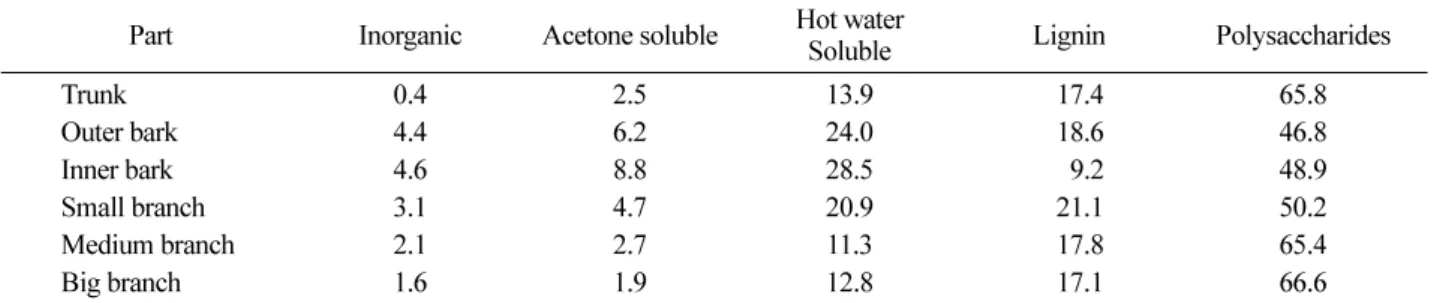
Extractives (both hydrophobic and hydrophilic) and ash content in bark were higher than those in trunk (Table 2). Due to higher extractives and ash contents in bark, bark containing branches also had higher extrac- tives and ash content than those in trunk. Within barks, there was different chemical composition between inner and outer bark, and inner bark had more hydrophilic extractives but outer bark had more lignin content.
In carbohydrate compositional analysis and polysac- charide contents in overall compositional analysis, bark had less polysaccharide than trunk, which resulted in less cellulose and xylan content (Table 3). However, glucomannan content was similar between bark and trunk. Holocellulose and cellulose content in bark were lower than those in sapwood and heartwood (Usia and Kara, 1997). Due to higher bark portion, carbohydrate content in small branch was lower than that in middle, larger branch or stem. Due to lower cellulose and xylose content in bark and small branch, this fraction can produce less monosaccharides than bigger branch or stem by acid or enzymatic saccharification with the- oretical yield.
In elementary analysis, bark had higher hydrogen and nitrogen and lower oxygen content than trunk (Table 4). In branch, small or medium branches had similar elementary composition with bark but big branch had similar composition with trunk. Higher amount of nitrogen in bark means higher physiological activity in bark area.
Table 2. Chemical composition of different part of yellow poplar (unit: %).
Part Inorganic Acetone soluble Hot water
Soluble Lignin Polysaccharides
Trunk 0.4 2.5 13.9 17.4 65.8
Outer bark 4.4 6.2 24.0 18.6 46.8
Inner bark 4.6 8.8 28.5 9.2 48.9
Small branch 3.1 4.7 20.9 21.1 50.2
Medium branch 2.1 2.7 11.3 17.8 65.4
Big branch 1.6 1.9 12.8 17.1 66.6
Small: less than 1 cm diameter, medium: 1-3 cm diameter, big: more than 3 cm diameter Table 3. Carbohydrate composition of different part of yellow poplar.
Part Polysaccharides Cellulose Xylan Glucomannan
Trunk 65.8 46.2 17.5 2.1
Outer bark 46.8 35.5 9 2.3
Inner bark 48.9 37.8 8.7 2.4
Small branch 50.2 35.7 14.4 0.1
Medium branch 65.4 44.6 18.5 2.3
Big branch 66.6 49.4 16.3 0.9
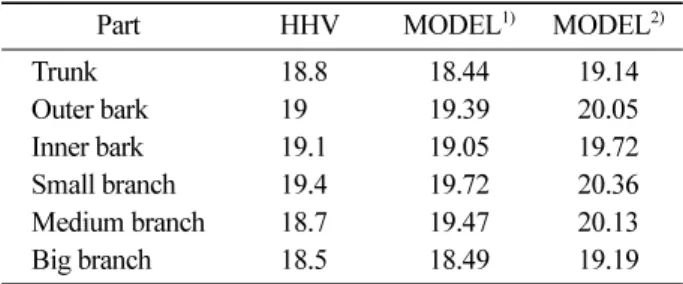
In energy content and elementary composition anal- ysis, energy content was measured by bomb calorim- eter and compared with theoretical energy content based on the elementary compositional analysis with Dulong's model and Ruyter model. The equations of two different models are listed in below. In Dulong's model, calorie unit value was converted to Joule unit value (Table 5).
1) Dulong model (Sivapalan et al., 2003) CV (Calorimetric value) = 80.80%C +
344.60(%H − %O/8) + 22.50%S (kcal/kg) 2) Ruyter model (Ruyter, 1982)
CV = 0.34%C + 1.40%H − 0.16%O (MJ/kg) With elementary analysis and energy content model calculation, Ruyter's model gave higher energy content than Dulong's one (Table 4). In yellow poplar biomass, Dulong's model gave closer energy content value to bomb calorimetric energy content value than Ruyter's one. Even though bark had higher ash content, it had higher energy content than trunk, which meant higher energy in hydrophic and hydrophilic extractives than polysaccharides or lignin. Due to different elementary composition, lignin and extractives has higher heating value than other wood component (White, 1986). With appropriate design in ash removal part, bark and bark- containing branch should be superior bio-solid fuels than trunk.
1. Comparison with fossil fuels
In secondary metabolism, main wood structural com-
ponents are biosynthesized from glucose. Due to high oxygen content in woody biomass, residual biomass has less energy content than natural gas, petroleum and coal (Table 6). However, effective usages of residual biomass can extract the energy, otherwise, there will be decom- posed to carbon dioxide and water. Net carbon dioxide emission for 19 MJ was compared in Table 6. Residual biomass had far less carbon dioxide emission than fossil fuels.
Conclusions
This study showed the potential to use residual wood for generating bioenergy. Residual wood showed the dif- ferent chemical composition compared with those of trunk in yellow poplar. Inner and outer bark had higher extractives content than those in trunk, which led to higher energy content than main woody trunk. Branches which contain the bark showed very similar chemical composition and energy content compared with trunk in yellow poplar. Therefore, residual biomass in yellow poplar can replace the trunk in the point of bioenergy generation based on the combustion.
Literature Cited
1. Hakkila, P. 1989. Utilization of residual biomass, Springer- Verlag, Berlin, Germany.
2. Halllac, B.B., Sannigrahi, P., Pu, Y., Ray, M., Murphy, R.J. and Ragauskas, A.J. 2009. Biomass characteriza- tion of Buddjeja daviddi: A potential feedstock for bio- Table 4. Elementary analysis of different part of yellow
poplar.
Part C H O N
Trunk 49.45 6.66 43.76 0.13
Outer bark 50.37 6.9 42.04 0.7
Inner bark 49.25 7.04 43.02 0.7
Small branch 50.97 6.88 41.22 0.93 Medium branch 50.79 6.83 41.92 0.46
Big branch 49.51 6.66 43.54 0.29
Table 5. Energy contents in different part of yellow poplar based on oven-dried biomass (HHV: higher heating values, Unit: MJ/kg)
Part HHV MODEL1) MODEL2)
Trunk 18.8 18.44 19.14
Outer bark 19 19.39 20.05
Inner bark 19.1 19.05 19.72
Small branch 19.4 19.72 20.36
Medium branch 18.7 19.47 20.13
Big branch 18.5 18.49 19.19
1)Based on Dulong's model
2)Based on Ruyter's model Table 6. Replaceme.nt of fossil fuel by residual biomass and net carbon dioxide emission.
Residual biomass Natural gas Petroleum Coal
Energy value (MJ) 19 18.8 19.1 19.1
Unit Energy value (MJ/kg) 19 49.4 43.5 29
Net weight (kg) 1 000.38 000.44 00.66
Net carbon dioxide emission (kg) 0.12 001.02 001.51 01.55
fuel production. Journal of Agricultural and Food Chemistry 57: 1275-1281.
3. Hu, Z., Skyes, R., Davis, M.F., Brummer, E.C. and Ragauskas. A.J. 2010. Chemical profiles of switchgrass.
Bioresource Technology101: 3253-3257.
4. IPCC. 2007. Climate Change 2007: Impacts, Adapta- tion and Vulnerability Summary for Policymakers, Cam- bridge University Press.
5. Madakadze, I.C., Stewart, K., Peterson, P.R., Coulman, B.E. and Smith, D.L. 1999. Switchgrass biomass and chemical composition for biofuel in eastern Canada.
Agronomy Journal 91: 696-701.6.
6. Niklas, K.J. 1999. The mechanical role of bark. Amer- ican Journal of Botany 86: 465-469.
7. Okuyama, T., Yamamoto, H., Yoshida, M., Hattori, Y.
and Archer, R.R. 1994. Growth stresses in tension wood:
role of microfibrils and lignification. Annal of Forest Science 51: 292-300.
8. Ruyter, H.P. 1982. Coalification model. Fuel 61: 1182- 1187.
9. Shin, S.-J. and Cho, N.-S. 2008. Conversion factors for carbohydrate analysis by hydrolysis and 1H-NMR spec- troscopy. Cellulose 15: 255-260.
10. Sivapalan, K., Yunus, M.N.M., Sopian, K., Samsuddin, A.H. and Rahman, R.A. 2003. Modeling the heating
value of municipal solid waste. Fuel 82: 1119-1125.
11. TAPPI. 1989a. TAPPI Test Methods T 204-om 82 Alco- hol-benzene and dichloromethane solubles in wood and pulp, Technical Association of Pulp and Paper Industry, 12. TAPPI. 1989b. TAPPI Test Methods T 207-om 88 WaterUSA.
solubility of wood and pulp, Technical Association of Pulp and Paper Industry, USA.
13. TAPPI. 1989c. TAPPI Test Methods T 211-om 85 Ash in wood and pulp, Technical Association of Pulp and Paper Industry, USA.
14. TAPPI. 1989d. TAPPI Test Methods T 684-pm 84 Gross heating value of black liquor, Technical Association of Pulp and Paper Industry, USA.
15. Usia, M. and Kara, S. 1997. The chemical composition of wood and bark of Cedrun libani A. Rich. European Journal of Wood and Wood Products55: 268.
16. White, R.H. 1986. Effect of lignin and extractives on the higher heating value of wood. WoodandFiber Science 19: 446-452.
17. Yan, J., Hu, Z., Pu, Y., Brummer, E.C. and Ragauskas, A.J. 2010. Chemical compositions of four switchgrass populations. Biomass and Bioenergy 34: 48-53.
(Received July 13, 2010; Accepted September 27, 2010)