• 검색 결과가 없습니다.

The audience's reaction effect based on vicarious emotional experiences and creative rhetorical expressions of the networking media platforms

N/A
N/A
Protected

Academic year: 2021

Share "The audience's reaction effect based on vicarious emotional experiences and creative rhetorical expressions of the networking media platforms"

Copied!
11
0
0

로드 중.... (전체 텍스트 보기)

전체 글

(1)

The audience's reaction effect based on vicarious emotional experiences and creative rhetorical expressions of the networking

media platforms

Hyuck-Soo Choi

Lecturer, Dept. of Advertising and Public Relations, Namseoul University

네트워킹 미디어 플랫폼의 대리적 감정 경험과 크리에이티브의 수사적 표현 방식에 따른 수용자 반응

효과
남서울대학교 광고홍보학과 강사 최혁수

Abstract This study involves an experiment aimed to reveal the communicative effects by different types of visual expressions in SNS advertisements. This study analyzes consumers’ dynamic responses to vicarious emotional experiences and the creative rhetorical expressions of networking media platforms through experiments that sample university students. The vicarious emotional experiences of networking media platforms have a significant effect on the consumers’ subsequent reactions. The greater the vicarious emotional experiences are, the more positive this effect is. There is a significant interactive effect between consumers’ vicarious emotional experiences and the rhetorical creative types of targeted media.

Key Words : Innovative networking, Media platform, Vicarious emotional experiences, Rhetorical effect, Creative image platform, Advanced technology

요 약 이 논문은 SNS 광고의 수사학적 표현 유형에 대한 실험 자극을 통해 커뮤니케이션 효과를 밝혀보는데 목적을 두었다. 간접적인 감정적 반응 수준과 SNS 매체의 크리에이티브 단서들을 통한 참여자의 역동적인 커뮤니케이션 반응 을 실험을 통해 분석하였다. 참여자는 실험의 목적을 충분히 이해하고 있는 대학생들로 제한하였다. SNS 미디어 플랫폼 에 대한 대리적 감정 경험은 수용자의 반응에 유의적인 영향을 미치는 것으로 밝혀졌다. 네트워킹 미디어 플랫폼에 대 한 대리적 감정경험이 높을수록 더 긍정적인 결과가 나타났다. 수용자의 대리적 감정경험과 수사적 크리에이티브 유형 간에도 유의적인 상호작용효과가 발생하였다.

주제어 : 혁신적인 네트워킹, 미디어 플랫폼, 대리적 감장 경험, 수사적 효과, 크리에이티브 이미지 플랫폼, 첨단 기술

*Corresponding Author : Hyuck-Soo Choi([email protected]) Received January 22, 2021

Accepted April 20, 2021 Revised February 15, 2021

Published April 28, 2021

(2)

1. Introduction

The development of new digital media has rapidly changed the communication environment for information deliverers and consumers. Traditional media, which delivers information unsophisticatedly and stimulates reactions unilaterally, is now marginalized as being old-fashioned. The changes in exchange channels between information deliverers and consumers stem less from changes in personal habits or values than from the structural changes driven by technological innovations. Facebook, a prime product of cutting-edge information technology, is a personal channel developed through innovative changes in media technology, but it has also contributed to the fundamental changes in how information consumers communicate. A Facebook advertisement premised on voluntary information consumption is a medium that allows for a great degree of freedom in expression. Nonetheless, a medium with a variety of expressional modes should not be equated to an effective medium[1].

Developed as a result of advances in digital technology, Facebook is oriented toward mutual communication and drives the traditional passive mode of personal communication to a proactive and sympathetic one. It is not complicated in terms of environmental limits and thus allows for easy access for anyone, thereby encouraging people to share information. Its communication structure does not dichotomize information deliverers and consumers: deliverers are also consumers and consumers may also become deliverers. As such, Facebook is an interaction-oriented medium of information exchanges, which comes with a variety of benefits. In particular, Facebook encourages voluntary access of consumers, which in turn has a binding effect[2,3].

Facebook users do not need to pay a fee, because a great number of individuals and

companies regard Facebook as an effective medium for advertising. Individuals and companies that want to deliver certain messages to Facebook users may do so without incurring excessive costs. Facebook is regarded as a highly effective advertising medium, considering the increasing number of its users and the exposure of a variety of advertisements. The value of Facebook as a channel increases every day;

thanks to the increase in exposure of advertisements. Whether a video advertisement on Facebook is as persuasive as its media value depends on the qualitative factors of the advertisement at issue. The qualitative factors then depend on the advertisement’s style of visual design. Visual design is the best approach to stimulate consumers’ emotional responses.

Similar to changes in media channels, visual designs of Facebook advertisements may either amplify or discourage user response; therefore, it is important to think carefully about visual design strategies[4,5]. The increase in the number of Facebook users does not automatically mean an increase in the rate of advertisement exposure; nor does it mean maximization of user responses. In other words, the goal for advertising can be met only with a visual design that is proper, not repulsive, and suitable to the digital environment. Designs of visual advertisements on social networking services can amplify both positive and negative reactions by users. Since a variety of moderating variables from users toward Social Network Service can have an impact on visual design strategy, it is important to produce generalizable results through consistent studies[6].

2. Networking media platforms and consumer dynamism

The rapid transformation of media has greatly

enriched human life. However, it may also bring

(3)

about serious problems. Innovative changes in technology can lead to a variety of problems, the most serious of which is a phenomenon of disconnection in communication. Human interactions require in-person contacts for resolution of key issues. However, communication with a machine occurs without any consideration of emotion or context, and likely fails to be a substantive way to resolve an issue[7].

SNS, the prevailing media in the twenty-first century, is deeply embedded in our daily life.

SNS applications, compared to other applications, are more public than private, as they help to build a community for people through information exchanges and communication. The competition among a variety of SNS has consistently been a subject of academic research because it promotes an understanding of consumer experiences and the development of more persuasive design strategies.

SNS media is extremely different from traditional media. For advertisements on both traditional and SNS media, media characteristics are the primary consideration throughout the production processes from the planning stage to the final feedback stage. In the case of dynamic media, it is important to design a strategy that can strengthen the persuasiveness through movements. On the other hand, for still media, highlighting dynamic graphicness to capture users’ attention is more efficient. The kinetics of an advertisement is not limited to a particular medium. Dynamism is the key for a good advertising strategy without exception[2,8].

SNS media is a new effective channel for persuasion by allowing consumers to select information directly and voluntarily. The biggest advantage of maximizing information selection is that consumers can either accept or reject messages from their desired channels in a selective manner. This is a unique characteristic that traditional media cannot provide to consumers. For consumers who may have been

bored by simple daily consumption patterns, SNS media, unlike analogue media, is new in providing an unprecedented system and innovative inordinacy, thereby capturing their independent attention. There are not many channels that could win consumers’ attention.

Considering that the changes in consumers’

attitudes begin with attention, one may easily understand the immense space for further development of SNS media in a modern society[9,10].

3. Rhetorical flexibility of innovative media and consumer dynamism

The visual expression of an advertisement is the part that gets directly exposed to consumers as a final product of a variety of inputs through the planning stage. One cannot expect an emotional response from consumers without properly portraying visual creativity that can channel emotions even if the planning for an advertisement is conducted in a meticulous and scientific manner. An advertisement’s visual creativity is the key to persuading consumers.

There is not a right script for an advertisement’s visual expression that could control consumer emotions. An advertisement’s visual elements are not created through a meticulous script; instead, they are highly flexible elements that could only be selected following a prolonged and painstaking creative process. The flexibility of visual expression provides an unlimited space for advertising expression[5,11].

Elements of visual simile in an advertisement

focus on selecting features that can go well with

the overall mood and flow thereof; therefore,

they have the advantage of not encouraging

repulsiveness despite lacking a sense of

freshness. Consumer repulsion against expressive

elements in an advertisement is the biggest

impediment for advertising effects. Since it is not

(4)

convenient to achieve target consumer response, to find a shortcut to the goal of an advertisement, it is important to find the positive elements already embedded in consumers’

cognition to reduce repulsiveness[12,17].

Conversely, visual metaphors can also maximize interests by combining the contents one intends to highlight in an advertisement with unique visual elements. Expressive elements of visual metaphor must utilize positive features that are very different from - and yet easily associated with - the advertised product. The novelty of visual, metaphoric expression channels attention to advertised information that follows it. Providing attention to an advertisement means an active participation in understanding various elements therein. A proactive approach to advertised information by a consumer is intended to resolve the novelty generated by visual metaphor. Once this novelty is resolved, consumers experience a sense of satisfaction from resolving a problem, which functions as a stimulating method that could be a tool for more effective persuasion[13,18].

In order to encourage positive reactions from consumers, expressions of visual simile and visual metaphor should be arranged in a way that facilitates convenient understanding of signs in an advertisement. Visual images in an advertisement must deliver not only visual signs but also their meanings. Visual elements that simply share signs cannot generate target reactions. The flexibility of visual images has the advantage of allowing for the best selection; at the same time, however, it may lead to a serious problem of incongruency in meanings delivered and accepted and thus requires careful planning.

If visual similes and metaphors in an advertisement attempt to stimulate and resolve curiosity in consumers but fail to be easily understood, they might stimulate anxiety in consumers. An increase in consumer anxiety could lead to a negative review of an

advertisement or a product; therefore, it is important to arrange them in a comprehensible manner. In other words, if the visual elements of an advertisement do not go well with the scenario of accommodation, they might produce a rebound effect, and the intended consequences cannot be guaranteed[14].

4. Research questions

Facebook advertisements are most effective when they are arranged with designs that are most suitable to the characteristics of Facebook as a digital medium. These characteristics include the facilitation for a word-of-mouth effect through networks formed among consumers and a prolonged relationship between a company and a client through one-on-one and regular communication. Facebook is a unique network formed through friend relationships and likes by numerous consumers[15,16]. These relationships are consistent and interacting among one another almost every single day.

Studies on Facebook conducted so far tend to focus on a single dimension. This study aims to examine the efficiency of SNS in terms of communication through experiments[20]. The research questions are as following:

Research question 1 :Does advertisement attitude vary depending on consumers’ vicarious emotional experiences (high/low) and creative modes (informational/imagery)?

Research question 2 :Does brand attitude vary depending on consumers’ vicarious emotional experiences (high/low) and creative modes (informational/imagery)?

Research question 3 :Does communicative effect vary depending on consumers’ vicarious emotional experiences (high/low) and creative modes (informational/imagery)?

Research question 4 :Does word-of-mouth

(5)

intention vary depending on consumers’

vicarious emotional experiences (high/low) and creative modes (informational/imagery)?

Research question 5 :Does intention to repurchase vary depending on consumers’

vicarious emotional experiences (high/low) and creative modes (informational/imagery)?

5. Research methodology 5.1 Samples and research design

This study involves an experiment aimed to reveal the communicative effects by different types of visual expressions in SNS advertisements. A total of 188 university students participated in this experiment, including 95 males (50.5%) and 93 females (49.5%). The effects of vicarious emotional responses are analyzed depending on different types of visual expressions of Facebook advertisements[21]. It is based on a between-subjects factorial design of 2 (vicarious emotional responses: high, low) by 2 (creativity modes: informational, imagery).

5.2 Measurement tool

This study examines internal consistency reliability of the measurement tool used. An individual's emotions are divided into two areas:

the emotions they actually feel about the experience and the emotions they judge about the emotions. The area of emotion is the primary response to human experiences, which is to feel anger, sadness, happiness, and fear etc. You can't always be experiencing all of these emotional states firsthand. In general, past experiences determine vicarious emotional experiences. Therefore, the high and low levels of vicarious emotional experiences with rhetorical expressions was distinguished through the treatment of the question. The internal consistency reliability (Cronbach’s α) of vicarious emotional response is .938; that of advertisement

attitude is .964; that of brand attitude is .964;

that of communicative effect is .953; that of intention to repurchase is .955; and that of word-of-mouth action is .972, a relatively high value according to the standard for social sciences.

Three questions of 7-point Likert standard are used to measure vicarious emotional responses.

Four questions of 5-point Likert are used to rate advertisement attitude and brand attitude. Three questions of 7-point Likert standard are used to analyze communicative effect. Three questions of 7-point Likert standard are used to analyze intention to repurchase and word-of-mouth behavior. Both informational and imagery types are prepared for Facebook experimental advertisements. These advertisements are made in a way that is distinguishable from existing advertisements in terms of all components including brand names and characteristics, for example, of an automobile advertisement.

Operation check has been conducted ahead of the experiment to verify the familiarity of the experimental advertisements. Since experimental advertisements were made to comply with the goal of this experiment, their level of completion was slightly lower than that of existing advertisements in terms of editing and connection of meanings of various constitutive elements.

The reason for choosing a car advertisement is

that the mood of the advertisement focuses on

emotion through visual images rather than on

the basis of rational judgment of the audience,

and it is a product type in which various types of

visual expression are developed. The reason why

various types of visual expressions are presented

in automobile advertisements is based on the

premise that the responses of the audience are

different. In particular, in the case of

experimental products, the use of metaphorical

processing as well as direct visual expressions

has appeared more frequently than other product

categories.

(6)

5.3 Data processing

The study data were processed as follows.

First, frequency analysis was conducted on the overall average of vicarious emotional experiences to categorize them into a high group and a low group. Reliability analysis was conducted to examine internal reliability consistency (Cronbach’s α).

Finally, to test the research questions, two-way analysis of variance was conducted based on a two-by-two between-subjects factorial design.

The above analyses were conducted using SPSS 21.0 program.

6. Research results 6.1 Categorization of vicarious emotional

experiences

To categorize vicarious emotional experiences (AVF) into a low group and a high group, their average values are added together. Values that are above and below the 50% standard are categorized into a high group and a low group, respectively. As shown in Table 1, a total of 84 persons (44.7%) are categorized into a low group and a total of 104 persons (55.3%) are categorized into a high group.

AVF n ratio(%)

AVFL 84 44.7

AVFH 104 55.3

Table 1. AVF group classification

6.2 Investigation of research questions A two-way analysis of variance based on a two-by-two between-subjects factorial design was conducted to examine the interaction effects of vicarious emotional experiences (high/low) and creative modes (informational/imagery) on advertisement attitude, brand attitude, communicative effect, word-of-mouth intention,

and intention to repurchase. The major results are as follows

6.2.1 Advertisement attitude

As shown in Table 2, an examination of the interaction effect of advertisement attitude by vicarious emotional experiences and creative modes shows that vicarious emotional experiences (high/low) and creative modes (informational/imagery) have a significant interaction effect on advertisement attitude (Eta2=.091, F=18.393, p<.001). Statistical power of this analysis is .989, which is above the minimal standard, .80.

F Eta

2

Observed

Power

AVFLH(a) 136.023*** .425 1.000

Creative type(b) 2.366 .013 .334

(a)*(b) 18.393*** .091 .989

Table 2. Interaction effect of advertising attitude according to AVE and creative type

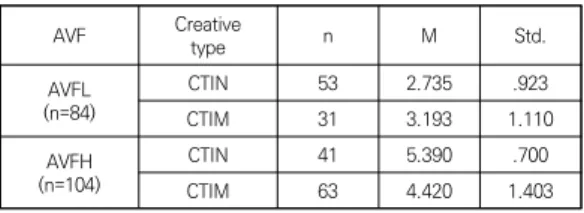
More specifically, as shown in Table 3 and Fig.

1, advertisement attitude is the highest (M=5.390) when vicarious emotional experiences are high and creative mode is informational. It is lowest (M=2.735) when vicarious emotional experiences are low and creative mode is informational.

Overall, advertisement attitude is higher when vicarious emotional experiences are high rather than low and creative mode is informational rather than imagery.

AVF Creative

type n M Std.

(n=84) AVFL

CTIN 53 2.735 .923

CTIM 31 3.193 1.110

(n=104) AVFH CTIN 41 5.390 .700

CTIM 63 4.420 1.403

Table 3. Advertising attitude according to AVE and

creative type

(7)

Fig. 1. Interaction effect on AVF and creative type of advertising attitude

6.2.2 Brand attitude

As shown in Table 4, an examination of the interaction effect of brand attitude by vicarious emotional experiences and creative modes shows that there is a significant interaction effect on brand attitude by vicarious emotional experiences (high/low) and creative modes (informational/imagery) (Eta2=.086, F=17.275, p<.001). Statistical power is .985, which is above the minimal standard, .80.

F Eta

2

Observed

Power

AVFLH(a) 112.085*** .379 1.000

Creative type(b) .594 .003 .120

(a)*(b) 17.275*** .086 .985

*** p<.001

Table 4. Interaction effect of brand attitude according to AVE and creative type

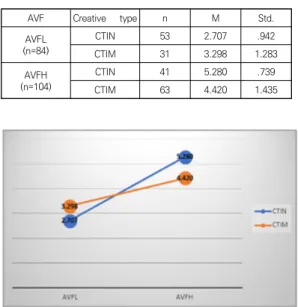
More specifically, as shown in Table 5 and Fig.

2, brand attitude is the highest (M=5.280) when vicarious emotional experiences are high and creative mode is informational. It is the lowest (M=2.707) when vicarious emotional experiences are low and creative mode is informational.

Overall, advertisement attitude is higher when vicarious emotional experiences are high rather than low and creative mode is informational rather than imagery.

AVF Creative type n M Std.

(n=84) AVFL CTIN 53 2.707 .942

CTIM 31 3.298 1.283

(n=104) AVFH

CTIN 41 5.280 .739

CTIM 63 4.420 1.435

Table 5. Brand attitude according to AVE and creative type

Fig. 2. Interaction effect on AVF and creative type of brand attitude

6.2.3 Communicative effect

The data in Table 6 establish that there is a significant interaction effect on communicative power by vicarious emotional experiences (high/low) and creative modes (informational/i magery) (Eta2=.085, F=17.131, p<.001). Statistical power is .985, which is above the minimal standard, .80.

F Eta

2

Observed

Power

AVFLH(a) 130.777*** .415 1.000

Creative type(b) 3.048 .016 .412

(a)*(b) 17.131*** .085 .985

*** p<.001

Table 6. Interaction effect of communication according to AVE and creative type

More specifically, as shown in Table 7 and Fig. 3,

communicative effect is the strongest (M=5.471)

when vicarious emotional experiences are high

and creative mode is informational. It is lowest

(M=2.767) when vicarious emotional experiences

are low and creative mode is informational.

(8)

Overall, advertisement attitude has stronger communicative power when vicarious emotional experiences are high rather than low and creative mode is informational rather than imagery.

AVF Creative

type n M Std.

(n=84) AVFL

CTIN 53 2.767 .950

CTIM 31 3.182 1.246

(n=104) AVFH

CTIN 41 5.471 .691

CTIM 63 4.449 1.448

Table 7. Communication according to AVE and creative type

Fig. 3. Interaction effect on AVF and creative type of communication

6.2.4 Intention to repurchase

The data in Table 8 elucidate that there is a significant interaction effect on intention to repurchase by vicarious emotional experiences (high/low) and creative modes (informational/

imagery) (Eta2=.099, F=20.262, p<.001). Statistical power is .994, which is above the minimal standard, .80.

F Eta

2

Observed

Power

AVFLH(a) 129.662*** .413 1.000

Creative type(b) 4.954* .026 .600

(a)*(b) 20.262*** .099 .994

* p<.05 *** p<.001

Table 8. Interaction effect of repurchase intention according to AVE and creative type

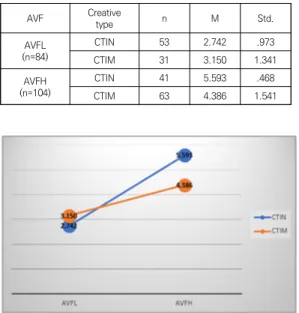
More specifically, as shown in Table 9 and Fig.

4, intention to repurchase is the strongest (M=5.593) when vicarious emotional experiences are high and creative mode is informational. It is lowest (M=2.742) when vicarious emotional experiences are low and creative mode is informational. Overall, intention to repurchase tends to be stronger when vicarious emotional experiences are high rather than low and creative mode is informational rather than imagery.

AVF Creative

type n M Std.

(n=84) AVFL

CTIN 53 2.742 .973

CTIM 31 3.150 1.341

(n=104) AVFH

CTIN 41 5.593 .468

CTIM 63 4.386 1.541

Table 9. Repurchase intention according to AVE and creative type

Fig. 4. Interaction effect on AVF and creative type of repurchase intention

6.2.5 Word-of-mouth behavior

The data in Table 10 suggest that there is a

significant interaction effect on word-of-mouth

behavior by vicarious emotional experiences

(high/low) and creative modes

(informational/imagery) (Eta2=.081, F=16.140,

p<.001). Statistical power is .979, which is above

the minimal standard, .80.

(9)

F Eta

2

Observed Power

AVFLH(a) 128.394*** .411 1.000

Creative type(b) 1.625 .009 .245

(a)*(b) 16.140*** .081 .979

*** p<.001

Table 10. Interaction effect of word-of-mouse according to AVE and creative type

More specifically, as shown in Table 11 and Fig. 5, word-of-mouth behavior is the strongest (M=5.642) when vicarious emotional experiences are high and creative mode is informational. It is the lowest (M=2.490) when vicarious emotional experiences are low and creative mode is informational. Overall, word-of-mouth behavior tends to be stronger when vicarious emotional experiences are high rather than low and creative mode is informational rather than imagery.

AVF Creative type n M Std.

(n=84) AVFL

CTIN 53 2.490 .959

CTIM 31 3.053 1.633

(n=104) AVFH CTIN 41 5.642 .559

CTIM 63 4.555 1.792

Table 11. Word-of-mouse according to AVE and creative type

Fig. 5. Interaction effect on AVF and creative type of word-of-mouse

7. Conclusion

For Facebook advertisement to be remembered

instead of being easily forgotten like flowing water, a creative strategy is required. Users do not log into Facebook to watch advertisements;

therefore, what is needed is not a thought- provoking message but a message that makes people automatically turn their heads around when they catch a glimpse of the advertisement.

Creative mode may stimulate a wide variety of reactions depending on the dispositions of consumers who casually log into Facebook. The creators of Facebook advertisements must channel consumers’ attention. However, it is still a debatable question what expression would make an effective message. Therefore, this study aimed to discover a feasible way to make a Facebook advertisement an effective, creative strategy and conducted experiments sampling university students. This study analyzed not only the effects of informational and imagery expressions but also the interaction effects by setting consumers’ psychological dispositions as moderating variables.

This study produces the same conclusion for advertisement attitude, brand attitude, communicative power, intention to repurchase, and word-of-mouth behavior, all of which are chosen as moderating variables. Vicarious emotional experiences and creative modes had an interaction effect on all moderating variables, that is, advertisement attitude, brand attitude, communicative power, intention to repurchase, and word-of-mouth behavior are all most positive in a group of high vicarious emotional experiences and informational creative mode.

Conversely, all moderating variables are lowest in

a group of low vicarious emotional experiences

and informational creative mode. Thus,

advertisement attitude, brand attitude,

communicative power, intention to repurchase,

and word-of-mouth behavior are more positive

when vicarious emotional experience is higher

rather than lower and creative modes are

informational rather than imagery.

(10)

The fact that the positive effect is higher for Facebook advertisements when creative mode is informational than when it is imagery is in line with the argument for motive-promoting effect proposed by controlling motive theory. Vicarious emotional experiences – considered as a consumer disposition here - are generated in a personal dimension experienced through the mood and tone of an advertisement. The fact that an SNS advertisement of an automobile is more effective when its informational expression amplifies vicarious emotional experiences shows that informational expressions amplify experiences on a personal level and generate more dynamic experiences than imagery images.

In the case of high vicarious emotional experience, informational advertising has been shown to be useful. This result is believed to be caused by the automobile advertisement product itself. This is because practical goods or products with high involvement are trying to find specific product information within the advertisement.

On the other hand, it can be seen that pleasure goods and products with low involvement have a higher influence on the image.

Dynamic experiences of an environment on a personal dimension react proactively to unpredictable changes. Kinetic explorations generate positive results by adapting to any kind of information pattern. Motive-promoting effect is not the type that pursues stability by settling for the present and avoiding danger.

Motive-promoting effect aims to achieve a goal by pursuing a change in behaviors and adopting an enterprising spirit for a better result. An informational expression that presents the characteristics of an automobile making future unpredictable suggests a dynamic future. Without participants’ adventures, it is difficult to achieve a positive result. Participates exposed to informational expression understand that without altering their current behaviors regarding the characteristics of an automobile, they would not

be able to achieve a sense of satisfaction and thus voluntarily pursues changes. Their dynamic changes demonstrate motive-promoting effect.

This research shows that informational expressions of SNS lead to better reactions than imagery expressions when participants are immersed in vicarious emotional experiences. An intention to repurchase and spread words implies that participants voluntarily spread their reactions to advertisements to other people.

Avoiding forced advertisement messages while searching for information is a normal phenomenon. Informational expression is a direct and explicit way to deliver information that could prevent such avoidance. Imagery expressions, in particular, are signs made to deliver meanings in an indirect and implied manner. Participants need to make considerable intervening efforts to understand the meanings hidden in imagery expressions. Many advertisement expressions fail to easily trigger participants’ active intervention. It is possible to have imagery expressions arranged in a way that could stimulate inferences particular to each individual; however, it would be difficult to generate target responses within a short period of time. Therefore, informational expressions that are easily comprehensible to participants without requiring much thinking or effort could provide a sense of psychological stability and maximize the emotional information thus acquired.

Since participants’ voluntary communication triggered by informational expressions are highly aligned with the characteristics of Facebook, advertisement creators should prudently consider informational expressions when making strategies for creative plans.

REFERENCES

[1] L. Andreu, A. B. Casado-Díaz & A. S. Mattila. (2015).

Effects of message appeal and service type in CSR

(11)

communication strategies. Journal of Business Research, 68(7) , 1488-95.

DOI : 10.1016/j.jbusres. 2015.01.039.

[2] S. V. Jin. (2018). Celebrity 2.0 and beyond! Effects of Facebook profile sources on social networking advertising. Computers in Human Behavior, 79(Feb), 154-168. DOI : 10.1016/ j.chb.2017.10.033.

[3] S. H. Ang & E. A. Lim. (2006). The influence of metaphors and product type on brand personality perception and attributes. Journal of Advertising, 35(2) , 39-53.

[4] L. Bergkvist. D. Eiderback & M. Palombo. (2012). The brand communication effects of using a headline to prompt the key benefit in Ads with pictorial metaphors. Journal of Advertising, 41(2), 67-76.

[5] N. Park. K. F. Kee & S. Valenzuela. (2009). Being immersed in social networking environment:

facebook groups, uses and gratifications, and social outcomes. Cyber Psychology & Behavior, 12(6), 729-33.

[6] D. M. Boyd & N. B. Ellison. (2007). Social network sites: Definition, history, and scholarship. Journal of Computer Mediated Communication, 13(1), 65-78.

DOI : 10.1111/ j.1083-6101.2007.00393.

[7] L. R. Briones. B. Kuch. B. F. Liu & Y. Jin. (2011).

Keeping up with the digital age: how the American Red Cross uses social media to build relationships.

Public Relations Review, 37(1), 37-43.

[8] J. Raacke & J. Bonds-Raacke. (2008). MySpace and facebook: applying the uses and gratifications theory to exploring friend-networking sites. Cyber Psychology & Behavior, 11(2), 169-74.

[9] B. P. Brown. A. R. Zablah. D. N. Bellenger & N.

Donthu. (2012). What factors influence buying center brand sensitivity? Industrial Marketing Management, 41(3), 508-20.

[10] S. I. Celebi. (2015). How do motives affect attitudes and behaviors toward internet advertising and facebook advertising? Computers in Human Behavior, 51(Oct), 312-24. DOI : 10.1016/j.chb.2015.05.011.

[11] L. C. Cheng. (2014). A qualitative research on brand sensitivity: traditional Chinese medicine health products. GSTF Business Review, 3(4), 75-80.

[12] M. Dehghani & M. Tumer. (2015). A research on effectiveness of Facebook advertising on enhancing purchase intention of consumers. Computers in Human Behavior, 49(Aug), 597-600.

[13] M. Esmaeilpour & F. Aram. (2016). Investigating the impact of viral message appeal and message credibility on consumer attitude toward brand. International Journal of Business & Economic Sciences Applied Research, 9(3), 24-33. DOI:10.1515/mmcks-2016-0010.

[14] E. F. McQuarrie & B. J. Phillips. (2005). Indirect persuasion in advertising: how consumers process

metaphors presented in pictures and words. Journal of Advertising, 34(2), 7-20.

[15] L. Gkiouzepas & M. K. Hogg. (2011). Articulating a new framework for visual metaphors in advertising.

Journal of Advertising, 40(1), 103-20.

[16] N. B. Ellison. C. Steinfield & C. Lampe. (2007). The benefits of Facebook friends: Social capital and college students’ use of online social network sites.

Journal of Computer Mediated Communication, 12, 1148-63.

[17] B. J. Phillips & E. F. McQuarrie. (2009). Impact of advertising metaphor on consumer belief. Journal of Advertising, 38(spring), 46-61,

DOI : 10.2753/JOA0091-3367380104.

[18] N. Rhodes. (2017). Fear-appeal messages: message processing and affective attitudes. Communication Research, 44(7), 952-75.

[19] L. Shen. (2010). On a scale of state empathy during message processing. Western Journal of Communication, 74(5), 504-24.

[20] J. B. Walther. B. Van Der Heide. S. Kim. D.

Westerman & S. T. Tong. (2008). The role of friends’

behavior on evaluation of individuals’ Facebook profile: are we known by the company we keep?

Human Communication Research, 34, 28-49.

[21] M. Weiss. (2008). Communicate empathically and they'll listen. Advertising Age, 79(16), 20.

최 혁 수(Hyuck-Soo Choi) [정회원]

․ 2021년 3월 ~ 현재 : 남서울대학교 광 고홍보학과 강사

․ 관심분야 : on-line Ads, New media Planning

․ E-Mail : [email protected]

수치

Table  3.  Advertising  attitude  according  to  AVE  and  creative  type
Table 4. Interaction effect of brand attitude according  to  AVE  and  creative  type
Fig.  3.  Interaction  effect  on  AVF  and  creative  type  of  communication
Table  11.  Word-of-mouse  according  to  AVE  and  creative  type

참조

관련 문서