- 148 -
개선된 직접순시토크제어기법을 이용한 SRM의 토크리플 저감
Huijun Wang, 김태형, 이동희, 안진우 경성대학교
Torque Reduction of SRM Using An Advanced Direct Instantaneous Torque Control Scheme
Huijun Wang, Tae-Hyoung Kim, Dong-Hee Lee, Jin-Woo Ahn Kyungsung University
Abstract
- In this paper, an advanced torque control scheme of SRM using DITC(Direct Instantaneous Torque Control) and PWM(pulse width modulation) is investigated. The proposed DITC-PWM regulates a duty ratio of the phase switch according to the torque error and simple control rules of DITC without any hysteresis bandwidth. The proposed control method is verified by the simulations and experimental results.
1. Introduction
An inherent torque ripple of SRM is one of a major concern for the industrial applications. In order to reduce the torque ripple, several methods of feed-forward torque control have been implemented in the past. Some of them use off-line or on-line calculated current profiles for phase excitation in order to deliver a smooth output torque, whereas several methods for optimization of profiles can be used [1-2], however these control techniques suffer from their relatively low flexibility and data intensive implementation.
Another very promising control scheme called DITC (Direct Instantaneous Torque Control) is proposed[3]. By estimation of instantaneous torque and a simple hysteresis control, total torque can be controlled in a certain tolerance band around a given reference value. The major benefits of this type are its high robustance against errors in measured rotor position. However, the switching frequency is not constant due to the hysteresis controls, and the torque ripple is dependent on sampling period. And torque can not be controlled within the band width. In order to reduce the torque ripple in a conventional DITC, the torque sampling rate is to be increased enough.
This paper presents an advanced DITC-PWM scheme for torque ripple reduction of SRM, which combines the conventional DITC and PWM method. The torque estimator and torque error can be realized by the DITC, but the switching rules are realized by PWM according to the torque error. The actual switching signals are controlled by the torque error and control rules of DITC. So, the torque ripple reduction and constant switching frequency can be obtainedthat is essential for the power filter design of input power lines.
2. Advanced DITC control method
2.1 Asymmetric converter
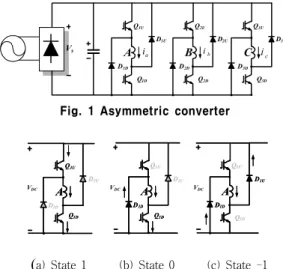
Within the last several decades, the research and development on the SRM have been focus on converter topologies. The most flexible and the most versatile four quadrant SRM converter is the classic converter shown in Fig. 1, which requires two switches and two diodes per phase. During the magnetization period, two phase switches connected to the winding are turned on and the magnetic energy is transferred from the source to the motor, which is shown in Fig. 2. Chopping or PWM, if necessary, can be accomplished by switching either one or both the switches during the conduction period according to the control strategy. In commutation, both switches are turned off and the phase winding is demagnetized through the two freewheeling diodes. The main advantage of this converter is the independent control of each phase.
2.2 Principle of proposed method
Fig. 3 shows the proposed control rules of DITC-PWM method.
The conventional DITC method uses a simple hysteresis switching
rules that has -1, 0 and 1 switching modes as shown in Fig. 2.
According to torque error at every sampling period, only one switching mode is activated at every sampling period in the conventional method. But proposed method uses one or two switching modes at every sampling period, and the activation time of the switching modes are changed by the torque error.
A
D1U
D1D Q1U
Q1D
Vs
ia B
D2U
D2D Q2U
Q2D
ib C
D3U
D3D Q3U
Q3D
ic
Fig. 1 Asymmetric converter
A
D1D Q1U
Q1D
A
D1D Q1U
Q1D
A
D1D Q1U
Q1D
D1U D1U D1U
A
D1D Q1U
Q1D
A
D1D Q1U
Q1D
A
D1D Q1U
Q1D
D1U D1U D1U
VDC VDC VDC
( a) State 1 (b) State 0 (c) State -1 Fig. 2 Operation modes of Asymmetric converter
(a) One-phase excitation period
(b) Two-phase excitation period
Fig.3 Advanced DITC control schemeIn the one-phase excitation period shown in Fig. 3(a), switching
modes of the active phase are changed from 0 to 1 in case of
positive torque error. And the duty ratio of switching modes is
decided by the torque error shown as Fig. 3(a). In a commutation
region shown in Fig. 3(b), phase currents of the incoming and
2007년도 대한전기학회 하계학술대회 논문집 2007. 7. 18 - 20- 149 -
outgoing phase produce the output torque. The switching mode of the outgoing phase remains -1 state in order to prevent the negative torque of the outgoing phase at the negative torque error. And the incoming phase is controlled according to torque error. If the incoming phase current can not supply the sufficient torque, the outgoing phase is controlled by the torque error to produce auxiliary output torque shown as Fig. 3(b).
3. Simulation and experimental results
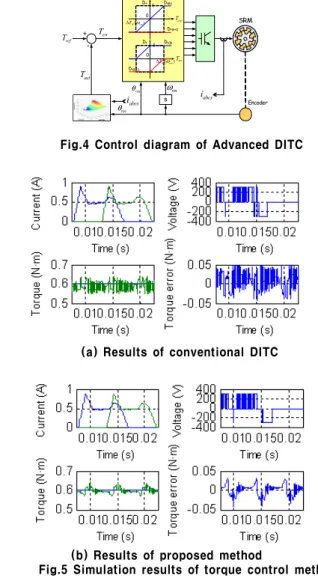
In order to verify proposed method, some simulations are applied with MATLAB software. Fig.4 is control diagram of advanced DITC SRM drive system. Fig.5 is simulation result, in which torque sampling time and PWM period are 30[
μs]. From the result we can see that torque ripple can be effectively reduced compared with conventional DITC, which means sampling rate can be reduced on the same total torque condition compared with conventional DITC.
Tref
Tact
iabcs
θrm
Terr
SRM
Encoder +
-
Dt
-1 Terr Dt(k)
Dt(k+1) 0 ( ) H rm Tω Δ
Dt Dt(k) 0
Terr Dt(k+1)
( ) H rm Tω Δ
ωrm s iabcs
1
1
θrm
.
..Fig.4 Control diagram of Advanced DITC
(a) Results of conventional DITC
(b) Results of proposed method
Fig.5 Simulation results of torque control method
The advanced DITC control method is implemented using a 12/8 SRM. Platform for the control strategy is designed by TMS320F2812 from TI(Texas Instruments) and phase current and voltage signals are feedback to 12bit ADC embedded by DSP, The rotor position and speed are obtained by 512ppr optical encoder. The rotor speed is calculated from captured encoder pulse by QEP function of DSP. The current toruqe control sampling period is designed as 30[
μs], PWM frequency are 22kHz and 16kHz respectively. The bandwidth is 10%
torque reference for conventional and proposed DITC control method.
Fig. 6 shows the experimental result of conventional method. From Fig. 6 we can see that torque ripple is very big in bandwidth because torque can not be controlled in the bandwidth by conventional DITC method, which means that torque sample time and bandwidth have to be reduced when reducing torque ripple, and
switching frequency will be raised and efficiency will be reduced.
Fig. 6 Experimental results of conventional DITC method
Fig. 7 and 8 are experimental results of proposed method. From the results we can see that torque ripple can be reduced because of PWM control and dynamic regulation according to torque error in the bandwidth.
Fig. 7 Experimental results of proposed method at 22kHz
Fig. 8 Experimental results of proposed method at 16kHz 4. Conclusions
In this paper a novel torque control method is proposed. Comparing with conventional hysteresis torque control method, it has following advantages:
1, under the same torque condition, torque sampling time can be raised and torque bandwidth can be enlarged;
2, torque can be dynamically regulated according to torque error in the bandwidth and switching frequency can be controlled;
3, fixed switching frequency allows for implementation of simple and low cost control hardware and filters.
[Reference]