http://dx.doi.org/10.11625/KJOA.2017.25.4.773 ISSN 2287-819X (Online)
‘알렉산드리아’ 유기 포도원에서 발생되는 가루깍지벌레의 계절적 조사 및 유기농업자재의 방제효과
*
1)
송명규*****․박재성**․이석호**․이재웅**․김승덕**․정창원**․김길하***․박종호****
Seasonal Occurrences and Organic Agricultural Materials’ Control Effect of Pseudococcus comstocki on ‘Muscat of Alexandria’
Organic Vineyard in Korea
Song, Myung-Kyu․Park, Jae-Seong․Lee, Seok-Ho․Lee, Jae-Wung․
Kim, Seung-Duck․Jeong, Chang-Won․Kim, Kyl-Ha․Park, Jong-Ho
This study was carried out to investigate the damage patterns, the occurrence and migration time of Pseudococcus comstocki and in order to improve the control effect of organic agricultural materials (OAMs). The experiment was carried out at Okcheon’s organic vineyard (2,500 ㎡, sandy loam, manure) where planted 8~9 year old ‘Muscat of Alexandria’ vines. The comstock mealybug’s migration to grape clusters occurred from the middle of July, and produced eggs in the grape clusters from the end of July, and the density of the comstock mealybug was highest at 0.6 ㎠ in late August. The number and fruit damage of comstock mealy- bug in eco-friendly vineyards were higher than in conventional culture vineyard.
And the marketability of green variety grape was more damaged from comstock mealybug than the black variety grape. Toxicities of 8 OAMs were evaluated to comstock mealybug at the recommended concentration. As a results, Lightyellow sophora and Derris extracts exhibited strong insecticidal activity with 100%
mortality. When the Lightyellow sophora extract was uniformly distributed on the vine from early-July to mid-July, fruit damage reduction rate was 96.2% and 84.6%, respectively. So commercial grapes could be harvested. Therefore, it was
*****
본 연구는 농촌진흥청 국립농업과학원 농업과학기술 연구개발사업 유기과수 품질 향상 및 문제
병해충 관리 기술 개발(과제번호: PJ010829)의 지원에 의해 이루어진 것임.
*****
충청북도농업기술원 포도연구소
*****
충북대학교 농업생명과학대학
*****
국립농업과학원 유기농업과
*****
Corresponding author, 충청북도농업기술원 포도연구소([email protected])
considered to be effective to reduce fruit damage by controlling in early - late July (the green stage) when the comstock mealybug migrated to grape clusters in the vine greenhouse. In the future, it will be necessary to study the effect of external exposure time and momentum on the control of OAMs.
Key words : control effect, grape, organic agricultural materials, Pseudococcus
comstockiⅠ. 서 론
우리나라 포도 재배면적은 2007년 18,843 ha에서 2015년 15,397 ha로 매년 감소되는 경 향인데 비하여 포도 친환경 재배 인증농가(유기, 무농약)는 2007년 112농가(77.3 ha)에서 2015년 556농가(371 ha)로 증가하였다(KOSIS). 유기재배 포도는 경북의 상주, 의성을 비롯 하여 전남, 전북, 충남, 충북 등의 포도 주산지 일부지역에서 많이 재배되고 있다. 최근 들 어 유기농업에 대한 소비자의 관심이 높아짐에 따라 포도 유기재배 농가도 증가하는 추세 이나 재배기술이 정립되어 있지 않아 많은 어려움을 겪고 있다. 친환경 포도 재배가 증가 되면서 관행재배에서 문제가 되지 않았던 해충이 문제화가 되고 있어 기존과 다른 포도 해충 관리 방법이 필요하게 되었다(Song, 2016).
‘알렉산드리아’(Muscat of Alexandria; MOA)는 북아프리카에서 기원하여 이집트의 ‘알렉 산드리아’ 항구에서 로마제국으로 재배가 확대되었고, 현재는 스페인, 이탈리아, 일본, 남미 에서 테이블 포도로 활용되며, 남유럽, 아프리카, 미국 캘리포니아, 호주 등에서 와인용으 로 활용되고 있는 포도 품종이다(Christensen, 2000). 당도가 높고, 껍질째 먹는 청포도로 국 내에서는 식용으로 재배되고 있다. 겨울철 추위에 약해 시설재배를 하고 있으며, 특히 충북 옥천, 영동은 유기재배를 통하여 차별화를 두고 있다.
가루깍지벌레[Pseudococcus comstocki (Kuwana)]는 매미아목(Aucheonorrhyncha) 가루깍지 벌레과(Pseudococcidae)에 속하는 해충으로 배나무 등 65종 이상의 식물을 가해하는 것으로 알려져 있다(Jeon et al., 2003). 가루깍지벌레는 연 3회 이상 발생하며, 성충의 몸에는 백색 을 띄는 왁스층이 덮여 있으며 작물보호제 등에 대한 저항성이 높아서 난방제 해충으로 취 급되는 종이다(Jeon et al., 1996). 포도원에서는 왁스물질에 싸인 난괴 또는 성충 및 약충 상 태로 포도나무의 조피 틈이나 점적호수, 피복비닐 틈 등에서 월동한다. 약충과 성충 모두 과실과 줄기 및 잎맥을 흡즙하여 1차로 피해를 주며, 이후 감로 분비로 그을음병 유발과 잎 의 광합성 능력 감소로 수세를 약화시킨다(Seo et al., 2016). 포도는 과실에 봉지를 씌우기 때문에 봉지 속의 과실에 정착한 개체들은 약제 살포로 쉽게 방제되지 않으므로, 봉지를 씌우기 전 발생밀도를 낮추는 것이 필요하다(Jeon et al., 1996).
국내에서 해충 관리용 유기농업자재로 등록된 제품의 약 71%가 님, 고삼, 데리스 추출물
을 함유하고 있다. 님 추출물은 멀구슬나무 씨앗에서 추출된 azadirachtin이 유효성분으로, 나비목 등 해충의 발육과 성장에 영향을 주는 것으로 알려져 있다. 데리스 추출물은 Derris eliiptica라는 식물 뿌리에서 추출한 rotenone이 유효성분으로, 흡즙성 해충을 방제하는 접촉 독제, 식독제 및 기피제로 사용되고 있다. 고삼 추출물은 matrine이 대표 유효성분으로, 주 로 진딧물, 나방류, 메뚜기 등에 살충효과가 있는 제품이다(Kim and Kim, 2009; Oh et al., 2013). 이러한 유기농업자재들의 가루깍지벌레에 대한 살충효과를 검정하고자 시험을 수행 하였다. 그리고 유기농업의 실천을 위하여 병해충 방제나 작물생육촉진 등의 목적으로 여 러 가지 유용미생물과 친환경유기농업자재에 대한 연구가 수행되고 있으나 기술적 측면에 서 현장 적용을 위한 검토가 더 필요하다. 따라서 '알렉산드리아' 청포도의 가루깍지벌레의 피해 양상을 조사하고, 발생 및 이동 시기를 구명하여 친환경 유기농업자재의 방제 효과를 높이고자 본 시험을 수행하였다.
Ⅱ. 재료 및 방법
1. ‘알렉산드리아’포도나무에서 가루깍지벌레의 연중 발생량 조사
2015년부터 2016년까지 5월~10월 동안 충청북도 옥천군 옥천읍(36°15'N 127°35'E)의 시 설하우스에 자연 초생재배를 하는 8~9년생 ‘알렉산드리아’ 유기재배 포도원(2,500 ㎡, 사 양토, 자가 퇴비 시용)의 포도나무 5주를 선택하여 10일 간격으로 가루깍지벌레 발생량을 조사하였다. 포도나무 줄기, 송이, 잎의 9 ㎠씩 5지점에서 난괴와 유충 및 암컷 성충의 밀 도를 관찰하였다. 2월~5월에는 주지의 줄기 껍질을 칼로 9 ㎠씩 도려내어 껍질 안쪽에 있 는 가루깍지벌레의 난괴와 약충 및 암컷 성충을, 6월부터는 나무 당 10잎을 채취하여 실 험실에서 실체현미경으로, 결과지는 줄기로부터 50 cm 간격으로 나누어 돋보기로 관찰하 였다. 결과지와 포도송이 사이의 과경부위와 포도송이는 봉지를 벗겨 돋보기로 관찰하였 다. 2017년 4월~10월 동안 매달 20일경에 포도 시설재배지 안에서 10 m 간격으로 5회 스 위핑하여 풀잠자리류 성충수를, 포도나무 5주에 풀잠자리류 알 수를 조사하였다. 재배기 간 중 월별 10일 간격으로 기상청에서 옥천 근처 지점에서 기록된 평균온도와 강수량은 Fig. 1과 같다.
Fig. 1. The mean temperatures and annual precipitation from 2015 to 2016 at Okcheon in Cungbuk province.
2. ‘알렉산드리아’포도나무에서 가루깍지벌레의 피해 양상 조사
2015년 8월 충청북도 옥천군과 영동군의 시설하우스 ‘알렉산드리아’ 유기재배 포도원 3 개의 포장에서 피해과율을 조사하였고, 피해도는 농작물 병해충발생 예찰요강을 수치로 보 정하여 다음 공식에 의하여 산출하였다(Park and Hong, 1992). 이들 유기재배 포도원은 2009~2010년 ‘알렉산드리아’ 품종을 심고, 정보를 공유하며 비슷한 형태로 재배를 하고 있 었다. 조사지점의 포도나무는 3×2.5 m 간격으로 평덕식으로 재배되었고, 샘플은 포장을 X 자로 그리고, 포도나무 5주에서 6송이씩 수거하여 조사하였다.
피해도(%) = 4A+3B+2C+D
× 100 4×총 조사과수
A : 16마리 이상/과실, B : 11~15마리, C : 6~10마리, D : 1~5마리
유기재배 포도원과 관행재배 포도원의 가루깍지벌레 밀도수와 피해율을 조사하기 위하 여 2015년 7월부터 9월까지 옥천, 영동, 김천, 상주 지역의 포도원의 인증형태, 재배품종별 과실 및 잎에서 가루깍지벌레 발생량과 피해정도를 조사하였다. 유기포도원에서는 '알렉산 드리아', ‘청수’와 ‘캠벨얼리’를, 관행재배 포도원에서는 ‘하니비너스’, ‘거봉’과 ‘캠벨얼리’
를 조사하였다. 조사 지점 당 10송이와 10가지(10잎/가지)에서 가루깍지벌레 발생량과 피해 율을 조사하였다.
3. 친환경 유기농업자재의 가루깍지벌레 살충효과 검정
친환경 유기농업자재의 가루깍지벌레 살충효과를 검정하기 위하여 포도연구소 실험실에 서 실내실험으로 진행하였다. Insect Breeding Dish (100×40 mm, Ventilation hole size 40 mm) 에 Filter paper를 깔고, 포도 10알을 넣은 뒤 감자에서 사육중인 가루깍지벌레 10마리를 접 종하였다. 하루 경과 후 가루깍지벌레가 포도알에 정착하여 흡즙하는지를 확인하였다.
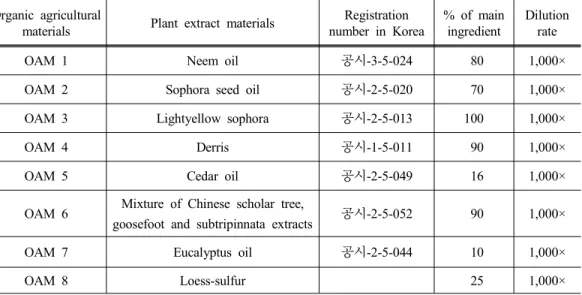
2016년 6월 15일에 님 오일, 너삼씨앗오일, 고삼, 데리스, 삼나무 오일, 회화+멀구슬+양명아 주 추출물, 유칼립투스, 황토유황합제 8종을 사용하여 3반복으로 준비한 Insect Breeding Dish에 골고루 살포하였다(Table 1). 공시되어 있는 유기농업자재 중 식물추출물이 겹치지 않고 함량이 높은 자재를 선택하였으며, 황토유황합제는 농과원 유기농업과에서 매뉴얼에 맞게 제조한 자재를 이용하였다. 처리 후 3일차와 7일차에 붓으로 움직임 여부를 파악하여 생충수를 조사하였고, 무처리구와 비교하여 방제가를 다음과 같이 나타내었다.
방제가(%) = (무처리구 생충수 – 처리구 생충수)
× 100 무처리구 생충수
Table 1. % of main ingredient and dilution rate of organic agricultural materials to control
Pseudococcus comstocki
Organic agricultural
materials Plant extract materials Registration number in Korea
% of main ingredient
Dilution rate
OAM 1 Neem oil 공시-3-5-024 80 1,000×
OAM 2 Sophora seed oil 공시-2-5-020 70 1,000×
OAM 3 Lightyellow sophora 공시-2-5-013 100 1,000×
OAM 4 Derris 공시-1-5-011 90 1,000×
OAM 5 Cedar oil 공시-2-5-049 16 1,000×
OAM 6 Mixture of Chinese scholar tree,
goosefoot and subtripinnata extracts 공시-2-5-052 90 1,000×
OAM 7 Eucalyptus oil 공시-2-5-044 10 1,000×
OAM 8 Loess-sulfur 25 1,000×
4. ‘알렉산드리아’포도원에서 방제시기에 따른 고삼 추출물의 방제효과
고삼 추출물(공시-2-5-013) 유기농업자재를 이용하여 살포시기에 따른 방제효과를 알기
위하여 2016년 6월~8월 동안 충청북도 옥천군 옥천읍(36°16'N 127°30'E)의 시설하우스에 자연 초생재배를 하는 8~9년생 ‘알렉산드리아’ 유기재배 포도원(2,500 ㎡, 사양토, 자가 퇴비 시용)에서 실시하였다. 6월 18일, 23일, 7월 5일, 14일, 24일, 8월 2일에 포도나무 3주 를 선택하여 고삼액을 골고루 살포했으며, 8월 12일에 포도나무 당 10송이의 포도를 실 험실로 가져와 포도송이 당 가루깍지벌레 수와 과실 피해율을 조사하였다.
5. 통계분석
실내 및 포장에서 유기농업자재의 살충효과에 대한 생물검정 결과는 일원분산분석으로 통계 분석하였다. 각 평균 간의 유의차는 Duncan의 다중검정(Duncan’s Multiple Range Test) 으로 비교하였고, 5%의 유의 수준으로 평가하였다. 모든 통계분석은 SAS 9.1 (SAS Insti- tute, 2003)을 이용하였다.
Ⅲ. 결과 및 고찰
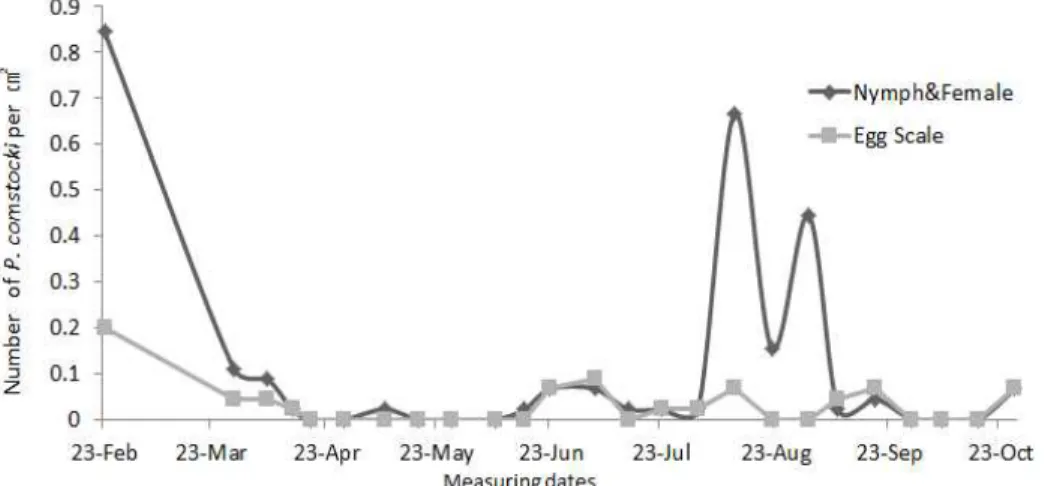
1. ‘알렉산드리아’포도나무에서 가루깍지벌레의 연중 발생량가루깍지벌레 밀도를 조사한 결과 Fig. 2와 같다. 2월 하순경 암컷과 약충 월동밀도는 0.8마리로 포도나무 줄기 껍질 안에 모여 분포하였고, 난괴는 0.2개로 암컷과 같이 또는 단독으로 발견되었다. 3월경에는 농가에서 나무껍질을 고압 호스로 벗긴 후 바닥에 떨어 진 나무껍질에 기계유제를 살포하여 가루깍지벌레 밀도 수가 급감되었다. 4월 초 알에서 부화를 시작하여 5월 상순 개화기에 2령이 관찰되었으나, 이후 6월 상순까지 포도나무에 서 가루깍지벌레를 발견하지 못하였다. 6월 중순 암컷 성충이 포도나무에서 관찰되었고, 7월 상순부터 포도 잎과 줄기에서 약충과 암컷성충이 관찰됐으며, 7월 하순에는 포도송 이에서 난괴가 관찰되었다. 8월 중순과 9월 상순에 포도송이에서 가루깍지벌레의 밀도가 0.6마리/㎠로 급격히 증가되고 감로에 의한 그을음으로 포도 상품성을 저해하였다. 9월 상순 포도 수확이 완료된 이후 가루깍지벌레는 나무줄기 껍질로 이동하고 숨어 월동준비 를 하였으며, 10월 상순부터 본격적인 월동에 들어갔다. 시설하우스 포도원에서 난괴는 월동기, 7월, 9월에 관찰되어 3세대를 경과하는 것으로 조사되었다. Park and Hong (1992) 은 배 과실 봉지 내 가루깍지벌레의 발생 양상은 6월 중순부터 서서히 증가되어 7월 중순 에 1차 peak를 나타냈고, 8월 상순에 2차 peak를 나타났던 것으로 보고하였다. 또한 Seo 등 (2011)은 인삼에서 가루깍지벌레는 8월 중순에 급격히 증가되었다고 보고하였는데, 3작물 에 공통적으로 8월 상·중순경 가루깍지벌레의 밀도가 가장 높았다.
가루깍지벌레가 어느 시기에 이동을 하는지 알아보기 위하여 2015년 7월~9월 동안 같은 유기재배 포도원에서 10일 간격으로 포도나무 부위별 가루깍지벌레 밀도를 조사한 결과 Fig. 3과 같다. 6월까지 주지, 결과지, 과경과 과일에는 가루깍지벌레가 발견되지 않았으나, 7월 상순에 주지에서 발견되어 7월 중순에는 결과지와 과경에서 발견되었다. 포도송이 안 에서는 7월 하순부터 관찰되었으며 8월 하순에 최고 밀도를 보였다가 감소하는 경향을 보 였고, 주지와 결과지에서 가루깍지벌레 밀도는 8월 중순과 9월 중순 2번의 peak를 보였다.
7월 중하순에 가루깍지벌레는 줄기에서 포도송이로 이동하였고, 7월 하순부터 포도송이에 산란을 했으며, 8월 하순 포도송이에서 밀도가 가장 높았다. 월동밀도가 높더라도 6월 하순 까지 가루깍지벌레를 발견하기 어려웠는데, 같은 시기 포도 시설하우스 내에 풀잠자리류 성충 수는 1~2.8마리로 높게 관찰되었다(Fig. 4). 가루깍지벌레들은 천적에게 잡아먹히지 않 기 위하여 포도나무껍질 사이로 숨기 때문인 것으로 보여졌다. 어리줄풀잠자리(Chrysoperla carnea (Stephens))를 활용한 생물적 방제 방법(Atlihan et al., 2004; Kift et al., 2005; Easter brock et al., 2006; Sablon et al., 2012)은 세계적으로 널리 이용되고 있으며, 국내에서도 풀 잠자리류를 활용한 생물적 방제 방법이 보고되었다(Ko, 1984). 국내에 자생하는 포식성 토 착 천적인 Chrysoperla nipponensis (Okamoto)를 당종려나무를 가해하는 가루깍지벌레에 대 한 생물적 방제 가능성을 확인하기도 하였다(Ham et al., 2013). 포도 시설하우스에서 풀잠 자리류 성충 밀도가 7월 이후 줄어들었다(Fig. 4). 풀잠자리류인 C. nipponensis는 25℃ 정도 면서 장일[15:9h (L:D)] 조건에서 세대기간이 짧아지고, 번식력이 높아졌는데(Chen et al., 2017), 7월부터는 시설하우스 내 고온으로 천적들이 가루깍지벌레 밀도를 억제하지 못하는 것으로 판단되었다.
Fig. 2. Density fluctuation of average numbers of
P. comstocki
nymphs and female adults or egg scales sampled from ㎠ trunk or arm or leaf or fruit of grape.Fig. 3. Density fluctuation of average numbers of
P. comstocki
nymphs and female adults sampled from arm, cane, peduncle and fruit of grapeFig. 4. Density fluctuation of average numbers of
Chrysoperla
sp. adult/swiping and egg/tree in greenhouse of organic vineyard
2. ‘알렉산드리아’포도나무에서 가루깍지벌레의 피해 정도
‘알렉산드리아’ 유기시설재배 시작 시기가 비슷하고 몇 해 동안 가루깍지벌레 피해를 지 속적으로 입은 옥천과 영동의 유기재배 시설포도원에서 2015년 8월 재배 포장의 위치에 따 른 피해를 조사한 결과 Table 2와 같이, 포도 ‘알렉산드리아’의 피해과율은 A, B, C 포장 각 각 12.8, 13.1, 14.6%였고, 피해도는 각각 8.3, 7.5, 6.7%로, 가루깍지벌레에 의한 피해가 포장 의 위치에 따라 큰 차이가 없었다. 이는 배 과수원에서 포장 위치와 상관없이 가루깍지벌 레류의 피해가 발생한다는 보고와 같은 경향이었다(Park and Hong, 1992). 가루깍지벌레가 재배품종이 같고 재배방법이 비슷한 경우 피해과율과 피해도가 유사한 것으로 판단되었다.
가루깍지벌레가 포도결과지를 타고 옆 나무로 이동하는 것을 관찰하였는데 포장으로 유입 되면 몇 년 안에 전체 포장으로 확산하는 것으로 판단되었다.
Table 2. Degree of fruit damaged by
Pseudococcus comstocki
in various locations of organic vineyardField Varieties No. of fruits
examined
aRate of fruits damaged (%)
bDegree of damage (%)
cA
Muscat of Alexandria
30 12.8 8.3 a
dB 30 13.1 7.5 a
C 30 14.6 6.7 a
a, bAverage of 3 replications of each field.
c Degree of damage(%) = 4A+3B+2C+D
× 100 4×Total fruits investigated
A ; above 16, B ; 11~15, C ; 6~10, D ; 1~5 individuals per grape fruit.
dDegree of damages followed by the same alphabetical letter are not significantly different at 5% level by Duncan’s multiple rage test.
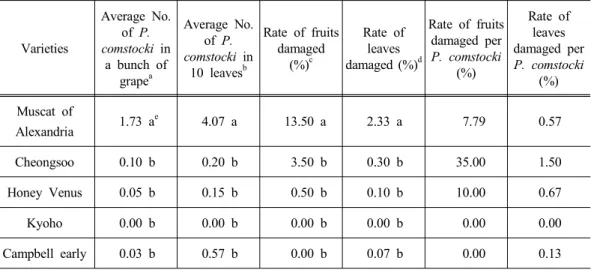
유기재배 포도원과 관행재배 포도원의 가루깍지벌레 밀도 수와 피해율을 비교하면 포도 송이와 포도잎에서의 밀도와 피해율이 유기재배 포도원에서 높아, 유기재배 포도원에서 문 제가 되는 것을 알 수 있었다(Table 3). 또한 포도 품종 '알렉산드리아'가 다른 품종에 비해 가루깍지벌레 밀도 수가 많았다. 이는 ‘알렉산드리아’ 수령이 8~9년생으로 나무가 크고 껍 질이 두꺼워 가루깍지벌레가 유기재배 3년생 ‘청수’와 관행재배 5년생 ‘하니비너스’에 비해 많았던 것으로 판단된다. 초록색 품종인 ‘알렉산드리아’, ‘청수’, ‘하니비너스’의 가루깍지벌 레 마리당 과실 피해율이 7.8, 35, 10으로 검은색의 ‘거봉’, ‘캠벨얼리’에 비하여 피해가 크 게 나타났다(Table 4).
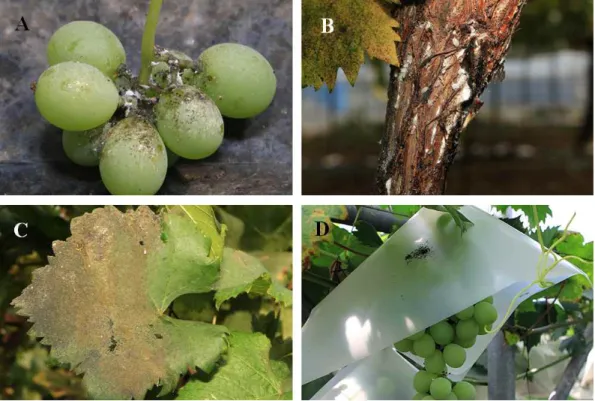
가루깍지벌레에 의한 피해는 여러 형태로 나타나는데(Fig. 5), 포도과실은 가루깍지벌레 의 흡즙과 감로로 인하여 상품성 저하로 팔 수 없어 농가 소득에 직접적으로 영향을 끼친 다. 특히 가루깍지벌레가 같은 밀도에서도 초록색인 '알렉산드리아' 품종은 검은색인 ‘캠벨 얼리’에 비하여 그을음병 증상이 눈에 띄게 되어 피해가 큰 경향이었다(Table 4). 가루깍지 벌레는 줄기 껍질 아래에서 월동과 은신을 한다. 특히 '알렉산드리아' 껍질은 캠벨얼리 껍 질과 다르게 여러 겹의 껍질이 붙어 있고, 공극들이 많으며, 조피작업이 힘들기 때문에 가 루깍지벌레가 은신하기에 유리하다. 그래서 6월 하순, 8월 중순, 9월 하순에 난괴가 껍질 사이에서 나타났던 것으로 판단된다(Fig. 3). 잎에서의 그을음병은 흡즙성 곤충의 감로로부 터 발생된다. 잎의 광합성과 가스교환을 방해하고, 상품성을 떨어뜨리며, 감염된 과일로 만 든 주스나 퓌레 등에서 발생될 곰팡이 포자가 건강상 피해를 준다(Scot, 2008). 뿐만 아니라
포도 봉지와 포도 보호 갓에 그을음이 생겨 상품 포장을 할 때 벗겨내고 새로 씌워야 하는 비용이 드는 등의 경제적 피해를 입힌다. 따라서 ‘알렉산드리아’ 유기재배 시 이러한 피해 를 줄이기 위해 유기농업자재를 이용한 효율적인 방제시기를 연구하게 되었다.
Table 3. Rate of fruits and leaves damaged by
Pseudococcus comstocki
in eco-friendly or normal cultivation vineyardDivision Varieties
Average No. of P.
comstocki in a
bunch of grapea
Average No. of P.
comstocki in 10
leaves
bRate of fruits damaged (%)
cRate of leaves damaged (%)
dEco-friendly
Muscat of Alexandria, Cheongsoo, Campbell early
0.92 a
e2.60 a 7.33 a 1.28 a
Normal cultivation
Kyoho, Honey Venus, Campbell early
0.01 b 0.12 b 0.06 b 0.03 b
a,b,c,d
Average of 10 replications of each variety.
e Average no. and rate of damages followed by the same alphabetical letter are not significantly different at 5%
level by Duncan’s multiple rage test.
Table 4. Rate of fruits and leaves damaged by
Pseudococcus comstocki
in each varietiesVarieties
Average No.
of P.
comstocki in
a bunch of
grape
aAverage No.
of P.
comstocki in
10 leaves
bRate of fruits damaged
(%)
cRate of leaves damaged (%)
dRate of fruits damaged per
P. comstocki(%)
Rate of leaves damaged per
P. comstocki(%) Muscat of
Alexandria 1.73 a
e4.07 a 13.50 a 2.33 a 7.79 0.57
Cheongsoo 0.10 b 0.20 b 3.50 b 0.30 b 35.00 1.50
Honey Venus 0.05 b 0.15 b 0.50 b 0.10 b 10.00 0.67
Kyoho 0.00 b 0.00 b 0.00 b 0.00 b 0.00 0.00
Campbell early 0.03 b 0.57 b 0.00 b 0.07 b 0.00 0.13
a,b,c,d
Average of 10 replications of each variety.
eAverage no. and rate of damages followed by the same alphabetical letter are not significantly different at 5%
level by Duncan’s multiple rage test.
3. 친환경 유기농업자재의 가루깍지벌레 방제효과
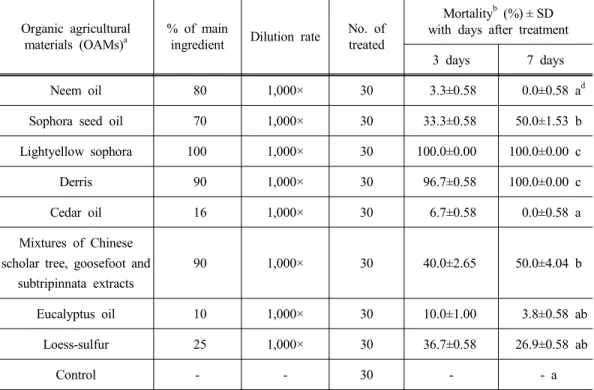
친환경 유기농업자재를 이용한 가루깍지벌레 살충효과는 Table 5와 같이, 고삼과 데리스 추출물에서 100%로 높은 효과를 보였고, 너삼씨앗오일, 회화+멀구슬+양명아주 추출물 처 리구에서 50%의 방제 효과를 보였으며, 님, 삼나무오일, 유칼립투스, 황토유황은 무처리와 유의하지 않았다. 고삼은 독성이 높아 살충제로 이용가치가 높았는데(Hwang et al., 2009), 주성분이 Matrine, Oxymatrine, Sophoranol, Anagyrine 및 Methylcytisine 등으로(NCSI, 1996), 본 연구에서도 가루깍지벌레 살충효과가 높게 나왔다. 데리스의 살충 활성 주요 성분은 Rotenone으로 접촉독, 식독에 의하여 흡즙성 해충을 방제하는 것으로 알려졌는데, 본 연구 에서도 가루깍지벌레에 대한 살충효과가 높아 같은 경향이었다.
Table 5. Activity of organic agricultural materials (OAMs) on the
Pseudococcus comstocki
female adults in vitroOrganic agricultural materials (OAMs)
a% of main
ingredient Dilution rate No. of treated
Mortality
b(%) ± SD with days after treatment
3 days 7 days
Neem oil 80 1,000× 30 3.3±0.58 0.0±0.58 a
dSophora seed oil 70 1,000× 30 33.3±0.58 50.0±1.53 b
Lightyellow sophora 100 1,000× 30 100.0±0.00 100.0±0.00 c
Derris 90 1,000× 30 96.7±0.58 100.0±0.00 c
Cedar oil 16 1,000× 30 6.7±0.58 0.0±0.58 a
Mixtures of Chinese scholar tree, goosefoot and
subtripinnata extracts
90 1,000× 30 40.0±2.65 50.0±4.04 b
Eucalyptus oil 10 1,000× 30 10.0±1.00 3.8±0.58 ab
Loess-sulfur 25 1,000× 30 36.7±0.58 26.9±0.58 ab
Control - - 30 - - a
aOAMs were treated on 15 June. 2016, and mortality was checked on 22 June. 2016.
bCorrected mortality = ((average survival rate of scales in control – survival rate in the treated) /survival rates in control)×100.
cEach datum represents the mean of three replicates
dCorrected mortalities followed by the same alphabetical letter are not significantly different at 5% level by Duncan’s multiple rage test.
Fig. 5. The grape’s damage symptom of
Pseudococcus Comstocki
nymphs and female adults. (A : fruit, B : trunk, C : sooty mold on leaves, D : grape protect bag)4. ‘알렉산드리아’포도원에서 방제시기에 따른 고삼 추출물의 방제효과
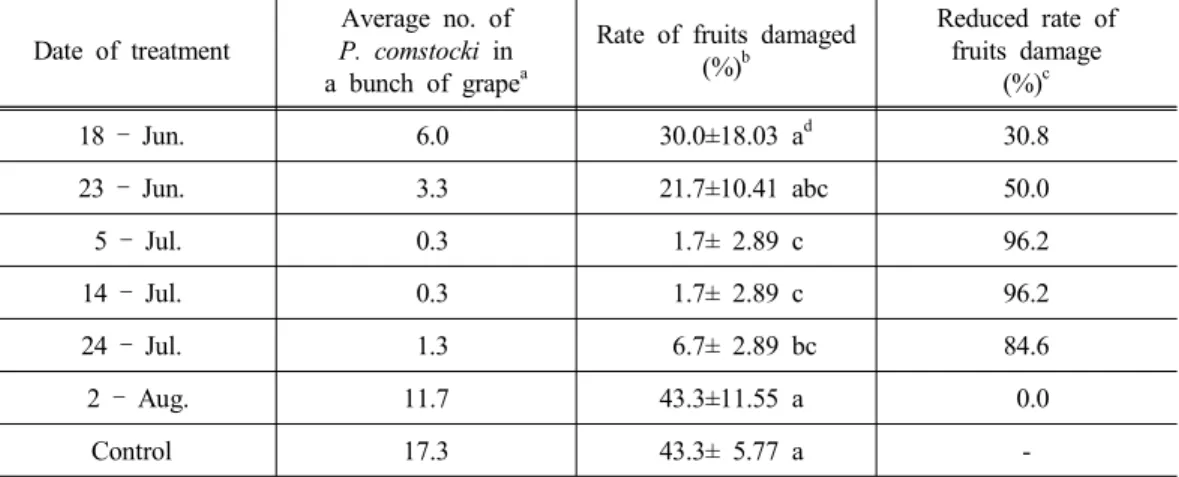
해충은 경제적 피해수준(Economic Injury Level, EIL) 이상 발생하게 될 경우 작물의 생육 기 전반에 큰 영향을 미치고, 수확량 및 상품성에 영향을 미친다. 이에 포장 내 해충의 밀 도는 항상 경제적 피해허용수준(Economic Threshold, ET) 이하로 유지되어야 한다. 특히, 깍 지벌레는 줄기나 잎을 가해하여 간접적 피해를 줄 뿐만 아니라, 과실을 직접 가해하기 때 문에 적은 양의 해충이 발생하더라도 방제를 철저히 하지 않으면 경제적 피해를 입을 수 있다(Kim et al., 2012). 살충제를 주기적으로 살포하는 배 과원에서도 5% 내외의 피해율을 보였는데(RDA, 1994), 친환경 유기농업자재의 경우 유기합성농약보다 잔효 기간이 짧고, 침투성이 낮아 직접 해충 몸에 맞아야 효과를 나타내기 때문에 적기 방제가 중요하다. 따 라서 Table 2, 3와 같이 포도나무에서 가루깍지벌레의 발생양상이 시기적으로 다르기 때문 에 발생생태에 맞춰 6월 18일부터 8월 2일까지 10일 간격으로 각각 포도나무에 고삼추출물 유기농업자재를 살포한 결과는 Table 5와 같다. 피해과율은 7월 5일, 7월 14일 및 7월 24일 방제 시 각각 유의하게 감소되었고, 6월 18일과 8월 2일 방제에는 무처리와 비슷하였다. 과 실 피해 경감율도 7월 5일과 7월 14일에는 각각 96.2%, 7월 24일에는 84.6%로 높았다(Table
6). 포도나무에서 가루깍지벌레가 6월 중순까지 발견되지 않았고, 포도 결과지에는 7월 상 순부터 나타나 포도송이로는 7월 중하순에 이동하는 것으로 조사되었다(Fig. 2, 3). 따라서
‘알렉산드리아’ 무가온 시설재배 시 가루깍지벌레가 포도송이로 이동을 하는 7월 상~하순 (2차 과실비대기)에 방제를 하면 과실 피해를 경감시키는데 효과적일 것으로 판단되었다.
Table 6. Effect of lightyellow sophora extract on
Pseudococcus comstocki
in the organic vineyard in several dates 2016 at Okcheon in Chungbuk provinceDate of treatment
Average no. of
P. comstocki ina bunch of grape
aRate of fruits damaged (%)
bReduced rate of fruits damage
(%)
c18 – Jun. 6.0 30.0±18.03 a
d30.8
23 – Jun. 3.3 21.7±10.41 abc 50.0
5 – Jul. 0.3 1.7± 2.89 c 96.2
14 – Jul. 0.3 1.7± 2.89 c 96.2
24 – Jul. 1.3 6.7± 2.89 bc 84.6
2 – Aug. 11.7 43.3±11.55 a 0.0
Control 17.3 43.3± 5.77 a -
aLightyellow sophora were treated on each date, 2016. and number and damaged fruits were checked on 12 August 2016.
bEach datum represents the mean of three replicates
cRate of reduced fruits damage = ((1 – Rate of fruits damaged in the treated/Rate of fruits damaged in control)
×100.
dRate values of fruits damaged followed by the same alphabetical letter are not significantly different at 5% level by Duncan’s multiple rage test.
Ⅳ. 적 요
‘알렉산드리아’ 청포도의 가루깍지벌레(Pseudococcus comstocki)의 피해 양상을 조사하고, 발생 및 이동 시기를 구명하여 친환경 유기농업자재의 방제 효과를 높이고자 본 시험을 수 행하였다. 충청북도 옥천군 시설하우스에 자연 초생재배를 하는 8~9년생 ‘알렉산드리아’
유기재배 포도원(2,500 ㎡, 사양토, 자가 퇴비 시용)에서 시기별 밀도를 조사한 결과 8월 상·중순경 가루깍지벌레의 밀도가 가장 높았다. 상품성에 영향을 끼치는 포도송이로의 이 동은 7월 중하순 이였고, 7월 하순부터 포도송이에 산란을 했으며, 8월 하순 포도송이에서 0.6마리/㎠로 밀도가 가장 높았다.
‘알렉산드리아’ 유기시설재배 시작 시기가 비슷하고 몇 해 동안 가루깍지벌레 피해를 지
속적으로 입은 옥천과 영동의 3개의 유기재배 시설포도원에서 재배포장의 위치에 따른 가 루깍지벌레 피해를 조사한 결과 피해과율과 피해도는 포장의 위치에 따라 큰 차이가 없었 다. 유기재배 포도원과 관행재배 포도원의 가루깍지벌레 밀도 수와 피해율을 비교하면 포 도송이와 포도잎에서의 밀도와 피해율이 유기재배 포도원에서 높아, 유기재배 포도원에서 문제가 되는 것을 알 수 있었다. 포도 품종 '알렉산드리아'가 다른 품종에 비해 가루깍지벌 레 밀도 수가 많았다. 초록색 품종인 ‘알렉산드리아’, ‘청수’, ‘하니비너스’의 가루깍지벌레 마리당 과실피해율이 7.8, 35, 10으로 검은색의 ‘거봉’, ‘캠벨얼리’에 비하여 피해가 크게 나 타났다. 포도과실은 가루깍지벌레의 흡즙과 감로로 인하여 상품성 저하로 팔 수 없어 농가 소득에 직접적으로 영향을 끼친다. 특히 가루깍지벌레가 같은 밀도에서도 초록색인 ‘알렉 산드리아’ 품종은 검은색인 ‘캠벨얼리’에 비하여 그을음병 증상이 눈에 띄게 되어 피해가 큰 경향이었다.
친환경 유기농업자재를 이용한 가루깍지벌레 살충효과는 고삼과 데리스 추출물에서 100
%로 높은 효과를 보였고, 나머지 유기농업자재는 살충효과가 떨어졌다. 6월부터 8월까지 고삼 추출물(공시-2-5-013) 유기농업자재를 포도나무에 7월 살포시 피해과율은 유의하게 감 소되었고, 6월과 8월 방제에는 효과가 없었다. 또한 과실 피해 경감율도 7월 상순과 7월 중 순에는 각각 96.2%, 7월 하순에는 84.6%로 높았다. 따라서 ‘알렉산드리아’ 무가온 시설재배 시 가루깍지벌레가 포도송이로 이동을 하는 7월 상~하순(2차 과실비대기)에 방제를 하면 과실 피해를 경감시키는데 효과적일 것으로 판단되었다. 앞으로 해충의 외부 노출 시기 및 운동량에 따른 약제방제 연구가 필요할 것으로 사료된다.
[Submitted, August. 24, 2017 ; Revised, November. 1, 2017 ; Accepted, November. 2, 2017]
References
1. Atlihan, R., B. Kaydan, and M. S. Ozgokce. 2004. Feeding activity and life history characteristics of the generalist predator, Chrysoperla carnea (Neuroptera: Chrysopidae) at different prey densities. Journal of Pest Science. 77(1): 17-21.
2. Chen, Zhen Z., L. Y. Liu, S. Y. Liu, L. Y. Cheng, X. H. Wang, and Y. Y. Xu1. 2017.
Response of Chrysoperla nipponensis (Okamoto) (Neuroptera: Chrysopidae) Under Long and Short Photoperiods. Journal of Insect Science. 17(2): 35: 1-9.
3. Christensen, L. 2003. Muscat of Alexandria (PDF). Pages 98-101 in: Wine Grape Varieties in California. University of California Agricultural and Natural Resources Publication 3419,
Oakland, CA.
4. Easterbrook, M. A., J. D. Fitzgerald, and M. G. Solomon. 2006. Suppression of aphids on strawberry by augmentative releases of larvae of the lacewing Chrysoperla carnea (Step- hens). Biocontrol Science and Technology. 16(9): 893-900.
5. Ham, E. H., J. S. Lee, B. W. Lee, T. H. Ahn, H. Y. Jin, J. H. Song, and Y. C. Choi. 2013.
A study on application of Pseudococcus comstocki (Kuwana)(Hemiptera: Pseudococcidae) by new native natural enemy (Chrysoperla nipponensis (Okamoto)) (Neuroptera: Chrysopidae) on tropical plant (Trachycarpus fortunei (Hook)). Korean Journal of Nature Conservation.
7(2): 147-150.
6. Hwang, I. C., J. Kim, D. I. Kim, S. G. Kim, S. S. Kim, and C. Jang. 2009. Evaluation of toxicity of plant extract made by neem and matrine against main pests and natural enemies.
Korean J. Appl. Entomol. 48: 87-94.
7. Jeon, H. Y., D. S. Kim, M. R. Cho, Y. D. Jang, and M. S. Lim. 2003. Temperature- dependent development of Pseudococcus comstocki (Homoptera: Pseudococcidae) and its stage transition models. Journal of Korea Appllied Entomology. 42(1): 43-51.
8. Jeon, H. Y., D. S. Kim, M. S. Yiem, and J. H. Lee. 1996. Modeling Temperature-Dependent Development and Hatch of Overwintered Eggs of Pseudococcus comstocki (Homoptera:
Pseudococcidae). Korean J. Appl. Entomol. 35(2): 199-125.
9. Kift, N. B., S. Sime, K. A. Reynolds, J. E. Jones, and G. M. Tatchell. 2005. Chrysoperla carnea (Neuroptera: Chrysopidae) controls Myzus persicae (Homoptera: Aphididae) despite behavioural differences between aphid clones that are associated with MACE-based insecti- cide resistance. Biocontrol Science and Technology. 15(1): 97-103.
10. Kim, G. H., D. S. Kim, C. G. Park, S. Cho, Y. Yun, and K. Y. Lee. 2012. Principles and applications in insect pest management. Hyangmunsa. pp. 146-162.
11. Kim, I. S. and I. S. Kim. 2009. Status and future prospects of pest control agents in environmentally-friendly agriculture, and importance of their commercialization. Korean J. of Environmental Agriculture. 28: 301-309.
12. Ko, J. H. 1984. Use of natural enemy for the control of forest pests. Forest. 219(4): 67-70.
13. KOSIS (KOrean Statistical Information Service), Statistical Database/ Agriculture, Forestry and Fishery/ Agriculture/ Crop Production Survey/ Fruit Production. http://kosis.kr/eng/statisticsList.
14. NCSI. 1996. Research of natural chemistry science in Korea. Natural Chemistry Science Institute. 396.
15. Oh, J. A., J. H. Choi, M. S. Choe, J. H. Kim, M. K. Paik, K. H. Park, S. S. Hong, J. B.
Lee, and D. H. Kim. 2013. Evaluation of honeybee acute toxicity of plant extracts, Neem,
Sophora and Derris. Journal of the Korean Society of Pesticide Science. 17: 473-477.
16. Park, J. D. and K. H. Hong. 1992. Species, Damage and Population Density of Pseudo- coccidae Injuring Pear Fruits. Korean J. Appl. Entomol. 35(2): 119~125.
17. Rural Development Administration (RDA), 1994. Manual for agricultural investigation, RDA, Suwon, Korea.
18. Sablon, L., E. Haubruge, and F. J. Verheggen. 2012. Consumption of immature stages of colorado potato beetle by Chrysoperla Carnea (Neuroptera: Chrysopidae) larvae in the laboratory. American Journal of Potato Research. 90(1): 51-57.
19. Sawamura, N. and Y. Narai. 2008. Effect of temperature on development and reproductive potential of two mealybug species Planococcus kraunhiae (Kuwana) and Pseudococcus comstocki (Kuwana) (Homoptera: Pseudococcidae). Jpn. J. Appl. Entomol. Zool. 52: 113-121.
20. Scot, Nelson. 2008. Sooty Mold. Plant Disease. Cooperative Extension Service. PD-52.
21. Seo, J. W., J. W. Park, S. H. Yun, M. K. Song, Y. S. Lee, H. N. Koo, and G. H. Kim.
2016. Distribution of Matsumoto Mealybug, Crisicoccus matsumotoi (Hemiptera: Pseu- dococcidae) in Pear Orchards and Susceptibility to Insecticides. Korean J. Pestic. Sci. 20(2):
1-5.
22. Seo, M. J., H. S. Shin, S. H. Jo, C. S. Gawk, H. R. Kwon, M. W. Park, S. H. Kim, D.
H. Cho, Y. M. Yu, and Y. N. Youn. 2011. Selection of Environmental-Friendly Control Agents for Controlling the Comstock Mealybug [Pseudococcus comstocki (Kuwana), Pseudo- coccidae, Hemiptera], The Korean J. of Pesticide Science. 15(4): 471-478.
23. Song, M. K., J. S. Park, S. H. Lee, J. W. Lee, S. D. Kim, W. H. Choi, K. H. Kim, and J. H. Park. 2016. Control efficacy of Bacillus thuringiensis against Herpetogramma luctuo- salis on ‘Campbell Early’ Organic Vineyard. Korean J. Org. Agric. 24(4): 797-808.