nation of control measures to reduce the transmission of the disease in health care settings to health care workers (HCWs) and patients, many of whom may be immunocompromised.
Reports of improved implementation of the recommended controls and fewer outbreaks of TB disease in health care set- tings suggest that these controls are effective in reducing and preventing health care-associated transmission of Mycobacte- rium tuberculosis
5.
The World Health Organization (WHO) policy on TB infection control recommends four levels of protection: an overarching managerial level, administrative control, environ- mental control, and personal respiratory protection
3. Simi- larly, because of the well-known occupational risk to HCWs from TB, the U.S. Centers for Disease Control and Prevention (CDC) have recommended in their guidelines that all health care settings should have a TB infection control program. This should be designed to ensure prompt detection, airborne pre- cautions, and treatment of individuals who have suspected or confirmed TB disease
1and should be based on a three-level hierarchy of controls, including administrative, environmental, and respiratory protection
1,2.
The first and most important level of this hierarchy is ad- ministrative control. Its goals are to prevent HCWs, other staff,
Introduction
Tuberculosis (TB) infection control is a combination of measures aimed at minimizing the risk of transmission within a population. The fundamental aspects of this control include early and rapid diagnosis and proper management of TB patients. Various guidelines
1-4have recommended a combi-
Preventing the Transmission of Tuberculosis in Health Care Settings: Administrative
Control
Kyung-Wook Jo, M.D.
Division of Pulmonary and Critical Care Medicine, Asan Medical Center, University of Ulsan College of Medicine, Seoul, Korea
It is well established that health care workers (HCWs) have a considerably higher risk of occupationally acquired tuberculosis (TB). To reduce the transmission of TB to HCWs and patients, TB infection control programs should be implemented in health care settings. The first and most important level of all protection and control programs is administrative control. Its goals are to prevent HCWs, other staff, and patients from being exposed to TB, and to reduce the transmission of infection by ensuring rapid diagnosis and treatment of affected individuals. Administrative control measures recommended by the United States Centers for Disease Control and Prevention and the World Health Organization include prompt identification of people with TB symptoms, isolation of infectious patients, control of the spread of the pathogen, and minimization of time spent in health care facilities. Another key component of measures undertaken is the baseline and serial screening for latent TB infection in HCWs who are at risk of exposure to TB.
Although the interferon-gamma release assay has some advantages over the tuberculin skin test, the former has serious limitations, mostly due to its high conversion rate.
Keywords: Tuberculosis; Health Personnel; Tuberculin Test; Interferon-Gamma Release Tests
Address for correspondence: Kyung-Wook Jo, M.D.
Division of Pulmonary and Critical Care Medicine, Asan Medical Center, University of Ulsan College of Medicine, 88 Olympic-ro 43-gil, Songpa- gu, Seoul 05505, Korea
Phone: 82-2-3010-5783, Fax: 82-2-3010-6968 E-mail: [email protected] Received: Dec. 11, 2015
Revised: Feb. 23, 2016 Accepted: Nov. 14, 2016
cc
It is identical to the Creative Commons Attribution Non-Commercial License (http://creativecommons.org/licenses/by-nc/4.0/).
Copyright © 2017
The Korean Academy of Tuberculosis and Respiratory Diseases.
All rights reserved.
and patients from being exposed to TB and reduce the trans- mission of infection by ensuring rapid diagnosis and treat- ment of patients and staff with TB
6. Another important aspect is to provide a package of prevention and care interventions for HCWs
6. This article discusses the details of administrative control recommended by the CDC and WHO, after first exam- ining the risk of TB for HCWs. We also review recent reports and disputes concerning the screening of HCWs for TB infec- tion.
Risk of TB among HCWs
1. Risk of active TB
The rate of diagnosis of active TB in HCWs has consistently been reported to be higher than that for the general popula- tion in a number of studies conducted in countries with low and high TB prevalence. For example, in England and Wales, HCWs are 2.4 times more likely to contract active TB than other people, after taking into account socioeconomic status, ethnic group, age, and sex
7. Recently, Chu et al.
8conducted a nationwide, population-based cohort study based on the Tai- wan National Health Insurance Database for the years 2000–
2010. They found that the incidence of active TB was higher for HCWs than for matched subjects, particularly for pulmo- nary TB compared with extrapulmonary TB. A study in South Korea investigated the prevalence of TB among HCWs em- ployed at a university hospital and found that the prevalence ratio for nurses working in a TB-related department (medical intensive care unit, pulmonary medicine ward, or emergency department) was higher than for the general population, sug- gesting that some of the HCWs developed active TB disease via a hospital infection
9.
2. Risk of TB infection
In addition to active TB, it is also well known that HCWs have a substantially increased risk of occupationally acquired TB infection. Menzies et al.
10showed that the median preva- lence of latent TB infection (LTBI) in HCWs was 63% in low- and middle-income countries and 24% in high-income coun- tries, suggesting the risk of LTBI is high for HCWs worldwide.
Recently, Casas et al.
11reported that the cumulative incidence of tuberculin skin test (TST) conversion was higher in HCWs who worked in high-risk areas in a tertiary referral hospital in Spain. In South Korea, a prospective study evaluated the annual incidence of LTBI among newly employed nurses at a tertiary care university hospital, and concluded that the an- nual risk of LTBI for these nurses was at least 3%
12.
Administrative Control
1. Administrative control in the CDC guidelines
According to the CDC guidelines
1,2, a TB infection control program should be based on the following three levels of hier- archy: (1) administrative control, which reduces the risk of ex- posure; (2) environmental control, which prevents the spread of the disease and reduces the concentration of droplet nuclei;
and (3) respiratory protection control, which further reduces the risk of exposure in specific areas and circumstances. Of these, the first and most important level is the use of adminis- trative measures to reduce the risk of exposure to people who might have TB disease. According to the CDC guidelines, this level comprises the implementation of a range of activities
1,2; these are summarized in Table 1.
Table 1. The activities of administrative control recommended by the U.S. Centers for Disease Control and Prevention 1. Assigning someone the responsibility and authority for TB infection control in the health-care setting
2. Conducting a TB infection control risk assessment of the setting
3. Developing and instituting a written TB infection control plan to ensure prompt detection, separation from others, and treatment of persons who have suspected or confirmed TB disease
4. Ensuring the availability of recommended laboratory processing, testing, and reporting of results 5. Implementing effective work practices for managing those who may have TB disease
6. Ensuring proper cleaning, sterilization, or disinfection of equipment that might be contaminated (e.g., endoscopes) 7. Testing and evaluating workers who are at risk for exposures to TB disease
8. Applying epidemiology-based prevention principles, including the use of setting-related TB infection control data 9. Using posters and signs to remind patients and staff of proper cough etiquette and respiratory hygiene
10. Coordinating efforts between the local health department and high-risk health-care and congregate settings Modified from the U.S. Centers for Disease Control and Prevention core curriculum on tuberculosis
2.
TB: tuberculosis.
2. Administrative control in the WHO policy
The administrative control measures according to the WHO policy
3, which covers TB infection control in congregate set- tings (i.e., institutions or environments where people live in close proximity to each other) and households as well as health care facilities, are rather different from those recom- mended by the CDC. Along with environmental control and personal protective equipment, the WHO’s policy for adminis- trative control in health care facilities includes the following
3.
1) Prompt identification of people with TB symptoms (triage)
Prompt identification of people with symptoms suggestive of TB is crucial. Generally, people suspected of having TB should be separated from other patients and placed in ade- quately ventilated areas, and should be diagnosed as a matter of priority.
2) Separation of infectious patients
Separation of infectious patients after triage is important. In particular, immunocompromised patients should be separat- ed from those with suspected or confirmed infectious TB. In addition, people with confirmed or suspected drug-resistant TB—especially TB that is multidrug or extensively drug re- sistant—should be separated or isolated from other patients, including those with drug-susceptible TB.
3) Control of the spread of the pathogen (cough eti- quette and respiratory hygiene)
To minimize the spread of droplet nuclei, any coughing patient with a respiratory infection—particularly, those with or suspected of having TB—should be educated in cough eti- quette and respiratory hygiene, that is, the need to cover their nose and mouth when sneezing and/or coughing with a phys- ical barrier, such as a piece of cloth, tissue, or surgical mask. It
is also important that such items are properly disposed of. If such physical barriers are not available, the best practice is for the mouth and nose to be covered with the bend of the elbow or the hands, which must then be cleaned immediately.
4) Minimizing the time spent in health care facilities Patients should spend as little time as possible in health care facilities, including clinics, to avoid the nosocomial transmis- sion of TB. Except in cases with complicated or concomitant medical conditions that require hospitalization, hospital stay is generally not recommended for the evaluation of people suspected of having TB or the management of patients with drug-susceptible TB. HCWs should ensure they minimize the time spent with such patients in areas that are overcrowded or poorly ventilated.
Serial Testing to Diagnose LTBI in HCWs
1. Serial testing with the TST
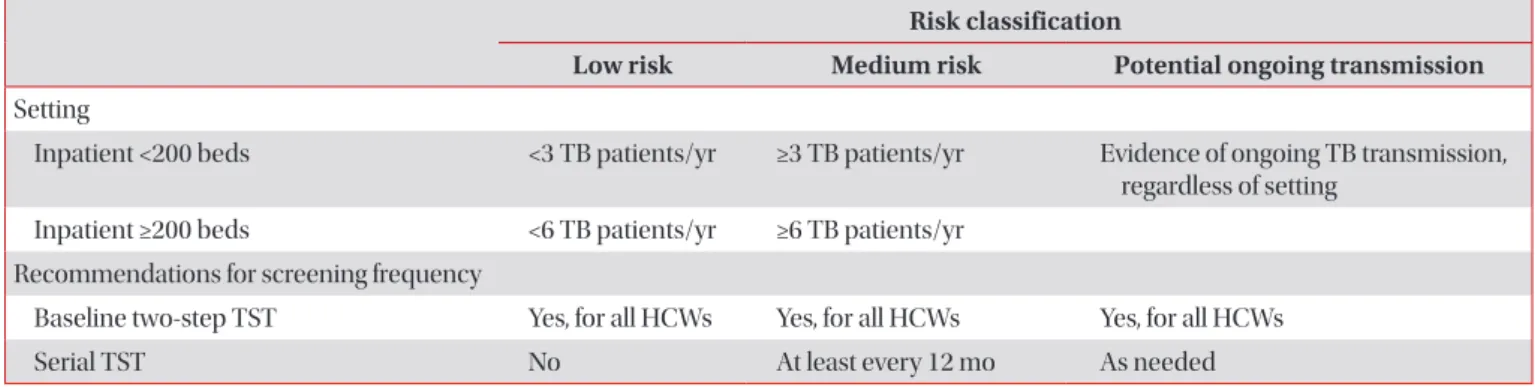
Screening of HCWs for LTBI is another key component of the administrative control of hospital TB infection control programs. According to the facility risk classification recom- mended by the CDC (Table 2), the majority of general hospi- tals and university hospitals in South Korea correspond to the medium risk level for TB. According to the CDC guidelines
1, in a setting classified as medium risk, all HCWs should receive a baseline TB screening test when they first start employment with the institution using a two-step TST to test for infection with M. tuberculosis. After this baseline testing, HCWs should receive annual TB screening using a TST (serial TST) (Table 2). Any HCWs with a baseline positive or newly positive TST result, or with the documentation of previous treatment for an LTBI or TB disease, should undergo chest radiography once to exclude active TB disease.
Table 2. Risk classification for various health care settings and recommended frequency of screening for Mycobacterium tuberculosis infection among health care workers
Risk classification
Low risk Medium risk Potential ongoing transmission Setting
Inpatient <200 beds <3 TB patients/yr ≥3 TB patients/yr Evidence of ongoing TB transmission, regardless of setting
Inpatient ≥200 beds <6 TB patients/yr ≥6 TB patients/yr Recommendations for screening frequency
Baseline two-step TST Yes, for all HCWs Yes, for all HCWs Yes, for all HCWs
Serial TST No At least every 12 mo As needed
Modified from U.S. Centers for Disease Control and Prevention 2005 guidelines
1.
TB: tuberculosis; TST: tuberculin skin test; HCW: health-care workers.
A TST conversion is defined as a TST induration that has in- creased in size by ≥6 mm and has a total size ≥10 mm. If such a TST conversion is observed in a HCW with a documented negative (<10-mm) baseline two-step TST result, this indicates a recent TB infection. Recent TST converters have a higher risk of TB development (by as much as 15-fold) than subjects with no risk factors, and approximately 5% of people newly infected with M. tuberculosis will develop the disease in the 1–2 years after infection
13,14. Therefore, among people infected with M. tuberculosis, a TST converter is generally classified as high risk for the development of active TB
15. Accordingly, the Korean TB guidelines revised in 2014 have classified anyone with a TST conversion within the previous 2 years as a high- risk group
16. HCWs whose TST result has recently converted to positive should therefore be regarded as candidates for pre- ventive chemotherapy.
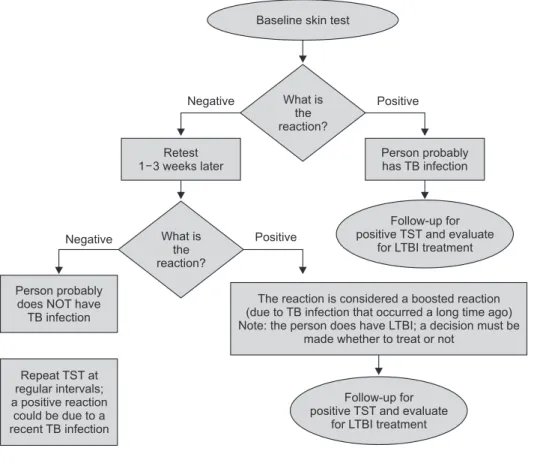
When a TST is used for baseline testing, two-step testing is recommended for HCWs whose initial TST results are nega- tive when a booster effect is considered
17,18. The concept and the interpretation of the two-step TST are as follows. (1) If the first-step TST result is negative, the second-step TST should be administered 1–3 weeks after the first TST was read. (2) If either the baseline first-step TST result is positive, or the first-step result is negative but the second step is positive, the HCW can be diagnosed as having a LTBI after active TB has been excluded. (3) If the first and second-step TST results are
both negative, the person is classified as not infected with M.
tuberculosis
1. A positive result of the second step of a baseline two-step TST is thought to be due to a boosting effect that may result from a remote infection of M. tuberculosis. The CDC guidelines recommend that all HCWs receive a baseline two- step TST when first employed (Figure 1)
1. In South Korea, most centers have not adopted this approach because of ex- ecutive difficulties. However, according to one report, the pro- portion of HCWs who convert to positive in the second step of the two-step TST is not rare in South Korea; among 556 newly employed HCWs at a university hospital, 14.2% experienced a boosted reaction on the second TST
19.
Although there is considerable experience of using the TST over several decades, this test has a number of drawbacks.
In particular, the TST requires two or more patient visits to conduct the test because the results are only available 48 to 72 hours later. In addition, a bacillus Calmette–Guerin (BCG) vaccination can cause a false-positive result. Third, although rare, the injections may result in an adverse skin reaction. Fi- nally, the TST result needs to be interpreted by a well-trained person.
2. Serial testing with interferon-gamma release assay Compared to the TST, the interferon-gamma release as- say (IGRA), including the QuantiFERON-TB Gold In-Tube
Figure 1. Two-step TST testing (from the U.S. Centers for Disease Control and Prevention core curriculum on tubercu- losis
2). TB: tuberculosis; TST: tuberculin skin test; LTBI: latent tuberculosis infec- tion.
Negative What is Positive
the reaction?
Retest 1 3 weeks later
Person probably has TB infection
Negative What is Positive
the reaction?
Follow-up for positive TST and evaluate
for LTBI treatment
Follow-up for positive TST and evaluate
for LTBI treatment Repeat TST at
regular intervals;
a positive reaction could be due to a recent TB infection
Person probably does NOT have TB infection
The reaction is considered a boosted reaction (due to TB infection that occurred a long time ago) Note: the person does have LTBI; a decision must be
made whether to treat or not Baseline skin test