• 검색 결과가 없습니다.

Impaired Expression of MAPK Is Associated with the Downregulation of TNF-${\alpha}$, IL-6, and IL-10 in Mycobacterium abscessus Lung Disease

N/A
N/A
Protected

Academic year: 2021

Share "Impaired Expression of MAPK Is Associated with the Downregulation of TNF-${\alpha}$, IL-6, and IL-10 in Mycobacterium abscessus Lung Disease"

Copied!
9
0
0

로드 중.... (전체 텍스트 보기)

전체 글

(1)

Tuberc Respir Dis 2012;72:275-283

CopyrightⒸ2012. The Korean Academy of Tuberculosis and Respiratory Diseases. All rights reserved.

Impaired Expression of MAPK Is Associated with the Downregulation of TNF-α, IL-6, and IL-10 in Mycobacterium abscessus Lung Disease

Yun Su Sim, M.D.

1

*, Su-Young Kim, Ph.D.

1

*, Eun Joo Kim, Ph.D.

1

, Sung Jae Shin, Ph.D.

2

, Won-Jung Koh, M.D.

1

1

Division of Pulmonary and Critical Care Medicine, Department of Medicine, Samsung Medical Center, Sungkyunkwan University School of Medicine, Seoul,

2

Department of Microbiology and Research Institute for Medical Sciences, Infection Signaling Network Research Center, Chungnam National University School of Medicine, Daejeon, Korea

Background: Healthy individuals who develop nontuberculous mycobacteria (NTM) lung disease are likely to have specific susceptibility factors which can lead to a NTM infection. The aim of the present study was to investigate the mechanism underlying innate immune responses, including the role of mitogen-activated protein kinase (MAPK), in Mycobacterium abscessus lung disease.

Methods: Extracellular signal-regulated kinase (ERK1/2) and p38 MAPK expression in monocytes from peripheral blood mononuclear cells were measured by Western blot analysis after stimulation by Mycobacterium avium in five patients with M. abscessus lung disease and seven healthy controls. A M. avium-induced cytokine assay was performed after inhibition of ERK1/2 and p38 MAPK pathways.

Results: Mycobacterium avium induced p38 and ERK1/2 expression in monocytes from healthy controls and subsequently upregulated tumor necrosis factor (TNF)-α, interleukin (IL)-6, and IL-10 production. In monocytes from patients with M. abscessus lung disease, however, induction of p38 and ERK1/2 expression, and the production of TNF-α, IL-6, and IL-10 were significantly lower.

Conclusion: Decreased activity of MAPK and cytokine secretion in monocytes from patients with M. abscessus lung disease may provide an explanation regarding host susceptibility to these uncommon infections.

Key Words: Nontuberculous Mycobacteria; Extracellular Signal-Regulated MAP Kinases; Mitogen-Activated Protein Kinases

Address for correspondence: Won-Jung Koh, M.D.

Division of Pulmonary and Critical Care Medicine, Depart- ment of Medicine, Samsung Medical Center, Sungkyunkwan University School of Medicine, 50, Irwon-dong, Gangnam- gu, Seoul 135-710, Korea

Phone: 82-2-3410-3429, Fax: 82-2-3410-3849 E-mail: [email protected]

*Yun Su Sim and Su-Young Kim contributed equally to this work.

Received: Nov. 12, 2011 Revised: Dec. 7, 2011 Accepted: Jan. 9, 2012

Introduction

Mycobacterium abscessus belongs to a group of rap- idly growing mycobacteria that cause a wide spectrum of infections in humans including pulmonary, skin, soft tissue, and bone disease

1,2

. Since M. abscessus is re- sistant in vitro to many antibiotics, obtaining a success-

ful treatment outcome is difficult, especially in patients with pulmonary disease

3-6

.

Numerous lung diseases cases associated with non- tuberculous mycobacteria (NTM), including M. ab- scessus , are elderly women without predisposing risk factors such as preexisting lung disease or demonstrable immunodeficiency

2,7-10

. Since NTM are ubiquitous in the environment (e.g., soil and water) and disease occur- rence is uncommon, normal host defense mechanisms must be sufficiently effective to prevent infection

8

. Therefore, otherwise healthy individuals who develop NTM lung disease are likely to have specific suscepti- bility factors that lead to NTM infection.

Toll-like receptors (TLRs) play a critical role in the

recognition of mycobacterial infection and function in

the host's innate defense response

11-13

. TLR2 is re-

(2)

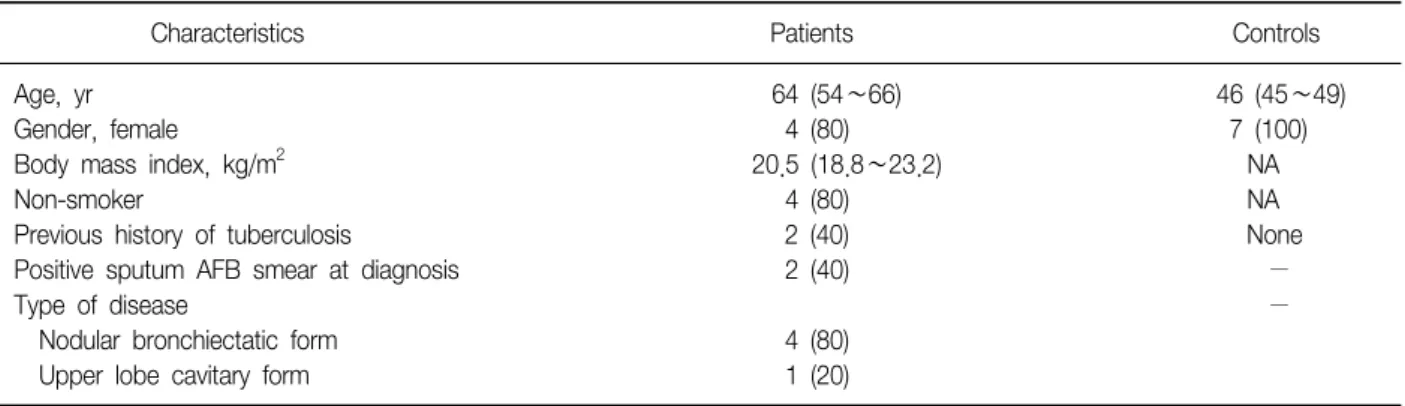
Table 1. Baseline characteristics of five patients with Mycobacterium abscessus lung disease and 7 healthy controls

Characteristics Patients Controls

Age, yr 64 (54∼66) 46 (45∼49)

Gender, female 4 (80) 7 (100)

Body mass index, kg/m

2

20.5 (18.8∼23.2) NA

Non-smoker 4 (80) NA

Previous history of tuberculosis 2 (40) None

Positive sputum AFB smear at diagnosis 2 (40) −

Type of disease −

Nodular bronchiectatic form 4 (80)

Upper lobe cavitary form 1 (20)

Data are presented as number or median (interquartile range or percentage).

AFB: acid-fast bacilli; NA: not available.

portedly required for NTM signaling and increased rates of M. avium infection are observed in TLR2-knockout mice

14

. Mitogen-activated protein kinases (MAPKs), which are triggered by mycobacteria through engage- ment of TLRs, are important signal-transducing enzymes involved in many facets of cellular regulation and cyto- kine responses

15,16

. The MAPK family is composed of three major serine-threonine protein kinases including p38, extracellular signal-regulated kinase (ERK1/2), and the c-Jun NH2-terminal kinase

15

.

Several studies have been performed on MAPK sig- naling in macrophages during NTM infection

17-19

, which suggested that the degree and timing of p38 and ERK1/2 activation contribute differently in response to myco- bacterial organisms. While ERK1/2 or p38 signaling are responsible for the induction of tumor necrosis factor (TNF)-α, a key cytokine involved in granuloma for- mation during NTM infection, p38 is primarily involved in the initiation of interleukin (IL)-10, which is an an- ti-inflammatory cytokine

18,20

. MAPK p38 and IL-10 path- ways might be associated with the survival of myco- bacterium in the macrophages

18,19,21,22

. Studies on NTM stimulated MAPK pathway have been performed in hu- man cells

12,20

, but few studies have examined the MAPK pathway in human patients with NTM lung disease as compared to healthy controls.

Our previous study suggested that the downregula- tion of TLR2 and the resulting decreased production of IL-12 p40 and TNF-α following stimulation of M.

avium may contribute to host susceptibility to NTM lung disease

11

. MAPKs engage TLRs when they initiate the immune response

15,16

. Therefore, we assessed whether the expression of MAPKs, known as a critical enzyme in immune responses during NTM infection, contribute to susceptibility in patients with M. abscessus lung dis- ease as compared to healthy controls.

Materials and Methods 1. Study population

The present study included five patients with M. ab-

scessus lung disease and seven healthy volunteers. The

diagnosis of M. abscessus lung disease was made ac-

cording to the diagnostic criteria published by the

American Thoracic Society

2

. All patients had character-

istic findings on high-resolution computed tomography

scans, such as bilateral bronchiectasis combined with

multiple small nodules and branching linear structures

23

.

Baseline characteristics of patients are presented in

Table 1. M. abscessus was identified using a polymer-

ase chain reaction and restriction length polymorphism

method based on the rpoB gene, as previously de-

scribed

24

. Peripheral blood samples of 30 mL were ob-

tained from the controls and patients before antibiotic

therapy was initiated. This study was approved by the

Institutional Review Board at our institution and written

informed consent was obtained from all participants.

(3)

2. Preparation and stimulation of human monocytes Peripheral blood mononuclear cells (PBMCs) were separated from heparinized whole blood using standard density gradient centrifugation with Ficoll-Paque

TM

(GE- Healthcare, Uppsala, Sweden). Cells were incubated for 1 hour at 37

o

C, and non-adherent cells were removed by pipetting off the supernatant. Adherent monocytes were then resuspended at a density of 1×10

5

cells/well in RPMI-1640 medium (Life Technologies, Grand Island, NY, USA) for the cytokine assay and at a density of 3×10

5

cells/well for the MAPK assay.

Monocytes were stimulated with either M. avium (American Type Culture Collection 25291; ATCC, Mana- ssas, VA, USA) which was obtained from the Korean Institute of Tuberculosis, at a multiplicity of infection (MOI) of 70 or lipoteichoic acid (LTA) from Staphylo- coccus aureus (10μg/mL; InvivoGen, San Diego, CA, USA) and incubated at 37

o

C for 18 hours. The prelimi- nary data of healthy human sample under different MOI showed peak level of TNF-α production over MOI of 50. Cell-free (cleared) supernatant fractions were col- lected and analyzed for cytokine release.

3. Cytokine assay

Culture supernatants were collected at 18 hours to ex- amine cytokine release from monocytes following M.

avium and LTA stimulation. The concentrations of IL-10, IL-6, and TNF-α in the culture supernatants were meas- ured using commercially available enzyme-linked im- munosorbent assays kits (BioSource, Camarillo, CA, USA).

Cytokine concentrations in samples were calculated using standard curves generated from recombinant cyto- kines, and the results were expressed in picograms per milliliter.

4. Signaling inhibition assays

Human monocytes (3×10

5

cells/well) were pre- treated with 10μg/mL of anti-TLR2-specific antibody (eBioscience, San Diego, CA, USA), 10μg/mL of the p38 signaling inhibitor SB203580 (Calbiochem, San

Diego, CA, USA) or 20μg/mL of the ERK1/2 selective inhibitor PD98059 (Calbiochem) for 90 minutes prior to stimulation. Cells were then stimulated with M. avium or LTA. Culture supernatants were harvested and as- sayed for cytokine activity.

5. p38 and ERK1/2 assays

Following stimulation, the human monocytes (3×10

5

cells/well) were harvested and lysed. For Western blot analysis, samples were separated on 8% sodium dodecyl sulfate-polyacrylamide gel electrophoresis, transferred to a polyvinylidene difluoride membrane (Invitrogen Life Technologies, San Diego, CA, USA), and immuno- blotted with the antibodies anti-phospho-p38, anti-p38, anti-phospho-ERK, anti-ERK (Cell Signaling Technology, Danvers, MA, USA), and anti-β-actin (Santa Cruz Bio- technology, Santa Cruz, CA, USA). The reaction was de- tected using an ECL Plus western blotting detection sys- tem (Amersham, GE-Healthcare, Buckinghamshire, UK), an enhanced chemiluminescence detection system.

6. Statistical analysis

Differences in each variable between patients and controls were evaluated with Mann-Whitney U-tests and a Wilcoxon test. A p-value less than 0.05 was consid- ered statistically significant.

Results

1. NTM leads to the phosphorylation of MAPKs in monocytes of patients with M. abscessus lung disease, but expression of MAPKs in patients is less than that of healthy controls

Because NTM-induced expression of MAPKs in heal- thy human monocytes has been confirmed in other studies, we examined whether MAPKs are activated in monocytes of patients with M. abscessus lung disease after stimulation with NTM. We then compared the ex- pression levels of MAPKs in monocytes between the pa- tients and healthy controls.

Western blot analysis with anti-phospho-ERK1/2 in

patients showed that ERK1/2 activity after M. avium

(4)

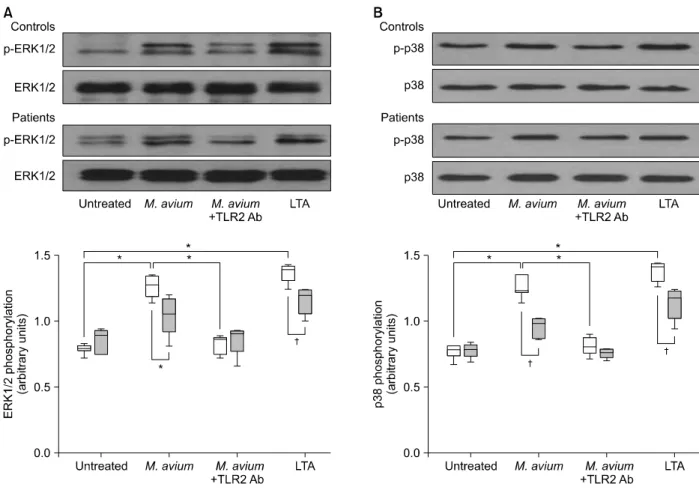
Figure 1. Mycobacterium avium-induced extracellular signal-regulated kinase (ERK1/2) and p38 expression in peripheral blood monocytes from patients with M. abscessus lung disease and healthy controls. ERK1/2 (A) and p38 (B) activation with M. avium or lipoteichoic acid (LTA) significantly decreased in patients (gray bar) as compared to healthy controls (white bar). Expression of ERK1/2 and p38 via inhibition with the anti-TLR2 antibody were not different between patients and controls. *p<0.05.

p<0.01. TLR2 Ab: Toll-like receptor 2 antibody.

stimulation (MOI 1:70) was upregulated as compared to ERK1/2 in the non-stimulated state (p=0.018) (Figure 1A). ERK1/2 expression after LTA showed similar results (p=0.043), although the expression of ERK1/2 in pa- tients was lower than that of healthy controls in re- sponse to M. avium stimulation (p=0.010), despite the small difference in ERK1/2 expression during the non-stimulated state between the patients and healthy controls (Figure 1A). Similar profiles were observed with response to p38 activation between patients with M. abscessus lung disease and healthy controls (Figure 1B).

After inhibition with a TLR2 neutralized antibody in healthy controls, expression of ERK1/2 after M. avium stimulation was lower than ERK1/2 without TLR2 in-

hibition (p=0.018). However, it did not differ sig- nificantly from ERK1/2 activation in the patients after TLR2 inhibition with the antibody (Figure 1A). Thus, the expression of ERK1/2 in response to M. avium stim- ulation with TLR2 inhibition was not different between the patients and controls, in contrast to significant differ- ences of ERK1/2 between patients and controls after M.

avium stimulation without TLR2 inhibition (Figure 1A).

The expression of p38 showed a similar tendency

(Figure 1B).

(5)

Figure 2. (A∼C) Inhibitory effects of extracellular sig- nal-regulated kinase (ERK1/2) and p38 on Mycobacterium avium-induced tumor necrosis factor (TNF)-α, interleukin (IL)-6, and IL-10 in monocytes from patients with M. ab- scessus lung disease and healthy controls. The anti-TLR2- specific antibody, the p38 signaling inhibitor SB203580 (SB), or the ERK1/2 selective inhibitor PD98059 (PD) prior to infection with M. avium at a MOI of 70 was added to the cells. The supernatants were harvested and ELISA was used to measure cytokine activity. *p<0.05.

p<0.01.

TLR2 Ab: toll-like receptor 2 antibody; MOI: multiplicity of infection; ELISA: enzyme-linked immunosorbent assays;

controls: white bar; patients: gray bar.

2. NTM-induced cytokine production in human mono- cytes is dependent on ERK1/2 and p38, but lower cytokine levels were observed in patients with M.

abscessus lung disease as compared to healthy controls

To determine whether MAPK activation was neces- sary for NTM-induced cytokine production, human monocytes were pretreated with the ERK1/2 inhibitor PD98059 or the p38 inhibitor SB203580 prior to M.

avium stimulation.

In human monocytes from healthy controls, TNF-α

secretion significantly increased after M. avium stim- ulation (MOI 1:70) as compared to the non-stimulated state (p=0.018). In contrast, inhibition of ERK1/2 or p38 reduced TNF-α production by M. avium stimulation (Figure 2A). Similar results were obtained with IL-6 pro- duction (Figure 2B). Moreover, IL-10 production after M. avium stimulation was suppressed by the inhibition of p38, but not the inhibition of ERK1/2 in healthy con- trols (Figure 2C).

We compared cytokine production in monocytes

from patients with M. abscessus lung disease versus

healthy controls in the presence and absence of ERK1/2

(6)

or p38 inhibition followed by M. avium stimulation.

TNF-α secretion in response to M. avium stimulation was lower in patients as compared to the controls (p=0.003). However, M. avium -induced TNF-α pro- duction after blocking ERK1/2 or p38 pathway did not show significant difference between patients and con- trols (Figure 2A). A similar tendency was shown in IL-6 (Figure 2A) and IL-10 (Figure 2C).

Discussion

To the best of our knowledge, the current study is the first to examine MAPK expression in patients with NTM lung disease including M. abscessus lung disease.

The present data demonstrate that both M. avium and LTA induce p38 and ERK1/2 expression in monocytes from healthy controls, and subsequently upregulate TNF-α, IL-6 and IL-10 production. However, in mono- cytes from patients with M. abscessus lung disease, the induction of p38 and ERK1/2 expression, and TNF-α, IL-6, and IL-10 production, occurred to a significantly lesser extent. IL-10 production is related not only to p38 but also to the ERK1/2 pathway. Thus, current findings suggest that impaired induction of p38 and ERK1/2 ex- pression in response to M. avium or LTA stimulation may contribute to host susceptibility to M. abscessus lung disease. For tolerance effect is partly eliminated, M. abscessus primed cell is stimulated by M. avium in- stead of same strain.

Since NTM are ubiquitous organisms, most people are resistant to infection unless their defense mecha- nisms have undergone iatrogenic alteration. However, the nature of the precise immune dysfunction that pre- disposes otherwise healthy subjects to NTM lung dis- ease are not clear. A few studies that have compared the immune responses of PBMCs from patients with NTM lung disease and healthy controls have shown that patients produce lower concentrations of IL-12, interfer- on-γ, and TNF-α

25-28

. These results suggest that sus- ceptibility to NTM lung disease is related to the sup- pression of the T-helper cell (Th) type 1 immune responses. Downregulation of TLR2 was suggested to

be involved in the immune suppression of NTM dis- ease

26

. However, additional detailed mechanisms re- sponsible for this immunologic imbalance remain unknown.

MAPK is involved in cytokine responses and in- flammation linked to the engagement of TLR2 and mye- loid differentiation factor 88 as demonstrated for NTM

13,16,29

. The present Western blot data show that p38 and ERK1/2 expression decreases with inhibition by the TLR2 antibody. These findings suggest that MAPK sig- naling pathway is related to the TLR2 pathway.

TNF-α is thought to mediate pathologic inflamma- tory reactions and protective responses to mycobacterial infections and to play a central role in granuloma for- mation, both directly and through the recruitment of chemokines

30

. Although IL-6 has been shown to pro- mote the intracellular growth of mycobacteria in mono- nuclear cells

31,32

IL-6 seems to be critical in resistance to mycobacterial infection

33

. Therefore, down-regulation of these cytokine in human with mycobacterial infection leads to disease development. In this study, TNF-α and IL-6 secretion decreased following stimulation with M.

avium and LTA when pretreated with p38 inhibitor and ERK1/2 inhibitor. These findings strongly suggest that p38 and ERK1/2 play essential roles in the production of TNF-α and IL-6 against M. avium . Previous studies have revealed that TNF-α, IL-6, and IL-10 production in M. avium or M. abscessus infection are increased by activation of the p38 and ERK1/2 MAPK signaling path- way in PBMCs of healthy humans

12

. M. abscessus was demonstrated to be activated by the p38 and ERK1/2 MAPK pathways and induces the secretion of TNF-α, IL-6, and IL-12 p40 via TLR2 in murine macrophages

13

. Some studies have indicated that p38 and ERK activa- tion are required for mycobacteria-induced TNF-α se- cretion

17,34,35

.

IL-10 is an anti-inflammatory cytokine mostly pro-

duced by Th2 cells. Previous studies have shown that

Th2 immune responses might increase in NTM lung dis-

ease since IL-10 is higher, whereas other cytokines are

lower in patients with NTM lung disease

25,28

. However,

the present data showed that IL-10 production was low-

(7)

er in patients with NTM lung disease than healthy con- trols and it decreased significantly with inhibition of p38 signaling. These findings suggest that the ERK1/2 and p38 MAPK pathways are critical for M. avium -induced TNF-α and IL-6 formation, whereas only the p38 MAPK pathway is essential for M. avium -induced IL-10 pro- duction. Recent studies have found that IL-10 was great- ly reduced (>90%) by the p38 inhibitor, whereas the ERK1/2 inhibitor only partially interfered with IL-10 (35

∼45%) in study on healthy human monocytes stimu- lated with M. avium or M. abscessus

12

. Another study of human macrophage stimulated with M. avium show- ed that induction of IL-10 was critically dependent on p38 MAPK activity, but only partially dependent on the ERK1/2 pathway

36

. Such divergent requirements for the MAPK pathway of TNF-α and IL-10 might affect regu- lation of production of inflammatory and anti-inflam- matory cytokine in NTM infection, although further study of type of cell or another strain is requirement.

Furthermore, this different MAPK role of TNF-α and IL-10 will be considered for the usage of MAPK pathway of novel target therapy.

Although these findings strongly suggest that regu- lation of the p38 and ERK1/2 MAPK pathways may be an important determinant of NTM infection suscepti- bility, the relationship between NTM lung disease and MAPK and cytokine expression was not fully examined.

In the present study, p38 and ERK1/2 MAPK expression, and TNF-α, IL-6, and IL-10 production in monocytes in NTM lung disease were lower than in healthy controls. In addition, treatment with the inhibitor of p38 or ERK1/2 blocked M. avium induced cytokine pro- duction in monocytes of healthy controls, but only had a minimal effect in those of patients. These results in- dicate that defects in the MAPK pathway are a crucial cause for the reduction in cytokine production during NTM lung disease. The present study has several im- portant limitations. First, the sample size in this study was relatively small, perhaps too small to make a defi- nite conclusion. Therefore, the result of this study has value of preliminary study. In addition, peripheral blood monocytes can reflect the immunoreactivity of

airway cells, but the immune response of peripheral blood monocytes may be confounded due to a lack of local immunoregulatory mechanisms present in the lung

37,38

. Therefore, further studies involving MAPK ex- pression and subsequent cytokine responses using bron- choalveolar lavage cells will be needed. Finally, depres- sion of MAPK expression and subsequent down- regulation of cytokine responses in patients with NTM lung disease might be a secondary phenomenon of NTM infection, and is not attributable to the suscepti- bility of patients with the disease. Secondary phenom- enon is that impairment of immune response or toler- ance effect for stimulation from other infection coming out after NTM infection. Therefore, further studies are needed to examine MAPK expression and cytokine re- sponses before and after treatment of M. abscessus infection.

NTM infection induced p38 and ERK1/2 expression in monocytes from healthy controls and subsequently upregulated TNF-α and IL-6 production. IL-10 pro- duction was related to the p38 pathway, but not the ERK1/2 pathway. In monocytes from patients with M.

abscessus lung disease, however, the induction of p38 and ERK1/2 expression, and the production of TNF-α, IL-6, and IL-10 were significantly lower. These findings suggest that decreased activity of MAPK and cytokine secretion in monocytes from patients with M. abscessus lung disease may partially explain the reasons for host susceptibility to these uncommon infections.

Acknowledgements

This work was supported by the Mid-career Resear- cher Program through an NRF grant funded by MEST (2010-0027659) and IN-SUNG Foundation for Medical Research (CA 98051).

References

1. Brown-Elliott BA, Wallace RJ Jr. Clinical and taxonomic

status of pathogenic nonpigmented or late-pigmenting

rapidly growing mycobacteria. Clin Microbiol Rev

(8)

2002;15:716-46.

2. Griffith DE, Aksamit T, Brown-Elliott BA, Catanzaro A, Daley C, Gordin F, et al. An official ATS/IDSA state- ment: diagnosis, treatment, and prevention of non- tuberculous mycobacterial diseases. Am J Respir Crit Care Med 2007;175:367-416.

3. Jeon K, Kwon OJ, Lee NY, Kim BJ, Kook YH, Lee SH, et al. Antibiotic treatment of Mycobacterium abscessus lung disease: a retrospective analysis of 65 patients.

Am J Respir Crit Care Med 2009;180:896-902.

4. Koh WJ, Jeon K, Lee NY, Kim BJ, Kook YH, Lee SH, et al. Clinical significance of differentiation of Myco- bacterium massiliense from Mycobacterium abscessus.

Am J Respir Crit Care Med 2011;183:405-10.

5. Jarand J, Levin A, Zhang L, Huitt G, Mitchell JD, Daley CL. Clinical and microbiologic outcomes in patients re- ceiving treatment for Mycobacterium abscessus pulmo- nary disease. Clin Infect Dis 2011;52:565-71.

6. Lyu J, Jang HJ, Song JW, Choi CM, Oh YM, Lee SD, et al. Outcomes in patients with Mycobacterium ab- scessus pulmonary disease treated with long-term in- jectable drugs. Respir Med 2011;105:781-7.

7. Dailloux M, Abalain ML, Laurain C, Lebrun L, Loos- Ayav C, Lozniewski A, et al. Respiratory infections as- sociated with nontuberculous mycobacteria in non-HIV patients. Eur Respir J 2006;28:1211-5.

8. Guide SV, Holland SM. Host susceptibility factors in mycobacterial infection: genetics and body morpho- type. Infect Dis Clin North Am 2002;16:163-86.

9. Koh WJ, Kwon OJ, Lee KS. Diagnosis and treatment of nontuberculous mycobacterial pulmonary diseases:

a Korean perspective. J Korean Med Sci 2005;20:913- 25.

10. Diagnosis and treatment of disease caused by non- tuberculous mycobacteria. This official statement of the American Thoracic Society was approved by the Board of Directors, March 1997. Medical Section of the American Lung Association. Am J Respir Crit Care Med 1997;156(2 Pt 2):S1-S25.

11. Ryu YJ, Kim EJ, Koh WJ, Kim H, Kwon OJ, Chang JH.

Toll-like receptor 2 polymorphisms and nontuber- culous mycobacterial lung diseases. Clin Vaccine Im- munol 2006;13:818-9.

12. Sampaio EP, Elloumi HZ, Zelazny A, Ding L, Paulson ML, Sher A, et al. Mycobacterium abscessus and M.

avium trigger Toll-like receptor 2 and distinct cytokine response in human cells. Am J Respir Cell Mol Biol 2008;39:431-9.

13. Shin DM, Yang CS, Yuk JM, Lee JY, Kim KH, Shin SJ,

et al. Mycobacterium abscessus activates the macro- phage innate immune response via a physical and functional interaction between TLR2 and dectin-1. Cell Microbiol 2008;10:1608-21.

14. Gomes MS, Flórido M, Cordeiro JV, Teixeira CM, Takeuchi O, Akira S, et al. Limited role of the Toll-like receptor-2 in resistance to Mycobacterium avium.

Immunology 2004;111:179-85.

15. Chang L, Karin M. Mammalian MAP kinase signalling cascades. Nature 2001;410:37-40.

16. Trinchieri G, Sher A. Cooperation of Toll-like receptor signals in innate immune defence. Nat Rev Immunol 2007;7:179-90.

17. Roach SK, Schorey JS. Differential regulation of the mi- togen-activated protein kinases by pathogenic and nonpathogenic mycobacteria. Infect Immun 2002;70:

3040-52.

18. Souza CD, Evanson OA, Weiss DJ. Role of the mi- togen-activated protein kinase pathway in the differ- ential response of bovine monocytes to Mycobacterium avium subsp. paratuberculosis and Mycobacterium avium subsp. avium. Microbes Infect 2007;9:1545-52.

19. Tse HM, Josephy SI, Chan ED, Fouts D, Cooper AM.

Activation of the mitogen-activated protein kinase sig- naling pathway is instrumental in determining the abil- ity of Mycobacterium avium to grow in murine macro- phages. J Immunol 2002;168:825-33.

20. Shiratsuchi H, Ellner JJ, Basson MD. Extracellular-regu- lated kinase activation regulates replication of Myco- bacterium avium intracellularly in primary human monocytes. Cell Tissue Res 2008;332:237-44.

21. Bhattacharyya A, Pathak S, Kundu M, Basu J. Mitogen- activated protein kinases regulate Mycobacterium avium-induced tumor necrosis factor-alpha release from macrophages. FEMS Immunol Med Microbiol 2002;34:73-80.

22. Klug K, Ehlers S, Uhlig S, Reiling N. Mitogen-activated protein kinases p38 and ERK1/2 regulated control of Mycobacterium avium replication in primary murine macrophages is independent of tumor necrosis fac- tor-alpha and interleukin-10. Innate Immun 2011;17:

470-85.

23. Koh WJ, Lee KS, Kwon OJ, Jeong YJ, Kwak SH, Kim TS. Bilateral bronchiectasis and bronchiolitis at thin- section CT: diagnostic implications in nontuberculous mycobacterial pulmonary infection. Radiology 2005;

235:282-8.

24. Koh WJ, Kwon OJ, Jeon K, Kim TS, Lee KS, Park YK,

et al. Clinical significance of nontuberculous mycobac-

(9)

teria isolated from respiratory specimens in Korea.

Chest 2006;129:341-8.

25. Vankayalapati R, Wizel B, Samten B, Griffith DE, Shams H, Galland MR, et al. Cytokine profiles in immunocom- petent persons infected with Mycobacterium avium complex. J Infect Dis 2001;183:478-84.

26. Ryu YJ, Kim EJ, Lee SH, Kim SY, Suh GY, Chung MP, et al. Impaired expression of Toll-like receptor 2 in nontuberculous mycobacterial lung disease. Eur Respir J 2007;30:736-42.

27. Kwon YS, Kim EJ, Lee SH, Suh GY, Chung MP, Kim H, et al. Decreased cytokine production in patients with nontuberculous mycobacterial lung disease. Lung 2007;185:337-41.

28. Greinert U, Schlaak M, Rüsch-Gerdes S, Flad HD, Ernst M. Low in vitro production of interferon-gamma and tumor necrosis factor-alpha in HIV-seronegative pa- tients with pulmonary disease caused by nontuber- culous mycobacteria. J Clin Immunol 2000;20:445-52.

29. Feng CG, Scanga CA, Collazo-Custodio CM, Cheever AW, Hieny S, Caspar P, et al. Mice lacking myeloid differentiation factor 88 display profound defects in host resistance and immune responses to Mycobacte- rium avium infection not exhibited by Toll-like re- ceptor 2 (TLR2)- and TLR4-deficient animals. J Immu- nol 2003;171:4758-64.

30. Stenger S. Immunological control of tuberculosis: role of tumour necrosis factor and more. Ann Rheum Dis 2005;64 Suppl 4:iv24-8.

31. Wallis RS, Ellner JJ. Cytokines and tuberculosis. J Leukoc Biol 1994;55:676-81.

32. Shiratsuchi H, Johnson JL, Ellner JJ. Bidirectional effects of cytokines on the growth of Mycobacterium avium

within human monocytes. J Immunol 1991;146:3165- 70.

33. Ladel CH, Blum C, Dreher A, Reifenberg K, Kopf M, Kaufmann SH. Lethal tuberculosis in interleukin-6-de- ficient mutant mice. Infect Immun 1997;65:4843-9.

34. Yadav M, Roach SK, Schorey JS. Increased mi- togen-activated protein kinase activity and TNF-alpha production associated with Mycobacterium smegmatis- but not Mycobacterium avium-infected macrophages requires prolonged stimulation of the calmodulin/calm- odulin kinase and cyclic AMP/protein kinase A pathways. J Immunol 2004;172:5588-97.

35. Hasan Z, Shah BH, Mahmood A, Young DB, Hussain R. The effect of mycobacterial virulence and viability on MAP kinase signalling and TNF alpha production by human monocytes. Tuberculosis (Edinb) 2003;83:

299-309.

36. Reiling N, Blumenthal A, Flad HD, Ernst M, Ehlers S.

Mycobacteria-induced TNF-alpha and IL-10 formation by human macrophages is differentially regulated at the level of mitogen-activated protein kinase activity.

J Immunol 2001;167:3339-45.

37. Sable SB, Goyal D, Verma I, Behera D, Khuller GK.

Lung and blood mononuclear cell responses of tuber- culosis patients to mycobacterial proteins. Eur Respir J 2007;29:337-46.

38. Schwander SK, Torres M, Carranza CC, Escobedo D,

Tary-Lehmann M, Anderson P, et al. Pulmonary mono-

nuclear cell responses to antigens of Mycobacterium

tuberculosis in healthy household contacts of patients

with active tuberculosis and healthy controls from the

community. J Immunol 2000;165:1479-85.

수치

Table  1.  Baseline  characteristics  of  five  patients  with  Mycobacterium  abscessus  lung  disease  and  7  healthy  controls
Figure 1. Mycobacterium avium-induced extracellular signal-regulated kinase (ERK1/2) and p38 expression in peripheral blood monocytes from patients with  M
Figure  2.  (A∼C)  Inhibitory  effects  of  extracellular  sig- sig-nal-regulated  kinase  (ERK1/2)  and  p38  on  Mycobacterium  avium-induced  tumor  necrosis  factor  (TNF)-α,  interleukin  (IL)-6,  and  IL-10  in  monocytes  from  patients  with  M

참조

관련 문서