Acetaminophen is one of the most common and avail- able analgesic and antipyretic medications worldwide and is highly accessible because it has fewer side effects than any other analgesic or antipyretic. However, acet- aminophen overdose can cause serious and lethal hepa- totoxicity. The daily maximal dose of acetaminophen is 4.0 g, and excessive doses between 7.5 g and 10.0 g can cause hepatotoxicity [1] because about 10% of acetamin- ophen is metabolized into the toxic metabolite N-acetyl- p-benzoquinone imine (NAPQI) by cytochrome P450 [2].
Large doses of acetaminophen result in severe glutathi- one depletion with overproduction of NAPQI, causing hepatotoxicity.
With similar pathophysiology, concurrent nephrotoxic- ity induced by acetaminophen has been raised as a con- cern over the past few decades [3,4]. However, regarding kidney function, acetaminophen use with appropriate therapeutic doses should be safer than nonsteroidal anti- inflammatory drugs (NSAIDs) or opiates. The National Kidney Foundation (NKF) recommends a single dose of acetaminophen as the drug of choice for pain control in
patients with kidney disease [5].
In comparison, ingestion of toxic amounts of acet- aminophen can cause acute kidney injury (AKI) because of acute tubular necrosis at the proximal tubule, and habitual acetaminophen use may result in chronic kid- ney disease (CKD) and end-stage renal disease (ESRD) from chronic interstitial fibrosis or papillary necrosis [6].
Excessive amounts of acetaminophen and NAPQI are ex- creted by the kidney and may contribute to AKI. Further- more, the associated oxidative stress can lead to direct nephrotoxicity [7].
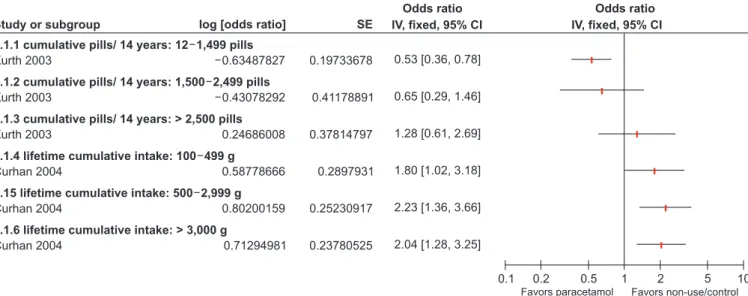
However, evidence that habitual use of acetaminophen alone increases the risk of ESRD has not been clearly demonstrated. A population-based cohort study reported that single-substance acetaminophen may be safe for patients with advanced CKD at stage 4 to 5 without an adverse effect on progression of CKD [8]. Finally, the as- sociation between acetaminophen use and renal impair- ment is still controversial.
In this issue of Kidney Research and Clinical Prac- tice, Kanchanasurakit et al [9] performed a systematic review and meta-analysis for the association between acetaminophen and renal impairment. Of 13,097 ar- ticles identified, 5 (two cohort studies and three case- control studies) with 13,114 participants were included.
All included studies were observational. Three studies focused on the association between acetaminophen use and CKD, another focused on AKI, and the other focused on AKI and CKD. The authors analyzed causes of hetero- geneity based on study design (case-control and cohort studies), identified publication bias, and discussed study limitations. More than one tool was used in the analyses to provide confidence in evaluation of the risk of bias in the observational studies. The results concluded that acetaminophen users without a prior history of kidney
Controversies in acetaminophen nephrotoxicity
Woo Yeong Park
Department of Internal Medicine, Keimyung University School of Medicine, Keimyung University Kidney Institute, Daegu, Republic of Korea
Editorial KIDNEY RESEARCH
AND CLINICAL PRACTICE
Received February 13, 2020; Revised February 23, 2020;
Accepted February 24, 2020
Edited by Gheun-Ho Kim, Hanyang University, Seoul, Republic of Korea
Correspondence: Woo Yeong Park
Department of Internal Medicine, Keimyung University School of Medicine, Keimyung University Kidney Institute, 1035 Dalgubeol- daero, Dalseo-gu, Daegu 42601, Republic of Korea. E-mail:
[email protected]
Copyright © 2020 by The Korean Society of Nephrology
CC