거대 갈조류 모자반으로부터 환원당과 레불린산의 생산
정귀택*
부경대학교생물공학과
Received: April 25, 2014 / Revised: May 12, 2014 / Accepted: May 12, 2014
서 론
화석자원의고갈과환경오염에대한우려로재생에너지의 개발과이용에많은관심이쏟아지고있다. 이러한재생에너 지중바이오에너지는재생가능한자원으로부터생물학적 또는열화학적인공정을통해바이오연료와화학제품을생 산할수있다. 최근목질계자원으로부터바이오에너지의생 산뿐만아니라, 해양자원인해조류를이용한연구가활발히 진행되고있다[5, 4, 13].
모자반(Sargassum fulvellum)은국내동·남해안과일본 해안에분포하는갈조류이다. 국내에서는식용으로사용되 며, 일부는 alginate의원료로사용되기도한다. 모자반의당 류의 주요 성분은 alginate와 sulfated polysaccharide (fucose, glucose, xylose, arabinose, galactose, mannose, rhamnose, glucuronic acid 등으로구성)로알려져있다. 이 러한성분의함량은종, 시기, 장소등의여건에따라다양 하다고알려져있다[7, 8, 14].
화석자원으로부터얻어왔던많은종류의화학물질을대
체하기위하여당을이용한생물공정또는화학공정을통해 생산하고자하는연구가수행되고있다. 당으로부터바이오 연료(bioethanol, biobutanol, biomethan 등) 뿐만 아니라, 다양한화학물질을생산할수있다. 이중 levulinic acid와 그유도체들은화석자원으로부터얻고있는일부화학중간 체들을대체할수있다고알려져있다. 그예로디젤연료첨 가제(ethyl levulinate, 2-methyltetrahydrofuran), 살충제 (δ-aminolevulinic acid), 고분자 단량체(β-acetylacrylic acid, diphenolic acid, 1,4-pentanediol) 등의다양한화합물 로전환될수있다. 그러나높은생산비때문에 levulinic acid 의상용화에는많은노력이요구되고있다[5, 9, 10, 13].
본연구에서는해양자원인모자반이바이오연료로전환가 능한환원당과화학중간체로사용되는 levulinic acid를생 산하는데있어잠재적인자원인지평가하기위하여묽은산 가수분해방법과반응표면분석법을적용하였다.
재료 및 방법
실험재료
실험재료로사용한모자반(S. fulvellum)은전남완도에서
2009년에수확한것을건조한후분쇄하여실험에사용하였
다. Sulfuric acid, calcium carbonate, levulinic acid 및기 Production of Total Reducing Sugar and Levulinic Acid from Brown Macro-algae Sargassum fulvellum
Gwi-Taek Jeong*
Department of Biotechnology, Pukyong National University, Busan 608-737, Republic of Korea
Recently, many biofuels and chemicals converted from renewable resources have been introduced into chemical industries.
Sargassum fulvellum is a brown macro-algae, which is found on the seashores of Korea and Japan. In this work, the production of total reducing sugar and levulinic acid from S. fulvellum, using dilute-acid catalyzed hydrothermal hydrolysis and statistical methodology, was investigated. As a result, 15.28 g/l total reducing sugar was obtained under the optimized conditions of 160.1oC, 1.0% sulfuric acid, in 20.2 min. Furthermore, 2.65 g/l levulinic acid was obtained at 189.5oC, 2.93% sulfuric acid, in 48.8 min.
Keywords: Sargassum fulvellum, total reducing sugar, levulinic acid, dilute-acid hydrothermal reaction
*Corresponding author
Tel: +82-51-629-5869, Fax: +82-51-629-5863 E-mail: [email protected]
© 2014, The Korean Society for Microbiology and Biotechnology
타시약은시약급의제품을사용하였다. 실험방법
모자반을 묽은 산 가수분해법을 이용하여 환원당과 levulinic acid을생산하기위하여다음과같은반응을수행 하였다. 각각의실험은 50 ml 규모의회분식스테인리스스 틸재질의반응기를사용하여고/액비(solid-to-liquid ratio, w:v) 1:15로설정하였다. 반응의시작은반응기내부의온도 가설정온도에도달하는시점을 0으로시작하였으며, 대략 5분정도가소요되었다. 반응기의온도는기름중탕을이용 하여 150-200oC의조건으로 PID 온도컨트롤러를이용하여 조절하여반응시간(9.8-60.2분) 동안반응하였다. 반응기내 의반응물은반응도를높이기위하여마그네틱바를이용하 여약 200 rpm으로교반하였다. 반응이종료되면반응기를 수돗물을사용하여실온으로빠르게냉각시킨후시료를취 하였다. 얻어진시료는 calcium carbonate를이용하여 pH를 6으로조절한다음 8,800 ×g로 20분간원심분리하여생성된
calcium sulfate를 제거하여 얻은 상등액을 환원당과
levulinic acid 농도분석에사용하였다[9, 10].
실험계획 및 통계분석
반응표면분석법을적용한실험계획을디자인하기위하여
Design-Expert 7 software (Stat-Ease, Inc., USA)를이용 하여 5-수준-3-인자의중심합성회전설계법을적용하였다. 반 응온도(150-200oC), 촉매농도(0.3-3.7 wt%), 반응시간(9.8- 60.2분)을반응인자로설정하여실험을계획하였다. 실험결 과(Table 1)를바탕으로 Design-Expert 7 프로그램을이용 하여회귀분석및 quadratic response surface model을구 성하였으며, 모델의질(quality)은측정계수(R2)와변이분석 (ANOVA)을통하여평가하였다[9, 10].
Combined severity factor의 정의. Combined severity factor (CSF)는반응온도, 반응시간, 그리고 pH의함수로써 반응의가혹도(severity)를나타내는것이다.
CSF = log[t exp(T – Tref)/14.75] − pH
여기에서, t는반응시간(min), T(t)는반응온도(oC), 기준반 응온도(Tref)는 100, 그리고 14.75는임의상수 값을나타낸 다. pH는실온에서반응전의 pH 값을사용하였다[1].
분석 방법
시료중의환원당은 glucose를표준물질로사용하여 DNS 법으로분석하였다. Levulinic acid의농도는굴절률검출기 가장착된 HPLC 시스템(Agilent 1100, USA)을사용하여분 Table 1. Experimental design and data for 5-level-3-factor response surface analysis in central composite rotatable second-order design.
STD Run Reaction
temperature (oC), A
Catalyst amount (wt %), B
Reaction time (min), C
Total reducing sugar (g/l)
Levulinic acid (g/l)
12 1 175.0 3.7 35.0 2.66 2.24
20 2 175.0 2.0 35.0 4.50 1.18
17 3 175.0 2.0 35.0 3.87 1.26
19 4 175.0 2.0 35.0 3.85 1.30
13 5 175.0 2.0 9.8 9.06 0.51
15 6 175.0 2.0 35.0 4.04 1.40
3 7 160.0 3.0 20.0 12.12 0.00
18 8 175.0 2.0 35.0 3.77 1.43
16 9 175.0 2.0 35.0 4.32 1.24
7 10 160.0 3.0 50.0 6.66 1.06
14 11 175.0 2.0 60.2 2.48 1.72
6 12 190.0 1.0 50.0 4.90 0.00
8 13 190.0 3.0 50.0 2.71 2.26
11 14 175.0 0.3 35.0 8.24 0.00
5 15 160.0 1.0 50.0 13.12 0.00
9 16 149.8 2.0 35.0 14.06 0.00
2 17 190.0 1.0 20.0 8.24 0.00
1 18 160.0 1.0 20.0 14.98 0.00
4 19 190.0 3.0 20.0 2.20 2.28
10 20 200.2 2.0 35.0 1.20 2.19
석하였다. Aminex 87H 칼럼(Bio-rad사, USA)과칼럼온도 65oC, 이동상 5 mM sulfuric acid (0.6 ml/min)의조건에서 분석하였다[11, 12].
결과 및 고찰
모자반으로부터 환원당과 levulinic acid 생성조건의 최적화 본연구에서는해양자원인거대해조류중갈조류인모자 반을산촉매를사용하여환원당및 levulinic acid로전환하 고자하였다. 산가수분해반응의조건의최적화를위하여 Design Expert 프로그램을사용하여실험계획법중반응표 면분석법(5-수준-3-인자의중심합성회전설계법)을적용하여 최적화를수행하였다. Table 1에실험계획법으로디자인한 실험변수의조건과실험을수행하여얻은결과를나타내었다.
실험결과에의하면, 160oC, 1% H2SO4, 20분의실험조건 (Run 18)에서가장높은 14.98 g/l의환원당이생성되었으며, 200.2oC, 2% H2SO4, 35분의 조건(Run 20)에서 가장낮은 환원당(1.2 g/l)이생성되었다. Levulinic acid의생성결과에 서는다수의실험조건(Run 1, 13, 19, 20)에서 2.2 g/l 정도의 LA가생성되었으나, 많은실험조건에서 LA가검출되지않 았다.
실험결과를 Design Expert 프로그램을사용하여다중회 귀분석(ANOVA)을수행하여얻은결과를 Table 2에나타내 었다. 변수의계수의 p-values가 0.05보다작으면중요하다 고판단하였다. 환원당생성의경우에있어서는분석하여얻 은모델식은 F-value가 18.92로적절히모델링되었다. 또한 세개의 1차식의계수(A, B, C)와세개의 2차식의계수(A2, B2, C2)가중요한인자로확인되었다. LA의경우에있어서 Table 2. ANOVA results for the response surface quadratic model for levulinic acid formation.
Source Sum of squares DF Mean square F-value Prob. > F
Total reducing sugar
Model 328.06 9 36.45 18.92 < 0.0001
A-Temperature 186.44 1 186.44 96.79 < 0.0001
B-Catalyst 53.11 1 53.11 27.57 0.0004
C-Time 32.96 1 32.96 17.11 0.0020
AB 0.15 1 0.15 0.08 0.7880
AC 2.54 1 2.54 1.32 0.2777
BC 0.01 1 0.01 0.00 0.9498
A2 37.91 1 37.91 19.68 0.0013
B2 10.42 1 10.42 5.41 0.0423
C2 13.37 1 13.37 6.94 0.0250
Residual 19.26 10 1.93
Lack of Fit 18.83 5 3.77 43.99 0.0004
Pure Error 0.43 5 0.09
Cor Total 347.32 19
Levulinic acid
Model 13.51 9 1.50 14.63 0.0001
A-Temperature 3.75 1 3.75 36.53 0.0001
B-Catalyst 6.44 1 6.44 62.75 < 0.0001
C-Time 0.70 1 0.70 6.79 0.0262
AB 1.51 1 1.51 14.75 0.0033
AC 0.15 1 0.15 1.44 0.2578
BC 0.14 1 0.14 1.32 0.2768
A2 0.36 1 0.36 3.48 0.0916
B2 0.31 1 0.31 3.06 0.1107
C2 0.33 1 0.33 3.17 0.1053
Residual 1.03 10 0.10
Lack of Fit 0.98 5 0.20 21.66 0.0021
Pure Error 0.05 5 0.01
Cor Total 14.54 19
는분석하여얻은모델식은 F-value가 14.63으로모델의중 요성이확인되었다. 또한분석하여얻은모델식은세개의 1차식의계수(A, B, C)와하나의 cross-product 계수(AB)가 중요한인자로확인되었다. 반응변수로반응온도, 촉매량, 그 리고반응시간을독립변수로설정하고, 환원당과 levulinic
acid 생성량을종속변수로설정하여다중회기분석을수행
하여각각의변수에대한통계분석을통하여얻은모델추 정식을다음과같이얻었다.
환원당= 302.7376−2.8751A−7.0291B−0.8456C + 0.0090AB + 0.0025AC + 0.0021BC + 0.0072A2 + 0.8504B2+ 0.0043C2 (R2= 0.945)
Levulinic acid =−22.4787 + 0.2430A−4.1019B + 0.1501C + 0.0290AB−0.0006AC + 0.0087BC
−0.0007A2−0.1477B2−0.0007C2 (R2= 0.929) 여기에서, A는반응온도(oC), B는촉매농도(wt %), 그리고 C 는반응시간(min)을나타낸것이다.
Fig. 1에각각의반응인자가모델에미치는영향을나타내
었다. 환원당생성모델에서는 A(반응온도), B(촉매농도), C (반응시간)가부정적인영향을크게미친반면에, A2, B2, C2 는 모델 식에 긍정적인 영향을 보였다. 이와는 반대로 levulinic acid의생성모델에서는 A, B, C, AB, BC가긍정 적인영향을나타내었다. 이는당의탈수반응에의해생성되 는 levulinic acid의생성기작과관련된것으로판단된다.
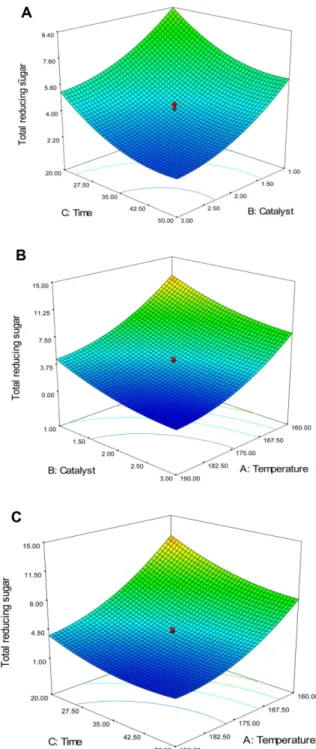
Fig. 2는모자반으로부터환원당의생성에미치는반응온
도, 촉매농도, 반응시간의상호작용을나타내었다. Fig. 2(A) 는일정반응시간 35분의조건에서환원당의생성에미치는 반응온도와촉매농도의상호관계를도시한것이다. 전체적
인반응온도조건에서는촉매농도가증가함에따라환원당 의생성이증가하였다. 촉매농도조건에서는낮은농도가높 은농도보다많은환원당을생성하였다. 반응온도가낮고촉
Fig. 1. Effect of explanatory factors on total reducing sugar and levulinic acid production. (A) Reaction temperature, (B) Catalyst concentration, (C) Reaction time.
Fig. 2. Response surface plot representing the effect of reac- tion temperature, catalyst concentration, reaction time, and the reciprocal interaction of these factors on the production of total reducing sugar from S. fulvellum at a constant reac- tion condition. (A) At a constant 35 min, (B) At a constant 2% sul- furic acid, (C) At a constant 175oC.
매농도가낮은조건에서가장높은환원당이생성되었다. Fig.
2(B)는 2%의촉매농도조건에서환원당의생성에미치는반 응온도와반응시간의상호관계를나타내었다. 낮은반응온
도와짧은반응시간에서환원당의농도도증가하는경향을 나타내었다. Fig. 2(C)는 175oC의반응온도조건에서환원당 의생성에미치는촉매농도와반응시간의영향을나타내었 다. 촉매농도가증가할수록환원당농도가감소하였다. 또한 반응시간이길어짐에따라환원당의농도가감소하였는데 이는반응시간이지남에따라생성된환원당중일부가탈 수반응(dehydration)을일으켜환원당이감소한것으로판 단된다[4, 10]. 모자반으로부터환원당생성에미치는반응인 자들의영향을비교하면, 실험한조건내에서는반응온도, 촉 매농도, 반응시간의조건이낮거나짧을수록많은양의환원 당이생성되는것으로판단된다.
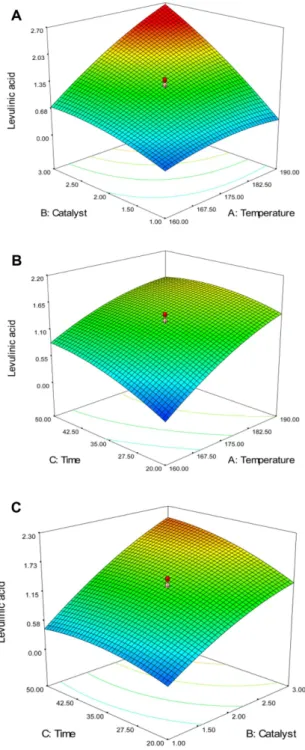
Fig. 3은모자반으로부터 levulinic acid의생성에반응온 도, 촉매농도, 반응시간이미치는상호작용에의한영향을나 타내었다. Fig. 3(A)는반응시간 35분의조건에서 levulinic acid의생성에미치는반응온도와촉매농도의상호관계를나 타내었다. 높은반응온도에서는낮은반응온도에서보다촉 매농도의증가에따른 levulinic acid의생성이선형적으로 증가하였다. 높은촉매농도에서는낮은촉매농도에서보다반 응온도의증가에따른 levulinic acid의생성이선형적으로 증가하였다. Fig. 3(B)는 2%의촉매농도에서 levulinic acid 의생성에미치는반응온도와반응시간의상호관계를나타 내었다. 반응온도와반응시간이증가할수록 levulinic acid의 생성도증가하였다. 높은반응온도에서는반응시간의영향 은낮았다. Fig. 3(C)는 175oC의조건에서 levulinic acid의 생성에미치는촉매농도와반응시간의영향을나타내었다. 촉매농도와반응시간이증가할수록 levulinic acid의농도도 증가하였다. 촉매농도의증가는대부분의반응시간조건에 서도 levulinic acid의선형적인증가를보였다. 모자반으로 부터 levulinic acid 생산에미치는반응인자들의영향을비 교하면, 높은반응온도와촉매농도에서 levulinic acid 농도 가증가하였고, 일정반응시간이후에는크게영향을미치지 못하였다.
반응표면분석법을적용하여실험한범위내에서모자반으 로부터환원당과 levulinic acid의생성을위한반응변수의 최적화를수행하여다음과같은최적의반응조건을얻었다. 환원당 생성의 최적 조건은 반응온도 160.1oC, 촉매농도 1.0%, 그리고반응시간 20.2분의조건에서 15.28 g/l의환원 당의생성이예측되었다. Levulinic acid는반응온도 189.5oC, 촉매농도 2.93%, 반응시간 48.8분의최적조건에서 2.65 g/l 의생성이예측되었다.
Table 3에 해양유래 해조류 자원으로부터 환원당과
levulinic acid의 생산과 관련된 연구결과를 비교하였다
[3, 6, 9-12]. 다양한종류의해조류로부터환원당의생산에 대한 연구결과가 보고되고 있다[3, 6, 11, 12]. 홍조류인 Palmaria palmate의산가수분해로부터 218 mg/g biomass Fig. 3. Response surface plot representing the effect of reac-
tion temperature, catalyst concentration, reaction time, and the reciprocal interaction of these factors on the production of levulinic acid from S. fulvellum at a constant reaction con- dition. (A) At a constant 35 min, (B) At a constant 2% sulfuric acid, (C) At a constant 175oC.
의 환원당을 얻었다는 보고가 있다[12]. 또한 갈조류인 Undaria pinnatifida로부터 28.65 g/l의환원당을생산하였 다는보고[3], 그리고 Saccharina japonica로부터산가수분
해와미생물당화를통해 69.1%의당화수율을얻었다고보
고되었다[6]. 또한녹조류인 Enteromopha intestinalis로부 터열수전처리와효소가수분해를통하여 20.1 g/l의환원당 을얻었다고보고되었다[11].
위의다양한해조류로부터환원당의생산은각각의해조 류를구성하고있는당성분의구성및함량이다르고, 이에 따른결과의직접적인비교는어렵다고판단된다. 그러나환 원당을생산하는방법으로는묽은산을이용하여 1단계로생 산하는방법과산또는열수전처리후미생물이나효소를 사용하여 2단계로환원당을생산하는방법으로크게분류할 수있었다. 전처리를이용하는방법은대체적으로낮은산농 도에서처리하여조직의구조를완화한후효소나미생물을 사용하여당화하였다. 이는직접적인 1단계방법에비하여 반응시간이길고, 부과적으로효소나미생물의반응에필요 한비용이증가하는단점을가지고있다. 이러한단점은묽 은산가수분해를통한모자반으로부터환원당의생산으로 극복할가능성이충분하다고판단된다.
해조류로부터 levulinic acid의생산과관련한적은수의 연구가보고되었다[9, 10]. 홍조류인 Gelidium amansii의경 우 9.74 g/l을생산하였다고보고[9]되었으며, 녹조류인 Codium fragile의경우에서는 4.26 g/l의 levulinic acid를생산하였다 고보고되었다[10]. 기존의연구에서는해조류중갈조류를 이용한연구가수행되지않아직접적인비교는어려우나, 본
연구에서사용한모자반의경우는홍조류와녹조류의연구 결과[9, 10]와비교하여낮은 levulinic acid 농도를나타내었 다. 이는각해조류종류에따른탄수화물의조성및구성이 상이하여 levulinic acid로전환이쉬운당으로구성되어있 는경우에는많은양의 levulinic acid가생성되었으리라판 단된다. 특히홍조류의경우에서는구성성분중 galactose와 1,3-anhydro-L-galactose가 많이 함유되어 있어 levulinic acid로쉽게전환된것으로판단된다[9, 12]. 또한모자반의 주요당성분인 alginate가 levulinic acid로전환되기어려 운것으로판단된다. 이에대한추가적인연구가필요하다고 Table 3. Comparisons of total reducing sugar and levulinic acid production.
Products Reaction conditions Product concentration Species/References
Total reducing sugar
Dilute-acid hydrothermal hydrolysis (160oC, 1.0% H2SO4, 20.2 min)
15.28 g/l This work
Dilute-acid hydrothermal hydrolysis (125oC, 0.4 M H2SO4, 25 min)
218 mg/g biomass Palmaria palmate [11]
Acid pretreatment (121oC, 40 mM H2SO4, 10%(w/v) slurry), microbial saccharification (1 g dry cell weight/l Bacillus sp. JS-1)
69.1% total saccharification yield
Saccharina japonica [14]
Thermal acid hydrolysis (121oC, 75 mM H2SO4, 60 min, 13%(w/v) slurry)
28.65 g/l Undaria pinnatifida [13]
Post-hydrothermal (at 170oC for 30 min) enzymatic hydrolysis
20.1 g/l (22% yield)
Enteromorpha intestinalis [12]
Levulinic acid Dilute-acid hydrothermal hydrolysis (189.5oC, 2.93% H2SO4, 48.8 min)
2.65 g/l This work
Acid hydrothermal reaction (160.0oC, 3.0% H2SO4, 43.1 min)
9.74 g/l Gelidium amansii [6]
Acid hydrothermal reaction (160.7oC, 3.9% H2SO4, 39.1 min)
4.26 g/l Codium fragile [9]
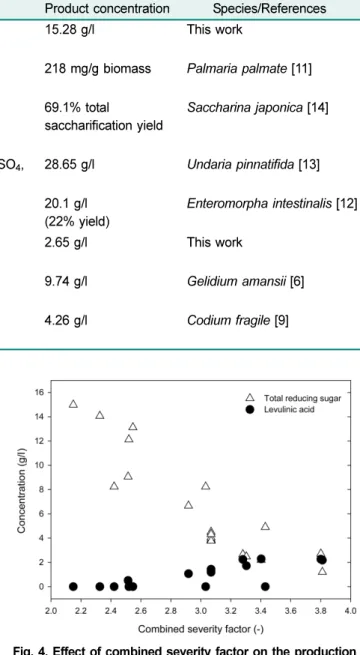
Fig. 4. Effect of combined severity factor on the production of total reducing sugar and levulinic acid by dilute-acid hydrothermal reaction of S. fulvellum.
판단된다.
Combined severity factor의 영향
Fig. 4는 combined severity factor (CSF)가모자반으로부 터환원당과 levulinic acid 생산에미치는영향을나타낸것 이다. 환원당의경우에서는 CSF가증가할수록선형적으로 감소하는경향을나타내었다. Levulinic acid의경우에서는 CSF가증가할수록 증가하는경향을보였다. 이는과도한 CSF의조건(높은반응온도, 높은촉매농도, 긴반응시간)에 서는 모자반으로부터 생성된 환원당이 5-HMF, furfural, levulinic acid와같은다른화학물질로전환되었기때문이 라고판단된다[9, 10].
요 약
본연구에서는거대해조류중갈조류에속하는모자반으 로부터 환원당 및 platform chemicals로 알려진 levulinic acid의생산을위하여묽은산촉매를이용한수열가수분해 법을수행하였다. 반응조건의최적화를위하여반응표면분 석법을적용하였다. 모자반으로부터환원당과 levulinic acid 의생성에미치는반응인자들의영향및상호작용을알아본 결과, 실험조건내에서반응온도, 촉매농도, 반응시간이낮 거나짧을수록많은양의환원당이생성되었다. 반면에높은 반응온도와촉매농도에서 levulinic acid 농도가증가하였고, 일정반응시간이후에는크게영향을미치지못하였다. 환원 당생성에있어서최적의반응조건은반응온도 160.1oC, 촉 매농도 1.0%, 그리고반응시간 20.2분의조건에서 15.28 g/l가 생성되었다. 또한 189.5oC, 2.93%, 48.8분의조건에서 2.65 g/l 의 levulinic acid를얻었다. 이러한결과는해양자원중거 대해조류로부터당과 platform chemicals을확보할수있 는가능성을제시함으로써화석자원의대체에활용할기본 정보를제공하고자하였다.
Acknowledgments
This research was supported by Basic Science Research Pro- gram through the National Research Foundation of Korea (NRF) funded by the Ministry of Education, Science and Technology (2012R1A1A2006718). Also, the author is thankful to SB Lee for technical support.
References
1. Banerji A, Balakrishnan M, Kishore VVN. 2013. Low severity
dilute-acid hydrolysis of sweet sorghum bagasse. Appl.
Energy 104: 197-206.
2. Cha JY, Hanna MA. 2002. Levulinic acid production based on extrusion and pressurized batch reaction. Ind. Crop. Prod. 16:
109-118.
3. Cho YK, Kim H, Kim SK. 2013. Bioethanol production from brown seaweed, Undaria pinnatifida, using NaCl acclimated yeast. Bioprocess Biosyst. Eng. 36: 713-719.
4. Demibras A. 2007. Progress and recent trends in biofuels.
Prog. Energy Combust. Sci. 33: 1-18.
5. Hayes DJ, Fitzpatrick S, Hayes MHB, Ross JRH. 2006. The biofine process - Production of levulinic acid, furfural, and for- mic acid from lignocellulosic feedstocks, pp. 139-164. In Kamm B, Gruber PR, Kamm M (eds.), Biorefineries - Indus- trial Processes and Products, WILEY-VCH Verlag GmbH &
Co. KGaA, Weinheim.
6. Jang JS, Cho YK, Jeong GT, Kim SK. 2012. Optimization of saccharification and ethanol production by simultaneous sac- charification and fermentation (SSF) from seaweed, Saccha- rina japonica. Bioprocess Biosyst. Eng. 35: 11-18.
7. Jeong DH, Kim KBWR, Kim MJ, Kang BK, Bark SW, Pak WM.
et al. 2014. Anti-atopic activity of Sargassum micracanthum ethanol extracts. Korean J. Microbiol. Biotechnol. 42: 82-88.
8. Jeong DH, Kim KBWR, Kim MJ, Kang BK, Ahn DH. 2013.
Anti-inflammatory activity of ethanolic extract of Sargassum micracanthum. J. Microbiol. Biotechnol. 23: 1691-1698.
9. Jeong GT, Park DH. 2010. Production of sugars and levulinic acid from marine biomass Gelidium amansii. Appl. Biochem.
Biotech. 161: 41-52.
10. Jeong GT, Park DH. 2011. Production of levulinic acid from marine algae Codium fragile using acid-hydrolysis and response surface methodology. KSBB J. 26: 341-346.
11. Kim DH, Lee SB, Jeong GT. 2014. Production of reducing sugar from Enteromorpha intestinalis by hydrothermal and enzymatic hydrolysis. Bioresour. Technol. 161: 348-353.
12. Mutripah S, Meinita MDN, Kang JY, Jeong GT, Susanto AB, Prabowo RE, et al. 2014. Bioethanol production from the hydrolysate of Palmaria palmata using sulfuric acid and fer- mentation with brewer’s yeast. J. Appl. Phycol. 26: 687-693.
13. The Pacific Northwest National Laboratory (PNNL) and the National Renewable Energy Laboratory (NREL). 2004. Top value added chemicals from biomass, volume I - Results of screening for potential candidates from sugars and synthesis gas. http://www.osti.gov/bridge.
14. Yeon JH, Seo HB, Oh SH, Choi WS, Kang DH, Lee HY, et al.
2010. Bioethanol production from hydrolysate of seaweed Sargassum sagamianum. KSBB J. 25: 283-288.