ZigBee 토폴로지를 이용한 스마트 홈 네트워크 시스템 설계
유단*․김광준**․이진우***
Design of Smart Home Network System based on ZigBee Topology
Liu-Dan
*․Gwang-Jun Kim
**․Jin-Woo Lee
*요 약
스마트 홈 시스템은 종합적인 네트워크 지능 홈 제어 시스템에서 실제적이며, 자동제어 시스템, 컴퓨터 네 트워크 시스템과 네트워크 통신 기술이다. 지능적인 홈 시스템은 사용자로 하여금 가옥, 무선 원격 제어, 터치 스크린 전화, 인터넷 또는 음성 인식 제어 가정용 장치를 화면 조작 또는 장치들을 연결함으로서 보다 편리하 게 해줄 수 있다.
본 논문에서는 상호간의 서로 다른 상태의 동작에 따른 사용자 요구가 필요가 없는 상호간의 통신이 가능 한 다양한 종류의 지능적인 가정용 장치를 구현함으로서 사용자가 대단히 효율적이고 편리하며 안전하도록 설계하였다.
ABSTRACT
Smart home System is shirt-sleeve, the automatic control systems, computer network system and network communication technology in the integration of network intelligent home control system. Intelligent household will let users have a more convenient means to management of domestic equipment, for example, through the house, wireless remote control, touch screen phone and Internet or speech recognition control household devices, more can perform scene operation, make more equipment form linkage.
In this paper, we propose the intelligent household various kinds of equipment within each other can communication, do not need to user command according to different state interactive operation, thus to bring the greatest degree of user efficient and convenient, comfortable and safe.
키워드
Smart Home System, Intelligent Home Control System, ZigBee Topology, Wireless Remote Control 스마트홈 시스템, 지능형 홈 시스템, ZigBee토플로지, 무선원격제어
* 전남대학교 전기․전자통신․컴퓨터공학부([email protected])
** 교신저자 : 전남대학교 전기․전자통신․컴퓨터공학부([email protected])
*** 전남대학교 전기․전자통신․컴퓨터공학부([email protected])
접수일자 : 2012. 05. 20 심사(수정)일자 : 2012. 06. 02 게재확정일자 : 2012. 06. 08
Ⅰ. Introduction
Currently the smart home system is mainly used
in a number of upscale communities and has not
been widely used for ordinary people. It cannot be
meet the ordinary people requirements and the rapid
development of the appliances technologies. Mobile phone is so extensively used by people on any time and any where. A lot of mobile phones can connect to 3G network. As we all know, the smart home controller integrally store a large number of audio, video, image information. It requires a high-speed and real-time network which can make it possible to let mobile phones become a control terminal[1][2].
The purpose of this thesis is to improve the deficiencies of the control network in current smart home system, and to design the controller module, 3G module and wireless module of the smart home control system, in order to use mobile phones as the "remote control" for smart home system.
Ⅱ. ZigBee Technology
Based on IEEE 802.15.4 wireless standard, ZigBee is a set of technical standards about net- working, security and application software. It is a short-range, low-complexity, low-power, low-data- transfer-rate, low-cost and two-way wireless communications technology [2][3].
ZigBee is composed of three kinds of devices:
ZigBee Coordinator, ZigBee Router, and ZigBee Terminal Unit. ZigBee coordinator is responsible for initializing, maintaining, and controlling the network.
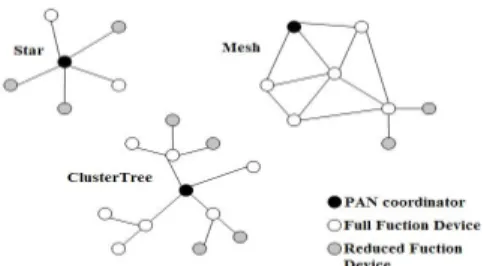
ZigBee router forms the network backbone. The ZigBee terminal unit is connected to the target systems and also connected to the router or coordinator[4]. ZigBee allows three kinds of different network topologies: Star, Tree, and Mesh networks. Fig. 1 shows examples of each topology.
The star topology is possible when there are all the devices within radio range of the coordinator.
In a tree network, the coordinator and routers can announce beacons periodically. Since ZigBee mesh network based on the AODV(Ad Hoc Ondemand Distance Vector) routing protocol does not require regular beacon, devices can communicate with each
other in peer-to-peer manner. Unlike other topologies, the tree routing protocol makes it possible to make an energy efficient network with low routing cost. Therefore, most ZigBee home automation networks prefer to construct ZigBee network with tree topology[4].
Fig. 1 Topologies supported by ZigBee The main technical features of ZigBee include :
1) Low power :
In the low-power standby mode, One pair of V Batteries can support a node to work 6 to 24 months, or even longer, which is one of the outstanding advantages of ZigBee.
2) Low cost :
Simple protocol and less demanding on the communications controller greatly reduce the cost of ZigBee, the price of each chip is about two dollars, and the ZigBee protocol is royalty-free. The frequency band 2.4GHz 2 868MHz (Europe) and 9I5MHz (the U.S.A) which ZigBee uses are license free frequency bands.
3) Low rate :
ZigBee works in a lower rate of 20~250kbps,
according to the different frequency bands where it
is, respectively supplies 250kbps (2.4GHz), 40kbps
(9I5MHz) and 20kbps (868MHz) of the raw data
throughput to meet the low-speed transmission data
applications.
4) Short latency :
ZigBee respond faster, in general from the sleep state into the work of just need I5ms, the node to connect into the network just need 30ms, further saving energy.
5) Large network capacity, network flexibility:
ZigBee can use star, tree, mesh network str- ucture, composed of up to 65,536 nodes in large networks. Mesh network architecture has the features of automatic configuration, automatic hea- ling and small interference, particularly suitable for home systems.
6) High security :
ZigBee provides three security models, including non-security settings, use the intervention control list (ACL) to prevent illegal access to data and the use of Advanced Encryption Standard (AES 128) of the symmetric cipher, in order to determine its security properties flexibly.
In the technology of ZigBee, its structure through layers to quantitate its each simplified standard.
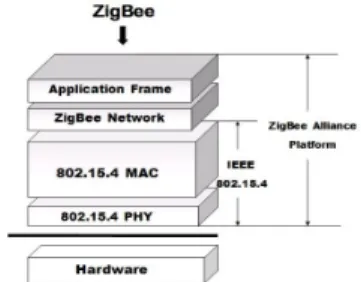
Every layer is responsible for completing its task and offering service for its upper layer, and interfaces among this layers offer services through definited logic links. The protocol layer structure of ZigBee technology is composed of three layers, while the systematical constructure four layers(Fig.
2) : PHY layer, MAC layer, Network layer and application frame layer[5].
Fig. 2 IEEE802.15.4/ZigBee protocol stack architecture
1) PHY Layer :
The IEEE 802.15.4 standard defines three frequency bands: 2.4GHz and 868/915 MHz dual PHY modes. All of these are based on direct sequence spread spectrum (DSSS) spreading tech- nique which has an advantage in that their wide channel filters. Generally speaking, raw data rates of 250 kbps can be achieved at 2.4 GHz(16 channels), 40 kbps at 915 MHz(10 channels) and 20kbps at 868 MHz(1 channels). We will focus on the 2.4GHz bands which is now recognized to be a global band, accepted in almost all countries.
2.4GHz band is attributed to a higher-order mod- ulation scheme. On the other hand, it facilitates access to high throughput and low latency for low dutycycle applications because of higher rate. The lower 868/915 MHz band is applicable in areas of North America, Europe, Australia and New Zealand.
Because of these two frequency bands with low propagation losses, they can be translated into better sensitivity and larger coverage area. The Physical data services include the following five aspects of function:
• Activation and deactivation of the radio tran- sceiver
• Receiver energy detection (ED)
• Link Quality Indication (LQI)
• Clear Channel Assessment (CCA)
• Sending and Receiving Data
2) MAC Layer :
The MAC layer of the IEEE 802.15.4 is in charge of the following tasks:
• Network beacon transmitted by network coordinator
• Synchronization with the beacon
• Support Personal Area Network (PAN) asso- ciation and disassociation
• Support for safety of plant
• A slotted CSMACA mechanism used by channel
access
• GTS management.
• Providing a reliable communication links between two MAC entity of equals.
3) Network Layer :
Most of the new technology development has been brought about the network layer. The responsibilities of the ZigBee network layer includes the usual tasks of network start-up, associating, dissociating, address assignment to devices, secu- rity, frame routing, etc. In addition, multiple network topologies are supported by the network layer. Also through the use of ZigBee routers, it achieves more efficient routing, involving in using multiple intermediate relay devices within the network. Network layer will mainly consider technology-based ad hoc network protocols, it is responsible for:
• Common network layer functions: constructed and maintenance of topological structures, naming and associated business, which including the add- ressing, routing and security.
• Electricity-saving as well as IEEE802.15.4 sta- ndard.
• A suite of technologies to enable scalable, selfo- rganizing, self-healing networks that can min- imize consumer spending and maintenance costs.
Ⅲ. Smart Home Network Hardware Design
Fig. 3 Smart Home System hardware structure
System hardware structure as shown in Fig. 3:
The ARM controller's main functions are operating date input and output I/O port and other parts, at the same time, achieving the acceptance and transmission of ZigBee date transmission and 3G Network communication and other functions. The- refore, the system need to choose more gen- eral-purpose I/O port and rich external resources for being easy to build chips of peripheral circuits.
Fig. 4 PXA27x series Processor Block Diagram
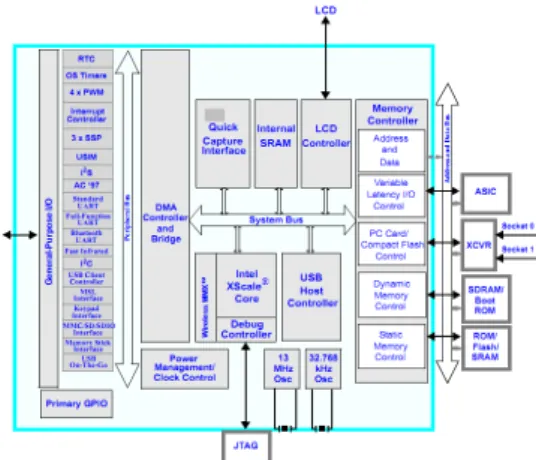
ARM master module is composed of the ARM controller, FLASH, SDRAM and related peripheral circuits. We select Intel Corporation PXA27x series as the system's processor(Fig. 4), PXA27x series[17]
based on the embedded processors ARMv5E Xscale
core, low-power, high performance(the highest fre-
quency is up to 624 MHz), very suitable for
embedded product development. With LCD controller,
3-channel UART, 4-channel DMA, IIC and SPI bus
interface, General-purpose I/O port, one USB host
interface and two USB device interface and other
resources. These resources based on PXA270X can
meet overall system requirements for the pro-
cessor[17].
Fig. 5 Control terminals software structure
In fact we use mobile phone to control an ARM architecture of controller, this controller also runs a transplant independent research and development of the Linux operating system. The operating system is the whole intelligence lives in the central part of the control system.
Software of the whole system uses the ARM architecture. Control terminal is the server because it provides service, and the phone or computer of the user is the client. The software structure of control terminal was shown in Fig. 5. It consists of hardware driver layer founded on hardware, operating system layer and application layer.
Hardware driver layer including 3G module driver, ZigBee module driver, and so on. The operating system layer adopted embedded Linux operating system, as Linux is open source operating system, and convenient to transplantation and development, and has the TCP/IP protocol stack. The Application layer transplant embedded ARM server Linux ope- rating system.
Ⅳ. Implementation of Smart Home Netwrok System
For we will tell the system, we selected the Qt as our software development tools, it is nokia programming a cross-platform c++ graphical user interface application framework. It provides to the application developers to build art graphic user interface used for function. Qt is completely object oriented, it is easy to expand, and allow really
component programming. Qt is also popular Linux desktop environment KDE foundation. Qt with excellent cross-platform characteristics, object- oriented, rich API, a lot of the development of documents, etc. At present in a variety of system software development can see his shadow. The product of famous for: Google earth (3 d virtual map software), Opera (famous web browser).
For commercial intelligent household system installed hardware, the system electricity, the kernel logo image in within about a minute or so, at this time with as shown in Fig. 6.
Fig. 6 About one minute of welcome interface
Eventually into our user interface, said system startup success, at this time with interface for :
Fig. 7 Graphic user interface
Through the controller user interface to moni-
toring sensor state, operation control type equi-
pment, video monitoring, data storage, and other
functions, the user interface including: community
interface, environmental interface, video interface,
history interface, set interface in Fig. 7.
Theme for main source window, CPP, of which the main code is for main window is set, the ministry branch at all levels of the interface to call.
SingleSwipeGestureRecognizer *pSingleSwipeGestureRecognizer;
CMainFrame *pMainFrame;
void IVIInit(bool *pStartMessageLoop) {
QTextCodec *codec = QTextCodec::codecForName("gbk");
QTextCodec *codec2 = QTextCodec::codecForName("utf8");
QTextCodec::setCodecForLocale(codec2);
QTextCodec::setCodecForCStrings(codec2);
QTextCodec::setCodecForTr(codec);
QFont font("simhei");
pSingleSwipeGestureRecognizer = new QSingleSwipeGestureRecognizer();
SingleSwipeGestureID=QGestureRecognizer::registerRecog nizer(pSingleSwipeGestureRecognizer);
DOL_INIT();
IVIDeviceManagerInit();
pMainFrame = new CMainFrame();
pMainFrame->setFont(font);
new Home(pMainFrame);
new CPageEnvironment(pMainFrame);
new Muti_video(pMainFrame);
new History(pMainFrame);
new Setting(pMainFrame);
new CPageWarn();
pMainFrame->show();
*pStartMessageLoop = true;
}
Ⅴ. Conclusion
On the basis of current smart home system, we add new zigbee technology, to improve the real- time of data maximally. The current information collection and wiring structure of the sensors are mature. Our thought is let the user comprehend his home environment and the situation of the olds and the kids without geographic restriction, to humanize the home environment. This requires the technology of real-time. Fluent video transformation, accuracy of the information, safety of the whole network
information, stability of the equipments, those are all what we should consider about. So that we could build a highly efficient residence facility and home affairs control system, improve the safety, convenience, comfort and aesthetic feeling of the home living, and finally achieve the environmental protection and energy saving of living condition.
This would compose the most popular smart home system, and fill our lives with high intelligence.
REFERENCES
[1] Xiang Gao and Li Zhao, "Research and Design of Smart Home System Based on Zigbee Technology", Artificial Intelligence and Computational Intelligence (AICI), Vol. 2, pp.290-293, Oct. 2010.
[2] Dongmei Yan, "ZigBee-based Smart Home System Design", Inf. Sci. & Technol. dept.
Tianjin Univ. of Finance & Econ., Vol. 2, pp.
650-653. Aug. 2010.
[3] Kwangil Hwang, ByoungJo Choi and Seokhoon Kang, "Enhanced self-configuration scheme for a robust ZigBee-based home automation", Consumer Electronics, Vol. 56, pp. 583–590, July 2010.
[4] Gao Mingming, Shaoliangshan, Huixiaowei and Sunqingwei, "The System of Wireless Smart House Based on GSM and ZigBee", Vol. 3, pp. 1017-1020, Oct. 2010.
[5] SiYou Xiao, Xuan Zhang, "Research on Key Technologies of Building Home Control Based on the Wireless Network", 2010 10th IEEE International Conference on Computer and Information Technology(CTT 2010), pp. 2222–
2227, Oct. 2010.
[6] 이태웅, 손철수, 김원중, “스마트 폰을 이용한 지능형 홈 네트워크 시스템 구현”, 한국전자통 신학회논문지, 6권, 4호, pp.505-509, 2011.
[7] 장용재, 박경욱, 이성근, “스마트 폰 기반 홈 자
동제어시스템 설계 및 구현”, 한국전자통신학회
논문지, 6권, 4호, pp.589-594, 2011.
저자 소개
유단(Liu-Dan)
2009년 7월 베이징 석유 화공대학 전자통신공학과 졸업(공학사) 2010년 9월 전남대학교 대학원 컴퓨터공학과(석사과정)
※ 관심분야 : 컴퓨터 네트워크, 실시간 통신 프 로그래밍, 스마트 미디어, 프로그래밍 언어 (Visual C++, Java) 등
김광준(Gwang-Jun Kim)
1993년 2월 조선대학교 컴퓨터공 학과 졸업(공학사)
1995년 2월 조선대학교 대학원 컴 퓨터공학과 졸업(공학석사) 2000년 2월 조선대학교 대학원 컴퓨터공학과 졸업 (공학박사)
2000년~2001년 Dept. of Electrical & Computer Eng.
Univ. of California Irvine Postdoc.
2003년 3월~현재 전남대학교 컴퓨터공학과 조교수
※ 관심분야 : 가상화, ATM망, 인터넷 통신, 컴퓨터 네트워크, 실시간 통신 프로그래밍, 영상 처리 및 통신, 프로그래밍 언어(Visual C++, Java), 의료정 보통신 등
이진우(Jin-Woo Lee)