Short communication KOREAN JOURNAL OF APPLIED ENTOMOLOGY
한국응용곤충학회지 ⓒ The Korean Society of Applied Entomology
Korean J. Appl. Entomol. 56(1): 77-81 (2017) pISSN 1225-0171, eISSN 2287-545X
DOI: https://doi.org/10.5656/KSAE.2016.11.0.069
Morphological Characteristics of Thecodiplosis japonensis (Diptera:
Cecidomyiidae) Larvae in Pine Forests Around Onsan Industrial Complex in Ulsan, Korea
Chong-Kyu Lee*
Department of Forest Resources, Gyeongnam National University of Sciences and Technology, Jinju 52725, Korea
공단지역 주변 소나무림의 솔잎혹파리 형태적 특성
이총규*
경남과학기술대학교 산림자원학과
ABSTRACT: The results from our investigation showed differences in pine needle damage by Thecodiplosis japonensis Uchida et Inouye and indicate serious environmental pollution caused by a petrochemical industrial complex. The gall formation rate by T. japonensis near the industrial complex was 47.94% compared to 9.94% in the site farthest from the complex. The average length of pine needles damaged by T. japonensis near the industrial complex and farthest site were 4.5 cm and 4.9 cm, respectively. The average number of larvae in pine needle galls near the industrial complex and farthest site were 3.4 and 2.4, respectively. The average body length and width of fullgrown larvae near the industrial complex were 2.40 mm and 0.7 mm, respectively, whereas larvae in the site farthest from the complex were 2.45 mm in length and 0.71 mm in width.
Key words: Environmental pollution, Thecodiplosis japonensis, Gall formation rate, Industrial complex, Fullgrown Larvae
초 록: 환경오염원으로부터 지역별 솔잎혹파리 피해도의 차이를 조사하기 위하여 실시한 결과, 솔잎혹파리 충영형성율은 석유화학공단에 의한 환 경오염이 심각한 상황에 있는 공단지역은 충영형성률 47.94%이었고, 대조지역은 9.94%였다. 솔잎혹파리 피해엽은 공단지역 피해엽의 길이는 평균 4.5 cm 였으며, 대조지역은 평균 4.9 cm 이었다. 솔잎혹파리 피해엽의 충영내 유충의 수는 공단지역은 평균 3.4개체이었고, 대조지역은 2.4개체 이 었다. 성숙유충의 크기는 공단지역이 유충체장은 2.40 mm, 체폭은 0.7 mm 이었으며, 대조지역의 유충체장은 2.45 mm, 체폭은 0.71 mm 이었다.
검색어: 환경오염, 솔잎혹파리, 충영형성율, 공업단지, 노숙유충
*Corresponding author: [email protected]
Received October 20 2016; Revised November 21 2016 Accepted December 20 2016
Thecodiplosis japonensis Uchida et Inouye mainly inhabits Korea and Japan. In Korea, population outbreaks of this insect were first recorded in 1929 in Biwon, Seoul, and Mokpo basin, Jeollanam-do (Takagi et al, 2003). These two areas have become the distribution sources of T. japonensis, and its outbreaks have expanded throughout Korea.
Thecodiplosis japonensis forms galls on the needles of Korean
red pines and Japanese black pines, impeding the growth of new branches and causing damaged needles to die within the infected year. In the case of black pines, the needles remain on the trees until the next year, reducing the quantity of food assimilation, thus hindering plant growth and vigor, and resulting in the occurrence of secondary harmful insects (Yim et al, 1981).
Many studies have been conducted on T. japonensis including its life cycle, ecology, and control strategies in Korea and other countries. Studies have investigated morphological features of dead and alive trees (Jeong and Hyun, 1986). Gall formation
This is an Open-Access article distributed under the terms of the Creative Commons Attribution Non-Commercial License (http://creativecommons.org/licenses/by-nc/3.0)
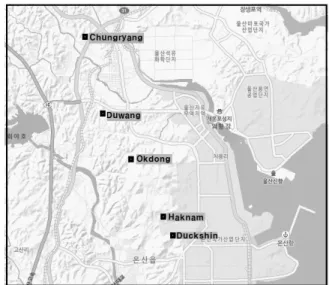
Fig. 1. Survey of Site rate of T. japonensis has been reported to increase rapidly for
six to 12 generations in newly invaded areas (Park and Hyun, 1983). As a result, pine growth decreases, leading to mortality, and decreases in tree densities. In addition, the initial and recovery periods of T. japonensis have been compared within and between generations, and it was reported that differences in larval stages of each region were caused by larval death and a parasitic bee (Lee, 1986). Ecological variation among populations of T. japonensis in southern and northern areas of Korea, such as Mooan of Jeonnam and Hoingseong of Gangwon (Hwang and Yim, 1990), indicated that genetic differen- tiation has occurred across 60 generations of T. japonensis. A study on population dynamics of T. japonensis indicated that decreases in the death rate within the entire population under the same ecological conditions was 23.1% during the warm period, 14.2% inside the gall , 25.0% during the underground period before wintering, and 52.9% and 32.0%, respectively, during the prepupal and pupal periods; changes in soil water content were most important to T. japonensis mortality. Further- more, as the amount of damage by T. japonensis increased, the emergence rate and size of their larvae decreased (Park and Hyun, 1977).
In nature, insects exist as a part of biotic community and different environmental factors can cause variations in their evolution. Plant damage caused by pollutants has been shown to influence the ecological adaptation of insects in a report on environmental biological indicators (Jeong and Hyun, 1986).
Air pollution caused by petrochemical industry also can affect crops and forests and has become a serious social issue.
Furthermore, studies have reported that plant production varies with proximity to pollution sources (Kim, 1988). Thus, the distribution of T. japonensis around an industrial complex may provide insight into T. japonensis damage on trees.
Accordingly, this study was conducted to investigate the relationships between gall formation rates of T. japonensis and air pollutants of the Onsan industrial complex of Ulsan. Sites were selected according to their distance from the pollution source (i.e., Onsan industrial complex) to investigate the habitat distribution of T. japonensis to provide basic information for future insect control.
Materials and Methods
Site selection
Ulsan Duckshin, Ulsan Haknam, Ulsan Okdong, Ulsan Duwang, and Ulsan Chungryang were selected as investigation areas according to their distance from industrial factories around the Ulsan petrochemical industrial zone. These sites were divided into three sub-areas of pine forest to investigate the level of damage caused by T. japonensis (Fig. 1).
T. japonensis and pine needle measurements
Gall formation rates of T. japonensis were compared among sites to investigate the damage level to pine needles. Five trees were randomly selected from each sub-area, for a total of 15 trees per site. In addition, between 2015 and 2016, the sites were classified into up and down, and two new trees were randomly collected in four directions. The rate of gall formation was calculated from the total number of needles.
Two hundreds new needles in each site were randomly collected from pine trees with symptoms of T. japonensis damage in 2015 and 2016, and the length of the needles was measured using calipers. The size (i.e., body length and width) of 50 escaped larvae per site and the number of larvae inside 30 gall damaged needles per site were measured using a stereoscopic microscope.
Table 1. Gall formation rate of T. japonensis by year and site
2015 2016
Site No. of
samples
No. of gall-formed pine needles
Gall formation rate(%)
No. of samples
No. of gall-formed pine needles
Gall formation rate(%)
Ulsan Duckshin 1997 927 46.42 1942 931 47.94
Ulsan Haknam 2997 952 37.77 2242 739 32.96
Ulsan Okdong 3167 782 24.69 2825 657 23.26
Ulsan Duwang 3202 637 19.89 2707 535 19.76
Ulsan Chungryang 2247 246 10.95 1972 196 9.94
Table 2. Comparison on damaged and healthy needles among site
Site Ulsan Duckshin Ulsan Haknam Ulsan Okdong Ulsan Duwang Ulsan Chungryang Length of damaged
needles (cm)
4.5/
3.7-5.5
4.6/
3.9-5.9
4.6/
3.9-6.4
4.7/
3.8-5.7
4.9/
4.3-6.5 Length of healthy
needles (cm) 9.2 9.3 9.3 9.9 10.5
Results and Discussion
Gall formation rates of T. japonensis
Site environmental included various chemical industries around Ulsan coastline. Although there were hills inland, pollutants emitted from high chimneys can be distributed broadly without barrier. Sea and land winds were interchanged during the day and night due to the sea, so the temperature range did not fluctuate compared to farther inland. The main winds blew in a southeastern direction, from the sea to inland, and therefore should have been affected directly by pollutants.
The average diameter at breast height and height of the pine trees were 15-20 cm and 6-9 m, respectively, and the age of the pine trees was 25-35 years old. The gall formation rate of T.
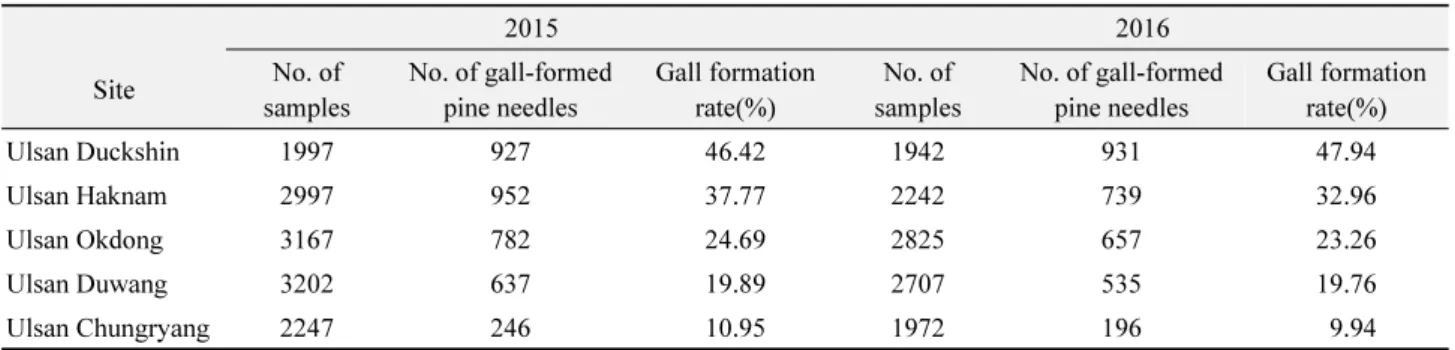
japonensis from this study indicated that gall formation rate in the area near the Onsan industrial complex was higher than in areas farther from the complex after 35 years of production (Table 1).
As shown in Table 1, gall formation rates of T. japonensis in Ulsan Chungryang, the site with lowest level of environmental pollution, was 10.95 and 9.94, respectively, for 2015 and 2016.
These rates were lower than the gall formation rates of Ulsan Duckshin (46.42%, 47.94% for 2015 and 2016, respectively), Ulsan Haknam (37.77%, 32.96%), Ulsan Okdong (24.69%,
23.26%), and Ulsan Duwang (19.89%, 19.76%), in which air pollution caused by petrochemical industrial complex was higher. Gall formation rate of T. japonensis has been found to increase as the distance from pollutants decreases. Accordingly, these findings seem to be the result of stoma damage, destruction of the wax layer on pine needles, and soil acidification due to air pollution and acid rain caused by petrochemical industrial complexes (Seo et al., 1995; Bae et al., 1987; Han, 1984). Pine trees also are very sensitive to air pollution; high levels of pollution can cause physical deterioration of the soil, resulting in decreased tree health and reproduction (Park and Hyun, 1983). Therefore, as pine resistance to disease and insect pests decrease, T. japonensis outbreaks occur. In addition, damage caused by T. japonensis in sites with high levels of nitrogen and calcium (including areas surrounding industrial complexes, dump, and filled ground) has increased recently. Gall formation rates also have increased as a result of increased in habitat for T. japonensis caused by sulfur and nitrogen oxides, which are pollutants emitted from petrochemical industries.
Pine needle damage by T. japonensis by site
There were not large differences in the lengths of healthy needles and needles damaged by T. japonensis between early July, when galls started to form, and the middle of October, when imago growth of T. japonensis was completed (Table 2).
Table 3. The number of larvae per gall by site
Site Ulsan Duckshin Ulsan Haknam Ulsan Okdong Ulsan Duwang Ulsan Chungryang No. of larvae per gall 3.4/
1-6
3.2/
1-6
2.8/
1-5
2.4/
1-5
2.4/
1-4 Table 4. Larval size of T. japonensis by site
Site Ulsan Duckshin Ulsan Haknam Ulsan Okdong Ulsan Duwang Ulsan Chungryang Standard Deviation Body length
(mm) 2.40 2.42 2.41 2.43 2.45 0.019
Body width
(mm) 0.70 0.71 0.71 0.70 0.71 0.001
Damaged needles do not grow once a gall is formed in the basal end of the needle (Ko, 1968). In the present study, accordingly, new plant part with damaged symptom on pine tree for the last two years have been collected and the lengths of healthy and damaged leaves have been measured. The results indicated that the average lengths of damaged and healthy needles at Ulsan Duckshin were 4.5 cm (49.9%) and 9.2 cm, respectively. Furthermore, the average lengths of damaged and healthy needles of Ulsan Chungryang, the site farthest from the industrial complex, were 4.9 cm (47.6%) and 10.5 cm, respectively, indicating differences between the sites nearest and farthest from the industrial complex. A previous report did not find distinct differences in the lengths of damaged or healthy leaves according to distance from the industrial complex (Hwang and Yim, 1990). However, this study found a 0.9 time difference in the lengths of damaged needles according to the distance from the source of environmental pollution. This difference in damaged needle lengths may have occurred as a result of the deterioration of pine trees caused by T. japonensis damage (Table 2).
Number of larvae inside gall damaged pine needles
The average number of larvae in damaged pine needles was 3.4 per gall in Ulsan Duckshin and 2.4 in Ulsan Chungryang (Table 3), thus the number of larvae per gall in damaged needles of T. japonensis within the site close to industrial complex was 0.7 times higher than the site farthest from the complex. This result indicates that the needles of pine forest, of which resistance is very low due to environmental pollution
caused by industrial complex, seems to be a good habitat for larvae of T. japonensis. Furthermore, this result is very similar to previous studies that found higher densities of T. japonensis in pine forests where environmental pollution had increased (Ferrell, 1980; Kim et al., 1985) (Table 3).
Size of mature larvae within gall damaged pine needles
Under laboratory conditions, larvae inside gall-damaged needles were induced to leave the galls, and the size of mature larvae was calculated by site. Under laboratory conditions, larvae inside gall-damaged needles were induced to leave the galls, and the size of 50 mature larvae was calculated by site using a stereoscopic microscope (Table 4). Comparison of larval sizes between the site near the industrial complex and the site farthest from the complex (Table 4) indicated that body length and width were 2.40-2.55 mm and 0.70-0.72 mm, respectively, and there were no differences in fullgrown larval sizes between different sites (Table 4).
Acknowledgments
This work was supported by Gyeongnam National University of Science and Technology Grant 2016.
Literature Cited
Bae, W.I., Byun, B.S., Yeom, Y.C., 1987. A study on forecasting of occurrence of major forest harmful insects (I), forecasting on change in density of population Thecodiplosis japonensis. J. of Forest Science Institute. 34, 142-148.
Ferrell, G. T. 1980. Risk-rating systems for mature red fir and white fir in northern Californua. USDA Forest Service. General Technical Report PSW(39). pp. 29-32.
Han, M. W., 1984. Biological features of Korean Thecodiplosis japonensis according to location. Master’s degree thesis. Seoul National University. Korea. pp. 45-50.
Hwang, Y.C., Yim, K.B., 1990. Ecological variation between two populations of Thecodiplosis japonensis in Korea. J. Korean For.
Soc. 79(2), 115-126.
Jeong, Y.J., Hyun, J.S., 1986. Studies on the major factors affecting the population of the overwintered pine needle gall midge, Thecodiplosis japonensis. Kor. J. of Plant Prot. 25(1), 1-9.
Kim, J.B., Kim, D,H., Bae, J.G., Park, J.S., Nam, H.O., Cho, S.M., 1985. Impacts of air pollution on plants(II). Nat’l Ins. of Environ.
Res. 7, 353-370.
Kim, J.K., 1988. Impacts of air pollution on forests, focusing on Maesongrim of Onsan Industrial Complex. Master’s degree thesis. Gyeongsang National University. Korea. pp. 4-20.
Ko, J.H., 1968. An ecological study on Thecodiplosis japonensis(2), summer felling period and damage distribution. J. Korean For.
Soc. 7, 40-44.
Lee, B.Y., 1986. Population dynamics of Thecodiplosis japonensis.
Doctor’s Thesis, Kyung Hee University, pp. 110-111.
Park, K.N., Hyun, J.S., 1977. Population dynamics of Thecodiplosis japonensis. J. Korean For. Soc. 24, 91-107.
Park, K.N., Hyun, J.S., 1983. Impacts of Thecodiplosis japonensis on growth of pine tree(I), change in gall formation rate. J. Korean For. Soc. 61, 20-26.
Seo, J.B., Jin, B.R., Shin, S.C., Park, H.O., Lee, B.Y., Lee, C.K., Seok K.K., 1995. Isolation of entomopathogenic fungi for infection to the pine gall midges, Thecodiplosis japonensis from the forest soil in Korea. Korean J. Appl. Entomol. 34(4), 368-372.
Takaki, K., Suzuki, T., Kawazu, K., 2003. Development and preventative effect against pine will disease of a novel liquid formulation of emamectin benzoate. Pest Manag Sci. 59, 365-370.
Yim, K.B., Lee, K.J., Park, I.H., 1981. Ecological changes of insect-damaged Pinus densiflora stands in the southern temperature forest zone of Korea(II). J. Korean For. Soc. 54, 49-59.