Evaluation in Physiomechanical Characteristics of Carbonized Oriented Strand Board by Different Carbonizing Conditions 1
Min Lee
2⋅Sang-Bum Park
2†⋅Sang-Min Lee
2⋅Dong-Won Son
2ABSTRACT
Environmental issues about indoor air quality have been increased and focused on volatile organic compounds (VOCs) caused cancer, asthma, and skin disease. Reducing VOCs has been attempted in many different methods such as using environmentally friendly materials and air cleaner or purifier. Charcoal is well known material for absorbing VOCs.
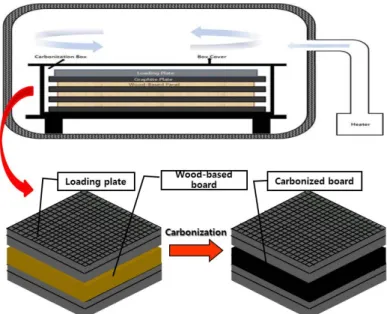
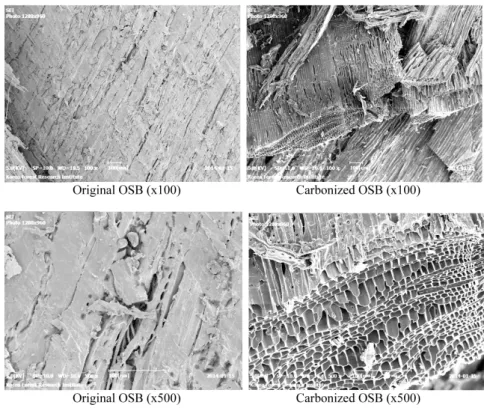
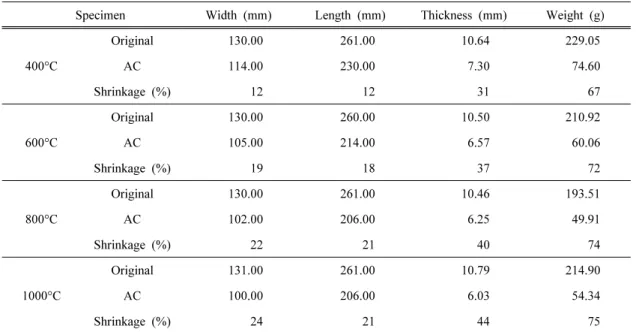
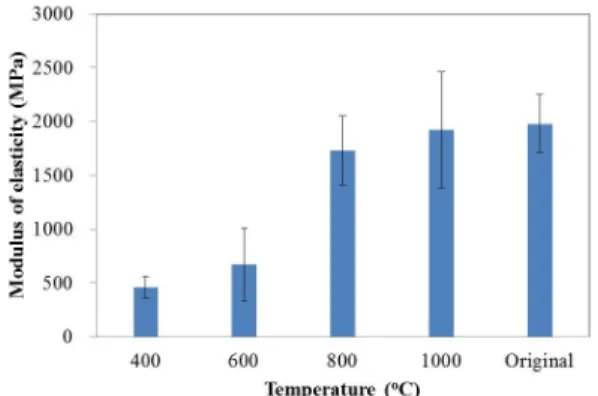
Therefore, carbonized board from medium density fiberboard has been developed. We assumed that the source of car- bonized boards can be any type of wood-based panels. In this study, carbonized boards were manufactured from ori- ented strand board (OSB) at 400, 600, 800, and 1000°C. Each carbonized OSB (c-OSB) was evaluated and determined physiomechanical characteristics such as exterior defects, dimensional shrinkage, modulus of elasticity, and bending strength. No external defects were observed on c-OSBs at all carbonizing conditions. As carbonizing temperature in- creased, less porosity between carbonized wood fibers was observed by SEM analysis. The higher rate of dimensional shrinkage was observed on c-OSB at 1000°C (66%) than c-OSB at 400, 600, and 800°C (47%, 58%, and 63%, re- spectively). The densities of c-OSBs were lower than original OSB, but there was no significant different among the c-OSBs. The bending strength of c-OSB increased 1.58 MPa (c-OSB at 400°C) to 8.03 MPa (c-OSB at 1000°C) as carbonization temperature increased. Carbonization temperature above 800°C yielded higher bonding strength than that of gypsum board (4.6 MPa). In conclusion, c-OSB may be used in sealing and wall for decorating purpose without ad- ditional artwork compare to c-MDF which has smooth surface.
Keywords : carbonization, carbonized board, oriented strand board (OSB), bending strength
1. INTRODUCTION 1)
A prime determinant of healthy life is the in- door air quality where people spend a large part of their life (WHO, 2010). The indoor air qual- ity has been received public attention because of its riskiness for human. Among the air pollu-
tants, the volatile organic compounds (VOCs) produced from indoor finishing materials such as medium density fiberboard (MDF), cement- gypsum board, and particle board (PB) can cause many health issues. Recently, people increase to spend time mostly in indoor area, so they have more chance to be exposed to hazardous sub-
1
Received February 12, 2013; accepted March 6, 2014
2
Department of Forest Products, Korea Forest Research Institute, Seoul, Korea
†