Effect of 12 Weeks Combined Exercise and Nutrition Education on Body Composition, Liver Function, Serum Lipids and Insulin Resistance in Obese Middle-aged Woman
Hae-Yeol Kim1, Yi-Sub Kwak2, Gi-Dong Sung1, Won-Mok Son1, Do-Yeon Kim1 and Yeong-Ho Baek1*
1Department of Physical Education, Pusan nstional University, Busan 46241, Korea
2Department of Physical Education, Dong-Eui University, Busan 47340, Korea
Received April 4, 2017 /Revised June 12, 2017 /Accepted June 28, 2017
This study investigated the effect of 12 weeks combined exercise and nutrition education program on body composition, liver function, serum lipids and insulin resistance in obese middle-aged women.
The combined exercise program was performed for 55 minutes 3 times per week during which the intensity progressively increased from RPE 13 to 14, 60-70%HRR (1~5 weeks), RPE 15 to 17, 70-80%
HRR (6~12 weeks) and nutrition education was conducted 20 minutes one day per week. The subjects were 21 obese middle-aged women were composed of the nutrition education group (A, n=7), com- bined exercise group (B, n=7), and the control group (C, n=7). The results of the study in the nutrition education group and combined exercise group were as follows; The A and B group had significantly lower body composition than did the control group. The A group had significantly lower liver func- tion, TC, TG, HDL-C, and HOMA-IR than did the control group. Consequently, combined exercise and nutrition education program effective in preventing diabetes caused by obesity in obese mid- dle-aged woman. On the basis of the results of this study, the following recommendations are made for further studies: additional studies are needed to confirm the results of this study and to compare the effects of combined exercise on these variables in obese and non-obese men and women by age or exercise type; they are also needed to develop effective nutrition education programs for different age groups or body types.
Key words : Combined exercise, insulin resistance, liver function, nutrition education, serum lipids
*Corresponding author
*Tel : +82-51-510-2719, Fax : +82-51-515-1991
*E-mail : [email protected]
This is an Open-Access article distributed under the terms of the Creative Commons Attribution Non-Commercial License (http://creativecommons.org/licenses/by-nc/3.0) which permits unrestricted non-commercial use, distribution, and reproduction in any medium, provided the original work is properly cited.
Journal of Life Science 2017 Vol. 27. No. 7. 817~825 DOI : https://doi.org/10.5352/JLS.2017.27.7.817
서 론
비만은 비정상적으로 과도하게 지방이 축적된 것으로 건강 에 심각한 손상을 초래할 수 있다고 정의하였으며, 전 세계 성인 인구의 약 13%가 비만이라고 보고되고 있다[64]. 우리나 라 전체 인구의 38.8% 비만이며, 특히 중년여성 중 28%가 비만 으로 중년여성의 비만이 해를 거듭할수록 증가 추세에 있다 [46].
이는 중년여성의 신체활동의 부족으로 인한 에스트로겐 분 비 감소가 신진대사 기능을 저하 시키며, 내장지방의 축적을 촉진하여 대사증후군과 심혈관 질환의 유병률을 증가시키고 있다[18].
Glutamate-oxaloacetate transaminase (GOT)와 glutamate pyruvate transaminase (GPT) 활성은 간 기능을 나타내는 대
표적인 지표로, 운동 중 골격근의 분해로 근세포로부터 유리 되어 혈액의 그 활성이 증가하며, 정상인보다 비만인이 높다 고 하였다[4].
비만은 비 알콜성 지방간(non-alcoholic fatty liver disease [NAFLD])과 연관이 있는 독립적인 요인으로[44], 신체활동과 비만에 대한 연구에서 ALT와 Gamma-Glutamyl Transferase (GGT) 수치가 직접적으로 지방간과 높은 상관이 있는 것으로 보고되고 있으며[38], 간기능 효소인 GOP, GPT는 정상인 보 다 비만인이 높게 나타나 비만과 지방간의 밀접한 연관성을 보고하였다[8].
비만은 혈중지질 수준에 영향을 미치며[61], 특히 TG와 LDL- C 농도 증가 및 HDL-C 농도의 감소는 죽상동맥경화증이나 심장질환의 직접적인 원인이 된다[15]. 또한 유산소성 운동과 근력 운동을 병행하는 규칙적인 복합운동의 경우에는 LDL-C, 체지방 감소 및 혈중 지질 농도의 개선 등에 긍정적인 변화를 포함하여 호흡․순환계통 기능을 향상시켜 심혈관계 질환 등 각종 생활습관병을 예방, 치료하는데 효과적인 운동이라 하였 다[14, 31].
비만과 밀접한 연관이 있는 인슐린 저항성은 인슐린 분비에 대한 체내 감수성의 저하로, 표적세포에서의 인슐린 반응을 감소시켜 대사 과정의 부정적인 변화를 일으켜 많은 합병증을
Table 1. Physical characteristics of subjects in each group Variables
Group Age (yrs) Height (cm) Weight (kg) BMI (kg/m2)
A (n=7) B (n=7) C (n=7)
44.29±2.93 43.86±3.63 44.00±2.89
160.90±4.36 165.10±4.63 162.29±3.92
68.96±7.03 68.94±7.21 67.56±11.36
26.79±3.98 25.27±2.20 25.61±3.80 Values are M ± SD.
A: combined exercise program and nutritional education group.
B: combined exercise program group.
C: control group.
유발하는 것으로 알려져 있다[48, 59, 63].
운동이 인슐린 저항성에 미치는 효과에 대해서는 운동 형태 와 기간에 따라서 서로 다른 차이가 있지만 대부분 긍정적인 효과가 있다고 보고되고 있는데[22], 저항성 운동과 유산소 운 동 모두 인슐린 활동을 증가시킨다고 하였다[12].
이러한 비만의 치료 및 예방법으로는 운동요법, 식이요법, 행동 수정요법, 약물 및 수술요법 등 분야별로 다양하다[3].
특히 운동요법 중에서 복합운동은 인체 내 지방을 직접적으로 연소 시키는 유산소 운동과 근력 및 근지구력을 증가 시켜 기초대사량 향상에 도움을 주는 저항운동을 동시에 제공하기 때문에 신체조성에 긍정적인 영향을 미치는 것으로 알려져 있으며[34], 체지방률을 감소시켜 혈관의 염증반응 감소에 영 향을 주어 대사성 질환과 죽상동맥경화와 같은 심혈관 질환의 예방에도 효과적이라고 하였다[19].
선행연구에서 복합운동 실시 후 신체조성[49], 체중, 체지방 률, 체지방량 감소[17], 간기능[33], 혈중지질[5] 및 인슐린 저항 성[35] 개선이 보고되고 있다.
영양교육은 비만을 효과적으로 치료하기 위하여 올바른 식 습관 형성을 통해 영양소 섭취 과다의 조절뿐 아니라 근본적 인 영양문제를 해결하기 위한 식사의 다양성을 고려한 식품, 식품군, 음식의 섭취상태와 선택 방법 등을 구체적으로 제시 해 주는 효과적인 실천 방안으로[36], 생활습관병 등의 문제 발생을 저하 시키는데 기여한다[40, 51].
영양교육을 실시 후 비만개선효과를 본 선행연구로는 중년 비만 여성을 대상으로 4개월간 저열량식과 운동을 실시한 결 과 체중과 체지방의 감소효과가 나타났으며[65], 영양교육 실 시 후 식습관, 식행동 및 영양 태도의 향상과 식생활의 변화를 보였다고 보고하였다[26].
최근 중년여성들의 비만과 관련된 질환들이 대두되고 있으 며, 그에 대한 연구도 활발히 진행되고 있지만 운동참여뿐만 아니라 영양교육에서도 그 중요성이 강조되고 있는 실정이다.
이에 본 연구에서는 복합운동과 영양교육이 중년비만여성 의 신체조성, 간기능, 혈중지질 및 인슐린 저항성의 변화를 알아보고, 비만 중년 여성에게 비만을 예방하고 올바른 식생 활을 위한 영양교육의 기초를 마련하여, 중년 여성의 비만 예 방에 효과적인 영양교육과 운동프로그램의 기초자료를 제공
하고자 한다.
재료 및 방법
연구방법
본 연구는 P대학교 생명윤리위원회의 승인(PNU_2015_89_
HR) 후 B광역시에 거주중인, 체지방률 30% 이상으로 규칙적 으로 운동을 하지 않고, 특정한 질환이 없는 40대 중년여성 중 복합운동 영양교육군(7명), 복합운동군(7명), 대조군(7명)으 로 총 21명을 대상으로 실시하였으며, 연구 대상자의 신체적 특징은 Table 1과 같다.
측정항목 및 방법
피험자들의 신장, 체중, 및 체지방률은 X-CANPLUS Ⅱ (JAWON Medical, PYD0017-070418, Korea)를 이용하여 측정 하였다. 혈액채취를 위해 채혈 전날 오후 8시 이후에는 공복을 유지하였다. 오전 8~10시에 진공 채혈관과 바늘을 이용하여 전완정맥에서 10 ml 혈액을 채취, 원심분리기로 10분간 3,000 rpm에서 원심분리 후 분석 시까지 혈청을 -70℃ 이하에서 냉 동보관 후 분석하였다.
혈액분석
혈중지질에서 TC 및 TG 분석방법은 효소 비색법을 이용하 였고, 검체 방법은 Serum (혈청)에서 검체를 하였다. TC 및 TG는 SIEMENS (Georgia, USA) 사의 시약으로 ADVIA-1650 (Georgia, USA) 자동 생화학 분석기를 이용하여 분석 하였다.
HDL-C 및 LDL-C는 SIEMENS (Georgia, USA) 사의 시약으로 ADVIA-1650 (Georgia, USA) 자동 생화학 분석기를 이용하여 분석하였다. 인슐린저항성은 공복 혈당과 혈중인슐린농도를 이용하여 Homeostasis model assessment for insulin resist- ance(HOMA-IR) 법으로 계산하였다[10].
HOMA-IR = [fasting insulin(nU/ml) × fasting glucose (mg/dl)] / 405
복합운동
복합운동 프로그램은[52]의 운동프로그램을 연구대상자들
Table 2. Weekly plan of combined exercise training program
Weeks Order/Time Exercise Intensity Frequency
Warm-up (5 min) Static stretching
1-5
Main exercise (15 min/set)
∙ Rope-skipping
∙ Push up
∙ V-up
∙ Squat
∙ Narrow push up
∙ Plank
∙ Lunge
∙ Burpee test
×3 set
60-70%HRR (RPE13-14)
3times/
weeks
6-12 70-80%HRR
(RPE15-17)
Cool-down (5 min) Static stretching
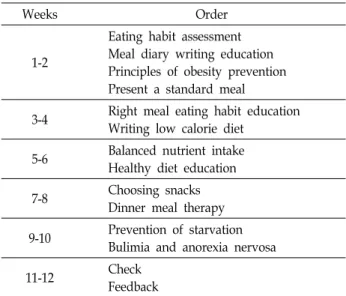
Table 3. Program used for the nutritional education in this study
Weeks Order
1-2
Eating habit assessment Meal diary writing education Principles of obesity prevention Present a standard meal
3-4 Right meal eating habit education Writing low calorie diet
5-6 Balanced nutrient intake Healthy diet education
7-8 Choosing snacks
Dinner meal therapy 9-10 Prevention of starvation
Bulimia and anorexia nervosa
11-12 Check
Feedback 설정에 맞도록 수정・보완하여 적용하였으며, 상체와 하체로
운동 부위를 나누어 맨손운동 7종목과 줄넘기를 1-5주는 40초, 6-12주는 50초 동안 반복하고 다음 종목으로 넘어가는 서킷트 방식을 실시하였다. 운동시간은 준비운동 5분, 본 운동 15분, 정리운동 5분으로 구성하여 3세트 총 55분으로 실시하였으며, 운동강도는 운동자각도(RPE : rating of perceived exertion)를 이용하여 1-5주는 13-14, 6-12주는 15-17 수준으로 실시하였다.
또한 운동 중 심박수 계측기기인 손목 시계형 POLAR (Polar RS400sd, APAC, USA)를 통해 심박수 변화량을 측정하여 1-5 주는 60-70%HRR, 6-12주는 70-80% HRR 설정하였다. 복합운 동 프로그램의 내용은 Table 2와 같다.
영양교육
영양교육은 G군 보건소에서 근무하고 있는 영양사를 통하 여 영양교육프로그램을 실시하였으며, 매주 1회 20분씩 영양 교육과 개별상담으로 나누어 실시하였다. 영양교육프로그램 의 내용은 Table 3과 같다.
자료처리
본 연구의 자료처리는 SPSS 23.0 Ver을 이용하여 측정 항목 에 대한 평균값(M)과 표준편차(SD)를 산출하여 실험 전·후의 항목별 평균값 차의 비교를 위해 집단 내에는 paired t-test를 실시하였으며, 집단 간 변화율의 차이를 알아보고자 %diff 값 을 산출하여 One-way ANOVA를 사용하였다. 사후검증은 Duncan-test를 실시하고, 각 항목별 통계적 유의수준은 a = .05 설정하였다.
결 과
신체조성의 변화
복합운동과 영양교육 후 신체조성의 변화는 Table 4와 같 다. 체지방량은 집단 내 복합운동 영양교육군과 복합운동군이 유의하게 감소하였고(p<0.01), 집단 간 복합운동 영양교육군 과 복합운동군이 대조군에 비해 유의하게 감소하였다(p<
0.01). 제지방량은 집단 내 복합운동 영양교육군이 유의하게 감소하였고(p<0.05), 집단 간 복합운동 영양교육군과 북합운 동군이 대조군에 비해 유의하게 증가하였다(p<0.05).
간기능의 변화
복합운동과 영양교육 후 간기능의 변화는 Table 5와 같다.
GOT는 집단 내 복합운동 영양교육군이 유의하게 감소하였고 (p<0.05), 집단 간 복합운동 영양교육군이 대조군에 비해 유의 하게 감소하였다(p<0.01). GPT는 차이가 없었다.
혈중지질의 변화
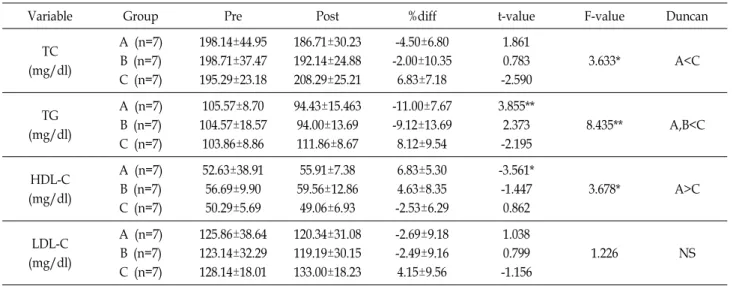
복합운동과 영양교육 후 혈중지질의 변화는 Table 6과 같 다. TC는 복합운동 영양교육군이 대조군에 비해 유의하게 감 소하였다(p<0.05). TG는 집단 내 복합운동 영양교육군이 유의 하게 감소하였고(p<0.01), 집단 간 복합운동 영양교육군과 운 동군이 대조군에 비해 유의하게 감소하였다(p<0.01).
HDL-C은 집단 내 복합운동 영양교육군이 유의하게 감소하
Table 4. Changes of body composition within each group
Variable Group Pre Post %diff t-value F-value Duncan
%BF (%)
A (n=7) B (n=7) C (n=7)
33.97±3.81 32.53±2.37 32.10±4.81
31.49±4.01 31.51±2.48 32.96±4.57
-7.42±4.99 -3.13±2.17 3.13±4.53
4.186**
3.922**
-1.566
9.558** A,B<C
LBM (kg)
A (n=7) B (n=7) C (n=7)
44.90±1.74 46.84±3.85 45.43±5.57
45.70±2.11 47.27±4.44 44.57±4.52
2.93±1.81 0.85±2.32 -1.68±2.31
-2.605*
-0.981 1.881
4.778* A,B<C
Values are M ± SD.
A: combined exercise program and nutritional education group B: combined exercise program group
C: control group
*p<0.05, **p<0.01
Table 5. Changes of liver function in each group
Variable Group Pre Post %diff t-value F-value Duncan
GOT (U/L)
A (n=7) B (n=7) C (n=7)
18.29±5.99 15.57±6.78 18.71±3.15
15.00±4.12 14.00±5.89 19.14±3.58
-15.92±13.63 -8.04±16.12
2.20±5.06
2.969*
1.616 -1.162
3.676* A<C
GPT (U/L)
A (n=7) B (n=7) C (n=7)
14.86±2.79 14.86±4.95 12.71±2.29
14.00±2.45 14.29±2.63 13.29±2.21
-5.21±10.24 0.14±15.20
4.92±7.72
1.441 0.525 -1.549
1.362 NS
Values are M ± SD. NS: non-significant
A: combined exercise program and nutritional education group B: combined exercise program group
C: control group
*p<0.05,
Table 6. Changes of blood lipid in each group
Variable Group Pre Post %diff t-value F-value Duncan
TC (mg/dl)
A (n=7) B (n=7) C (n=7)
198.14±44.95 198.71±37.47 195.29±23.18
186.71±30.23 192.14±24.88 208.29±25.21
-4.50±6.80 -2.00±10.35
6.83±7.18
1.861 0.783 -2.590
3.633* A<C
TG (mg/dl)
A (n=7) B (n=7) C (n=7)
105.57±8.70 104.57±18.57
103.86±8.86
94.43±15.463 94.00±13.69 111.86±8.67
-11.00±7.67 -9.12±13.69 8.12±9.54
3.855**
2.373 -2.195
8.435** A,B<C
HDL-C (mg/dl)
A (n=7) B (n=7) C (n=7)
52.63±38.91 56.69±9.90 50.29±5.69
55.91±7.38 59.56±12.86
49.06±6.93
6.83±5.30 4.63±8.35 -2.53±6.29
-3.561*
-1.447 0.862
3.678* A>C
LDL-C (mg/dl)
A (n=7) B (n=7) C (n=7)
125.86±38.64 123.14±32.29 128.14±18.01
120.34±31.08 119.19±30.15 133.00±18.23
-2.69±9.18 -2.49±9.16 4.15±9.56
1.038 0.799 -1.156
1.226 NS
Values are M ± SD. NS: non-significant
A: combined exercise program and nutritional education group B: combined exercise program group
C: control group
*p<0.05, **p<0.01
Table 7. Changes of insulin HOMA-IR within each group
Variable Group Pre Post %diff t-value F-value Duncan
Glucose (mmol/L)
A (n=7) B (n=7) C (n=7)
76.43±8.68 77.14±3.63 75.43±6.11
75.71±7.34 77.14±4.41 84.14±8.90
-0.75±3.64 0.02±3.93 11.60±8.12
0.658 0.000 -3.812
10.627** A,B<C
Insulin (μU/mL)
A (n=7) B (n=7) C (n=7)
8.29±1.70 7.63±1.35 7.84±2.60
6.54±2.17 7.40±1.58 8.08±2.08
-18.70±29.55 -2.58±15.59
5.18±11.88
1.742 0.598 -0.723
2.479 NS
HOMA-IR
A (n=7) B (n=7) C (n=7)
1.57±0.43 1.45±0.28 1.46±0.47
1.21±0.36 1.41±0.33 1.69±0.53
-18.50±32.55 -2.56±16.18 16.99±12.02
1.642 0.466 -3.807
4.487* A,B<C
Values are M ± SD. NS: non-significant
A: combined exercise program and nutritional education group B: combined exercise program group
C: control group
*p<0.05, **p<0.01
였고(p<0.05), 집단 간 복합운동 영양교육군이 대조군에 비해 유의하게 증가하였다(p<0.05). LDL-C는 차이가 없었다.
인슐린 저항성의 변화
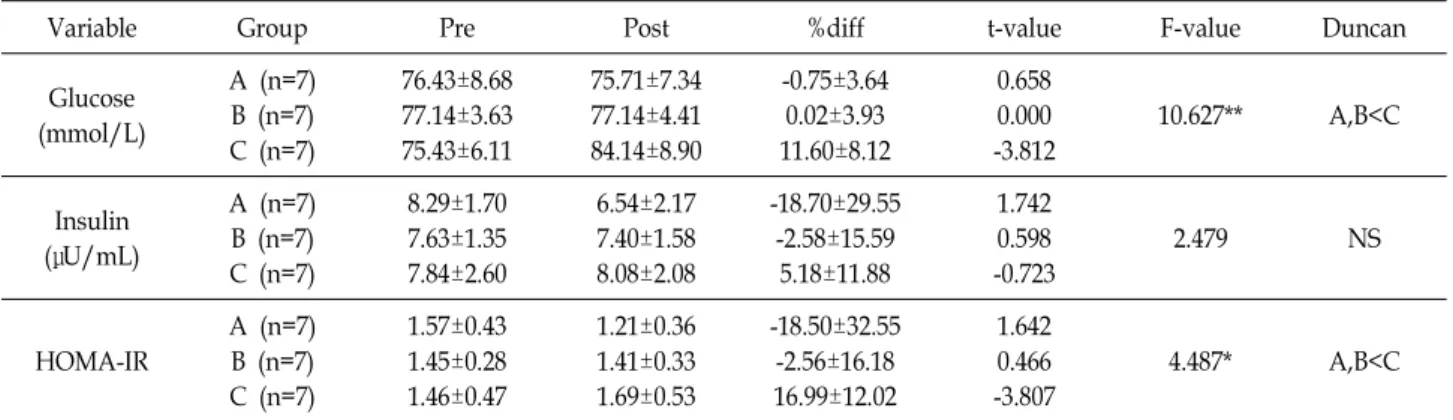
복합운동과 영양교육 후 인슐린 저항성의 변화는 Table 7 과 같다. 혈당은 복합운동 영양교육군과 복합운동군이 대조군 에 비해 유의하게 감소하였다(p<0.01). 인슐린은 유의한 차이 가 나지 않았다. 인슐린 저항성은 복합운동 영양교육군과 복 합운동군이 대조군에 비해 유의하게 감소하였다(p<05).
고 찰
신체조성
신체조성은 체중의 질적인 면을 측정하는 수단으로 기본적 으로 체지방, 근육량 등과 같은 다양한 요소로 구성되어 있으 며, 건강상태와 영양상태 및 만성질환 등의 기초적인 평가요 소이다[27].
중년기 여성은 생리적으로 노화단계에 접어드는 시기로 체 력의 저하, 근육량의 감소 및 체지방의 증가현상이 나타나 비 만이 될 가능성이 급격히 높아진다[13]. 그러나 운동을 통한 체중과 체지방 감소는 비만으로 인한 대사성 질환 발병률을 감소시키며, 나아가 지질 이상혈증 개선의 효과가 있고[56] 영 양교육 후 체지방률의 감소가 보고되고 있다[53].
선행연구에서 중년여성을 대상을 12주간 주3회 복합운동과 영양교육을 실시한 결과 체지방량 감소와 제지방량 증가를 보고하였으며[47], 12주 동안 저칼로리 식이와 유산소성 운동 을 실시한 결과 식이운동군 운동의 체중과 체지방률의 유의한 감소를 보고 하였고[1], 비만 여성을 대상으로 12주간 영양교 육을 병행한 복합운동프로그램을 실시한 결과 체지방량 감소 와 제지방량 증가를 보고하였다[67].
본 연구 결과 체지방량은 집단 내 복합운동 영양교육군과, 복합운동군이 집단 간 복합운동 영양교육군이 대조군보다 유 의하게 감소하였고, 제지방량에서 복합운동과 영양교육군이 대조군보다 유의하게 증가하였다.
이는 복합운동을 통한 신체활동량 증가에 따른 에너지소비 량 증가와 영양교육을 통한 식습관 개선 및 일일 칼로리 섭취 량을 감소 시켜, 체지방률이 감소한 것으로 사료된다.
이상의 결과 복합운동과 영양교육이 중년여성의 신체조성 에 긍정적인 영향을 미치는 것으로 나타났으며, 신체활동량 증가와 식습관의 개선이 신체조성 개선에 도움이 될 것으로 사료된다.
간 기능
비만 및 과체중은 간기능의 이상과 지방간에 원인으로 알려 져 있으며, 비만 상태에 따른 간기능을 조사한 결과 과체중에 서 간기능 수치가 뚜렷하게 증가하고, 영양교육에 필요성을 보고하고 있다[25].
비만에서 주로 발병하는 비 알코올성 지방간질환에는 비교 적 예후가 좋은 단순 지방간(Simple fatty liver)과 함께 간의 섬유화가 진행되다가 나중에 간경화로 발전할 가능성이 있는 비 알코올성 지방간염(non-alcoholic steatohepatitis: NASH) 등이 해당되므로 그 심각성이 부각되고 있다[66].
과체중과 비만은 간기능 지표와 유의한 관련성이 있는 것으 로 보고하였으며[43], 50세 전후의 과체중 환자들을 대상으로 약 27개월 동안 관찰한 결과, 3% 미만의 체중증가가 있었던 집단에서 혈청 GOT 및 GPT 수치가 유의하게 증가한 것으로 나타났다[44].
그러나 운동은 간에서 지질의 산화를 자극하고 지방합성을 억제하여 간의 중성지방 축적을 감소시키는 것으로 알려져 있으며[20], 선행연구에서 비만 고교생을 대상을 12주간 주 5
회, 1회 50분, 복합운동을 실시한 결과 GOT, GPT가 유의하게 감소하였고[33], 비만 남자 대학생을 대상을 12주간 주 4회, 1회 40분, 복합운동을 실시한 결과 GOT, GPT가 유의하게 감 소하였다[36].
본 연구결과 GOT는 복합운동 영양교육군이 대조군에 비해 유의하게 감소하였는데, 이는 복합운동과 영양교육이 체중, 체지방률, 혈중지질 개선의 효과를 반영한 결과라 생각되며, 특히 GOT는 간 외에 근육, 신장, 뇌 등 다양한 조직의 반응에 서 나타나므로 GOT의 감소는 신체활동과 식습관 개선에 의한 체지방의 감소에 의한 것으로 생각된다. 이상의 결과 복합운 동과 영양교육이 중년여성의 간기능에 긍정적 영향을 미치는 것으로 나타났으며, 규칙적인 운동과 영양교육이 간기능 개선 에 도움이 될 것으로 사료된다.
또한 복합운동군에도 유의하지는 않지만 감소하는 경향이 나타나, 운동과 함께 영양교육을 실시한 것이 간 기능 개선에 더 효과적이라는 것을 알 수 있었다.
혈중지질
비만인들의 높은 체중 및 체지방량은 혈중지질과 깊은 연관 이 있으며, 혈중지질 중에서 TC, TG 및 LDL-C은 높게 나타나 고, HDL-C은 낮게 나타난다[54].
총콜레스테롤은 장내에서의 영양흡수상태, 지질대사이상, 고지혈증 및 동맥경화증 등을 판단하는데 사용되는 지표이다 [50]. 선행연구에서 폐경 전 비만여성을 대상으로 10주간 주 2회, 60분, 복합운동을 실시한 결과 TC가 유의하게 감소하였 다[30].
본 연구 결과 TC는 복합운동 영양교육군이 대조군에 비해 유의하게 감소하였는데, TC의 감소는 복합운동을 통해 LPL (lipoprotein lipase)의 활성 증가와 HTGL (hepatic trigly- ceride lipase)의 활성저하로 콜레스테롤 농도의 체내 이화작 용 증가되고 합성율은 저하와[62] 영양교육을 통한 고지방 식 품 섭취의 감소에 의한 것으로 생각된다.
중성지방(TG)은 자연계에 존재하는 지질의 98% 이상을 차 지하는 흔한 형태의 지질로써 지방세포와 근 골격계에 위치하 고 있으며 간, 장, 피하지방에서 합성되며 공복 시 혈중 TG는 간에서 지방산과 당을 재료로 합성된 것이다[42].
선행연구에서 비만중년여성을 대상으로 12주간, 주3회 복 합운동을 실시한 결과 TG가 유의하게 감소하였다[7]. 본 연구 결과 TG는 복합운동 영양교육군과 운동군이 대조군에 비해 유의하게 감소하였는데 이는 복합운동이 FFA의 흡수와 산화 를 위한 근육조직의 능력 향상과 근육내의 LPL의 합성과 분비 를 증가시켜 근육 내 TG 감소[9] 및 영양교육을 통한 에너지 섭취량 감소에 의한 것으로 사료된다.
HDL-C는 간과 소장에서 합성되어 혈중으로 유출되며, 지 질 중 가장 큰 비중을 차지하고 있고, 일반적으로 HDL-C의 감소는 콜레스테롤의 운반능력의 감소로 죽상경화 병변을 일
으키기 쉬우며 심근경색 등의 허혈성 질환의 발병률이 높다 [28].
선행연구에서 비만 중년여성을 대상을 12주간 주 6회 60분 씩 복합운동을 실시한 결과 HDL-C가 유의하게 증가하였고 [16], 비만 중년여성을 대상으로 12 복합운동과 영양교육을 실 시한 결과 HDL-C 유의하게 증가하였다고 하였다[35].
본 연구 결과 HDL-C은 복합운동 영양교육군이 대조군에 비해 유의하게 증가하였는데 이는 복합운동이 콜레스테롤 에 스테르 전달 단백질의 활성도를 낮추어 HDL2-C 입자의 분해 속도를 떨어뜨려 HDL-C 농도 증가[11] 및 영양교육을 통한 체지방 감소와 제지방량 증가에 의한 것으로 사료된다.
LDL-C는 고지혈증 및 동맥경화증의 위험인자로, 주요 기능 은 말초조직으로 콜레스테롤을 운반하는 역할을 한다[2].
선행연구에서 비만 중년여성을 대상을 12주간, 주 5회, 60분 씩 복합운동을 실시한 결과 LDL-C에 유의한 차이가 없었다 [32]. 본 연구 결과 LDL-C은 유의한 차이가 나지 않았지만, 다소 감소 경향을 보였으며, 이는 규칙적인 운동과 영양 교육 을 통하여 LDL-C를 개선시킬 수 있을 것으로 사료된다.
인슐린 저항성
인슐린 저항성은 포도당이 근육세포에서 에너지원으로 활 동 되지 못하기 때문에 혈당이 비정상적인 상승과 고인슐린혈 증이 뒤따르며[21], 이는 심혈관질환이 위험인자인 고혈압, 제 2형 당뇨병 및 지질대사 이상 등과 같은 직접적인 관련을 보이 게 된다[54].
인슐린 저항성을 증가시키는 요인으로는 체중증가, 체지방 량 증가, 복부지방 증가, 제지방량 감소, 운동부족 및 폐경 등 이 있다[14].
비만인들의 높은 체지방률은 인슐린 저항성과 정적 상관관 계가 있다[60], 하지만 유산소 운동은 골격근에서 당 섭취를 촉진시켜 인슐린 감수성 증가와[23, 57], 저항성 운동은 근육 내 인슐린 신호체계를 활성화 시킨다[6].
선행연구에서 비만 중년여성을 대상을 12주, 주 5회, 1회 60분, 복합운동을 실시한 결과 인슐린 저항성 유의하게 감소 하였으며[41], 비만 중년 여성을 대상으로 12주, 주 3회 1회 80분, 복합운동을 실시한 결과 인슐린 저항성 유의하게 감소 하였고[58], 비만 중년여성에게 12주간의 복합운동은 인슐린 저항성의 감소를 가져 왔다고 하였다[45].
또한 중년 여성을 대상으로 12주간 주3회 운동과 영양교육 을 실시한 결과 인슐린 저항성에 유의한 효과가 나타났다고 하였다[38].
본 연구결과 인슐린 저항성은 복합운동 영양교육군과 운동 군이 대조군에 비해 유의하게 감소하였는데, 이는 규칙적인 운동과 식이 조절을 하지 않은 대조군의 혈당과 인슐린 증가 로 인하여 인슐린저항성에 영향을 미친 것으로 생각되며, 복 합운동이 인슐린작용을 억제시키는 유리지방산 감소로 당 대
사 촉진[29] 및 영양교육을 통한 체중감소와 체지방량 감소에 의한 것으로 사료된다.
References
1. An, J. H. 2005. The effects of the low calorie diet and aerobic exercise therapy on the body composition, exercise capacity and muscle strength in the obese women. Master´s thesis Kwan Dong University, Gangwon, Korea.
2. Beak, I. Y. 2009. Exercise and energy metabolism. Seoul:
Daehanmedia.
3. Beak, I. Y. 2013. Health & exercise. Seoul: Chenongsong.
4. Brancaccio, P., Maffulli, N., Buonauro, R. and Limongelli, F. M. 2008. Serum enzyme monitoring in sports medicine.
Clin. Sports Med. 27, 1-18.
5. Byun, J. C. and Woo, H. Y. 2009. Effects of long-term com- bined exercise training on body composition, blood lipids, inflammatory markers and ghrelin level in obese and non-obese men. Kor. J. Sport sci. 24, 455-465.
6. Camacho, R. C., Galassetti, S. N., David, S. N. and Wasser- man, D. H. 2005. Glucoregulation during and after exercise in health and insulin-dependent diabetes. Exerc. Sport Sci.
Rev. 33, 17-23.
7. Cho, J. Y. and Choi, W. J. 2014. The effect of 12 weeks com- bined exercise on blood lipid and inflammatory factors in the obese middle aged women. Kor. Soc. Grow. Develop. 22, 273-281.
8. Choi, S. L. 2002. Effect of long-term bicycle exercise on blood lipids and serum enzyme in obese student. Master´s thesis Chonnam National University, Gwangju, Korea.
9. Cornette, R. 2008. The emotional impact of obesity on children. Worldviews Evid. Based Nurs. 5, 136-141.
10. Matthews, D. R., Hosker, J. P., Rudenski, A. S., Naylor, B. A., Treacher, D. F. and Tuner, R. C. 1985. Homeostasis model assessment: Insulin resistance and b-cell function from fasting plasma glucose and insulin concentration in man. Diabet 28, 412-419.
11. Durant, R. H., Baranowski, T., Rhodes, T., Gutin, B., Thomp- son, W. O. and Carroll, R. 1993. Association among serum lipid and lipoprotein concentrations and physical activity, physical fitness, and body composition in young children.
J. Appl. Physiol. 123, 185-192.
12. Ervin, R. B. 2009. Prevalence of metabolic syndrome among adults 20 years of age and over, by sex, age, race and eth- nicity, and body mass index: United States, 2003-2006. Natl.
Health Stat. Report. 5, 1-7.
13. Evens, W. and Rosenberg, I. H. 1991. Biomarker. New York:
Simon & Schuster.
14. Fasshauer, M. and Paschke, R. 2003. Regulation of adipocy- tokines and insulin resistance. Diabetologia 46, 1594-603.
15. Gill, J. M. 2007. Physical activity, cardiorespiratory fitness and insulin resistance: a short update. Curr. Opin. Lipodol.
18, 47-52.
16. Gug, D. H. 2008. Effects of combined exercise on blood lip- ids, inflammatory markers, and obesity-related hormones in
middle aged women. Doctoral disseration Chonnam National University, Gwangju, Korea.
17. Go, S. M. 2005. The effect of circuit training regarding the body development of women in their thirties and forties with the ideal body composition. Master´s thesis Inje University, Busan, Korea.
18. Han, M. S. 2011. Metabolic syndrome emerging from menopause. J. Men. Med. 17, 127-135.
19. Han, T. S. and Lean, M. E. J. 2011. Metabolic syndrome.
Med. 43, 80-87.
20. Hannukainen, J. C., Nuutila, P., Borra, R., Kaprio, J., Kujala, U. M. and Janatuinen, T. 2007. Increased physical activity decreases hepatic free fatty acid uptake: a study in human monozygotic twins. J. Physiol. 578, 347-358.
21. Hwkins, M. and Rossetti, L. 2005. Insulin resistance and its role in the Pathogenesis of type 2 Diabetes, Ed. Lippicott Willians & Wilkins.
22. Henriksen, E. J. 2002. Invited review: Effects of acute ex- ercise and exercise training on insulin resistance. J. Appl.
Physiol. 93, 788-796.
23. Horwitz, J. F. 2007. Exercise-induced alterations in muscle lipid metabolism improvement insulin sensitivity. Exerc.
Sport. Sci. Rev. 35, 192-196.
24. Jeon, J. H. 2013. Effects of 12 weeks combined training on vascular compliance, insulin resistance and body composi- tion in middle-aged obese women. Kor. Sport Soc. 11, 357- 374.
25. Jung, S. I. and Hong, S. M. 2010. Analysis of different diet- ary habits by classification of body mass index of middle school male students in Ulsan City. Kor. Soc. Comm. Nutr.
15, 342-350
26. Kang, J. S. and Kim, H. S. 2004. A study on the evaluation of a nutritional education program for the middle aged obese women. J. Kor. Soc. Food. 17, 356-367.
27. Kang, C. K., Lee, M. G. and Lim, M, J. 2008. Effects of a 10-weeks rope skipping training on body composition.
physical fitness, blood lipid profiles, and insulin sensitivity in general collegiate students. Kor. J. Physi. Educ. 47, 359-369.
28. Kang, H. S., Kim, G. J., Kim, T. U., Jang, G. T., Jeon, J. G.
and Jo, H. C. 2006. Physiology of sport and exercise. Seoul:
Daehanmedia.
29. Kelly, D. E. and Coodpaster, B. H. 1999. Effects of physical activity on insulin action and glucose tolerance in obesity.
Med. Sci. Sports Exerc. 31, 619-623.
30. Ki, S. K., Paik, J. K., Oh, M. S. and Lee, M. S. 2015. The Effects of combined exercise on the body composition, health related physical fitness and blood lipids in Obese mothers. Kor. J. Physi. Educa. 24, 1533-1544.
31. Kim, D. H., Kuk, D. H., Lee, H. Y., Kim, M. G. and Shin H. J. 2010. The effects of combined exercise on blood in- flammatory markers, leptin and adiponectin in middle aged women. Kor. Soc. Grow. Develop. 18. 25-30.
32. Kim, E. M. and Kim, S. H. 2012. The complex of exercise for 12 weeks on body composition, blood Lipids, car- diovascular diseases risk factors in obese middle-aged women. J. Physi. Educ. 8, 31-39.
33. Kim, E, S., Hong, S. M. and Lee, E. Y. 2011. Effect of com- bined exercise on indices of obesity and liver function in obese high school students. J. Wellness. 6, 325-334.
34. Kim, H. D., Kim, J. S., Kim, D. J. and Jo, H. C. 2011. The effects of combined exercise program on body composition and obesity related factors in obese middle-aged women.
Kor. Soc. Sport. Leis. Study 45, 811-820.
35. Kim, J. H., No, J. C. and Kang, S. J. 2013. Effects of aerobic and resistance exercise on insulinresistance, c-reactive pro- tein, and physical fitness in middle-aged women with meta- bolic syndrome. J. Kor. Ass. Certi. Exerc. Profess. 15, 81-91.
36. Kim, S. H. 2010. The effects of aerobic and resistance ex- ercise on physical fitness and liver inflammatory factor and Adiponectin in obese university students with non-alcoholic fatty Liver disease(NAFLD). Master´s thesis Dong-A Uni- versity. Busan, Korea.
37. Kim, S. H., Kim, J. Y., Ryu, G. A. and Son, J. M. 2007.
Evaluation of the dietary diversity and nutrient intakes in obese adults. Kor. Soc. Comm. Nutr. 12, 583-591.
38. Kim, Y. S., Park, K. D., Kang, H. J., Lee, D. C., Lee, J. H.
and Kwon, H. S. 2005. The effects of exercise and nutrition education on insulin resistance, cardiopulmonary function and body composition in metabolic syndrome. Kor. J. Sport Sci. 16, 54-63
39. Lawlor, D. A., Sattar, N., Smith, G. D. and Ebrahim, S. 2005.
The association of physical activity and adiposity with ala- nine aminotransferase and gamma-glutamyltransferase. Am.
J. Epidemiol. 161, 1081-1088.
40. Lee, J. W., Lee, H. S., Chang, N. S. and Kim, J. M. 2009.
The relationship between nutrition knowledge scores and dietary behavior, dietary intakes and anthropometric pa- rameters among primary school children participating in a nutrition education program. J. Nutr. Health. 42, 338-349.
41. Lee, J. Y. and Kim, Y. K. 2014. Effect of 12 weeks combined exercise on insulin resistance and c-reactive protein in obese women. Kor. Soc. Sci. 32, 1229-1239.
42. Lee, K. N. 2003. Clinical Laboratory Tests. Seoul: Medical Cultural History.
43. Lee, K. S., Kim, K. H. and Cho, Y. C. 2009. Prevalence of fatty liver and its association with indices of obesity, liver function and hyper lipidemia among adult males. Kor.
Acade. Indust. Cooper. Soc. 10, 1414-1423.
44. Lee, S. Y., Choi, S. H. and Kim, Y. J. 2002. Impact of weight change on hepatic markers in overweight, middle-aged patients. J. Kor. Soc. Study. Obes. 11, 362-368.
45. Lim, S, T. and Jung, H. H. 2012. Effects of combined exercise on health related fitness and GLP-1 in middle aged women with obesity. Kor. J. Sports Sci. 21, 1139-1147.
46. Ministry of Health and Welfare. 2014. Korean health sta- tistics; korean national health and nutrition examination sur- vey(KNHANES Ⅵ-1). Ministry of Health & Welfare, 564-565.
47. Moon, M, J. 2005. Study on the effect of combined exercise and nutritional education on the body composition, physical fitness, bone mineral density, and dietary habits of mid- dle-aged women. Master´s thesis Pusan National University.
Busan, Korea.
48. Morino, K., Petersen, K. and Shulman, G. 2006. Molecular mechanisms of insulin resistance in humans and their po- tential links with mitochondrial dysfunction. Diabetes 55, 9- 15.
49. Na, S, H. 2007. The effects of a composite exercise program for middle-age obese women on body composition, adipo- nectin and c-reactive protein. Kor. Soc. Sport. Leis. Study 31, 1025-1032.
50. Nybo, L., Sundstrup, E., Jakobsen, M. D., Mohr, M., Hornstrup, T. and Simonsen, L. 2010. High-intensity train- ing versus traditional exercise interventions for promoting health. Med. Sci. Sport. Exer. 42, 1951-1958.
51. Parizkova, J. 2008. Impact of education on food behaviour, body composition and physical fitness in children. Br. J.
Nutr. 99, 26-32.
52. Park, C, H., Heo, T, I. and Kim, T, U. 2009. The Effect of weight circuit with rhythmic rope skipping on physical fit- ness, body composition and metabolic syndrome in over- weight and obese middle school girls. J. Life. Sci. 11, 221- 235.
53. Park, S, Y., Yang, Y, J. and Kim, Y, R. 2011. Effects of nu- trition education using a ubiquitous healthcare (u-Health) service on metabolic syndrome in male workers. J. Nutr.
Health. 44, 231-242.
54. Press, V., Freestone, I. and George, C. F. 2003. Physical activ- ity: The evidence of benefit in the prevention of coronary heart disease. Int. J. Med. 96, 245-251.
55. Reaven, G. 2004. The metabolic syndrome or the insulin re- sistance syndrome? Different names, different concepts, and different goals. Endocrinol. Metb. Clin. North Am. 33, 283-303.
56. Rod, K. D., Richad, A. A. and Gregory, W. H. 2004. Physical activity epidemiology. Human Kinetics.
57. Sanz, C., Gautier, J. F. and Hanaire, H. 2010. Physical ex- ercise for the prevention and treatment of type 2 diabetes.
Diabetes. Metab. 36, 346-351.
58. Shin, D, S., Lee, C. J., Im, K. C., Roh, D. J., Kim, S. M. and Kim, S. 2013. Effects of combined exercise on body composi- tion, atherogenic index and insulin resistance in obese mid- dle-aged women. Kor. Soc. Sci. 22, 1217-1228.
59. Solinas, G., Vilcu, C., Neels, J. G., Bandyopadhyay, G. K., Luo, J. L. and Naugler, W. 2007. JNK1 in hematopoietically derived cells contributes to diet-induced inflammation and insulin resistance without affecting obesity. Cell Metab. 6, 386-397.
60. Son, J. C., Chio, B. H., Kim, G. M. and Kim, B. T. 2002.
Correlation of homa index and body measurements, body composition, blood lipid profile. J. Kor. Soc. Study Obes. 11, 309.
61. Tuomilehto, J. 2005. Cardiovascular risk : Prevention and treatment of the metabolic syndrome. Diabetes Res. Clin.
Pract. 68, 28-35.
62. Wang, S. W. 2004. The effects of 12 weeks training depend- ing on existing or non-existing obese genes to metabolic reg- ulatory hormones, blood lipids and body compositions. Kor.
J. Physi. Educa. 43, 699-711.
63. Weiss, R., Dziura, J., Burgert, T. S., Tamborlane, W. V.,
초록:12주간 복합운동과 영양교육이 비만중년여성의 신체조성, 간기능, 혈중지질 및 인슐린 저항성에 미치는 영향
김해열1․곽이섭2․성기동1․손원목1․김도연1․백영호1*
(1부산대학교 체육교육과, 2동의대학교 체육학과)
본 연구는 체지방률 30% 이상인 비만 중년여성을 대상으로 복합운동 영양교육군(n=7), 복합운동군(n=7), 대조 군(n=7) 총21명을 대상으로 연구한 결과 다음과 같은 결론을 얻었다. 12주간 복합운동과 영양교육의 실시는 비만 중년 여성의 체지방률, 제지방량, GOT, TC, TG, HDL-C, 인슐린 저항성을 개선시키는 효과를 나타냈다. 이러한 결과는 복합운동과 영양교육이 비만중년여성의 신체조성, 간기능, 혈중지질, 및 인슐린 저항성에 긍정적인 영향을 미쳐 중년여성의 비만을 개선하는데 효과적인 프로그램 사료되며, 추후에도 비만중년여성의 운동방법, 운동빈도, 식이방법 등을 고려한 다양한 연구가 필요할 것으로 사료된다.
Taksali, S. E. and Yeckel, C. W. 2004. Obesity and the meta- bolic syndrome in children and adolescents. N. Engl. J. Med.
350, 2362-2374.
64. World Health Organization. (2015, January). Obesity and overweight. Fact sheet N°311, from http://www. wh- o.int/mediacentre/factsheets/fs311/en/
65. Yang, K. M. and Jang, J, H. 2009. Biochemical analysis over- weight or obese women through a herbal medicine-based nutritional education program. J. Life. Sci. 15, 293-302.
66. Yang, H. R., Ko, J. S. and Seo, J. K. 2007. The role of adipo- kines in the pathogenesis of non-alcoholic fatty liver disease in obese children; the relationship between body Fat dis- tribution and insulin resistance. Kor. J. Pediatr. Gastr. Nutr.
10, 185-192.
67. Yoon, J. W., Jeon, J. G. and Lee, W. G. 2009. Effects of com- bined exercise program with nutrition education on body composition, physical fitness and blood ingredient in obese women. Kor. Alli. Health Physi. Educa. 47, 172-173.