턱관절장애 유무에 따른 깨물근, 목빗근의 두께 및 근긴장도, 최대 입벌림 범위의 비교 및 상관성 연구
이근효
1천승철
2ǂ1
건양대학교 일반대학원 물리치료학과 학생,
2ǂ건양대학교 의과학대학 물리치료학과 교수
Comparison and Correlation on Muscle Thickness and Muscle Tone of Masseter Muscle and Sternocleidomastoid Muscle, Maximum Jaw Opening in Subjects With and Without
Temporomandibular Joint Disorder
Lee Keunhyo, PT, MSc
1Chon Seungchul, PT, Ph.D
2ǂ1
Dept. of Physical Therapy, Graduate School of Konyang University, Student
2ǂ
Dept. of Physical Therapy, College of Medical Science of Konyang University, Professor
Abstract
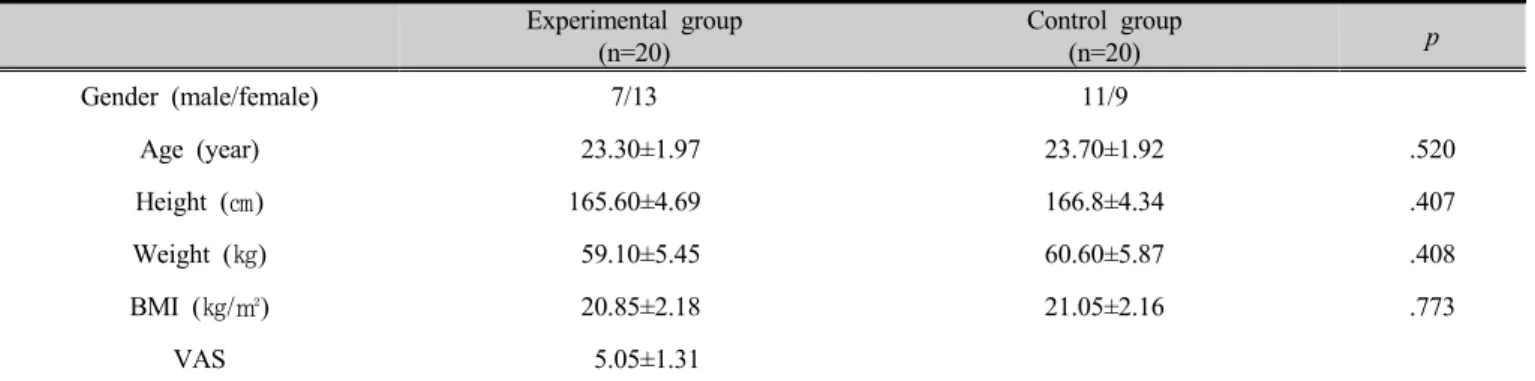
Purpose : Temporomandibular joint disorder (TMJD) is often accompanied by pain and limited range of motion of the jaw joint, which affect patients’ quality of life and result in hypertrophy or hyperactivity of the muscles around the jaw joint. In this study, we compared the muscle thickness and tone of the masseter and sternocleidomastoid (SCM) muscles and the jaw range of motion in individuals with and without TMJD. Correlation comparison was performed on the results of the TMJD group.
Methods : This study included 40 patients; 20 patients were assigned to an experimental group (TMJD group) and 20 to a control group (non-TMJD group). Ultrasonography, myotonometry, and measurements performed with digital Vernier calipers were used to determine the changes in muscle thickness, muscle tone, and maximum jaw opening, respectively. The independent t-test was used for intergroup comparison of data, and Pearson correlation coefficients were used to compare correlations in the TMJD group results.
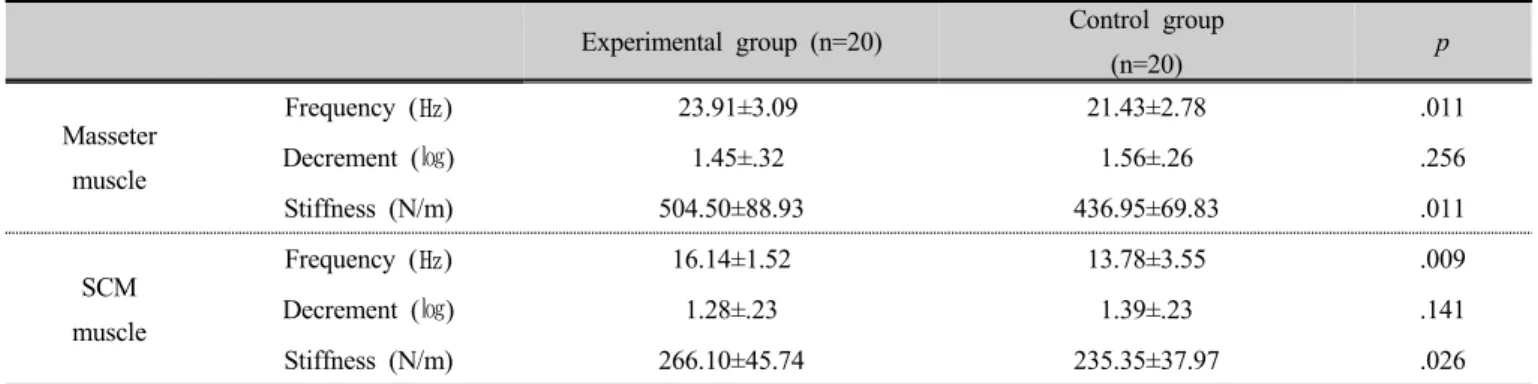
Results : We observed a significant intergroup difference in the masseter and SCM thickness during the relaxed and clenched phases (p<.05). A significant intergroup difference was also observed in maximum jaw opening (p<.05). With regard to muscle tone, we observed a significant intergroup difference in frequency (p=.011) and stiffness (p=.011) of the masseter, as well as in the frequency (p=.009) and stiffness (p=.026) of the SCM. We observed a moderate negative correlation (r=-.524) between maximum jaw opening and the frequency of the masseter. Additionally, we observed a moderately negative correlation between jaw opening and muscle stiffness (r=-.321).
Conclusion : Planning exercise programs to treat patients with TMJD who present with pain should focus on efforts to reduce muscle thickness and achieve muscle relaxation (to reduce muscle tension) for improved jaw range of motion.
Key Words : masseter muscle, muscle tone, range of motion, sternocleidomastoid muscle, temporomandibular joint disorder
1)
ǂ